Tag: LaidOff

  • Portland State Ordered to Reinstate Some Laid-Off Faculty

    Portland State Ordered to Reinstate Some Laid-Off Faculty

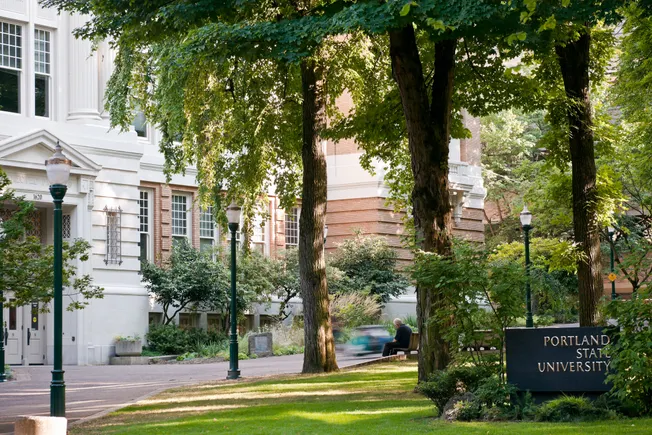
    An independent arbitrator ordered Portland State University to reinstate 10 faculty members after determining the university violated its collective bargaining agreement with the Portland State University American Association of University Professors, Oregon Public Broadcasting reported.  

    The faculty senate in April voted no confidence in the administration’s “Bridge to the Future” plan to address an $18 million budget deficit, and the vote “underscores the fact that the university made its layoff decisions before it had sufficient evidence to support them. That is a violation of the collective bargaining agreement,” the arbitrator wrote in her decision

    PSU-AAUP filed a labor grievance after the university laid off 17 non-tenure-track professors at the end of the 2024–25 academic year as part of its plan to close the deficit before the end of the spring term. The remaining seven employees declined to grieve their layoffs. 

    “[The decision] forces the university to respect the concept of shared governance,” union president Bill Knight told OPB. “It’s a reminder to the university that they can’t simply make arbitrary administrative decisions without involving the faculty.”

    The union contract requires university officials to follow a specific, lengthy process to lay off faculty members for economic reasons—as opposed to eliminating courses or programs—which the arbitrator determined they did not do. Portland State is considering an appeal.

    The budget cuts were successful in closing the deficit, OPB reported. Recent financial documents show the university saved more than $12.3 million—about 88 full-time faculty positions—in its academic affairs division. But more personnel cuts are likely. In September, the Portland State University Board of Trustees approved a plan to address a $35 million shortfall over two years.

    Source link

  • Education Department plans return of laid-off OCR employees

    Education Department plans return of laid-off OCR employees

    This audio is auto-generated. Please let us know if you have feedback.

    Dive Brief:

    • The U.S. Department of Education said it plans to bring back more than 260 Office for Civil Rights staff that it cut as part of its March reduction in force, returning groups of employees to the civil rights enforcement arm in waves every two weeks Sept. 8 through Nov. 3. 
    • The department’s Aug. 19 update was filed as required by a federal judge’s order in Victim Rights Law Center v. U.S. Department of Education directing that the Education Department be restored to “the status quo” so it can “carry out its statutory functions.” 
    • Since March, the Education Department has been paying the OCR employees about $1 million per week to sit idle on administrative leave, according to the update.

    Dive Insight:

    The update, filed in U.S. District Court for the District of Massachusetts, comes as a U.S. Supreme Court emergency order in a separate but similar case allowed the agency to move forward with mass layoffs across the entire department, rather than just OCR.

    That case — New York v. McMahon— was overseen by the same judge who ordered on June 18 that OCR be restored to its former capacity.

    Last week, Judge Myong Joun said he stood by his OCR order regardless of the Supreme Court’s decision in New York v. McMahon because the students who brought the Victim Rights Law Center case have “unique harms that they have suffered due to the closure of the OCR.”

    In March, the Education Department closed seven of its 12 regional offices as part of the layoffs that impacted 1,300 staffers across the entire department.

    Civil rights and public education advocates, as well as lawmakers and education policy experts warned that such a significant slash to OCR would compromise students’ civil rights and compromise their equal access to education that OCR is meant to protect.

    In April, the Victim Rights Law Center case was brought by two students who “faced severe discrimination and harassment in school and were depending on the OCR to resolve their complaints so that they could attend public school,” said Joun in his Aug. 13 decision.

    The Education Department’s update this week that it is returning OCR employees to work is in compliance with Joun’s decision.

    After Joun ordered the Education Department in the New York case to restore the department more broadly, the administration filed an emergency appeal with the Supreme Court to push the RIF through.

    The department did not respond by press time to K-12 Dive’s inquiry as to whether it intends to likewise appeal the Victim Rights Law Center decision to the Supreme Court.

    Source link

  • Education Department plans return of laid-off OCR staffers

    Education Department plans return of laid-off OCR staffers

    This audio is auto-generated. Please let us know if you have feedback.

    Dive Brief:

    • The U.S. Department of Education said it plans to bring back more than 260 Office for Civil Rights staff that it cut as part of its March reduction in force, returning groups of employees to the civil rights enforcement arm in waves every two weeks Sept. 8 through Nov. 3. 
    • The department’s Aug. 19 update was filed as required by a federal judge’s order in Victim Rights Law Center v. U.S. Department of Education directing that the Education Department be restored to “the status quo” so it can “carry out its statutory functions.” 
    • Since March, the Education Department has been paying the OCR employees about $1 million per week to sit idle on administrative leave, according to the update.

    Dive Insight:

    The update, filed in U.S. District Court for the District of Massachusetts, comes as a U.S. Supreme Court emergency order in a separate but similar case allowed the agency to move forward with mass layoffs across the entire department, rather than just OCR.

    That case — New York v. McMahon— was overseen by the same judge who ordered on June 18 that OCR be restored to its former capacity.

    Last week, Judge Myong Joun said he stood by his OCR order regardless of the Supreme Court’s decision in New York v. McMahon because the students who brought the Victim Rights Law Center case have “unique harms that they have suffered due to the closure of the OCR.”

    In March, the Education Department closed seven of its 12 regional offices as part of the layoffs that impacted 1,300 staffers across the entire department.

    Civil rights and public education advocates, as well as lawmakers and education policy experts warned that such a significant slash to OCR would compromise students’ civil rights and compromise their equal access to education that OCR is meant to protect.

    In April, the Victim Rights Law Center case was brought by two students who “faced severe discrimination and harassment in school and were depending on the OCR to resolve their complaints so that they could attend public school,” said Joun in his Aug. 13 decision.

    The Education Department’s update this week that it is returning OCR employees to work is in compliance with Joun’s decision.

    After Joun ordered the Education Department in the New York case to restore the department more broadly, the administration filed an emergency appeal with the Supreme Court to push the RIF through.

    The department did not respond by press time to K-12 Dive’s inquiry as to whether it intends to likewise appeal the Victim Rights Law Center decision to the Supreme Court.

    Source link

  • Trump Education Department Delays Return of Laid-Off Workers Over Logistics – The 74

    Trump Education Department Delays Return of Laid-Off Workers Over Logistics – The 74


    Get stories like this delivered straight to your inbox. Sign up for The 74 Newsletter

    Parking permits. Desk space. Access cards.

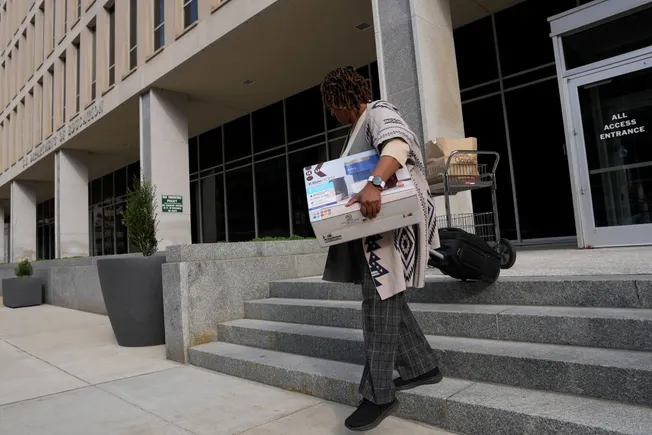
    Ordered to bring back roughly 1,300 laid-off workers, the U.S. Department of Education instead has spent weeks ostensibly working on the logistics. Meanwhile, the Trump administration wants the U.S. Supreme Court to decide they don’t have to restore those jobs after all.

    The legal argument over the job status of Education Department workers is testing the extent to which President Donald Trump and Education Secretary Linda McMahon can reshape the federal bureaucracy without congressional approval.

    The employees, meanwhile, remain in limbo, getting paid for jobs they aren’t allowed to perform.

    An analysis done by the union representing Education Department employees estimates the government is spending about $7 million a month for workers not to work. That figure does not include supervisors who are not part of the American Federation of Government Employee Local 252.

    “It is terribly inefficient,” said Brittany Coleman, chief steward for AFGE Local 252 and an attorney in the Office for Civil Rights. “The American people are not getting what they need because we can’t do our jobs.”

    McMahon announced the layoffs in March, a week after she was confirmed by the Senate, and described them as a first step toward dismantling the Education Department. A few days later, Trump signed an executive order directing McMahon to do everything in her legal authority to shut down the department.

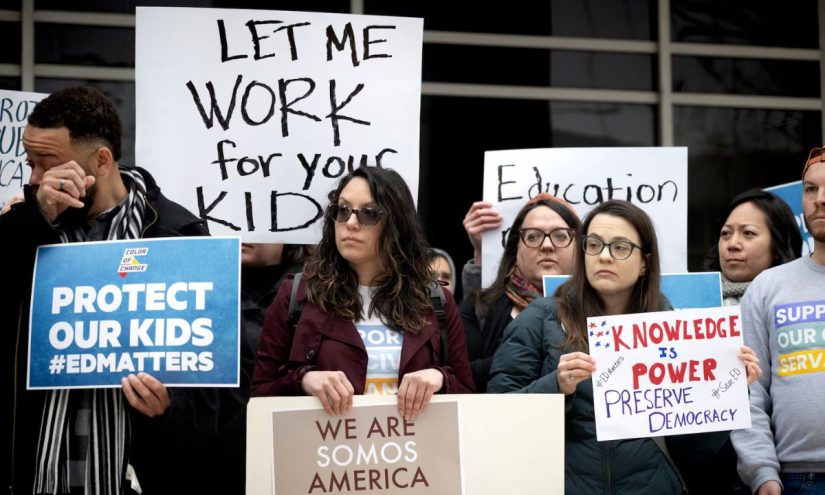
    The Somerville and Easthampton school districts in Massachusetts, along with the American Federation of Teachers, other education groups, and 21 Democratic attorneys general sued McMahon over the cuts. They argued the layoffs were so extensive that the Education Department would not be able to perform its duties under the law.

    The layoffs hit the Office for Civil Rights, Federal Student Aid, and the Institute of Education Sciences particularly hard. These agencies are responsible for federally mandated work within the Education Department. By law, only Congress can get rid of the Education Department.

    U.S. District Court Judge Myong Joun agreed, issuing a sweeping preliminary injunction in May that ordered the Education Department to bring laid off employees back to work and blocked any further effort to dismantle or substantively restructure the department.

    The Trump administration sought a stay of that order, and the case is on the emergency docket of the Supreme Court, where a decision could come any day.

    In the administration’s request to the Supreme Court, Solicitor General John Sauer argued that the harms the various plaintiffs had described were largely hypothetical, that they had not shown the department wasn’t fulfilling its duties, and that they didn’t have standing to sue because layoffs primarily affect department employees, not states, school districts, and education organizations.

    Sauer further argued that the injunction violates the separation of powers, putting the judicial branch in charge of employment decisions that are the purview of the executive branch.

    “The injunction rests on the untenable assumption that every terminated employee is necessary to perform the Department of Education’s statutory functions,” Sauer wrote in a court filing. “That injunction effectively appoints the district court to a Cabinet role and bars the Executive Branch from terminating anyone.”

    The Supreme Court, with a conservative 6-3 majority, has been friendlier to the administration’s arguments than lower court judges. Already the court has allowed cuts to teacher training grants to go through while a lawsuit works its way through the courts. And it has halted the reinstatement of fired probationary workers.

    The Education Department did not immediately respond to a request for comment.

    Last week, Joun issued a separate order telling the Education Department that it must reinstate employees in the Office for Civil Rights. The Victims Rights Law Center and other groups had described thousands of cases left in limbo, with children suffering severe bullying or unable to safely return to school.

    Meanwhile, the Education Department continues to file weekly updates with Joun about the complexities of reinstating the laid-off employees. In these court filings, Chief of Staff Rachel Oglesby said an “ad hoc committee of senior leadership” is meeting weekly to figure out where employees might park and where they should report to work.

    Since the layoffs, the department has closed regional offices, consolidated offices in three Washington, D.C. buildings into one, reduced its contracts for parking space, and discontinued an interoffice shuttle.

    In the most recent filing, Oglesby said the department is working on a “reintegration plan.”

    Coleman said she finds these updates “laughable.”

    “If you are really willing to do what the court is telling you to do, then your working group would have figured out a way to get us our laptops,” she said.

    This story was originally published by Chalkbeat. Chalkbeat is a nonprofit news site covering educational change in public schools. Sign up for their newsletters at ckbe.at/newsletters.


    Get stories like these delivered straight to your inbox. Sign up for The 74 Newsletter

    Source link