The UK is at a pivotal moment when it comes to the English language tests it uses to help decide who can enter the country to study, work, invest and innovate.
The government’s new industrial strategy offers a vision for supporting high-value and high-growth sectors. These sectors – from advanced manufacturing and creative industries, to life sciences, clean energy and digital – will fuel the UK’s future growth and productivity. All of them need to attract global talent, and to have a strong talent pipeline, particularly from UK universities.
This summer’s immigration white paper set out plans for new English language requirements across a broader range of immigration routes. It comes as the Home Office intends to introduce a new English language test to provide a secure and robust assessment of the skills of those seeking to study and work in the UK.
In this context, the UK faces a challenge: can we choose to raise standards and security in English tests while removing barriers for innovators?
The answer has to be ‘yes’. To achieve, as the industrial strategy puts it, “the security the country needs… while shaping markets for innovation,” will take vision. That clearly needs government, universities and employers to align security and growth. There are no short-cuts if we are serious about both.
The sectors that will power the industrial strategy – most notably in higher education, research and innovation – are also those most boxed in by competing pressures. These pressures include the imperative to attract world-class talent and the need to show that those they help bring to the country are well-qualified.
But these pressures do not have to box us in. We need not compromise on security or growth. We can achieve both.
Getting English testing right is a critical part of the solution. That means putting quality and integrity first. We should demand world-class security and safeguards – drawing on the most sophisticated combination of human and artificial intelligence. It also means deploying proven innovations – those that have been shown to work in other countries, like Australia and Canada, that have adjusted their immigration requirements while achieving talent-led growth.
Decision-making around English language testing needs to be driven by evidence – especially at a time of flux. And findings from multiple studies tells us that those students who take high-quality and in-depth tests demonstrate greater academic resilience and performance. When it comes to high-stake exams, we should be setting the highest expectations for test-takers so they can thrive in the rapidly changing economy that the country is aspiring to build.
The government and high-growth sectors, including higher education, have an opportunity to grow public confidence, prioritise quality and attain sustainable growth if we get this right.
Decision-making around English language testing needs to be driven by evidence – especially at a time of flux
More than a third of the UK’s fastest-growing startups have at least one immigrant co-founder. Such contributions from overseas talent are indispensable to the country’s future success – and the industrial strategy’s “focus on getting the world’s brightest minds to relocate to the UK” is smart.
At Cambridge, we help deliver IELTS, the world’s most trusted English test. Over the decades, we’ve learned that quality, security and innovation reinforce one another. It’s why we draw on our constantly evolving knowledge of linguistics to make sure our tests assess the real-life language skills people use in actual academic and professional environments.
Technological innovations and human intelligence must be central to the test-taking experience: from content creation to exam supervision to results delivery. Having one without the other would be reckless.
We should deploy the latest data science and AI advances to spot risks, pinpoint potential fraud, and act intelligently to guarantee a system that’s fair for all. IELTS draws on proven AI and data science developments to prevent fraud and improve the information available to institutions like universities, businesses and UKVI.
As the government takes its industrial strategy, immigration reforms and English testing changes forward, it’s vital that departments coordinate on the shared opportunities, and tap into the best evidence available.
This is complex work. It requires a collaborative spirit, creative thinking and deep expertise. Fortunately, the UK has plenty of that.
About the author: Pamela Baxter is managing director, IELTS at Cambridge University Press & Assessment
By Tamsin Thomas, Senior Strategic Engagement Manager, Duolingo English Test.
The English language proficiency of international students is once again under the microscope. Heightened scrutiny is being driven by media coverage of international admissions, including The Times and BBC Radio 4’s File on 4, as well as the new immigration white paper. The Home Office is currently tendering for an English test for immigration purposes and has also undertaken a review of university English testing arrangements.
There are growing questions about how UK universities assess English proficiency, which tests are accepted, and what governance arrangements are in place to ensure that students have the level of English they need to succeed. These are valid and necessary discussions.
But it’s also true that much of the debate is happening without lived experience. Most contributors to this conversation — from media commentators to admissions professionals and policymakers — have never sat a high-stakes English language test themselves, certainly not as an entry requirement for studying in another country. That gap matters.
How Do International Students Currently Meet English Language Requirements?
UK universities have built robust and nuanced systems for assessing English proficiency, shaped by decades of global engagement. These typically fall into three broad categories:
Secondary school qualifications: Many countries offer high school-level English that meets UK university entry standards. For example, iGCSEs, the IB, Hong Kong’s HKDSE, or Germany’s Abitur are often accepted without additional testing.
Standardised English proficiency tests: Many international students – especially those from countries where English is not the primary language of instruction – take tests like IELTS, TOEFL, or the Duolingo English Test (DET) in addition to their school diplomas.
Evidence of prior study in English: If a student has completed at least three years of education in English at the tertiary level, this can meet requirements under a “Medium of Instruction” policy.
In countries like India and Nigeria, the situation is more complex. Both operate parallel education systems – some in English, others in regional languages. Students with strong English scores in the Indian Standard XII (CBSE, ISC) or the West African WAEC are often accepted without further testing. Graduates of other boards may need to take a test.
These frameworks are diverse by design – reflecting the deep, often country-specific, relationships and expertise UK universities have developed over time.
While the media sometimes focuses on the small minority of international students whose English may fall short, it’s worth remembering that perfection is not the benchmark. Most international students meet entry requirements – and universities have systems in place to support language development throughout the degree. After all, only a small percentage of UK students get a Grade 9 in GCSE English, and developing academic English skills is part of what universities train students to do. Language proficiency exists on a spectrum – the question isn’t whether students are fluent on entry, but whether they have the foundation to succeed.
What Happens When a New Test Enters the Market?
As a relatively new entrant to this space, the Duolingo English Test – now accepted by over 40 UK universities – has seen firsthand how institutions evaluate and onboard new tests.
Typically, the process reflects a practical need to expand the range of tests, paired with a careful scrutiny process – usually via committee:
Recruitment teams identify a test that meets student demand or addresses market access barriers.
Admissions teams assess delivery method, validity, and the external evidence base.
English-language colleagues evaluate whether the test provides evidence that students can succeed academically on campus.
Compliance teams consider immigration implications and policy compatibility – is the test secure?
Tests are often accepted provisionally, with performance tracked for one to two years, however long it takes to build up enough data to make an informed decision. Institutions benchmark outcomes against long-accepted credentials: Do the score thresholds align, and are there heightened compliance risks?
The process is rarely quick, but it is thorough.
What Does Good Governance Look Like?
While most UK universities use similar criteria for test evaluation, governance structures vary. In some institutions, decisions sit with dedicated English policy working groups; in others, with international admissions committees. Sometimes responsibility is split between professional services and academics. In others, it’s entirely devolved to professional services.
This variation isn’t necessarily a problem but it does mean there’s no single ‘sector-wide’ process for evaluating or monitoring English tests.
As an online test provider, one gap that has always seemed under-discussed is the practical reality of actually taking a test. If you’re a student in Afghanistan, where crossing borders is difficult and test centres don’t operate, how are you supposed to prove your English proficiency? If you’re a mobility-impaired test taker in a country without inclusive building regulations, how do you sit a test at all? The global distribution of test centres is far from comprehensive.
Join the Conversation — Enter the DET University Challenge
Here’s the challenge: put yourself in an international student’s shoes. Could you meet your own university’s English language entry requirements?
The DET University Challenge 2025 invites UK university staff – whether English is their first language or not – to sit an English proficiency test similar to those taken by millions of international students each year.
The Challenge offers a practical, engaging way for staff to experience a process usually reserved for students. It’s a prompt for reflection – and yes, maybe a little fun along the way.
At a time when English requirements are under increasing public, political, and policy scrutiny, there’s real value in taking a closer look at the systems we rely on – and at how they feel from the other side.
So: do you have what it takes to meet your university’s English language entry requirements?
The DET University Challenge is open until 31 May 2025 with participants able to win up to £5,000 in prize money for their university or a designated Higher Education access charity. Terms and conditions apply.
by Estefania Gamarra, Marion Heron, Lewis Baker and Harriet Tenenbaum
Do you remember when you started university, and you were expected to use a whole new language? We don’t just mean new nomenclature such as ‘seminars’ or ‘tutorials’, but language that can help you make a clear argument or disagree politely with a classmate. This language, or educational dialogue, and in particular disagreeing politely, is critical to be an engaged citizen in a healthy democracy, without otherwise descending into unhealthy practices such as ‘cancel culture’ as recently highlighted in the media. In this blog post, we argue that universities have a responsibility not only to teach students how to talk in an academic context, but also for this teaching to be discipline-specific and embedded in the disciplinary study where possible.
There is a long-held misperception that all students who start university are able to talk the talk of the university, that is, they have the language skills, the terminology, and the confidence to articulate their opinions from their first day. This is just simply not true for many undergraduate students. Having English as a first language is also not necessarily an advantage. Bourdieu et al (1994, p8) said, “academic language… is no one’s mother tongue, not even that of children of the cultivated classes”.
What do we mean by language here? We have drawn on the pedagogy and research from compulsory school education, namely the work of scholars at Cambridge University. Their work on educational dialogue has been successfully incorporated into school teaching with impressive results. Educational dialogue here refers to communicative acts such as agreeing, disagreeing, reasoning and expressing ideas. Research in school settings has shown that encouraging such dialogue can boost academic attainment. One study highlighted the relationship between elaborating on ideas and attainment in reading, spelling, punctuation and grammar. Despite this compelling evidence, similar strategies have been underexplored in higher education.
In our university classrooms, we hear students say things such as: ‘I know the answer, but don’t know how to phrase it’ and ‘I need to learn how to express my answer like that’. So, if students are themselves noticing a need for academic language, why are we so behind in the higher education context? And more importantly, what language do these students need? Do they all need the same academic language to confidently talk the talk? This is exemplified by the dialogue below between two engineering students working on answering multiple-choice questions together, an excerpt from our forthcoming research:
Student A: Yeah, listen, we need to be able when we say “force”, to say why.
Student B: Yeah, to flip it.
Student A: Because we were right, like, C is incorrect, but we don’t say why it is not incorrect.
Student B: I don’t know how to word it, you know.
In our current research project, supported by a Nuffield Foundation grant, we explore whether pairs of Foundation Year students across Engineering, Psychology and Bioscience, engaging in discipline-specific multiple-choice questions, can learn to develop these academic language skills and the extent to which they can do this in an academic year-long intervention programme.
Our early findings indicate that while students are capable of using academic language, the forms they adopt vary by discipline. For example, consider one of the most basic interactions in academic discussions – giving and asking for reasons. Typically, the default marker for requesting justification is “why?”. The following extract from a psychology discussion illustrates this:
Student A: Why do you think that is?
Student B: Because, uh, if you got negative emotion, you know, so that is not called positive psychology. Yep, yeah, so I’m thinking about understanding like how to prevent negative emotions.
In contrast, in science courses such as biology or engineering, it was more common to use “how?” rather than “why?” when asking for reasoning. Consider this extract from an engineering discussion:
Student A: Yes. Then the same as D.
Student B: D? How?
Student A: And then it’s…
Student B: Oh.
Student A: And this is…
Student B: So the arrow goes this way…
Student A: So then P goes this way…
Here, Student B not only asks for the reasoning by using “how?”, but the response unfolds as a sequence of steps outlining the reasoning process. This example also highlights another subject-specific difference: while psychology students typically expand on each other’s arguments or examples, engineering students more frequently build on each other’s equations, often with the assistance of pen and paper.
So, based on these snippets of authentic student dialogues, let’s return to the question posed at the beginning. Yes, all students can and do need to learn academic language to talk to each other and develop understanding, but the type of language depends on the discipline. Disciplinary differences can be seen in the way students build on each other’s ideas (eg long turns, short turns) as well as the words and phrases used. The evidence from our project shows this.
We argue that learning to talk the language of higher education should not be considered a prerequisite but instead, should be an essential feature of the higher education curriculum embedded within disciplinary studies.
Why is this important? Integrating academic language training into the curriculum can enhance students’ academic confidence, foster a stronger sense of belonging, and ultimately improve retention rates. In a post‐COVID world, where student engagement is waning, this conversation‐based approach may also help rebuild the social and collaborative fabric of university life.
Moreover, the skills developed through such training are highly transferable beyond academia. Students acquire essential discussion and teamwork abilities that prove invaluable in their future careers. It is important to emphasise that developing these skills requires deliberate training; we must not assume that students will acquire them without practice and guidance.
Although students may already use discipline‐specific language, targeted training helps them become accustomed to engaging in – and, more importantly, listening to – disagreement. These conversational practices become part of their repertoires, enabling them to generalize these skills across various contexts. As noted earlier, we must all learn to engage in constructive disagreement to counteract cancel culture. While the manner of such discourse may vary by discipline, developing these skills is essential for active participation in a healthy, thriving democracy.
Estefania Gamarra Burga is a Postdoctoral Research Fellow at the University of Surrey. Her research interests include educational dialogue, discourse analysis, gender, and spatial cognition in STEM and higher education.
Marion Heron is Associate Professor of Educational Linguistics in the Surrey Institute of Education, University of Surrey. She supervises doctoral students on topics in the field of applied linguistics and higher education. She researches in the areas of language and education, with a particular interest in classroom discourse, genre and doctoral education.
Lewis Baker is a Senior Lecturer in the Faculty of Engineering and Physical Sciences and a Chartered Science Teacher. His research interests include teaching pedagogy and science education, often within a foundation year context.
Harriet Tenenbaum is Professor of Social and Developmental Psychology. Her research focuses on social justice in young people, everyday conversations, and teaching and learning across the lifespan.
On April 2, the U.S. Citizenship and Immigration Services (USCIS) announced minor changes to the Form I-9 to align with statutory language. The changes update language in the document that was included in previous editions of the Form I-9 released under the Biden administration.
The new Form I-9 changes the language in Section 1, checkbox 4 from “A noncitizen authorized to work” to “an alien authorized to work” (italicized for emphasis). Additionally, USCIS announced that E-Verify and E-Verify+ have updated the Citizenship Status selection during case creation. Specifically, the selection “a noncitizen authorized to work” is updated to “an alien authorized to work.” In previous editions of the Form I-9 and in the E-Verify case creation process, the Biden administration’s USCIS changed the language from “alien” to “noncitizen” in this checkbox to align with an internal memo issued by the administration in April 2021 aiming to change the language used by agencies when talking about immigrants.
The new Form I-9 from the Trump administration also updates the descriptions of the documents accepted under List B to say “sex” instead of “gender.” This change aligns with another April 2 announcement from USCIS about updates to its Policy Manual to clarify that the agency will only recognize two biological sexes, male and female, consistent with the Trump administration’s executive order, “Defending Women From Gender Ideology Extremism and Restoring Biological Truth to the Federal Government.” In the USCIS announcement on sex, the agency states that it would not deny benefits “solely because the benefit requestor did not properly indicate his or her sex” but that the agency would not issue documents with a blank sex field or with a sex different from the sex assigned at birth.
The new Form I-9 from the Trump administration, known as the January 20, 2025, edition, is valid through May 31, 2027. Previous editions of the Form I-9 that include language from the Biden administration are still valid as well, including two editions from August 1, 2023, that have expiration dates on July 31, 2026, and May 31, 2027. Employers may continue to use the previous Form I-9 editions through their expiration dates; however, employers using the August 1, 2023, edition with the July 2026 expiration date in an electronic system are required to update their system with the Form I-9 expiring in May 2027 by July 31, 2026.
CUPA-HR will continue to monitor for updates related to the Form I-9 and E-Verify.
BOSTON (March 31, 2025) – In recent months, almost 2,000 schools and districts have purchased or renewed licenses for Lexia English Language Development (Lexia English) fromLexia, aCambium Learning Group brand. Using powerful speech recognition technology, the program supports students in grades K-6 to build their linguistic confidence in academic English.
“More than 162,000 students and 77,000 educators at 7,400 schools used the program during the 2024 school year. In addition, those students practiced academic conversations 4.3 million times in the program,” said Lexia President, Nick Gaehde. “The numbers show just how much students and educators have needed access to a culturally responsive language learning solution.”
One of those educators who used the program is Lynmara Colón, the director of Student Opportunity and Multilingual Services at Prince William County Schools in Virginia. After a pilot, the district has allowed individual middle and elementary schools to purchase Lexia English during the 2024-2025 school year. Prince William County Schools serves more than 20,000 English learners who speak 140 languages. “We are the 10th most diverse district in the nation,” Colón said. “But when I try to find tools for diverse students, there’s not a lot that meets the specific needs of the student population we serve.”
Colón noted that the program had boosted student growth to the point of reducing her worries about providing staff with a high-quality tool focused on helping Emergent Bilingual students. She expressed appreciation for the way the program helps her forecast and make sense of language acquisition data. “With Lexia, I can have visibility into how they’re doing with language comprehension,” she said. “I always know to expect the best from our Lexia partners. I have high expectations, and they never disappoint.”
Lexia English’s approach to English language learning is to empower emergent bilinguals by honoring their heritage languages and offering culturally responsive, adaptive learning pathways to foster academic and linguistic growth. Seventeen characters with diverse backgrounds help students practice speaking skills by engaging with content in academic subjects such as math, science, social studies, and general knowledge.
Gaehde concluded, “With Lexia English, educators can celebrate multilingualism in the classroom, providing students with the tools to succeed in both English language development and overall academic achievement.”
About Lexia
Lexia®, a Cambium Learning® Group brand, is transforming literacy education, driving change in 1 of every 3 school districts across the United States. For more than 40 years, Lexia has been a thought leader in literacy education, delivering award-winning, research-based solutions grounded in the science of reading. With a full spectrum of offerings, including professional learning, curriculum, and embedded assessment tools, Lexia provides educators with Structured Literacy solutions that are proven effective and designed to drive meaningful literacy outcomes. By empowering educators with unparalleled ease of use and the knowledge and tools they need, Lexia helps more students unlock their potential to read, write, and speak with confidence. For more information, visit lexialearning.com.
About Cambium Learning Group
Cambium Learning Group is the education essentials company, providing award-winning education technology and services for K-12 educators and students. With an intentional collection of respected global brands, Cambium serves as a leader, helping millions of educators and students feel more seen, valued, and supported every day. In everything it does, the company focuses on the elements that are most essential to the success of education, delivering simpler, more certain solutions that make a meaningful difference right now.
To learn more, visit www.cambiumlearning.com or follow Cambium onFacebook,LinkedIn, andX. The Cambium family of brands includes: Cambium Assessment®, Lexia®, Learning A-Z®, ExploreLearning®, and Time4Learning®.
eSchool Media staff cover education technology in all its aspects–from legislation and litigation, to best practices, to lessons learned and new products. First published in March of 1998 as a monthly print and digital newspaper, eSchool Media provides the news and information necessary to help K-20 decision-makers successfully use technology and innovation to transform schools and colleges and achieve their educational goals.
This HEPI blog was kindly authored by colleagues at the German Embassy in London and the German Academic Exchange Service (DAAD).
#ShoutOutForGerman – this is the title of a week-long campaign from 17 to 21 March to showcase all things German across the entire UK and inspire learning German. The German Embassy London and the German Academic Exchange Service are only two of the organisations behind this campaign. Why are we shouting out for German? Because the steady decline of German learners in the UK, of students pursuing German at the university level, the closure of language departments and the ongoing threat of further closures is a cause for concern.
The benefits of learning German are clear: it provides students with communication skills and enhances career opportunities, but it also fosters closer economic and cultural ties between the UK and Germany. The German Embassy in London and the German Academic Exchange Service both work to strengthen language learning in general and German in particular at British universities.
There are countless reasons for studying German. Just like learning any foreign language, it equips people with critical communication and transferable skills, opens the door to other ways of thinking, and strengthens personal connections across borders. The case for German is even stronger, as it is the most sought-after foreign language among UK employers and a key language in fields such as science, engineering, finance, and international relations. Germany remains the UK’s second-largest goods trading partner, and a strong command of the language provides a competitive advantage in the job market. German is the language of influential philosophers, writers, and scientists, offering access to a rich intellectual and cultural heritage.
Beyond the economic advantages, language learning plays a crucial role in diplomacy and international relations. The ability to speak each other’s language fosters trust, facilitates collaboration, and strengthens bilateral ties. As John le Carré once said, “The decision to learn a foreign language is an act of friendship.” Looking at the events unfolding in today’s world, it would be a gross understatement to say that the European continent is facing a multitude of challenges. To navigate the new realities, to preserve our safety, our hard-fought liberties, our prosperity and place in the world, the links between the UK and its European neighbours will be of pivotal importance – and key among them is the German-British partnership. Learning each other’s language can be understood as a commitment to strengthen and future-proof this partnership from the ground up.
A Declining Trend in German Studies
And yet, demand for studying languages at universities has been in a downtrend, and courses offered have been declining in parallel. According to HESA, the numbers of full-time students enrolled in German or German studies at British universities decreased from 1,780 in 2019 to 1,330 in 2023, marking a 25% decrease in just four years. This highlights an alarming trend that could lead to further erosion of German language education in higher education institutions. In lockstep, severaluniversities have closed their language departments entirely in recent years in response to budget constraints. Language centres can only, in part, make up for the loss that is generated by the lack of language degree courses – even though their existence is proof of the value and necessity universities attribute to language skills.
This development is, among others, a consequence of various decisions which have shaped the nature of educational politics in the UK as we know them today. It is thus more important than ever, that languages are given their due place in England’s Curriculum and Assessment Review – where the German Ambassador has made the plea for consistent language instruction over the entire educational journey. The assessment represents an important fork in the road and opportunity for a firm push towards stopping and gradually reversing the downtrend in language learning, lest it have long-term consequences for Britain’s position in global academia, diplomacy, and business.
The German Embassy and DAAD’s Commitment to German in the UK
The DAAD London has been around for over 70 years, as the DAAD’s oldest branch in the world. The German Embassy, the DAAD, and the Goethe-Institut London have been actively engaged in promoting German across all sectors in the UK for years. From providing scholarships and funding for students to supporting language teaching and teacher training at universities, we have consistently worked to strengthen German language education.
Each year, the DAAD funds many UK students to spend part of their summer at German universities, where they have the chance to learn German alongside young people from around the world. The annual German Language Competition, in collaboration with the Institute for Languages, Cultures, and Societies and other partners, encourages German learners to explore creative themes such as But Don’t Mention the War, Roads Not Taken and Love Letters between Victoria and Albert. The DAAD’s mission to promote the German language dates back to 1952, when the first DAAD Lecturer was placed at Aberystwyth University. At the time, no one could have predicted that this would lead to thousands more coming to the UK, teaching German language, literature, and culture to young Britons across UK universities. Our latest push comes in the form of our “Making the Case for German” initiative, which the German Ambassador Miguel Berger launched in late 2023 in partnership with the DAAD and the Goethe-Institut London. It serves as a comprehensive platform open to all who promote German in every sector, including schools, universities, and cultural organisations. Launched as a nationwide alliance, the initiative fosters collaboration through events, forums, and partnerships.
Such an alliance is necessary as this is a challenge we must address collectively. The Embassy, the DAAD, the Goethe-Institut and our partners will continue to support German in the UK through strategic initiatives, funding opportunities, and advocacy, but in order to reverse the trend, a national effort is needed. Universities, educators, policymakers, and businesses must work together to ensure that future generations have access to quality language education, and a communicative effort is necessary for people to recognize its immense value.
Giving a Collective #ShoutOutForGerman from 17 to 21 March
This is the reason why we came up with the idea for a #shoutoutforGerman campaign. In the week of 17 to 21 March dubbed German Week, we will celebrate all teachers and schools, university lecturers and German or Modern Languages departments, parents and pupils, students and civil society organisations such as town twinning associations as well as any individuals out there in the UK who are working very hard to keep German alive. Each and every one can take part, sharing what they like about German language, literature or culture. By sharing positive stories under the hashtag #ShoutOutForGerman, we will collectively give a huge shout out for all things German in the UK and hopefully convince some to dip their toes into the language of Klopp and Tuchel. The DAAD and the Goethe-Institut have further strengthened this campaign by offering a range of offerings to universities and schools alike.
Looking ahead
We firmly believe that multilingualism is not a luxury but a necessity in today’s world and that quality language education should be available to everybody. The Embassy, together with the Goethe-Institut, the DAAD and its partners will continue to make the case for German all across the country, by building alliances and supporting individual efforts to the best of our abilities. In this vein, the Embassy will soon start to officially recognise individuals and organisations who have shown particular dedication in promoting German in the UK. If Britain is to remain globally competitive, culturally enriched, and diplomatically agile, the decline in language learning has to be reversed. And German, as one of the most widely spoken languages in Europe and a key language of business and diplomacy, should be at the heart of that effort.
The series, premiering on February 5, was filmed at Bell English Schools’s Cambridge premisis in August 2025, which hosted Dong-Il Sung, Kwang-Kyu Kim, Ki-Jun Um, Hyuk Jang, and Seung-Hwan Shin for two weeks in August 2024.
The program, Shala Shala, follows the actors’ authentic experiences of learning English alongside other students, taking part in activities, and staying with host families and in Bell Cambridge’s on-campus residences.
“These are male, middle-aged actors who are famous in South Korea, but who have got to a certain point in their career and maybe they want to try more roles in English or maybe they want to travel personally with their families,” Rebecca Stead, head of marketing at Bell Educational Services told The PIE News.
“So, the premise of the show was that it’s never too late to late to learn English,” Stead added.
To make it as authentic as possible, 50 hidden cameras were set up around the school to capture the actors’ true experiences taking classes with Bell’s summer learners.
While Stead maintained that the actors were “great students”, the program’s trailer reveals a somewhat bumpy path to language learning success.
“It was a big operation and really interesting for us staff to see how a TV program is made, and the other students were really excited to have the actors around,” she added.
The premise of the show was that it’s never too late to late to learn English
Rebecca Stead, Bell English
With seven schools for adult students and young learners across the UK, Bell’s Cambridge institution is its flagship location offering year-round language courses to learners of all ages.
“We’ve got these beautiful gardens and traditional buildings, and it’s in Cambridge, which is such an attractive destination. It’s very much that quintessential image of what a lot of people from other countries imagine the UK to be like,” Stead noted.
“Not only are we showcasing Bell but we’re also showcasing the UK and what a valuable experience it is to study and travel here, so hopefully it will be a positive thing for the industry as a whole.”
The program comes at a time of slowing recovery for the UK’s ELT sector, with levels likely to be a “new normal” for the sector, according to a recent report by English UK.
The program will be airing on YouTube as well as the South Korean television network JTBC on February 5, 2025.
We were split into two teams scrimmaging against each other. The boys I play with are competitive so there was the usual light trash talking, jersey pulling and agile foot skills.
We were playing friendly rules with no corner kicks. My teammate, Gugu, was fouled in the makeshift goalie box and dramatically fell to the ground yelling for a penalty kick.
None of us expected the coach to listen to him, but surprisingly he gave it to our team on the condition that I take the kick. All the players lined up around the box as I prepared to shoot, choosing to aim for the bottom right corner.
Two things you should know: First this is in Italy and I’m an American teenager who speaks little Italian. Second, I’m the only girl on the team.
The coach blew the whistle. I confidently ran, kicking the ball with all my strength. It went soaring over the crossbar into the fence behind. I wanted to crawl into a hole and hide.
A lifelong love of sports
Sports have been a part of my life for as long as I can remember. As soon as I learned to walk, my parents introduced me to swimming (after all, 71% of earth’s surface is water). They had me learn tennis to hone my hand-eye coordination, ballet to cultivate “grace” and finally soccer to channel my boundless energy.
Ballet was the first to go. I was asked to leave for being too much of a distraction (it’s not my fault the class was boring and repetitive). Swimming followed when the early practices and relentless cycle of toxic comparison drained it of joy. Tennis, while never officially abandoned, became more of a casual hobby, a skill I maintained with occasional matches.
But soccer? Soccer was different. It endured. Not just for me, but for my siblings as well. My older brother and younger siblings all share a similar love for the sport.
My football career began at six years old with my recreational team, Purple Thunder, where the post-game refreshments — orange slices and chocolate milk — mattered more than the outcome of the game.
Next came Academy, where I was paired with a “special buddy” (one of the older kids) to help me focus and follow directions. By eight, I advanced to the competitive world of travel soccer — a commitment that has defined half of my life. Over the past eight years, I’ve played on various teams, with different coaches, in several leagues and have witnessed the growing intensity of competition as more pressure is placed on each player.
Soccer bridges divides across borders.
Soccer has taken me across the country and around the world. I’ve played soccer in Denmark, Sweden and Germany against local girls’ teams in those countries. Soccer is now a cornerstone of my identity.
When the external factors of my life changed as I grew and I matured, soccer remained the one constant.
During the pandemic, I found solace in dribbling by myself in my basement and backyard. When I moved to boarding school, leaving behind my family and home, my high school soccer team became my anchor.
Despite all the stress I endured through these changes, my love for the game only deepened as I experienced the unique camaraderie of a team composed of players from all over the world, united by our shared passion for soccer and desire to win.
I cried when my favorite coach left for another job, cried again, then confronted a different coach who left me off the roster for games. I cried when a teammate lost her brother.
Sports transcends the field.
Soccer is more than a game. It’s an art, an outlet. And a team is more than just a group of players: it’s a community, a support system that celebrates your successes and lifts you up when you fall. In those eight years, I believed I had encountered every type of soccer environment imaginable — until I arrived in Italy.
So I could play here, the extracurricular coordinator at my study abroad school called on Gianni, a host parent who works for the local soccer club, Viterbese.
Equal parts nervous and excited, I met Gianni and told him about my soccer experience — travel for eight years, high school varsity for two — and what I’m looking for — consistent, high level practices to keep me in shape.
He suggests two teams I could play with, but both are boys’ teams, and I choose one. We decide I will go to the team’s practice on Monday and he even offers me a ride.
The second he leaves, my spiraling begins as my brain conjures up all the worst possible scenarios. Monday arrives and I can’t decide whether to be filled with dread or excited to finally play.
At the field, the boys are already huddled with the coach. Now I’ll stand out even more. I get my cleats on and join the circle, suffering through an awkward introduction with the coach, then we begin.
It’s been four months now since that moment, and I’ve gone to every practice I could. I was nervous at first, especially after Gianni stopped coming and I was left to navigate it on my own. But during the drills on the first day, I quickly realized I’d been overthinking it. They weren’t a team of young Messis and Ronaldos, just regular teenage boys.
There are many ways to communicate.
While I’d played against teams that didn’t speak English before, practicing alongside them and becoming part of their team was an entirely new experience.
Learning a new language is a year-long journey, and I take it one day at a time. So while I’ve built up a solid repertoire of Italian words and calcio (soccer) vocabulary, I’ve discovered other ways to communicate — through the game itself.
Words aren’t always necessary to understand my teammates’ personalities. I can learn plenty from how they play. Whether they prefer to dribble or pass, take the shot or let someone else score, arrive early to practice, talk over the coach, yell at teammates or tug on someone’s jersey, these small choices on the field speak volumes about a person’s true character.
Playing soccer here has been living proof that actions truly speak louder than words and that sports have a unique ability to connect people. As a 16-year-old girl from Northern Virginia, I’ve formed a connection with 15-year-old Italian boys from a small city north of Rome.
It’s also a reminder that no matter how experienced or “well-versed” you think you are in a passion, there are always more opportunities to grow — if you’re willing to take the leap. I’ve embarrassed myself countless times, as I did trying to make that penalty shot after Gugu was fouled. I’ve lost the ball, missed shots, stumbled over Italian. I once even forgot my cleats.
But despite the awkward moments, I wouldn’t trade this experience for anything.
Three questions to consider:
1. How did the author manage to communicate with her teammates without knowing the language they spoke? 2. What does the author mean by soccer being more than a sport? 3. What sport or hobby are you passionate about and are there people who share that passion?
Language learning institution’s growth is projected to increase in the coming years. From 2024 to 2030, the global language learning market is predicted to expand at a compound annual growth rate of 20%. Due to the globalization of the labor market, language learning is likely to be in high demand.
Though language learning is growing in popularity, for lasting success, your school must find effective ways to stand out among other language academies looking to boost their enrollment. Digital advertising offers a broad spectrum of tools to attract students, but knowing how to maximize the impact of these strategies is key to success. At Higher Education Marketing, we’ve spent years refining approaches that yield measurable results for schools offering language learning programs. The following strategies offer actionable steps to elevate your ads targeting language students and attract the right prospects to your programs. Let’s explore!
Want to create successful ad campaigns?
Request a Free paid advertising consultation.
Understanding the Unique Needs of Language Learners
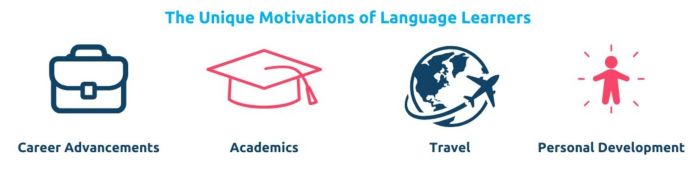
Language learners are a distinct group with varied motivations, backgrounds, and learning goals. Some are looking to learn a language for career advancement, while others may seek language acquisition for academic, travel, or personal reasons. Advertising that speaks directly to these needs requires a keen understanding of the diverse audience you aim to reach. One of the first ways to maximize the impact of digital advertising is through careful audience segmentation. Instead of promoting the same message across all channels, consider the specific motivations that drive different groups of learners and tailor your messaging accordingly.
Segmenting audiences by factors such as age, occupation, location, and even language proficiency allows schools to create highly targeted campaigns. How does language impact advertising for schools?Simply put,it depends heavily on your organizational goals. If you’re looking to target professionals wanting to learn English for business purposes, the language in your ad copy should reflect the vocational value of your programs. On the other hand, copy-targeting students hoping to improve their French skills before an international exchange can be more casual and experience-focused. This approach ensures the content resonates more deeply with potential students, increasing the chances of conversion.
Do you need help launching your language school’s latest ad campaign? Reach out to discover how we can support you.
Leveraging Social Media Platforms to Build Authentic Engagement
Social media is a powerful tool for language learning programs, offering an opportunity to create ongoing engagement with potential students. However, simply posting ads isn’t enough. The most successful social media campaigns foster a sense of community and engagement, which encourages followers to take the next step toward enrollment.
For language schools, showcasing success stories is one way to build trust. Highlighting testimonials from former students, sharing video snippets of language immersion experiences, and offering short, valuable language tips can increase authenticity. Interactive content, such as live Q&A sessions or virtual language exchange events, can draw in potential students who want to see what learning at your institution feels like before they commit.
Schools can also encourage user-generated content by asking current students to share their experiences online, providing social proof that can be far more persuasive than traditional ads. When students are shown engaging and relevant ad content on their social media feeds and in your school’s stories, they are much more likely to visit your site and perhaps even take the first step in your enrollment process.
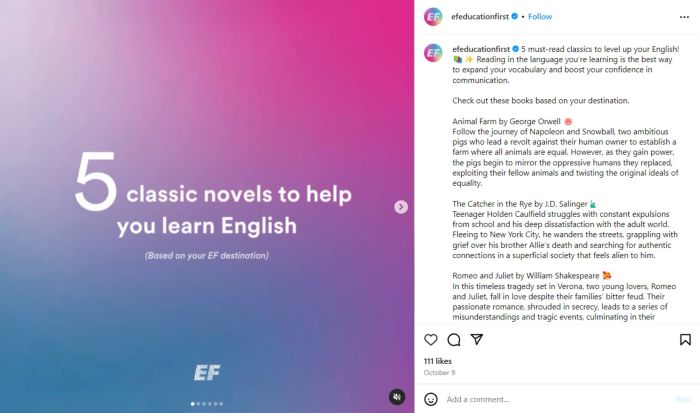
Example: Here, a leading language school, EF Education First uses Instagram to drive their organic traffic. In their post, they share valuable language acquisition tips, providing an English reading list for their students. Try using social media to share actionable language tips with your audience. This will drive engagement, boost your follower count, and broaden your digital reach.
Source: Instagram | EF Education First
Creating Culturally Relevant Ads to Reach Global Audiences
Language learning programs often attract an international audience, which means your digital ads must resonate across cultures. One way to do this is by crafting culturally relevant ads that speak directly to the experience of international students. The language and imagery used in ads should align with the cultural values of the target audience. For example, an ad targeting language students in the Asian market might highlight the importance of family and education, while an ad aimed at Latin American students might focus on community and connectivity.
Schools should also consider creating ads in multiple languages to appeal to global audiences. You may be wondering how to go about this. For example, Can you target by language on Google Ads? Yes! Google Ads allows advertisers to create campaigns that specifically target users based on the language settings of their browser or device. You can set up your ads to appear in multiple languages, ensuring that they reach potential students who speak those languages. Additionally, you can create language-specific ad copy and landing pages, enhancing the relevance of your campaigns.
Optimizing Paid Search Ads for Long-Tail Keywords
One of the most effective ways to drive qualified traffic to your website is through paid search advertising. Language schools can take advantage of this by focusing on long-tail keywords that are specific to language learning. While broad keywords like “learn English” may have high competition, phrases like “intensive French courses for business professionals in Paris” or “Spanish language classes for travelers” are more targeted and tend to attract a highly motivated audience.
Long-tail keywords may have lower search volumes, but they often result in higher conversion rates because they target users who already have a clear intent. This approach not only helps you to maximize your ad budgets but also ensures that the clicks you receive are more likely to turn into enrollments.
Source: Hutong School
Example: Here, Hutong School uses the long-tail keyword: Global Chinese language school in their metadata. This targeted keyword is designed to attract students who not only want to learn Chinese but also want to do so at a global institution that welcomes students from all over the world. Specificity in keywords ensures higher quality leads who are specifically looking for you.
Crafting Compelling Ad Copy That Speaks to Pain Points
Effective ads for language learning and education go beyond promotion and address the specific challenges that potential students face. Whether it’s the fear of not being left behind in class or the worry about balancing language learning with other responsibilities, successful ads speak directly to these concerns.
To craft compelling ad copy, start by identifying the pain points that your target audience experiences. Are they professionals concerned about fitting language classes into their busy schedules? Are they international students worried about mastering a new language before moving abroad? Once you’ve identified these challenges, your ads should provide solutions. Highlight the flexibility of your class schedules, emphasize the support systems you have in place for struggling students, or showcase how your programs help learners achieve fluency quickly.
Source: KCP International Japanese Language School
Example: Here, KCP addresses a very common pain point for language learners in their ad copy. Many fear that it’s ‘too late’ to learn a new language as the experience can be expensive and time-consuming. KCP positions itself as the solution to this barrier, ensuring its audience that as long as they meet four basic criteria, learning Japanese is within reach for them.
Using Retargeting to Capture Warm Leads
Retargeting is one of the most powerful tools in digital advertising, particularly for language schools where prospective students may need time before making an enrollment decision. Retargeting campaigns allow schools to stay top-of-mind by showing ads to users who have already visited the school’s website or engaged with its content.
Retargeting works particularly well for language learning programs because it targets individuals who are already interested in the subject but may not have been ready to commit when they first encountered the program. Your school can use this strategy to provide reminders about upcoming enrollment deadlines, promote special offers, or share new content that highlights the benefits of your courses.
For instance, if a visitor left your site after viewing the course offerings but didn’t sign up, retargeting ads can remind them of the benefits of joining your program. This approach can be particularly effective when combined with personalized messaging, such as offering tailored suggestions based on the courses they viewed.
Incorporating Video Content to Showcase Language Learning in Action
Video ads offer a dynamic and authentic way to showcase your school’s programs. HEM’s tailored video ad services help you stand out, whether promoting a specific course or building brand awareness. From high-energy hype videos to authentic student interviews, we create compelling visuals that maximize visibility and generate results. How does that affect you as a language learning institution?
Video content is a particularly effective tool for language schools, offering prospective students a glimpse into the real-life experience of learning a new language. Whether it’s a classroom setting, a student testimonial, or a tutorial on language pronunciation, videos create an emotional connection that static ads often lack.
To maximize the impact of your video content, ensure that it highlights the immersive, interactive nature of your language programs. Videos should showcase the benefits of learning in a dynamic environment where students can practice speaking in real-life scenarios. This builds excitement and helps prospective students visualize themselves succeeding in your program.
Additionally, video ads on platforms like YouTube or social media can target specific audience segments. Language schools can use these platforms to create ads tailored to different learner types, such as professionals looking to learn a language for work or students hoping to study abroad.
Source: LSI Worldwide | YouTube
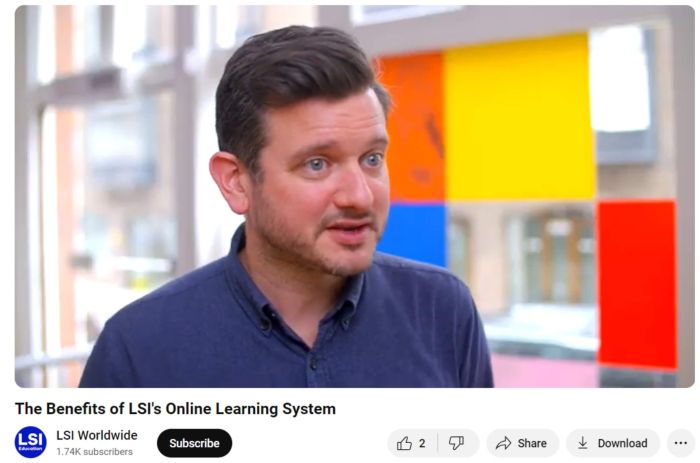
Example: This promotional video presented by a school director highlights the unique selling points of their online learning system. The unique academic benefits of your programs are an excellent topic for your promotional videos – particularly when presented by a language expert within your faculty. What makes your instruction style unique?
Harnessing the Power of Influencer Marketing
Language schools can also benefit from partnering with influencers, especially those passionate about language learning or travel. Influencers offer access to a built-in audience that already trusts their recommendations. By working with influencers who align with your institution’s values, language schools can reach potential students who may not have been aware of your programs.
An effective influencer marketing campaign for a language school might include sponsored posts where the influencer shares their language learning journey, highlighting the value of enrolling in formal programs. Schools can also consider offering affiliate programs, allowing influencers to earn commissions for every student who enrolls through their recommendation.
Utilizing Data Analytics to Refine Advertising Campaigns
Data-driven decision-making is at the heart of successful digital advertising. Language schools must continually analyze their campaign’s performance to ensure they’re reaching the right audience and achieving optimal results. Tools like Google Analytics and Facebook Insights can provide valuable insights into which ads are performing well and which need to be adjusted.
For example, schools can track metrics like click-through rates, conversion rates, and the cost per lead to determine the effectiveness of their campaigns. By continuously monitoring these metrics, schools can make data-driven decisions that maximize their return on investment. Adjustments might include refining audience targeting, improving ad copy, or reallocating the budget to the platforms that yield the highest returns.
Offering Free Trials or Sample Lessons to Convert Prospects
One of the most effective ways to convince prospective students to enroll in your language learning program is by offering a free trial or sample lesson. Language learning can be an intimidating prospect, and many students may hesitate to commit without knowing what to expect. By offering a no-obligation sample lesson, schools give potential students a taste of the learning experience, which can be enough to convert them into paying students.
This strategy works particularly well in digital advertising campaigns where schools can drive traffic to a landing page offering the free trial. Ads promoting a “try before you buy” approach can alleviate apprehension about committing to a full program.
Source: WuKong Education Online | YouTube
Example: WuKong Education Online offers a trial class to attract their prospects. Trials are an excellent way to convert leads and are particularly effective for online academies.
By implementing these language learning advertising strategies, your school can significantly enhance the effectiveness of your digital advertising campaigns. At Higher Education Marketing, we believe that understanding the unique needs of language learners, leveraging innovative tools, and continuously refining your approach is key to driving enrollment and building lasting connections with students.
Want to create successful ad campaigns?
Request a Free paid advertising consultation.
Frequently Asked Questions
Question: Can you target by language on Google Ads?
Answer: Yes! Google Ads allows advertisers to create campaigns that specifically target users based on the language settings of their browser or device. You can set up your ads to appear in multiple languages, ensuring that they reach potential students who speak those languages. Additionally, you can create language-specific ad copy and landing pages, enhancing the relevance of your campaigns.
Question: How does language impact advertising?
Answer: Simply put,An ad aimed at professionals wanting to learn English for business purposes should be crafted differently from one targeting students hoping to improve their French skills before an international exchange. This approach ensures the content resonates more deeply with potential students, increasing the chances of conversion.
If you’ve ever tried to learn a new language, you know that it’s far from easy or straightforward.
Fortunately, we have a lot more language learning tools available than our ancestors (who basically just had books and other humans to learn from).
Indeed, we have an overwhelming number of resources available. Hardly a day goes by without me hearing about a new language learning app that promises to revolutionize the learning process or offer a quick path to fluency.
But no matter how great (or how expensive) the app you use, gaining fluency in a language requires lots of study and practice. You can do things to make your study time more effective or even more fun, but there’s no substitute for putting in the hours.
Having said that, language learning apps can play an important role in your journey to fluency. And not all of them are created equal.
In this article, we take a look at six of the best. Whether you’re looking to practice vocab or find a private teacher, there’s an app for you on this list.
Overview: The best free app for learning the basics of a wide variety of languages.
Price: Free (with ads). For $6.99 / month, you can remove ads and unlock additional practice options.
Platforms: Android, iOS, Web
If you’ve looked into learning a language at all, you’ve probably come across Duolingo. The app launched in 2011, and it’s continued to grow ever since.
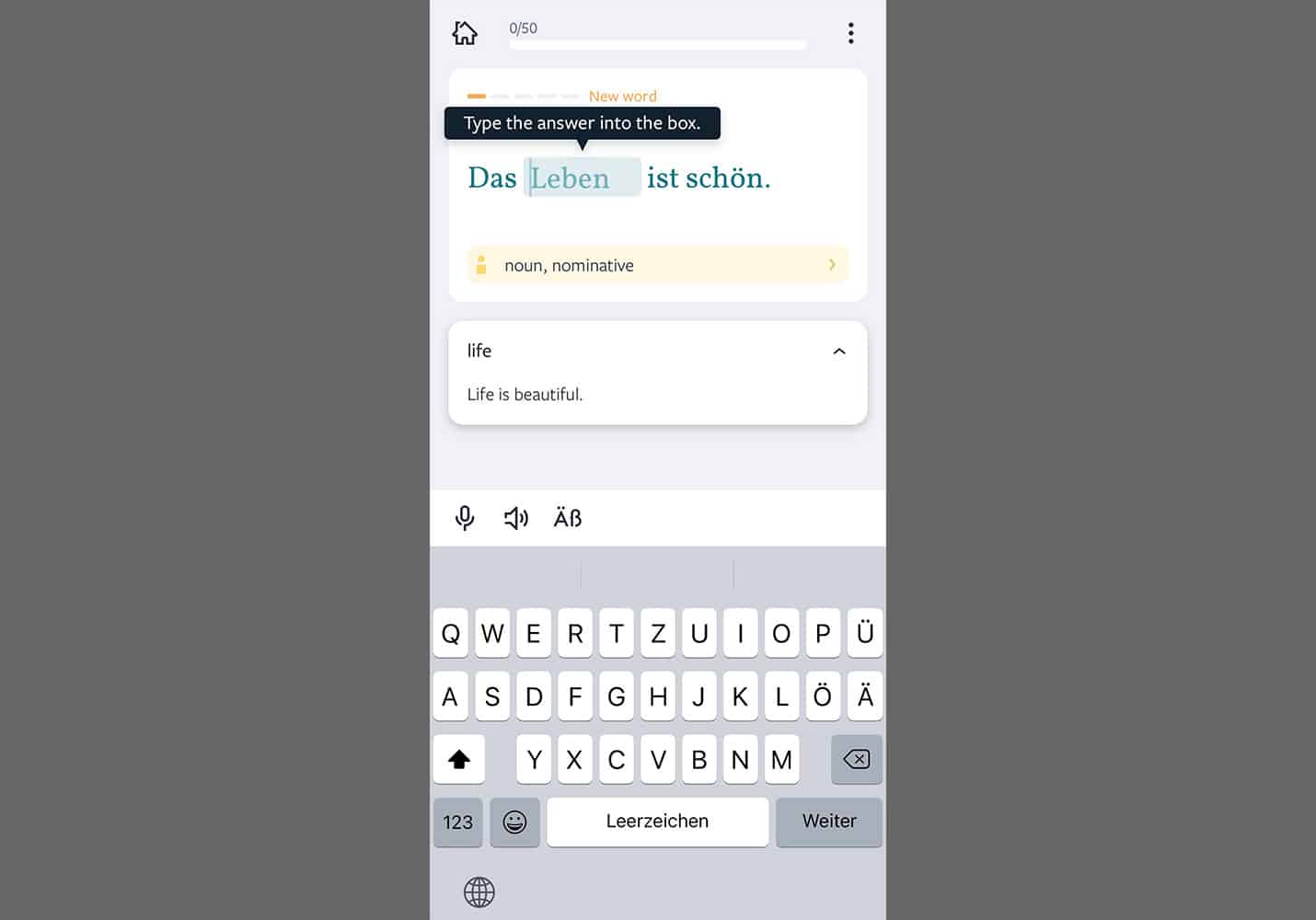
Of all the apps on this list, Duolingo offers the most learning content for free. It combines listening practice, vocabulary lessons, grammar info, and even speaking practice. And as long as you don’t mind a few ads, you get all of this without paying a dime.
Duolingo also boasts a vast number of languages. Currently, you can use the app to learn:
Arabic
Czech
Danish
Dutch
Esperanto
Finnish
French
German
Greek
Haitian Creole
Hawaiian
Hebrew
High Valyrian
Hindi
Hungarian
Indonesian
Irish
Italian
Japanese
Klingon
Korean
Latin
Mandarin Chinese
Navajo
Norwegian
Polish
Portuguese
Romanian
Russian
Scottish Gaelic
Spanish
Swahili
Swedish
Turkish
Ukrainian
Vietnamese
Welsh
Yiddish
What’s more, Duolingo lets you learn languages you won’t find in other language learning apps:
There are languages with a small number of speakers, such as Yiddish and Navajo.
There are dead languages such as Latin.
And there are even fictional languages such as Klingon and High Valyrian.
If you’re trying to learn any of these languages, Duolingo is the place to begin.
The only downside of Duolingo is its focus on translation. Even when you reach higher levels, the app continues to present lessons in English. This can impede your ability to learn to think in the language you’re learning.
But if you’re a complete beginner, Duolingo is still a great place to start your language learning journey (especially since it’s free).
Overview: A fantastic app for learning vocabulary in several widely-spoken languages.
Price: $9.99 / month after a 14-day free trial
Platforms: Android, iOS, Web
Many language courses focus too much on grammar in the beginning. And while grammar is important for learning to speak, vocabulary is far more important for communicating.
If you know a bit of vocabulary, you can make yourself understood (even if you sound a bit childlike in the process). The same is not true if you know grammar but lack essential vocab.
Recognizing this, Lingvist focuses on vocabulary. The app starts by teaching you the most common words in the language you’re learning. The goal is to learn vocab that covers “80% of everyday scenarios.” This way, you don’t waste your time learning words you’re unlikely to use.
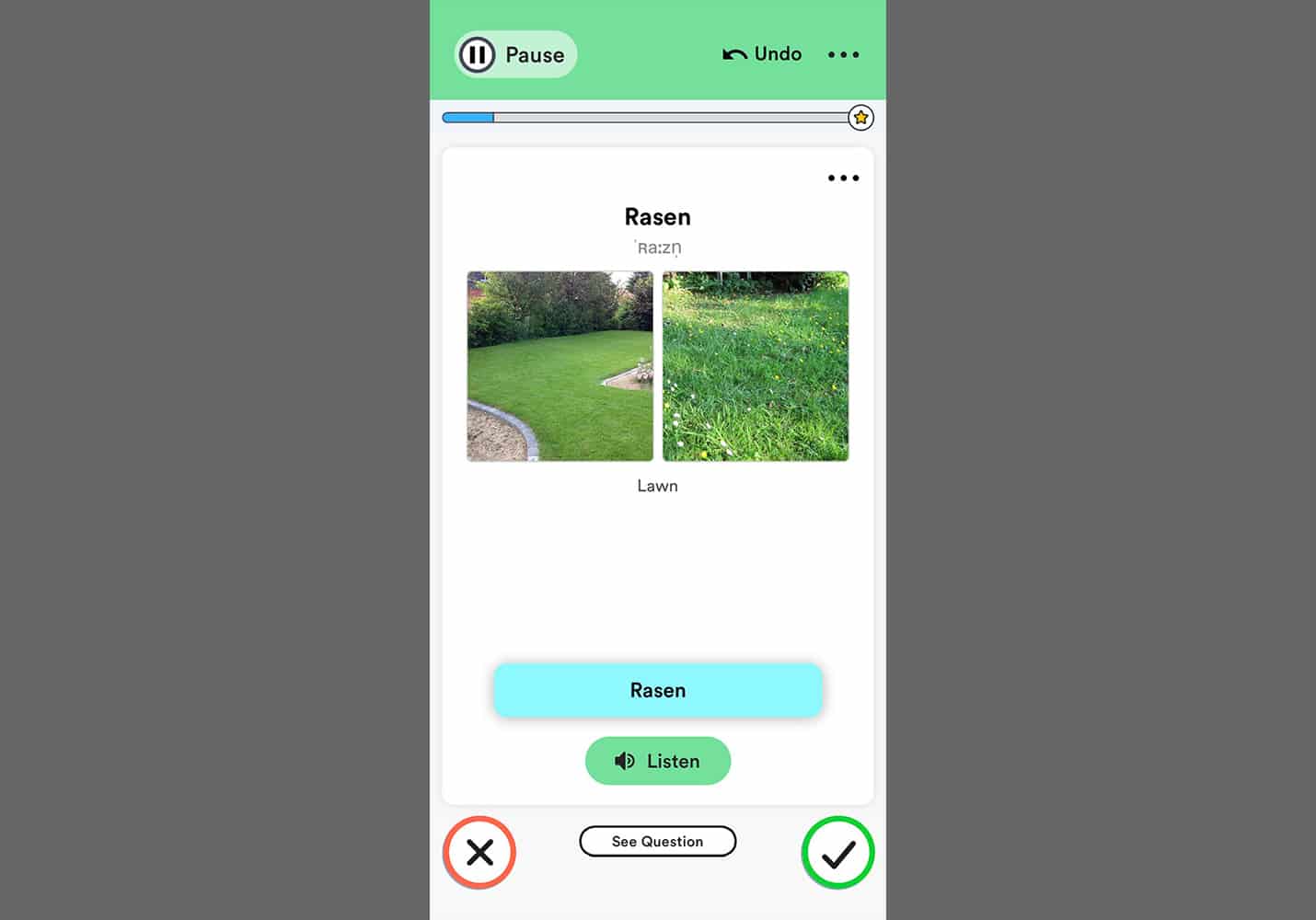
Lingvist also uses spaced repetition to help you learn more efficiently. The app quizzes you on words right before you’re about to forget them, which is the most optimal way to memorize information.
Plus, Lingvist will focus on the words you struggle with, not wasting your time reviewing vocabulary you already know. If you’ve used a flashcard app such as Anki, this approach will be familiar.
The only disadvantage of Lingvist is its limited selection of languages. Currently, the app supports:
Dutch
French
German
Italian
Portuguese
Russian
Spanish (Castilian & Latin American)
If you’re learning one of these languages, Lingvist is a great option. But prospective learners of other languages will need to look elsewhere.
Overview: The best app for learning to pronounce, spell, and think in another language.
Price: $9.99 / month after a 14-day free trial. Live coaching is available for an additional fee (select languages only).
Platforms: Android, iOS
Full disclosure: I backed the original Fluent Forever app project on Kickstarter, and I currently use the app. However, I don’t receive any compensation for mentioning it.
Do you want to be mistaken for a native speaker? If so, mastering pronunciation in your target language is essential.
Proper pronunciation will also improve your listening comprehension, making it far easier to communicate with native speakers and enjoy media in the language you’re learning.
Recognizing this, Fluent Forever focuses on teaching you to pronounce (and spell) your target language first. Only once you’ve mastered these basics do you move on to learning vocabulary and grammar. This approach is based on a method that founder and polyglot Gabriel Wyner developed in his book Fluent Forever.
In addition to teaching you pronunciation and spelling, Fluent Forever uses a frequency-based approach to learning vocabulary. That is, you learn the most common words first.
The app also steers you away from translation and teaches you to think in the language you’re learning. It does this with picture-based flashcards that you create yourself. Making the language more personal in this way improves your learning and retention.
Fluent Forever currently supports the following languages:
Dutch
French
German
Italian
Japanese
Korean
Mandarin Chinese
Portuguese (Brazilian)
Russian
Spanish (Latin American & Castilian)
In addition to the app-based learning, Fluent Forever also offers live coaching with professional teachers (for an additional monthly fee).
Coaching is only available in select languages as of this writing, but the developers are working to expand coaching options based on user interest.
Overview: An app that lets you find language teachers for one-on-one, online lessons.
Price: Varies (each teacher sets their own rate).
Platforms: Android, iOS, Web
Traditionally, live language lessons were prohibitively expensive. But thanks to the power of the internet and video chat platforms, one-on-one lessons are now cheaper and more accessible than ever before.
iTalki has played a big part in this language education revolution.
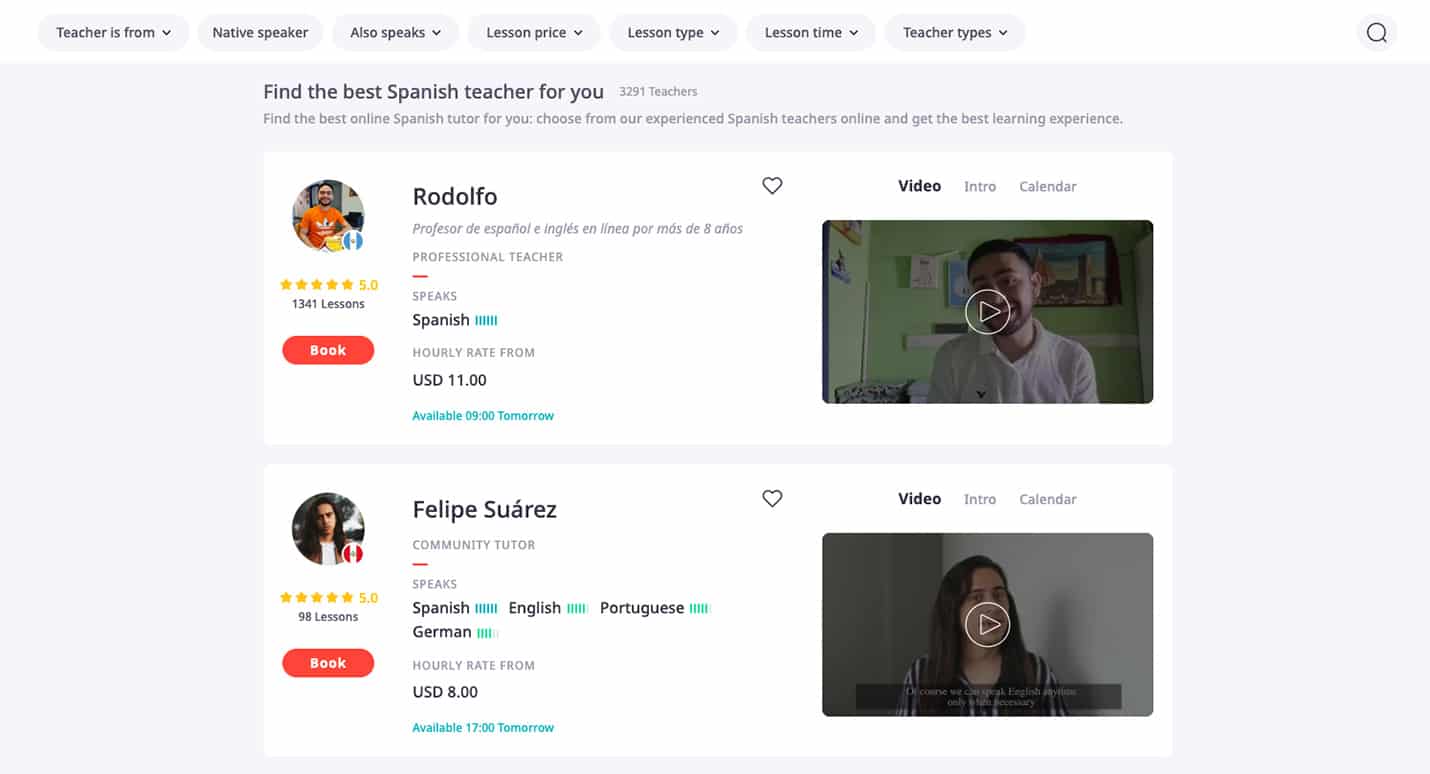
Unlike the other apps on this list, iTalki doesn’t offer language lessons itself. Instead, it’s a place to find and book lessons with live teachers. Teachers on iTalki range from “community tutors” without formal training to professional instructors with decades of experience.
To find a teacher on iTalki, all you have to do is sign up for an account. Then, you can filter prospective teachers based on language, price, and even level of experience. From there, you can typically book a trial lesson for a small fee. This helps you and the teacher decide if you’ll work well together.
The cost of lessons on iTalki varies. Each teacher sets their own rate, and some offer discounts for purchasing multiple lessons in advance. Currency exchange rates and differences in cost of living also mean that some teachers will be cheaper than others.
iTalki claims to offer lessons in over 150 languages. More popular/widely spoken languages will tend to have more teachers available. Still, it’s possible to find teachers of obscure or even endangered languages such as Irish Gaelic or Aramaic.
Overview: A community-driven Q&A platform for language learners.
Price: Free (limited features). For $4.49 / month, you can remove ads, search for questions, and play an unlimited number of audio/video answers.
Platforms: Android, iOS, Web
Apps like Duolingo, Fluent Forever, and Lingvist are great for learning the basics of a language. Eventually, however, you’ll have questions about your target language that these platforms just can’t answer.
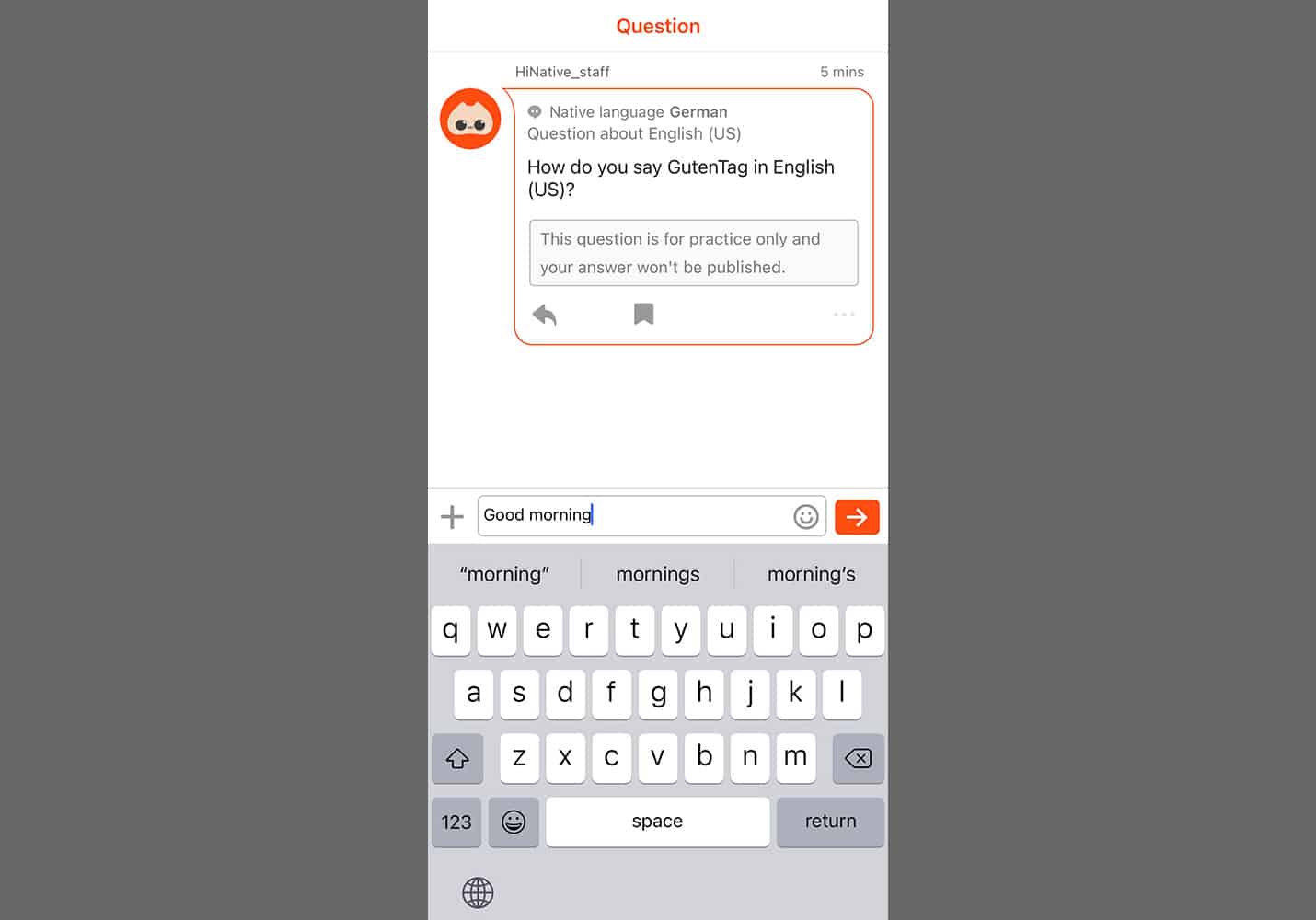
In this case, your best option is to ask a teacher. But hiring a teacher can be expensive (and excessive for one-off questions). As an alternative, consider HiNative. This platform lets you post questions about a language and get answers from native speakers.
For instance, let’s say you’re unsure about the meaning of a particular slang term. HiNative is the perfect place to post your question and get answers you’d never find in a textbook.
Even better, you can ask most questions for free (though you can pay to boost the visibility of your questions and get a response faster).
In addition to posting questions about vocabulary and grammar, you can also get feedback on your writing or even your pronunciation.
Just be sure to take some time to answer questions about your native language. HiNative is a community-driven platform, after all, and it only works if all users contribute.
HiNative currently supports over 110 languages. Though, as with iTalki, more widely spoken or popular languages will tend to have more contributors.
Overview: The best app for learning to read Japanese.
Price: $9 / month. A lifetime subscription is also available for a one-time payment of $299.
Platforms: Web
This last app comes courtesy of a suggestion from Martin (our operations lead, web developer, and an avid Japanese learner).
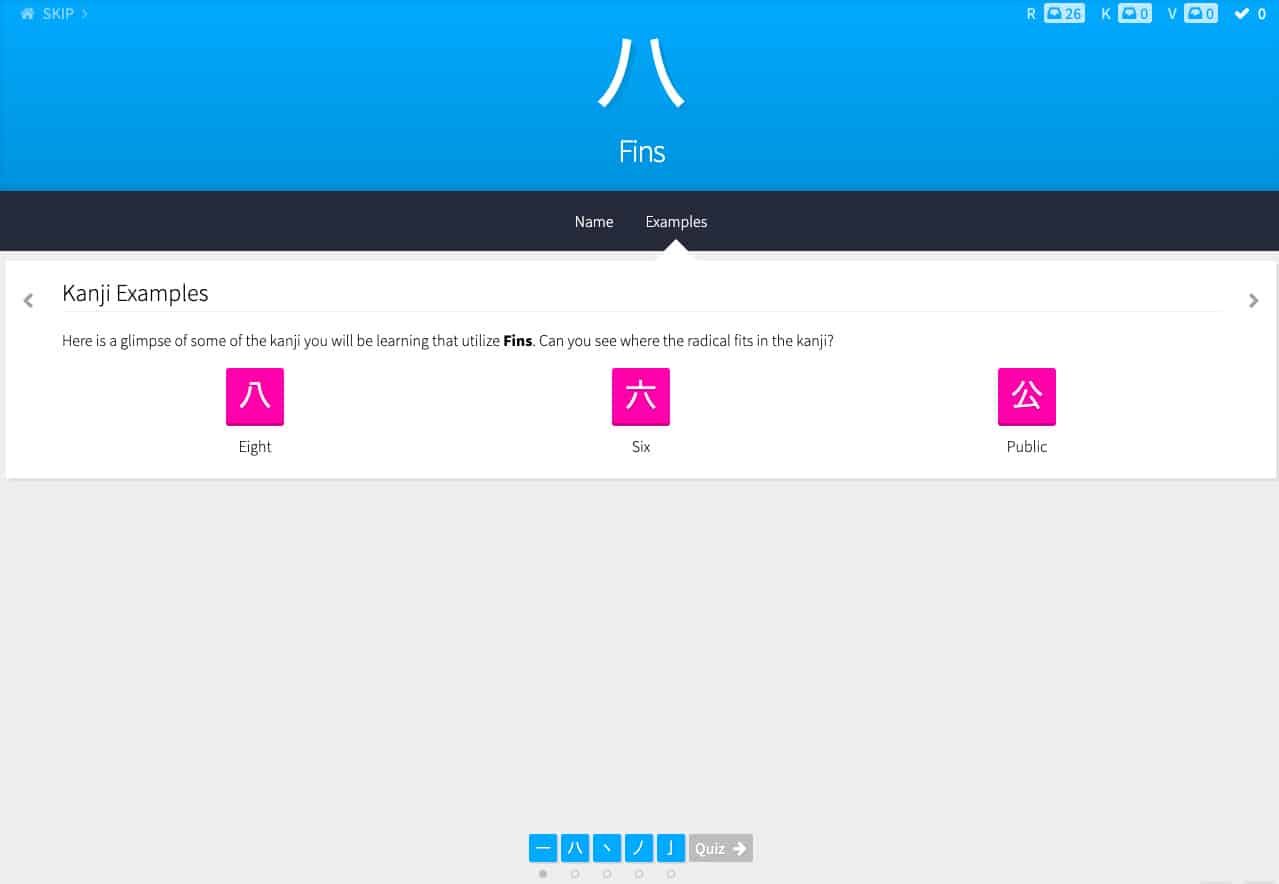
WankiKani addresses one of the biggest challenges for students of Japanese: reading. Japanese uses a writing system unlike any other, and it’s notoriously difficult and confusing. That is, until you start using WaniKani.
The app combines mnemonics and spaced repetition to teach you 2,000 kanji and 6,000 vocabulary words in just over a year. Even better, the first three levels of learning in the app are free (no ads, time limits, or other restrictions).
Great as all of this is, be aware that WaniKani is not a resource for learning to speak Japanese. For that, Martin recommends iTalki or Duolingo (particularly Duolingo Stories, which focus on listening skills).
Finally, WaniKani typically does a New Year’s sale on their lifetime membership. This can save you a fair bit of money if you plan to stick with the app long-term.
Language Learning Apps Are Only the Beginning
If you’re learning a new language, the apps on this list are a great place to start.
However, an app can only get you so far. To truly learn a language, you need to spend lots of time practicing and ultimately using it. Fortunately, this process is a lot of fun once you’re past the beginner stage.