
This blog was kindly authored by Professor Lynne Bianchi, Vice Dean for Social Responsibility & Equality, Diversity, Inclusion and Accessibility, at the University of Manchester
I recently had the fortune to be part of a panel discussing the place of Service Learning in higher education, chaired by HEPI. My reflections before and since may inspire you to take time to think about your perspective on the nature and role of Service Learning in fast-changing university and civic landscapes. In its simplest sense, Service Learning is an educational approach that combines academic study with community service.
In my role within a large science and engineering faculty, I have rallied our staff and students to think seriously about the features, advantages and benefits of Service Learning in science and engineering contexts. For our university, this teaching and learning approach isn’t new, with expertise in the biomedical sciences and humanities teaching us much about the way in which undergraduate students can create benefit for our local communities whilst enriching their own academic experiences.
In this blog, I build on my own background as a teacher and higher education academic and draw on my experience in curriculum design when focusing on how we can provide authentic and impactful Service Learning experiences for our undergraduates.
It doesn’t take long working in this area to unearth a wide range of terms that are used interchangeably – from place-based learning, real-world learning, community-engaged learning, practice-based learning, critical urban pedagogy, industry-inspired learning and more. A gelling feature is that to get Service Learning working well there must be an authentic benefit to each party involved. The students should develop skills and understanding directly required within their degree, and the partner should have a problem explored, solved, or informed. In essence, the experience must lead to a ‘win-win’ outcome(s) to be genuine.
In our context in science and engineering, we have envisioned Service Learning working well, and considered this to include when:
I am still pondering this question as there are so many variables and options that influence the choice. Which year group should service learning drop into? Or, does a developmental over time approach suit better? Is Service Learning more impactful in the later undergraduate years, or should it be an integral part of each year of their experience with us? Realistically, there won’t be a one-size-fits-all all model, and there are benefits and challenges to each. What will need to underpin whichever approach we take, will be the focused need to elicit the starting points of our students, our staff and our partners in whichever context.
Going from ‘zero to hero’ in Service Learning will require training and support for all parties. My experience working across the STEM sector for nearly three decades has taught me that no one partner is the same as another – what is a big deal to one can mean nothing to another. My thinking is that we need to see each person involved in the Service Learning experience as a core ‘partner’ and each has learning starting points, aspirations and apprehensions. Our role as programme leaders is to identify a progression model that appreciates that this is ‘learning’ and that scaffolds and key training will be required at different times – even within the process itself.
In my early career at this university, I spent time within the Teaching & Learning Student Experience Professional Support teams, where I saw firsthand the integral way that any university programme relies on expertise in taking theoretical ideas into practice. The interplay between project management, planning, timetabling, eLearning, marketing and communications and student experience support teams, to name some, will have play such critical roles in achieving excellence in Service Learning. Working at scale in our faculty across 10 different discipline areas, will require integrated work with other faculties to harness the power of interdisciplinary projects and digital support for course delivery and assessment that can embrace an internal-external interface.
Support for scaling up will also require a culture of risk-taking to be valued and championed. Over the introductory years, we need to provide a sense of supported exploration, a culture of learning and reflection, and an ethos where failure is rarely a negative, but an opportunity. Of course, science and engineering disciplines bring with them our obligations to accrediting bodies, and a close dialogue with them about ambition, relevance and need for this enriching approach needs to be clearly articulated and agreed so that any course alteration becomes a course invigoration rather than a compromise.
Faculty culture and the way the university and the sector views and reviews SL will have a significant implication on practice and people feeling safe to innovate. As the university forges and launches its 2035 strategy the spaces for innovation and development are increasingly championed, and the months and years ahead will be ones to watch in terms of establishing a refreshed version of teaching and learning for our students.
In closing this short exploration of Service Learning, I can feel a positive tension in the air – the excitement to work together to further invigorate our student experience whilst supporting our staff and partners to embrace varied new opportunities. The ‘getting it right’ story will have many chapters, many endings as the genres, characters and plots are there for us all to create – or more pertinently ‘co-create’! What drives me most to remain in this space of uncertainty for a while longer is the anticipation of creating experiences that truly make a difference for good. As our universities transform themselves over the coming years, I invite you to join us in the dialogue and development as we have so much to learn through collaboration.
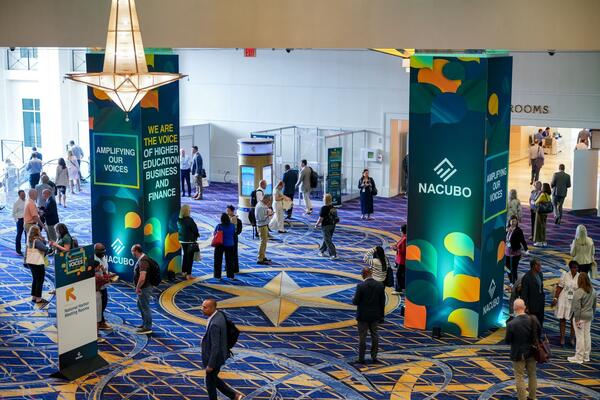
NATIONAL HARBOR, Md.—Just outside of Washington, D.C., across the Potomac River, Capitol Hill cast a shadow over the annual meeting of the National Association of College and University Business Officers, where concerns over federal funding and policy changes were palpable among attendees.
At panels and in side conversations during the three-day meeting, held at the sprawling Gaylord National Resort and Convention Center, attendees swapped strategies, drilled into pressing issues and commiserated over pressures on the sector wrought by both the political environment and a business model that is strained in many places. Representatives of a diverse mix of institutions from across the nation attended, but common challenges emerged: They worry about the impact of looming federal policy changes, which they expect to add pressure to institutions already grappling with financial challenges related to enrollment declines, high tuition discount rates and other issues.
Here’s a recap of themes and moments that emerged from the conference.
At a packed panel covering recent activity out of Washington, NACUBO vice president for policy and research Liz Clark noted the strains business officers are feeling amid a “tumultuous year” marked by a flurry of federal actions, including the passage of the so-called One Big Beautiful Bill Act, pushed by President Donald Trump, which included various provisions for higher education.
The legislation, signed earlier this month, caps some student loans while eliminating the Grad PLUS program, limits repayment options and requires programs to pass an earnings test for attendees to access federal student loans, among other provisions, including changes to the endowment tax. Passed on a partisan line with Republicans under pressure to deliver Trump’s signature legislation, Clark noted it is just one action—albeit a significant one—that has reshaped higher education this year.
Clark added that 2025 has “brought a lot of fear, anxiety and contempt” as colleges navigate restrictions on diversity, equity and inclusion programs; cancellation of federal grants and contracts; and various state laws that have “created a challenging environment” for the sector.
“I feel like we have, this year, been dealing with everything, everywhere, all at once,” Clark said.
Clark noted that despite the concerns she highlighted, the One Big Beautiful Bill Act, which she abbreviated “Bubba,” and other policies that were proposed could have hit higher education much harder. One example she offered was the endowment tax, which in the final bill fell far short of what House Republicans initially proposed.
But in another panel on tax reform, Clark suggested that the endowment tax could still be revised in ways that resemble earlier proposals and would have affected more universities and at higher rates.
“Don’t forget that ideas never die in Washington,” Clark warned.
A panel of higher education lawyers also weighed in on current challenges for the sector.
Kate Hudson, deputy vice president and counsel for government relations and public policy at the Association of American Universities, warned at the start that the session would not have “a whole lot of good news.” Given the rapid pace of changes from the federal government, she also offered a caveat: “Anything I say today could be out of date in 72 hours.”
Hudson noted that campus attorneys are dealing with multiple actions from the federal government, such as federal funding freezes and far-reaching executive orders, as the Trump administration seeks to reshape everything from academic research to college admissions.
“I don’t think it is too dramatic to say that this is a wholesale renegotiation by force of the government-academia partnership,” Hudson said. “I don’t think that’s an overstatement.”
Jen Gartner, deputy general counsel at the University of Maryland, argued that the relationship between the federal government and research institutions shifted from “extremely collaborative and collegial” to a suddenly “adversarial approach” that has left universities flummoxed. That strain has particularly been felt around grants, which she said have often been terminated for unclear reasons. She also said the federal government has provided unclear information on such cancellations, sometimes providing contradictory statements in the same termination notice.
And as higher education attorneys have sought answers, she said, they’ve reviewed few.
“It’s not just that universities don’t know what to do—agencies don’t know what to do, either, and [staff are] not picking up the phone or responding to emails if they’re even still there,” Gartner said.
Related to research, Hudson also warned that Trump administration’s scrutiny of international students, which includes now vetting their social media posts for evidence of hostility toward the U.S. government and culture, also has the potential to harm the sector.
“It’s not an overestimation to say that threats … to legal immigration, to your campuses, do present an existential threat to the academic research enterprise itself at a time when [research and development] budgets and graduates from STEM degrees in our competitors, such as China, are off the charts and reaching new heights,” she said. “International students will go elsewhere.”
Hudson added that the AAU has not historically focused on immigration law, but that has suddenly shifted amid the threats to international students and faculty.
Inside Higher Ed also hosted a panel at this year’s conference to discuss the results of the 15th annual Survey of College and University Chief Business Officers, released last week. That survey, conducted in partnership with Hanover Research, found college business officers confident in the long-term outlook but worried about their financial situation in the near future.
Most respondents believe their institutions will be in worse financial shape next year. Only 43 percent expressed the belief that their institution would be in better shape next year. But Rick Mills, president and CEO of United Educators, was skeptical about the sentiment that financial situations will improve by next year given the various challenges discussed at the conference.
“At one level, I take heart in the optimism,” Mills remarked. “I think it’s what keeps all of us going, and what gets you to work in the morning, and perhaps, in the end, helps us solve the problem. On the other hand, it strikes me as slightly fantastical thinking in the current environment.”