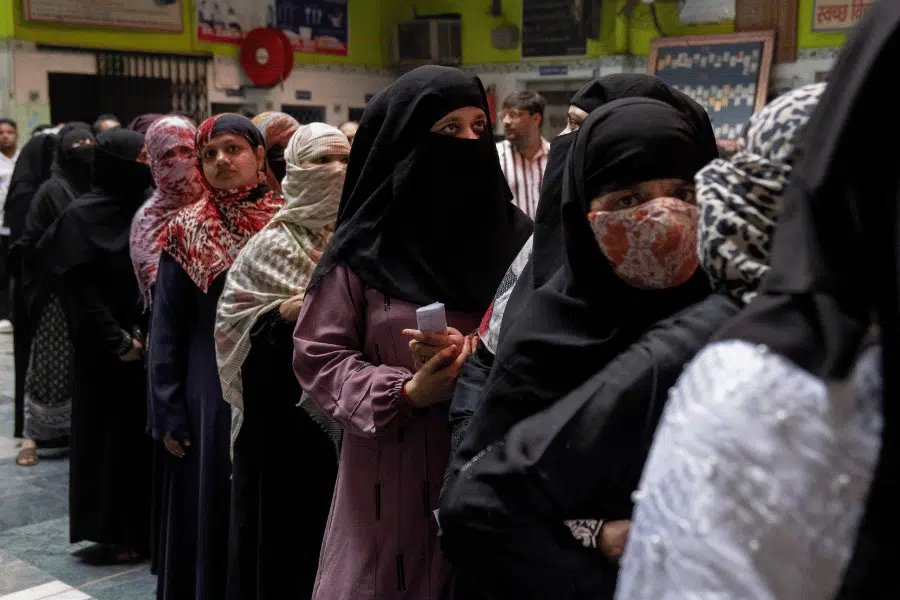
Sidra Khan is a young Muslim woman in India who aspires to be a lawyer. Since early childhood, she has valued and respected Islam, the religion she was born into. But her headscarf now meets eagle eyes when she travels on public transport or tries to make a point during college lectures.
She feels that anti-Muslim rhetoric in India is causing her peers to judge her on the basis of religion and not merit. This, many Muslim students like Khan feel, is a casualty of having the government of Prime Minister Narendra Modi rule India.
Over the last decade, the government of this secular country long considered the world’s largest democracy has introduced religious-based laws and politicians have incited anger and hatred against those who aren’t Hindu through rhetoric in speeches and AI campaigns. In northeast India’s Assam state, Wajid Alam, a college history student, watched a new election video from the ruling Bharatiya Janata Party with unease.
An AI generated video shared by BJP’s official social media handles suggested that if the BJP loses power, Assam would be overrun by Muslims. It used AI-generated imagery to depict Muslims in hijabs and skull caps allegedly taking over airports, stadiums, tea gardens and other public spaces.
It concluded with a message claiming Muslims could grow to 90% of Assam’s population, provoking other religious groups to choose the BJP to get rid of Muslims.
The politics of religion
For Alam and millions of Muslims in Assam, the video felt like an attack. And it is not the first time the BJP has been accused of demonizing religious minorities. Under Prime Minister Narendra Modi, India — a country founded on principles of secularism and religious freedom — has seen growing hostility toward Muslims and Christians.
Some 200 million people in India practice the Muslim faith, making it the world’s third largest population of Muslims.
Modi became India’s 14th prime minister in May 2014. Not long after, reports of attacks on religious minorities began to climb. In June 2014, Mohsin Shaikh, a young Muslim IT worker in Pune, was beaten to death by Hindu extremists — the first of several lynchings that followed.
A year later, in 2015, a Hindu mob in Dadri, Uttar Pradesh, killed Mohammad Akhlaq on suspicion of eating beef — considered a serious offense in the Hindu religion. That made global headlines and signalled the rise of cow-protection vigilantism.
By 2016–17, assaults on Muslims accused of trading or transporting cattle spread across northern India, with cases like the lynching of dairy farmer Pehlu Khan in Rajasthan. Christians, too, came under pressure during this period: nationalist groups staged forced reconversion campaigns, disrupted prayer meetings, vandalized churches and invoked new anti-conversion laws to arrest pastors and worshippers.
Muslims under Modi’s rule
Together, these incidents marked the early years of the Modi era as a turning point, when both Muslims and Christians began to face growing hostility in daily life.
At the same time, hostile rhetoric against minorities became increasingly common in election campaigns. BJP leaders and affiliated Hindu nationalist groups framed Muslims as “outsiders” or “invaders,” with speeches warning of demographic “takeovers” or linking entire communities to terrorism and cow slaughter.
Christians were accused of running covert “conversion factories,” with pastors painted as threats to India’s cultural identity. These narratives — echoed at rallies, on television debates and, more recently, through AI-generated propaganda — blurred the line between campaign messaging and hate speech. For many analysts, this marked a shift: politics was no longer just influenced by religion, but actively weaponizing it to polarize voters.
These speeches were not isolated slips but part of a larger pattern. Muslims were painted as “infiltrators,” “termites” or participants in a supposed “love jihad” plot to convert Hindu women, while Christians were accused of running “conversion factories” and threatening India’s culture.
Senior BJP figures, including party president Amit Shah and Uttar Pradesh Chief Minister Yogi Adityanath, used such language at rallies to mobilize support. Over time, this messaging blurred into mainstream political discourse, normalizing suspicion and hostility toward entire communities.
Political divisions
India’s experience is part of a wider global pattern. Around the world, political movements are blending nationalism and religion to define who “belongs.” A recent Pew Research Center study found that while the United States ranks lower than many countries on overall religious nationalism, it stands out among wealthy democracies for how many adults say the Bible should influence national laws or that being Christian is essential to being truly American.
In the United States, debates over Christian nationalism have become a powerful current within the Republican Party and Donald Trump’s political rhetoric.
Trump and allied evangelical leaders increasingly frame America as a “Christian nation,” a message that blurs the line between faith and state power. Commentators warn that this effort to link patriotism with religion mirrors broader global trends — from India to Israel to Turkey — where religious identity is being harnessed for political gain.
Both the U.S. and Indian constitutions enshrine secularism, which is the idea that the state would keep equal distance from all religions. In India’s case, that principle mattered in a country where Hindus form the majority but millions of Muslims, Christians, Sikhs and Buddhists also call the nation home.
A history of strife
Even before Modi, religion and politics were sometimes entwined: the Congress Party drew on Hindu symbolism, the 1984 anti-Sikh riots scarred the country and the destruction of the Babri mosque in 1992 shook faith in secularism. Still, the political consensus was that India was not to be defined by one faith.
“But a lot has changed under Modi and the BJP,” said Sneha Lal, a Hindu student studying to become a primary school teacher. “We did not grow up in this India.”
Lal is bothered by some of the BJP’s tactics that have promoted anti-conversion laws in several states, laws often used against Christians and Muslims accused of proselytizing.
In 2019, the Citizenship Amendment Act introduced fast-track citizenship for non-Muslim refugees, a move widely criticized as discriminatory toward Muslims. That same year, Delhi revoked the autonomy of Jammu and Kashmir, India’s only Muslim-majority state. Alongside these legal changes, election campaigns have increasingly featured polarizing rhetoric, and propaganda — including AI-generated videos — has circulated warning of demographic “takeovers.”
Critics say these policies and messages together mark a break from India’s founding secular vision, pushing the country toward a Hindu-first identity.
Can there be a unified national identity?
Seema Chishti, a senior journalist who has witnessed India’s journey from secular to right-wing, said that mixing religion with politics and diluting India’s unified national identity across religious and ethnic groups is a stated core principle of the ruling party, based on its militant roots.
“The Indian Constitution recognises no barriers to being Indian, i.e. nationality is not contingent on faith, caste, region, creed, gender or political views,” Chishti said. “BJP has loudly proclaimed ‘Hindu-India’ and instilled ‘Hindu’ nationalism in politics, education, the armed forces and every other facet of Indian life.”
An example of Modi’s attempt to link Indian-ness with Hinduism is the Citizenship Amendment Act of 2019 which fast-tracks Indian citizenship for non-Muslims from three neighbours: Pakistan, Bangladesh and Afghanistan. “This action echoes ideas of India being a Hindu homeland,” Chishti said.
On 15 August 2025, on India’s 79th Independence Day, Modi addressed crowds gathered at Delhi’s historical Red Fort, as he did the last 11 years that he has been in power.
On a day which commemorates India’s long struggle for self-rule that culminated in self-governance and independence from the British empire, Modi referred to the right-wing paramilitary organization Rashtriya Swayamsevak Sangh or RSS as a philanthropic organization. RSS has espoused an India for Hindus only.
Intolerance and violence
All this has had tragic consequences. On 25 September, a seven-year-old Muslim boy was abducted from his neighborhood and brutally murdered in northern India’s Azamgarh.
But religious hate crimes haven’t only targeted Muslims. On 11 June, a mob allegedly linked to Hindu extremist groups attacked guests at a Christian wedding and set fire to a utility vehicle. And on 25 July, two Catholic nuns were arrested in central India’s Chhattisgarh state following a complaint by a member of an extremist Hindu group.
India’s United Christian Forum reported that in 2024, Christians across the country witnessed 834 such incidents, up 100 incidents from 734 in 2023 — that comes out to more than two Christians being targeted every day in India simply for practising their faith.
These incidents of attacks and even public hate speeches against Christians are not limited to vandalism, they extend to physical assaults, disruption of prayer gatherings, financial boycotts and even motivated arrests.
This anti-Christian sentiment has been fanned by Hindu extremist groups in the country, which are indirectly and sometimes directly backed by the ruling BJP and other Hindu nationalist groups. These groups are increasingly using anti-conversion laws created in the Modi era to harass Christians.
Christians in India
Arun Pannalal, president of the Chhattisgarh Christian Forum, said that two things are happening: Lawlessness of mobs who target Christians is ignored by police, while Christians often find themselves subject to seemingly random arrests.
“On random calls by Bajrang Dal goons the Police arrested the nuns, without evidence of anything,” Pannalal said. “But when the nuns wanted to complain against the goons, it was not lodged.”
Chishti said that more than politicising religion, by inserting religion into politics, the BJP is trying to portray itself as the only ‘Hindu’ party and the others consequently as not. She maintains that the BJP has fought elections on issues that polarise Indians, divide them and not on its performance or electoral record. Its electoral dominance has also meant that other parties in the fray, the opposition too find themselves playing on the BJP’s turf.
“The BJP has done its best to make the political discourse about faith, symbols of religion — Hindu and Muslim — and portraying themselves as saviours of the Hindu faith and righting so-called historical wrongs,” Chishti said.
As a result, the media focuses on the religious conflicts, instead of other pressing issues, such as the economic well-being of people, the public health or education systems, joblessness and inflation, Chishti said.
As India heads toward future elections, the blending of religion and politics raises questions not just for its own democracy but for others around the world. For young people in India, the stakes are immediate: whether their country remains true to its founding promise of secularism and equal rights.
But for readers everywhere, India’s story is part of a larger global trend from the United States to Turkey to Israel, where religion and nationalism intertwine to shape politics. Understanding how these forces play out in the world’s largest democracy can help us make sense of how faith and power continue to influence politics across the globe.
India’s struggle shows that when religion becomes a political weapon, democracy itself can become the battleground.
Questions to consider:
1. How is freedom of religion protected in India?
2. In what ways are Muslims being treated differently by the Modi administration?
3. In what ways to you feel comfortable or uncomfortable in your community expressing your faith?