Students often learn about entrepreneurship without a clear path to turn their ideas into a viable business. The University of Dayton’s capstone course gives them that path.
Launched in fall 2024, Flyer Nest guides students to develop scalable business ideas they can continue after graduation.
Housed in UD’s School of Business Administration, Flyer Nest is part of the university’s entrepreneurship program and teaches students not just how to launch companies but also how to design ventures that solve real problems and benefit their communities.
To date, Flyer Nest has served 12 teams totaling about 70 students, with each team developing a single business venture. Two teams have continued their ventures beyond the course, and six new teams began this semester.
Vince Lewis, associate vice president for entrepreneurial initiatives at UD, said all students in the capstone course end the semester not just with a classroom project but with a proposal they can submit for funding.
“There is a bigger learning outcome than just the start-up,” Lewis said. “Students gain better confidence in actually being able to execute an entrepreneurial venture.”
He added that two students from a continuing team raised about $400,000 to fund their venture aimed at improving helmet safety for football players.
“That’s a valuable, real-world opportunity,” Lewis said. “Students build a business case and then present it to business owners, investors and entrepreneurs at the end of the semester to get feedback.”
“It really does provide a win for students actively pursuing start-ups,” he added.
Lewis said students build their projects around technologies they find in a database of innovations available for licensing from research labs.
“Scientists and engineers develop [the technologies], but they aren’t focused on commercializing them,” said Lewis. He added that Flyer Nest teams work together to turn these technologies into solutions for real-world problems, from disease detection to health literacy for Black Americans.
Lewis said the team from Flyer Nest’s inaugural cohort focused on helmet safety secured $200,000 in state funding through TVSF, then secured the rest from new-venture competitions and grants.
The project leveraged the students’ football backgrounds and technology originally designed for hazmat suits to create a sensor embedded in helmet chin straps, he said.
“If you integrate Bluetooth and communications already being added into helmets, it can alert coaches or someone on the sideline that a chin strap isn’t tight, potentially preventing head injuries,” said Lewis.
He added that another team from the capstone course is using technology originally designed to detect fatigued pilots to assist truck drivers. The students are currently partnering with three local trucking companies interested in pursuing the venture with them.
What’s next: Lewis said next steps involve expanding Flyer Nest beyond business and entrepreneurship majors, particularly pulling students from engineering, design, communications and other disciplines.
He also said he wants to create a year-round venture studio where students can continue developing their ideas after the semester ends.
For other institutions interested in creating an experiential course like Flyer Nest, Lewis said it’s essential that they have strong institutional commitment and an engaged community partner embedded in the local entrepreneurial ecosystem.
“The community partners are what makes it work,” Lewis said. “Because they have this vast network of people they can bring in and integrate into the course to help us execute.”
Ultimately, Lewis said, running a capstone course like Flyer Nest requires dedication and a willingness to navigate the uncertainty that comes with real-world learning.
“It’s a significant lift in terms of effort, because there’s a little ambiguity when you’re going into it,” he said. “This experiential, real-world opportunity for students is a really big commitment.”
Get more content like this directly to your inbox. Subscribe here.
This audio is auto-generated. Please let us know if you have feedback.
Dive Brief:
A group of 20 states filed a lawsuit Friday alleging that President Donald Trump’s proclamation implementing a $100,000 fee on new H-1B skilled worker visas is unlawful, and should be vacated and set aside.
The plaintiffs in California v. Noem, each of them being an attorney general for a Democratic state, claimed that the fee is arbitrary and capricious in violation of the Administrative Procedure Act, and fails to adhere to that law’s procedural requirements. The complaint alleged the administration exceeded statutory authority and usurped congressional authority over immigration and revenue collection.
Friday’s complaint in the U.S. District Court for the District of Massachusetts is at least the third such lawsuit challenging Trump’s H-1B policy. Other challenges include a California lawsuit filed by several unions, industry groups and other co-plaintiffs, as well as a challenge filed in Washington, D.C., by the U.S. Chamber of Commerce.
Dive Insight:
California and Massachusetts are the lead state plaintiffs in the lawsuit, which alleged several anticipated negative effects could result from Trump’s proclamation. The complaint identified public colleges, schools and healthcare systems as entities whose operations are particularly threatened by the $100,000 fee.
Illinois, for example, alleged that the new fee “effectively eliminated” the Chicago Public Schools’ use of H-1B visas to fill roles such as those in bilingual and special education. Maryland similarly said a loss of access to the visas would pose a “grave risk” to classroom staffing in its Baltimore City Public Schools district.
The plaintiffs alleged that the U.S. Department of Homeland Security’s authority to assess fees in connection with H-1B visas is limited to levels that are commensurate with agency costs and that the $100,000 fee “bears no connection to any costs” borne by immigration and customs authorities.
“The Trump Administration thinks it can raise costs on a whim, but the law says otherwise,” California Attorney General Rob Bonta said in a press release announcing the lawsuit. “We are going to court to defend California’s residents and their access to the world-class universities, schools, and hospitals that make Californians proud to call this state home.”
Trump issued the proclamation imposing the new fee in September. At the time, the president justified the decision by noting “systemic abuse” of the H-1B program that “has undermined both our economic and national security.” Trump also criticized employers, saying some abused the visa program to the disadvantage of American citizens.
The proclamation spawned confusion for participating employers and an array of questions, some of which the government addressed in an October regulatory update. The announcement noted that employers could pay the fee at a Treasury Department website and clarified that it would not be applied to petitions requesting an amendment, change of status or extension of stay for noncitizens who are inside the U.S., so long as the request is granted by the U.S. Citizenship and Immigration Services.
In a blog post, law firm Fragomen said employers and foreign nationals “should stay on top of developments in the lawsuits because court orders, government guidance, or both could mean new instructions with little notice.”
The U.S. Treasury Department launched an online payment website for employers to pay President Donald Trump’s $100,000 fee on new H-1B visa petitions, according to an update last week from the U.S. Citizenship and Immigration Services.
USCIS said the fee applies to new H-1B petitions filed on or after Sept. 21 on behalf of beneficiaries who are outside the U.S. and do not have a valid H-1B visa, or whose petitions request consular notification, port of entry notification or pre-flight inspection. Payment must be made prior to filing a petition with USCIS, per the agency.
Separately, USCIS’ update clarified that the fee requirement does not apply to petitions requesting an amendment, change of status or extension of stay for noncitizens who are inside the U.S., if that request is granted by USCIS. If it is not granted, then the fee applies.
Dive Insight:
Trump’s proclamation announcing the H-1B fee left employers with plenty of unanswered questions. While Monday’s update provides some clarity, the policy’s future is still uncertain in part because business groups, employers, unions, lawmakers and other stakeholders oppose it.
At least two lawsuits have been filed seeking to enjoin the fee proclamation — one by the U.S. Chamber of Commerce in Washington, D.C., and another by a group of plaintiffs in California. Both similarly alleged that the H-1B fee violates the constitutional separation of powers as well as the Administrative Procedure Act. The complaints also warned of negative effects on U.S. employers that depend on the H-1B program to attract skilled foreign workers.
In a letter to Trump and Secretary of Commerce Howard Lutnick, a bipartisan group of congressional lawmakers agreed to the need for reform of the H-1B program while expressing concerns about the potential effects of the fee on U.S. employers’ ability to compete with their global counterparts for talent.
“The recently announced H-1B visa changes will undermine the efforts of the very catalysts of our innovation economy — startups and small technology firms — that cannot absorb costs at the same level as larger firms,” the lawmakers wrote.
Trump and the White House have said the fee is necessary to combat “systemic abuse” of the H-1B program by employers that seek to artificially suppress wages at the cost of reduced job opportunities for U.S. citizens. In addition to the fee imposed on new visa petitions, the administration issued a proposed rule to change its selection process for H-1B visas to be weighted in favor of higher-paying offers.
USCIS’ guidance noted that the Secretary of Homeland Security may grant other exceptions to the H-1B fee in “extraordinarily rare” circumstances where:
A beneficiary’s presence is in the national interest.
No American worker is available to fill the role.
The beneficiary does not pose a threat to U.S. security or welfare.
Requiring payment from the employer would significantly undermine U.S. interests.
The agency provided an email address to which employers could send requests for fee exemption along with supporting evidence.
Employers planning to file for new H-1B visas should plan to pay the fee unless litigation results in some kind of change, Akshat Divatia, attorney at law firm Harris Sliwoski, wrote in an article Tuesday. Divatia noted that some of the criteria for exemptions outlined by USCIS may conflict with congressional design of the H-1B program, and that employers “should watch closely how the courts respond” to such arguments.
This audio is auto-generated. Please let us know if you have feedback.
Dive Brief:
The U.S. Treasury Department launched an online payment website for employers to pay President Donald Trump’s $100,000 fee on new H-1B visa petitions, according to an update Monday from the U.S. Citizenship and Immigration Services.
USCIS said the fee applies to new H-1B petitions filed on or after Sept. 21 on behalf of beneficiaries who are outside the U.S. and do not have a valid H-1B visa, or whose petitions request consular notification, port of entry notification or pre-flight inspection. Payment must be made prior to filing a petition with USCIS, per the agency.
Separately, USCIS’ update clarified that the fee requirement does not apply to petitions requesting an amendment, change of status or extension of stay for noncitizens who are inside the U.S., if that request is granted by USCIS. If it is not granted, then the fee applies.
Dive Insight:
Trump’s proclamation announcing the H-1B fee left employers with plenty of unanswered questions. While Monday’s update provides some clarity, the policy’s future is still uncertain in part because business groups, employers, unions, lawmakers and other stakeholders oppose it.
At least two lawsuits have been filed seeking to enjoin the fee proclamation — one by the U.S. Chamber of Commerce in Washington, D.C., and another by a group of plaintiffs in California. Both similarly alleged that the H-1B fee violates the constitutional separation of powers as well as the Administrative Procedure Act. The complaints also warned of negative effects on U.S. employers that depend on the H-1B program to attract skilled foreign workers.
In a letter to Trump and Secretary of Commerce Howard Lutnick, a bipartisan group of congressional lawmakers agreed to the need for reform of the H-1B program while expressing concerns about the potential effects of the fee on U.S. employers’ ability to compete with their global counterparts for talent.
“The recently announced H-1B visa changes will undermine the efforts of the very catalysts of our innovation economy — startups and small technology firms — that cannot absorb costs at the same level as larger firms,” the lawmakers wrote.
Trump and the White House have said the fee is necessary to combat “systemic abuse” of the H-1B program by employers that seek to artificially suppress wages at the cost of reduced job opportunities for U.S. citizens. In addition to the fee imposed on new visa petitions, the administration issued a proposed rule to change its selection process for H-1B visas to be weighted in favor of higher-paying offers.
USCIS’ guidance noted that the Secretary of Homeland Security may grant other exceptions to the H-1B fee in “extraordinarily rare” circumstances where:
A beneficiary’s presence is in the national interest.
No American worker is available to fill the role.
The beneficiary does not pose a threat to U.S. security or welfare.
Requiring payment from the employer would significantly undermine U.S. interests.
The agency provided an email address to which employers could send requests for fee exemption along with supporting evidence.
Employers planning to file for new H-1B visas should plan to pay the fee unless litigation results in some kind of change, Akshat Divatia, attorney at law firm Harris Sliwoski, wrote in an article Tuesday. Divatia noted that some of the criteria for exemptions outlined by USCIS may conflict with congressional design of the H-1B program, and that employers “should watch closely how the courts respond” to such arguments.
When Jake Winston began looking at colleges in fall 2019, he was primarily looking at public colleges in his home state of North Carolina, as he felt those would be the only institutions he could afford. He was interested in Washington & Lee University, in Virginia, due to its location—far enough for a change of scenery, but not so far he couldn’t visit home—and its rich and complex history. But he didn’t think he could afford the high price tag.
At a presentation by admissions officials, though, he learned about the W&L Promise, which covers the full cost of tuition for all students whose families fall into a specific income bracket. Once he got his aid offers back from colleges, WLU was the obvious choice, costing him just $5,000 annually, a sum that he paid out of pocket using money he made from summer research jobs.
“Being able to know I was going to graduate debt-free from the start allowed me to pick what I was passionate in, and that’s teaching, which is not the highest-paying role in the country,” said Winston, who now teaches seventh-grade history in Northern Virginia. “But it is what I wanted to do with my life.”
WLU has one of the oldest tuition-guarantee programs in the country. It launched in 2014, offering free tuition to students whose families make less than $75,000 each year; now, that number has surged up to $150,000, and students whose family income is less than $75,000 also get free room and board.
Since then, more and more colleges—especially, but not only, selective private institutions—are offering completely free tuition to students whose families fall under a certain income threshold. Nowadays, that maximum is typically $100,000 annually, an income bracket that includes about 57 percent of U.S. families as of 2024, according to an analysis by the Motley Fool. But some have expanded the offer of free tuition to those whose families make as much as $200,000, encompassing all but 16 percent of American households. (Most programs also require the families to have typical assets, and some are only open to in-state students.)
Administrators at more than half a dozen institutions with promise programs told Inside Higher Ed that they hope that the move will attract low-income students who didn’t realize how financially accessible higher education, even at expensive institutions, can be. It’s also an effort to improve cost transparency—an area that has frequently come under scrutiny as the actual cost of college has become increasingly obscured by scholarships, aid, fees and books and other indirect costs.
Breaking the Cost Barrier
For many institutions offering tuition guarantees—also called promise programs—it’s more of a change in rhetoric than in actual financial aid policy.
Carnegie Mellon University in Pittsburgh, for example, announced a program last November guaranteeing free tuition for students with family incomes under $75,000 and promising those with incomes under $100,000 wouldn’t have to take out any student loans to access a CMU education, beginning with the incoming class in fall 2025. But according to Brian Hill, the university’s associate vice provost for student financials and enrollment systems, that’s how the university had already been quietly operating since 2016.
“In truth, it was to make sure that prospective students knew that CMU was an affordable option for them. That was the primary reason,” he said. “We’ve been saying that we met full demonstrated financial need for our students … [but] a barrier we don’t know if we’d gotten through or not is students that would look at the sticker price [of $67,020 per year] and just completely write CMU off before they even explored it.”
At the same time, experts argue that the price of higher education has actually gone down when accounting for inflation and the high rate of aid students generally receive. For several decades, higher education has followed a model in which institutions advertise a high cost of attendance but a significant number of students receive large scholarships. This approach helps to make higher education look like a luxury product while students and families feel like they’re getting a good deal. But that strategy has come to bite institutions in the butt, according to W. Joseph King, former president of Lyon College and a higher education consultant, as many low- and middle-income students now feel the high cost of college makes an education unattainable.
“What this led to was almost like an arms race of rising stated tuition numbers and a fall in net tuition numbers. All sorts of groups, including the federal government, have been trying to get to numbers that are more reflective of the actual cost,” he said.
Promise programs aim to change that narrative by showing low- and middle-income families that getting an education even at a seemingly pricey school can be achievable.
Colleges have made other attempts to communicate that message to students and parents. That includes developing net price calculators, which often show that low-income students would be paying just a fraction of the sticker price, or announcing that their institution is able to meet all of a student’s demonstrated financial need—a number based on a federal student aid formula that determines how much a family is able to pay.
But many families have no idea what demonstrated financial need means or are unaware of net price calculators, enrollment professionals say. Simply saying that an institution offers free tuition can be the ultimate tool for price transparency, according to Milyon Trulove, vice president and dean of admission and financial aid at Reed College, which announced plans to expand its regional promise program—currently available only to students in Oregon and Washington—to all students with family incomes under $100,000 in 2026.
The institution also has a net price calculator, he said. But if presented with both that calculator and the promise of free tuition, the latter will immediately be meaningful to students, whereas the former won’t.
“[Students] say, ‘This makes sense to me, today, right now … and now I can listen to all the other stuff about fit and anxiety about money is no longer in the way of me fully participating in the college admission process,’” he said.
Along with institutions offering free tuition to any student who fits within a certain income bracket, even more institutions offer tuition guarantees to students based on grade point average or for transferring from a local community college system.
‘Rigorous Financial Planning’
Most of the university officials who spoke with Inside Higher Ed said that their institution was in a very strong financial position and able to afford to support so many students because of large endowments and generous donations, including fundraising specifically aimed at increasing student aid.
From 2016 to 2024, Carnegie Mellon, for example, increased its undergraduate financial aid budget 86 percent.
“We truly made a massive commitment to making affordability a real thing at CMU,” said Hill. “I think we’re in a very positive position in terms of finances, but it took a lot of commitment from … executive leadership to make this a priority.”
Wake Forest, which announced last week that it will offer free tuition to all North Carolina students with family incomes below $200,000, is one of the few schools that said that its promise program, called the North Carolina Gateway, would substantially increase the total amount of aid it gives out. President Susan Wente said that, similarly to CMU, the funds for the initiative come in large part from a massive fundraising effort that has raised over $150 million for financial aid since 2022.
“This involved rigorous financial planning and analysis and knowing we could meet the commitment, should we announce it,” she said.
But not every university with a promise program is leaning on massive donation campaigns. Radford University, a public institution in Virginia, was able to begin offering free tuition to all students from Virginia with incomes below $100,000 simply because of the ample amount of funding it gets from the state, according to Dannette Gomez Beane, vice president for enrollment management and strategic communication.
Virginia tends to be generous toward higher education, Beane said, but the two regional public universities in southwest Virginia, which has the lowest college-going rate of higher education of any area in the state, receive the most funding. That’s what allowed Radford to begin its promise program, which the institution promoted heavily in the 60-mile radius around its campus, in 2024.
“With all things higher ed and higher ed financial aid, not everything is sure, and we’re learning that this year more than ever,” she said. “I think that state funding, federal funding—if you have models that are dependent on those, you have to constantly be adjusting your models … there is that vulnerability, but we’re just gracious that we’ve had favor with the state.”
Boosting Low-Income Enrollment
Although many of these programs are new, those that have been around for multiple years have seen positive results. At Washington & Lee, Sally Richmond, vice president for admissions and financial aid, said that there have been massive jumps in enrollment of rural students, first-generation students and Pell-eligible students since she joined the university in 2016.
It’s impossible to say whether those changes can be attributed specifically to the university’s promise program, she noted. But, she said, “our financial aid office, who is certainly on the front line of having these conversations along with our admissions team, speaks to the fact that this concept of the promise is the one that resonates most with our prospective students and families.”
Reed College, similarly, saw a 25 percent increase in middle-income students in its program’s first year, during which it was only available to students from Oregon and Washington.
Wente, Wake Forest’s president, said she is eager to see how the university’s newly announced tuition guarantee program will impact low- and middle-income enrollment.
“As a scientist myself, we’re going to pilot this, look at its impact, look at how we can ensure that it’s really achieving what we hope in terms of offering students greater access,” she said. “In terms of the middle and lower income bands, those are the students who often don’t have as many options. So, how do we give them as many options as possible?”
This audio is auto-generated. Please let us know if you have feedback.
Dive Brief:
Learning how to use a drone can help students develop hands-on STEM skills such as programming while also fostering interpersonal skills like collaboration and resilience, experts said.
However, for these programs to be sustainable at the middle and high school levels, educators must ensure they connect drone usage to real-world scenarios, collaborate with local business and government agencies, and make the curriculum engaging beyond the first year of instruction, educators said.
“Drones are used in so many industries now. It’s no longer just trying to build a robot arm, they’re being used in police work, agriculture, space, construction work, etc.,” said Louann Cormier, senior program manager of aerial drone competition at the Robotics Education & Competition Foundation. She encourages educators to simply “take the leap” if they are interested in incorporating drones into their classrooms.
Dive Insight:
For a sustainable and effective drone program, educators need to connect with students and demonstrate that this technology can be applied in the real world, said David Thesenga, a middle school science teacher at Dawson School, a private school in Colorado.
Cormier noted how learning with drones can open students’ eyes to pathways they hadn’t considered before.
“There’s so many industries where [students] don’t think of STEM or they don’t think of technology, but now all of a sudden they do, and it just opened up opportunities to them,” said Cormier. “The more that you can connect with them on their own interest levels or something that they find fascinating, that’s your entry point.”
Drones can be an expensive undertaking, Thesenga said, but schools don’t need to buy top-of-the-line drones. It’s actually about balance, explained Cormier, because cheap drones are not a great option either — they tend to break more easily and have function issues.
Cormier encourages districts to start with an entry-level educational drone, because they are safe and don’t require any sort of certification to use. A sustainable drone program also requires a good teacher or coach who’s invested in it, who’s going to stick around for a while and think about how this is done, Thesenga said
Going beyond the classroom and training students for drone competitions can also make the program more sustainable long-term. Students not only get excited, but it also gives them something to strive for, Cormier said.
Competitions also help educators give a focus to instruction. For beginning educators who may not know what to cover, the competition aspect includes specific tasks, and the curriculum aligns with what they’ll be judged on. It provides a pathway to start, and from there, educators become more confident and comfortable and can progress into instructing on other areas of the drone industry.
A sustainable drone program also needs to keep students engaged as they progress through the different school levels, said Jenn DeBarge-Goonan, executive vice president of communications for Rocket Social Impact, which works with companies and nonprofits to develop social impact programs.
DeBarge-Goonan said that making sure there’s a new challenge each year as the program evolves ensures that a student in year three is not doing the same thing they did in years one and two.
There are several ways to fund these programs, Thesenga and Cormier noted. When looking at grants, Thesenga highlighted that they are often not specifically drone-related. However, schools can fund drone programs through general classroom grants or education tech grants.
Cormier recommends reaching out to local organizations that utilize drones, as they are typically invested in the expansion of drone usage and need people in their labor pipeline.
The new associated campus, which is being launched in collaboration with Vijaybhoomi University in Karjat, a town near Mumbai, and its business education arm, the Jagdish Sheth School of Management, will initially offer a bachelor in business administration program starting September 2025.
The collaboration with Vijaybhoomi aligns perfectly with our vision to nurture global leaders with a strong foundation in innovation and ethics Alexandre de Navailles, KEDGE
To be eligible for the undergraduate program, students must have completed or be currently enrolled in grade 12, India’s equivalent of the final year of high school, and either have a minimum SAT score of 1300 or pass KEDGE’s internal entrance exam.
“In line with its mission to educate future leaders in their local contexts, KEDGE already operates associated campuses in Abidjan and Dakar (Africa), as well as in Shanghai and Suzhou (China),” read a statement by the grande école.
“This new strategic partnership in South Asia, established with Vijaybhoomi University and its JAGSoM Business School, will enable the joint development of innovative programmes. These will combine KEDGE’s academic expertise with the evolving needs of the Indian market in areas such as sustainable management, the creative industries, sport, entrepreneurship and innovation.”
As its associated campus prepares to introduce a BBA program within the next two months, KEDGE’s collaboration with Vijaybhoomi University will also lead to the launch of several master of science programs in areas such as sports management, arts and creative industries, sustainable transformation, luxury management, entrepreneurship and innovation, and design.
These programs are expected to launch in September 2026 and will be delivered at the Vijaybhoomi University campus, with select modules featuring remote lectures from KEDGE faculty based in France.
According to a report by Careers360, an executive MBA and a PhD program tailored for working professionals are also expected to be introduced in the coming years.
Moreover, a dedicated India operations team appointed by KEDGE will oversee all academic affairs related to the associated campus.
“This partnership is a testament to KEDGE’s mission to extend its global footprint and bring top-tier education closer to students worldwide. The collaboration with Vijaybhoomi aligns perfectly with our vision to nurture global leaders with a strong foundation in innovation and ethics,” stated Alexandre de Navailles, general manager, KEDGE.
KEDGE’s India plans build on the success of its ventures in other parts of Asia and Africa.
In China, the school has established two Franco-Chinese institutes – both recognised by the Chinese Ministry of Education – focused on art, design management, humanities, and social sciences, together welcoming over 300 high-potential Chinese students each year.
Meanwhile in Africa, its Dakar campus in Senegal, operational since 2008, offers bachelor’s and master’s programs in management along with executive education. The Abidjan campus in Côte d’Ivoire, launched in 2020, reflects the school’s ambition to grow its footprint across the continent.
Though French institutions have previously been encouraged to establish fully fledged campuses in India, Campus France has been actively exploring joint campus opportunities, a focus highlighted during The PIE Live India 2025.
Moreover, it’s not just KEDGE, ranked among the top 10 business schools in France, that is expanding its presence.
ESCP, another leading French business school, has partnered with IIT Bombay and IIT Madras to facilitate student and faculty exchanges, joint research, and the integration of emerging technologies in sustainability, entrepreneurship, and AI.
This blog was kindly authored by Alex Stanley, NUS Vice President of Higher Education, Saranya Thambirajah, NUS Vice President Equality & Liberation and Alex Sobel Member of Parliament for Leeds Central and Headingly.
Today, we’re proud to launch the Commission on Students in Higher Education, a project between the APPG on Students, supported by NUS UK and a group of expert Commissioners, and based on evidence, event attendance and input from over 50 students’ unions and sector organisations.
The Commission speaks to the themes of the Department for Education’s HE Review and Post-16 Strategy and places the voices of students right at the heart of key questions on inspiring high-quality teaching and learning, access and widening participation.
In the current financial climate for universities and for the Treasury, we would have loved to be able to produce a Commission which speaks to interventions in quality, that highlights the groundbreaking pedagogical practice that students’ unions and educational organisations were excited to share with us, and the amazing widening participation work that we have seen across the country.
However, across all of our work we had to return to the question of funding, for students and for the sector. Right now, we risk a situation where the state of funding for students and for universities creates a double crisis, where neither the student themselves have the money to thrive while studying, nor the university has the money to adequately support them.
We know that students are working longer and longer hours outside of their degrees, in jobs not directly relevant to their future careers. The HEPI and AdvanceHE Student Academic Experience Survey for 2025 shows that this is eating into their independent study time, with the average weekly study time dropping by two hours over the last year.
Our evidence shows a further impact of working hours: what is suffering is not necessarily academic outcomes, but students’ overall experience in higher education. Students’ unions reported to us that the uptake of student activities, clubs, societies, and extracurricular activities is decreasing, and when asked, students stated that they were spending the time they would have liked to spend on activities undertaking paid work instead.
This should raise significant concerns for anyone involved in higher education and student life. When a student enters university, they of course gain experience and qualifications from their academic study, but the skills and experiences gained from their additional activities are just as valuable for many students. In providing these activities, students’ unions are engines of social capital.
Those students who work the longest hours and come from middle and lower income families are seeing the sharpest end of the cost-of-living crisis are also those who stand to benefit from extracurricular activity. There are some widening participation initiatives actively working to rectify this, by providing mentoring and support to participate in additional activities. Evaluation of these programs, further explored in the Commission report, found that those who were enrolled in the programs were also more likely to take up leadership positions in their Students’ Unions, clubs and societies. This shows the need for financial support which supports not only academic, but social participation.
As part of the Commission, we received proposals on how a fairer settlement for student maintenance could be reached within the current financial envelope. The Commission considered proposals on funding maintenance through a system of stepped repayments to redress regressive distributional effects in the current student loan repayment system, to instituting a graduate levy on employers who benefit from recruiting graduates, both of which have been covered in the HEPi report How should undergraduate degrees be funded?
The cross-party consensus is clear: right now, it’s imperative that the government establish a new system of student maintenance that rises with the cost of living and ensures grant funding is available for the poorest students. We also believe that the government should have ambition toward meeting a Student Minimum Income, also fully explored here.
In the Post-16 Review, the Department for Education has the opportunity to publish with a suite of bold, brave reforms to make like better for students. We will not be able to have the conversation about teaching, access and high-quality student experience without a foundational conversation about funding and student maintenance: we urge the Department to include a new settlement for student maintenance in the scope of the Post-16 Strategy.
You can read the full report from the Commission here.
As of 2023, more than 464 million people listen to podcasts regularly, and this number is growing each year. And with over 70% of parents listening with their children, podcasts are a communication channel your school can’t afford to overlook.
Why does this matter for education marketing?
Because parents, students, and alumni increasingly expect content that’s on demand, easy to consume, and aligned with how they already engage with other brands. A podcast offers exactly that. It provides a way to humanize your institution, give voice to your values, and build stronger relationships with your audience, all without requiring a massive budget or full production studio.
Is a school podcast worth the effort?
Here’s the reality: Schools that use podcasting strategically are finding new ways to connect with prospective families, boost engagement, and increase brand awareness. Whether you’re trying to showcase your faculty, highlight student achievements, or simply keep your community informed, a podcast gives you a direct line to your audience’s attention.
First things first, what is a podcast in school? A school podcast is an audio series created by educators, students, or staff to share news, stories, or educational content. It can highlight campus life, feature interviews, or support learning, helping schools connect with their communities in an accessible, on-demand format.
This blog post breaks down seven clear steps for launching a school podcast, from planning and production to promotion and measurement.
Struggling with enrollment?
Our Digital Marketing team can help you generate more leads!
Step 1: Define Your Podcast’s Purpose
Before you record a single second of audio, it’s important to answer one key question: Why are we starting this podcast?
A well-defined purpose ensures your content stays focused and impactful. Are you hoping to:
Attract and engage prospective families?
Showcase student life and culture?
Build thought leadership through staff and faculty interviews?
Strengthen alumni connections?
The most successful school podcasts have a clear audience and goal. For example, a private school may want to build trust with prospective families by featuring authentic stories from teachers and students. A language institute might use a podcast to demonstrate teaching methods or highlight student success stories. A university could aim to strengthen alumni ties through interviews and updates.
Whatever the goal, be specific. Broad intentions like “we want to communicate better” are too vague. Instead, anchor your podcast in a focused objective, be it enhancing recruitment, increasing transparency, or offering value-added resources to your community.
Once the purpose is clear, ensure leadership is aligned. Gaining buy-in from school administrators and relevant departments will give your project momentum, credibility, and cross-functional support.
Example: Yale University’s admissions office launched an official podcast called Inside the Yale Admissions Office to pull back the curtain on their application process. Their goal was to demystify college admissions for prospective students by sharing firsthand insights from actual admissions officers. Because the project aligned perfectly with Yale’s outreach goals, it had strong internal buy-in. Admissions staff themselves host the show, with support from the Dean.
Pro tip: Avoid trying to appeal to everyone. Tailor your podcast to a specific listener group and let that clarity shape your voice, content, and messaging.
Step 2: Choose the Right Format
The best podcast format is the one that plays to your strengths and fits your resources. You don’t need to copy what others are doing. What matters most is that your format fits your team and speaks to your audience.
Popular school-friendly formats include:
Interviews with staff, students, or alumni to spotlight personalities and accomplishments
Thematic episodes exploring topics like student life, curriculum innovations, or study tips.
Student-produced episodes that give learners ownership and boost engagement, or other types of user-generated content
Roundtable discussions where multiple voices weigh in on a key theme.
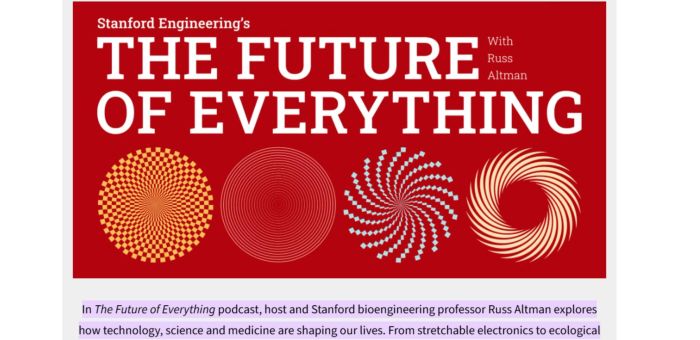
Example: A great illustration of a defined concept is Stanford University’s The Future of Everything podcast, produced by its School of Engineering. The show’s premise is crystal clear – each episode explores how technology, science, and medicine are shaping our lives and future. Hosted by a Stanford bioengineering professor, it follows an interview format where experts discuss innovations in fields from AI to health care. This distinctive theme and structure leverage Stanford’s academic strengths and consistently deliver on what the title promises.
Whatever you choose, aim for consistency in tone and structure. A 20-minute interview series sounds very different from a 10-minute solo voice memo, but either can be powerful if well-executed.
Remember: A podcast is more than a recording; it’s a conversation. Make space for authenticity and spontaneity to shine through.
Step 3: Build a Content Plan and Plan Episodes in Advance
Now that you’ve defined your purpose and format, it’s time to think long-term. One of the biggest mistakes new podcasters make is launching without a content roadmap. Jumping into production without a plan can lead to burnout or disjointed messaging.
Ask yourself:
What themes or topics will we cover across the season?
Which internal experts or guests should we feature?
Are there recurring segments that can anchor each episode?
A solid content calendar will help you avoid scrambling for ideas and ensure your messaging supports broader marketing campaigns (like admissions deadlines, open houses, or graduation season).
Here’s an example of a 6-episode launch plan for a K–12 school podcast:
Welcome from the Head of School
A Day in the Life of a Student
Meet Our Parent Community
Inside the Classroom: A Faculty Roundtable
From Our Alumni: Life After Graduation
How We Support Student Wellbeing
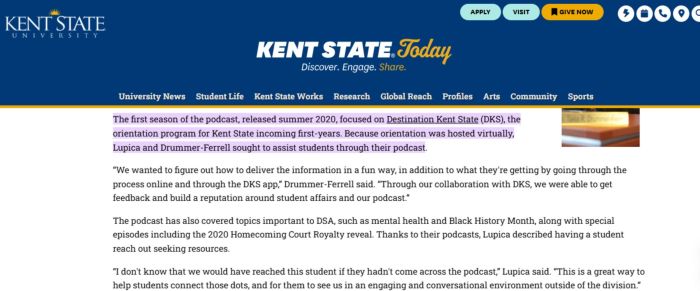
Example: At Kent State University, the Division of Student Affairs took a strategic approach when launching its podcast. They deliberately planned the first season of the podcast to coincide with the university’s virtual orientation program for new students. Because orientation had moved online (due to the pandemic), the podcast team organized a series of episodes addressing topics incoming freshmen needed, essentially turning the podcast into a fun, on-demand extension of orientation. They collaborated with the orientation staff (Destination Kent State) to ensure content was relevant and even gathered feedback from that partnership to improve the show.
Bonus tip: Batch-record your first few episodes in advance so you can launch with momentum and buffer time.
Step 4: Set Up Your Equipment and Software
Worried about needing a full recording studio? Don’t be. Getting started doesn’t require expensive equipment. Here’s a basic setup to launch your podcast with professional quality:
Essentials:
Microphone: A USB mic like the Blue Yeti or Samson Q2U delivers clear, studio-like audio.
Headphones: Avoid audio bleed and ensure consistent sound levels during editing.
Recording Software: Tools like Audacity (free) or Descript (freemium) let you easily record and edit.
Hosting Platform: Services like Buzzsprout, Podbean, or Anchor distribute your podcast to Spotify, Apple Podcasts, and Google Podcasts.
Tip for schools on a budget: Consider using your media or IT lab for recordings. You may already have access to podcast-friendly tools through student programs.
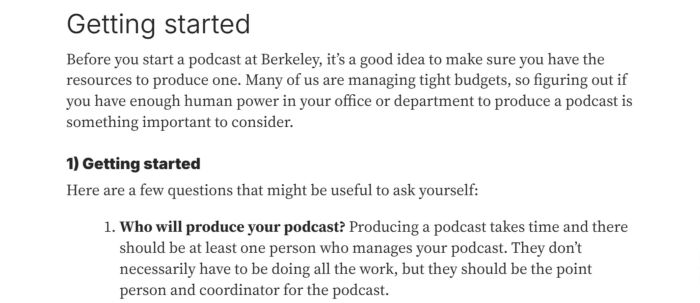
Example: At UC Berkeley, staff in the communications department use a variety of clever do-it-yourself strategies to produce high-quality podcasts on a tight budget, proving that high production value is possible even without a fancy studio or expensive equipment.
Step 5: Record and Edit With Your Audience in Mind
Now it’s time to hit “record.” As you begin, remember that quality matters, not just in audio clarity, but in tone, pacing, and structure.
Keep your episodes:
Concise. Aim for 15 to 30 minutes per episode. That’s long enough to deliver substance, but short enough to fit into a morning commute or lunchtime walk.
Focused. Each episode should revolve around a single topic or theme. If you have more to say, turn it into a two-part series.
Natural. Avoid reading from a script word-for-word. Outline your key points, then speak conversationally.
Editing is where your podcast becomes polished. Using editing software, you can tighten up the conversation, remove umms/uhs, add intro music or segues, and generally polish the recording. Aim to balance the sound levels between speakers and cut any extraneous digressions to keep the episode flowing. The goal is an episode that sounds natural but also stays on topic and within your desired length.
Don’t be discouraged if the first few recordings feel rough. Podcasting has a learning curve for everyone, and you’ll get more comfortable and skilled with each episode. Incorporate feedback from early listeners and continuously improve your technique.
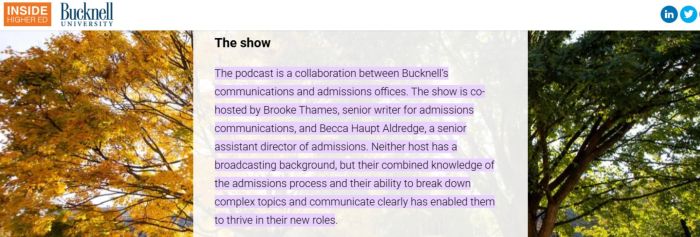
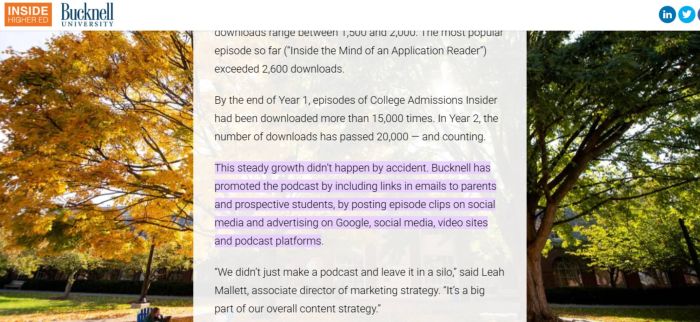
Example: The team behind Bucknell University, which produces the College Admissions Insider podcast, began with two co-hosts from the admissions office and communications staff who had no prior podcasting experience. They weren’t trained radio personalities, but their deep knowledge of the admissions process and ability to communicate enabled them to create engaging episodes from the get-go. In their case, the hosts’ confidence and skill grew quickly as they recorded more sessions. After the first few episodes, they found their rhythm in interviewing guests and editing the content into a polished final product.
Pro tip: If editing feels overwhelming, explore student help or freelance editors. Podcast production is a great opportunity for cross-department collaboration.
Step 6: Publish and Distribute Your Podcast
With a finished episode in hand, it’s time to share it with the world. This step involves uploading your episode to your chosen podcast hosting platform and ensuring it gets distributed to all the major listening apps. The good news: once set up, this process is straightforward.
Start by choosing a podcast hosting service (if you haven’t already). There are many options – from free platforms like Anchor (Spotify for Podcasters) to paid hosts like Libsyn, Podbean, or Buzzsprout. The host is essentially where your audio files live and where your podcast’s RSS feed is generated. When you upload a new episode, your host will update the RSS feed, which in turn notifies podcast directories (like Apple Podcasts) to pull the new content.
Upload your MP3 file to the host and fill in the episode details: title, description, episode number, season (if applicable), etc. Use this metadata to attract listeners – write a clear, engaging description and include relevant keywords (e.g., “STEM education chat with our Science Department” or “Tips for college admissions interviews”). Also, upload your cover art if you haven’t already, as it will display on players.
Next, distribute your podcast. Submit the RSS feed to major platforms such as Apple Podcasts, Spotify, Google Podcasts, and Amazon Music. Many hosts provide one-click distribution or guides to do this. Usually, you only need to do the submission once for each platform; after that, new episodes will appear automatically. Don’t forget any niche or regional platforms popular with your audience. Essentially, you want your school’s podcast to be available wherever listeners might look.
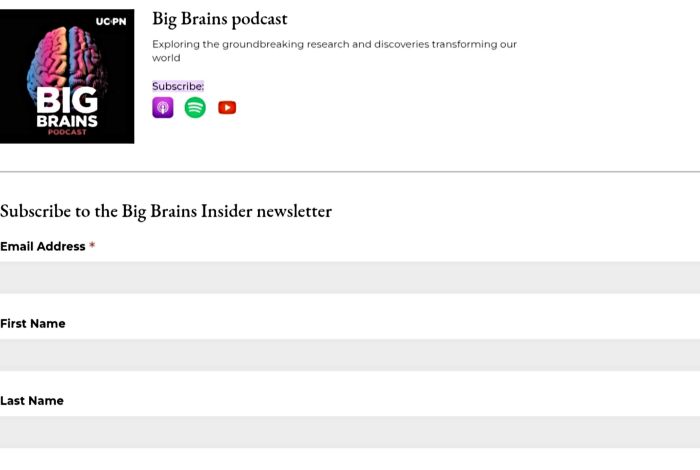
Example: The University of Chicago hosts its award-winning Big Brains podcast on a platform that syndicates it widely – on the official UChicago site, the podcast page prominently offers subscribe buttons for Apple Podcasts, Spotify, and even YouTube. Once UChicago uploaded episodes and submitted their feed, their content became available across all those apps. In practice, this means a parent commuting to work can pull up Apple Podcasts and find the school’s show, while a student on Android might use Spotify to listen – the experience is seamless.
“If you build it, they will come” doesn’t quite apply in podcasting. After creating a podcast for students and other members of your school’s community, you have to actively promote your school podcast so that your community (and beyond) know it exists. Promotion is an ongoing step, not a one-time task.
Here’s how to promote your school podcast effectively:
Website: Create a dedicated podcast page with episode archives and show notes.
Social Media: Share episode clips, quotes, or audiograms on social media platforms like Instagram, Facebook, and LinkedIn.
Email Marketing: Feature new episodes in newsletters or nurture campaigns.
Admissions Materials: Mention your podcast in brochures or application confirmation emails.
Student Portals and Alumni Networks: Make your episodes discoverable for internal and extended communities.
Example: Bucknell didn’t just publish episodes and hope people would find them. The university made the podcast an integral part of its outreach. They promoted it vigorously by including podcast links in emails to prospective students and parents, sharing episode clips on social media, and even running targeted online ads to reach more listeners.
Think beyond downloads: Use the podcast to reinforce messaging in other marketing assets like blog posts, webinars, or virtual tours.
Bonus Tip: Track Performance and Evolve
Like any marketing initiative, measurement is key. Use analytics tools (often provided by your podcast host) to track:
Number of downloads
Listener demographics
Episode drop-off points
Subscription growth
But don’t stop at the numbers. Solicit feedback from listeners. What do they want to hear more of? Which episodes resonated most?
Note: Your podcast will evolve. You might tweak your format, test new topics, or expand your production team. That’s a good thing. Podcasting, like all great content marketing, thrives on iteration.
Partner With HEM to Create an Authentic Podcast That Stands Out
Starting a school podcast isn’t about jumping on a trend. It’s about creating a platform to tell your school’s story in a compelling, authentic way.
Why are podcasts good for school?Podcasts are engaging, cost-effective, and easy to access. They help schools build trust, highlight culture, and communicate more personally with students, parents, and alumni, especially in today’s mobile-first world where audio content fits busy lifestyles.
In today’s crowded education market, families crave meaningful connections. They want to hear directly from your community, not just what you offer, but who you are. A podcast helps you do exactly that.
It’s a platform that humanizes your brand, showcases your values, and builds real relationships with your audience. In short, it allows your community to hear your voice, quite literally.
In a nutshell, the answer to the question “How do I make an academic podcast?” can be summed up in a few crucial steps. Start by defining your goal and audience. Choose a format, plan episodes, and use basic recording equipment or software. Feature faculty or students, keep episodes concise, edit for clarity, and publish on platforms like Spotify or Apple Podcasts. Promote it across your school’s channels.
Ready to bring your school’s story to life through podcasting? Start by defining your audience and recording a pilot episode. With each step, you’ll gain clarity and momentum.
If you’d like support planning your podcast strategy, identifying compelling topics, or aligning the content with your admissions goals, HEM is here to help.
Would you like to learn how to create a podcast for students?
Contact HEM for more information.
Struggling with enrollment?
Our Digital Marketing team can help you generate more leads!
Frequently Asked Questions
Question: What is a podcast in school? Answer: A school podcast is an audio series created by educators, students, or staff to share news, stories, or educational content. It can highlight campus life, feature interviews, or support learning, helping schools connect with their communities in an accessible, on-demand format.
Question: Why are podcasts good for school? Answer: Podcasts are engaging, cost-effective, and easy to access. They help schools build trust, highlight culture, and communicate more personally with students, parents, and alumni, especially in today’s mobile-first world where audio content fits busy lifestyles.
Question: How do I make an academic podcast? Answer: Start by defining your goal and audience. Choose a format, plan episodes, and use basic recording equipment or software. Feature faculty or students, keep episodes concise, edit for clarity, and publish on platforms like Spotify or Apple Podcasts. Promote it across your school’s channels.
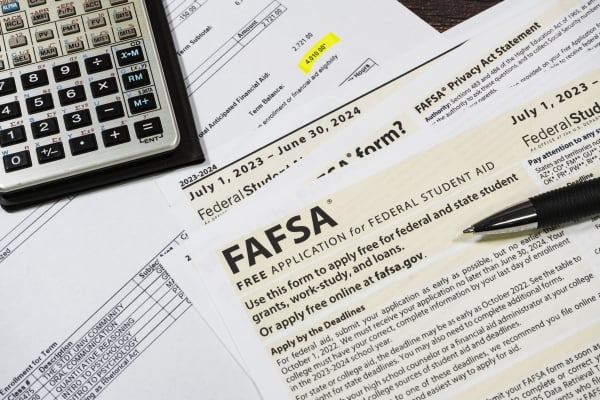
The Education Department said it would aim to launch this year’s FAFSA on Oct. 1, the traditional deadline, for the first time since 2022.
Richard Stephen/iStock/Getty Images Plus
The Department of Education plans to launch this year’s Free Application for Federal Student Aid on Oct. 1, the agency announced Monday.
It would be the first time since 2022 that the form is released by the traditional deadline date, after a major overhaul and technical issues pushed back the 2023–24 launch to January and the 2024–25 launch to late November.
The department will also repeat a new beta-testing period that was piloted last fall. Officials plan to gradually roll out the FAFSA to a limited number of school districts and college-access organizations starting in August and will begin sending test Institutional Student Information Records to colleges at the same time.
They’re also introducing a simplified process for inviting contributors to the form, a step that frustrated many families over the past two years and stymied completion of the new FAFSA. Instead of requiring a unique Contributor ID code, this year students can invite a parent or guardian to contribute to the form by entering their email, and contributors don’t have to be registered on StudentAid.gov beforehand.