As the first in my family to attend college, I felt a profound commitment to excel academically and gain admission to a top university. Growing up amid the hustle and bustle of Silicon Valley, I always envisioned a bright future ahead, with college at the forefront of my goals since elementary school.
At my Title I elementary and middle schools, student-to-teacher ratios were even higher than those listed online. There was a lack of classroom technology and resources like history textbooks. Our two middle school counselors each managed students by the hundreds, making it nearly impossible for them to keep track of individual academic progress and educational goals. Afterward, I attended a private high school, thanks to support from my family. Our caring teachers made the effort to get to know each student, and dedicated counselors advocated for me when it mattered most.
Yet when conversations about college came around, navigating the complex system was difficult. I had to chart my own path to success through independent research, often looking at data that was scattered and inconsistent. It hindered my ability to educate myself on college-going rates, costs, outcomes and employment prospects post-graduation.
Related: Interested in innovations in higher education? Subscribe to our free biweekly higher education newsletter.
Limited resources available at many underserved schools across the nation make it a more challenging environment for students to get support and excel, thus limiting their true academic potential.
In my senior year of high school, after gaining newfound confidence while serving as a commissioner at-large in my county’s youth commission, I decided to try to challenge the status quo in higher education through the power of data and find a way to speak up for other first-generation students who find themselves interacting with systems not designed with their experiences in mind. My mentors at a regional food bank where I volunteered shaped me to lead with confidence and heart.
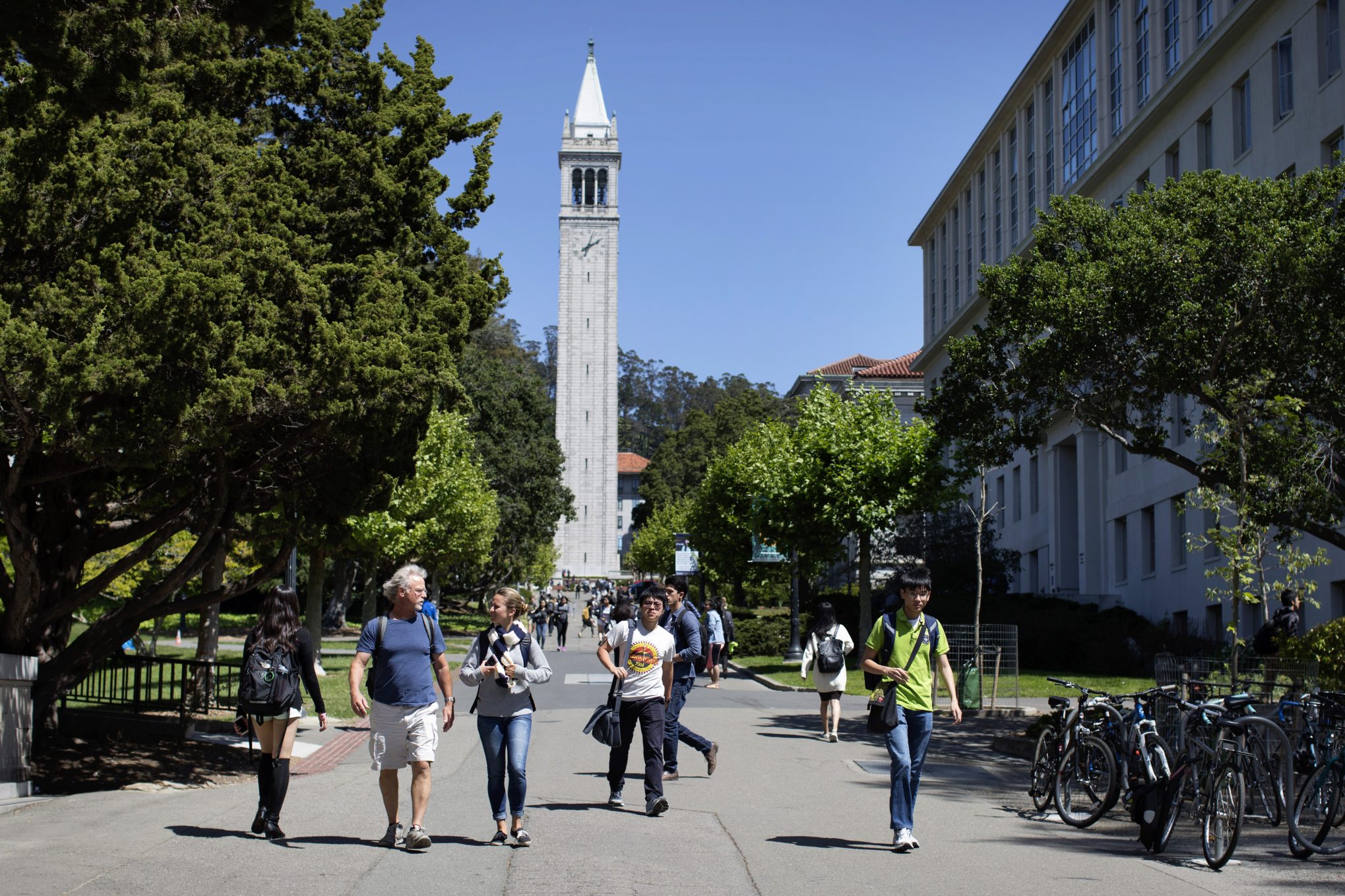
When I received my admission letter from the University of California, Berkeley, I felt deeply honored to earn a place at one of the world’s leading research and teaching institutions.
I am now an advisory board member of the recently formed California Cradle-to-Career Data System, the state’s longitudinal system that connects education and career outcomes data in one central place. I have learned firsthand that the resources available for students to gauge their potential postgraduate earnings often rely on self-submitted data or estimates, rather than on an accurate overview of college and career outcomes.
As part of this work, I am now helping my state’s leaders develop tools like the Student Pathways dashboard, which provides insights on the higher education options available to students after high school.
The tool provides information on a single website for everyone to access at any time. By streamlining access to this data, it allows students and the adults helping them to easily pinpoint which types of degrees or certifications are right for them, which may lead to employment opportunities where they live and which colleges or universities the students’ classmates are headed to.
Students need access that can help them map out their futures — whether they hope to attend college, earn a certificate or enter the workforce directly after high school. Using data in the pathways tool can clarify how others have navigated to and through college and hopefully help students chart their own paths.
As the youngest advisory board member, I have the opportunity to provide proposals and recommendations from a student’s perspective on how the system can engage with communities to make its data more accessible. Community engagement involves ensuring that Californians are aware of the data system, can understand and interpret the available data and have an opportunity to share their feedback.
I often think about how the countless hours I spent trying to find information to help guide my goals and decision-making were both a burden and barrier to attending college. I know firsthand how the power of data can help build a successful future.
Today, many first-generation and low-income college students do not have the opportunity to assess which pathways will yield the most fruit. I’m confident that with accessible facts and data for our decision-making, we can confidently forge the paths that will bring our dreams to life.
Mike Nguyen is a rising junior studying business administration and science, technology, and society at the Haas School of Business at the University of California, Berkeley. This piece was written in collaboration with Alexis Takagi, a basic needs coordinator at Santa Clara University. Both Nguyen and Takagi are advisory board members of the California Cradle-to-Career Data System.
The Hechinger Report provides in-depth, fact-based, unbiased reporting on education that is free to all readers. But that doesn’t mean it’s free to produce. Our work keeps educators and the public informed about pressing issues at schools and on campuses throughout the country. We tell the whole story, even when the details are inconvenient. Help us keep doing that.
Last August, Republican Rep. Gino Bulso looked out at a room filled with dozens of fellow state lawmakers as he touted new legislation he had just helped become a reality in Tennessee. Under the law, a fetal ultrasound or a video of a computer-animated fetus developing in the womb had become mandatory viewing for students in the state’s sex education classes.
Bulso was there at the request of the event’s host, anti-abortion advocacy nonprofit Live Action. The group had gathered legislators from across the country to provide them “with the policy information and persuasion strategies they need to end abortion,” according to its annual report.
Bulso’s panel, “The Agenda for Life in Schools and Beyond,” focused on how he had successfully shepherded his bill into becoming the second so-called fetal development education law in the country.
When lawmakers returned to their home states after the Live Action event, The Hechinger Report found, at least 10 of them sponsored bills similar to Bulso’s, in some cases proposing that students as young as third grade watch fetal development videos. Another legislator who introduced such a bill had sent his chief of staff and wife to the event. And the volume of legislation stemming from the gathering may be higher: Live Action keeps its list of attendees private, though many lawmakers posted about the event on social media or were featured in Live Action’s promotional materials.
Since 2023, when North Dakota became the first state to pass fetal development education legislation, anti-abortion lawmakers in more than 20 additional states have proposed such bills; 6 of those states, including Bulso’s, have passed them. As a result, this fall, nearly 4 million children will attend school in a state that requires them to watch a video or ultrasound of a fetus in the womb during sex education classes. And this year, legislators in four states tried to go even further: Their proposals would have required students to view depictions of abortions, including computer-animated videos.
After the fall of Roe v. Wade in 2022, public schools have become an increasingly important battleground in the fight over abortion rights. Even though 12 states now ban abortion in all circumstances, the number of procedures has increased nationwide since the Supreme Court’s decision to overturn Roe.Public support for abortion rights has also risen. Many anti-abortion advocates hope that getting their message in front of students can help them win the hearts and minds of young people and change these trends in the long run.
While critics, including medical professionals and some parents, say that the fetal development education materials being introduced to schools are manipulative and little more than propaganda, Live Action and other groups that produce them maintain they are medically accurate and unbiased. Experts in sex education and abortion policy say a related problem is the dearth of sex education in schools — students, on average, receive only about six hours during their high school years — that creates a vacuum for anti-abortion groups to move into.
“They’re attempting to reach children at an age where I would assume most haven’t been exposed to issues of an abortion,” says Alisa Von Hagel, a political science professor at University of Wisconsin-Superior who has studied the strategies of the anti-abortion movement. “They’re attempting to be the first to imprint this quote, unquote ‘knowledge’ or opinion about these issues.”
During a debate earlier this year in the Arkansas Senate, Republican Sen. Alan Clark referred to his state’s proposal as “one of the most important pro-life bills that’s ever come before us.” He also said, “It will shape the minds of kids from now on.”
The proposal would have required showing a video created by Live Action to students starting in sixth grade. In the video, titled “Meet Baby Olivia,” a narrator tells the viewer that life begins at conception and says the fetus, named Baby Olivia, begins playing and exploring as early as 11 weeks.
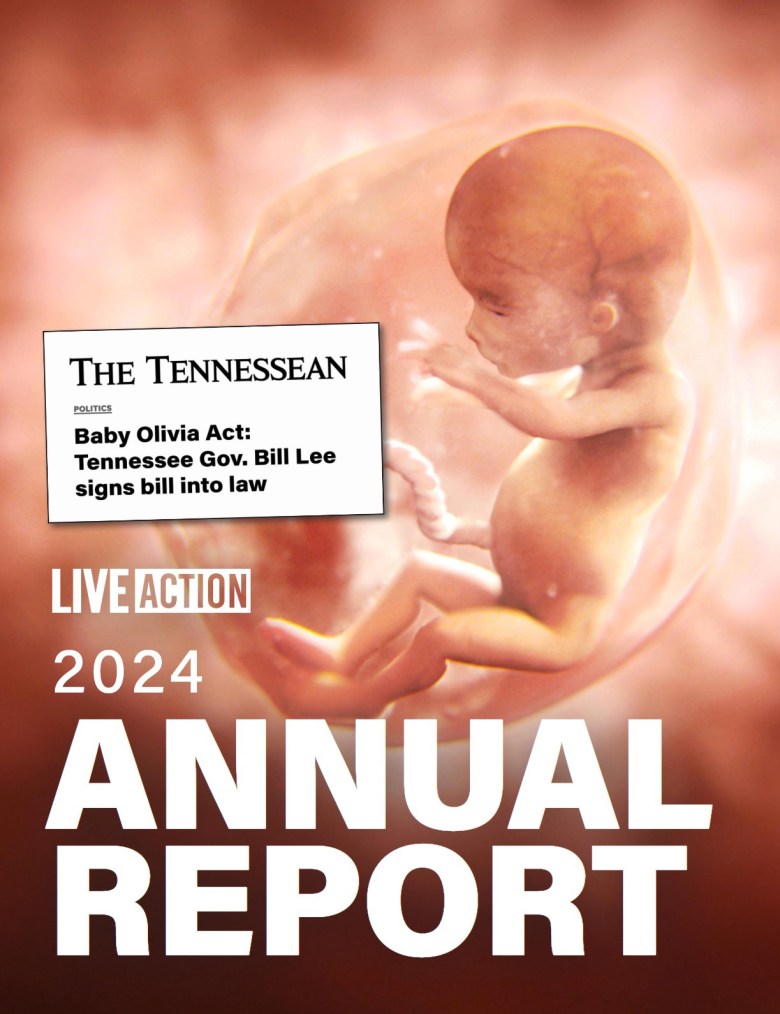
In an annual report, Live Action noted that its “Meet Baby Olivia” video caused a “37-point shift towards the pro-life perspective among viewers.” The organization also highlighted the impact its materials can have on kids, in particular, to help “instill a reverence for life as children at impressionable ages develop their world view.”
Tennessee state Rep. Gino Bulso sponsored the nation’s second fetal development education law. He credits the anti-abortion group Live Action with helping him get it passed. Credit: George Walker IV/AP Images
Both Bulso and Noah Brandt, Live Action’s vice president of communications, have said the only goals of Baby Olivia and fetal development education are to teach and inform students — but they also expected it to leave an impression. “It is intuitive that, after watching that, people would be less likely to support abortion on demand,” Brandt said.
Live Action’s work to connect with students is also part of playbooks for other anti-abortion organizations. Take Heartbeat International, for example, a group that supports clinics known as “crisis pregnancy centers,” which provide limited medical care and encourage people not to have abortions. Heartbeat also offers in-person and online training, including one program on how to “Change the Nation with Pro-life Education,” featuring specific tactics for working with public schools. One speaker at Heartbeat’s 2023 national conference described performing an ultrasound on a pregnant woman in front of public school students to “plant a seed of life.”
Before creating “Meet Baby Olivia,” Live Action was best known for anti-abortion campaigns and undercover stings against Planned Parenthood, and largely worked outside of policymaking. But as the organization has grown in recent years, it has begun to coordinate directly with legislators.
Live Action held its inaugural lawmaker summit in 2022, two months after Roe was overturned. The following spring, North Dakota passed a fetal development education law, the nation’s first.
Many proposed fetal development education bills mention the video “Meet Baby Olivia” by name. Critics say that the video is designed to manipulate the viewer’s emotions, while its creator, Live Action, says it is accurate. Credit: Live Action
By 2024, the summit had doubled in size to host 70 lawmakers at a four-star hotel in Chapel Hill, North Carolina. Lawmakers attended panel discussions titled “Saving Our Children and Helping Their Mothers” and “Communications and Persuasion: Winning the Messaging War.” Live Action also screened its abortion videos, including “Meet Baby Olivia.”
On his panel, Bulso walked through every step of creating Tennessee’s law, from filing the bill to committee deliberations to its eventual passage. He gave Live Action credit for providing him with resources to help make the case that “Meet Baby Olivia” was scientifically accurate.
Most of the proposed fetal development education bills don’t prescribe a specific video, but many suggest the Baby Olivia video. Two bills in Texas do mention alternatives: A 1983 film by PBS’s NOVA called “The Miracle of Life” and a video produced by the St. John Paul II Life Center, a crisis pregnancy center.
Said Brandt, it’s up to “lawmakers, school board members, teachers, that kind of thing, to try to make prudential judgments about, ‘Is the actual resource I’m using a good resource to accomplish the goal that I’ve been tasked to accomplish?’”
“Meet Baby Olivia” in particular, has been sharply criticized by medical experts since Live Action released the video in 2021. Many doctors have raised concerns about its language and portrayal of the timeline of fetal development. Parents and students in Fargo, North Dakota, used arguments such as these to convince the school district to use a different video to meet the state law.
“The Baby Olivia video is designed to manipulate students’ emotions rather than to share objective facts about embryonic and fetal development,” Nisha Verma, senior advisor of reproductive health policy and advocacy for the American College of Obstetricians and Gynecologists, said in a statement. “The video attempts to advance anti-abortion policies such as fetal personhood and uses non-scientific language about conception, pregnancy, embryos, and fetuses to evoke an emotional response.”
Live Action maintains the video is medically accurate — and has its own roster of anti-abortion doctors who endorse it, including a handful who collaborated with the organization on the video’s creation.
The approval of some medical professionals was part of the appeal of “Meet Baby Olivia” and another Live Action video series called “What Is Abortion?” for New Hampshire Rep. John Sellers, another Republican who attended the group’s lawmaker summit. The series shows a computer rendering of three different points in the pregnancy process.
Since 2023, getting fetal development education into public schools has been a priority for the anti-abortion group, Live Action. Credit: Live Action
In January, Sellers filed two bills to make Live Action’s videos required viewing for New Hampshire students — including college students in the case of “Meet Baby Olivia.” Both bills, however, faced opposition: Nearly 700 residents officially recorded their objection with the state or submitted testimony opposing the fetal development bill, and 1,080 registered their opposition to the abortion video legislation. By comparison, the number of residents who registered in favor was 23 and 30, respectively.
Many of those who submitted written testimony called the bill an attempt to indoctrinate students; Sellers maintained the legislation was nonpolitical. “We’re just trying to get the information out to the kids so they’re educated,” he said in an interview. “I don’t know how you indoctrinate somebody with the truth of the development of life … or the truth that these are the types of procedures of abortions. I can’t see that being indoctrination.”
Sellers said further that he hoped education could help people “make a better decision of, ‘Should I get an abortion or not?’”
Several people who opposed Sellers’ bills agreed that the videos contained some factual information and that topics such as fetal development and abortion could be useful to learn about in schools, but it was the presentation of the information — and that it came from an anti-abortion group — that worried them, they explained.
“My biggest concern is that it’s set up to come from a moralistic and fear-based place as opposed to a medical or wellness model,” said Stephanie Vazzano, a therapist who lives in New Hampshire who submitted written testimony opposing the abortion video bill. “They do have some facts. When you watch them you can be really seduced by those facts … but then these other things get slipped in.”
During the hearing for his bills, Sellers repeatedly said he was open to other abortion videos being shown but didn’t know of any. This lack of alternativeshas allowed Live Action to succeed in getting into schools so far, said Mary Ziegler, a law professor at University of California-Davis and author of several books on the history of abortion debates. “Part of what they’ve exposed is that there are gaps in the way we’ve done sex education,” she points out. “There’s truth in the sense that sex education programs across the board, including those favored by progressives, don’t have enough information about pregnancy, childbirth, abortion or fetal development.”
In many ways, Live Action’s efforts — as well as those of Heartbeat International and other organizations working to reach K-12 students — are a response to groups that run comprehensive sex education programs. Five states require comprehensive sex education, and individual districts in other states also provide it. These programs typically cover an array of topics including contraception, gender identity, consent, and options if one becomes pregnant. Planned Parenthood offers such a program to schools and has become the single-largest provider of sex ed nationwide.
“I’m sympathetic if someone says we wouldn’t want any organization that has any point of view creating any materials for our public school system,” Brandt of Live Action said. “But I would just say that’s not the reality that’s happening across the country. It’s tough to find curriculum that is from a group that no one would oppose.”
Even some anti-abortion Republicans have drawn a line at directly promoting the use of Live Action materials in public schools. Among them is Arkansas Sen. Breanne Davis, who led the opposition to a bill that specifically called for “Meet Baby Olivia” to be shown in schools. She raised concerns about requiring content from “a political advocacy group.” Davis said in an interview, “That’s just out of bounds for what we should be putting into law.”
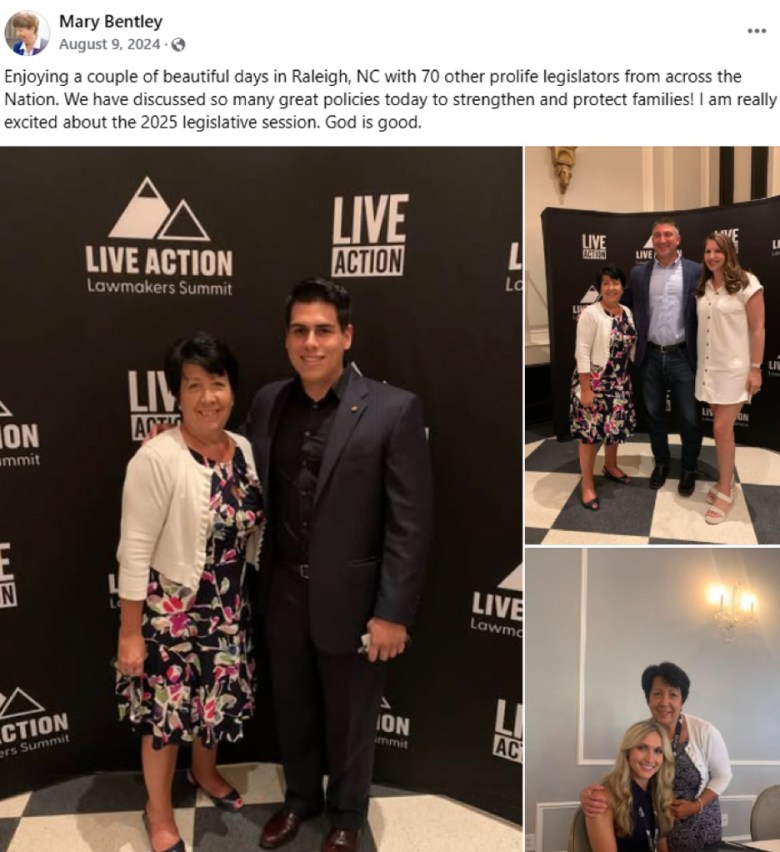
At least 11 state legislators who attended Live Action’s Lawmaker Summit, including Arkansas Rep. Mary Bentley, introduced fetal development legislation during the 2025 legislative session. Credit: Facebook
In hearings, Arkansas representative and bill sponsor Mary Bentley argued it would be easier and better for school districts to be told which video to use rather than have to make that determination themselves. She remains staunchly in support of the Baby Olivia video: “I think it’s so good to help kids understand the process of fetal development,” she said. “I just assumed that it would get the support that we needed in the most pro-life state in the nation.”
Davis proposed a competing bill, one that would require the Arkansas department of education to adopt standards for age-appropriate fetal development education, including showing an ultrasound, in the future. No video would be required, but districts could still show one, such as “Meet Baby Olivia,” if they chose to.
In the end, Bentley’s bill died and Davis’s legislation was signed into law in April.
For Brandt, of Live Action, the law falls short of what he considers the “gold standard” of fetal development education, but “We’re happy that they passed some version of it,” he said. “That is definitely better than nothing, and maybe can even be improved upon in the future.”
Contact investigations editor Sarah Butrymowicz at [email protected] or on Signal: @sbutry.04.
The Hechinger Report provides in-depth, fact-based, unbiased reporting on education that is free to all readers. But that doesn’t mean it’s free to produce. Our work keeps educators and the public informed about pressing issues at schools and on campuses throughout the country. We tell the whole story, even when the details are inconvenient. Help us keep doing that.
In the race to help students recover from pandemic-related learning loss, education leaders have overlooked one of the most powerful tools already at their disposal: experienced teachers.
For decades, a myth has persisted in education policy circles that after their first few years on the job, teachers stop improving. This belief has undercut efforts to retain seasoned educators, with many policymakers and administrators treating veteran teachers as replaceable cogs rather than irreplaceable assets.
But that myth doesn’t hold up. The evidence tells a different story: Teachers don’t hit a plateau after year five. While their growth may slow, it doesn’t stop. In the right environments — with collaborative colleagues, supportive administrators and stable classroom assignments — teachers can keep getting better well into their second decade in the classroom.
This insight couldn’t come at a more critical time. As schools work to accelerate post-pandemic learning recovery, especially for the most vulnerable students, they need all the instructional expertise they can muster.
That means not just recruiting new teachers but keeping their best educators in the classroom and giving them the support they need to thrive.
In a new review of 23 longitudinal studies conducted by the Learning Policy Institute and published by the Thomas B. Fordham Institute, all but one of the studies showed that teachers generally improve significantly during their first five years. The research review also found continued, albeit slower, improvement well into years 6 through 15; several of the studies found improvement into later years of teaching, though at a diminished pace.
These gains translate into measurable benefits for students: higher test scores, fewer disciplinary issues, reduced absenteeism and increased postsecondary attainment. In North Carolina, for example, students with highly experienced English teachers learned more and were substantially less likely to skip school and more likely to enjoy reading. These effects were strongest for students who were most at risk of falling behind.
While experience helps all teachers improve, we’re currently failing to build that experience where it’s needed most. Schools serving large populations of low-income Black and Hispanic students are far more likely to be staffed primarily by early career teachers.
And unfortunately, they’re also more likely to see those teachers leave after just a few years. This churn makes it nearly impossible to build a stable, experienced workforce in high-need schools.
It also robs novice teachers of the veteran mentors who could help them get better faster and robs students of the opportunity to learn from seasoned educators who have refined their craft over time.
To fix this, we need to address both sides of the equation: helping teachers improve and keeping them in the classrooms that need them most.
Research points to several conditions that support continued teacher growth. Beginning teachers are more likely to stay and improve if they have had high-quality preparation and mentoring. Teaching is not a solo sport. Educators who work alongside more experienced peers improve faster, especially in the early years.
Teachers also improve more when they’re able to teach the same grade level or subject year after year. Unfortunately, those in under-resourced schools are more likely to be shuffled around, undermining their ability to build expertise.
Perhaps most importantly, schools that have strong leadership and which foster time for collaboration and a culture of professional trust see greater gains in teacher retention over time.
Teachers who feel supported by their administrators, who collaborate with a team that shares their mission and who aren’t constantly switching subjects or grade levels are far more likely to stay in the profession.
Pay matters too, especially in high-need schools where working conditions are toughest. But incentives alone aren’t enough. Short-term bonuses can attract teachers, but they won’t keep them if the work environment drives them away.
If we’re serious about improving student outcomes, especially in the wake of the pandemic, we have to stop treating teacher retention as an afterthought. That means retooling our policies to reflect what the research now clearly shows: experience matters, and it can be cultivated.
Policymakers should invest in high-quality teacher preparation and mentoring programs, particularly in high-need schools. They should create conditions that promote teacher stability and collaboration, such as protected planning time and consistent teaching assignments.
Principals must be trained not just as managers, but as instructional leaders capable of building strong school cultures. And state and district leaders must consider meaningful financial incentives and other supports to retain experienced teachers in the classrooms that need them most.
With the right support, teachers can keep getting better. In this moment of learning recovery, a key to success is keeping teachers in schools and consciously supporting their growing effectiveness.
Linda Darling-Hammond is founding president and chief knowledge officer at the Learning Policy Institute. Michael J. Petrilli is president of the Thomas B. Fordham Institute, a visiting fellow at the Hoover Institution and an executive editor of Education Next.
The Hechinger Report provides in-depth, fact-based, unbiased reporting on education that is free to all readers. But that doesn’t mean it’s free to produce. Our work keeps educators and the public informed about pressing issues at schools and on campuses throughout the country. We tell the whole story, even when the details are inconvenient. Help us keep doing that.
The Trump administration moved quickly after taking office to open dozens of investigations into schools and universities nationwide. Most of those announced publicly mark a dramatic shift in priorities from previous administrations.
The Education Department and other agencies are looking into allegations of antisemitism and racial discrimination against white students at dozens of colleges. The agency also has begun investigating policies that protect transgender athletes and, in some cases, targeted entire state departments of education as part of that work.
Related: Become a lifelong learner. Subscribe to our free weekly newsletter featuring the most important stories in education.
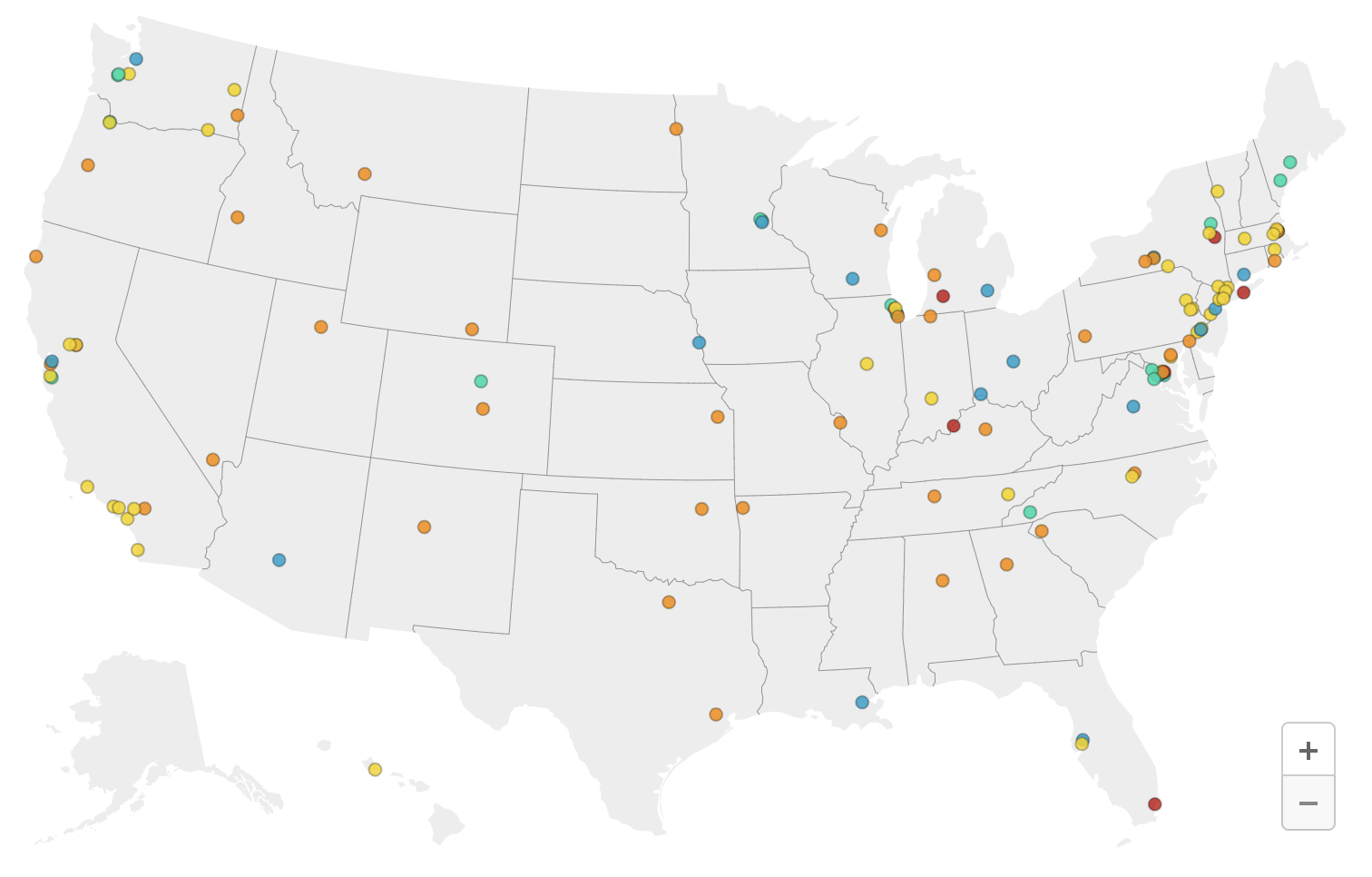
Here’s a look at investigations the Trump administration has announced. This map and list will be updated. Know of an investigation we missed? Tell us: [email protected].
Although the majority of investigations that have been opened are in states considered to be liberal, almost every state in the country has at least one entity under scrutiny. And many institutions face more than one investigation.
To date, colleges and universities have received the most attention from the administration, with more than 60 targeted over alleged incidents of antisemitism and another 45 under scrutiny over their work with a program that aims to increase diversity among Ph.D. candidates. Most of the K-12 investigations involve transgender policies, including those about access to sports and locker rooms.
Contact investigations editor Sarah Butrymowicz at [email protected] or on Signal: @sbutry.04
The Hechinger Report provides in-depth, fact-based, unbiased reporting on education that is free to all readers. But that doesn’t mean it’s free to produce. Our work keeps educators and the public informed about pressing issues at schools and on campuses throughout the country. We tell the whole story, even when the details are inconvenient. Help us keep doing that.
A torrent of controversy has erupted over the Trump administration’s decision to shutter the federal Department of Education. Critics howl that it will destroy public education in America. Supporters insist it will somehow make things better.
The only thing that’s clear is that our public education system is broken. It’s time for politicians to stop using education as a political football, with blue and red teams competing for control rather than sharing the responsibility to prepare our children for their futures.
The resulting chaos and confusion and rigid policies choke the joy out of learning and of working in our schools. Insufficient attention by leaders to education culture can result in fear and distrust, turf wars and a tendency to blame and make excuses for a lack of progress.
Such behaviors produce a toxicity that disables learning and disempowers leadership. Instead of increasing our nation’s economic prosperity, we’re deepening inequality, limiting opportunity and sadly wasting the potential of many children, on whose ability to thrive our country depends.
Poor work conditions, insufficient support, inadequate pay and limited career opportunities are among some of the reasons teachers are leaving and schools are struggling to attract top talent. Reductions in funding from the Great Recession through the present render our facilities dangerous in some instances and unwelcoming in others. Would you buy a house with barbed wire fencing and unkempt grounds that make you wonder whether the aim is to keep something out or in?
What should we do to change what is going on inside our schools?
We must first of all start working together to make our public schools great places to teach and learn.
Great places to work and learn are places that are well led, fueled by purpose and guided by shared, positive behaviors that advance learning goals and serve as “rules of the road” for how employees and students are expected to behave.
In great schools, employees, students and families are respected and valued. Leaders in great schools inspire their employees — all of them — to do more than they think they can. Employees align behind the purpose of enabling learning, which creates momentum and camaraderie for what they are working to attain together.
In great schools, leaders inspire their communities to join them in cheering for and supporting kids’ future successes. Families, no matter their socioeconomic status, feel a sense of belonging.
Problems are perceived as opportunities to get better, not sources of indiscriminate blame. Solutions are found by looking in the mirror first. External threats to learning, such as poverty or parents’ underemployment, are acknowledged and addressed. Schools don’t dodge their responsibility to educate all kids.
In great schools, kids are known by caring employees; they feel seen and heard and are deeply engaged and invested in their learning.
Every employee working in a great school district feels responsible for achieving the district’s mission, no matter whether they work inside or outside of the classroom.
When kids return after being absent, employees welcome them back, tell them they were missed and focus on catching them up. They do not judge the constraints of their families’ lives or mete out punishment as though missing school is a crime.
Great places to learn must also be great places to work. We must reframe our concept of schools as not just places where kids learn. Great places to work care about the needs of all the human beings in their care, including and especially their employees.
“To win in the marketplace, you must first win in the workplace,” Douglas R. Conant, former Campbell Soup Company CEO famously said. He knew what is becoming clearer within our public school systems — that unhappy, unfulfilled employees lead to high turnover, disengagement by students and staff and disaffected families turning to alternative educational offerings.
It is no secret that attracting and retaining top talent to work in our schools is increasingly difficult as employees seek more stability. Attracting younger workers is even more difficult.
Many of those who currently work in schools, especially teachers, are stressed, burned out and dissatisfied. Being stressed and burned out is not a normative experience; it’s a symptom of a weak culture, and an organizational problem to be solved. And employee turnover is no longer limited to teachers. There are increasing vacancies among principals, bus drivers and food service and facilities staff.
The quality of the experiences of employees working in our schools must be higher. Every point along the employee experience continuum, from applying for a job to choosing to leave, is an opportunity to deepen employee engagement and commitment to being a high performer.
We can fix what we have broken. Thinking differently about making our public schools great places to work and learn is a good place to start. No policy changes are required to demonstrate concern for the human beings the system employs and seeks to educate.
Etienne R. LeGrand is a thought leader, writer and culture-shaping strategist and adviser at Vivify Performance.
This story about school culture was produced by The Hechinger Report, a nonprofit, independent news organization focused on inequality and innovation in education. Sign up for Hechinger’s weekly newsletter.
The Hechinger Report provides in-depth, fact-based, unbiased reporting on education that is free to all readers. But that doesn’t mean it’s free to produce. Our work keeps educators and the public informed about pressing issues at schools and on campuses throughout the country. We tell the whole story, even when the details are inconvenient. Help us keep doing that.
A Black History Month event, canceled. A lab working to fight hunger, shuttered. Student visas revoked, then reinstated, uncertain for how long. Opportunities for students pursuing science careers, fading.
The first six months of the Trump administration have brought a hailstorm of changes to the nation’s colleges and universities. While the president’s faceoffs with Harvard and Columbia have generated the most attention, students on campuses throughout the country are noticing the effects of the administration’s cuts to scientific and medical research, clampdown on any efforts promoting diversity equity and inclusion (DEI), newly aggressive policies for students with loan debt, revoking of visas for international students and more.
Many of the administration’s actions are being challenged in court, but they are influencing the way students interact with each other, what support they can get from their institutions — and even whether they feel safe in this nation.
The Hechinger Report traveled to campuses around the country to look at what these changes mean for students. Reporters visited universities in four states — California, Illinois, Louisiana and Texas — to understand this new era for higher education.
Related: Interested in more news about colleges and universities? Subscribe to our free biweekly higher education newsletter.
Louisiana State University
BATON ROUGE, La. — Last fall, Louisiana State University student A’shawna Smith had an idea for a new campus group to educate students about their legal rights and broader problems in the criminal justice system. Smith, a sociology major, had spent the prior summer interning at a law firm and noticed how many clients didn’t know their rights after an arrest.
Smith, now a rising senior, called it The Injustice Reform and soon recruited classmates and a campus adviser. They wrote a mission statement and trained as student group leaders. On Feb. 20, LSU’s student government, which awards money to campus groups that comes from student fees, gave them $1,200; Smith and her classmates planned to use the award to recruit members and organize events.
At Louisiana State University, in Baton Rouge, students say actions taken by the school’s administration in response to the federal crackdown on diversity, equity and inclusion are changing the campus culture and harming the operations of student government. Credit: Tyler Kaufman/AP Photo
But on April 8, Injustice Reform’s treasurer received a text message from Cortney Greavis, LSU’s student government adviser. She said LSU was rescinding the money: The group’s mission statement ran afoul of new federal and state restrictions on DEI. Its mission mentions racial disparities and police brutality, but the organizers were never told which words violated the rules. Smith and fellow leaders started chipping in their own money to keep the group going: $10 here and there, whatever they could afford, said Bella Porché, a rising senior on the group’s executive board.
Canceling awards to student groups is one way students say administrators at LSU, the state’s flagship university, have restricted what they can do and say since the U.S. Department of Education wrote to schools and colleges nationwide on Valentine’s Day. The letter described DEI efforts — designed to rectify current and historic discrimination — as discriminatory and threatened schools with the loss of federal money unless they ended the consideration of race in admissions, financial aid, housing, training and other practices.
Since the letter, discussion of DEI on campus “has become an anti-gay, anti-Black sort of conversation,” said Emma Miller, a rising senior and elected student senator. “People who are minorities don’t feel safe anymore, don’t feel represented, don’t feel seen, because DEI is being wiped away and their university is not saying anything.”
In a March 7 report, the university detailed dozens of changes made to comply with the letter’s demands. For example, it ended any preference granted to students from historically underrepresented groups for certain privately funded scholarships; opened membership in school-funded student organizations — like a women-in-business group — to all; and canceled activities perceived to emphasize race, even a fitness class kicking off Black History Month.
Student government leaders say the restrictions hinder their ability to operate. Rising junior Tyhlar Holliway, a member of the student government’s Black Caucus, said school administrators essentially shut down the caucus’ proposal that the student government issue a statement after the Department of Education letter in support of DEI programs and initiatives.
LSU public relations staff did not respond to interview requests or to an emailed list of questions, and the school’s civil rights and Title IX division director declined to speak.
Miller said administrators have told student leaders that all their proposed legislation must be reviewed by the school’s general counsel for compliance with the March 7 guidelines. The administration, for example, blocked a student government bill to fund a Black hair care event designed to help students prepare for career and professional opportunities, said senior Paris Holman, a student government member. “We have conferences and interviews and need to know how to take care of our hair,” said Holman, who is Black.
Students have also tailored the language of other bills to avoid the appearance of support for DEI. Holman said that in one case the student senate changed the language in a bill funding an end-of-year event for a minority student organization to remove any reference to the organization as serving minority students.
The school also overrode student government decisions about which groups, like A’shawna Smith’s, could be funded by student fees. In February, the student government voted to provide $641 to help a pre-med student, who is Black, attend a student medical education conference, in part so she could share what she’d learn with other pre-med students. A few weeks later, she received an email from Greavis, the student government adviser, saying she wouldn’t be able to attend with university funds because that money could no longer be used for “DEI-related events, initiatives, programs, or travel.” Greavis didn’t respond to requests for an interview.
The email didn’t specify why the medical conference crossed the line. But the sponsoring organization’s mission statement notes its commitment to “supporting current and future underrepresented minority medical students,” and a conference plenary speaker was scheduled to address the “enduring case for DEI in medicine.” Fewer than 6 percent of doctors are Black and research has shown improved health outcomes for Black patients who are seen by physicians of the same race.
“It doesn’t feel like a democracy,” said Holman of serving in student government at this moment.
She and other students say the university’s actions are starting to change the broader culture at LSU, which serves nearly 40,000 undergraduate and graduate students on its campus of Italian Renaissance buildings shaded by magnolias and Southern live oaks. About 60 percent of students are white and 18 percent are Black, according to federal data.
Mila Fair, a rising sophomore journalism major and a reporter for the campus TV station, said students tell her they’re afraid to join protests, in part because of LSU’s new anti-DEI rules and the national crackdown on student demonstrations. Those who do attend are often afraid to go on camera with her, she said.
Professor Andrew Sluyter of Louisiana State University. The university purged hundreds of webpages referencing DEI-related content, including a press release announcing a prestigious fellowship he’d won that mentioned “higher education’s racial inequities.” Credit: Steven Yoder for The Hechinger Report
Latin American studies professor Andrew Sluyter said administrators normally listen to the student government — even more than to the faculty government — but now worry about students getting the school into “political hot water.” He had his own run-in with the DEI ban: As part of a February effort to scrub school websites of diversity references, in which the university purged hundreds of webpages referencing DEI-related content, LSU deleted a 2022 press release announcing a prestigious fellowship he’d won that mentioned “higher education’s racial inequities.”
Students recognize the pressure LSU is under from the federal government, but they want administrators to stand up for them, said graduate student Alicia Cerquone, a student senator. “We want some sort of communication from the university that shows commitment to its community, that they have our backs and they’ll protect students,” she said.
— Steven Yoder
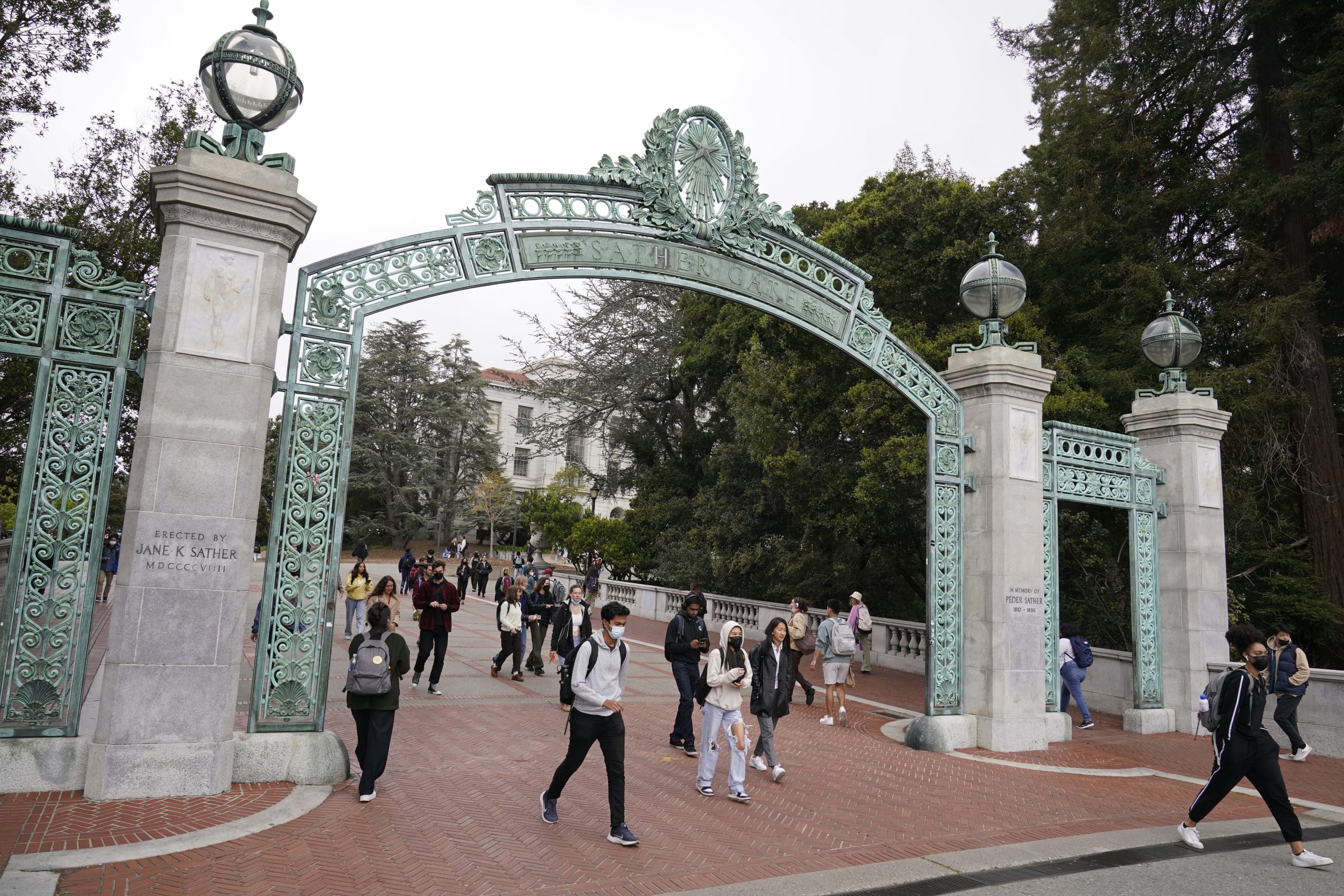
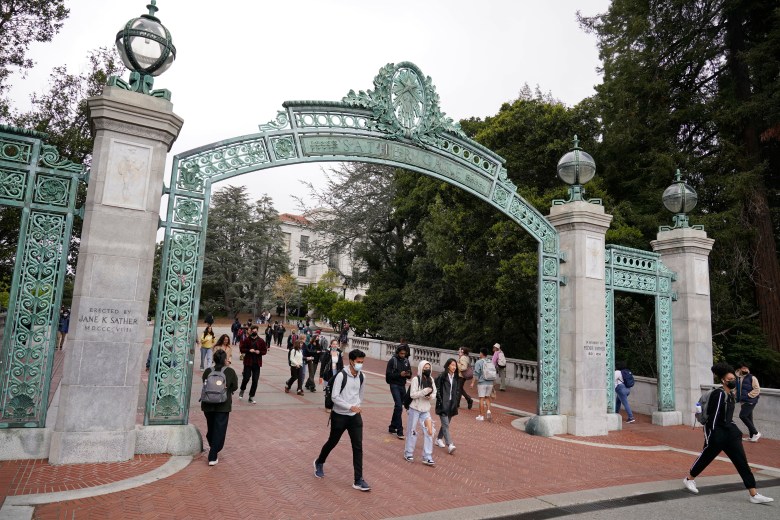
The University of California, Berkeley
BERKELEY, Calif. — Since early April, Rayne Xue, a junior at the University of California, Berkeley, has watched with trepidation as the Trump administration has taken one step after another to limit international students’ access to American higher education.
First came the abrupt cancellation, then reinstatement, of visas for 23 Berkeley students and recent graduates. Then the government cut off Harvard’s ability to enroll international students — a move since blocked by a federal judge — raising fears that something similar could happen at Berkeley. And late last month, as this year’s graduates were celebrating their recent commencements, Secretary of State Marco Rubio paused interviews for all new student visas and announced he would “aggressively revoke” those of Chinese students.
About 16 percent of University of California, Berkeley, students come from outside the United States. Credit: Eric Risberg/AP Photo
Xue, who is from Beijing and won a student senate seat this past spring on a platform of supporting international students, said the administration’s actions strike at a critical part of campus life at Berkeley.
“College is the opportunity of a lifetime to unlearn prejudices and embrace new perspectives, neither of which is possible without a student body that comes from a wide range of geographic and cultural backgrounds,” she said.
About 16 percent of UC Berkeley’s more than 45,000 students come from outside the United States to study at the crown jewel of California’s public research university system, where creeks run through campus beneath cooling redwoods and parking spaces are set aside for Nobel laureates. China, India, South Korea and Canada send the biggest numbers. International students pay higher tuition than California residents, boosting the university’s coffers and subsidizing some of their peers. Many of them conduct cutting-edge research in fields like computer science, engineering and chemistry.
Now the Trump administration’s immigration crackdown, magnified by the yanking of billions in federal research dollars, has international students worried about their future on campus. Many are changing their behavior to avoid scrutiny: Some canceled travel plans and many said they avoid walking near any campus protests in fear of being photographed.
“It’s difficult for international students to feel secure when they cannot anticipate what the administration might charge against them next — or whether they might be unfairly targeted,” said one global studies major who asked not to be identified for fear of attracting retaliation.
Tomba Morreau, a rising junior from the Netherlands studying sociology, said he stopped posting about politics on social media — just in case.
That kind of self-censorship troubles Paul Fine, co-chair of the Berkeley Faculty Association, which represents about a fifth of the university’s tenure-track faculty.
Federal policies are “creating this culture of fear where people start to censor themselves and try to stay under the radar and not show up in their full selves, whether for academic work or activism,” he said.
International students in Fine’s classes told him they wanted to attend a recent protest against federal threats to higher education but were afraid of the consequences, he said. Others told him they were skipping academic conferences outside the United States that they otherwise would have attended.
“Berkeley really prides ourselves on being an intellectual hub that convenes people from all over the world to work on the most important problems,” Fine said. Now that identity is at risk, he said, especially as actual and threatened cuts to grants make it harder for faculty to hire international graduate students and postdocs.
Most poignant, he said, was hearing from demoralized Chinese students who left a repressive government to come to the United States only to see attacks on academic freedom replicated here.
We want to hear from you.
Are you a student, professor, staff or faculty member? Our journalists want to know how the Trump administration is affecting higher education and life on your college campus.
Xue said she hopes the crisis facing universities would draw attention to the challenges international students face, including limited financial aid and the stereotype that all of them are wealthy. With her colleagues in student government, she is lobbying for Berkeley to spend more on the international office, which provides one-on-one advising on visa issues and employment.
For Lily Liu, a Chinese computer scientist, 2025 was shaping up to be a year of milestones. She graduated with a doctorate last month, has a job lined up at a leading artificial intelligence company and is engaged to be married in November.
But the Trump administration’s changing policies toward international scholars have complicated celebrations for Liu, who’s in a federal program that extends her visa for up to a year beyond graduation so she can gain work experience here. She canceled summer travel plans with her family, concerned she might not be let back into the country. And she’s considering moving her wedding to the United States from China, even though many of her relatives wouldn’t be able to attend.
“For international students, every policy affects us a lot,” she said. So Liu is careful. After the publication of her thesis was delayed, she visited Berkeley’s international office to make sure the setback wouldn’t affect her work permit. Her fiancé has a green card, which should theoretically mean his immigration status is more stable. But these days, she said, who knows?
— Felicia Mello
The University of Texas at San Antonio
SAN ANTONIO, Texas — Growing up here, Reina Saldivar had always loved science — all she wanted to watch on TV was “Animal Planet.” Yet until she applied on a whim to a program for aspiring researchers after her first year at the University of Texas at San Antonio, she assumed she would spend her life as a lab technician, running cultures.
The program, Maximizing Access to Research Careers, or MARC, was started by the National Institutes of Health decades ago at colleges around the country to prepare students, especially those from historically underrepresented backgrounds, for livelihoods in the biomedical sciences.
Saldivar got in. And through the program, she spent much of her time on campus in a university lab, helping develop a carrier molecule for a new Lyme disease vaccine. Now Saldivar, who graduated this spring, plans to eventually return to academia for a doctorate.
“What MARC taught me was that my dreams aren’t out of reach,” she said.
Saldivar is among hundreds who’ve participated in the MARC program since its 1980 founding at the University of Texas at San Antonio. She may also be among the last. In April, the university’s MARC program director, Edwin Barea-Rodriguez, opened his email inbox to find a form letter terminating the initiative and advising against recruiting more cohorts.
The letter cited “changes in NIH/HHS [Health and Human Services] priorities.” In recent months, the Trump administration has canceled at least half a dozen programs meant to train scholars and diversify the sciences as part of an effort to root out what the president labels illegal DEI.
In a statement to The Hechinger Report, NIH said that it “is committed to restoring the agency to its tradition of upholding gold-standard, evidence-based science” and is reviewing grants to make sure the agency is “addressing the United States chronic disease epidemic.”
With MARC ending, Barea-Rodriguez is searching for a way to continue supporting current participants until they graduate next academic year. Without access to federal money, however, the young scientists are anxious about their futures — and that of public health in general.
“It took years to be where we are now,” said Barea-Rodriguez, who said he was not speaking on behalf of his university, “and in a hundred days everything was destroyed.”
UTSA’s sprawling campus sits on the northwest edge of San Antonio, far from tourist sites like the Alamo and the River Walk. Forty-four percent of the nearly 31,000 undergraduate students are the first in their families to attend college; more than 61 percent identify as Hispanic or Latino. The university was one of the first nationwide to earn Department of Education recognition as a Hispanic-serving institution, a designation for colleges where at least a quarter of full-time undergraduates are Hispanic.
When Barea-Rodriguez arrived to teach at the school in 1995, many locals considered it a glorified community college, he said. But in the three decades since, the investments NIH made through MARC and other federal programs have helped it become a top-tier research university. That provided students like Saldivar with access to world-class opportunities close to home and fostered talent that propelled the economy in San Antonio and beyond.
The Trump administration has quickly upended much of that infrastructure, not only by terminating career pipeline programs for scholars, but also by pulling more than $8.2 million in National Science Foundation money from UTSA.
One of those canceled grants paid for student researchers and the development of new technologies to improve equity in math education and better serve elementary school kids from underrepresented backgrounds in a city that is about 64 percent Hispanic. Another aimed to provide science, technology, engineering and math programming to bilingual and low-income communities.
UTSA administrators did not respond to requests for comment about how federal funding freezes and cuts are affecting the university. Nationwide, more than 1,600 NSF grants have been axed since January.
In San Antonio, undergraduates said MARC and other now-dead programs helped prepare them for academic and professional careers that might have otherwise been elusive. Speaking in a lab remodeled and furnished with NIH money, where leftover notes and diagrams on glass erase boards showed the research questions students had been noodling, they described how the programs taught them about drafting an abstract, honing public speaking and writing skills, networking, putting together a résumé and applying for summer research positions, travel scholarships and graduate opportunities.
“All of the achievements that I’ve collected have pretty much been, like, a direct result of the program,” said Seth Fremin, a senior biochemistry major who transferred to UTSA from community college and has co-authored five articles in major journals, with more in the pipeline. After graduation, he will start a fully funded doctoral program at the University of Pittsburgh to continue his research on better understanding chemical reactions.
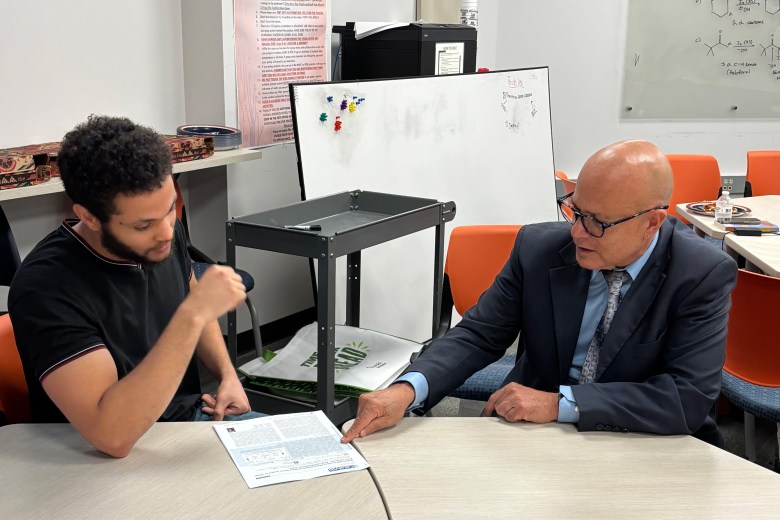
Seth Fremin, a senior biochemistry major at the University of Texas at San Antonio, with Edwin Barea-Rodriguez. Credit: Alexandra Villareal for The Hechinger Report
Similarly, Elizabeth Negron, a rising senior, is spending this summer at the Massachusetts Institute of Technology, researching skin microbiomes to see if certain bacteria predispose some people to cancers.
“It’s weird when you meet students who didn’t get into these programs,” Negron said, referring to MARC. “They haven’t gone to conferences. They haven’t done research. They haven’t been able to mentor students. … It’s very strange to acknowledge what life would have been without it. I don’t know if I could say I’d be as successful as I am now.”
With money for MARC erased, Negron said she will probably need a job once she returns to campus in the fall so she can afford day-to-day expenses. Before, research was her job.
“Without MARC,” she said, “it becomes a question of can I at least cover my tuition and my very basic needs.”
— Alexandra Villarreal
The University of Illinois Urbana-Champaign
CHAMPAIGN, Ill. — When Peter Goldsmith received notice in late January that his Soybean Innovation Lab at the University of Illinois would soon lose all of its funding, he had no idea it was coming. Suddenly Goldsmith, the lab’s director, had to tell his 30 employees they would soon be out of a job and tell research partners across Africa that operations would come to a halt. The lab didn’t even have money to water its soybean fields in Africa.
One employee, Julia Paniago, was in Malawi when she got the news. “We came back the next day,” she said of her team, “and it was a lot of uncertainty. And a lot of people cried.”
The University of Illinois’ Soybean Innovation Lab (SIL) was part of a network of 17 labs at universities across the country, all working on research related to food production and reducing global hunger, and all funded through the U.S. Agency for International Development — until the Trump administration shut down USAID.
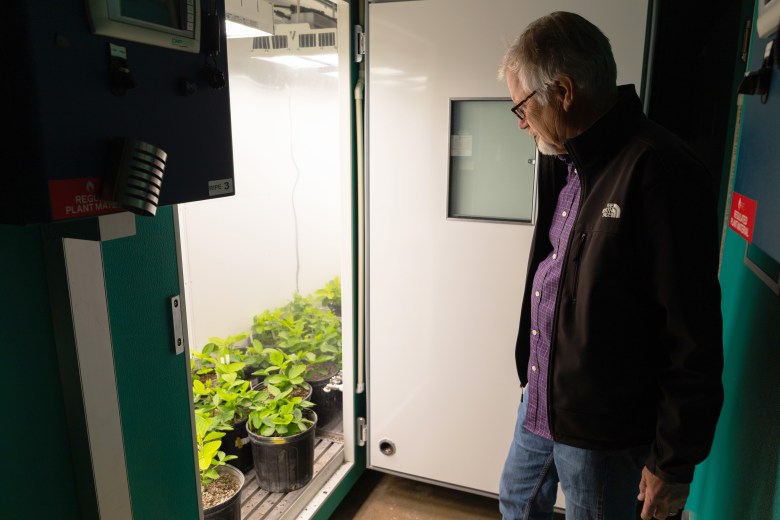
Brian Diers is former deputy director of the University of Illinois’ Soybean Innovation Lab. The lab lost its funding because of cuts to the U.S. Agency for International Development. Credit: Miles MacClure for The Hechinger Report
Soybeans — which provide both oil and high-protein food — aren’t yet commonly grown in Malawi. SIL researchers have been working toward two related goals: helping local farmers increase soybean production and ameliorate malnutrition and generating enough interest in the crop there that a new export market will open for American farmers.
The lab’s researchers work in soybean breeding, economics and mechanical research as well as education. They hope to show that soybean production in Africa is worth further investment so that eventually the private sector will come in after them.
“The people who work at SIL, they like being right at the frontier of change,” Goldsmith said. “It’s high-risk work — that’s what the universities do, that’s what scientific research is about.”
UI, the state’s flagship with a sprawling campus spread between the cities of Urbana and Champaign, is noted for its research work, especially agricultural research.
Labs and researchers across the university lost funding in cuts made by the Trump administration; more than $25 million from agencies including NIH, NSF and the National Endowment for the Humanities was cut, Melissa Edwards, associate vice chancellor for research and innovation, said, a total of 59 grants amounting to 3.6 percent of their overall federal grant portfolio.
Annette Donnelly, who just received her doctorate in education, is among those affected. Her research focuses on educating malnourished children in Africa and developing courses to help Africans learn how to process soybeans into oil.
In April, SIL was handed a lifeline — an anonymous $1 million gift that will keep the lab running through April 2026. The donation wasn’t enough for Goldsmith to rehire all of his employees; SIL’s annual operating budget before the USAID cuts was $3.3 million (and would have kept things running through 2027). But, he said, the money will allow SIL to continue its research in the Lower Shire Valley in Malawi, a project he hopes will attract future donors to fund the lab’s work.
The April donation saved Donnelly’s job, but her priorities shifted. “We’re doing research,” she said, “but we’re also doing a lot of proposal writing. It has taken on a much greater priority.”
Donnelly hopes to attract more funding so she can resume research she had started in western Kenya, demonstrating that introducing soy into children’s diets increased their protein intake by up to 65 percent, she said.
The impact that funding cuts will have on researchers at the soybean lab pales in comparison to the impact on their partners in Africa, Donnelly emphasized. There, she said, the cuts mean processors will likely slow production, limiting their ability to deliver soy products. “The consequences there are much bigger,” she said.
The Soybean Innovation Lab was funded through the Feed the Future initiative, a program to help partner countries develop better agricultural practices that began under the Obama administration in 2010. All 17 Feed the Future innovation labs funded through USAID lost funding, except for the one at Kansas State University, which studies heat-tolerant wheat.
The soybean lab’s office is housed on a quiet edge of the Illinois campus in a building once occupied by the university’s veterinary medicine program. Across the street, rows of greenhouses are home to the Crop Science Department’s experiments.
There, Brian Diers is breeding soybean varieties that resist soybean rust, a disease that’s been an obstacle to ramping up soybean production across sub-Saharan Africa. A professor emeritus who is retired, Diers works part-time at SIL to assist with soybean breeding. The April donation wasn’t enough to cover his work. Now he volunteers his time.
“ If we can help African agriculture take off and become more productive, that’s eventually going to help their economies and then provide more opportunities for American farmers to export to Africa,” he said.
Goldsmith drew an analogy between his lab’s work and the state of American agriculture in the 1930s. As the Dust Bowl swept through the Great Plains, Monsanto or another company could have stepped in to help combat it, but didn’t. Public land-grant universities did.
“That’s where the innovation comes from, from the public land grants in the U.S.,” Goldsmith said. “And now the public land grants still work in U.S. agriculture but also in the developing world.”
Commercial soybean producers hesitate to dip their toes into unproven markets, he said, so it’s SIL’s job to demonstrate that a viable market exists. “That was our secret sauce, in that lots of commercial players liked the products, the technologies we had, and wanted to move into the soybean space, but it wasn’t a profitable market,” Goldsmith said of the African soybean market.
Diers said federal funding cuts imperil not just the development of commerce and global food production but the next generation of scientists as well.
“We could potentially lose a generation of scientists who won’t go into science because there’s no funding right now,” he said.
— Miles MacClure
Contact editor Lawrie Mifflin at [email protected] or 212-678-4078. Contact editor Caroline Preston at 212-870-8965, via Signal at CarolineP.83 or on email at [email protected].
The Hechinger Report provides in-depth, fact-based, unbiased reporting on education that is free to all readers. But that doesn’t mean it’s free to produce. Our work keeps educators and the public informed about pressing issues at schools and on campuses throughout the country. We tell the whole story, even when the details are inconvenient. Help us keep doing that.
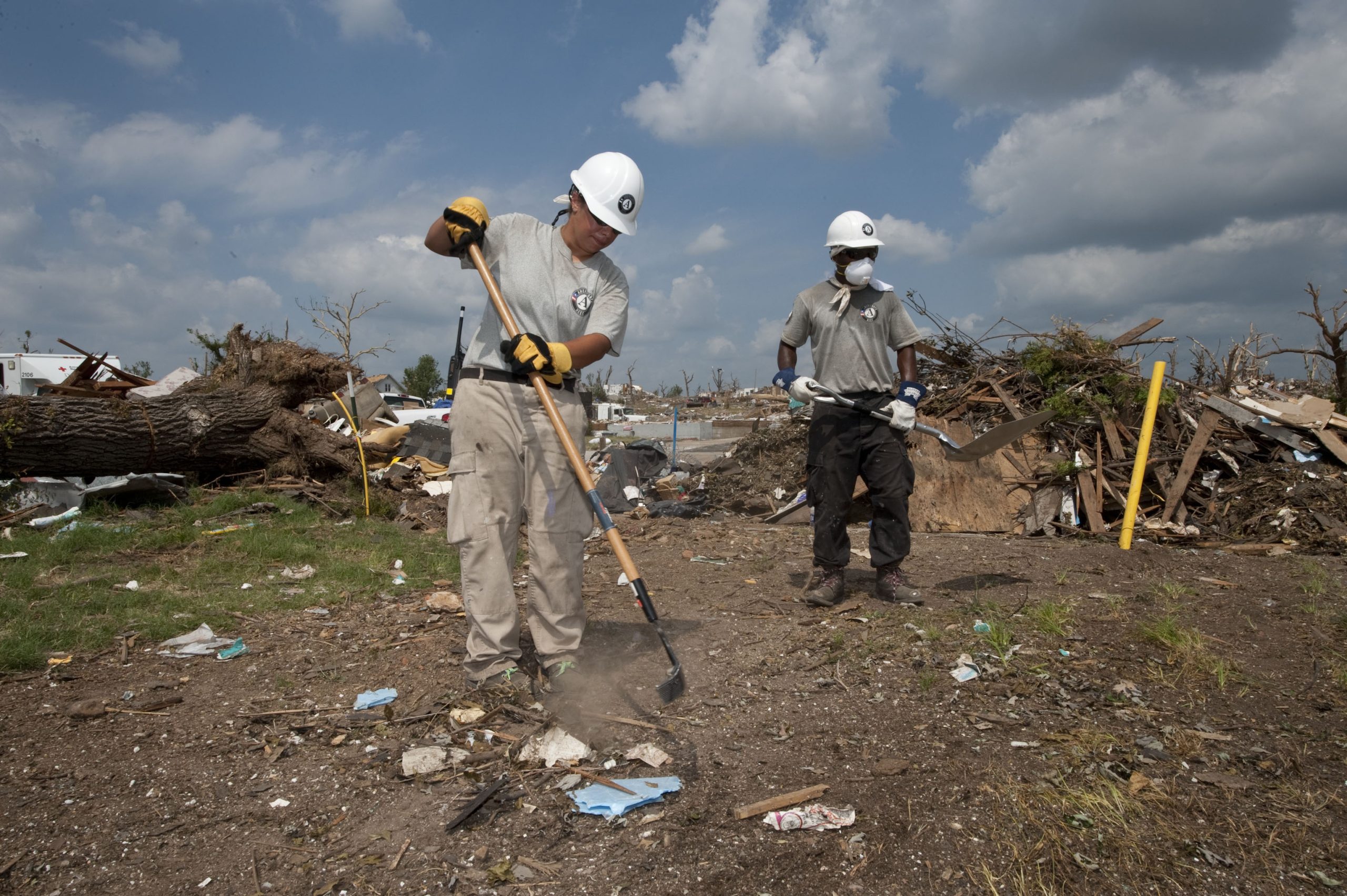
The recent decision to cancel $400 million in AmeriCorps grants is nothing short of a crisis. With over 1,000 programs affected and 32,000 AmeriCorps and Senior Corps members pulled from their posts, this move will leave communities across the country without critical services.
The cuts will dismantle disaster recovery efforts, disrupt educational support for vulnerable students and undermine a powerful workforce development strategy that provides AmeriCorps members with in-demand skills across sectors including education.
AmeriCorps provides a service-to-workforce pipeline that gives young Americans and returning veterans hands-on training in high-demand industries, such as education, public safety, disaster response and health care. Its nominal front-end investment in human capital fosters economic mobility, enabling those who engage in a national service experience to successfully transition to gainful employment.
As leaders of Teach For America and City Year, two organizations that are part of the AmeriCorps national service network and whose members receive education stipends that go toward certification costs, student loans or future education pursuits, we are alarmed by how this crisis threatens the future of the education and workforce pipelines that power our nation’s progress, and it is deeply personal. We both started our careers as corps members in the programs we now lead.
Aneesh began his journey as a Teach For America corps member teaching high school English in Minnesota. Jim’s path began with City Year, serving at a Head Start program in Boston. We know firsthand that AmeriCorps programs are transformative and empower young people to drive meaningful change — for themselves and their communities.
At Teach For America, AmeriCorps grants are essential to recruiting thousands of new teachers every year to effectively lead high-need classrooms across the country. These teachers, who have a consistent and significant positive impact on students’ learning, rely on the AmeriCorps education awards they earn through their two years of service to pay for their own education and professional development, including new teacher certification fees, costs that in some communities exceed $20,000.
Termination of these grants threatens the pipeline of an estimated 2,500 new teachers preparing to enter classrooms over the summer. At a time when rural and urban communities alike are facing critical teacher shortages, cutting AmeriCorps support risks leaving students without the educators they need and deserve.
City Year, similarly, relies on AmeriCorps to recruit more than 2,200 young adults annually to serve as student success coaches in K-12 schools across 21 states, 29 cities and 60 school districts.
These AmeriCorps members serving as City Year student success coaches provide tutoring and mentoring that support students’ academic progress and interpersonal skill development and growth; they partner closely with teachers to boost student achievement, improve attendance and help keep kids on track to graduate. Research shows that schools partnering with City Year are two times more likely to improve their scores on English assessments, and two to three times more likely to improve their scores on math assessments.
Corps members gain critical workforce skills such as leadership, problem-solving and creative thinking, which align directly with the top skills employers seek; the value of their experience has been reaffirmed through third-party research conducted with our alumni. The City Year experience prepares corps members for success in varied careers, with many going into education.
AmeriCorps-funded programs like Breakthrough Collaborative and Jumpstart further strengthen this national service-to-workforce pathway, expanding the number of trained tutors and teacher trainees while also preparing corps members for careers that make a difference in all of our lives.
Those programs’ trained educators ensure all students gain access to excellent educational opportunities that put them on the path to learn, lead and thrive in communities across the country. And the leaders of both organizations, like us, are AmeriCorps alumni, proof of the lasting effect of national service.
Collectively, our four organizations have hundreds of thousands of alumni whose work as AmeriCorps members has impacted millions of children while shaping their own lives’ work, just as it did ours. Our alumni continue to lead classrooms, schools, districts, communities and organizations in neighborhoods across the country.
The termination of AmeriCorps grants is a direct blow to educators, schools and students. And, at a time when Gen Z is seeking work that aligns with their values and desire for impact, AmeriCorps is an essential on-ramp to public service and civic leadership that benefits not just individuals but entire communities and our country at large.
For every dollar invested in AmeriCorps, $17 in economic value is generated, proving that national service is not only efficient but also a powerhouse for economic growth. Rather than draining resources, AmeriCorps drives real, measurable results that benefit individual communities and the national economy.
Moreover, two-thirds of AmeriCorps funding is distributed by governor-appointed state service commissions to community- and faith-based organizations that leverage that funding to meet local needs. By working directly with state and local partners, AmeriCorps provides a more effective solution than top-down government intervention.
On behalf of the more than 6,500 current AmeriCorps members serving with Teach For America and City Year, and the tens of thousands of alumni who have gone on to become educators, civic leaders and changemakers, we call on Congress to protect AmeriCorps and vital national service opportunities.
Investing in AmeriCorps is an investment in America’s future, empowering communities, strengthening families and revitalizing economies. Let’s preserve the fabric of our national service infrastructure and ensure that the next generation of leaders, educators and community advocates who want to serve our nation have the ability to do so.
Aneesh Sohoni is Teach For America’s new CEO. Previously, he was CEO of One Million Degrees and executive director of Teach For America Greater Chicago-Northwest Indiana. He is a proud alum of Teach For America.
Jim Balfanz, a recognized leader and innovator in the field of education and national service, is CEO and a proud alum of City Year.
The Hechinger Report provides in-depth, fact-based, unbiased reporting on education that is free to all readers. But that doesn’t mean it’s free to produce. Our work keeps educators and the public informed about pressing issues at schools and on campuses throughout the country. We tell the whole story, even when the details are inconvenient. Help us keep doing that.
For the last four years, school and public libraries have been drawn into a culture war that seeks to censor, limit and discredit diverse perspectives.
Yet time and time again, as librarians have been encouraged or even directed to remove books that include LGBTQ+, Black, Latino and Indigenous characters or themes or history from their collections, they have said no.
When librarians said no, policy changes were submitted and laws were proposed — all in the name of controlling the library collection.
Some librarians lost their jobs. Some had their lives threatened. Legislators proposed bills that attempt to remove librarians’ legal protections, strive to prevent them from participating in their national professional associations, seek to limit some materials to “adults only” areas in public libraries and threaten the way library work has been done for decades.
Here’s why this is wrong. For generations, libraries have been hubs of information and expertise in their communities. Librarians and library workers aid in workforce development, support seniors, provide resources for veterans, aid literacy efforts, buttress homeschool families —among many other community-enriching services. Your public library, the library in your school and at your college, even those in hospitals and law firms, are centers of knowledge. Restrictions such as book bans impede their efforts to provide information.
Related: Become a lifelong learner. Subscribe to our free weekly newsletter featuring the most important stories in education.
Professional librarians study the First Amendment and understand what it means to protect the right to read. We provide opportunities for feedback from our users so that they have a voice in decision-making. We follow a code of ethics and guidelines to make the best selections for our communities.
It is illegal for a library to purchase pornographic or obscene material; we follow the law established by the Supreme Court (Miller v. California, 1973). That decision has three prongs to determine if material meets the qualifications for obscenity. If the material meets all three, it is considered obscene and does not have First Amendment protection.
But our procedures have been co-opted, abused and flagrantly ignored by a small and vocal minority attempting to control what type of information can be accessed by all citizens. Their argument, that books are not banned if they are available for purchase, is false.
When a book or resource is removed from a collection based on a discriminatory point of view, that is a book ban.
Librarians follow a careful process of criteria to ensure that our personal biases do not intervene in our professional work. Librarians have always been paying attention. In 1939, a group of visionary librarians crafted the Library Bill of Rights to counter “growing intolerance, suppression of free speech and censorship affecting the rights of minorities and individuals.” In 1953, librarians once again came together and created the Freedom to Read Statement, in response to McCarthyism.
You may see a similar censorship trend today — but with the advent of the internet and social media, the speed at which censorship is occurring is unparalleled.
Much of the battle has focused on fears that schoolchildren might discover books depicting families with two dads or two moms, or that high school level books are available at elementary schools. (Spoiler alert: they are not.)
The strategy of this censorship is similar in many localities: One person comes to the podium at a county or school board meeting and reads a passage out of context. The selection of the passage is deliberate — it is meant to sound salacious. Clips of this reading are then shared and re-shared, with comments that are meant to frighten people.
After misinformation has been unleashed, it’s a real challenge to control its spread. Is some subject matter that is taught in schools difficult? Yes, that is why it is taught as a whole, and not in passages out of context, because context is everything in education.
Librarians are trained professionals. Librarians have been entrusted with tax dollars and know how to be excellent stewards of them. They know what meets the criteria for obscenity and what doesn’t. They have a commitment to provide something for everyone in their collections. The old adage “a good library has something in it to offend everyone” is still true.
Thankfully, there are people across the country using their voices to fight back against censorship. The new documentary “Banned Together,” for example, shows the real-world impact of book banning and curriculum censorship in public schools. The film follows three students and their adult allies as they fight to reinstate 97 books pulled from school libraries.
Ultimately, an attempt to control information is an attempt to control people. It’s an attempt to control access, and for one group of people to pass a value judgment on others for simply living their lives.
Libraries focus on the free expression of ideas and access to those ideas. All the people in our communities have a right to read, to learn something new no matter what their age.
Lisa R. Varga is the associate executive director, public policy and advocacy, at the American Library Association.
This story about book bans was produced byThe Hechinger Report, a nonprofit, independent news organization focused on inequality and innovation in education. Sign up for Hechinger’s weekly newsletter.
The Hechinger Report provides in-depth, fact-based, unbiased reporting on education that is free to all readers. But that doesn’t mean it’s free to produce. Our work keeps educators and the public informed about pressing issues at schools and on campuses throughout the country. We tell the whole story, even when the details are inconvenient. Help us keep doing that.
UPDATE: The hearing scheduled for May 9 has been postponed until May 16 at the U.S. District Court for the District of Columbia. The court will hear two similar motions at the same time and consider whether to temporarily restore the cuts to research and data collections and bring back fired federal workers at the Education Department. More details on the underlying cases in the article below.
Some of the biggest names in education research — who often oppose each other in scholarly and policy debates — are now united in their desire to fight the cuts to data and scientific studies at the U.S. Department of Education.
The roster includes both Grover J. “Russ” Whitehurst, the first head of the Institute of Education Sciences (IES) who initiated studies for private school vouchers, and Sean Reardon, a Stanford University sociologist who studies inequity in education. They are just two of the dozens of scholars who have submitted declarations to the courts against the department and Secretary Linda McMahon. They describe how their work has been harmed and argue that the cuts will devastate education research.
Professional organizations representing the scholars are asking the courts to restore terminated research and data and reverse mass firings at the Institute of Education Sciences, the division that collects data on students and schools, awards research grants, highlights effective practices and measures student achievement.
Related: Our free weekly newsletter alerts you to what research says about schools and classrooms.
Three major suits were filed last month in U.S. federal courts, each brought by two different professional organizations. The six groups are the Association for Education Finance and Policy (AEFP), Institute for Higher Education Policy (IHEP), American Educational Research Association (AERA), Society for Research on Educational Effectiveness (SREE), National Academy of Education (NAEd) and the National Council on Measurement in Education (NCME). The American Educational Research Association alone represents 25,000 researchers and there is considerable overlap in membership among the professional associations.
Prominent left-wing and progressive legal organizations spearheaded the suits and are representing the associations. They are Public Citizen, Democracy Forward and the Legal Defense Fund, which was originally founded by the National Association for the Advancement of Colored People (NAACP) but is an independent legal organization. Allison Scharfstein, an attorney for the Legal Defense Fund, said education data is critical to documenting educational disparities and improve education for Black and Hispanic students. “We know that the data is needed for educational equity,” Scharfstein said.
Officers at the research associations described the complex calculations in suing the government, mindful that many of them work at universities that are under attack by the Trump administration and that its members are worried about retaliation.
“A situation like this requires a bit of a leap of faith,” said Elizabeth Tipton, president of the Society for Research on Educational Effectiveness and a statistician at Northwestern University. “We were reminded that we are the Society for Research on Educational Effectiveness, and that this is an existential threat. If the destruction that we see continues, we won’t exist, and our members won’t exist. This kind of research won’t exist. And so the board ultimately decided that the tradeoffs were in our favor, in the sense that whether we won or we lost, that we had to stand up for this.”
The three suits are similar in that they all contend that the Trump administration exceeded its executive authority by eliminating activities Congress requires by law. Private citizens or organizations are generally barred from suing the federal government, which enjoys legal protection known as “sovereign immunity.” But under the Administrative Procedure Act of 1946, private organizations can ask the courts to intervene when executive agencies have acted arbitrarily, capriciously and not in accordance with the law. The suits point out, for example, that the Education Science Reform Act of 2002 specifically requires the Education Department to operate Regional Education Laboratories and conduct longitudinal and special data collections, activities that the Education Department eliminated in February among a mass cancelation of projects.
The suits argue that it is impossible for the Education Department to carry out its congressionally required duties, such as the awarding of grants to study and identify effective teaching practices, after the March firing of almost 90 percent of the IES staff and the suspension of panels to review grant proposals. The research organizations argue that their members and the field of education research will be irreparably harmed.
Of immediate concern are two June deadlines. Beginning June 1, researchers are scheduled to lose remote access to restricted datasets, which can include personally identifiable information about students. The suits contend that loss harms the ability of researchers to finish projects in progress and plan future studies. The researchers say they are also unable to publish or present studies that use this data because there is no one remaining inside the Education Department to review their papers for any inadvertent disclosure of student data.
The second concern is that the termination of more than 1,300 Education Department employees will become final by June 10. Technically, these employees have been on administrative leave since March, and lawyers for the education associations are concerned that it will be impossible to rehire these veteran statisticians and research experts for congressionally required tasks.
The suits describe additional worries. Outside contractors are responsible for storing historical datasets because the Education Department doesn’t have its own data warehouse, and researchers are worried about who will maintain this critical data in the months and years ahead now that the contracts have been canceled. Another concern is that the terminated contracts for research and surveys include clauses that will force researchers to delete data about their subjects. “Years of work have gone into these studies,” said Dan McGrath, an attorney at Democracy Forward, who is involved in one of the three suits. “At some point it won’t be possible to put Humpty Dumpty back together again.”
In all three of the suits, lawyers have asked the courts for a preliminary injunction to reverse the cuts and firings, temporarily restoring the studies and bringing federal employees back to the Education Department to continue their work while the judges take more time to decide whether the Trump administration exceeded its authority. A first hearing on a temporary injunction is scheduled on Friday in federal district court in Washington.*
A lot of people have been waiting for this. In February, when DOGE first started cutting non-ideological studies and data collections at the Education Department, I wondered why Congress wasn’t protesting that its laws were being ignored. And I was wondering where the research community was. It was so hard to get anyone to talk on the record. Now these suits, combined with Harvard University’s resistance to the Trump administration, show that higher education is finally finding its voice and fighting what it sees as existential threats.
The three suits:
Public Citizen suit
Plaintiffs: Association for Education Finance and Policy (AEFP) and the Institute for Higher Education Policy (IHEP)
Attorneys: Public Citizen Litigation Group
Defendants: Secretary of Education Linda McMahon and the U.S. Department of Education
Date filed: April 4
Where: U.S. District Court for the District of Columbia
A concern: Data infrastructure. “We want to do all that we can to protect essential data and research infrastructure,” said Michal Kurlaender, president of AEFP and a professor at University of California, Davis.
Status: Public Citizen filed a request for a temporary injunction on April 17 that was accompanied by declarations from researchers on how they and the field of education have been harmed. The Education Department filed a response on April 30. A hearing is scheduled for May 9.
Democracy Forward suit
Plaintiffs: American Educational Research Association (AERA) and the Society for Research on Educational Effectiveness (SREE)
Attorneys: Democracy Forward
Defendants: U.S. Department of Education, Institute of Education Sciences, Secretary of Education Linda McMahon and Acting Director of the Institute of Education Sciences Matthew Soldner
Date filed: April 14
Where: U.S. District Court for the District of Maryland, Southern Division
A concern: Future research. “IES has been critical to fostering research on what works, and what does not work, and for providing this information to schools so they can best prepare students for their future,” said Ellen Weiss, executive director of SREE. “Our graduate students are stalled in their work and upended in their progress toward a degree. Practitioners and policymakers also suffer great harm as they are left to drive decisions without the benefit of empirical data and high-quality research,” said Felice Levine, executive director of AERA.
Status: A request for a temporary injunction was filed April 29, accompanied by declarations from researchers on how their work is harmed.
Legal Defense Fund suit
Plaintiffs: National Academy of Education (NAEd) and the National Council on Measurement in Education (NCME)
Attorneys: Legal Defense Fund
Defendants: The U.S. Department of Education and Secretary of Education Linda McMahon
Date filed: April 24
Where: U.S. District Court for the District of Columbia
A concern: Data quality. “The law requires not only data access but data quality,” said Andrew Ho, a Harvard University professor of education and former president of the National Council on Measurement in Education. “For 88 years, our organization has upheld standards for valid measurements and the research that depends on these measurements. We do so again today.”
Status: A request for a temporary injunction was filed May 2.*
* Correction: This paragraph was corrected to make clear that lawyers in all three suits have asked the courts to temporarily reverse the research and data cuts and personnel firings. Also, May 9th is a Friday, not a Thursday. We regret the error.
The Hechinger Report provides in-depth, fact-based, unbiased reporting on education that is free to all readers. But that doesn’t mean it’s free to produce. Our work keeps educators and the public informed about pressing issues at schools and on campuses throughout the country. We tell the whole story, even when the details are inconvenient. Help us keep doing that.
After a five-year pause, the Trump administration is bringing back financial penalties for the many millions of borrowers who are too far behind on their student loan payments. It’s led to confusion and financial uncertainty.
At least 5 million people are in default, meaning they have failed to make payments on their loans for at least nine months — and millions more are projected to join them in the coming months.
The Hechinger Report spoke to student loan experts about what to expect and how to prepare, as well as about a separate effort in Congress to adjust how student loans work.
The Biden administration restarted loan repayments in October 2023. That came without any consequences, however, for about a year. But interest, which had also been frozen since the start of the pandemic, has been piling up for some borrowers since the fall of 2023.
All told, about 43 million federal student loan borrowers owe a total of $1.6 trillion in debt. Starting May 5, those in default face having tax refunds withheld and wages garnished if they don’t start making regular payments.
A college degree can be a path to long-term financial security, but the process of repaying loans can lead to financial hardship for many borrowers. About half of all students with a bachelor’s degree graduate with debt, which averages more than $29,000. And although average debt tends to be lower for graduates of public universities (about $20,000), close to half of people who attend those schools still leave with debt.
Related: Interested in more news about colleges and universities? Subscribe to our free biweekly higher education newsletter.
The student loan landscape is likely to change in some way over in the coming months: The Trump administration is expected to push the limits on aggressive collection practices, while Republicans in Congress are determined to adjust repayment options. Here’s what we know about what the Trump administration’s actions mean for student borrowers.
Once you’ve failed to make a loan payment in 270 days, you will probably enter into default. That means, as of May 5, the government can take your federal tax refund and apply it to your debt. Starting in June, the government can also withhold up to 15 percent of any money you receive from Social Security, including disability payments. And later this summer, officials said, they will start the process of taking a cut ofyour paycheck, although borrowers have the right to appeal. Going into default can also harm your credit score, which can make it harder to rent an apartment or borrow money for other reasons, like buying a car.
Can I go back to school to avoid repaying my loans?
Some influencers on social media have recommended enrolling in school as a way to delay making payments. It’s true that most loans are deferred while you’re in school, meaning you wouldn’t have to pay while you’re taking classes, but you may also add to what you already owe if you spend more time in college. Unless you’re confident a new certificate or degree will boost your income, delaying repayment and increasing what you owe could make paying off your loans even more difficult.
I can’t afford to repay my loan. What should I do?
There are other options. One type links your monthly payments to what you earn. These income-based repayment plans can shrink your monthly loan bill. There is also a graduated repayment plan that can lower your payments initially, after which they increase every two years. A third option is an extended repayment plan, which lowers your monthly payments but adds months or years to the time it will take to pay off your loans. The government’s Loan Simulator is one way to find options available to you.
Where can I go if I need help?
The Education Department’s Default Resolution Group can help provide advice for borrowers who are already in default. The Federal Student Aid call center is set up to answer questions. Borrowers can also reach out to their loan servicers for guidance.
What’s the difference between loan deferment, loan forbearance and default?
Loan deferment: The Education Department may grant a loan deferment for several reasons, including when a borrower is experiencing an extreme economic hardship or is unemployed. That means the borrower can temporarily stop paying off the loan without any financial penalties; in the case of subsidized undergraduate loans, interest doesn’t keep accruing during that time.
Forbearance: A loan forbearance also allows a borrower to stop payments, or make smaller ones, without any penalties. However, interest usually keeps building on all loans during that time.
Default: If a borrower is in default, it means they have failed to make payments for at least 270 days without permission. That’s when the government can begin to garnish tax refunds, Social Security benefits and wages, and a borrower’s credit score will drop.
I’ve heard income-driven repayment plans are in trouble. Is that true?
There are several types of income-driven repayment plans, which are meant to keep payments affordable. The Biden administration’s Saving for a Valuable Education (SAVE) plan is on hold because of legal challenges from Republican-led states. That plan previously offered eligible borrowers a repayment plan with lower monthly payments and a quicker path to loan forgiveness than other previously available options. But borrowers can still enroll in the Pay As You Earn (PAYE) plan and other income-based repayment options, in which payments are capped at 10 percent of a borrower’s income, or the Income-Contingent Repayment Plan, which requires payments of up to 20 percent of income and allows full repayment more quickly. Congressional Republicans hope to eliminate several of these plans in favor of just one income-based repayment plan, but it’s unclear if that bill will pass the Senate.
What’s happening with the court cases challenging the SAVE program?
Courts have effectively paused the SAVE plan. The 8 million borrowers who are enrolled don’t have to make payments, and interest will not be added while the court decides the case. With those payments paused, borrowers in this group who are intending to seek loan forgiveness for working in public service are also not making progress toward that goal. If Congress eliminates the SAVE program or the courts officially kill it, those borrowers would need to enroll in a different repayment plan.
Does Public Service Loan Forgiveness (PSLF) still exist?
Yes, the Public Service Loan Forgiveness program is still available. Borrowers should still be eligible if they are in an income-driven repayment plan and make regular payments for 10 years. They must work for the federal, state or local government — teachers and firefighters are eligible, for example — or for qualifying nonprofit organizations, such as some health care clinics or foster care agencies. The goal of PSLF is to encourage graduates to pursue careers that may pay less than jobs with private companies but which benefit their communities or the country as a whole.
The Trump administration issued an executive order in March aimed at limiting which organizations’ jobs could qualify for PSLF — for instance, a nonprofit could be excluded if the government decides it is “supporting terrorism,” engaging in civil disobedience or aiding undocumented immigrants in violation of federal law. So far, it’s unclear what the effect will be.
What other changes might be in store for student loans?
As part of the federal budget process, congressional Republicans have proposed a slew of changes to student loans that some policymakers worry will make borrowing more expensive for students — especially those in graduate programs.
The proposals include changes to:
Subsidized loans: Congressional Republicans want to get rid of subsidized loans for undergraduates, which would mean interest would accrue while a student was in college. They also want to cap total undergraduate borrowing at $50,000.
Grad Plus: They also want to end the Grad Plus program, which allows students to borrow money to cover the cost of graduate school. Student advocates worry that this would push more students into the private student loan market, which has fewer protections for borrowers.
Income-driven repayment: One proposal would simplify income-driven repayment into one option and prevent interest from causing student debt to balloon for students in income-driven repayment plans.
The proposed changes are included in the federal budget bill and may undergo many revisions as Congress figures out its spending priorities for the year.
This story about student loan repayment was produced by The Hechinger Report, a nonprofit, independent news organization focused on inequality and innovation in education. Sign up for the Hechinger newsletter.
The Hechinger Report provides in-depth, fact-based, unbiased reporting on education that is free to all readers. But that doesn’t mean it’s free to produce. Our work keeps educators and the public informed about pressing issues at schools and on campuses throughout the country. We tell the whole story, even when the details are inconvenient. Help us keep doing that.