Tag: lawmakers

  • Lawmakers Confront Columbia President About Old Messages

    Lawmakers Confront Columbia President About Old Messages

    Claire Shipman, acting president of Columbia University, apologized Wednesday for writing messages in 2023 and 2024 that House Republicans say “appear to downplay and even mock the pervasive culture of antisemitism on Columbia’s campus,” Jewish Insider reported

    “The things I said in a moment of frustration and stress were wrong. They do not reflect how I feel,” Shipman wrote in a private email the outlet obtained Wednesday. Shipman said she was addressing “some trusted groups of friends and colleagues, with whom I’ve talked regularly over the last few months.” 

    The apology comes one day after the House Committee on Education and Workforce sent Shipman a letter asking her to explain the intent of internal messages she wrote about antisemitism on the Manhattan campus following the start of Israel’s war in Gaza and the Oct. 7, 2023, Hamas attack. During the time frame in question, Shipman, who became acting president in March, was co-chair of the university’s Board of Trustees. 

    In its letter, the committee, which has subpoenaed numerous documents related to antisemitism at Columbia, cited a message Shipman wrote to now-resigned president Minouche Shafik on Oct. 20, 2023, that said, “People are really frustrated and scared about antisemitism on our campus and they feel somehow betrayed by it. Which is not necessarily a rational feeling but it’s deep and it is quite threatening.” The committee told Shipman her statement was “perplexing, considering the violence and harassment against Jewish and Israeli students already occurring on Columbia’s campus at the time.” 

    The committee, which has already compelled Columbia and numerous other universities to testify about their responses to campus antisemitism, also cited in its letter several messages from Shipman that convey alleged “distrust and dislike” for Shoshana Shendelman, a Jewish member of the university’s board who has been outspoken about perceived inadequacies of Columbia’s antisemitism response. “I just don’t think she should be on the board,” Shipman said in a January 2024 message. In April 2024, Shipman wrote that she was “so, so tired” of Shendelman. 

    In addition to ongoing scrutiny from Republican members of Congress, the Trump administration has attacked Columbia for months, accusing the university of not protecting Jewish students sufficiently and cutting off more than $400 million in federal funds. Although Columbia agreed to the administration’s demands, including overhauling disciplinary processes, Trump hasn’t yet restored the university’s funding. Instead, the Education Department reported Columbia to its accreditor, which has since issued a warning to the university.

    Source link

  • Voters want AI political speech protected – and lawmakers should listen

    Voters want AI political speech protected – and lawmakers should listen

    This essay was originally published in 24sight’s The Vox Populi section on June 24, 2025.


    As artificial intelligence plays a growing role in political discourse, lawmakers across the country have rushed to propose new regulations over fears that misinformation will proliferate with the new technology. But new polling suggests these efforts may not fully reflect public sentiment and serve as a red flag for lawmakers when their state legislatures reconvene in the fall.

    A recent national survey conducted by Morning Consult for the Foundation for Individual Rights and Expression finds that American voters strongly support prioritizing free speech when crafting AI regulations, even amid growing concerns about AI’s impact.

    Sixty percent of voters say AI-generated content poses a greater threat to elections than government regulation of it. Yet when pressed to choose between stopping deceptive content and protecting free speech, voters side with free speech, 47% to 37%. That support cuts across political lines.

    These numbers also tell a complicated story: Americans are uneasy about AI, but they’re more concerned about the government using AI regulation as a tool to silence dissent, just like many Americans feel about the government regulating content on social media. Our most recent survey shows a striking 81% worry that rules governing election-related AI content could be misused to suppress criticism of elected officials. And over half fear that making it a crime to publish altered political content could chill legitimate political commentary.

    These aren’t abstract fears. Across the country, lawmakers have introduced, and even enacted, bills that would target the mere sharing of AI-generated political content, no matter the context or intent. In Texas and Vermont, for example, proposed legislation cast such a wide net that distributing satire, parody, criticism, or even memes would have been banned or otherwise ensnared in regulation. Ordinary citizens, not just political campaigns, would face penalties for posting altered images of politicians online.

    Americans have the right to speak, joke, criticize, and comment freely, regardless of whether they use AI as an expressive tool in doing so. When lawmakers write vague or sweeping rules about what people can say about candidates, they silence the very public discourse that elections foster.

    Indeed, 28% of voters say government regulation of AI-generated or AI-altered content would make them less likely to share content. That’s not just a statistic, it’s a warning sign. Lawmakers risk silencing voters when their voices matter most. And the effect is even greater among young people, who are significantly more likely to engage with and create AI-generated content. When nearly a third of voters, especially the next generation of political voices, are deterred from participating in public discourse, we’re not just regulating technology — we’re shrinking the space for political engagement.

    Not every datapoint in the polling breaks in favor of free speech. Protecting speech commands broad support, yet many voters also favor checks on misinformation. In the same FIRE survey, while 77% of voters think preserving the right to freedom of speech should be the government’s main priority when making laws that govern the use of AI, 74% of voters believe it’s more important to protect people from misinformation than it is to protect free speech.

    Even so, the poll suggests many voters want any effort to curb misinformation to have firm safeguards for open debate. Many bills on the table this year definitely missed that mark.

    Technologies evolve. The principles of the First Amendment do not. In our system of government, the answer to bad speech isn’t censorship. It’s more speech.

    Source link

  • Censoring lawmakers, T-shirts, and seashells

    Censoring lawmakers, T-shirts, and seashells

    We discuss the Supreme Court backing Maine lawmaker Laurel Libby, NPR filing suit against Trump, a years-long dispute over a student wearing a “there are only two genders” shirt, the Secret Service investigation into James Comey, the latest on…

    Source link

  • Texas lawmakers shelve SLAPP bills that would have allowed the rich and powerful to sue critics into silence

    Texas lawmakers shelve SLAPP bills that would have allowed the rich and powerful to sue critics into silence

    Good news for Texans who like their speech free. Three bills that would have gutted speech protections under the Texas Citizens Participation Act are officially dead in the water.

    At the start of the 2025 legislative session, FIRE teamed up with the Protect Free Speech Coalition — a broad coalition of civil liberties groups, news outlets, and other organizations that support free speech in Texas — to fight these bills. 

    The TCPA protects free speech by deterring frivolous lawsuits, or SLAPPs (strategic lawsuits against public participation), intended to silence citizens with the threat of court costs. 

    SLAPPs are censorship disguised as lawsuits. And laws like the TCPA are a vital defense against them.

    The first bill, HB 2988, would have eroded the TCPA by cutting its provision of mandatory attorney fees for speakers who successfully get a SLAPP dismissed. 

    That provision ensures two very important things.

    First, it makes potential SLAPP filers think twice before suing. The prospect of having to pay attorney’s fees for suing over protected speech causes would-be SLAPP filers to back off.

    Second, when a SLAPP is filed, mandatory fees ensure the victim can afford to defend their First Amendment rights. They no longer face the impossible choice between self-censorship and blowing their life savings on legal fees. Instead, they can fight back, knowing that they can recover their legal fees when they successfully defend their constitutionally protected expression against a baseless lawsuit.

    Even though the Constitution — and not one’s finances — guarantees the freedom to speak out about issues affecting their community and government, making TCPA fee-shifting discretionary would have undermined that freedom for all but the most deep-pocketed Texans. 

    FIRE’s own JT Morris testified in opposition to HB 2988 when it received a hearing in the Judiciary & Civil Jurisprudence committee.

    The other two bills — SB 336 and HB 2459 — would have made it easier for SLAPP filers to run up their victim’s legal bills before the case gets dismissed, thereby putting pressure on victims to settle and give up their rights. 

    Since last fall, FIRE has been working with the Protect Free Speech Coalition to oppose these bills. We’ve met with lawmakers, testified in committee, published commentary, and driven grassroots opposition.

    All three bills are now officially dead for the 2025 legislative session, which ends today. That means one of the strongest anti-SLAPP laws in the country remains intact and Texans can continue speaking freely without fear of ruinous litigation.

    Make no mistake: SLAPPs are censorship disguised as lawsuits. And laws like the TCPA are a vital defense against them. That defense still stands. And the First Amendment still protects you and your speech on important public issues — no matter how much money’s in your wallet.

    Source link

  • Lawmakers and judge push back on Education Department’s gutting, citing inefficiency

    Lawmakers and judge push back on Education Department’s gutting, citing inefficiency

    This audio is auto-generated. Please let us know if you have feedback.

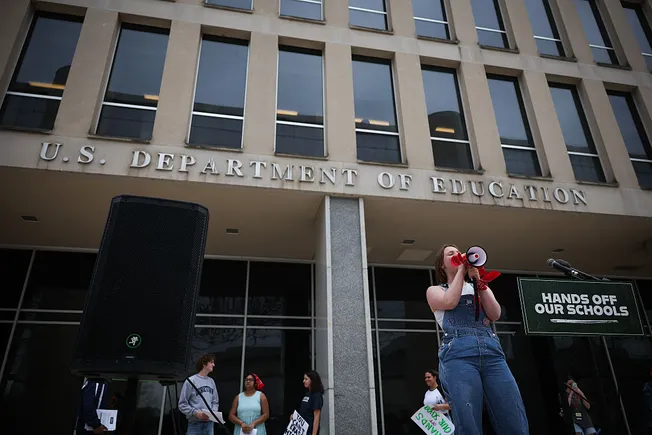
    The Trump administration’s decision to gut federal programs administered by the U.S. Department of Education and lay off half of the agency’s staff in an attempt to increase its efficiency has been met with resistance from lawmakers and, most recently, a federal judge whose court order brought efforts to close the department to an abrupt halt. 

    In an update required by a May 22 court order, the Education Department posted on its website that it has notified its employees of the court-ordered reversal of the reduction in force that left the agency with only about 2,183 out of 4,133 employees. The department on May 27 acknowledged its being compelled by the order in State of New York v. McMahon “to restore the Department to the status quo such that it is able to carry out its statutory functions.” 

    U.S. District Judge Myong Joun, in temporarily reversing the reduction in force, said gutting the department would lead to “irreparable harm that will result from financial uncertainty and delay, impeded access to vital knowledge on which students and educators rely, and loss of essential services for America’s most vulnerable student populations.” 

    “This court cannot be asked to cover its eyes while the Department’s employees are continuously fired and units are transferred out until the Department becomes a shell of itself,” Joun said in his decision.

    The Education Department appealed Joun’s ruling the same day it was issued. The agency did not respond to K-12 Dive’s request for comment. 

    Delays in distributing grant funds

    The decision came on the heels of a May 16 letter sent by Democratic lawmakers to U.S. Education Secretary Linda McMahon. They claimed the Education Department was delayed in distributing grant funding for the 2025-26 school year. The delay gives states and districts less time to allocate funds meant to help students experiencing homelessness and other underserved students the grants are meant to help, they said.

    “States and school districts are best able to plan to most effectively use federal funds with advance knowledge of expected funding, as Congress intends by providing funds on a forward-funded basis,” said Sen. Patty Murray of Washington, Sen. Tammy Baldwin of Wisconsin, and Rep. Rosa DeLauro of Connecticut in the letter. 

    Murray is vice chair of the Senate Committee on Appropriations, of which Baldwin is also a member. DeLauro is ranking member of the House Appropriations Committee. 

    “We believe you need to immediately change course and work in partnership with states and school districts to help them effectively use federal funds,” the lawmakers wrote in their reprimand of the department’s delay.

    By the lawmakers’ count, the department took three times as long under this administration to distribute Title I-A grants than under the Biden administration. Whereas the former administration took two weeks to distribute the funds after the appropriate law was signed in 2024, the current administration took more than 50 days after the enactment of the 2025 appropriations law to distribute Title I-A funds. The program provides $18.4 billion by formula to more than 80% of the nation’s school districts. 

    The department also delayed applications for the Rural Education Achievement Program, which funds more than 6,000 rural school districts. It opened applications to REAP’s Small, Rural Schools Assistance program nearly two months later than the Biden administration, and gave districts half the time to apply — just 30 days compared to 60 in FY 2024.  

    AASA, The School Superintendents Association, said it was aware of this delay. “We understand this release date is significantly later than usual coupled with a shortened application window, so it is important to ensure all eligible districts are aware of this change,” the association said in a May 7 post, prior to the application’s release on May 14. The deadline for program applications is June 13. 

    These delays in funding distribution and last week’s letter from Democrats come as the department bumped funding for charter schools by $60 million this month. 

    Source link

  • Republican lawmakers grill 3 more college presidents over antisemitism concerns

    Republican lawmakers grill 3 more college presidents over antisemitism concerns

    This audio is auto-generated. Please let us know if you have feedback.

    Republicans on the House’s education committee grilled three college presidents Wednesday about how they’ve handled alleged incidents of antisemitism in the wake of the Israel-Hamas war, expanding their probe beyond the Ivy League and other well-known research universities. 

    The leaders came from Haverford College, a small private liberal arts college in Pennsylvania; DePaul University, a private Catholic research university in Chicago; and California Polytechnic State University, San Luis Obispo, a public institution in California. 

    All three institutions have been a hotbed of political activity for over a year. Pro-Palestinian protesters set up encampments at both Haverford and DePaul last year. Cal Poly also saw demonstrations, including a pro-Palestinian protest held around the one-year anniversary of the Oct. 7, 2023, Hamas attack on Israel. 

    Republicans on the House Committee on Education and Workforce said they sought to crack down on campus antisemitism and uphold Title VI of the Civil Rights Act, which prohibits discrimination based on race, color and national origin in federally funded programs. 

    However, some Democrats accused the panel’s GOP members of using antisemitism concerns to quell free speech. They also blasted the Trump administration for detaining international students involved in pro-Palestinian demonstrations and for its heavy cuts to the U.S. Department of Education’s Office for Civil Rights, which investigates antisemitism and other discrimination allegations at colleges and schools. 

    Wednesday’s hearing was the first the House education committee has held on campus antisemitism since President Donald Trump retook office. Since then, his administration has frozen funding at several high-profile institutions that have been probed by the committee, claiming the colleges haven’t done enough to protect students from antisemitism. 

    “The Trump administration has taken a sledgehammer to due process rights of institutions,” said Virginia Rep. Bobby Scott, the top Democrat on the committee. “The public has seen a barrage of reports of this administration taking action without any investigation, such as taking away federal funding.” 

    Haverford’s federal funding threatened

    Haverford President Wendy Raymond and DePaul President Robert Manuel struck a conciliatory tone in their opening remarks, and all three leaders outlined steps they have recently taken to protect Jewish students from discrimination, including setting up an antisemitism task force and tightening protest rules.

    “I recognize that we haven’t always succeeded in living up to our ideals,” Raymond said. “I remain committed to addressing antisemitism and all issues that harm our community members. I am committed to getting this right.”

    Last year, a group of Haverford students sued the college over allegations it had denied Jewish students the ability to participate in classes and educational activities “without fear of harassment if they express beliefs about Israel that are anything less than eliminationist.” 

    The lawsuit contains accounts of several incidents and comments it says are antisemitic, including one professor sharing a social media post on Oct. 11, 2023. The post included an image the lawsuit described as Hamas breaking through the border between Gaza and Israel and stating, “We should never have to apologize for celebrating these scenes of an imprisoned people breaking free from their chains.” 

    A federal judge dismissed the case in January but allowed plaintiffs to file an amended lawsuit, which they did that month.  

    Rep. Elise Stefanik, a Republican from New York, asked Raymond whether the professor who shared the post had faced disciplinary action, but the Haverford president declined throughout the hearing to talk about individual cases or share specific figures on disciplinary actions. The professor, Tarik Aougab, is listed on Haverford’s website as a faculty member.

    “Many people have sat in this position who are no longer in the positions as president of universities for their failure to answer straightforward questions,” Stefanik replied. 

    Source link

  • Texas Bill Would Limit Uncertified Teachers in Schools – The 74

    Texas Bill Would Limit Uncertified Teachers in Schools – The 74


    Get stories like this delivered straight to your inbox. Sign up for The 74 Newsletter

    Lawmakers want to turn the tide on the growing number of unprepared and uncertified teachers by restricting who can lead Texas classrooms. But school leaders worry those limits will leave them with fewer options to refill their teacher ranks.

    Tucked inside the Texas House’s $7.6 billion school finance package is a provision that would ban uncertified teachers from instructing core classes in public schools. House Bill 2 gives districts until fall 2026 to certify their K-5 math and reading teachers and until fall 2027 to certify teachers in other academic classes.

    Texas would help uncertified teachers pay for the cost of getting credentialed. Under HB 2, those who participate in an in-school training and mentoring program would receive a one-time $10,000 payment and those who go through a traditional university or alternative certification program would get $3,000. Special education and emergent bilingual teachers would get their certification fees waived. Educator training experts say it could be the biggest financial investment Texas made in teacher preparation. Rep. Brad Buckley, the Salado Republican who authored the bill, has signaled the House Public Education Committee will vote on HB 2 on Tuesday.

    District leaders, once reluctant to hire uncertified teachers, now rely on them often to respond to the state’s growing teacher shortage. And while they agree with the spirit of the legislation, some worry the bill would ask too much too soon of districts and doesn’t offer a meaningful solution to replace uncertified teachers who leave the profession.

    “What’s going to happen when we’re no longer able to hire uncertified teachers? Class sizes have to go up, programs have to disappear…. We won’t have a choice,” said David Vroonland, the former superintendent of the Mesquite school district near Dallas and the Frenship school district near Lubbock. “There will be negative consequences if we don’t put in place serious recruitment efforts.”

    A floodgate of uncertified teachers

    Nowadays, superintendents often go to job fairs to recruit teachers and come out empty-handed. There are not as many Texans who want to be teachers as there used to be.

    The salary in Texas is about $9,000 less than the national average, so people choose better-paying careers. Teachers say they are overworked, sometimes navigating unwieldy class sizes and using weekends to catch up on grading.

    Heath Morrison started to see the pool of teacher applicants shrink years ago when he was at the helm of Montgomery ISD. Many teachers left the job during the COVID-19 pandemic, which accelerated the problem.

    “This teacher shortage is getting more and more pronounced,” said Morrison, who is now the CEO of Teachers of Tomorrow, a popular alternative teacher certification program. “The reality of most school districts across the country is you’re not making a whole lot more money 10 years into your job than you were when you first entered … And so that becomes a deterrent.”

    As the pool of certified teachers shrunk, districts found a stopgap solution: bringing on uncertified teachers. Uncertified teachers accounted for roughly 38% of newly hired instructors last year, with many concentrated in rural districts.

    The Texas Legislature facilitated the flood of uncertified teachers. A 2015 law lets public schools get exemptions from requirements like teacher certification, school start dates and class sizes — the same exemptions allowed for open enrollment charter schools.

    Usually, to teach in Texas classrooms, candidates must obtain a certification by earning a bachelor’s degree from an accredited college or university, completing an educator preparation program and passing teacher certification exams.

    Teacher preparation experts say certifications give teachers the tools to lead a high quality classroom. To pass certification tests, teaching candidates learn how to plan for lessons and manage discipline in a classroom.

    But the 2015 law allowed districts to hire uncertified teachers by presenting a so-called “district of innovation plan” to show they were struggling to meet credential requirements because of a teacher shortage. By 2018, more than 600 rural and urban districts had gotten teacher certification exemptions.

    “Now, what we’ve seen is everyone can demonstrate a shortage,” said Jacob Kirksey, a researcher at Texas Tech University. “Almost every district in Texas is a district of innovation. That is what has allowed for the influx of uncertified teachers. Everybody is getting that waiver for certification requirements.”

    This session, House lawmakers are steadfast on undoing the loophole they created after new research from Kirksey sounded the alarm on the impacts of unprepared teachers on student learning. Students with new uncertified teachers lost about four months of learning in reading and three months in math, his analysis found. They missed class more than students with certified teachers, a signal of disengagement.

    Uncertified teachers are also less likely to stick with the job long-term, disrupting school stability.

    “The state should act urgently on how to address the number of uncertified teachers in classrooms,” said Kate Greer, a policy director at Commit Partnership. The bill “rights a wrong that we’ve had in the state for a long time.”

    The price of getting certified

    Rep. Jeff Leach, a Plano Republican who sits on the House Public Education Committee, said his wife has worked as an uncertified art teacher at Allen ISD. She started a program to get certified this winter and had to pay $5,000 out of pocket.

    That cost may be “not only a hurdle but an impediment for someone who wants to teach and is called and equipped to teach,” Leach said earlier this month during a committee hearing on HB 2.

    House lawmakers are proposing to lower the financial barriers that keep Texans who want to become teachers from getting certified.

    “Quality preparation takes longer, is harder and it’s more expensive. In the past, we’ve given [uncertified candidates] an opportunity just to walk into the classroom,” said Jean Streepey, the chair of the State Board for Educator Certification. “How do we help teachers at the beginning of their journey to choose something that’s longer, harder and more expensive?”

    Streepey sat on the teacher vacancy task force that Gov. Greg Abbott established in 2022 to recommend fixes to retention and recruitment challenges at Texas schools. The task force’s recommendations, such as prioritizing raises and improving training, have fingerprints all over the Texas House’s school finance package.

    Under HB 2, districts would see money flow in when they put uncertified teachers on the path to certification. And those financial rewards would be higher depending on the quality of the certification program.

    Schools with instructors who complete yearlong teacher residencies — which include classroom training and are widely seen as the gold standard for preparing teacher candidates — would receive bigger financial rewards than those with teachers who finish traditional university or alternative certification programs.

    Even with the financial help, lawmakers are making a tall order. In two years, the more than 35,000 uncertified teachers in the state would have to get their credential or be replaced with new, certified teachers.

    “The shortages have grown to be so great that I think none of us have a really firm handle on the measures that it’s going to take to turn things around.” said Michael Marder, the executive director of UTeach, a UT-Austin teacher preparatory program. “There is financial support in HB 2 to try to move us back towards the previous situation. However, I just don’t know whether the amounts that are laid out there are sufficient.”

    Restrictions like “handcuffs”

    Only one in five uncertified teachers from 2017 to 2020 went on to get a credential within their first three years of teaching. Texas can expect a jump in uncertified teachers going through teacher preparatory programs because of the financial resources and pressure on schools through HB 2, Marder said.

    But for every teacher who does not get credentialed, school leaders will have to go out and find new teachers. And they will have to look from a smaller pool.

    The restrictions on uncertified teachers “handcuffs us,”said Gilbert Trevino, the superintendent at Floydada Collegiate ISD, which sits in a rural farming town in West Texas. In recent years, recruiters with his district have gone out to job fairs and hired uncertified teachers with a college degree and field experience in the subjects they want to teach in.

    Rural schools across the state have acutely experienced the challenges of the teacher shortage — and have leaned on uncertified teachers more heavily than their urban peers.

    “We have to recruit locally and grow our own or hire people who have connections or roots in the community,” Trevino said. “If we hire a teacher straight out of Texas Tech University, we may have them for a year. … And then they may get on at Lubbock ISD or Plainview ISD, where there’s more of a social life.”

    Floydada Collegiate ISD recruits local high school students who are working toward their associate’s degree through what is known as a Grown Your Own Teacher program. But Trevino says HB 2 does not give him the time to use this program to replace uncertified teachers. From recruitment to graduation, it takes at least three years before students can lead a classroom on their own, he said.

    School leaders fear if they can’t fill all their vacancies, they’ll be pushed to increase class sizes or ask their teachers to prepare lessons for multiple subjects.

    “Our smaller districts are already doing that, where teachers have multiple preps,” Trevino said. “Things are already hard on our teachers. So if you add more to their plate, how likely are they to remain in the profession or remain in this district?”

    At Wylie ISD in Taylor County, it’s been difficult to find teachers to keep up with student growth. Uncertified teachers in recent years have made up a large number of teacher applicants, according to Cameron Wiley, a school board trustee.

    Wiley said restrictions on uncertified teachers is a “good end goal” but would compound the district’s struggles.

    “It limits the pot of people that’s already small to a smaller pot. That’s just going to make it more difficult to recruit,” Wiley said. “And if we have a hard time finding people to come in, or we’re not allowed to hire certain people to take some of that pressure off, those class sizes are just going to get bigger.”

    Learning suffers when class sizes get too big because students are not able to get the attention they need.

    “This bill, it’s just another obstacle that we as districts are having to maneuver around and hurl over,” Wiley said. “We’re not addressing the root cause [recruitment]. We’re just putting a Band-Aid on it right now.”

    This article originally appeared in The Texas Tribune at https://www.texastribune.org/2025/03/15/texas-school-funding-uncertified-teachers-shortage/.

    The Texas Tribune is a member-supported, nonpartisan newsroom informing and engaging Texans on state politics and policy. Learn more at texastribune.org.


    Get stories like these delivered straight to your inbox. Sign up for The 74 Newsletter

    Source link

  • Kentucky lawmakers vote to ban DEI spending at public colleges

    Kentucky lawmakers vote to ban DEI spending at public colleges

    This audio is auto-generated. Please let us know if you have feedback.

    Dive Brief:

    • Kentucky lawmakers passed a bill Thursday that would prohibit public colleges from using any funds for diversity, equity and inclusion efforts, sending the bill to the governor’s desk. 
    • The state Senate passed the bill in a 32-6 vote Wednesday night, largely along party lines. House lawmakers gave the bill their final approval Thursday morning, according to local media. If signed into law, public colleges would have until the end of June to eliminate all DEI positions and offices.
    • Democrat Gov. Andy Beshear, who has previously opposed efforts to limit DEI at public colleges, said Thursday that he intends to closely review the bill but appeared skeptical. “We certainly don’t want to impact the flexibility of our universities” to recruit and retain diverse student bodies, he said. However, Republican lawmakers have a veto-proof legislative supermajority.

    Dive Insight:

    In addition to the ban on DEI spending, the bill seeks to limit the classes that colleges could require students to take. It would prohibit courses designed primarily “to indoctrinate participants with a discriminatory concept” and bar the Council on Postsecondary Education, Kentucky’s higher education coordinating board, from approving degree programs that require students to take such classes.

    The bill defines discriminatory concepts as those justifying or promoting “differential treatment or benefits conferred to individuals on the basis of religion, race, sex, color, or national origin.”

    The bill would also prohibit colleges from using diversity statements — descriptions of one’s experiences with and commitment to diverse student populations. And it would bar colleges from requiring employees or students to undergo diversity training.

    The legislation would exempt DEI training and programs required by federal and state law.

    Additionally, the bill requires state colleges to undergo audits every four years to prove they did not spend funds on DEI.

    State Sen. Stephen West, a Republican, said Wednesday that the legislation had been “fully vetted” and that every college that would be affected by the bill had the opportunity to submit input.

    In support of the bill, West, the chair of the Senate education committee, cited the U.S. Supreme Court’s 2023 decision banning race-conscious admissions practices.

    While the court’s ruling exclusively addressed admissions, West applied it to higher education more broadly — an interpretation also adopted by the U.S. Department of Education, and one that is becoming increasingly popular among conservative critics of DEI.

    Similarly, West raised a common criticism of college DEI — alleging that it holds White students responsible for a past in which they did not play a role. 

    He cited his youngest son during Wednesday’s hearing. “He’s responsible for himself and should not be made to feel less than, and this applies to every student, no matter what your race, creed, national origin, sex,” West said.

    Democratic State Sen. Keturah Herron pushed back against West’s argument.

    “I know that you said that you are not responsible for the sins of the past, and you’re not,” Herron told West on Wednesday. “You’re not responsible for the things that have happened to my mother or my life experiences either. However, you are responsible, and we are responsible — this whole body is responsible — for what we do today moving forward.”

    Student and faculty groups have also opposed the bill, saying it would eliminate grants and programs that are crucial to the success of students from underrepresented backgrounds.

    But even with Beshear’s anticipated veto, some Kentucky college leaders have been operating under the assumption that HB 4 — or a bill like it — would become law this year.

    The University of Kentucky dissolved its DEI center in August, with Northern Kentucky University doing the same shortly thereafter.

    At the time, Eli Capilouto, president of the University of Kentucky, said lawmakers signaled their intent to restrict diversity efforts, forcing his institution to prepare.

    “Kentucky legislators have made clear to me in our conversations that they are exploring these issues again as they prepare for the 2025 legislative session,” he said. “If we are to be a campus for everyone, we must demonstrate to ourselves and to those who support and invest in us our commitment to the idea that everyone belongs — both in what we say and in what we do.”

    Source link

  • Local lawmakers press Penn to uphold DEI

    Local lawmakers press Penn to uphold DEI

    Local lawmakers walked out of a meeting with University of Pennsylvania officials on Tuesday due to what they said was insufficient support for diversity, equity and inclusion, WHYY reported.

    Pennsylvania state senator Art Haywood and state representative Napoleon Nelson, both Democrats, reportedly walked out of the meeting after a Penn official referred to diversity as a “lightning rod.” 

    The meeting, which included several elected state and city officials, became contentious, with lawmakers pressing Penn to hold its ground against the Trump administration’s executive actions on DEI, according to WHYY.

    Penn has since removed webpages about its DEI initiatives and updated its nondiscrimination policies, despite swirling legal questions and a nationwide injunction handed down last week that blocked the Trump administration’s plans to crack down on college DEI efforts.

    University officials denied backtracking on Penn’s commitment to DEI, according to lawmakers’ accounts of the meeting.

    A university spokesperson told the Philadelphia radio station that Penn remains “committed to nondiscrimination in all of our operations and policies” and said the institution appreciated the concerns raised.

    Lawmakers indicated that they would continue to press Penn on its commitment to DEI; several provided fiery statements to WHYY casting the university’s response as weak.

    “Penn has made a cowardly move, rushing to heed dog-whistle demands from a feckless federal leadership and dismantle their programs that welcome students and workers from an expansive range of backgrounds,” state senator Nikil Saval, a Democrat, told the radio station.

    Source link

  • Lawmakers Advance Bill Requiring SD Schools to Teach Native American History, Culture – The 74

    Lawmakers Advance Bill Requiring SD Schools to Teach Native American History, Culture – The 74


    Get stories like this delivered straight to your inbox. Sign up for The 74 Newsletter

    South Dakota public schools would be required to teach a specific set of Native American historical and cultural lessons if a bill unanimously endorsed by a legislative committee Tuesday in Pierre becomes law.

    The bill would mandate the teaching of the Oceti Sakowin Essential Understandings. The phrase “Oceti Sakowin” refers to the Lakota, Dakota and Nakota people. The understandings are a set of standards and lessons adopted seven years ago by the South Dakota Board of Education Standards with input from tribal leaders, educators and elders.

    Use of the understandings by public schools is optional. A survey conducted by the state Department of Education indicated use by 62% of teachers, but the survey was voluntary and hundreds of teachers did not respond.

    Republican state Sen. Tamara Grove, who lives on the Lower Brule Reservation, proposed the bill and asked legislators to follow the lead of Sisseton Wahpeton Oyate Chairman J. Garret Renville. He has publicly called for a “reset” of state-tribal relations since the departure of former Gov. Kristi Noem, who was barred by tribal leaders from entering tribal land in the state.

    “What I’m asking you to do today,” Grove said, “is to lean into the reset.”

    Joe Graves, the state secretary of education and a Noem appointee, testified against the bill. He said portions of the understandings are already incorporated into the state’s social studies standards. He added that the state only mandates four curricular areas: math, science, social studies and English-language arts/reading. He said further mandates would “tighten up the school days, leaving schools with much less instructional flexibility.”

    Members of the Senate Education Committee sided with Grove and other supporters, voting 7-0 to send the bill to the full Senate.

    The proposal is one of several education mandates that lawmakers have considered this legislative session. The state House rejected a bill this week that would have required posting and teaching the Ten Commandments in schools, and also rejected a bill that would have required schools to post the state motto, “Under God the People Rule.”

    South Dakota Searchlight is part of States Newsroom, a nonprofit news network supported by grants and a coalition of donors as a 501c(3) public charity. South Dakota Searchlight maintains editorial independence. Contact Editor Seth Tupper for questions: [email protected].


    Get stories like these delivered straight to your inbox. Sign up for The 74 Newsletter
    Source link