
Tag: lawmakers

  • Facing Tighter Budget, Oklahoma Lawmakers Cast Doubt on Walters’ Budget Requests – The 74

    Facing Tighter Budget, Oklahoma Lawmakers Cast Doubt on Walters’ Budget Requests – The 74


    Get stories like this delivered straight to your inbox. Sign up for The 74 Newsletter

    OKLAHOMA CITY — As state officials anticipate a smaller budget in the next fiscal year, lawmakers on Tuesday appeared doubtful of requests to spend millions on Bibles for public schools and salary increases at the Oklahoma State Department of Education.

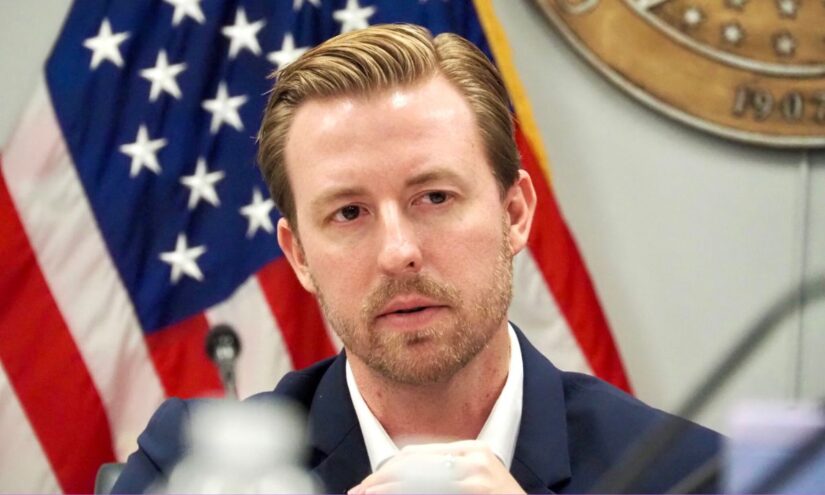
    The agency’s leader, state Superintendent Ryan Walters, again asked for $3 million to purchase copies of the Bible, the Declaration of Independence and the U.S. Constitution to place in every public school classroom. He also requested $2.3 million for a 6% cost-of-living salary bump for Education Department employees, who last saw a pay raise in 2019.

    Although his total budget request would increase the agency’s funding by $113 million, Walters hinted at “potential staff cuts” to limit the Education Department’s operational expenses during a meeting Tuesday with the Senate Appropriations Committee.

    “I​​ do believe we can save $1.3 million in some of the costs that we’ve been able to absorb through rolling positions together, cutting positions that are duplicated in their services,” Walters said during the meeting.

    Members of the influential appropriations committee heard Walters’ budget requests for the 2026 fiscal year. The state is required to pay some of the projected expenses, such as an extra $88.6 million for the rising cost of health insurance for public school employees.

    Another $4 million would increase the teacher maternity leave fund, which Walters said is growing in popularity. He also asked for $500,000 to offer firearms training to teachers.

    Senators of both parties questioned Walters’ request for $3 million to buy 55,000 copies of the King James Version Bible, which they suggested could be donated to schools or found for free online.

    House lawmakers had similar questions during a hearing with Walters last week.

    The state superintendent has advocated for more instruction on the Bible to help contextualize American history and the beliefs of the country’s founding fathers. He said he doesn’t intend for schools to preach Christianity to students.

    Last year, he ordered all school districts in the state to incorporate the Bible into their lesson plans and proposed new academic standards for social studies that would mandate instruction on biblical stories. His agency already spent under $25,000 on 532 copies of Lee Greenwood’s God Bless the USA Bible, which is informally known as the Trump Bible because it has the president’s endorsement.

    Walters’ Bible instruction mandate already faces a legal challenge on church-state separation grounds.

    Sen. Brenda Stanley, R-Midwest City, said she never encountered a classroom that didn’t have a Bible available to students during her 43-year career in education.

    Sen. Dave Rader, R-Tulsa, encouraged Walters to exhaust all resources for Bible donations before having the Legislature consider spending $3 million.

    “We could take the $3 million elsewhere, if somebody is willing to make those available to us at no cost,” Rader said during the hearing.

    The Senate committee also appeared dubious of funding a COLA increase for an agency that has lost dozens of employees over the past two years. Walters told the committee the Education Department employed 520 people when he took office in January 2023 and that it now counts 460 employees.

    “If you have decreased your (full-time employees), it would appear to me that there are already dollars inside your operating budget to offer salary increases,” Sen. Kristen Thompson, R-Edmond, told Walters during the hearing.

    Walters disagreed that staff departures would be enough to fund the increase. A complicating factor is the large number of federally funded salaries at the agency, he said.

    The department has considered reducing its staff even further after the state Board of Equalization projected the Legislature will have $119 million less to spend in the 2026 fiscal year, Walters said.

    The projection is preliminary, and the Board of Equalization will meet again this month for updated numbers.

    “After the last Board of Equalization meeting, we really went in and tried to do a deep dive into can we continue to see cuts, and we believe that we do need to be able to do that,” Walters said.

    Legislative leaders are preparing to limit expenses in light of the budget projections, especially as Gov. Kevin Stitt pushes for further tax cuts, flat agency budgets and “eliminating wasteful government spending.”

    The governor suggested no funding increases to public schools nor to the state Education Department in a budget proposal he released Monday.

    House Speaker Kyle Hilbert, R-Bristow, said Monday that he shares many of the governor’s priorities “as we seek to tighten our belt fiscally this year.” Senate President Pro Tem Lonnie Paxton, R-Tuttle, echoed Stitt’s tax-cut message when he endorsed “improving the lives of Oklahomans by allowing them to keep more of their hard-earned money.”

    Oklahoma Voice is part of States Newsroom, a nonprofit news network supported by grants and a coalition of donors as a 501c(3) public charity. Oklahoma Voice maintains editorial independence. Contact Editor Janelle Stecklein for questions: [email protected].


    Get stories like these delivered straight to your inbox. Sign up for The 74 Newsletter
    Source link

  • Florida lawmakers pass bill to roll back in-state tuition for undocumented students

    Florida lawmakers pass bill to roll back in-state tuition for undocumented students

    This audio is auto-generated. Please let us know if you have feedback.

     Dive Brief:

    • Florida lawmakers passed an expansive immigration package this week that would remove undocumented students’ eligibility for in-state tuition rates at public colleges.
    • If signed into law, the reversal would take effect July 1. However, the legislation has intensified a growing rift between the state’s Republican lawmakers and Gov. Ron DeSantis as they compete to show their loyalty to President Donald Trump and his goal of cracking down on immigration.
    • DeSantis heavily criticized the package, saying Wednesday that it “fails to honor our promises to voters, fails to meet the moment, and would actually weaken state immigration enforcement.” The governor said he would veto it unless legislators approved more restrictive immigration measures.

    Dive Insight:

    For a decade, Florida has permitted undocumented students to pay in-state tuition rates at public colleges if they attended their last three years of high school in the state and enrolled in higher education within two years of graduation.

    Republican State Sen. Randy Fine first proposed rolling back the allowance in December as a standalone bill. In January, DeSantis cited the bill as a priority when he abruptly called a special legislative session aimed at helping Trump implement tougher immigration policies.

    Florida has two public higher education systems — the Florida College System and the State University System of Florida, which oversee 28 colleges and a dozen universities, respectively. 

    In the 2023-24 fiscal year, just over 2,000 nonresident students attending one of the university system’s institutions received a waiver to pay in-state tuition, according to an analysis of the bill prepared by the Senate appropriations committee’s staff. In the Florida College System, the number was almost 4,600 that year. The combined discounts were valued at almost $40.7 million, it said. 

    The analysis did not disaggregate the student data by immigration status, and it’s unclear how many undocumented students would be affected by the revocation of the tuition waiver. One report from 2023 estimated about 40,000 undocumented students attended Florida colleges in 2021.

    It’s also unclear if colleges would benefit financially from the end of the waiver, the analysis said.

    “Some students who are undocumented for federal immigration purposes may choose to pay the out-of-state fee while others may choose to withdraw from school,” it said. “Institutions may experience an increase in fee revenue as students pay the out-of-state fees, or experience declines in fee revenue as those students decide to withdraw from school and are not replaced by other students.”

    Republican lawmakers praised the final legislative package — given the backronym title Tackling and Reforming Unlawful Migration Policy, or TRUMP, Act —  and said it would help the state act in partnership with the federal government. 

    The bill’s sponsors in the Florida House and Senate, as well as the top Republicans in both chambers, also repeatedly invoked Trump’s name in prepared statements.

    “Supporting President Trump’s mission to secure our borders, Florida stands ready to act with the most aggressive immigration policy ever introduced,” said House Speaker Daniel Perez. 

    Senate President Ben Albritton touted the state’s previous work on immigration.

    “When it comes to cracking down on illegal immigration, Florida is already so far ahead of most states,” he said.

    But in a press release two days later, DeSantis’ office dismissed the legislators’ work as a half-measure. 

    Republicans hold a veto-proof supermajority in both chambers of the Legislature. Typically, this supercharged influence would be unlikely to matter, as the governor’s mansion is also held by a Republican.

    But DeSantis’ lack of approval adds uncertainty and diminishes the odds of the package becoming law. Without his approval, it is unclear if legislators would return to the drawing board or if enough Republicans would band together to overrule his veto.

    DeSantis’ popularity within his own state party has weakened recently. 

    The governor’s decision to call the special session did not receive unanimous support from his peers. The dissenters criticized the move as inappropriately getting ahead of Trump’s policies.

    Shortly after the session began, Florida lawmakers ended it and called their own as a means of prioritizing their goals over DeSantis’. And both Reps. Perez and Fine have publicly criticized DeSantis.

    Perez suggested to the Tampa Bay Times on Thursday that DeSantis hadn’t sufficiently communicated with legislators ahead of the session. He added that “all options are on the table” to get anti-immigration legislation passed — including overriding a DeSantis veto.

    The $500 million package seeks to enact measures outside of the higher education sector. It would create the position of chief immigration officer to coordinate enforcement actions with the federal government. It would also mandate the death penalty for undocumented immigrants found guilty of capital crimes — a rule that would run contrary to longstanding U.S. Supreme Court precedent and could spur legal challenges.

    Nikki Fried, chair of the Florida Democratic Party, did not mince words in response to the bill’s passage Tuesday.

    “Florida Republicans have lost their damn minds this week,” Fried said in a statement. “Despite attempts from Democrats to protect students, this legislation promises to kick Dreamers out of college before they can finish their degree and gives huge bonuses to local law enforcement for working with ICE to ramp up deportations. It’s an unconscionable abuse of power for a state legislature.” 

    Source link