Tag: layoffs

  • Trump Education Department Delays Return of Laid-Off Workers Over Logistics – The 74

    Trump Education Department Delays Return of Laid-Off Workers Over Logistics – The 74


    Get stories like this delivered straight to your inbox. Sign up for The 74 Newsletter

    Parking permits. Desk space. Access cards.

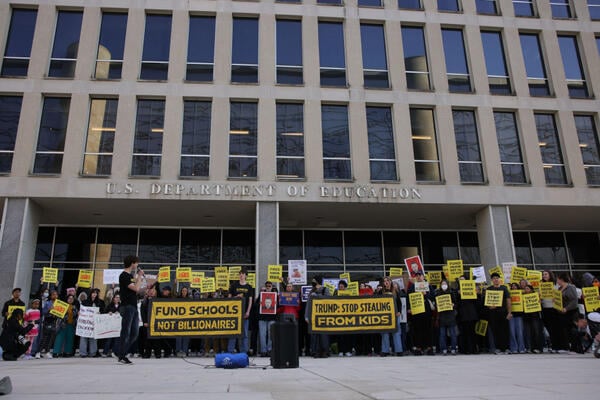
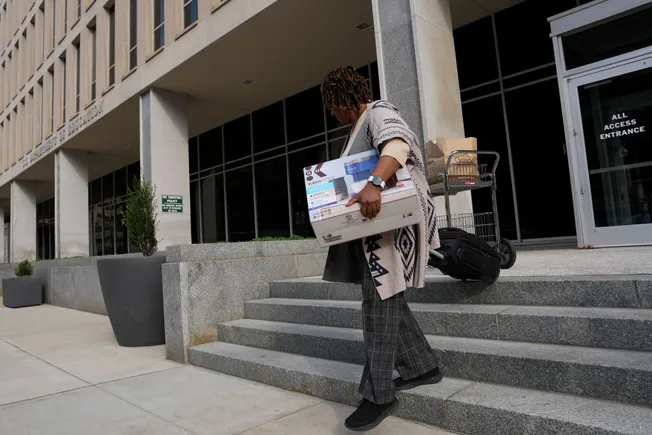
    Ordered to bring back roughly 1,300 laid-off workers, the U.S. Department of Education instead has spent weeks ostensibly working on the logistics. Meanwhile, the Trump administration wants the U.S. Supreme Court to decide they don’t have to restore those jobs after all.

    The legal argument over the job status of Education Department workers is testing the extent to which President Donald Trump and Education Secretary Linda McMahon can reshape the federal bureaucracy without congressional approval.

    The employees, meanwhile, remain in limbo, getting paid for jobs they aren’t allowed to perform.

    An analysis done by the union representing Education Department employees estimates the government is spending about $7 million a month for workers not to work. That figure does not include supervisors who are not part of the American Federation of Government Employee Local 252.

    “It is terribly inefficient,” said Brittany Coleman, chief steward for AFGE Local 252 and an attorney in the Office for Civil Rights. “The American people are not getting what they need because we can’t do our jobs.”

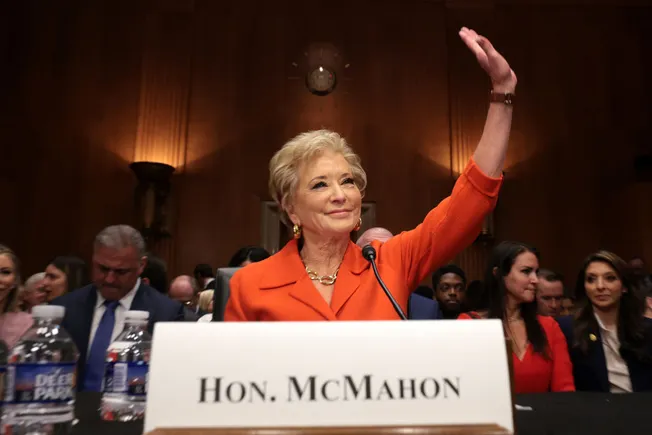
    McMahon announced the layoffs in March, a week after she was confirmed by the Senate, and described them as a first step toward dismantling the Education Department. A few days later, Trump signed an executive order directing McMahon to do everything in her legal authority to shut down the department.

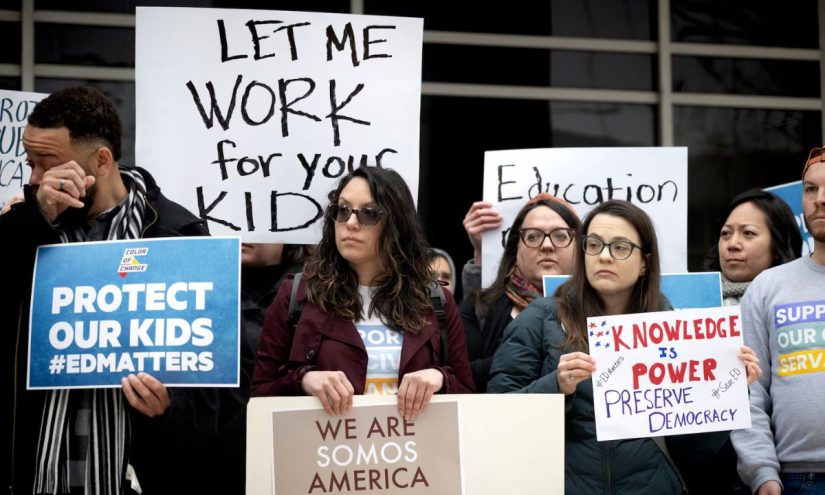
    The Somerville and Easthampton school districts in Massachusetts, along with the American Federation of Teachers, other education groups, and 21 Democratic attorneys general sued McMahon over the cuts. They argued the layoffs were so extensive that the Education Department would not be able to perform its duties under the law.

    The layoffs hit the Office for Civil Rights, Federal Student Aid, and the Institute of Education Sciences particularly hard. These agencies are responsible for federally mandated work within the Education Department. By law, only Congress can get rid of the Education Department.

    U.S. District Court Judge Myong Joun agreed, issuing a sweeping preliminary injunction in May that ordered the Education Department to bring laid off employees back to work and blocked any further effort to dismantle or substantively restructure the department.

    The Trump administration sought a stay of that order, and the case is on the emergency docket of the Supreme Court, where a decision could come any day.

    In the administration’s request to the Supreme Court, Solicitor General John Sauer argued that the harms the various plaintiffs had described were largely hypothetical, that they had not shown the department wasn’t fulfilling its duties, and that they didn’t have standing to sue because layoffs primarily affect department employees, not states, school districts, and education organizations.

    Sauer further argued that the injunction violates the separation of powers, putting the judicial branch in charge of employment decisions that are the purview of the executive branch.

    “The injunction rests on the untenable assumption that every terminated employee is necessary to perform the Department of Education’s statutory functions,” Sauer wrote in a court filing. “That injunction effectively appoints the district court to a Cabinet role and bars the Executive Branch from terminating anyone.”

    The Supreme Court, with a conservative 6-3 majority, has been friendlier to the administration’s arguments than lower court judges. Already the court has allowed cuts to teacher training grants to go through while a lawsuit works its way through the courts. And it has halted the reinstatement of fired probationary workers.

    The Education Department did not immediately respond to a request for comment.

    Last week, Joun issued a separate order telling the Education Department that it must reinstate employees in the Office for Civil Rights. The Victims Rights Law Center and other groups had described thousands of cases left in limbo, with children suffering severe bullying or unable to safely return to school.

    Meanwhile, the Education Department continues to file weekly updates with Joun about the complexities of reinstating the laid-off employees. In these court filings, Chief of Staff Rachel Oglesby said an “ad hoc committee of senior leadership” is meeting weekly to figure out where employees might park and where they should report to work.

    Since the layoffs, the department has closed regional offices, consolidated offices in three Washington, D.C. buildings into one, reduced its contracts for parking space, and discontinued an interoffice shuttle.

    In the most recent filing, Oglesby said the department is working on a “reintegration plan.”

    Coleman said she finds these updates “laughable.”

    “If you are really willing to do what the court is telling you to do, then your working group would have figured out a way to get us our laptops,” she said.

    This story was originally published by Chalkbeat. Chalkbeat is a nonprofit news site covering educational change in public schools. Sign up for their newsletters at ckbe.at/newsletters.


    Get stories like these delivered straight to your inbox. Sign up for The 74 Newsletter

    Source link

  • Layoffs at Southern New Hampshire University

    Layoffs at Southern New Hampshire University

    Southern New Hampshire University (SNHU), long hailed as a leader in online education and a symbol of institutional reinvention, laid off approximately 60 employees on June 27, 2025. The move came without warning to staff, according to an anonymous source close to the situation.

    Employees reportedly received a generic email from Lisa Marsh Ryerson, SNHU’s newly installed president, delivering the news of their termination. There was no video call, no face-to-face meeting, and no meaningful explanation beyond the cold language of corporate HR.

    “There was no sincerity,” the source said. “No real communication. Just a robotic email. No opportunity for questions, no acknowledgment of people’s service.”

    The layoffs have sent shockwaves through the university’s workforce—many of whom had believed that SNHU’s image as a student-centered and employee-friendly institution translated into job security. That assumption, it appears, was misplaced.

    SNHU, which once garnered praise from the Obama administration for its innovative online learning model, has undergone significant changes in recent years. Under the leadership of former president Paul LeBlanc, the university expanded its online programs rapidly and became one of the largest nonprofit providers of online degrees in the United States. But as the market for online education becomes increasingly competitive and enrollment pressures mount across the country, even big players like SNHU appear to be tightening their belts.

    What’s striking about this latest round of cuts is not just the numbers—but the tone. At a university that prides itself on personalization and student engagement, employees describe the layoff process as abrupt, impersonal, and dehumanizing.

    “They preach empathy to students,” the source noted. “But when it came to their own staff, there was none.”

    It’s unclear which departments or roles were affected. SNHU has yet to issue a public statement, and no mention of the layoffs could be found on the university’s website or social media accounts at the time of publication.

    The layoffs at SNHU follow broader trends in the higher education sector, where institutions—both public and private—are increasingly resorting to staff reductions amid enrollment declines, demographic shifts, and uncertain funding landscapes. But even in this context, the lack of transparency and empathy stands out.

    The Higher Education Inquirer will continue to monitor developments at Southern New Hampshire University and invites current and former employees to share their experiences confidentially.

    Source link

  • Duke University offers buyouts and signals future layoffs as federal cuts hit

    Duke University offers buyouts and signals future layoffs as federal cuts hit

    Dive Brief:

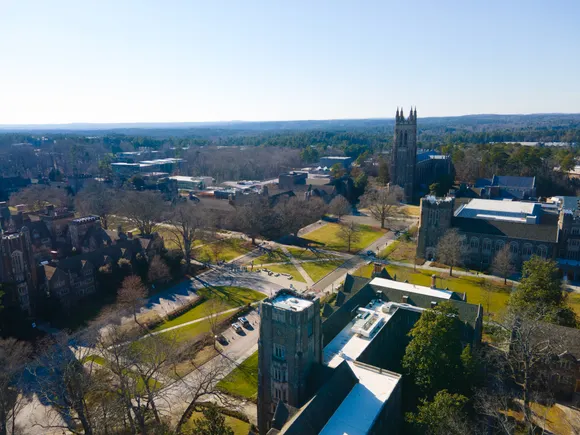
    • Duke University is offering voluntary buyouts for employees and has frozen hiring as it braces for federal funding cuts, the institution said Wednesday. 
    • The North Carolina institution signaled that layoffs were likely in the coming months, but said it is “pursuing several employment actions now in hopes of reducing the scale of involuntary separations later this summer.”
    • The moves are in response to federal cuts and policy shifts, which could translate into funding losses for Duke between $500 million and $750 million, university officials said during an internal webinar Wednesday, according to media reports.

    Dive Insight:

    Historically, much of Duke’s research enterprise has been devoted to work on behalf of the government. Federal grant support made up nearly three-quarters of the $1.5 billion in sponsored research funds that Duke received in fiscal 2024, much of it going toward health science.

    The university, in its latest financial statement, described its medical school as “one of the largest biomedical research enterprises in the country.” And funding just from the U.S. Department of Health and Human Services — which houses the National Institutes of Health — accounted for 58% of all of Duke’s sponsored research funding. 

    The National Science Foundation and U.S. Department of Energy also accounted for tens of millions of dollars in the university’s funding. 

    Since President Donald Trump retook office, those agencies and others have been cutting and delaying grant awards at a frantic pace, including moves to cap reimbursement for indirect research costs at NIH and the Energy Department. Both funding caps have been blocked in courts — at least for now — but the Trump administration is continuing to fight the legal cases against the policies. 

    Uncertainty over the funding will likely loom for some time to come. 

    For Duke, the NIH indirect cost cap would mean $194 million in lost funding each year, President Vincent Price and other leaders said in February. 

    “Much is at stake,” the officials said then. “Our nation’s world-leading research enterprise has been enabled by — and will only be sustained by — partnership and co-investment from both the government and higher education.” 

    They also signaled at the time that “careful planning and difficult decisions” could lie ahead. 

    Today, Duke is trying to cut $350 million from its budget, according to reports of the university’s presentation, as it grapples with funding gaps under the Trump administration. 

    As it trims down, Duke has paused capital spending on buildings, renovations and other projects that are “not fully funded or deemed essential,” the university said Wednesday. 

    It’s also reviewing universitywide programs — such as technology adoption, off-campus real estate and on-campus space consolidation — for potential cost-savings.  

    Employee benefits could also be on the chopping block. 

    “A study is also under way to assess how certain changes to the university’s benefits may generate savings while protecting the program’s strong competitive position,” Duke said.

    However, Executive Vice President Daniel Ennis told employees Wednesday that the university still plans to give out merit raises and will not change its tuition grant program for children of employees. 

    Universities around the country have been scrambling in recent months to open breathing room in their budgets to cope with the uncertainty and disruption created by cuts and delays at federal agencies. Many have frozen hiring and budgets to maintain financial flexibility while others have laid off employees to cope with cuts.

    Source link

  • Despite layoffs, NAEP to continue as planned in 2026

    Despite layoffs, NAEP to continue as planned in 2026

    Despite massive layoffs that left the U.S. Department of Education with a skeleton crew in charge of administering and analyzing the Nation’s Report Card, the agency said on Thursday the assessment will continue as planned next year.

    “The Department will ensure that NAEP [the National Assessment of Educational Progress] continues to provide invaluable data on learning across the U.S,” said U.S. Secretary of Education Linda McMahon in a statement on Thursday. “The 2026 NAEP assessments in reading and math are on track for administration in January 2026.” 

    In addition to assessing math and reading in 4th and 8th grades in January 2026, a letter sent to states Thursday shows U.S. history and civics will be administered for 8th graders as planned prior to the March layoffs.

    NCES is preparing for the 2025-26 cycle now and will administer the assessments between Jan. 26 and March 20, 2026, according to the letter. Math and reading results for the nation, states, and districts participating in the Trial Urban District Assessment, which tracks academic progress in urban districts, will be released in early 2027.

    National results for civics and U.S. history are expected to be released later in 2027. District and state-level data for those assessments will not be released. 

    Melissa McGrath, chief of staff for the Council of Chief State School Officers, said in a statement that NAEP “offers an important measure of student achievement and we are pleased that it will be administered in reading and math in 2026.”

    The department’s update on testing in all subject areas — including optional ones — partially addresses concerns that have been stewing for over a month among education and testing experts that cuts to the agency would sacrifice the integrity of the Nation’s Report Card.

    Former employees of the National Center for Education Statistics, which oversees the Nation’s Report Card, had worried that the mass layoffs would result in a “barebones” assessment that produced lower-quality data. 

    The Education Department has maintained that most of NAEP’s work was done through contracts, which it said remain in place.

    “Despite spending hundreds of millions in taxpayer funds annually, IES has failed to effectively fulfill its mandate to identify best practices and new approaches that improve educational outcomes and close achievement gaps for students,” Madi Biedermann, the department’s deputy assistant secretary for communications, told sister publication Higher Ed Dive in March. Biederman said the Institute of Education Sciences is going to be restructured “to improve student outcomes while maintaining rigorous scientific integrity and cost effectiveness.” 

    In her statement Thursday, McMahon said NAEP is “a critical tool for parents, educators, and experts to assess our students’ preparedness and advise on necessary interventions.”

    McMahon said that while the “final mission” — to close the department to the maximum extent possible as ordered by President Donald Trump in a March executive order — continues, she is still “committed to providing states with the tools and best practices to advance the educational achievement of our nation’s students.” 

    Modernizations of the assessment, which have been in the works for years, will also continue, the Thursday letter to states said — including pilot assessments in mathematics and reading in grades 4, 8, and 12 to help the assessment transition to updated mathematics and reading frameworks.

    It is still unclear whether plans for other innovations such as remote, device-agnostic and adaptive administrations of the exam will still roll out.

    In 2022, NCES Commissioner Peggy Carr — who was put on administrative leave as part of March’s layoffs — told K-12 Dive that assessments were set to become device agnostic in 2026, meaning students were going to be able to eventually test on any device. The Education Department had also planned to pull out most of its field administration staff, relying instead on school staff to administer assessments where possible, Carr said.

    Source link

  • Students and Institutions in Limbo After Mass Layoffs at OCR

    Students and Institutions in Limbo After Mass Layoffs at OCR

    A month after the Department of Education closed seven of its 12 regional civil rights offices and laid off nearly half the staff in the Office for Civil Rights, there’s still uncertainty about how the agency will perform its functions with such reduced numbers.

    OCR was founded to ensure equal access to education for all students and is responsible for investigating claims that schools and institutions of higher education failed to protect their students from discrimination. But under the current administration, the office has shifted gears to focus on President Donald Trump’s top priorities: removing trans women from women’s sports teams, protecting against alleged discrimination against white students, and protecting students against alleged antisemitism.

    Back in February, the office’s acting head, Craig Trainor, told employees to pause all investigations except for a handful that aligned with those priorities, according to ProPublica. Trainor quickly told investigators they could once again begin investigating disability-related complaints, which made up the largest share of the pending complaints, but not those related to race- or sex-based discrimination.

    Tracey Vitchers, the executive director of It’s On Us, a nonprofit advocacy organization focused on combating campus sexual violence, says this harks back to the first Trump administration: At the time, a large number of complaints were “quietly ignored” by OCR, leading to a massive backlog for former president Joe Biden’s administration to handle when he came into office in 2021.

    “That was the playbook during the first administration, and it was just that they just sat on shelves, essentially—digital shelves. Those cases were put on the digital shelf, ignored, not opened, not investigated,” she said.

    When Trump took office, more than 12,000 cases were open with OCR, including over 3,000 at institutions of higher education, according to a database of open OCR cases.

    Over half of all OCR cases were being handled by a regional office that is now closed, according to a report from Sen. Bernie Sanders, a Vermont Independent who is the ranking member on the Senate Health, Education, Labor and Pensions Committee. Following the layoffs, each investigator’s caseload—which was already at an all-time high of 42 cases—is expected to skyrocket to 86 cases as a result of the cuts, significantly reducing investigators’ ability to resolve each complaint, per the report.

    The data in the report reflects concerns from former OCR staffers who warned that the layoffs would make protecting students’ civil rights more difficult.

    Experts say that OCR complaints going unresolved can be a serious impediment to a student’s ability to learn.

    “At the postsecondary level, common complaints are refusals to accommodate,” said Paul Grossman, an attorney who worked at OCR for 41 years and is now executive counsel for the Association for Higher Education and Disability. “A student wants a particular kind of accommodation, and the school says, ‘No, that’s a fundamental alteration or an undue burden,’ and the student, as a result, may get dismissed because they don’t meet the academic standards, may get dismissed because they don’t meet conduct standards, whatever the case may be. Or the student may just be unhealthy—they may not be well enough to continue, because they don’t get the accommodation.”

    The public repository of open OCR cases, which used to be updated weekly, has not been updated since Jan. 14, just before Inauguration Day. But ProPublica reported in late February that only about 20 new cases have been opened since Trump took office, whereas about 250 cases were opened in the same period last year.

    That most likely comes down to OCR’s decisions about what to investigate. But Vitchers also noted that, since even before Trump’s second term began, she hasn’t been as eager to advise students to open a case with OCR in response to their institutions mishandling Title IX complaints. After the Biden administration finalized its Title IX regulations, which offered protections to transgender students and which organizations like It’s On Us said were much more sympathetic to victims of sexual violence than Trump’s previous regulations, in the summer of 2024, numerous states sued to block the regulations. The legal tussle made for a complicated environment for students seeking justice for sexual harassment or assault through Title IX, and the Biden rule was eventually vacated just over a week before Inauguration Day.

    “Very honestly, with the back-and-forth on Title IX, and particularly once we saw the Biden rule get challenged, we sort of, somewhat quietly, encouraged students to really pause and take a hard look at, what was the outcome that they were looking for? And help them assess, is the OCR complaint going to get you the outcome that you’re actually looking for here?” she said. “If it is, then we will support you in finding an attorney and filing a case. But with so many of the students that we work with, many of them made the decision to, essentially, protect their own peace.”

    ED did not respond to a request for comment.

    Mediation, Digital Accessibility and More

    On top of concerns about the backlog of complaints going unanswered, experts are also worried about other, lesser-known functions of OCR that likely are not currently happening.

    In some cases, complainants can opt for early mediation, a type of resolution that is more informal and generally quicker than an investigation. But it is unclear if such mediations are happening currently; Grossman said he has heard one example of a planned mediation being canceled, and ED did not respond to a question from Inside Higher Ed about the issue. Grossman also noted that OCR is responsible for continuing to monitor the aftermath of investigations that have already been resolved.

    Jamie Axelrod, director of disability resources at Northern Arizona University and a past president of AHEAD, pointed out that OCR is responsible for conducting digital compliance reviews, in-depth surveys of whether a school or university’s digital resources, such as its website and learning management systems, are accessible to students with disabilities. During the previous Trump administration, Axelrod said, ED stood up a specialized team to complete these reviews and provide technical assistance to institutions to help them make their digital resources more accessible. Now, that team has been reduced significantly, according to Axelrod.

    He also noted that OCR is supposed to be a tool schools and universities can turn to in order to answer any questions about how to appropriately accommodate their students.

    “The point of that is to avoid circumstances that wind up causing discrimination against students with disabilities, and so that’s a key role,” he said. “And it’s hard to really calculate how many instances of discrimination [that prevented from] happening in the first place. It’s hard to count what you prevented, but that is an important role, and I’m sure it leads to resolution of lots of complicated circumstances.”

    The impacts of the cuts are likely to go even deeper than the individual cases that have been displaced to new investigators and the specific programs that will likely fall by the wayside.

    “Like any postsecondary educational institution, there’s a lot of institutional memory that’s developed,” Grossman said. “You have to develop connections, relationships, understandings, insights, experience, and all these people who are going out the door, you’re just lighting a match to all that expertise and experience. And to me, that’s a really sad thing.”

    Source link

  • What do the massive Education Department layoffs look like? See for yourself.

    What do the massive Education Department layoffs look like? See for yourself.

    President Donald Trump’s promise to dismantle the U.S. Department of Education was long heralded. Dating back to his first term, the vow was loudly and oft-repeated by candidate Trump on the campaign trail in 2024.

    But while the plan went nowhere during his first time in the White House, it has come to fruition through a slew of executive actions since his inauguration in January.

    What began with abruptly canceled education grants in February escalated with the confirmation of U.S. Education Secretary Linda McMahon on March 3 and her promise of “our department’s final mission” that same day. The culmination came in massive layoffs on March 11 and a Trump executive order a week later instructing McMahon to close the department “to the maximum extent appropriate and permitted by law.”

    A handful of the Trump administration’s actions — including last week’s order — have already been challenged in court. But in the meantime, their impacts are tangible in everything from students’ civil rights protections to funding for teacher grants. 

    K-12 Dive obtained an organizational chart from the Education Department detailing the offices impacted by the March 11 layoffs, as well as a list of about 970 union employees out of 1,300 employees who were let go, which offices they had been employed in and their positions. While the list of employees isn’t comprehensive, it gives a general idea of where cuts were concentrated — and what that might mean for education in the long run. 

    Based on those documents, here are eight visuals to help understand Trump’s multiphased gutting of the Education Department and its widespread impact: 

    By the numbers


    $600 million

    Cut to “divisive” teacher training grants


    $900 million

    Cut to multiyear research contracts

    The March 11 layoffs were preceded by cuts to over $1 billion in grant funding. Research grants housed in the National Center for Education Statistics were on the chopping block, as were teacher training grants that the administration called “divisive.” 

    The teacher grants impacted include the Supporting Effective Educator Development Grant Program, the Teacher Quality Partnership Program, and the Teacher and School Leader Incentive Program. These cuts would later be successfully challenged through at least two lawsuits. This week, Trump filed an emergency application with the U.S. Supreme Court challenging the lower court ruling and seeking the immediate cancellation of $65 million in teacher training grants it says advances diversity, equity and inclusion initiatives. 

    Former National Center for Education Statistics employees also confirmed to K-12 Dive that research grants related to student assessments were cut — a move that will likely result in a “barebones” approach to congressionally mandated tests like the Nation’s Report Card.

    By the numbers


    4,133

    number of employees prior to department’s gutting


    600

    number of employees that take buyouts prior to layoffs


    1,300

    number of staff fired on March 11


    2,200

    approximate number of employees following layoffs

    After the initial cuts to grants — and on the night of McMahon’s March 3 confirmation — employees were given an 11:59 p.m. ET deadline to voluntarily accept a $25,000 separation agreement in an effort to downsize the agency’s workforce. According to a later announcement by the department, about 600 employees took that offer leading up to the March 11 layoffs. 

    The layoffs would bring the total number of employees impacted by the reduction in force — part of McMahon’s “final mission” for the Education Department — to 1,900, or nearly half of its 4,133 count.

    FSA, OCR, and IES hit hard in March 11 layoff

    The data represents the 970 union workers laid off on March 11, 2025, and excludes non-union workers.

    On March 11, the administration laid off nearly 1,300 employees across various offices within the Education Department. Among offices losing the most people were Federal Student Aid, which students depend on to determine their eligibility for federal grants and loans for college. The move is the opposite of a recommendation made by the Government Accountability Office last year — following a botched FAFSA rollout — to “plan for and ensure hiring of sufficient staff to increase capacity” in the FSA office.

    The Institute for Education Sciences, home to the National Center for Education Statistics and oversight for the Nation’s Report Card, was cut down by over a hundred staff and left NCES with a skeletal staff of a handful.

    And the English Language Acquisition office was completely decimated, with all of its some dozen unionized employees laid off, according to the Education Department’s organizational chart. That move came less than two weeks after Trump signed an order making English the official language of the United States.

    Another Education Department arm significantly impacted was the Office for Civil Rights, which enforces laws that protect students’ civil rights. The reduction there comes after the Biden administration pleaded to Congress for an increase in funding and staff to address a case backlog, escalated by Title VI complaints based on shared ancestry or ethnicity in light of the Israel-Hamas war. The Trump administration has acknowledged the backlog but halved the office’s headcount rather than increasing staff.

    7 OCR regional offices closed, affecting half the nation

    The civil rights arm also lost seven of its dozen regional office

    OCR is responsible for keeping schools in compliance with civil rights laws and handles investigations that in the past often took months or even years to complete. Those investigations, among other things, ensure equal access to education for sexual assault survivors, students with disabilities and students from all races and ethnicities.

    Attorneys and equal opportunity employees were most common positions cut

    The data represents the 970 union workers laid off on March 11, 2025, and excludes non-union workers.

    Out of hundreds of OCR employees fired, a significant number were civil rights attorneys and equal opportunity employees, leaving the office with a skeletal crew to oversee more than 12,000 currently open investigations. At least 200 employees in total were let go. 

    These attorneys carried out the majority of OCR’s work, including determining case outcomes and sometimes helping to develop policy guidance. 

    Source link

  • What will NCES layoffs mean for the Nation’s Report Card?

    What will NCES layoffs mean for the Nation’s Report Card?

    This audio is auto-generated. Please let us know if you have feedback.

    The Trump administration has all but axed the U.S. Department of Education’s statistical research arm — the National Center for Education Statistics — sparing only a handful of employees who are left without department staff needed to analyze education data. 

    “They didn’t just RIF a few people, they deleted the agency for all intents and purposes,” said an NCES employee of more than a decade who was part of the massive March 11 layoffs

    The loss of over a hundred Institute of Education Sciences employees — including almost all of the NCES staff comes as part of sweeping cuts to the Education Department that left the federal agency with only half of its workforce. NCES, which traces its existence to an 1867 law establishing a federal statistical agency to collect, analyze and report education data,  has been tasked with research and analysis on everything from graduation rates and student outcomes to teacher and principal development. 

    Overall, NCES research tracked the condition of education in the nation, including gaps in achievement and resources for underserved students. During the pandemic, the unit closely analyzed trends in school resources and educator and student mental health. 

    Perhaps most notably, NCES oversaw and ensured the quality of the Nation’s Report Card, along with other key student outcome studies. School and college leaders rely on such NCES research to improve student performance, and its findings often help inform federal and state policymakers on funding decisions.

    Now, those caught in the latest wave of the administration’s cuts are warning that their haphazard nature will lead to a decline in the quality of assessments and data overseen by NCES. Longtime NCES employees report being fired at a moment’s notice and abruptly losing access to years — sometimes decades — of work, with no communication from the administration about how to offboard so as to preserve and pass on critical information. 

    “A lot of institutional knowledge is going to be lost,” said another former NCES employee who worked closely on the Nation’s Report Card. This employee and the others who spoke to K-12 Dive asked to remain anonymous for fear that identification could affect their severance terms.

    NAEP and international assessment employees impacted

    Although NCES employees are nearly all gone, many of NCES’ functions they previously carried out are congressionally mandated, meaning they will still need to be done. That includes portions of the National Assessment of Educational Progress, commonly known as the Nation’s Report Card. 

    The required parts include: reading and math assessments in 4th and 8th grade, long-term trend assessments for 9, 13 and 17-years-olds, and 12th grade reading and math assessments. The long-term assessment for 17-year-olds was last administered in 2012, having been canceled during the pandemic, and again for this spring due to what the Education Department cited as funding issues.

    Other portions of the federal test such as science, U.S. history and civics are optional. 

    The federally mandated assessment has often served as a yardstick for student performance in various subjects, most notably reading and math. Following the pandemic, it helped educators understand which subject areas students struggled in the most during and following school closures. 


    “Despite spending hundreds of millions in taxpayer funds annually, IES has failed to effectively fulfill its mandate to identify best practices and new approaches that improve educational outcomes and close achievement gaps for students.”

    Madi Biedermann

    U.S. Department of Education’s Deputy Assistant Secretary for Communications


    Congress also mandates that student performance be compared on an international level, a requirement usually fulfilled by the Program for International Student Assessment, or PISA. 

    The latest round of PISA testing was expected to begin by the end of March. Plus, the main NAEP for grades 4, 8 and 12 was supposed to begin early next year — preparation for which was set to begin this summer, according to former NCES employees. 

    The Education Department, in a March 13 statement emailed to sister publication Higher Ed Dive, said, “IES employees impacted by the reduction in force conducted none of the research related to NAEP, the College Scorecard, and IPEDS.”

    “That work is all done through contracts that are still maintained by the Department,” said Madi Biedermann, deputy assistant secretary for communications at the department, in the statement.

    Source link

  • What will NCES layoffs mean for the Nation’s Report Card?

    What will NCES layoffs mean for the Nation’s Report Card?

    This audio is auto-generated. Please let us know if you have feedback.

    The Trump administration has all but axed the U.S. Department of Education’s statistical research arm — the National Center for Education Statistics — sparing only a handful of employees who are left without department staff needed to analyze education data. 

    “They didn’t just RIF a few people, they deleted the agency for all intents and purposes,” said an NCES employee of more than a decade who was part of the massive March 11 layoffs

    The loss of over a hundred Institute of Education Sciences employees — including almost all of the NCES staff comes as part of sweeping cuts to the Education Department that left the federal agency with only half of its workforce. NCES, which traces its existence to an 1867 law establishing a federal statistical agency to collect, analyze and report education data,  has been tasked with research and analysis on everything from graduation rates and student outcomes to teacher and principal development. 

    Overall, NCES research tracked the condition of education in the nation, including gaps in achievement and resources for underserved students. During the pandemic, the unit closely analyzed trends in school resources and educator and student mental health. 

    Perhaps most notably, NCES oversaw and ensured the quality of the Nation’s Report Card, along with other key student outcome studies. School and college leaders rely on such NCES research to improve student performance, and its findings often help inform federal and state policymakers on funding decisions.

    Now, those caught in the latest wave of the administration’s cuts are warning that their haphazard nature will lead to a decline in the quality of assessments and data overseen by NCES. Longtime NCES employees report being fired at a moment’s notice and abruptly losing access to years — sometimes decades — of work, with no communication from the administration about how to offboard so as to preserve and pass on critical information. 

    “A lot of institutional knowledge is going to be lost,” said another former NCES employee who worked closely on the Nation’s Report Card. This employee and the others who spoke to K-12 Dive asked to remain anonymous for fear that identification could affect their severance terms.

    NAEP and international assessment employees impacted

    Although NCES employees are nearly all gone, many of NCES’ functions they previously carried out are congressionally mandated, meaning they will still need to be done. That includes portions of the National Assessment of Educational Progress, commonly known as the Nation’s Report Card. 

    The required parts include: reading and math assessments in 4th and 8th grade, long-term trend assessments for 9, 13 and 17-years-olds, and 12th grade reading and math assessments. The long-term assessment for 17-year-olds was last administered in 2012, having been canceled during the pandemic, and again for this spring due to what the Education Department cited as funding issues.

    Other portions of the federal test such as science, U.S. history and civics are optional. 

    The federally mandated assessment has often served as a yardstick for student performance in various subjects, most notably reading and math. Following the pandemic, it helped educators understand which subject areas students struggled in the most during and following school closures. 


    “Despite spending hundreds of millions in taxpayer funds annually, IES has failed to effectively fulfill its mandate to identify best practices and new approaches that improve educational outcomes and close achievement gaps for students.”

    Madi Biedermann

    U.S. Department of Education’s Deputy Assistant Secretary for Communications


    Congress also mandates that student performance be compared on an international level, a requirement usually fulfilled by the Program for International Student Assessment, or PISA. 

    The latest round of PISA testing was expected to begin by the end of March. Plus, the main NAEP for grades 4, 8 and 12 was supposed to begin early next year — preparation for which was set to begin this summer, according to former NCES employees. 

    The Education Department, in a March 13 statement emailed to sister publication Higher Ed Dive, said, “IES employees impacted by the reduction in force conducted none of the research related to NAEP, the College Scorecard, and IPEDS.”

    “That work is all done through contracts that are still maintained by the Department,” said Madi Biedermann, deputy assistant secretary for communications at the department, in the statement.

    Source link

  • IES, the Institute of Education Sciences, is in disarray after layoffs

    IES, the Institute of Education Sciences, is in disarray after layoffs

    President Donald Trump promises he’ll make American schools great again. He has fired nearly everyone who might objectively measure whether he succeeds.

    This week’s mass layoffs by his secretary of Education, Linda McMahon, of more than 1,300 Department of Education employees delivered a crippling blow to the agency’s ability to tell the public how schools and federal programs are doing through its statistics and research branch. The Institute of Education Sciences (IES) is now left with fewer than 20 federal employees, down from more than 175 at the start of the second Trump administration, according to my reporting. It’s not clear how the institute can operate or even fulfill its statutory obligations set by Congress. 

    IES is modeled after the National Institutes of Health and was established in 2002 during the administration of former President George W. Bush to fund innovations and identify effective teaching practices. Its largest division is a statistical agency that dates back to 1867 and is called the National Center for Education Statistics (NCES), which collects basic statistics on the number of students and teachers. NCES is perhaps best known for administering the National Assessment of Educational Progress, which tracks student achievement across the country. The layoffs  “demolished” the statistics agency, as one former official characterized it, from roughly 100 employees to a skeletal staff of just three. 

    “The idea of having three individuals manage the work that was done by a hundred federal employees supported by thousands of contractors is ludicrous and not humanly possible,” said Stephen Provasnik, a former deputy commissioner of NCES who retired early in January. “There is no way without a significant staff that NCES could keep up even a fraction of its previous workload.”

    Related: Our free weekly newsletter alerts you to what research says about schools and classrooms.

    Even the new acting commissioner of education statistics, a congressionally mandated position, was terminated with everyone else on March 11 after just 15 days on the job, according to five former employees. Chris Chapman replaced Biden-appointee Peggy Carr, who was suddenly removed on Feb. 24 without explanation before her congressionally designated six-year term was to end in 2027. It was unclear who, if anyone, will serve as the commissioner after Chapman’s last day on March 21. (Chapman did not respond to an email for comment.) Meanwhile, the chief statistician, Gail Mulligan, was put on administrative leave until her early retirement on April 1.* There is apparently no replacement to review the accuracy of figures reported to the public.  

    Two offices spared

    Only two IES offices were untouched by this week’s layoffs: the National Center for Special Education Research, an eight-person office that awards grants to study effective ways to teach children with disabilities, and the Office of Science, a six-person office that reviews research for quality, accuracy and validity. It was unclear why they were spared. Other areas of the Education Department that fund and oversee education for children with disabilities also had relatively lighter layoffs.

    A draft of an executive order to eliminate the Education Department was prepared in early March, but Trump hadn’t signed it as of this week. Instead, McMahon said on Fox News that she began firing employees as a “first step” toward that elimination. Former department employees believe that McMahon and her team decided which offices to cut. Weeks before her confirmation, about a half dozen people from McMahon’s former think tank, the right-wing America First Policy Institute, were inside the department and looking at the bureaucracy, according to a former official at the Education Department. The Education Department did not respond to my email queries.

    The mass firings this month were preceded by a Feb. 10 onslaught, when Elon Musk’s Department of Government Efficiency terminated much of the work that is overseen by these education research and statistics units. Most of the department’s research and data collections are carried out by outside contractors, and nearly 90 of these contracts were canceled, including vital data collections on students and teachers. The distribution of roughly $16 billion in federal Title I aid to low-income schools cannot be calculated properly without this data. Now, the statisticians who know how to run the complicated formula are also gone. 

    ‘Five-alarm fire’

    The mass firings and contract cancellations stunned many. “This is a five-alarm fire, burning statistics that we need to understand and improve education,” said Andrew Ho, a psychometrician at Harvard University and president of the National Council on Measurement in Education, on social media.  

    Former NCES Commissioner Jack Buckley, who ran the education statistics unit from 2010 to 2015, described the destruction as “surreal.” “I’m just sad,” said Buckley. “Everyone’s entitled to their own policy ideas, but no one’s entitled to their own facts. You have to share the truth in order to make any kind of improvement, no matter what direction you want to go. It does not feel like that is the world we live in now.”

    The deepest cuts

    While other units inside the Education Department lost more employees in absolute numbers, IES lost the highest percentage of employees — roughly 90 percent of its workforce. Education researchers questioned why the Trump administration targeted research and statistics. “All of this feels like part of an attack on universities and science,” said an education professor at a major research university, who asked not to be identified for fear of retaliation. 

    That fear is well-founded. Earlier this month the Trump administration canceled $400 million in federal contracts and grants with Columbia University, blaming the university’s failure to protect Jewish students from antisemitism during campus protests last year over Israeli attacks on Gaza. Among them were four research grants that had been issued by IES, including an evaluation of the effectiveness of the Federal Work-Study program, which costs the government $1 billion a year. That five-year study was near completion and now the public will not learn the results. (The Hechinger Report is an independent news organization at Teachers College, Columbia University.

    Related: Tracking Trump: His actions on education

    Tom Brock, executive director of the Community College Research Center at Teachers College, Columbia University, said he had been cautiously optimistic that he could successfully appeal the cancellation of his $2.8 million in education research grants. (He planned to argue that Teachers College is a separate entity from the rest of Columbia with its own president and board of trustees and it was not affected by student protests to the same degree.) But now the IES office that issued the grants, the National Center for Education Research, has lost its staff. “I’m very discouraged,” said Brock. “Even if we win on appeal, all the staff have been laid off. Who would reinstate the grant? Who would we report to? Who would monitor it? They have completely eliminated the infrastructure. I could imagine a scenario where we would win on appeal and it can’t be put into effect.”

    Active contracts

    Many contracts with outside organizations for data collection and research grants with university professors remain active. That includes the National Assessment of Educational Progress, which tracks student achievement, and the Integrated Postsecondary Education Data System (IPEDS), which collects data on colleges and universities. But now there are almost no employees left to oversee these efforts, review them for accuracy or sign future contracts for new data collections and studies. 

    “My job was to make sure that the limited public dollars for education research were spent as best as they could be,” said one former education official who issued grants for the development of new innovations. “We make sure there’s no fraud, waste and abuse. Now there’s no watchdog to oversee it.” 

    The former official asked to remain anonymous as did more than a dozen other former employees whom I talked to while reporting this story. Some explained that the conditions of their termination, called a “reduction in force” or “RIF,” could mean losing their severance if they talked to the press. The terminated employees are supposed to work from home until their last day on March 21, and they described having limited access to their work computer systems. That is stymying efforts to wind down their work with their colleagues and outside contractors in an orderly way. One described how she had to take a cellphone picture of her termination notice on her laptop because she could no longer save or send documents on it. 

    Related: DOGE’s death blow to education studies

    So far, there has been no sign of protest among congressional Republicans, even though some of the cuts affect data and research they have mandated. A spokesman for Sen. Bill Cassidy, Republican of Louisiana and chairman of the Senate committee on Health, Education, Labor and Pensions, directed me to Cassidy’s statement on X. “I spoke to @EDSecMcMahon and she made it clear this will not have an impact on @usedgov ability to carry out its statutory obligations. This action is aimed at fulfilling the admin’s goal of addressing redundancy and inefficiency in the federal government.”

    Following the law

    In theory, a skeletal staff might be able to fulfill the law, which is often “ambiguous,” said former NCES commissioner Buckley. For example, the annual report to Congress on the condition of education could be as short as one page. Laws mention several data collections, such as ones on financial aid to college students and on the experiences of teachers, but often don’t specify how often they must be produced. Technically, they could be paused for many years without running afoul of statutes.

    The remaining skeleton crew could award contracts to outside organizations to do all the work and have them “supervise themselves,” said Buckley. “I’m not advocating that oversight be pushed out to contractors, but you could do it in theory. It depends on your tolerance for contracting out work.”

    NAEP anxiety

    Many are anxious about the future of NAEP, also known as the Nation’s Report Card. Even before the firings, William Bennett, Education Secretary under President Ronald Reagan, penned an open letter along with conservative commentator Chester Finn in The 74, urging McMahon to preserve NAEP, calling it “the single most important activity of the department.” 

    Colorado Gov. Jared Polis, a Democrat who chairs the National Governors Association, is especially concerned. In an email, Polis’ spokesman emphasized that Polis believes that “NAEP is critical.” He warned that “undercutting data collection and removing this objective measuring stick that helps states understand and improve performance will only make our efforts more difficult.” 

    Though much of the test development and administration is contracted out to private organizations and firms, it is unclear how these contracts could be signed and overseen by the Education Department with such a diminished staff. Some officials suggested that the National Assessment Governing Board (NAGB), which sets NAEP policy, could take over the test’s administration. But the board’s current staff doesn’t have the testing or psychometrics expertise to do this. 

    Related: Former Trump commissioner blasts DOGE education data cuts

    In response to questions, board members declined to comment on the future of NAEP and whether anyone in the Trump administration had asked them to take it over. One former education official believes there is “apparently some confusion” in the Trump administration about the division of labor between NAGB and NCES and a “misunderstanding of how work gets done in implementing” the assessment.

    Mark Schneider, a former IES director who is now a senior fellow at the American Enterprise Institute, said he hoped that McMahon would rebuild NCES into a modern, more efficient statistical agency that could collect data more cheaply and quickly, and redirect IES’s research division to drive breakthrough innovations like the Defense Department has. But he conceded that McMahon also cut some of the offices that would be needed to modernize the bureaucracy, such as the centralized procurement office. 

    So far, there’s no sign of Trump’s or McMahon’s intent to rebuild. 

    * Clarification: An earlier version of this story said that Mulligan had been terminated, but she revised a social media post about her status after publication of this story to clarify that she was not subject to the “reduction in force” notice. 

    Contact staff writer Jill Barshay at 212-678-3595, jillbarshay.35 on Signal, or [email protected].

    This story about the Institute of Education Sciences was written by Jill Barshay and produced by The Hechinger Report, a nonprofit, independent news organization focused on inequality and innovation in education. Sign up for Proof Points and other Hechinger newsletters.

    The Hechinger Report provides in-depth, fact-based, unbiased reporting on education that is free to all readers. But that doesn’t mean it’s free to produce. Our work keeps educators and the public informed about pressing issues at schools and on campuses throughout the country. We tell the whole story, even when the details are inconvenient. Help us keep doing that.

    Join us today.

    Source link

  • Watch DOGE layoffs in real-time with Layoffs.fyi

    Watch DOGE layoffs in real-time with Layoffs.fyi

    Layoffs.fyi is keeping track of US federal government layoffs. The website was originally created to track tech layoffs and has been featured in the Wall Street Journal, Bloomberg, and NY Times. 

    Source link