It’s neither a personal nor an especially novel observation to suggest that both in the UK and across North America and Western Europe, debates about campus climate, culture and freedom of speech were upended on 7 October 2023.
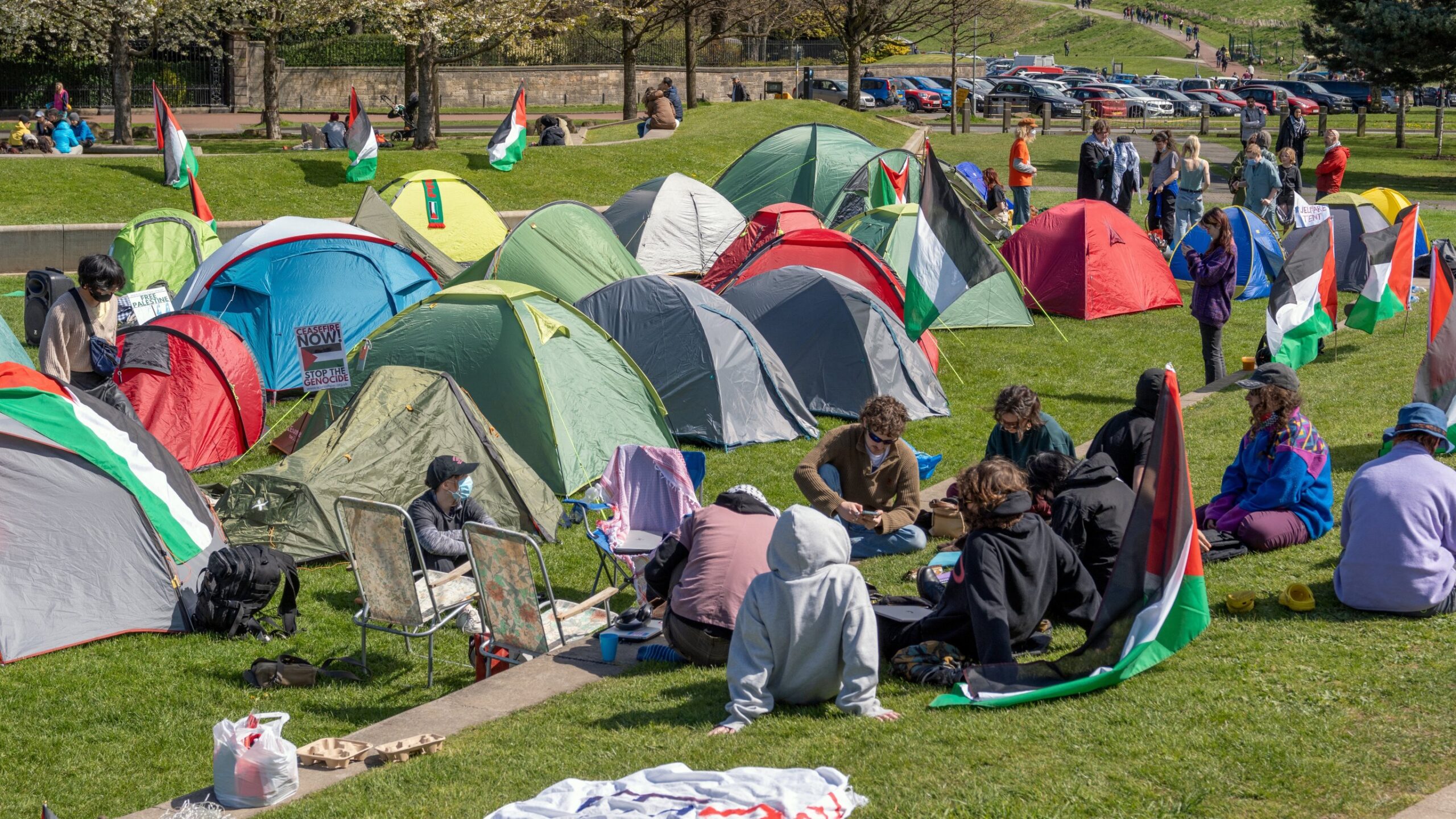
It’s not the purpose of the report, but you can really feel some of the contradictions coming to a head in Josh Freeman’s terrific new HEPI report on the Encampments protesting for Palestine and the response to them, tentatively timed to offer early reflections now that a ceasefire has been secured.
What until October 7 had been a rhetorically wide framing of freedom of speech and a pretty narrow one over protection from harm and harassment was always going to be challenged when speech took the form of pro-Palestine placards rather than the punch and judy of rarified Russell Group debating societies.
And while plenty of people still pretend that there are no “fine lines” and contradictions between, say, expressions of pro-Palestinian solidarity and antisemitism, Freeman’s report lays out the realities and complexities of universities, their students’ unions and students themselves being expected to tread and police those lines.
I was struck, reading the report, by the contradictions between the way in which student “debaters” (the subject of a previous report from Freeman) and student activists of the sort in the encampments are often framed in terms of what they represent – the former is often assumed to be a near-universal experience or at least an ideal, while the latter are painted as an angry mob that often aren’t even students anyway.
Both, in truth, are pretty unrepresentative of the contemporary higher education experience, both can seem like indulgences that many students are unable to afford, but both do have an influence on students’ understanding of the world. The fact that both appear to be largely confined to the Russell Group could easily be a source of shame rather than relief.
Motivations and disruptions
There’s a good methodology to the report that some tend to turn their nose up at when used on other issues – it’s basically a qualitative, case study-based approach, drawing on lived experiences through semi-structured interviews with key players – student protestors, university staff, students’ union officers, and Jewish students – while triangulating these insights with documentary analysis of public statements and social media discourse.
As a result, there are some fascinating insights from Freeman. Fairly early on, he notes that in the student interviews, many were motivated by factors which, at least at face value, went far beyond the situation in Gaza – referring to other factors like islamophobia, tuition fees, staff pay and pensions, mental health or even the freedom to protest:
These issues were rarely mentioned in encampments’ official demands but they appear to have been significant motivators to join the protests.
There’s also a clutch of material on the way in which the encampments themselves operated – laying bare both aspects and incidents of obvious antisemitism, but also anguish about the right (and for some, perceived duty) to object to and highlight the actions of Israel throughout the war, and the way in which those protestors knew that that might be misinterpreted.
Material on “disruption” is interesting too. Freeman identifies both an oft-denied truism – that this kind of “speech” is designed to be disruptive – and a less-understood concern of some protestors that keeping students on side by not excessively disrupting their education was important.
The section on the “institutional response” is particularly helpful, mainly because it draws comparisons in the approach on engagement. The running theme is that where – either by chance or by design – institutional managers and student protesters were caused to meet and discuss as people, some inching away from simplistic demonisation was possible and helpful. By contrast, it looks like a lack of engagement allowed a simplistic framing – of protester as terrorist, and university manager as oppressor – to unhelpfully persist.
Freeman also reflects on the learning made possible by those encounters:
The ultimate goals of discussions should be learning, on the one hand – these examples suggest institutions still have much to learn from their students – and explaining, on the other, why some demands are not feasible.
Another aspect of the diversity in approaches relates to “demands”. The old “give them an inch and they’ll take a mile” approach to students can be seen in this quote:
It would create two categories of students … it would give them a carte blanche for any kind of behaviour.
…while others were perceptive enough to recognise that hard and fast rules can look quite silly quite quickly when it’s often context that counts:
It’s a special situation, an emotional issue. It’s okay to call this a one-off. Though some have said we are setting a bad precedent by allowing this behaviour.
That’s true too over a running theme in the narrative amongst protesters – that taking an early and unequivocal stance on Ukraine in the way that most of the sector did was, for them, incompatible with a sudden concern for neutrality over Israel/Palestine.
Frustratingly, Freeman even reports that after accusations of being “hypocrites”, “several” senior staff said that, on reflection, their institutions would avoid political statements entirely in the future – as if carefully crafted regulations will always trump context. They won’t.
I’d also tentatively add that while it was undoubtedly true that:
…In comparison with the Marking and Assessment Boycott, there is tiny traffic from students. To the bulk of our students, it [the conflict] is not on their radar. We have had a few hundred emails on divestment, but they are the same people writing over and over, with the same template.
…one might argue that a huge international conflict, with significant global implications, might cause one to wonder why more students weren’t engaged, particularly in universities where “activism” is more a rarity than a rhythm.
Threats, reputation and officialdom
There are, inevitably, some pointed observations both about government and the Office for Students – which to this day has said almost nothing about so many of the edge cases of freedom v harm involved in Israel/Palestine, despite being in the process of launching two new “sandbags on the see saw” in the form of free speech duties and anti-harassment duties.
Universities – perhaps it was always thus – were neither to be trusted nor offered much in the way of help when being left to resolve the tensions themselves:
They’ve left us to it. That may have been the best thing.
In a week when student activists appear to have brought down a populist Prime Minister in Serbia, I was also especially interested in Freeman’s observations about the relationship between what we might call the “official” voice of students – students’ unions – and the activists in the encampments.
Before I even got to page 35, for example, I knew that words to this effect would appear somewhere:
We engage with the Students’ Union as they are the democratically elected representatives, not with some small group of people, most of whom have nothing to do with the University or its community.
I would note in eyebrow-raising passing that I’ve often come across that view from those who tend, in other contexts, to challenge the representativeness of their students’ union when advancing recommendations or opinions.
But more broadly, I tend to adopt a straightforward principle when an organised group of students decides that the “official” channel of communication isn’t cutting the mustard – they often have a point. That’s partly because, back on that “hard and fast rule” thing, some SUs (and their universities) can take their apoliticism and desire to be seen to be supporting all students too far – overcooking reputational or charity law fears, and undercooking their role as clearing houses for often opposed student opinion.
When Freeman recommends that:
Distinguishing between the collective position of the students’ union on the one hand and the stances of individual elected officers on the other, so elected officers can remain true to their own views and the mandate they were elected on, while allowing the students’ union to remain apolitical, follow charity law and be representative of the wider student body.
…it also seems fairly clear that the “own views” aspect of that doesn’t mean silence in the way that has been imposed for many an SU officer with strong views on the issues.
Mediation and advocacy
What’s helpful in the report is the description of the positive role that many SU officers and staff played in the process as mediators (supporting both encampments and institutions to reach a resolution), as intermediaries (passing “intelligence” between encampments and institutions), and as advocates to make sure the voices of all students are heard roles that many of their staff (outside a handful) are neither routinely funded for nor recognised.
And as Freeman puts it when discussing allegations of illegitimacy:
But rather than undermining the positions of elected officers, it might be more productive to work with the SU to create an effective process for dialogue with all groups of students. When the main mechanism for students to contribute to institutional policy does not function properly, it may explain why many students choose to bypass their unions and channel their frustrations through protest.
I discussed some of the differences between what we might call the “official” student movement and the activists leading the blockades in Serbia in my write up on that issue elsewhere on the site – and I’m struck by the character of the past 18 months’ pro-Palestinian activism when compared to previous intensifications of the Middle East conflict.
For many years, the “voice” of such activism tended to be the Federation of Islamic Student Societies (FOSIS), often setting up an arguably unhelpful and simplistic link between Jewish students, the Union of Jewish Students and a “pro Israel” position on the one hand, and Muslim students, FOSIS and a “pro Palestinian” position on the other.
For all sorts of obvious reasons, the simplicity of those links and resultant “sides” was always problematic – it has never been just Muslim students and Jewish students caught up in debates over the conflict, and there have always been significant differences of opinion on the conflict within those “sides”.
But it’s also true to say that both UJS and FOSIS were able to act in an “official” student representative role in a similar way to that that Freeman frames students’ unions as inhabiting – able to speak to power, their own members, and through NUS, each other. In recent years, FOSIS has fallen away in prominence – the channel for much of the anger and activism now represented by the Palestinian Solidarity Campaign and related offshoots – while UJS has tended to focus its efforts on persuading power to exert authority over antisemitism.
That is not to suggest that either is wrong, or illegitimate, or especially problematic – but it has meant that in this phase of the Middle East crisis, one “side” has looked very official, while the “other” has looked like the opposite. In a climate where words like “oppressor” get attached to one side and “terrorist” to the other, those types of perhaps accidental perceptions are likely to have clouded wider students’ engagement in and understanding of what has been happening.
Partnership and power
Bringing both Serbia and the HEPI paper together, in quieter moments this week I’ve been caused to re-read this terrific paper from Simon Varwell on citizen participation in an era of emergency decision-making.
Varwell is a former staffer from Sparqs – the little known (outside of Scotland) student participation “agency” originally set up to give a boost to class rep training north of the border. It rarely gets the credit it deserves from Scottish ministers or Principals, but it’s much more than its roots as a train the trainer scheme for reps these days – producing acres of intelligent and helpful material that has helped to engender partnership between students and universities in Scotland more generally.
His paper – written in the teeth of the Covid crisis – makes a compelling argument that what Sherry Arnstein described in the late 60s as a “ladder” of participation pretty much turned into a circle during the pandemic – where the very highest and lowest levels of student engagement overlapped in a zone of anger and conflict.
![]()
I think that argument matters – not especially from a tactical point of view, but because it’s clear that in some universities, notions of “partnership” melt away quickly when something more “serious” or “risky” is on the table – whether that’s making cuts to provision, handling Covid, or dealing with ministerial and press interest in a protest or “woke” initiative on campus.
Partnership can mean all sorts of things to all sorts of people. But fundamentally it’s about sharing power, both between groups of students and between students and their university.
Few would argue that partnerships of the latter should be “equal”. But when what is sold as a safe environment doesn’t feel like it, and when what is promoted as way of having your voice heard or your interests met feels like being ignored or marginalised, “senior” partners should always be mindful that universities aren’t schools, authority tends to depend on consent, and whatever the weight of expectation on the “grown ups” to crack down and control, conflict almost always requires both mediation and mutual respect.