Tag: Leadership

  • COLUMN: Trump is bullying, blackmailing and threatening colleges, and they are just beginning to fight back

    COLUMN: Trump is bullying, blackmailing and threatening colleges, and they are just beginning to fight back

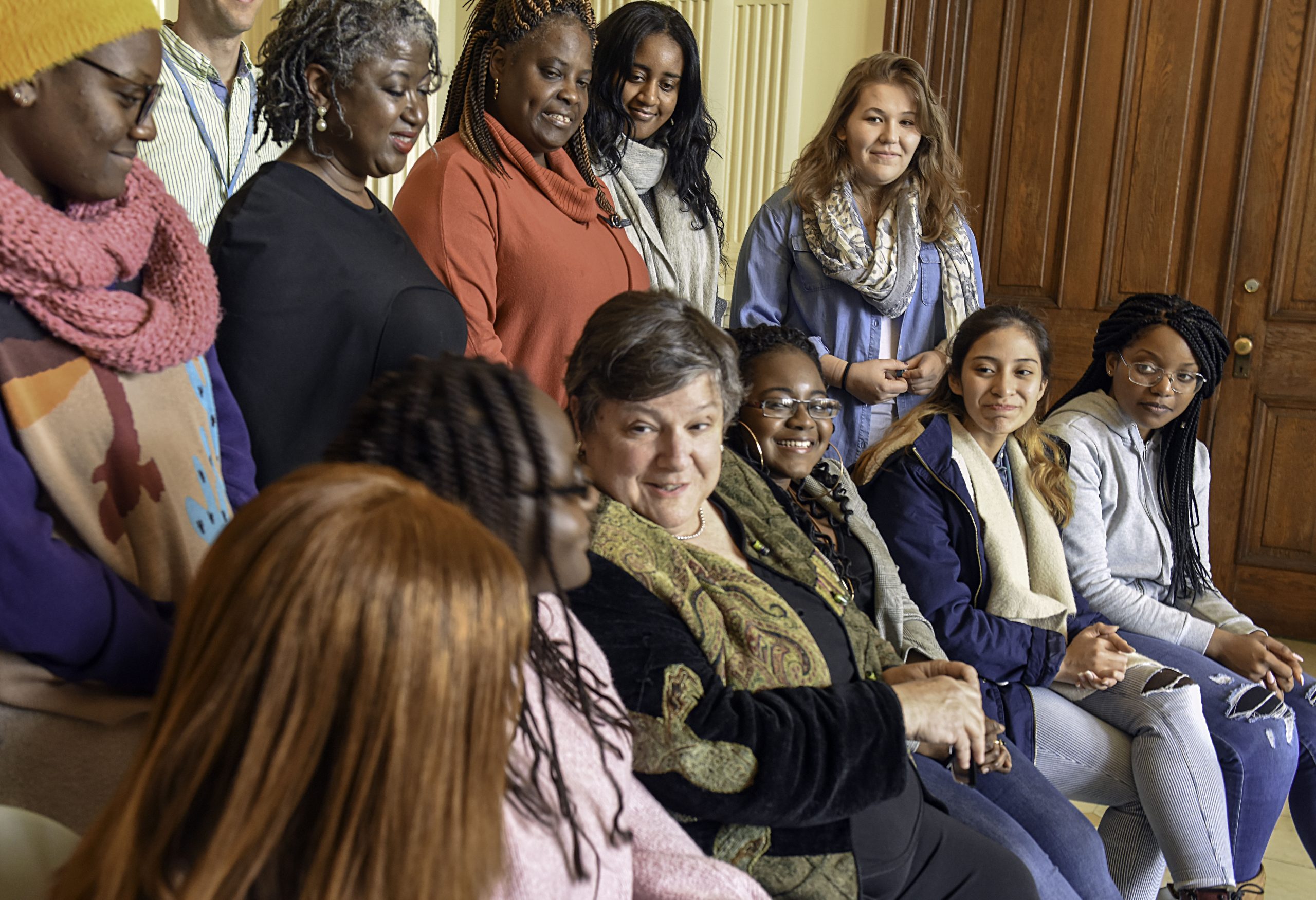
    Patricia McGuire has always been an outspoken advocate for her students at Trinity Washington University, a small, Catholic institution that serves largely Black and Hispanic women, just a few miles from the White House. She’s also criticized what she calls “the Trump administration’s wholesale assault on freedom of speech and human rights.”

    In her 36 years as president, though, McGuire told me, she has never felt so isolated, a lonely voice challenging an agenda she believes “demands a vigorous and loud response from all of higher education. “

    It got a little bit louder this week, after Harvard University President Alan Garber refused to capitulate to Trump’s demands that it overhaul its operations, hiring and admissions. Trump is now calling on the IRS to rescind Harvard’s tax-exempt status.

    The epic and unprecedented battle with Harvard is part of Trump’s push to remake higher education and attack elite schools, beginning with his insistence that Harvard address allegations of antisemitism, stemming from campus protests related to Israel’s bombardment of Gaza following attacks by Hamas in October 2023.

    Related: Become a lifelong learner. Subscribe to our free weekly newsletter featuring the most important stories in education.

    Garber responded that “no government — regardless of which party is in power — should dictate what private universities can teach, whom they can admit and hire, and which areas of study and inquiry they can pursue” — words that Harvard faculty, students and others in higher education had been urging him to say for weeks. Students and faculty at Brown and Yale are asking their presidents to speak out as well.

    Many hope it is the beginning of a new resistance in higher education. “Harvard’s move gives others permission to come out on the ice a little,” McGuire said. “This is an answer to the tepid and vacillating presidents who said they don’t want to draw attention to themselves.”

    Harvard paved the way for other institutions to stand up to the administration’s demands, Ted Mitchell, president of the American Council on Education, noted in an interview with NPR this week.

    Stanford University President Jonathan Levin immediately backed Harvard, noting that “the way to bring about constructive change is not by destroying the nation’s capacity for scientific research, or through the government taking command of a private institution.”

    Former President Barack Obama on Monday urged others to follow suit.

    A minuscule number of college leaders had spoken out before Harvard’s Garber, including Michael Gavin, president of Delta College, a community college in Michigan; Princeton University’s president, Christopher Eisgruber; Danielle Holley of Mount Holyoke; and SUNY Chancellor John B. King Jr. Of more than 70 prominent higher education leaders who signed a petition circulated Tuesday supporting Garber, only a handful were current college presidents, including Michael Roth of Wesleyan, Susan Poser of Hofstra, Alison Byerly of Carleton, David Fithian of Clark University, Jonathan Holloway of Rutgers University and Laura Walker of Bennington College.

    Speaking out and opposing Trump is not without consequences: The president retaliated against Harvard by freezing $2.2 billion in grants and $60 million in contracts to Harvard.

    Related: For our republic to survive, education leaders must remain firm in the face of authoritarianism

    Many higher ed leaders think it’s going to take a bigger, collective effort fight for everything that U.S. higher education stands for, including those with more influence than Trinity Washington, which has no federal grants and an endowment of just $30 million. It’s also filled with students working their way through school.

    About 15 percent are undocumented and live in constant fear of being deported under Trump policies, McGuire told me. “We need the elites out there because they have the clout and the financial strength the rest of us don’t have,” she said. “Trinity is not on anyone’s radar.”

    Some schools are pushing back against Trump’s immigration policies, hoping to protect their international and undocumented students. Occidental College President Tom Stritikus is among the college presidents who signed an amicus brief this month detailing concerns about the administration’s revocation of student and faculty visas and the arrest and detention of students based on campus advocacy.

    “I think the real concern is the fear and instability that our students are experiencing. It is just heartbreaking to me,” Stritikus told me. He also spoke of the need for “collective action” among colleges and the associations that support them.

    Related: Tracking Trump: His actions to abolish the Education Department, and more

    The fear is real: More than 210 colleges and universities have identified 1,400-plus international students and recent graduates who have had their legal status changed by the State Department, according to Inside Higher Ed. Stritikus said Occidental is providing resources, training sessions and guidance for student and faculty.

    Many students, he said, would like him to do more. “When I’m around students, I’m more optimistic for our future,” Stritikus said. “Our higher education system has been the envy of the world for a very long time. Clearly these threats to institutional autonomy, freedom of expression and the civil rights of our community put all that risk.”

    Back at Trinity Washington, McGuire said she will continue to make calls, talk to other college presidents and encourage them to take a stronger stand.

    “I tell them, you will never regret doing what is right, but if you allow yourself to be co-opted, you will have regret that you caved to a dictator who doesn’t care about you or your institution.”

    Contact Liz Willen at [email protected]

    This story about the future of higher education was produced by The Hechinger Report, a nonprofit, independent news organization focused on inequality and innovation in education. Sign up for the Hechinger newsletter.

    The Hechinger Report provides in-depth, fact-based, unbiased reporting on education that is free to all readers. But that doesn’t mean it’s free to produce. Our work keeps educators and the public informed about pressing issues at schools and on campuses throughout the country. We tell the whole story, even when the details are inconvenient. Help us keep doing that.

    Join us today.

    Source link

  • Doing right by the teachers who do right by the world

    Doing right by the teachers who do right by the world

    Key points:

    • Ethical PD is a call to action for all involved in teacher professional development
    • Key questions that unleash powerful PLCs
    • GenAI and cultural competency: New priorities in teacher preparation
    • For more news on teacher PD, visit eSN’s Educational Leadership hub

    Teachers are superheroes. Every day, they rise to the challenge, pouring their hearts into shaping the future. They stay late to grade papers, show up early to tutor struggling students, and spend their weekends planning lessons that inspire young minds. They do this because they believe in their mission–a mission to change lives, ignite passions, and build a better world.

    More News from eSchool News

    We are again in uncertain times. We again find ourselves dealing with sudden changes and uncertainty. We seem to be in a state of constant change and ambiguity.

    In today’s evolving educational landscape, effective student assessment goes beyond multiple-choice tests and letter grades. According to a recent study, over 60 percent of educators believe traditional assessments fail to fully measure student understanding.

    Holden, my 21-month-old, has fallen in love.  His early morning snack and “couch time” includes a dose of “Tiger!”  This is toddler for, “Mom, turn on Daniel Tiger’s Neighborhood.”

    The COVID-19 pandemic left an indelible mark on K-12 education, placing immense pressure on teachers as they adapted, literally overnight, to new methods of instruction.

    Spring brings not only showers and flowers, but it also brings the opportunity to interview for new education positions. Preparing for an interview involves several key steps that can significantly impact the outcome.

    STEM careers are on the rise. According to the U.S. Bureau of Labor Statistics, employment in STEM occupations is expected to grow by 10.4 percent from 2023 to 2033, compared to just 3.6 percent for non-STEM occupations.

    The U.S. Department of Education is giving state education agencies 10 days to certify that their schools do not engage in any practices that the administration believes illegally promote diversity, equity, and inclusion.

    COVID had already killed thousands of people in other countries and was spreading in the United States when a top federal health official said schools should prepare to offer “internet-based teleschooling” in case they had to close for a period of time.

    More than half of educators (62 percent) are already making use of AI at school, with more than one-quarter using it daily for work purposes, according to a Twinkl survey of more than 3,500 U.S. teachers.

    Many math tasks involve reading, writing, speaking, and listening. These language demands can be particularly challenging for students whose primary language is not English.

    Want to share a great resource? Let us know at [email protected].

    Source link

  • Leading (again) in uncertainty

    Leading (again) in uncertainty

    Key points:

    • Change has become the norm in our high-speed world
    • How school leaders can manage and control emotions
    • Em-pathy, not un-pathy, in school leadership
    • For more news on navigating change, visit eSN’s Educational Leadership hub

    We are again in uncertain times. We again find ourselves dealing with sudden changes and uncertainty. We seem to be in a state of constant change and ambiguity. The causes are different, but the feelings–and often our immediate reactions to these events–are the same.

    More News from eSchool News

    Teachers are superheroes. Every day, they rise to the challenge, pouring their hearts into shaping the future. They stay late to grade papers and show up early to tutor struggling students.

    In today’s evolving educational landscape, effective student assessment goes beyond multiple-choice tests and letter grades. According to a recent study, over 60 percent of educators believe traditional assessments fail to fully measure student understanding.

    Holden, my 21-month-old, has fallen in love.  His early morning snack and “couch time” includes a dose of “Tiger!”  This is toddler for, “Mom, turn on Daniel Tiger’s Neighborhood.”

    The COVID-19 pandemic left an indelible mark on K-12 education, placing immense pressure on teachers as they adapted, literally overnight, to new methods of instruction.

    Spring brings not only showers and flowers, but it also brings the opportunity to interview for new education positions. Preparing for an interview involves several key steps that can significantly impact the outcome.

    STEM careers are on the rise. According to the U.S. Bureau of Labor Statistics, employment in STEM occupations is expected to grow by 10.4 percent from 2023 to 2033, compared to just 3.6 percent for non-STEM occupations.

    The U.S. Department of Education is giving state education agencies 10 days to certify that their schools do not engage in any practices that the administration believes illegally promote diversity, equity, and inclusion.

    COVID had already killed thousands of people in other countries and was spreading in the United States when a top federal health official said schools should prepare to offer “internet-based teleschooling” in case they had to close for a period of time.

    More than half of educators (62 percent) are already making use of AI at school, with more than one-quarter using it daily for work purposes, according to a Twinkl survey of more than 3,500 U.S. teachers.

    Many math tasks involve reading, writing, speaking, and listening. These language demands can be particularly challenging for students whose primary language is not English.

    Want to share a great resource? Let us know at [email protected].

    Source link

  • 6 ways tech simplifies school communication and engagement

    6 ways tech simplifies school communication and engagement

    Key points:

    • Streamlining school communication empowers all district stakeholders
    • The dos and don’ts of parent-educator communication
    • Female district leaders target back-to-school priorities
    • For more on school communication, visit eSN’s Educational Leadership hub

    As technology trainers, we support teachers’ and administrators’ technology platform needs, training, and support in our district. We do in-class demos and share as much as we can with them, and we also send out a weekly newsletter. We coordinate a lot of different training sessions across our many different platforms, and support principals during staff meetings and on professional development days.  

    More News from eSchool News

    Many math tasks involve reading, writing, speaking, and listening. These language demands can be particularly challenging for students whose primary language is not English.

    As a career and technical education (CTE) instructor, I see firsthand how career-focused education provides students with the tools to transition smoothly from high school to college and careers.

    In recent years, the rise of AI technologies and the increasing pressures placed on students have made academic dishonesty a growing concern. Students, especially in the middle and high school years, have more opportunities than ever to cheat using AI tools.

    Math is a fundamental part of K-12 education, but students often face significant challenges in mastering increasingly challenging math concepts.

    Throughout my education, I have always been frustrated by busy work–the kind of homework that felt like an obligatory exercise rather than a meaningful learning experience.

    During the pandemic, thousands of school systems used emergency relief aid to buy laptops, Chromebooks, and other digital devices for students to use in remote learning.

    Education today looks dramatically different from classrooms of just a decade ago. Interactive technologies and multimedia tools now replace traditional textbooks and lectures, creating more dynamic and engaging learning environments.

    There is significant evidence of the connection between physical movement and learning.  Some colleges and universities encourage using standing or treadmill desks while studying, as well as taking breaks to exercise.

    This story was originally published by Chalkbeat. Sign up for their newsletters at ckbe.at/newsletters. In recent weeks, we’ve seen federal and state governments issue stop-work orders, withdraw contracts, and terminate…

    English/language arts and science teachers were almost twice as likely to say they use AI tools compared to math teachers or elementary teachers of all subjects, according to a February 2025 survey from the RAND Corporation.

    Want to share a great resource? Let us know at [email protected].

    Source link

  • With higher education under siege, college presidents cannot afford to stay silent 

    With higher education under siege, college presidents cannot afford to stay silent 

    Higher education is under siege from the Trump administration. Those opposing this siege and the administration’s attacks on democracy would do well to heed the wise advice of Benjamin Franklin given just prior to the signing of the Declaration of Independence in 1776: “We must all hang together, or most assuredly we shall all hang separately.” 

    This is particularly true right now for college and university presidents.

    College presidents come from a tradition based on the importance of ideas, of fairness, of speaking the truth as they understand it, whatever the consequences. If they don’t speak out, what will later generations say when they look back at this dark, dark time?

    The idea that Trump’s attacks on higher education are necessary to combat antisemitism is the thinnest of covers, and yet only a very few college presidents have been brave enough to call this what it is. 

    The president and those around him don’t care about antisemitism. Trump said people who chanted “Jews will not replace us” were “very fine people”; he dined with avowed antisemites like Nick Fuentes and Ye (Kanye West). 

    Marjorie Taylor Greene blamed the California wildfires of 2018 on space lasers paid for by Jewish bankers. Robert Kennedy claimed that Covid “targeted” white and Black people but spared Ashkenazi Jews and Chinese people. The Proud Boys pardoned by Trump for their part in the January 6 insurrection have routinely proclaimed their antisemitism; they include at least one member who has openly declared admiration for Adolf Hitler.

    Fighting antisemitism? That was never the motive for the Trump administration’s attacks on colleges and universities. The motive was — and continues to be — to discipline and tame institutions of higher learning, to bring them to heel, to turn them into mouthpieces of a single ideology, to put an end to the free flow of ideas under the alleged need to combat “wokeism.”

    Related: Interested in innovations in the field of higher education? Subscribe to our free biweeklyHigher Education newsletter.

    Columbia University has been a prime target of the Trump administration’s financial threats. I’ve been a university provost. I’m not naïve about the tremendous damage the withholding of federal support can have on a school. But the fate of Columbia should be a cautionary tale for those who think keeping their heads down will help them survive. (The Hechinger Report is an independent, nonprofit, nonpartisan organization based at Teachers College, Columbia University.) 

    Columbia was more than conciliatory in responding to concerns of antisemitism. The administration suspended two student groups, Students for Justice in Palestine and Jewish Voice for Peace, for holding rallies that allegedly included “threatening rhetoric and intimidation.” 

    They suspended four students in connection with an event featuring speakers who “support terrorism and promote violence.” 

    They called in police to dismantle the encampment created to protest the War in Gaza. Over 100 protesters were arrested

    They created a Task Force on Antisemitism, and accepted its recommendations. They dismissed three deans for exchanging text messages that seemed to minimize Jewish students’ concerns and referenced antisemitic tropes. 

    President Minouche Shafik resigned after little more than a year in office. (Last week, the university’s interim president, Katrina Armstrong, also resigned.) In September 2024, the ADL reports, the university went so far as to introduce “new policies prohibiting the use of terms like ‘Zionist’ when employed to target Jews or Israelis.” 

    None of this prevented the Trump administration from cancelling $400 million worth of grants and contracts to Columbia — because responding to antisemitism was never the real impetus for the attack. 

    Related: Tracking Trump: His actions to dismantle the Education Department, and more

    Was Marjorie Taylor Greene asked to renounce antisemitism as a condition for her leadership in Congress? 

    Was Robert Kennedy asked to renounce antisemitism in order to be nominated for a Cabinet position?

    Were the Proud Boys asked to renounce antisemitism as a condition for their pardoning? 

    This is an attack on higher education as a whole, and it requires a collective defense. Columbia yesterday. Harvard today, your school tomorrow. College presidents cannot be silent as individual schools are attacked. They need to speak out as a group against each and every incursion. 

    They need to pledge to share resources, including financial resources, to resist these attacks; they should mount a joint legal resistance and a joint public response to an attack on any single institution. 

    These days, as many have observed, are much like the dark days of McCarthyism in the 1950s. In retrospect, we wonder why it took so long for so many to speak up. 

    Today we celebrate those who had the moral strength to stand up right then and say, “No. This isn’t right, and I won’t be part of it.” 

    The politicians of the Republican Party have made it clear they won’t do that, though most of them understand that Trumpism is attacking the very values — freedom, democracy, fairness — that they celebrate as “American.” 

    They have earned the low opinion most people have of politicians. But college and university presidents should — and must — take a stand. 

    Rob Rosenthal is John E. Andrus Professor of Sociology, Emeritus, at Wesleyan University. 

    Contact the opinion editor at [email protected].

    This story about higher education and the Trump administration was produced byThe Hechinger Report, a nonprofit, independent news organization focused on inequality and innovation in education. Sign up for Hechinger’sweekly newsletter.
    The Hechinger Report provides in-depth, fact-based, unbiased reporting on education that is free to all readers. But that doesn’t mean it’s free to produce. Our work keeps educators and the public informed about pressing issues at schools and on campuses throughout the country. We tell the whole story, even when the details are inconvenient. Help us keep doing that.

    Join us today.

    Source link

  • ‘Building Balance’ at Harvard: Allison Pillinger Choi’s bid for alumni leadership

    ‘Building Balance’ at Harvard: Allison Pillinger Choi’s bid for alumni leadership

    Since its founding in 1836, the Harvard Alumni Association (HAA) has sought to “renew that interest in Harvard’s welfare and glory which separation and absence have hitherto caused too long and lamentably to slumber.”

    Today, as Harvard faces mounting challenges to its foundational commitment to Veritas (Truth) — steadily being replaced, it seems, by Pontius Pilate’s cynical sneer: Quid est veritas? (What is truth?) — a renewed interest among alumni in their alma mater’s “welfare and glory” is more vital than ever.

    And the upcoming HAA Board elections offer Harvard alumni the perfect place to start. The task is to elect leaders who will champion free expression, viewpoint diversity, civil discourse, and academic freedom — the very tools that make the pursuit of Veritas possible.

    Among the candidates seeking an elected director position, Allison Pillinger Choi, A.B. 2006, stands out with a compelling vision. Under the banner of “Building Balance,” Choi is campaigning for a Harvard where “all truth-seeking ideas — whether conservative, liberal, or otherwise — are heard, valued, and respected.”

    Choi’s life story exemplifies the very balance she aims to promote. Born and raised in South Florida to a Korean immigrant mother and a third-generation Jewish American father, she mastered the art of equilibrium early on. This instinct for poise carried her through Harvard, where she balanced an economics degree, Division I varsity tennis, editorship on The Crimson’s business board, and shifts at various Cambridge eateries.

    Allison Pillinger Choi with her husband, Brian, and two children in the Dunster House library at Harvard. 

    After a successful postgraduate career in finance and fitness — balancing checkbooks and barbells — she now lives in New York with her husband and two children while serving on local nonprofit boards dedicated to the arts, civics, and the environment. Most notably, she is the co-founder of Experiment in Dialogue, an initiative promoting conversations across ideological divides.

    Choi is also the author of the book “Bleeding Heart Conservatives,” a defense of compassionate conservatism, and a regular contributor to City Journal and the San Francisco Chronicle, where she writes on polarization and viewpoint diversity.

    FIRE recently sat down with Choi to discuss her campaign for the HAA Board, her thoughts on free expression at Harvard, and how she envisions bringing balance to her alma mater. Below is our conversation, edited for readability. 


    How has your experience at Harvard, both as a student and alum, shaped your views on free expression and intellectual diversity?

    As an undergraduate, I sensed unspoken limits on which political views were acceptable. In one instance, I remember taking a class on labor markets where the professor made it clear how he felt about unions. While I respected his research and affable style of teaching, as the daughter of a union worker, I knew the issue was more complex. 

    My father had explained to me and my brother that while unions can be a force for good, they also have downsides. I knew there was more to the argument than was offered in class, but I didn’t want to cross that invisible line — so I often just stayed quiet, went along with the prevailing view, and answered questions accordingly.

    That experience stayed with me. Over the years, as an alum, I’ve heard even more troubling stories — students and faculty feeling pressured to hide their beliefs or adjust how they talk about certain issues to avoid backlash. It made me realize that maybe I was part of the problem by staying silent. 

    Now, I want to be part of the solution — not only by encouraging people to speak up but also by helping others see that viewpoint diversity is essential for genuine intellectual growth.

    Your campaign focuses on “Bringing Balance.” Can you explain what that means and why you think it’s important right now, especially at Harvard?

    The theme of my campaign, “Building Balance,” carries several layers of meaning. For one, it’s about fostering a diversity of viewpoints. This doesn’t mean insisting on a strict 50/50 split or symmetrical representation. Rather, it’s about broadening the spectrum of perspectives and opinions. It ensures that a wide range of voices are present. This approach helps prevent institutions from falling into the trap of echo chambers, where only reinforcing viewpoints are heard and where growth is limited.

    “Building Balance” also refers to finding stability. Many higher education institutions today are navigating heightened tensions. I believe that embracing viewpoint diversity — by welcoming advocates from various personal and political backgrounds — can contribute to a healthier, more stable environment where all sincere, truth-seeking perspectives are respected and considered.

    Finally, “Building Balance” is about recognizing and strengthening the extraordinary elements present at Harvard. It’s not about dismantling, it’s about building upon a strong foundation. I believe that viewpoint diversity, civil discourse, and academic freedom are the foundational elements of our university community, and integral to continued success.

    What role do you see alumni playing in promoting free expression and viewpoint diversity at Harvard?

    Alumni have numerous ways to contribute to the promotion of free expression and viewpoint diversity at Harvard. One of the most simple and effective actions is to just show up. Attend HAA events and broader Harvard community gatherings that highlight heterodox thinkers and speakers. And why not invite an alumni friend along? Extra credit if that friend brings a different political perspective!

    The HAA is always looking for new ways to engage alumni and increase participation. With the growing number of initiatives supporting the classical liberal values of freedom and expression at Harvard, our community has more opportunities for anyone eager to champion viewpoint diversity. As an HAA elected director, I would support and expand these initiatives.

    One of the unique — and often overlooked — aspects of being a viewpoint diversity advocate is that there’s no requirement to hold any particular opinion. All that’s needed is curiosity. However, if a viewpoint diversity advocate does have strong convictions, that’s perfectly fine, too. The key is to approach differing views with humility and charity. With these qualities, every alumnus is capable of both promoting and exercising free expression and viewpoint diversity.

    Indeed, it’s an “exercise.” As Harvard professor Eric Beerbohm, head of the university’s new Civil Discourse Initiative, aptly puts it, “The ability to engage in empathetic disagreement is like a muscle — it grows stronger with deliberate practice. These kinds of scenarios, where participants are challenged to consider new perspectives and make tough decisions, provide exactly that kind of exercise.”

    How can the HAA better engage alumni who feel disconnected or frustrated with the current campus climate?

    As an elected director, I would love to help the HAA deepen alumni engagement and re-engage those who feel disconnected or frustrated. One effective approach is to expand the variety of event themes, particularly by hosting panel discussions that feature diverse viewpoints on a range of important topics. 

    While the panelists would be experts in their fields, each would offer a unique perspective and set of beliefs. The common thread among them would be their shared commitment to open inquiry and civil discourse.

    These events could be modeled after the spirit of professor Michael Sandel’s renowned undergraduate course, “Justice,” one of Harvard’s most popular classes. In Sandel’s lectures, he regularly invited professors with opposing viewpoints to debate controversial topics, with the goal of seeking truth. Professors like Sandel understand that complex issues rarely have clear-cut answers. 

    It is only through the rigorous process of challenging and questioning that we improve our understanding, move closer to truth, and expand our communities. Alumni groups could carry forward Sandel’s legacy of viewpoint diversity by hosting events where renowned thinkers debate significant topics, fostering a space for respectful and productive dialogue among heterodox thinkers and doers.

    If elected, what would success look like for you at the end of your term as an elected director?

    If elected, success at the end of my three-year term would mean accomplishing at least two key goals. The first would be seeing more HAA volunteers actively contributing to viewpoint diversity initiatives within their areas of interest. With roughly 200 Harvard clubs and 60 shared interest groups covering a range of professional fields, academic disciplines, and personal identity backgrounds, there is so much opportunity to foster diverse perspectives! 

    While these HAA groups share common interests, each alumnus brings something unique. I believe we can proactively seek and encourage a diversity of viewpoints across our HAA communities. 

    The second goal is to establish an alumni event series that pays homage to the deep friendship between Justices Ruth Bader Ginsburg and Antonin Scalia — both former Harvard Law students. Their remarkable bond transcended the controversial issues they often disagreed on in their judicial decisions. 

    United by their shared love of country and opera, among other interests, they demonstrated how mutual respect and admiration can flourish despite ideological differences. I want to celebrate this sentiment through events that feature speakers of opposing views, followed by a post-debate social.


    Allison Pillinger Choi’s candidacy for HAA Board is a call to action –– to awaken alumni from their “slumber” and take an interest in the “welfare and glory” of Harvard. If you are a Harvard alum and are interested in supporting Choi’s vision for “Building Balance,” be sure to make your voice heard in this important election. 

    The HAA Board election begins on April 1 and will remain open until 5 p.mEST on May 20th. All Harvard degree holders as of Jan. 1, 2025 are eligible to vote. Alumni can cast their ballots online, via the alumni portal, or by paper ballot, which you will receive in the mail, to fill six openings among the HAA elected directors.

    Source link

  • Humans in an AI world

    Humans in an AI world

    Key points:

    Like it or not, AI is evolving, and it is cementing its place in education. And the CoSN 2025 Conference is preparing attendees to meet the AI challenge head-on, focusing this year’s conference theme on human leadership in an AI world.

    Register here to attend this year’s conference in Seattle.

    Ken Shelton, an independent consultant, speaker, advisor, and strategist, opens the conference on Monday, March 31 with his keynote, Reimagining Learning with AI: A Path to Empowerment. Shelton will explore the promises and perils of leveraging AI in education and will delve into strategies for maximizing AI’s benefits while addressing its risks, ensuring that AI becomes a tool for true empowerment in education.

    On Tuesday, April 1, panelists Lindsay E. Jones, CEO of CAST, Lindsay Kruse, CEO of All Means All, and Rachell Johnson, director of assistant technology at SCATP, will participate in a general session, Leadership, Not Bystanders, moderated by Sarah Radcliffe, director of Future Ready Learning in the School District of Altoona. Panelists will discuss how can to ensure that no student is overlooked as AI continues to reshape education.

    The closing keynote on Wednesday, April 2, Beyond the Algorithm–Building Trust, Access, and Purpose in AI-Enhanced Education, features Richard Culatta of ISTE + ASCD, Victor Lee of the Graduate School of Education at Stanford University, Pati Ruiz, EdD, of Digital Promise, and Kris J. Hagel of the Peninsula School District. The discussion will focus on ensuring AI enhances, rather than diminishes, human potential in education.

    Workshops include:

    • Student data privacy
    • Generative AI implementation
    • Education leadership in the digital age
    • AI and leadership
    • Organizational change management for digital transformation

    Spotlight sessions cover cybersecurity and physical security, tackling cell phones in classrooms, top edtech trends in 2025, edtech and AI quality indicators, and FERPA.

    Wondering what the CoSN conference has for you?

    Chief Technology Officers 

    • Learn proven strategies for getting the dollars you need to build the infrastructure for today and tomorrow
    • Connect with your peers and build your community of practice
    • Discover how to stretch scarce resources to make the greatest impact on teaching and learning Instructional Technology Directors

    Instructional Technology Directors 

    • Hear about new tools and models for engaging students and personalizing instruction
    • Strategize about how to bridge the gap between the technical and instructional silos
    • Improve your leadership skills and how to scale technology beyond islands of innovation

    Superintendents, District Teams, and Education Service Agencies 

    • Hear from thought leaders on how to create a vision for digital conversion and continuously improving innovative culture in your district
    • Learn tips for breaking down the silos and leveraging technology to enable a 21stcentury school system
    • Share creative and strategic solutions about how to create robust learning environments at school and at home 

    Industry, Government, and Nonprofit Representatives 

    • Understand what is keeping school system technology leaders up at night 
    • Share information on emerging tools and services for learning
    • Learn about better strategies and models for implementing, maintaining, and evaluating technology for learning
    Laura Ascione
    Latest posts by Laura Ascione (see all)

    Source link

  • OPINION: Here’s why we cannot permit America’s partnership with higher education to weaken or dissolve

    OPINION: Here’s why we cannot permit America’s partnership with higher education to weaken or dissolve

    Abrupt cuts in federal funding for life saving medical research. Confusing and misleading new guidance about campus diversity programs. Cancellation, without due process, of hundreds of millions of dollars in federal grants and contracts held by a major university. Mass layoffs at the Education Department, undermining crucial programs such as federal student aid.

    All of this, and more, in the opening weeks of the second Trump administration.

    The president has made clear that colleges and universities face a moment of unprecedented challenge. The partnership the federal government forged with American higher education long ago, which for generations has paid off spectacularly for our country’s civic health, economic well-being and national security, appears in the eyes of many to be suddenly vulnerable.

    America must not permit this partnership to weaken or dissolve. No nation has ever built up its people by tearing down its schools. Higher education builds America — and together, we will fight to ensure it continues to do so.  

    Related: Tracking Trump: his actions on education    

    Some wonder why more college and university presidents aren’t speaking out. The truth is, many of them fear their institutions could be targeted next.

    They are also juggling immense financial pressures and striving to fulfill commitments to teaching and research.

    But the American Council on Education, which I lead, has always stood up for higher education. We have done it for more than a century, and we are doing it now. We will use every tool possible — including litigation, advocacy and coalition-building — to advance the cause.

    ACE is the major coordinating body for colleges and universities. We represent institutions of all kinds — public and private, large and small, rural and urban — with a mission of helping our members best serve their students and communities.

    Let me be clear: We welcome scrutiny and accountability for the public funds supporting student aid and research. Our institutions are subject to state and federal laws and must not tolerate any form of discrimination, even as they uphold freedom of expression and the right to robust but civil protest. 

    We also know we have much work to do to raise public confidence in higher education and the value of a degree.

    However, we cannot allow unwarranted attacks on higher education to occur without a vigorous and proactive response.

    When the National Institutes of Health announced on Feb. 7 a huge cut in funding that supports medical and health research, ACE joined with the Association of American Universities, the Association of Public and Land-grant Universities and a number of affected universities in a lawsuit to stop this action.

    ACE has almost never been a plaintiff in a lawsuit against the federal government, but the moment demanded it. We are pleased that a federal judge has issued a nationwide preliminary injunction to preserve the NIH funding.

    When the Education Department issued a “Dear Colleague” letter Feb. 14 that raised questions about whether campus programs related to diversity, equity      and inclusion would be permissible under federal law, ACE organized a coalition of more than 70 higher education groups calling for the department to rescind the letter.      

    We raised concerns about the confusion the letter was causing. We pointed out that the majority opinion from Chief Justice John Roberts in the Students for Fair Admissions case acknowledged that diversity-related goals in higher education are “commendable” and “plainly worthy.”    

     We invited the department to engage with the higher education community to promote inclusive and welcoming educational environments for all students, regardless of race or ethnicity or any other factors. We remain eager to work with the department. 

    Related: Fewer scholarships and a new climate of fear follow      the end of affirmative action

    Unfortunately, in recent days the administration has taken further steps we find alarming.

    ACE denounced the arbitrary cancellation of $400 million in federal grants and contracts with Columbia University. Administration officials claimed their action was a response to failures to adequately address antisemitism at Columbia, though it bypassed well-established procedures for investigating such allegations. (The Hechinger Report is an independent unit of Teachers College, Columbia University.)

    Ultimately, this action will eviscerate academic and research activities, to the detriment of students, faculty, medical patients and others.

    Make no mistake: Combating campus antisemitism is a matter of utmost priority for us. Our organization, along with Hillel International and the American Jewish Committee, organized two summits on this topic in 2022 and 2024, fostering important dialogue with dozens of college and university presidents.

    We also are deeply concerned about the letter the Trump administration sent to Columbia late last week that makes certain demands of the university, including a leadership change for one of its academic departments. To my mind, the letter obliterated the boundary between institutional autonomy and federal control. That boundary is essential. Without it, academic freedom is at risk.

    Meanwhile, layoffs and other measures slashing the Education Department’s workforce by as much as half will cause chaos and harm to financial aid and other programs that support millions of students from low- and middle-income families. We strongly urge the administration to change course and Congress to step in if it does not.

    Despite all that has happened in the past several weeks, we want President Trump and his administration to know this: Higher education is here for America, and ready to keep building. Colleges and universities have long worked with the government in countless ways to strengthen our economy, democracy, health and security. We cannot abandon that partnership. We must fortify it. 

    Ted Mitchell is president of the American Council of Education in Washington, D.C.

    Contact the opinion editor at [email protected].

    This story about academic freedom was produced by The Hechinger Report, a nonprofit, independent news organization focused on inequality and innovation in education. Sign up for Hechinger’s weekly newsletter.

    The Hechinger Report provides in-depth, fact-based, unbiased reporting on education that is free to all readers. But that doesn’t mean it’s free to produce. Our work keeps educators and the public informed about pressing issues at schools and on campuses throughout the country. We tell the whole story, even when the details are inconvenient. Help us keep doing that.

    Join us today.

    Source link

  • The Leadership Skills Presidents Need Right Now: The Key

    The Leadership Skills Presidents Need Right Now: The Key

    As college presidents face increasing scrutiny from state and national lawmakers, building a strong cabinet-level team is critical, according to Jorge Burmicky, assistant professor in education leadership and policy studies in the School of Education at Howard University.

    Burmicky is one of three researchers who identified the core competencies of the modern college presidency. In a recent episode of The Key, Inside Higher Ed’s news and analysis podcast, Burmicky noted, “There’s always been a lot of pressure to be a college president, but it really has become an impossible job.” 

    A new leader’s ability to assemble a strong team as soon as they start the job will help fill gaps in their individual skill sets, he said. “It’s not if an emergency happens—it’s when it happens, and you have to have a good team that is going to have your back that you trust and can help you in those areas where you don’t feel as confident.”

    College presidents rated trustworthiness as the most important competency for effective leadership in higher education; however, students surveyed for Inside Higher Ed’s annual Student Voice survey ranked presidents among the least trusted people on their campus. 

    Burmicky isn’t surprised by this gap between presidents’ intentions and students’ perceptions. “Presidents work really hard to build trust, and you would think that because they’re working so hard and they value it so greatly that we would see a narrower difference,” he said. “But the reality is that so much of the communication that goes to different constituents varies. We’re in an era when students really want to understand what’s happening right now.” 

    Blame for structural issues that are beyond the president’s control—like the botched FAFSA rollout—often falls at the feet of presidents and other institutional leaders, Burmicky added. “There’s clearly a lot of resentment.” 

    Students are just one group of constituents college presidents must build trust with, however. Declining trust in higher education in general is one of Burmicky’s biggest concerns for the sector. Better communicating how institutions operate would help address public distrust, he said. 

    “We like to point fingers at the president, but the reality is there are [more people] than just the president who make decisions at a university—there’s also the Board of Trustees or the Board of Regents.”

    Listen to the full interview between Jorge Burmicky and Sara Custer, editor in chief at Inside Higher Ed, and find more episodes of The Key here.

    Source link

  • The four contemporary mindsets of leadership

    The four contemporary mindsets of leadership

    Following the launch of Advance HE’s Framework for Leading in Higher Education, Romy Lawson, Senior Deputy Vice Chancellor at Flinders University in Australia, shares thoughts on contemporary leadership

    When I reflect on my career, and particularly my leadership development, I must admit it was rather adhoc and self-motivated instead of being part of a planned and structured program. 

    As I believe is probably the case for many others, I learnt as a follower. I learnt on the job through doing. I learnt through assimilating and accommodating. I learnt by being challenged. I learnt from mentors, and occasionally I learnt through being trained. 

    These are all very valuable ways to learn but I question if I had had a framework to use as a reference point, could I have planned my development in a more productive fashion? Self-assessing my competencies in different areas, seeking out opportunities to optimise strengths and work on areas of development, as a tool to help showcase my ability and as a way to support career choices.

    Framework for leadership

    I think having a framework is even more important in this day and age where many top-down leadership models of leader-follower are being left behind for a leader-leader model. A model where decision-making authority is delegated down to where the information originated (control), where focus is given on increasing competence and knowledge so teams can make good decisions (competence), and ensuring staff are clear on the organisation’s goals to align their decisions (clarity).

    This shift in leadership was, in part, derived from the black swan event of the Covid-19 pandemic that made us appreciate that there are times when there just is not a blueprint. During times like this, leaders must adapt, transition, transform, shift and adjust. 

    The experience of leading in a university during a pandemic made me question whether the role of a leader has changed permanently. I adopted four contemporary leadership mindsets that I believe are essential for the modern-day leader.

    1. Power of doubt

    During Covid, the one certainty was uncertainty. This meant the ability to predict what was going to happen and, subsequently, knowing how and what to plan became very challenging. During this time leaders still had to make decisions, often with limited information, and under immense time pressures. In hindsight, some of these decisions were not always the right decisions, or only had value for a short time span. 

    The power of doubt is when leaders are willing to constantly question themselves, to doubt their decisions, and have the humility to see when decisions are wrong or only appropriate for a moment in time. Modern leaders need to be open to reversing or changing their decisions. Adopting this approach allows leaders to be more agile as well as more relatable.

    2. Incomplete leader (complete team)

    The second important leadership shift is the move from leader as master to that of the incomplete leader (complete team). Leaders need to acknowledge that in some areas they will always have more to learn, or they have areas of weakness. Leaders need to have the self-awareness to understand that they are always incomplete. 

    The way to achieve completeness is through building a complete team; a group that augments the leader’s skills and compensates for their limitations. One of the most important roles of the leader is to purposefully select and assemble a team of people representing a wide range of skills and abilities suitable for the current climate. Leaders then need to be a part of this team, rather than an external leader, for it to function most effectively.

    3. Engagement

    Leaders need to recognise the value of their people in a direct and intentional way. It is time for leaders to open the doors to connect, engage, listen and understand where people are coming from; their intentions.

    Leaders need to adopt meaningful dialogue rather than broadcasting; to strive to understand before being understood; and when they think they understand, to listen twice as hard. This is true engagement.

    4. Empowering

    Empowering people is the last leadership approach that is fundamental.

    Staff often experience frustrations in their work environments that make their job hard or annoying. These may be simply the equivalent of “pebbles in their shoes”, where it is possible for an individual to fix the problem and remove the pebble themselves. However, frequently staff do not take this initiative, because they need to feel they have the power to stop and improve something themselves or the tools to support them in solving the issue. Often in these situations what is most important to the staff member is for the pebble to be acknowledged by others before they are ready to sort it out themselves. 

    Challenging people to find their pebbles empowers them and providing tools helps the pebbles to be recognised and the solution celebrated. 

    Repositioning leadership

    The Framework for Leading in Higher Education helps us to reposition leadership to this more contemporary perspective. It builds from the concept of knowing, being, doing, which is an Aboriginal model of leadership. This model sees leaders gaining an understanding that they translate into application and in time these actions become behaviour, then values and mindsets. 

    The Framework for Leading in Higher Education provides guidance for leaders at any level to enhance their ‘being’ as a leader. 

    Learn more about Advance HE’s Framework for Leading in Higher Education and download the resource for free now.

    Advance HE also offers leadership development designed for staff working in higher education. Explore the opportunities.

    Romy Lawson is the Senior Deputy Vice Chancellor at Flinders University. She has been actively involved in higher education in both the UK and Australia. She is a member of Advance HE’s Steering Group for the Framework for Leading in Higher Education and sits on Advance HE’s Leadership & Management Advisory Board. She is also Chair of Universities Australia DVCA Executive and Co-Chair of UA Women.

    Do you have an idea for a story?
    Email [email protected]

    Source link