Higher education is designed to be a space for open inquiry and disagreement, but encouraging students to engage in constructive dialogue can be a challenge.
A January survey by the American Association of Colleges and Universities found that a majority of faculty believe they should intentionally invite student perspectives from all sides of an issue, and that they encourage mutually respectful disagreement among students in their courses.
Students, however, are less likely to say that they’re exercising these muscles. A 2022 survey by the Foundation for Individual Rights and Expression found that 63 percent of students felt too intimidated to share their ideas, opinions or beliefs in class because they were different than those of their peers. About 84 percent of respondents agreed that students need to be better educated on the value of free speech and the diversity of opinion on campus.
A course at the Joan B. Kroc School of Peace Studies at the University of San Diego pushed master’s students out of their comfort zone by engaging them in challenging and vulnerable conversations. The class, Crossing the Divide, taught by Sarah Federman, associate professor of conflict resolution, took nine students on a two-week trip across the southern U.S. in May 2024, starting in California and ending in Washington, D.C. Throughout the journey, students visited historic sites, interacted with strangers, discussed polarizing topics and learned to develop empathy across differences.
In this episode of Voices of Student Success, host Ashley Mowreader spoke with Federman to learn more about her class, the trip and some of the lessons she learned about engaging students in constructive dialogue.
An edited version of the podcast appears below.
Q: We are talking today about a course that you created that is designed to help students create connections during polarizing times. I wonder if you can back us up to the genesis of this course and where the idea originally came from.
Sarah Federman, associate professor of conflict resolution at the Joan B. Kroc School of Peace Studies, University of San Diego
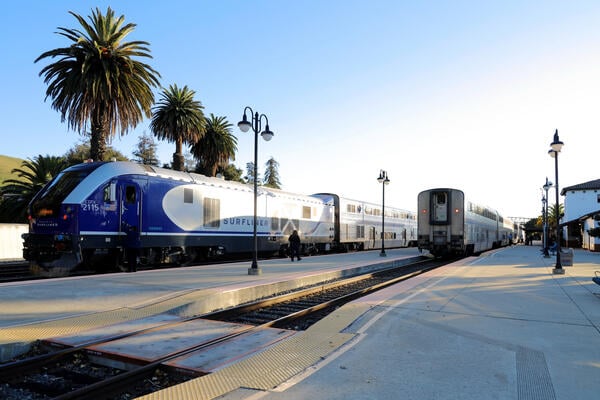
A: Sure. So I had been working on a book about the French National Railways, its role in the Holocaust and how it tried to make amends. I won this Amtrak writing residency—which doesn’t exist anymore, which is a big tragedy; I hope they start it again.
I got to crisscross the United States on a train while editing the book. And I didn’t really get much editing done, because it was so much fun just seeing the country, binge-watching the country, talking to strangers, getting off at the stops. And I thought, oh, man, if I ever have a chance to teach—because I didn’t have a teaching job at that point—I was like, I want to pick everybody on the train. This would be the best classroom. So that’s where the idea came from.
Q: Why a train specifically? There are a lot of ways to get across the U.S., and our rail system isn’t the best compared to some other nations. Why was it so inspiring to use the train?
A: I don’t know if you’ve noticed how loud flights are. I put in my earplugs because it’s so loud, if you even wanted to talk to somebody—and you only have the person next to you. You’re trying to decide if you want to talk to this person for six hours or not. It’s much more closed, and you can’t see much for most of the flight, so that doesn’t really allow the kind of socialization and visibility, although you do get to see below you and the sense of what you’re flying over.
The car, you just have your road buddies, so maybe you’ll talk to people at a gas station or a restaurant or an electric charging station, but you can choose not to. But people who go on the train for these longer trips have chosen it for the experience, and so there’s an openness and an adventure attitude that makes people really friendly. So that’s why train.
Our trains are not fast. We don’t have high-speed trains, so you see the country kind of slowly, which is actually really nice. You roll by towns, and you get to think about the people. In France, you know, you go by so fast you can barely see anybody you know, because your eyes are like [darting].
Q: That’s awesome. Tell me about the course design when it came to building this and mapping out, literally, where you wanted students to go.
A: I actually hired a student to help me. We spent a year and a half planning this trip, because the trains stop at weird times—like, we really wanted to go to Yuma, for example, but the train arrived there at 3 a.m.; we’re not gonna arrive at 3 a.m. So we had to pick some of [the destinations] based on when the trains left, and also what we could do in these different sites and how different they would be, one from the other, and how different they would be for the students. Like, what would be the most different we could expose you to? So those were all the things we had in mind.
We started in San Diego, and we took a train up to Los Angeles—and that train is amazing. You just watch surfers and dolphins, all the way up to L.A., and then there were all these people on the train. So we talked to those strangers. And then L.A., Tucson, Houston, New Orleans, Birmingham, took a stop in Montgomery, and then D.C., where we ended in front of the Constitution and the Declaration of Independence [at the National Archives]. But in each of those stops, we [got] off and went to smaller places.
Q: When it came to preparing students to engage with others, what kinds of conversations were you hoping they had? Was there any sort of guidance on how to engage with other people?
A: [The students] were most nervous about talking to strangers. They’re like, “We’re gonna have to do what?” They were terrified.
I remember the first night we were in the L.A. train station getting ready for our first overnight train to Tucson, and like, that was just the nerves of, like, “Oh my god, oh my god. What are they gonna say?”
We read a really helpful book by Mónica Guzmán, [I Never Thought of It That Way] [that] talked about how to talk [and] why you want to talk across difference. It’s a cute book. It’s really accessible. There are some drawings in it and the students really connected with that.
Once they got over [the fear], it was really easy, but in a way, they almost needed the invitation to talk to strangers from me. I can tell you about some of the conversations, but that was the biggest fear.
One thing I’ll say is I knew that the strangers would enrich their lives, but I did not anticipate how much [the students] would enrich the other people on the train. I saw them lighting up other people. We’re nervous about how other people are gonna see us, but we also don’t realize the gift we are to other people.
Q: That’s really cool. I was also curious about the students. You took nine students in the spring of 2024. Were they from San Diego? Were they from everywhere? Was this a trip that was exposing them to new and different parts of the U.S.?
A: Great question, because I really was wondering that, too.
Some of the students had really traveled, but they hadn’t traveled in the U.S., in the same way, or they’d driven across maybe quickly. We had a few U.S. citizens, a Canadian, [all] different ages, like 22 to … we had some older folks.
It was a really nice mix, but again, people haven’t really seen our country in that way, or we’re just trying to get from point A to point B, we’re just trying to see what this country looks like. So I think for almost all of us [it was new]. I actually hadn’t been to half the stops.
Q: How was that for you, navigating those spaces for the first time alongside your students?
A: It was a good lesson. They were so great, so they rolled with it. But I was like, it would have been really helpful to know … I mean, they’re so competent, and we all figured things out, but I think it would have been [better] if I’d known the space better. Next time I’ll be able to get different speakers [to speak with students], knowing where we have more time, knowing distances.
But actually, I think in a way, it made me fresh, too, and it kept me open. Like, “OK, I’m the leader, in a sense, but we’re co-learning and co-creating this experience.”
Q: One of my favorite parts of student experiential learning is that reflection piece—getting students to sit down, maybe write about it or talk through those experiences. What was that reflection piece like?
A: I gave everyone a journal with a sticker for our class, and everyone had writing assignments. One student made this beautiful scrapbook; they took napkins from places and [wrote] all over.
Every morning on WhatsApp, I’d write the writing prompt of the day that would have them reflect upon where we’d been. Did they anticipate a place to be a particular way and then it wasn’t?
The most surprising outcome of the writing exercise for me was I asked them at the end to rate which cities they would want to live in, and for many students, Birmingham, Ala., ended up in the top two.
Q: Wow. Why was that?
A: I know, and you wouldn’t think that from students who are studying in San Diego on the coast. You’d think they’d want to be on the coast, maybe. But they thought [Birmingham] was super livable. They’d made all these great parks. It was affordable, it was relaxed, it had great arts, it had a university. And so they’re like, “I can live here.” And I know one of the stresses for younger people is like, “How can I afford to live in a place?” And they saw it, and they’re like, “I could live and thrive here.” And that helped me understand what was on their minds.
Q: We talk a lot about flyover states in travel, like, these are just places that you pass through. But I think having that intentionality to show students, Birmingham, Ala., actually has really cool things, and you’d never know unless you got off the train or got out of the car and looked at it. I hope it sparked a bit of adventure in these students, at least, to maybe explore areas that they wouldn’t typically.
A: I hope so, too, and really that they now are anchored in what they saw in these places, and so when they hear about them in the news, or this and that, they have their own experience as well, to anchor any other stories they’re hearing.
Q: I love that you mentioned media, or how we consume stories about places that are unfamiliar, because that was one of the goals [of the course]: to create empathy with people who might be different, demographically or in their living situation or their political views.
I know that was a big driver in this, creating conversations in a challenging time for our country. I wonder if you can talk about that growth, or that experience that you saw students having to step out of their own comfort zones and learn and empathize with others.
A: I think we wanted to get [experiences] and we will, next time, get even more experiences.
I took them to the 16th Street Baptist Church, which is the famous church where a bomb exploded during the civil rights movement and four little girls were killed. And then I was like, “Well, I think it’s Sunday, so we might as well go to church,” and some were like, “Oh my god, we’re not gonna do that,” like, terrified, “Oh my god.” This is a famous church. Let’s just, like, see what they have to offer, and see what they’re talking about.
We were so lucky. There was a really young pastor. He was like, 22, and we were sitting there in terror. And then it was like, “Oh, that was actually kind of interesting.” But that was a real out-of-your-comfort-zone [moment].
For example, there’s a lot of collective, understandable concern about climate change and the fossil fuel industry, and when you meet the people who are in the industry, they’re not evil people. Most of the people who work in it or work in offshoots of it, it’s where they grew up. This is what’s there. These are the jobs. And so you start to realize, “Oh, right, these are people who have a job or are raising a family,” and it helps to stop the deep othering. You can still be tough on the problem, but that idea of being soft on the people.
We had a guy [in the class] who was a marine. He’s a big guy, so he had the courage to go up to this other really big guy on the train. He was filled with tattoos and stuff, and they had a great conversation. The [stranger] apparently, trained with Mike Tyson or something. But he was like, “I was even nervous around this guy.”
We were really demographically different as a group. Like, we had gender differences, ethnic differences, so you got to see and be like, “Now, when you move through that space, what did you notice? What did you notice?” And that was fun, too. It wasn’t designed that way. It was just who signed up for the class, but that was fun to see. We made some surprising friends along the way.
Q: Do you have a favorite anecdote or interaction that you or a student had?
A: One of the nice things about the overnight train is that you have to eat meals with different people, with strangers. We met this couple, a doctor and her husband, and we got really chatty with them. One of the students said she spent the evening talking to this woman and just like, cried out, like all the things she’s worried about in the world. And she said, “This woman consoled me.” Her name is Consuelo. She’s like, “[Consuelo] helped me heal my heart in such a powerful way.”
And we then ran into them. We met them in Tucson, we ran into them in New Orleans on the street. We had this happy reunion, because we had all talked to them and benefited from them. And there’s some things, I don’t know if you’ve ever found this, but sometimes you can share more easily with a stranger. And so there were a lot of conversations, like the marine ended up learning how to make, like, essential oils and candles. I was like, given this little crystal from somebody. Students were up knitting with people, playing card games at night with strangers.
Of course, when there’s a lot of uncertainty, we close up, and fear makes us quiet, and then that just allows more fear, more distrust, and it’s a spiral. So we went with an intention to not do that. We wanted to enjoy each other, and we wanted to enjoy this country, and we really did. I mean, we had no problems with anybody, actually, on the whole trip. I mean, I don’t think we created any problems.
Oh, actually, we did have one sort of contentious conversation on the way to L.A. that was pretty funny …
Q: That’s pretty early in the trip to have it, too.
A: Yeah, I forget what I said, but she was, like, not having it. I think she was really against electric vehicles or something. I just didn’t expect it. So I was like, “Oh yeah, OK, yeah, no, it’s true. The batteries are a problem. I’m with you.”
Q: If you had to give advice or insight to somebody else who wants to do something similar, maybe not that long of a trip or that far across the country, but what really made the experience work? Is there anything you would do differently?
A: Great question, especially as I’m looking to plan one for next May. It definitely doesn’t have to be long, like, even a short trip—I mean, the longer trips, you have people who are touring and so they’re, like, more open—but I would have students sit next to different people and I would have the group be small enough that the students talk to different people.
I don’t know if listeners have heard of Bryan Stevenson, who wrote Just Mercy and created the Legacy of Slavery museum, but I just heard him give a talk in San Diego a couple weeks ago, and he was talking about the importance of being in proximity to the people who are having the experiences. The closer you can get students—we went to Homeboy Industries, which is the largest gang rehabilitation center in the world. It’s in L.A., and they got to talk to some of the people who were in that program, and the stories, like … I could never recreate that.
It’s doing that piece, getting them in proximity and creating opportunities for them to have one-on-one little conversations with them, like, “Hey, I had this question,” so I think that’s important.
I’m taking a bunch of students into prison in a couple weeks to also get in proximity to the people we don’t hear from. So I’d say a smaller group, be in proximity.
You can also have, like, for Homeboys, we [spoke with] somebody who was in recovery, but we also had a criminologist with us, so she could talk about the systems and he could talk about the lived experience. So it’s nice to have both.
Q: I think there can be a narrative that people writ large, but especially young people, do not want to engage with people that are different from them. And I wonder, just based on your experience with this trip, and then also some of this other work that you’re doing taking students into prisons, how we can combat that narrative and reaffirm that it is important to speak across differences, and that people are eager to learn how to do that?
A: I’m with you. I understand. I don’t love to dive right into difference. But I think the starting point is that we actually have a lot more in common than is different. Like, we focus on the difference, and that creates a lot of pain and separation.
I mean, I bet we’re all even close with people with whom we really disagree on certain things, but it just doesn’t come up, like we just talk about, you know, the Venn diagram, where we overlap, right? But there’s parts of us that don’t quite fit.
So you can always find connection really easily. You talk about the weather, you can complain about a train being late, or even something silly, and then just bond over that, and then just let it roll.
I think going headlong into difference is a hard place to start when there’s no trust in the relationship, and even when there is, you kind of want to edge your way around it. But I think we all need to learn it; I need to learn it, too. I’m better at it in some contexts than others, like when I’m surprised, like that woman [who opposed electric vehicles], I was like, “Wait, OK, hold on, I didn’t know I was gonna run into difference right here.” But it’s a practice, so I don’t know, maybe I teach what I most need to learn. So I’m learning it with the students. It’s a great process, and it’s just so great to be open about it.
But I think what we end up finding is that we have a lot more in common. Like, when you get under the top issues and, like, what do people care about? They want to feel safe. They want their families to be healthy. They want to be healthy. They want to feel prosperous. They want to enjoy what they’re doing. They want their kids to thrive. They want clean air—like, ultimately, under it all, are we really that different? I don’t know.
Q: That’s great. Higher education is doing its best to be more constructive when it comes to dialogue and embracing students with differences and teaching how to have productive conversations on campus. Because we’ve seen—I think, especially in the past year and a half—how escalations can happen on campus. So I like that this is a microcosm of, “Here’s how you take this [skill] out into the real world. Here’s how you practice. Here’s how you do it in a safe way with friends, and then go forth and do.”
A: Yeah. In class, I have students create role-plays about conflicts that they’re interested in, with lots of different perspectives. So students get to practice talking with people who have different views, but we’re all acting, and they get to try on different views. I think that’s good in the classroom, too, when you can’t get on a train right away, role-plays where students can experience difference when acting, and no one has to take responsibility for different viewpoints.
Q: It’s Jane Doe saying those things, not me, Ashley.
A: Exactly! “Jane said that, I dunno.”
Got Leads?
If you live in or have connections to places and spaces in the Southwest or Southern U.S. that hold cultural, national or personal significance that you think would be an interesting and educational stop for her class next spring, Federman said readers can email her.
Q: What’s next? You mentioned another trip coming up in May—what are you hoping and planning for?
A: Yeah! That’s gonna be the 250th anniversary of the country, so that’s going to be a very interesting time. We’ll still plan to do it in May. We’ll do a similar route, but I’m thinking of some different ways to do it that tie into those themes, glories and traumas of our 250-year history. I think that’s sort of the theme I’m gonna go with.
I definitely want to do more with talking to strangers. I want to go, if they’ll let us in, to like a pancake breakfast at a church, or some kind of county fair or a rodeo. We want to get into small-town things. We’re a small group, so we won’t be overwhelming, but just to really get a sense of a place.
Get more content like this directly to your inbox. Subscribe here.

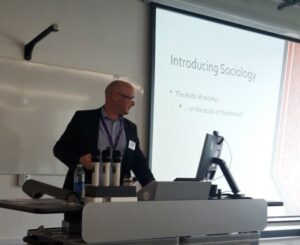 The afternoon was completed by a lecture from Go Higher’s sociology lecturer, Dr David Ellis (left), who discussed his research in a talk titled ‘Towards a Sociology of Debt: Cultural Change in Britain and Beyond’. David explored the deregulation of banking by the Conservative Party in the 1980s, and the impact that it is still having today. A major point of discussion was what constituted ‘credit’ and how it differed from ‘debt’. There were so many comments and questions following this that we reached the end of the day before we knew it.