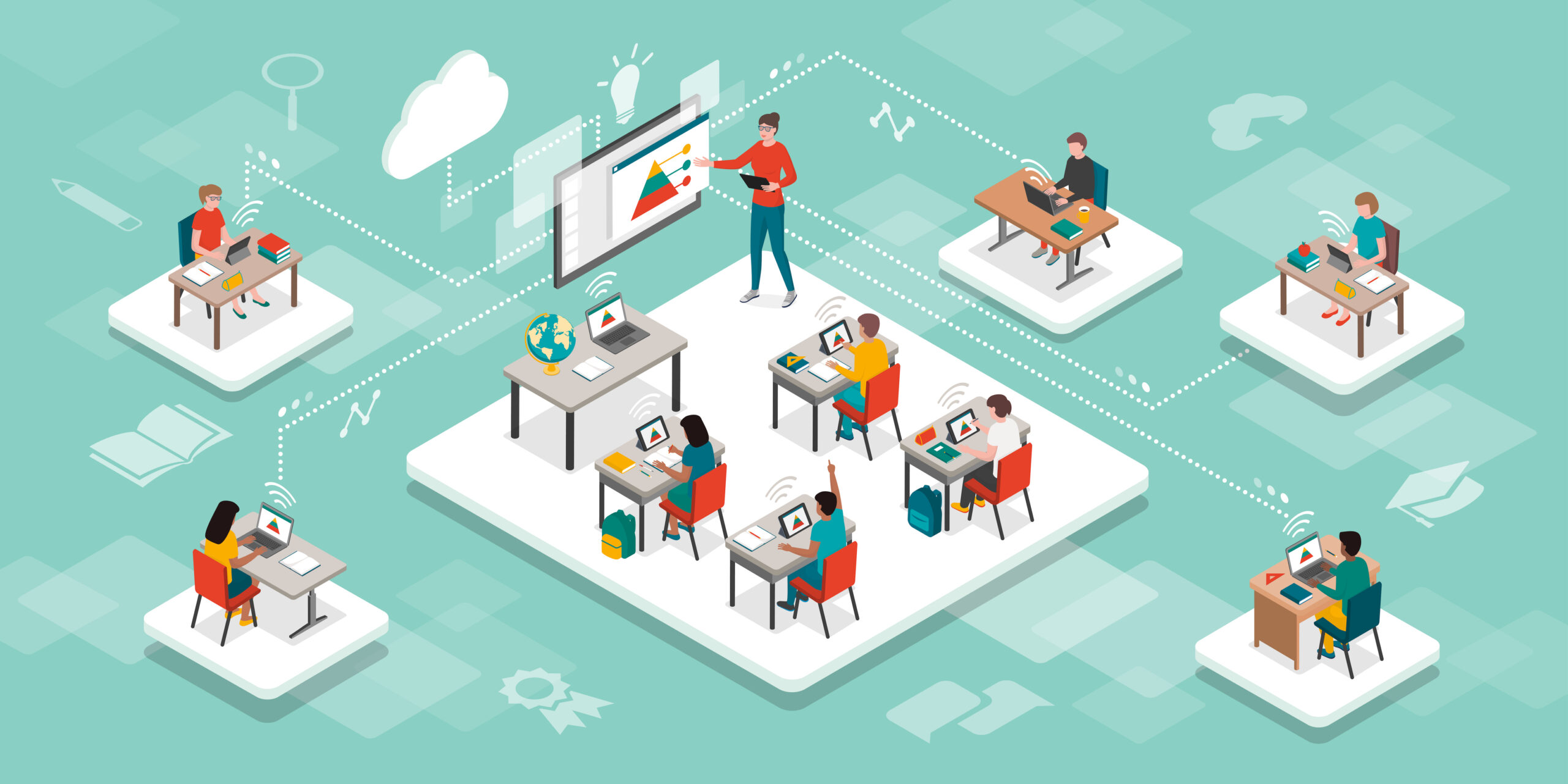
Virtual field trips have emerged as an engaging resource, offering students immersive experiences and allowing them to explore global landmarks, museums, and natural wonders without leaving their classrooms.
Virtual field trips connect students to places that, due to funding, geography, or other logistical challenges, they may not otherwise have a chance to visit or experience.
These trips promote active engagement, critical thinking, and cater to diverse learning styles. For instance, students can virtually visit the Great Wall of China or delve into the depths of the ocean, fostering a deeper understanding of subjects ranging from history to science.
If you’re looking for a new virtual field trip to bring to your classroom, here are a few to investigate:
Giant Panda Cam at the Smithsonian National Zoo: Watch Bao Li and Qing Bao–the two new Giant Pandas at Smithsonian’s National Zoo–as they explore their indoor and outdoor habitats at the David M. Rubenstein Family Giant Panda Habitat. The Giant Panda Cam is live from 7 a.m. to 7 p.m. ET daily. After 7 p.m., the cam feed will switch to a pre-recorded view of the last 12 hours.
The Superpower of Story: A Virtual Field Trip to Warner Bros. Studios: Students will go behind the scenes on an exclusive virtual field trip to DC Comics headquarters at Warner Bros. Studios in Burbank, California!.They’ll step into the world of legendary superheroes and blockbuster films, uncovering the secrets of how stories evolve from bold ideas to iconic comics to jaw-dropping live-action spectacles on the big screen. Along the way, they’ll hear from the creative minds who shape the DC Universe and get an insider’s look at the magic that brings their favorite characters to life.
Mount Vernon: Students can enter different buildings and click on highlighted items or areas for explanations about their significance or what they were used for.
Arctic Adventures: Polar Bears at Play Virtual Field Trip: Do polar bears play? The LEGO Group’s sustainability team, Polar Bears International, and Discovery Education travel to Churchill Manitoba and the Polar Frontier habitat at the Columbus Zoo and Aquarium in search of polar bears at play. Students will meet polar bears and play experts and uncover how arctic animals use play to learn just like humans, while inspiring students to use their voice to change their planet for the better.
The Manhattan Project: Join The National WWII Museum for a cross-country virtual expedition to discover the science, sites, and stories of the creation of the atomic bomb. Student reporters examine the revolutionary science of nuclear energy in the Museum’s exhibits and the race to produce an atomic weapon in complete secrecy.
The Anne Frank House in VR: Explore the hiding place of Anne Frank and her family in virtual reality using the Anne Frank House VR app. The app provides a very special view into the Secret Annex where Anne Frank and the seven other people hid during WWII. In the VR app, all of the rooms in the Secret Annex are furnished according to how it was when occupied by the group in hiding, between 1942 and 1944.
Night Navigators: Build for Bats Virtual Field Trip: Join Discovery Education, the LEGO Group’s Social Responsibility Team, and Bat Conservation International as we travel across Texas and Florida in search of bat habitats. Students will meet play experts as they explore how these nighttime pollinators use play to learn and discover the critical role of bats in protecting farmers’ crops from pests and what we can do to help bats thrive.
Laura Ascione is the Editorial Director at eSchool Media. She is a graduate of the University of Maryland’s prestigious Philip Merrill College of Journalism.
As I explored in part 1, the implications of Michael Godsey’s article for higher education are profound, particularly in the way it highlights disparities in student motivation, engagement and academic culture between different types of institutions.
His observations about the buy-in effect at private K-12 schools—where students and their families actively choose and invest in the educational experience—find a parallel in higher education, where the most selective colleges tend to foster stronger academic engagement, often by self-selecting for motivation as much as talent.
Selective Colleges and the Culture of Academic Commitment
Just as Godsey observes that students at private schools like his daughter’s exhibit greater enthusiasm and self-discipline, students at elite colleges and universities often display a higher level of academic investment. This is not necessarily because they are inherently more talented but because they have been filtered through a selection process that prioritizes motivation, work ethic and demonstrated academic dedication.
Students at these institutions expect rigorous coursework and embrace the challenge rather than resisting it.
Faculty are less preoccupied with maintaining order and more focused on deep intellectual engagement because the students themselves uphold a culture of academic seriousness.
The peer effect reinforces engagement—when all students around you are driven, it’s harder to disengage without standing out.
This dynamic is similar to tracking in K-12 schools, where students deemed more academically capable are placed in advanced or honors programs, shielding them from the distractions of less engaged peers. The difference is that in higher education, this sorting happens through admissions rather than within schools.
The Motivation Gap Across Different Types of Colleges
At broad-access institutions, such as regional public universities or community colleges, faculty often encounter a wide spectrum of student engagement—some highly dedicated, others struggling with external obligations and some with little intrinsic motivation for academic work. This presents a challenge similar to what Godsey describes in public high schools:
Many students don’t see themselves as having bought in to the academic experience. They may be there out of necessity (to qualify for a better job or a chance to participate in athletics) rather than a deep commitment to intellectual growth.
External distractions—jobs, family responsibilities, financial pressures—compete with academic priorities, making it harder to sustain focus and engagement.
A culture of disengagement can take hold, just as in the public school classrooms Godsey describes, making it difficult for even motivated students to thrive.
Should Higher Education Track Students More Explicitly?
One implicit takeaway from Godsey’s argument is that students benefit when they are surrounded by peers who share their academic enthusiasm. This raises a controversial but important question for higher education: Should colleges do more to track students into different learning environments based on motivation and engagement, rather than simply ability?
In some ways, this already happens:
Honors programs at public universities function as internal selective institutions, grouping together highly motivated students and giving them smaller, discussion-driven courses with top faculty.
Gated entry into high-demand majors is widespread, often driven to enhance a particular college’s rankings.
Specialized cohorts and living-learning communities create subgroups of engaged students who reinforce each other’s academic commitment.
Highly structured programs (such as those in STEM and pre-professional tracks) implicitly filter for motivation by their demanding course sequences.
Yet, tracking within higher education is far less explicit than in K-12 schools. At many institutions, faculty find themselves teaching classes with highly diverse levels of motivation, which can lead to tensions:
Should professors lower expectations to accommodate less prepared or less motivated students?
Should they hold firm on rigor and risk alienating or failing a significant portion of their class?
How can institutions better cultivate a culture of academic commitment, particularly in settings where students do not automatically arrive with strong buy-in?
Bridging the Motivation Gap in Higher Education
Rather than creating rigid tracking systems that could exacerbate educational inequalities, colleges need to find ways to embed buy-in within all types of institutions. Possible strategies include:
Creating more cohort-based learning models: Small, high-impact learning communities, similar to honors programs but available to all students, can cultivate shared academic identity and accountability.
Rethinking advising and orientation: Encouraging intentional major selection and career goal setting early on can help students see education as a personal investment rather than an obligation.
Using pedagogical strategies that reinforce engagement: Active learning, project-based work and immersive real-world applications can encourage students to see their studies as meaningful.
Reinforcing faculty-student relationships: At elite institutions, students benefit from close faculty mentorship; replicating this at other colleges through structured faculty-student interactions could increase motivation and accountability.
The Best Schools Don’t Just Teach—They Create a Culture of Learning
At first glance, the purpose of education seems straightforward: Schools exist to teach students knowledge and skills. But the most effective institutions do far more than simply deliver content. The best schools create an intellectual culture—a shared commitment to curiosity, critical thinking and lifelong learning.
This distinction is especially relevant in higher education, where student engagement, institutional culture and faculty mentorship shape not just what students learn, but how they learn and apply knowledge beyond the classroom.
The Difference Between Teaching and Cultivating a Learning Culture
This distinction is critical. If universities merely teach, students may approach their studies passively, checking off degree requirements with minimal engagement. But when institutions create a vibrant learning culture, students take ownership of their education. They become active participants in discussions, independent researchers and engaged citizens who seek knowledge not just for grades, but for its intrinsic value.
How a Learning Culture Manifests in Higher Education
A learning culture is shaped by many factors, including institutional values, faculty engagement, student expectations and extracurricular opportunities. The best colleges and universities foster this culture in several ways:
High-impact educational practices: Research has shown that certain experiences—such as undergraduate research, study abroad, service learning and collaborative projects—dramatically enhance student learning. Institutions that embed these practices into coursework ensure that students don’t just passively absorb information but engage with real-world applications of knowledge. For example:
Portland State University incorporates service learning into its capstone courses, requiring students to work on community-based projects.
CUNY’s Macaulay Honors College integrates research experiences into its curriculum, ensuring students engage in inquiry-driven learning from their first year.
Faculty as mentors, not just lecturers: At institutions with strong learning cultures, faculty members do more than deliver lectures—they mentor students, involve them in research and challenge them to think critically. Close faculty-student relationships create opportunities for intellectual exchange outside the classroom. Some universities institutionalize this by:
Encouraging faculty-student lunches or informal discussion groups (e.g., the University of Michigan’s M-PACT mentoring program).
Embedding research experiences in first-year courses (e.g., the University of Texas at Austin’s Freshman Research Initiative).
Intellectual curiosity beyond the classroom: The best colleges cultivate a campuswide intellectual atmosphere. This happens through:
Public lectures, symposia and visiting scholar programs that expose students to ideas beyond their coursework.
Student-driven initiatives like debate societies, interdisciplinary discussion groups and maker spaces.
Engagement with the arts and humanities, ensuring that even students in technical fields experience creative and philosophical inquiry.
Challenging, not just accommodating, students. Many institutions focus heavily on student retention and satisfaction, sometimes at the cost of intellectual rigor. A true culture of learning, however, challenges students. The best universities set high academic expectations while providing the support needed to meet them. Examples include:
Honors programs and cohort-based learning communities that create rigorous academic environments within broader universities.
Writing-intensive courses across all disciplines, reinforcing analytical skills that extend beyond students’ majors.
Project-based and interdisciplinary coursework that requires synthesis of ideas rather than rote memorization.
Implications for Colleges and Universities
If higher education institutions want to cultivate a true learning culture, it must move beyond simply delivering content and reimagine how it engages students. Some key implications include:
Rethinking how we measure success: Universities often emphasize graduation rates, job placement and standardized learning outcomes. While these metrics are important, they do not necessarily reflect a thriving intellectual culture. Institutions should also assess engagement: Are students participating in meaningful discussions? Are they involved in research? Are they developing the habits of lifelong learners?
Ensuring high-impact practices are accessible to all students: Many transformative experiences—such as study abroad and research opportunities—are disproportionately available to students at elite institutions. Public universities and community colleges must find ways to embed these experiences into the curriculum, making them accessible to part-time, commuter and first-generation students.
Prioritizing faculty-student interaction: Universities must incentivize mentorship by valuing faculty engagement with students in promotion and tenure decisions. Large lecture-based institutions should integrate more small-group learning experiences to facilitate faculty-student connections.
Encouraging intellectual risk-taking: A culture of learning is not about teaching students to parrot back information but about encouraging them to take intellectual risks. This means fostering open debate, embracing interdisciplinary inquiry and encouraging creative problem-solving.
Creating a campus climate that values inquiry: Universities must ask themselves: Do students feel that intellectual curiosity is encouraged? Are there informal spaces for discussion and debate? Are students challenged to think critically about complex issues rather than being shielded from uncomfortable ideas?
The University as a Catalyst for Lifelong Learning
A true learning culture does not end at graduation. The best colleges and universities equip students with the intellectual tools to continue learning throughout their lives. This means fostering habits of critical inquiry, a passion for ideas and the ability to adapt to new knowledge.
The best schools, like the most impactful professors, don’t just teach; they inspire curiosity, cultivate resilience and shape the way students engage with the world. If higher education is to fulfill its democratic and intellectual promise, it must embrace this mission—not just to produce degree holders, but to create lifelong learners.
Steven Mintz is professor of history at the University of Texas at Austin and the author, most recently, of The Learning-Centered University: Making College a More Developmental, Experiential and Equitable Experience.
The working classes are an easy foil for the dreams of conservative politicians. They are the salt of the earth, proper people who do real stuff, unlike the woke metropolitan elite who sit around and think things but are removed from the real world.
As Joel Budd points out in his new book Underdogs The Truth About Britain’s White Working Class, they are to the conservative imagination “sensible truth-tellers and bulwarks against left-wing nonsense.” Even more so they are the consensus position on immigration “The mass immigration that the elite has tolerated is crushing their wages, burdening the public services they rely on and filling their neighbourhood with strangers.” As Budd also points out this, well, isn’t true. In 2024 they voted for Starmer’s Labour Party who campaigned on public finances, NHS, and inflation.
New Labour old problems
It is with this in mind that Labour’s response to Reform’s election performance is as wrong as it is entirely predictable. Its wrongness could have significant consequences for universities.
Let’s start with the big results. In May’s local elections in England Reform gained 677 councillors,ten councils, two mayors, and an MP. The votes are spread across the country but as John Curtice points out for the BBC there is an education faultline.
Reform did best in places that most overwhelmingly voted for Brexit. University graduates overwhelmingly did not vote for Brexit. Reform received less than 20 per cent of the vote in wards where more than two in five people have a degree compared to 43 per cent in wards where over half of adults have few qualifications. As Curtice states
In summary, Reform did best in what has sometimes been characterised in the wake of the Brexit referendum as ‘left-behind’ Britain – places that have profited less from globalisation and university expansion and where a more conservative outlook on immigration is more common.
The policy solution alighted on by outriders in the Labour Party has so far been to say that Reform has done well therefore Labour should do things that appeal to the kind of people that vote for Reform. Or, at least, the kind of things Labour assumes appeal to the people that vote for Reform. And one of the key assumptions is that getting immigration down, whoever those immigrants might be, including students, is necessary for their electoral survival.
Blue Labour redux
University of Oxford graduate, and Blue Labour standard bearer, Jonathan Hinder MP has said he would not be “that disappointed” if universities went bust because of reducing international student immigration. Presumably he does not mean his own alma mater. Jo White, of the Red Wall Caucus, has urged Labour to “take a leaf out of President Trump’s book” when it comes to immigration. The end of the Labour Party which purports to be closer to its working class roots is moving rapidly and decisively against immigration. Tightening restrictions on graduates, and by extension making the UK a less attractive place to study, has been reported as an idea winning favour at the Home Office.
The issue with the general public is that it is complicated. On its own, reducing student immigration will not win Labour a single vote in Runcorn in Helsby where Reform most recently won an MP. For a start Runcorn does not have a university so it will certainly not address immigration issues brought up during the election. Runcorn does however have several organisations that benefit from a vibrant university sector. SME net-zero collaboration with Lancaster. INEOS which benefits from the proximity of a university workforce and industrial collaborations. And Riverside College, amongst other examples, as a franchise partner of the University of Staffordshire.
It is also worth making entirely clear that people in Runcorn also go to university. It’s a particular fault of both an understanding of class and an understanding of universities that this conflation is often made.
Immigration, immigration, immigration
If reducing student immigration will not make a material difference perhaps it will signal a vibes shift that will bring places like Runcorn on side. Again, here is where the working class will let you down. Analysis of the British Election Study collated by Joel Budd demonstrates that “Young white working-class people are not as liberal as young white middle-class people. But when it comes to immigration and race, they resemble them more closely than they resemble old white working-class people.” Again, there is just not a long term winning strategy in discouraging student and graduate migration.
For universities this might be comforting but it isn’t the point.
The extent to which anyone is willing to defend student immigration is the question of the extent to which they are willing to defend the value of universities. The value of universities is felt in exports and jobs but it is most directly felt on the extent to which the effects of a university make a place feel better. The thing that Boris Johnson, or at least his advisors, understood that higher education consistently has not is that people see politics through their places. Crime. Clean high streets. Local shops. Good jobs. Green spaces. Feeling safe to go out at night. And the myriad of tangible things that make up a place.
In policy terms the absolute antithesis of levelling up are reforms which will depress international student numbers. The last thing Runcorn needs is a poorer Liverpool and weaker universities. The challenge for universities is to tilt the scale toward being popular not just being valuable. So popular as to make decisions on cutting student immigration culturally and electorally harder not just economically wrongheaded.
The question then is how can universities do things in places that feel like they are doing good as well as actually doing good.
A day like today is not for soundbites
A key question is how infrastructure can be use toward a broad and good civic end. For example, of all of the things that the University of Liverpool did during Covid (of which there were many I have direct experience of, having worked there), the one that looms largest in my memory is when it gave up its car parks for NHS staff. Not the vaccines it helped develop or the PPE it manufactured but a low cost, high kindness gesture that resonated with people at the time. The other part of this is how largely universities loom in local communities. The extent to which their infrastructure, offices, shops, cafes, and other buildings and amenities are dispersed across the towns, cities, and localities so their presence has a resonance with the lives of people from day to day. People will often be aware of a university where it precedes the word hospital. There are opportunities for other collaborative infrastructures.
Universities tend to be pretty good at turning their research into lectures, experiments, and days out for young people in an education setting. They are less good at making their research experiential for adults. Light Years by the University of Durham (full disclosure: I volunteer in supporting this work) has taken research to places people actually gather, places of worship, highstreets, and places of local interest across Durham county, as opposed to just the city.
And it’s harder to articulate or even work out, but the extent to which local people feel universities are on their side matters. The cultural closeness universities build to their populations is not always about what they do but whether local people feeling it’s “their” or “the” university. There is no magic bullet for this beyond the slow grind of knowing a local place and acting with it.
The political vibes risk overtaking a political reality. The key to Labour winning back its voters is to make tangible differences in the places they live. The economic headroom for them to do that runs through higher education institutions and their success. The permission to do so depends on people feeling like universities are a thing worth saving even with difficult political trades offs.
When the developers of Canvas, the world’s leading web-based learning management system (LMS) software, invite you to a party—July 22-24 this year in Spokane, WA—you might consider the offer. Expected to draw 3,000 attendees across various roles from individual educators to IT leadership, the event promises product reveals, professional development, and collaborative opportunities like Hack Night, designed to help educators and administrators demonstrate tangible value when they return to their institutions. I was able to grab Ryan Lufkin, Vice President of Global Academic Strategy at Instructure, for some pre-show scuttle butt. Have a listen and scroll down for some highlights:
➜InstructureCon 2025 is evolving its AI strategy beyond basic features to an “agentic approach,” leveraging partnerships with Anthropic, Microsoft, and Google to create integrated AI experiences across campus environments. Says Ryan: “That’s because our open architecture is the most well-positioned learning platform in the world to really pull in, not just those AI-powered features that we’ve developed, but we also leverage those from our partners.”
➜Instructure is responding to educational institutions’ budget constraints by focusing on helping customers maximize their technology investments through better data usage, adoption metrics, and optimization strategies. Says Ryan: “We really want educators and administrators to walk away with just a toolkit of how to use these products better, how to use them more deeply and tangibly show that value because we know the budgets are tight.”
A few session highlights:
Transforming Student Success with Mastery Connect: A Proven Approach to Data-Driven Instruction in Richland One School District
Get ready to discover how Richland One (R1) School District in South Carolina has been transforming student success with Mastery Connect since 2015! This digital assessment platform has empowered R1 teachers to seamlessly administer standards-based formative and summative assessments, dive into score reports, and collaborate with colleagues. MC has unlocked deeper insights into student mastery, giving teachers and teams the tools they need to drive data-driven instruction. Join us for an exciting session where R1 will share its curriculum map structure and district approach to formative assessments. Discover how to save time on data collection and analysis—whether you’re a teacher or an admin. Learn how newer features like Quick Reassess and Assessment Compare can help you work smarter, not harder! You’ll also explore how to harness real-time data to fuel impactful discussions in your Professional Learning Communities (PLCs), driving focused, results-oriented collaboration.
Cracking the Code: Turning Data into Action with Mastery Connect
Drowning in data but struggling to make it meaningful? Join us on a journey to transform numbers into actionable insights using Mastery Connect! In this session, we’ll share how we built educator buy-in, shifted mindsets, and empowered teachers to use data in meaningful ways. Discover practical strategies for making data analysis approachable, actionable, and impactful—without overwhelming teachers. We’ll explore real-world examples, time-saving tips, and effective ways to connect assessment data to instructional decisions. Whether you’re just getting started or looking to refine your approach, this session will equip you with insights and strategies to turn data into a catalyst for student success.
Beyond the Classroom: Maximizing Canvas for Non-Academic Programs in Resource-Limited Environments.
As institutions face financial and regulatory challenges, maximizing existing technology investments is essential. While Canvas is primarily used for academic courses, its capabilities extend beyond the classroom. This session explores how a small liberal arts institution has successfully repurposed Canvas for faculty onboarding, professional development, syllabus archiving, student organizations, and institutional assessment—all without additional costs. A key focus will be the development of a syllabus submission portal designed to streamline syllabus collection, ensure compliance with learning outcomes, and create a structured faculty repository. Attendees will gain practical insights into overcoming adoption challenges, achieving measurable ROI, and applying these strategies to institutions of varying sizes.
Kevin is a forward-thinking media executive with more than 25 years of experience building brands and audiences online, in print, and face to face. He is an acclaimed writer, editor, and commentator covering the intersection of society and technology, especially education technology. You can reach Kevin at [email protected]
Miami –Achieve Miami, a nonprofit dedicated to equalizing educational opportunities for students throughout Miami-Dade County, has received $2.4 million from multiple philanthropic organizations and leaders, including a leadership gift of $2 million from Kenneth C. Griffin, founder and CEO of Citadel and founder of Griffin Catalyst. The funding, awarded over the past year, will further expand Achieve Miami’s transformative programs, reaching thousands of K-12 students through initiatives including Achieve Scholars, which prepares high schoolers for college success; Achieve Summer, a dynamic program combating learning loss through hands-on academics and enrichment; and the Teacher Accelerator Program (TAP), a groundbreaking effort to address Miami-Dade’s urgent teacher shortage.
Kenneth C. Griffin’s $2 million leadership gift is specifically focused on supporting TAP in creating a pipeline of talent for the teaching profession through recruiting, preparing, and mentoring aspiring educators, including those who had not previously considered a career in education. This gift builds on Griffin’s $3.5 million gift to TAP in 2022, further strengthening Achieve Miami’s efforts to recruit and train qualified educators to teach in public, private and charter schools across Miami-Dade and close learning gaps in the city’s schools. Griffin has a longstanding commitment to improving education and has contributed more than $900 million to providing greater access to a high-quality education and pathways to success for students in Florida and across the country.
Additional grants include:
$200,000 from the Bezos Family Foundation, which is a director’s gift supporting early and adolescent learning through grants and programs that advance the science of learning.
$100,000 from the Panera Bread Foundation, as part of its national initiative to support nonprofits that provide educational access to underserved youth.
$65,000 from Morgan Stanley, in support of Achieve Miami’s financial literacy and career readiness programs, which equip students in the organization’s Achieve Scholars program with essential money management skills for financial independence and future success. As part of its commitment, a team of Morgan Stanley employees guide students through financial literacy sessions across ten Miami-Dade County public schools, providing essential lessons on topics like budgeting, investing, entrepreneurship, savings, and credit.
$50,000 from City National Bank of Florida, as part of its long-term partnership with Achieve Miami in support of the Achieve Scholars program. City National Bank is planning financial literacy programming for students over the summer.
“Every student deserves access to resources, mentors, and opportunities that can set them up for success,” said Leslie Miller Saiontz, Founder of Achieve Miami. “These generous grants, led by Ken Griffin, will enable us to expand our reach, empower more educators, and bridge opportunity gaps that are prevalent in Miami. By investing in students and teachers, we are building a stronger future for our community.”
“Each of us has a story of how a teacher has changed our lives,” said Ken Griffin in February 2023 alongside his initial gift to Achieve Miami. “I care deeply about bringing more high-quality educators into Miami classrooms to help ensure the children of Miami will continue to enjoy the impact of life-changing teachers.”
Despite being one of the fastest-growing states with the nation’s fourth-largest economy, Florida ranks #21 in per capita education funding. Achieve Miami’s initiatives aim to eliminate educational disparities by equipping students with the tools and support needed for success with a variety of diverse enrichment programs such as Achieve Scholars, Achieve Saturdays, and Achieve Music.
Achieve Miami’s impact to-date includes support for over 10,000 Miami-Dade County students, college and career readiness programming for Achieve Scholars across ten high school sites, providing internet access to over 106,000 homes through Miami Connected, and the recruitment and training of nearly 200 new teachers through the Teacher Accelerator Program (TAP) since the initiative’s launch in 2023.
ABOUT ACHIEVE MIAMI
Achieve Miami is a nonprofit organization that is dedicated to fostering a transformational education ecosystem in Miami. Since its founding in 2015, the organization has supported over 10,000 K-12 students, bolstered programming for 60+ local schools, and engaged thousands of volunteers. Together with partners from the public and private sector, Achieve Miami designs and manages programs that bring together members from various parts of the community to extend learning opportunities for students, teachers, and community leaders. Learn more at www.achievemiami.org.
ABOUT THE TEACHER ACCELERATOR PROGRAM
Teacher Accelerator Program (TAP) is a non-profit organization creating a pipeline of talent for the teaching profession through recruiting, preparing, and mentoring aspiring educators. TAP’s comprehensive and streamlined program equips college students and career changers with the skills, knowledge, and certification necessary to excel in the classroom. TAP addresses the nationwide teacher shortage crisis by providing a built-in path to teaching, inspiring a new generation of educators.
TAP participants take a one-semester course, followed by a six-week paid summer internship, earn a certificate to teach, and begin instructing in a Miami-Dade County public, private, or charter school classroom. TAP is an initiative of Achieve Miami, supported by Teach for America Miami-Dade, and is offered by the University of Miami, Florida International University and Miami-Dade College. Learn more at www.teacheraccelerator.org.
eSchool Media staff cover education technology in all its aspects–from legislation and litigation, to best practices, to lessons learned and new products. First published in March of 1998 as a monthly print and digital newspaper, eSchool Media provides the news and information necessary to help K-20 decision-makers successfully use technology and innovation to transform schools and colleges and achieve their educational goals.
by Estefania Gamarra, Marion Heron, Lewis Baker and Harriet Tenenbaum
Do you remember when you started university, and you were expected to use a whole new language? We don’t just mean new nomenclature such as ‘seminars’ or ‘tutorials’, but language that can help you make a clear argument or disagree politely with a classmate. This language, or educational dialogue, and in particular disagreeing politely, is critical to be an engaged citizen in a healthy democracy, without otherwise descending into unhealthy practices such as ‘cancel culture’ as recently highlighted in the media. In this blog post, we argue that universities have a responsibility not only to teach students how to talk in an academic context, but also for this teaching to be discipline-specific and embedded in the disciplinary study where possible.
There is a long-held misperception that all students who start university are able to talk the talk of the university, that is, they have the language skills, the terminology, and the confidence to articulate their opinions from their first day. This is just simply not true for many undergraduate students. Having English as a first language is also not necessarily an advantage. Bourdieu et al (1994, p8) said, “academic language… is no one’s mother tongue, not even that of children of the cultivated classes”.
What do we mean by language here? We have drawn on the pedagogy and research from compulsory school education, namely the work of scholars at Cambridge University. Their work on educational dialogue has been successfully incorporated into school teaching with impressive results. Educational dialogue here refers to communicative acts such as agreeing, disagreeing, reasoning and expressing ideas. Research in school settings has shown that encouraging such dialogue can boost academic attainment. One study highlighted the relationship between elaborating on ideas and attainment in reading, spelling, punctuation and grammar. Despite this compelling evidence, similar strategies have been underexplored in higher education.
In our university classrooms, we hear students say things such as: ‘I know the answer, but don’t know how to phrase it’ and ‘I need to learn how to express my answer like that’. So, if students are themselves noticing a need for academic language, why are we so behind in the higher education context? And more importantly, what language do these students need? Do they all need the same academic language to confidently talk the talk? This is exemplified by the dialogue below between two engineering students working on answering multiple-choice questions together, an excerpt from our forthcoming research:
Student A: Yeah, listen, we need to be able when we say “force”, to say why.
Student B: Yeah, to flip it.
Student A: Because we were right, like, C is incorrect, but we don’t say why it is not incorrect.
Student B: I don’t know how to word it, you know.
In our current research project, supported by a Nuffield Foundation grant, we explore whether pairs of Foundation Year students across Engineering, Psychology and Bioscience, engaging in discipline-specific multiple-choice questions, can learn to develop these academic language skills and the extent to which they can do this in an academic year-long intervention programme.
Our early findings indicate that while students are capable of using academic language, the forms they adopt vary by discipline. For example, consider one of the most basic interactions in academic discussions – giving and asking for reasons. Typically, the default marker for requesting justification is “why?”. The following extract from a psychology discussion illustrates this:
Student A: Why do you think that is?
Student B: Because, uh, if you got negative emotion, you know, so that is not called positive psychology. Yep, yeah, so I’m thinking about understanding like how to prevent negative emotions.
In contrast, in science courses such as biology or engineering, it was more common to use “how?” rather than “why?” when asking for reasoning. Consider this extract from an engineering discussion:
Student A: Yes. Then the same as D.
Student B: D? How?
Student A: And then it’s…
Student B: Oh.
Student A: And this is…
Student B: So the arrow goes this way…
Student A: So then P goes this way…
Here, Student B not only asks for the reasoning by using “how?”, but the response unfolds as a sequence of steps outlining the reasoning process. This example also highlights another subject-specific difference: while psychology students typically expand on each other’s arguments or examples, engineering students more frequently build on each other’s equations, often with the assistance of pen and paper.
So, based on these snippets of authentic student dialogues, let’s return to the question posed at the beginning. Yes, all students can and do need to learn academic language to talk to each other and develop understanding, but the type of language depends on the discipline. Disciplinary differences can be seen in the way students build on each other’s ideas (eg long turns, short turns) as well as the words and phrases used. The evidence from our project shows this.
We argue that learning to talk the language of higher education should not be considered a prerequisite but instead, should be an essential feature of the higher education curriculum embedded within disciplinary studies.
Why is this important? Integrating academic language training into the curriculum can enhance students’ academic confidence, foster a stronger sense of belonging, and ultimately improve retention rates. In a post‐COVID world, where student engagement is waning, this conversation‐based approach may also help rebuild the social and collaborative fabric of university life.
Moreover, the skills developed through such training are highly transferable beyond academia. Students acquire essential discussion and teamwork abilities that prove invaluable in their future careers. It is important to emphasise that developing these skills requires deliberate training; we must not assume that students will acquire them without practice and guidance.
Although students may already use discipline‐specific language, targeted training helps them become accustomed to engaging in – and, more importantly, listening to – disagreement. These conversational practices become part of their repertoires, enabling them to generalize these skills across various contexts. As noted earlier, we must all learn to engage in constructive disagreement to counteract cancel culture. While the manner of such discourse may vary by discipline, developing these skills is essential for active participation in a healthy, thriving democracy.
Estefania Gamarra Burga is a Postdoctoral Research Fellow at the University of Surrey. Her research interests include educational dialogue, discourse analysis, gender, and spatial cognition in STEM and higher education.
Marion Heron is Associate Professor of Educational Linguistics in the Surrey Institute of Education, University of Surrey. She supervises doctoral students on topics in the field of applied linguistics and higher education. She researches in the areas of language and education, with a particular interest in classroom discourse, genre and doctoral education.
Lewis Baker is a Senior Lecturer in the Faculty of Engineering and Physical Sciences and a Chartered Science Teacher. His research interests include teaching pedagogy and science education, often within a foundation year context.
Harriet Tenenbaum is Professor of Social and Developmental Psychology. Her research focuses on social justice in young people, everyday conversations, and teaching and learning across the lifespan.
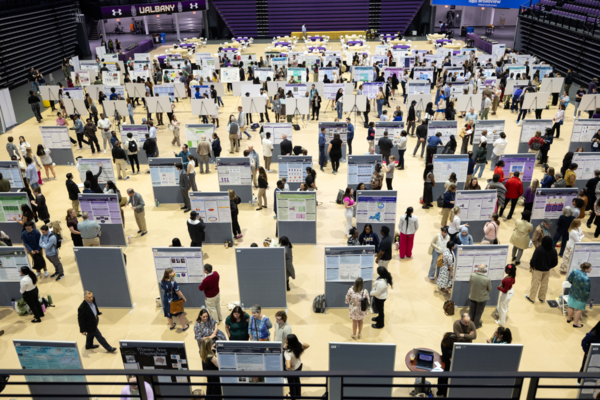
On Wednesday, April 30, the University at Albany’s campus buzzed with energy as students, faculty and staff bounced between poster fairs, musical performances, student presentations and other exhibitions. Showcase Day, a newer campus tradition, reserves one day in the spring term to celebrate various student achievements from the year, including dance performances, internship experiences and scientific research.
In addition to boosting campus engagement, the initiative highlights the important work of the University at Albany and invites outside groups to partner with the institution, Provost Carol Kim said.
The background: Kim was inspired to create Showcase Day after kick-starting a similar initiative at her previous institution, the University of Maine. After a few delays due to COVID-19, the University at Albany launched Showcase Day in 2023.
“Post-COVID, our campus felt an ennui,” Kim said. National research shows decreased levels of student participation in campus activities, including faculty-led research, since 2020. “How do we energize or develop more engagement on campus, get people excited again? This event has made a huge difference.”
Many colleges and universities host research symposia in the spring to honor and demonstrate student achievement throughout the academic year, typically in STEM courses or faculty-led research.
UAlbany’s event, however, engages undergraduate and graduate students across colleges, exposing students to opportunities within their discipline and beyond, as well as in graduate studies. Around 37 percent of UAlbany students are first generation, and they may be unaware of the various avenues of experiential learning or research at the institution, Kim said.
The initiative also breaks disciplinary silos, exposing individuals to different kinds of academic work in ways that build campus culture, Kim said. “It’s natural for many faculty, staff and students to stay in their college, in their departments, and many times they don’t know what their colleagues and peers are doing.”
How it works: Showcase Day is a one-day event that unites various student presentations, including posters, artistic performances and demonstrations, under one umbrella.
The day is integrated into the calendar as a no class academic day, which means that while classes are not canceled, professors typically assign students work related to Showcase Day. That could include a review of a theatrical demonstration or a summary of a poster presentation.
One of the most important elements of establishing a campuswide symposium was getting buy-in from campus leadership and the University Senate, Kim said. The event requires the support of hundreds of volunteers, making outside support through sponsorships and community partners another essential element.
Photos by Brian Busher/University at Albany
This year, 2,200 students participated in the event, with over 1,300 unique presentations delivered to an audience of faculty, staff, prospective students, donors, legislators and industry leaders, as well as middle and high school students.
Student projects ranged from research presentations on air quality and native plants to an orchestra performance and robotics demonstration. Many colleges assign an end-of-term project within courses or majors that lend themselves to a Showcase presentation, Kim said; others are student-prompted creations such as internship work experience reflections.
Showcasing Student Success
Other innovative approaches colleges and universities have taken to highlight student achievement include:
At the University of Dayton, an interdisciplinary partnership between graphic design and biology students produces high-quality research posters.
A centralized hub breaks barriers for students interested in experiential learning and research opportunities to identify open positions and engage at San Francisco State University.
A statewide research journal for undergraduate students in Florida provides greater opportunities for learners to share their research beyond institutional journals.
A research festival at Tennessee Tech University celebrates student work in English composition courses.
What’s next: Since Showcase Day launched in 2023, hundreds of students have participated in the event. Student and staff feedback shows that the event has been a positive influence on campus culture, inspiring pride in the participants and the work being done at the institution, Kim said.
“From facilities to student affairs and academic affairs, they’re very proud of their part in contributing to this showcase,” Kim said.
In the future, university leaders would like to see more engagement with potential employers, embedding career development or engagement as a piece of the event. Kim also sees potential in extending the event to multiple days, allowing campus members to participate in a greater number of activities.
Do you have an academic intervention that might help others improve student success? Tell us about it.
There I was, standing in front of my face-to-face Introduction to Psychology class on a sunny Monday afternoon in spring 2024. I was watching as a few of my students took notes while the remaining students sat passively, perhaps hoping my animated gestures and pacing would somehow osmotically transfer my explanation of classical conditioning into their brains. Meanwhile, in my online section of the same course, students worked through carefully crafted modules at their own pace, their participation in discussion boards ebbing and flowing unpredictably. That’s when it hit me—despite years of teaching experience, I’m still searching for ways to spark the same level of engagement whether I’m interacting with students face-to-face or through carefully designed asynchronous activities. These parallel yet distinct teaching environments demand intentional strategies that can adapt while maintaining their power to actively engage students in the learning process.
Rethinking Active Learning for Asynchronous Spaces
Traditional active learning techniques that work beautifully in my face-to-face classes often fall flat in the asynchronous online environment. Take the classic “turn to your neighbor and discuss” prompt that energizes my traditional classes—there’s no direct equivalent when students are logging in at different times throughout the week. Yet simply abandoning these proven engagement strategies isn’t the answer. Instead, we need to reimagine active learning for both spaces, maintaining the core principles while adapting the execution. The key is finding techniques that preserve what makes active learning so powerful—student engagement, peer interaction, and immediate application of concepts—while acknowledging the unique constraints and opportunities of each learning environment.
One of the most powerful techniques in my traditional classroom is the think-pair-share discussion format. Students have those precious moments to gather their thoughts before turning to a classmate to discuss concepts like confirmation bias or the impact of classical conditioning on everyday behavior. The students are energized as pairs merge into small groups, building on each other’s insights before sharing with the whole class. But how do we capture that same collaborative energy in an asynchronous environment?
I’ve found success by structuring online discussions in three distinct phases that mirror the in-person experience. First, students post their initial response to a thought-provoking prompt (the “think” phase). Then, they must meaningfully respond to two classmates’ posts, building on their ideas rather than simply agreeing (the “pair” phase). Finally, students return to their original post and reflect on how their understanding has evolved after engaging with their peers’ perspectives (the “share” phase). The key is crafting prompts that demand critical thinking—instead of asking “What is classical conditioning?” I might ask “How would you use classical conditioning principles to help someone overcome their fear of public speaking?”
Timing matters, too. In my face-to-face class, I allow two to three minutes for individual reflection, five minutes for pair discussions, and 10 minutes for group sharing. Online, I’ve found success with a similar proportional structure: two days for initial posts, three days for peer responses, and two days for final reflections. This creates a rhythm that keeps the discussion moving while accommodating varied schedules.
Designing Collaborative Learning Experiences
Interactive content creation transforms how students engage with course material in both environments. In my traditional classes, I divide students into small groups to create concept maps exploring the relationships between different psychological disorders. Armed with markers and paper, they work collaboratively to connect concepts like anxiety, depression, and trauma responses, discovering links they might have missed studying alone. The energy is palpable as groups share their maps, debating connections and building on each other’s insights.
For my online students, I’ve adapted this activity using collaborative digital tools. Students work in small groups throughout the week to build their concept maps using shared online workspaces. Each student must add at least three concepts and make meaningful connections to their groupmates’ contributions. The asynchronous format actually offers an advantage here – students have time to think deeply about their contributions and can watch their group’s map evolve over several days. I provide specific deadlines for initial contributions and peer feedback to maintain momentum.
I have found that the key to success in either environment lies in providing clear examples of strong concept maps at the outset, establishing specific criteria for meaningful connections, and requiring students to explain their reasoning for each link they create. Deadlines for each phase keep the momentum going, while incorporating peer evaluation into the final grade ensures consistent participation. The resulting maps often reveal insights that surprise both me and my students, demonstrating how collaborative learning can deepen understanding regardless of the teaching modality.
Measuring Engagement and Refining Strategy
One-minute papers serve as powerful self-assessment tools in my traditional classes. For example, at the end of our discussion on memory formation, I ask students to quickly write down the most important concept they learned and one question they still have. This simple exercise reveals gaps in understanding and helps students consolidate their learning. In our next class, I address the most common questions, creating a feedback loop that keeps everyone engaged.
For my online students, I’ve transformed this into structured reflection journals. After completing each module, students must identify their key takeaway and pose one substantive question about the material. The asynchronous format allows for deeper reflection, and I’ve noticed online students often make fascinating connections to their personal experiences. Each week, I compile the most thought-provoking questions into a FAQ document, creating a collaborative resource that benefits the entire class.
Success in both formats require clear guidelines about what constitutes a meaningful reflection versus surface-level observations. Students stating that “the limbic system processes emotions” won’t suffice—they need to explain how this knowledge changes their understanding of human behavior. This approach not only reinforces learning but also develops critical thinking skills that serve students well beyond our course.
Measuring engagement across different learning environments requires that I use a systematic approach. In my traditional classroom, I track participation through observation and collect quick feedback via index cards. For my online students, I monitor not just the frequency but the quality of their discussion posts and collaborative work. The key metrics that I use remain consistent across both spaces: depth of analysis, peer interaction quality, and concept application.
I use a simple framework that examines three elements: initial engagement (participation in discussions or activities), sustained interaction (meaningful responses to peers), and learning application (connecting concepts to real-world scenarios). For each component, I look for evidence of critical thinking rather than mere completion. This approach helps identify which strategies are working and which need adjustment.
Beyond quantitative measures, I pay attention to qualitative indicators like the sophistication of student questions and the complexity of peer-to-peer discussions. These insights guide my refinement of teaching strategies in both environments, ensuring that active learning remains effective regardless of delivery method.
As the spring semester progressed, I saw the impact of the adapted strategies in both my traditional and online psychology classes. Those initially passive students in my traditional class began to engage in our active learning exercises, while my online students built an active learning community through their thoughtful asynchronous interactions. In my experience, the key isn’t choosing between traditional and online teaching methods—it’s understanding how to preserve active learning while adapting strategies to fit each unique environment. By reimagining rather than simply transplanting these strategies, we can create engaging learning experiences that work effectively across both spaces.
Dr. Dunja “Dee” Trunk, a professor of psychology at Bloomfield College of Montclair State University, has a passion for teaching and a genuine belief in the transformative power of education.
There I was, standing in front of my face-to-face Introduction to Psychology class on a sunny Monday afternoon in spring 2024. I was watching as a few of my students took notes while the remaining students sat passively, perhaps hoping my animated gestures and pacing would somehow osmotically transfer my explanation of classical conditioning into their brains. Meanwhile, in my online section of the same course, students worked through carefully crafted modules at their own pace, their participation in discussion boards ebbing and flowing unpredictably. That’s when it hit me—despite years of teaching experience, I’m still searching for ways to spark the same level of engagement whether I’m interacting with students face-to-face or through carefully designed asynchronous activities. These parallel yet distinct teaching environments demand intentional strategies that can adapt while maintaining their power to actively engage students in the learning process.
Rethinking Active Learning for Asynchronous Spaces
Traditional active learning techniques that work beautifully in my face-to-face classes often fall flat in the asynchronous online environment. Take the classic “turn to your neighbor and discuss” prompt that energizes my traditional classes—there’s no direct equivalent when students are logging in at different times throughout the week. Yet simply abandoning these proven engagement strategies isn’t the answer. Instead, we need to reimagine active learning for both spaces, maintaining the core principles while adapting the execution. The key is finding techniques that preserve what makes active learning so powerful—student engagement, peer interaction, and immediate application of concepts—while acknowledging the unique constraints and opportunities of each learning environment.
One of the most powerful techniques in my traditional classroom is the think-pair-share discussion format. Students have those precious moments to gather their thoughts before turning to a classmate to discuss concepts like confirmation bias or the impact of classical conditioning on everyday behavior. The students are energized as pairs merge into small groups, building on each other’s insights before sharing with the whole class. But how do we capture that same collaborative energy in an asynchronous environment?
I’ve found success by structuring online discussions in three distinct phases that mirror the in-person experience. First, students post their initial response to a thought-provoking prompt (the “think” phase). Then, they must meaningfully respond to two classmates’ posts, building on their ideas rather than simply agreeing (the “pair” phase). Finally, students return to their original post and reflect on how their understanding has evolved after engaging with their peers’ perspectives (the “share” phase). The key is crafting prompts that demand critical thinking—instead of asking “What is classical conditioning?” I might ask “How would you use classical conditioning principles to help someone overcome their fear of public speaking?”
Timing matters, too. In my face-to-face class, I allow two to three minutes for individual reflection, five minutes for pair discussions, and 10 minutes for group sharing. Online, I’ve found success with a similar proportional structure: two days for initial posts, three days for peer responses, and two days for final reflections. This creates a rhythm that keeps the discussion moving while accommodating varied schedules.
Designing Collaborative Learning Experiences
Interactive content creation transforms how students engage with course material in both environments. In my traditional classes, I divide students into small groups to create concept maps exploring the relationships between different psychological disorders. Armed with markers and paper, they work collaboratively to connect concepts like anxiety, depression, and trauma responses, discovering links they might have missed studying alone. The energy is palpable as groups share their maps, debating connections and building on each other’s insights.
For my online students, I’ve adapted this activity using collaborative digital tools. Students work in small groups throughout the week to build their concept maps using shared online workspaces. Each student must add at least three concepts and make meaningful connections to their groupmates’ contributions. The asynchronous format actually offers an advantage here – students have time to think deeply about their contributions and can watch their group’s map evolve over several days. I provide specific deadlines for initial contributions and peer feedback to maintain momentum.
I have found that the key to success in either environment lies in providing clear examples of strong concept maps at the outset, establishing specific criteria for meaningful connections, and requiring students to explain their reasoning for each link they create. Deadlines for each phase keep the momentum going, while incorporating peer evaluation into the final grade ensures consistent participation. The resulting maps often reveal insights that surprise both me and my students, demonstrating how collaborative learning can deepen understanding regardless of the teaching modality.
Measuring Engagement and Refining Strategy
One-minute papers serve as powerful self-assessment tools in my traditional classes. For example, at the end of our discussion on memory formation, I ask students to quickly write down the most important concept they learned and one question they still have. This simple exercise reveals gaps in understanding and helps students consolidate their learning. In our next class, I address the most common questions, creating a feedback loop that keeps everyone engaged.
For my online students, I’ve transformed this into structured reflection journals. After completing each module, students must identify their key takeaway and pose one substantive question about the material. The asynchronous format allows for deeper reflection, and I’ve noticed online students often make fascinating connections to their personal experiences. Each week, I compile the most thought-provoking questions into a FAQ document, creating a collaborative resource that benefits the entire class.
Success in both formats require clear guidelines about what constitutes a meaningful reflection versus surface-level observations. Students stating that “the limbic system processes emotions” won’t suffice—they need to explain how this knowledge changes their understanding of human behavior. This approach not only reinforces learning but also develops critical thinking skills that serve students well beyond our course.
Measuring engagement across different learning environments requires that I use a systematic approach. In my traditional classroom, I track participation through observation and collect quick feedback via index cards. For my online students, I monitor not just the frequency but the quality of their discussion posts and collaborative work. The key metrics that I use remain consistent across both spaces: depth of analysis, peer interaction quality, and concept application.
I use a simple framework that examines three elements: initial engagement (participation in discussions or activities), sustained interaction (meaningful responses to peers), and learning application (connecting concepts to real-world scenarios). For each component, I look for evidence of critical thinking rather than mere completion. This approach helps identify which strategies are working and which need adjustment.
Beyond quantitative measures, I pay attention to qualitative indicators like the sophistication of student questions and the complexity of peer-to-peer discussions. These insights guide my refinement of teaching strategies in both environments, ensuring that active learning remains effective regardless of delivery method.
As the spring semester progressed, I saw the impact of the adapted strategies in both my traditional and online psychology classes. Those initially passive students in my traditional class began to engage in our active learning exercises, while my online students built an active learning community through their thoughtful asynchronous interactions. In my experience, the key isn’t choosing between traditional and online teaching methods—it’s understanding how to preserve active learning while adapting strategies to fit each unique environment. By reimagining rather than simply transplanting these strategies, we can create engaging learning experiences that work effectively across both spaces.
Dr. Dunja “Dee” Trunk, a professor of psychology at Bloomfield College of Montclair State University, has a passion for teaching and a genuine belief in the transformative power of education.
Abraham Maslow’s Hierarchy of Needs is a fundamental psychological theory that explains human motivation. At its base are physiological and safety needs, followed by love and belonging, esteem, and self-actualization at the peak. While this theory is universally recognized for understanding personal growth in human development, it can also be applied to an individual’s educational journey.
Had Maslow been an educator, he might have reconsidered the foundation of our education system to one that would align student aptitudes and interests to sustain the rapidly changing workforce. Consider the phrase, “If you give a man a fish, he will be hungry tomorrow. If you teach a man to fish, he will be richer forever.” It could be applied here, too. If we pair students’ strengths and aptitudes with in-demand careers through personalized learning, we are ensuring the success of our students and tomorrow’s workforce, thus realigning motivation and fulfilling the individuals Hierarchy of Needs.
States have begun investing in career-connected learning (CCL) to connect learning to career pathways as a means to boost employability and inevitably support businesses and the local economy.
Students are rarely guided toward career paths that match their aptitudes (or natural talents). But if our districts began doing so, we would likely see higher levels of employment and job satisfaction, and lower economic instability and gaps in the job market. This could ultimately impact our communities and the national economy at large.
While work is being done, there is still plenty to do as the career exposure gap grows, particularly in IT, manufacturing, finance, and more. It’s time for educational stakeholders–policy, K-12 decision makers, guidance counselors and parents alike–to rethink how we prepare young people for their futures.
The foundation: Addressing basic needs first
It has become ever so clear that every student, starting as early as junior high, should have the opportunity to take an aptitude assessment. Researchers have identified that students’ natural aptitudes solidify by age 14, forming the foundation for understanding what they’re inherently good at. If Maslow were designing today’s educational experience, this would be the starting point–helping students discover their strengths and setting the stage for growth.
Students’ ability to learn, and therefore their level of education, has always shown to have direct correlations to their physical well-being and sense of security. Often, students feel discouraged and unengaged in their coursework because it doesn’t connect to their innate strengths, making it harder to feel confident in their abilities and motivated to tap into potential future pathways for employment.
When these foundational supports are provided, students are likely to feel ready to explore career opportunities and develop the workplace-ready skills needed in today’s economy.
Building confidence: Belonging and self-esteem in education
Students thrive when they feel a sense of belonging–both in the classroom and in the broader community. They also need to build self-esteem by experiencing achievement, recognition, and purpose. Connecting education with natural aptitudes and real-world career experiences can foster this sense of belonging and achievement.
Encouraging students to participate in internships, apprenticeships, or mentorship programs can bridge the connection between their talents and real-world job opportunities. This fosters a sense of community and a personal identity tied to their future careers and success. CCL helps students understand that they have valuable contributions to make, both in school and beyond, which often leads to students taking ownership of their educational journeys.
Path to self-actualization: Unlocking career potential
At the pinnacle of Maslow’s hierarchy is self-actualization. Students are no longer just attending school to pass tests–they are actively seeking knowledge and skills to help them achieve their dreams. Students are often more motivated when they see the relevance of their learning, especially when they understand how it connects to their future aspirations.
Tech solutions have helped districts provide personalized career assessments and work-based learning experiences for students, which empowers them to explore their career interests in-depth. When we offer students opportunities for hands-on exploration and real-world application, they find greater fulfillment in their educational experiences and a stronger desire to achieve higher learning goals.
The crisis: How the current system is failing to meet Maslow’s vision
Most high school graduates (75 percent) do not feel prepared to make college or career decisions after graduation.
Simultaneously, 40 percent of employers stated that educational institutions do not sufficiently prepare students for their future careers, and 90 percent emphasized the need for stronger partnerships between K-12 schools and postsecondary institutions.
Despite the clear benefits of linking education to career pathways, more often schools solely focus on academic success, neglecting the broader skills students need to thrive in the workforce. And CCL is frequently seen as a nice-to-have, rather than an essential piece of education. The growing career exposure gap is evidence of this disconnect.
Closing this disconnect begins with helping people understand where to invest in their skills.
A new model: Career-connected learning as the solution
By ensuring basic needs are met, fostering belonging and esteem, and unlocking students’ potential, we equip students with the real-world skills they need to succeed. CCL benefits every student and should be seen as an essential part of education, not just a nice-to-have.
Personalized learning platforms, aptitude assessments, career identification, and skill-based learning tools provide the foundation for this transformation. But it’s the convergence among educators, employers, policymakers, and technology providers that will ultimately ensure that every student has the opportunity to realize their full potential.
My final thoughts: Maslow would remind us that education isn’t just about filling students’ heads with knowledge–it’s about inspiring them to dream, grow, and discover their limitless opportunities. This vision offers not just hope for individual students, but economic benefits for society as a whole.
Edson Barton, YouScience
Edson Barton is CEO and co-founder at YouScience, an education technology company transforming college and career readiness through its award-winning platform Brightpath.
Latest posts by eSchool Media Contributors (see all)