Tag: Learning

  • Designing Effective Intended Learning Outcomes – Sijen

    Designing Effective Intended Learning Outcomes – Sijen

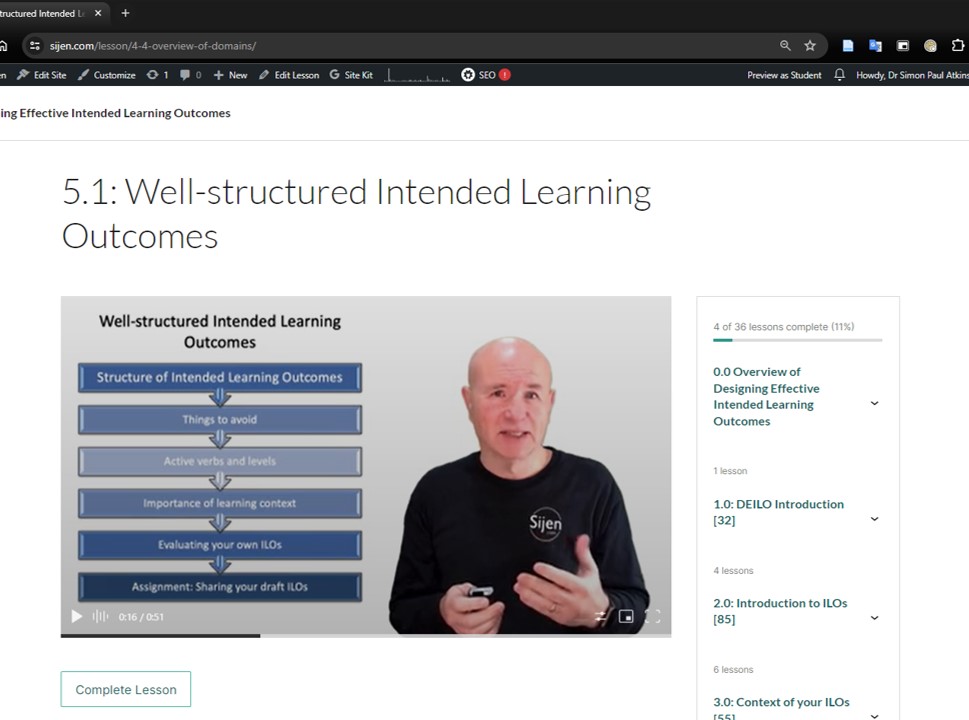
    I am delighted to release a version of the DEILO: Designing Effective Intended Learning Outcomes on the SenseiLMS platform for individuals self-study, self-paced, learning at USD139.00. The course takes between 3 and 10 hours depending on the depth of engagement. You also have the opportunity, entirely optional, to engage with me virtually by submtting draft ILOs for my review and feedback. The course also allows for a certificate (again totally optional) to be triggered on succesfull completion of the course and a final assessement.

    Please note that individual registration requires an individual’s email rather than a shared email. If you want to review the course with a view to programme, departmental or institutional licensing just drop me an email at [email protected]. Course overview is available here.


    Source link

  • The Ultimate Guide to Universal Design for Learning

    The Ultimate Guide to Universal Design for Learning

    Universal Design for Learning (UDL) is a framework that involves using a variety of teaching methods to respond to the needs of all your higher ed students. It is a teaching technique that provides flexibility in how instructional materials are delivered—and is ideal for supporting students of all backgrounds, cultures and abilities.

    Table of contents

    1. What is Universal Design for Learning?
    2. What are the three core tenets of Universal Design for Learning?
    3. Why should you use universal design in your online course?
    4. How can you apply universal design in your online course?
    5. Universal Design for Learning examples
    6. Questions to ask yourself when designing an accessible course
    7. The history of Universal Design for Learning
    8. Bring UDL to life with Top Hat
    9. References

    1. What is Universal Design for Learning?

    Universal Design for Learning (UDL) helps college and university educators create flexible programs that are easy to adapt to the unique needs of all students. This teaching framework involves using many techniques—in everything from course delivery to media use—to reduce barriers and reach every college student.1

    UDL guidelines are put into practice in a variety of facets, including outside of academia. For instance, you may use closed captioning when watching television. Your smartphone can read the information on a website aloud. Meanwhile, automatic doors make grocery stores more accessible. In these three scenarios, UDL helps level the playing field for everyone, regardless of ability.

    The UDL guidelines are presented as a graphic organizer, or a matrix table. Vertically, the principles are grouped under engagement, representation, and action and expression. Horizontally, the UDL principles are presented as access, build and internalize. Each guideline has corresponding checkpoints that include best practices. The graphic organizer helps viewers understand how criteria differ across the three principles. View the table below for a breakdown of the UDL guidelines.

    Provide multiple means of engagement Provide multiple means of representation Provide multiple means of action and expression
    Recruiting interest Perception Physical action
    Sustaining effort and persistence Language and symbols Expression and communication
    Self-regulation Comprehension Executive function

    2. What are the three core tenets of Universal Design for Learning?2

    • Action and expression: This learning approach involves giving students multiple ways to access information. Universal Design for Learning examples include giving students multiple ways to demonstrate that they’ve learned the material.
    • Representation: A key tenet of this approach is providing information in multiple formats. Universal Design for Learning examples include offering students videos, books or interactive demos that cover the material covered in a lecture. Students can then choose the format that best suits their needs.
    • Engagement: This approach is designed to motivate college students in a variety of ways. Universal Design for Learning examples include assigning projects that relate to a student’s background and interests. This pillar may be put into practice through gamification or discussions.

    2.1. Multiple means of action and expression

    This topic covers the ‘how’ of learning. It is also referred to as the strategic network. Each learner navigates the classroom in a different way, and they also express themselves uniquely. If someone has an executive function disorder, meaning they have trouble planning, organizing and problem solving, they will express themselves differently than someone who has a language barrier. For example, some postsecondary students are able to use written communication with ease, while others can only communicate through speech.

    2.1.1. Executive functions

    Executive functions encapsulate a human being’s highest level of skills. This ability allows learners to overcome their impulses to make long-term goals and strategies. Executive functions are limited by the individual’s working memory when executive functioning capacity is devoted to managing “lower level” skills that don’t come as naturally to a person. The individual’s capacity for executive functions can also be lowered by disabilities.

    With universal design for learning, instructors can expand a learner’s executive function by scaffolding—that is breaking up lessons into bite-sized pieces—to ensure they do not use up the learner’s working memory. Educators can help students scaffold executive skills so that they can use them more effectively. Setting goals and creating plans to reach these goals can help. Professors can also support students by helping them self-monitor their progress over time, which helps students guide their practice through the semester. It also helps learners better understand what advice to ask their instructors for.3

    2.1.2. Expression and communication

    Every learner has a different capacity for expression and communication. In addition, various types of media may support different learning styles. For example, a learner who has dyslexia may perform better at expressing their thoughts through verbal conversations versus written essays.

    Educators must provide different modalities for communication. This may involve using various types of media or tools for communication. Professors can help students become more fluent in a variety of communication modalities, which will then lend to independent learning.4

    2.1.3. Physical action

    Interactive software, textbooks and other curricular materials are recognized as Universal Design for Learning examples that can help students understand information. For instance, a postsecondary student may need a different type of workbook if they require assistive technology. These assistive technologies can help students who have disabilities. Some students could benefit from having expanded keyboards or voice-activated switches, for example.5

    With this tenet of UDL, it’s important to vary the methods for response and navigation. This involves creating an accessible learning environment that all students can thrive in. The second part of this UDL principle involves opening doors to the tools that will create equal opportunity.

    2.2. Multiple means of representation

    This topic can be considered the ‘what’ of learning. It’s also referred to as the recognition network. Every learner absorbs the information that is presented to them in a different way. While a sensory or learning disability may cause this difference, cultural differences and different personalities may also affect how the student learns.

    2.2.1. Comprehension

    The goal of education is to help learners turn information into knowledge that they can apply in their everyday lives. With Universal Design for Learning, educators should get higher ed students involved in transforming and gathering usable knowledge. Gaining usable knowledge is an active process, so students need to be involved in order for this process to work. This means students need to use skills like consumption, categorization and active memorization. They must also learn how to integrate new knowledge with their prior understanding of the subject. The best Universal Design for Learning example here involves relying on organizers such as concept maps to help students visually draw connections between learning units. Metaphors, stories and analogies are also effective in helping students see the importance and relevance of topics.

    To achieve these goals, instructors must present information in an accessible way. They should connect the information to previous experiences and offer background information as well. They can highlight relationships, patterns and information so that students can see how the information relates to their goals and other knowledge. Through breaking up lessons into digestible amounts, professors can support students as learners find meaning in their new knowledge and process the information. Finally, educators can help students apply information to new contexts.6

    2.2.2. Language, mathematical expressions and symbols

    Students interpret linguistic and non-linguistic symbols in different ways. While symbols like division signs provide clarity for some students, others do not understand specific symbols. Likewise, college students attribute different meanings to pictures or words based on their familial backgrounds and culture.

    Because of this, educators must provide alternative representations for students. They should clarify different symbols, vocabulary, mathematical notations and syntax. If there is a pattern in different equations, grammar or musical notations, they should be explicit about it. When necessary, instructors should use translations, graphics, movement, activities, simulations, images and videos to make learning active.7 Try pairing a chemistry formula with an illustration or simulation to put this principle into practice.

    2.2.3. Perception

    Provide the same information through formats that stimulate different senses—ranging from sight, hearing or touch—to make lessons perceptible to learners. This practice will help students absorb information through audio, tactile or visual means. Instructors should also give students formats that can be adjusted such as text that can be increased in size. Other examples of perception include offering alternatives for video and auditory information.8 Such examples are providing videos featuring American Sign Language (ASL) and complementing audio clips with transcripts.

    2.3. Multiple means of engagement

    Providing multiple means of engagement can be thought of as the ‘why’ of learning. It’s also referred to as the affective network. Every college student is motivated in a different way academically. Likewise, students have different learning styles. While some love spontaneity, others will only feel comfortable when there is a daily routine followed in the classroom. Additionally, some prefer to work alone or in groups.

    2.3.1. Self-regulation

    Ideally, the learning environment should support and encourage the student’s motivation. When students are in higher education, they should be encouraged to learn how to regulate their own emotions and become self-motivated. By regulating their emotions, students can better cope with changes in their environment. A Universal Design for Learning example includes asking students how they’re feeling today on a scale of 1-5 to understand their needs and any accommodations.

    Postsecondary students frequently learn how to self-regulate by observing their professors. Virtual classrooms can encourage this skill by modeling motivation and self-regulation. Then, educators can prompt students to use these abilities in real life. Instructors should discuss their expectations and help students set personal goals. They can support students as they self-assess their abilities and become more aware of their mistakes. Over time, students can learn how to develop healthy emotional responses to a variety of events.9

    2.3.2. Sustaining effort and persistence

    In order for a student to learn, they must make an effort to pay attention in class. If a student is motivated correctly, they can focus and make a sustained effort in the classroom. Each learner self-regulates in a different way, and these disparities are often due to their motivation levels. Other factors like contextual interference—a disruption in the motor learning phenomenon that affects how people learn and practice new skills—and self-regulation skills can also impact the student’s concentration. This is caused in part by the learner not seeing the value of certain goals and objectives.

    Educators can support students by providing different resources to help them learn. Students are more likely to rise to the expectations set to them, so teachers should provide the tools that students need to succeed and help them achieve a certain level of understanding. When introducing goals, instructors should also discuss why each goal matters—put into practice through detailed criteria—so that students feel motivated to achieve each objective.10

    2.3.3. Recruiting interest

    If the information does not engage the student’s interest, it is essentially inaccessible. Students must be able to absorb and process information in their minds. Each student is interested in different topics of discussion, so teachers must figure out how to gauge their interest in different ways.

    Instructors can attract the student’s interest by providing multiple choices whenever it is possible to do so. By allowing for individual choices and autonomy, educators can empower students to take control of their learning. Teachers should also connect the subject matter to experiences outside of the classroom. If university students believe the subject matter has value, they are more likely to be interested in learning it. Finally, teachers should attempt to eliminate distractions so that students have a safe space to learn new information.11

    3. Why should you use universal design in your online course?

    When using the UDL framework in an online course, you create equal opportunity for students of different backgrounds and abilities to learn the course material. If you are only teaching students in one specific way, many of your students may not be learning the information properly. Universal Design for Learning can help you make your course accessible to all types of learners.

    When using the UDL framework in an online course, you create equal opportunity for students of different backgrounds and abilities to learn the course material.

    4. How can you apply universal design in your online course?

    When using the principles of UDL in your online course, consider the course’s engagement, representation, action and expression goals. Here are four ways to put Universal Design for Learning examples to use in your class.

    4.1. Syllabus

    Your course syllabus shows college students what they will be learning in the upcoming quarter. It should give students multiple ways to engage with the content, such as through class readings, podcasts, webinars and guest lectures. The syllabus can communicate regular routines, assessment formats and expectations. It should also include the ways that students can access the course content. Consider adding headers and subheadings in your syllabus to make it accessible for screen readers. Download Top Hat’s syllabus template now, available in either Google Docs or Word format.

    4.2. Course materials

    To follow the principles of universal design, you should select an array of course materials. Instead of only using a textbook, your course can incorporate podcasts, discussion boards, essays, videos and physical activities. By changing the way students can absorb information, you can make the course information accessible to every student.

    4.3. Assessment

    While some students can take a written test without any issues, others have trouble reading written tests or turning them in. In the realm of assessment, Universal Design for Learning examples might include using video conferencing software to measure student understanding. Depending on the coursework, you could also use assessment techniques like recorded videos.

    4.4. Teaching

    In order to make your course more accessible, vary the way you teach your course. Images, graphs and textbooks are effective in helping students understand information. Some students learn better through audio tracks, so you may want to use a recorded lecture, video or podcast as well. In addition, you can teach students through discussion groups and other techniques as well.

    Top Hat’s Student Engagement toolkit is packed with templates and strategies to create accessible assessments, lesson plans and classroom discussions. Access now.

    5. Universal Design for Learning examples

    The following list includes Universal Design for Learning examples that you can use to create an equitable and accessible learning environment. You can also create other feedback, assignment and learning options that help diverse learners master the course material in your class.

    5.1. Assignment options

    Students can achieve the course’s learning objectives through a variety of assignment styles. Beyond traditional homework, students can also submit video recordings of a presentation or speech. They can alternatively create comic strips or podcasts. Another Universal Design for Learning example involves flexible assignment due dates. This policy accommodates students who may have obligations outside of class, such as work or family responsibilities, or who may need additional time due to disabilities or health issues.

    5.2. Regular feedback

    In order for students to improve, they must regularly receive detailed feedback. Formative assessments can help with this goal, where the student’s ongoing learning is monitored. These assessments also provide feedback that educators can use to improve their course delivery.

    5.3. Digital and audio text

    Textbooks are just one way that university students can learn. Audiobooks and text-to-speech programs can also help. In addition, you can use audio transcripts and videos with closed captions for students who require assistive technologies. Professors can use multiple modes of communication to convey information, including verbal instructions, written handouts, visual aids, and online resources. These specific Universal Design for Learning examples help students with diverse language abilities, learning styles, and sensory preferences to comprehend the material effectively.

    6. Questions to ask when designing an accessible course

    6.1. Multiple means of engagement

    1. Does the course encourage independent student responsibilities? In order for college students to learn, they have to be motivated and engaged. When students work independently on coursework, they feel responsible for the outcome. They also become more engaged in studying the material. Consider facilitating surveys or a student interest inventory at the start of the semester to gauge interests, hobbies and strengths. You can then use this information to tailor units of study accordingly.
    2. Can students complete at least some course content at their own pace and in any order they wish? Everyone learns at a different pace. When the course moves too quickly, students can fall behind. Over time, this can cause students to lose motivation. Letting students learn at their own pace in a blended or online course acknowledges their unique circumstances and provides them with the time they need to engage with the course material. Consider implementing an assignment ‘grace period’ to allow students to plan their schedules accordingly based on priorities.
    3. Are course learning goals and outcomes clear? When students are confused or lost, it is impossible for them to become engaged in the course material. You can remove this obstacle by clarifying your learning goals. When students know what to expect and what they need to do, they are more likely to achieve the course’s goals.

    6.2. Multiple means of representation

    1. Is the course content provided in multiple ways? With Universal Design for Learning, the goal is to help postsecondary students from all backgrounds and abilities. Students may have visual or aural impairments or have a disability. They may also come from a culture where subject matter is taught differently. Ideally, your course content should be provided through multiple techniques so that everyone has an equal opportunity to learn. Universal Design for Learning examples include complementing course readings with interviews or videos.
    2. Do learning opportunities and assignments use students’ prior knowledge? You can help students retain information by connecting it to their prior knowledge. You can show how new information relates to a previous class or personal experience. Sometimes, you can even assign students the task of reflecting on everything they have learned and how the new topics related to their personal experiences.
    3. Does the course have interactive learning activities online? If you are teaching online, ensure you have multiple ways to get students involved. Interactive activities help students feel like active participants in the learning process. Because students are more likely to learn when they are actively involved, this technique is extremely important for online learners. It ensures that students are just as motivated in their studies, even from a distance. Complement lectures or readings with simulations or other opportunities for students to apply their knowledge.

    6.3. Multiple means of action and expression

    1. Have you provided students with note taking support? There are many different disabilities that can make it difficult for students to take notes. To help your students, offer them multiple ways to take notes in class. They can use videos, audio recordings or written techniques to recall information. Some students may also benefit from making graphs or drawings of the new course material.
    2. Does the course include a variety of assessment methods? While some students can take written tests, this is not the best way to assess every student. Universal Design for Learning examples that support a flexible assessment strategy include video interviews, recordings, posters and other techniques. If you use written tests, you may need to offer support such as audio recordings of the questions and answers. Balance summative assessments with low stake formative assessments that enable students to receive more regular and timely feedback.
    3. Are college students encouraged to communicate with faculty and classmates in the course? Open communication between faculty and students—and especially on the student-student level—helps many learn and absorb new information. Ideally, instructors should offer multiple ways for students to communicate with their classmates and teachers. Universal Design for Learning examples could include using online forums, video conferences, interviews or essay feedback to host conversations with students.

    Our Teaching with Top Hat Toolkit offers videos and helpful resources to design an accessible learning community in our platform. Browse the toolkit today.

    7. The history of Universal Design for Learning

    Originally, this technique started out as an architectural concept. In architecture, universal design refers to creating designs that appeal to everyone. These designs must also comply with the Americans with Disabilities Act (ADA). Because of the ADA, many schools began using inclusive facilities and providing equal access to their courses. Originally, the idea of universal design in architecture was created by architect Ron Mace at North Carolina State University.

    In 1984, the Center for Applied Special Technology (CAST) was formed. CAST applied the original universal design guidelines to the educational space as a means of facilitating reform. Today, the CAST website houses plenty of instructional design tips and professional development strategies to make the postsecondary education experience more accessible.12

    8. Bring UDL to life with Top Hat

    Top Hat’s feature suite ensures your students have access to an equitable learning environment. Postsecondary students are able to learn from anywhere—the platform’s offline mode still lets students complete their homework assignments, even without having an Internet connection. Similarly, students can use multiple devices to engage with content stored in Top Hat. Top Hat is compatible with assistive technologies such as screen readers, plus keyboard navigation makes it simple to navigate through content.

    Outside of class time, alternative text on images in textbook readings helps students using screen readers understand the visuals alongside the text. Instructors can personalize the learning experience for individual students by customizing assignment due dates and grade weights. This ensures students have multiple ways to express their knowledge—and at a time that suits them.

    Top Hat’s accessibility features create a level playing field in your course. Learn more about what Top Hat can do for your students here.

    9. References

    • Morin, A. (n.d.). What is Universal Design for Learning (UDL)? Understood. https://www.understood.org/en/learning-thinking-differences/treatments-approaches/educational-strategies/universal-design-for-learning-what-it-is-and-how-it-works
    • CAST. (n.d.). The UDL Guidelines. http://udlguidelines.cast.org/
    • CAST. (n.d.). Executive Functions. http://udlguidelines.cast.org/action-expression/executive-functions/executive-functions
    • CAST. (n.d.). Expression & Communication. http://udlguidelines.cast.org/action-expression/expression-communication
    • CAST. (n.d.). Physical Action. http://udlguidelines.cast.org/action-expression/physical-action
    • CAST. (n.d.). Comprehension. http://udlguidelines.cast.org/representation/comprehension
    • CAST. (n.d.). Language & Symbols. http://udlguidelines.cast.org/representation/language-symbols
    • CAST. (n.d.). Perception. http://udlguidelines.cast.org/representation/perception
    • CAST. (n.d.). Self regulation. http://udlguidelines.cast.org/engagement/self-regulation
    • CAST. (n.d.). Sustaining Effort & Persistence. http://udlguidelines.cast.org/engagement/effort-persistence
    • CAST. (n.d.). Recruiting Interest. http://udlguidelines.cast.org/engagement/recruiting-interest
    • OCALI. (n.d.). History of UDL. https://www.ocali.org/project/learn_about_udl/page/udl_history

    Tagged as:

    Source link

  • The essential PLUS for returning to learning at Liverpool by Sarah Hanson – ALL @ Liverpool Blog

    The essential PLUS for returning to learning at Liverpool by Sarah Hanson – ALL @ Liverpool Blog

    If you are a mature student, returner to learning or someone who has experienced a disrupted education, you may be anxious about the support available for anyone not familiar with higher education and its challenges.  Starting your higher education journey is one of the most exciting times of your life, but we realise you might have some concerns as well. Whatever they might be, you don’t need to worry as the University of Liverpool offers lots of support.

    Our Student Services team, who offer a huge range of services, including mental health support like counselling, a Mental Health Advisory Service and wellbeing support including self-help guides, workshops and events. They also provide financial advice, including guidance on managing the rising cost of living and support for disabled students through initiatives like Disability Coaches, a peer support service of trained students with lived experience of disability and accessing disability support. Disability Coaches can help with initial enquiries, support plans, obtaining medical evidence and Disabled Students’ Allowance (DSA).

    The Liverpool Guild of Students offer free and confidential advice to all students about the options available to you, covering academic, housing, wellbeing issues and more. Through the Guild you can  access a huge range of Societies, providing a brilliant opportunity to make new friends through shared interests. They also provide schemes like Give It A Go and lots of volunteering programmes, giving you the chance to enhance your student experience.

    From September 2024, Go Higher students will be able to access Liverpool Plus, a brand new post-entry support programme. Including an Enhanced Welcome package, 1-2-1 support with your transition into first year, bespoke events with University services like Global Opportunities and Libraries, and priority access to schemes like the Liverpool Advocate programme.

    With Liverpool Plus, we’ll provide the support you need to make the most out of your time at University

    Source link

  • What Are Student Learning Outcomes?

    What Are Student Learning Outcomes?

    Learning outcomes are descriptions of the abilities, skills and knowledge that are used for assessing student learning. Learning outcomes should outline what students possess and can demonstrate upon completion of a learning experience or set of experiences. When developing a list of student learning outcomes for educators to set as curriculum objectives to improve student learning, consider the following recommendations:

    How to Build Student Learning Outcomes

    Choose between 3-5 learning outcomes: You should choose a sufficient amount of learning outcomes to ensure student progress can be measured without becoming overly complicated for educators to assess. It is also worthwhile to point out that not all educational activities will assess all learning outcomes. Each educational activity can assess students’ development and comprehension focusing on 1-2 student learning objectives for each class. Less than 3 objectives likely mean that student learning objectives are not robust enough for an entire course.

    Learning outcomes should be straightforward: The outcomes identified and described in your plan should be concise and simple. They should avoid complex phrasing or compound statements that mesh more than one statement together to communicate effectively. Each learning outcome should focus on the development of one skill or the meeting of one goal in order to be straightforward and ensure effective learning.

    Learning outcomes should be expressed in the future tense: It is very important for the proper implementation of student learning outcomes that they are expressed in the future tense. The statement should express what an individual student should be able to do as the result of specific instruction or educational activity. Outcomes should involve active learning, and be observable so they can be quantified for examining key student success metrics through learning assessment. They should create and make use of information literacy skills.

    Learning outcomes should be realistic: In order to ensure student learning outcomes are successful, they must be attainable for the students for whom they are designated. Outcomes need to be designed with students’ ability, their initial skill sets, cognitive development and the length of the institutional time frame (a week, a semester, etc) designated to attain these skill sets in mind. Further, they should also align with the material for teaching to students.

    Learning outcomes should align with the curriculum: The learning outcomes developed should be consistent with the curriculum objectives within the program and discipline in which they are taught. This is especially important when interpreting assessment results to analyze where changes in instruction should be made. Curriculum mapping is one example of an effective way to ensure that chosen learning outcomes correspond to the designated curriculum. A curriculum map is a diagram that explains which learning outcomes are plotted against specific program courses. This helps ensure that learning goals are reached in a timely manner.

    Methods of Constructing Learning Outcomes

    Implementing taxonomies: Taxonomies of learning experiences and student outcomes can be useful outlines for developing thorough and insightful lists of student outcomes. Taxonomies classify and compartmentalize the different types of student learning. Taxonomies usually follow a structure that divides learning into three categories. The first is the cognitive domain, which has six levels, ranging from the simple recall or recognition of facts, as the lowest level, up to increasingly more complex and abstract mental levels, followed by the highest order which is classified as evaluation. The second domain is the affective domain involves our feelings, emotions, and attitudes. This domain includes the ways in which humans deal with things emotionally, such as feelings, values, appreciation, enthusiasm, motivations, and attitudes. The final domain is the psychomotor domain, which focuses refers to the motor skills learners are expected to have acquired and mastered at each stage of development.

    Bloom’s Taxonomy of Educational Objectives (1956) is one traditional framework for structuring learning outcomes. Levels of performance for Bloom’s cognitive domain include knowledge, comprehension, application, analysis, synthesis, and evaluation. These categories are arranged in ascending order of cognitive complexity where evaluation represents the highest level. There are six steps within Bloom’s Taxonomy to achieve learning outcomes. The first step is knowledge, which focuses on knowing and remembering important facts, concepts, terms, principles or theories. The second step is comprehension, which focuses on the understanding of specific learning concepts or curriculum objectives. The third step is application, which focuses on skills and knowledge applications to solve problems. The fourth step is analysis, which focuses on identifying different structures and organizations of specific concepts or subjects, identifying relationships and different moving elements within an organization. The fifth step is synthesis, which focuses on the creation and integration of new ideas into a solution, in order to propose an action plan and potentially formulate a new classification scheme by using critical thinking. The sixth and final step in Bloom’s Taxonomy is evaluation, which judges the quality of knowledge more broadly or a specific learning concept based on its adequacy, use, value or logic.

    Using power verbs: When constructing learning outcomes, it is important to make use of concrete action words that are able to describe and quantify specific action that is observable and measurable.

    Using a Curriculum Map: Once learning outcomes have been developed and approved, making use of a curriculum map can help in viewing how the outcomes developed are being met in each course at an institution. A curriculum map is a straightforward way to visualize the ways in which an educator or institution can list learning outcomes in the rows and the program courses in the columns to demonstrate which courses contribute to each learning outcome. In each cell, letters can be placed to indicate how the course relates to the learning outcome. Use the letters “I,” “R,’ and “E” to identify which courses in the program “introduce”, “reinforce,” or “emphasize” the corresponding learning outcomes. By putting the curriculum maps into place, educators can watch for unnecessary redundancies, inconsistencies, misalignments, weaknesses, and gaps in their learning outcomes in order to optimize them for student success in their program review.

    Measuring Student Learning Outcomes

    Assessment of student learning outcomes: Assessment is a systematic and on-going way of collecting and interpreting information in order to analyze its effectiveness. The academic assessment process can also provide greater insight into how well learning outcomes relate and correspond to the goals and outcomes developed to support the institution’s mission and purpose. An ideal learning outcomes assessment process aims to answer the questions of what an institution is doing and how well it is doing it. Assessments begins with the expression of learning outcomes and course learning. The key to writing measurable outcomes involves describing the first three components: firstly analyzing the outcome, secondly, determining the method of assessment, Third, involves recognizing the criteria for success, as part of the student-centered assessment cycle.

    Program and Performance outcomes: program and performance outcomes describe the goals of a program rather than focusing on what students should know, do or value at the end of a given time period. Program outcomes can be as one-dimensional and simple as a completion of a task or activity, although this is not as meaningful as it could be and does not provide the educator with enough information for improvement. To accomplish the latter, educators and department heads should try to assess the effectiveness of what a given program has set out to accomplish. Performance outcomes usually have quantitative targets and specific timelines.

    Tagged as:

    Source link

  • The Benefits of Distant Learning

    The Benefits of Distant Learning

    What is distance learning?

    Distance learning refers to the education of students who may not always be physically present at a school. Historically, this involved correspondence between an individual and an academic institution by mail. Today, it involves learning through online tools and platforms. A distance learning program can take place entirely in online learning environments, or a combination of distance learning and traditional classroom instruction (called blended or hybrid). Massive open online courses (MOOCs), offering large-scale interactive participation and learning resources, are more recent developments in distance learning. During the COVID-19 pandemic and subsequent campus closures, educators and institutions relied heavily on distance learning methods to complete the semester.

    Types of distance learning

    Within the scope of distance education there are two very important concepts: synchronous and asynchronous learning.

    Synchronous learning

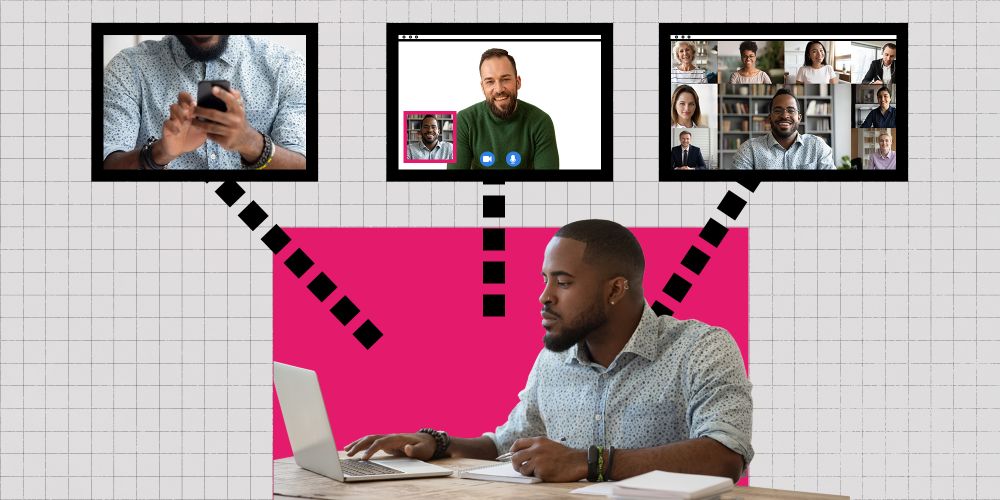
    Synchronous learning requires some form of communication during classroom time. It has a less flexible learning plan because the classes are conducted on a set schedule using videoconferencing or live online webinars.

    • Fixed-time online courses are the most common type of distance education. Students sign into their online educational portal to access distance learning resources, including live class video streams. Using this method, students and instructors make use of live chats and discussion boards for communication.
    • Video conferencing takes advantage of tools and platforms, like Zoom, that have expansive capabilities and can be used globally. Video conferencing provides learning opportunities for students by allowing them to see their instructors and peers in real time, creating a sense of community in the virtual classroom.

    Synchronous distance learning most closely mirrors the typical in-class experience. Delivering course content virtually in real time creates a sense of intimacy and timeliness that is particularly effective for increasing student engagement. Depending on supporting technology, such as learning management platforms, educators can also respond directly to questions and discussions, provide feedback and use interactive polling and click-on-target questions to gauge comprehension and ensure students are moving in the right direction. This includes the ability for attending students to access lecture slides, engage with their peers in discussion threads, and answer interactive questions.

    Synchronous learning provides opportunities to apply concepts and collaborate. It’s especially useful when teaching material that requires immediate feedback or clarification to keep students on track. There are important social benefits as well. Given the new normal students and faculty find themselves contending with, the opportunity to connect with peers, work together and see each other can go a long way in alleviating the sense of isolation many may feel when learning in a virtual environment.

    Asynchronous learning

    Asynchronous learning allows the student to work at their own pace, and normally has a very distinct syllabus, with weekly deadlines for homework and other assignments. Students have regular access to their peers and their instructors, although this is typically managed through email and discussion boards.

    • Open schedule online courses give students the greatest amount of freedom. All deadlines are pre-set and students are encouraged to be self-sufficient and complete their assignments on their own timelines. Without dedicated class time, students complete their coursework whenever they choose to allot the time to do so. Final exams normally occur at the end of the semester, and are open for several days to provide students with some flexibility as to when they choose to take it.
    • Hybrid distance education combines synchronous and asynchronous methods of online learning. Students must adhere to specific predetermined deadlines for assignment completion. The majority of the coursework is completed online, but in some cases, the student can physically speak with an instructor in person through live chats or video conferencing. Hybrid distance education may also include attending a physical classroom for certain periods of time. Conversely, it may involve covering specific modules and then returning to distance learning to complete additional modules and assignments.

    Asynchronous learning is particularly beneficial if students with varying levels of Internet access find it difficult to follow a specific schedule. Accessing all course materials, readings and assignments in a single place allows students to explore topics in detail and at their own pace. Discussion forums and one-to-one communications through email are simple ways to create engagement, even if much of the learning is self-directed. Asynchronous learning also provides the opportunity for instructors to promote peer collaboration, creating specific assignments that require students to work with each other or review each other’s work outside the confines of a class schedule.

    Without the benefit of live interaction, it’s especially important for students and instructors alike to communicate—or over-communicate —as the case may be. One of the disadvantages of asynchronous learning is student apathy and isolation. Taking time to set course expectations, provide clear assignment instructions and responding to student emails and discussion thread posts are essential.

    How distance learning impacts students

    There are many advantages to distance education. Online courses provide a more accessible learning experience for students. Accessibility in higher education means all students are provided with an equal opportunity to access course materials. This should be top of mind for educators in planning how to deliver their courses. It is no longer realistic to expect that all students have access to online materials outside of the traditional classroom, and even when they do, it’s important to take time to orient students properly. A Top Hat survey of more than 3,000 students found that 28 percent reported difficulty navigating and using online learning resources and tools. Accessibility goes hand-in-hand with flexibility: letting students choose how and where learning takes place can reduce barriers associated with finding success in higher ed.

    Forming an accessible course starts with giving careful consideration to ensuring all students can benefit from your teaching model.

    In online learning environments, students may feel isolated from their peers and campus communities. Participation has therefore become even more important with the shift to remote education. With in-person learning, instructors can gauge by a show of hands who understood your course material. In an online environment, opportunities for participation, such as discussion questions interspersed throughout lecture presentations, can help bridge the gap. Engagement in the classroom may start with icebreaker activities and diagnostic assessments. From here, instructors should consider introducing more collaborative activities such as case studies and debates to ensure students have ample opportunity to put theory into practice.

    Academic success isn’t the only concern students face. Stable housing facilities and regular access to food, along with physical and mental health resources are also top of mind for today’s college students. This is particularly in the midst of the coronavirus pandemic. Empathetic teaching practices, such as shortening lecture modules to provide students with key takeaways and making those lectures available for students to review on their own, are essential in creating supportive learning communities. Empowering students starts with respecting their individual needs and circumstances. It’s also important to dedicate time to connect with students beyond the actual class schedule. As part of the responsibilities of teaching in an online learning environment, instructors should set aside time to answer students’ questions, provide feedback and connect with them on a more personal level, similar to on a social media site.

    The future of distance learning

    Students were okay with “good enough” online education at the height of the pandemic and subsequent school closures, according to Top Hat’s COVID-19 State of Flux Survey results. But they will be less likely to put up with subpar learning in the coming semester. The good news is that many students see value in the flexibility of virtual learning. In fact, around a third of students would prefer a blended approach, with both in-person and online components. The key to success is improving the online experience and ensuring students see the return on their academic investment.

    It is clear that distance learning is here to stay. The fall semester is approaching and pressure on institutions to be ready to teach effectively is increasing. Regardless of what the situation on college campuses looks like in the fall, it is paramount to ensure students see the value of investing their time and effort in courses that may need to be delivered online.

    Even when institutions reopen their physical doors and life returns to ‘normal,’ the ability to teach online, in-person or some combination of the two will yield important benefits in terms of flexibility, as well as dimensionalizing the learning experience. As educators and students grow more comfortable and more confident with the virtual classroom, so do the opportunities to infuse learning with new experiences and new possibilities.

    Tagged as:

    Source link

  • 2024 Top Tools for Learning Votes – Teaching in Higher Ed

    2024 Top Tools for Learning Votes – Teaching in Higher Ed

    Each year, I look forward to reviewing the results of Jane Hart’s Top 100 Tools for Learning and to submitting my votes for a personal Top Tools for Learning list. I haven’t quite been writing up my list every single year (missed 2020 and 2023), but I did submit a top 10 list in 2015, 2016, 2017, 2018, 2019, 2021, and 2022. I avoid looking at the prior year’s lists until I have identified my votes for current year.

    My 2024 Top Tools for Learning

    Below are my top 10 Tools for Learning for 2024. The biggest change in my learning tools involves using social media less, most specifically that service that used to have an association with a blue bird and can most closely be associated with a cesspool these days.

    Overcast

    This podcast catcher is a daily part of my life and learning. Overcast has key features like smart speed and voice boost, which you can have for free with some non-intrusive ad placements, or pay a small fee for a pro subscription and have them hidden from view. Overcast received a major design overhaul in March of 2022, which led me to reorganize my podcast playlists to take full advantage of the new features.

    Unread

    While Overcast is for the spoken word, Unread is primarily for written pieces. Powered by real simple syndication (RSS), Unread presents me headlines of unread stories across all sorts of categories, which I can tap (on my iPad) to read, or scroll past to automatically mark as read. I use Unread in conjunction with Inoreader, which is a robust RSS aggregator that can either be used as an RSS reader, as well, or can be used in conjunction with an RSS reader, such as Unread.

    LinkedIn

    The biggest change from prior year’s surveys has to do with social media. The bird app just isn’t like it used to be. I’ve found most of my professional learning via social media takes place on LinkedIn these days. If you’re on LinkedIn, please follow me and the Teaching in Higher Ed page.

    YouTube

    Once I found out that I could subscribe to new YouTube videos on my RSS reader, Inoreader, it changed how often I watch YouTube videos. That, plus subscribing to YouTube Premium, which means we get ad-free viewing as a family, makes me spending a lot more time with YouTube. I even have my own YouTube channel, which I occasionally post videos on, most recently about my course redesign and use of LiaScript.

    Loom

    The expression tells us that it is better to show than tell in many contexts. Loom is a simple screen casting tool. Record what’s on your screen (with or without your face included via your web cam) and as soon as you press stop, there’s a link that automatically gets copied to your computer’s clipboard which is now ready to paste anywhere you want. I use Loom for simple explanations, to have asynchronous conversations with colleagues and students, to record how-to videos, and to invite students to share what they’re learning. If you verify your Loom account as an educator, you get the pro features for free.

    Kindle App

    I primarily read digitally and find the Kindle iPad app to be the easiest route for reading. I read more, in total, when I am disciplined about using the Kindle hardware, but wind up grabbing my iPad most nights.

    Readwise

    It is so easy to highlight sections of what I’m reading on the Kindle app and have those highlights sync over to a service called Readwise. The service “makes it easy to revisit and learn from your ebook and article highlights.

    Canva

    My use of the graphic design website Canva has evolved over the years. I started by using it to create graphics and printable signs for classes. Now I also use it to create presentations (which can include embedded content, slides, videos, etc.). For some presentations I’m doing in the coming weeks, I’m experimenting with using Beautiful.ai for my presentations. I still think Canva is great, but am having fun trying something new.

    Raindrop.io

    Probably more than any other app, I use Raindrop on a daily basis. It is a digital bookmarking tool. I wrote about how I use Raindrop in late 2020. I continue to see daily benefits with having such a simple-yet-robust way of making sense of all the information coming at me on a daily basis.

    Craft

    I don’t change my core productivity apps very often. In the case of Craft, once I made the switch, I never looked back. This app has both date-based and topic-based note-taking, as well as individual and collaborative features. From their website: “Craft is where people go to ideate, organize, and share their best work.”

    Those are my top ten for the year, not in any particular order. The first draft of this post had eleven items, since I lost count as I was going. I wind up using Zoom as so much a part of almost every day, it winds up getting forgotten, given its ubiquity in my life. I’m leaving it on this post, even though it takes me over my count of ten.

    Zoom

    I use Zoom so often that one of the years, I entirely left it off of my top ten listing, because it is just always there. Recent enhancements I have grown to appreciate are the built-in timer app, the AI transcripts and summaries, and that you can present slides while people are in breakout rooms.

    Your Turn

    Would you like to submit a vote with your Top Tools for Learning? You can fill out a form, write a blog post, or even share your picks on Twitter. The 2024 voting will continue through Friday, August 30, 2024 and the results will be posted by Monday, September 2, 2024.

    Source link

  • Making Online Learning More Engaging in Higher Education – Edutechniques

    Making Online Learning More Engaging in Higher Education – Edutechniques

    With my recent work in Maynooth University (MU) in Ireland and my ten years of refining and teaching the courses we offer in the MAET program at Michigan State University (MSU), Ive been pontificating and procrastinating on what is current state of play with making more engaging online content in the higher education realm.

    Using Multiple Platforms for Collaboration/Communication

    At MSU we utilise Slack alongside our Brightspace D2L learning platform. This is the latest in a long line of platforms we have added to encourage collaboration and communication amongst our students. Discussion forums on LMS are by default….not the best..and not conducive to authentic engagement. We have found with Slack that engagement is up due to the interface and the fact that Slack has an app. Threads are logical and embedding multimedia works well. At Maynooth University, I taught the blended course TL517 Digital Technology in Higher Education which was delivered in Moodle, the old course framework had a weekly requirement to post to Moodle. I mixed it up a bit by incorporating live Microsoft Team activities along with collaborative Padlets. Padlet gave the students a different visual approach to communicating their thoughts and collaborating with others. The use of breakout rooms in Microsoft Teams gave the students the opportunity to navigate smaller groups in socially constructing knowledge and understanding.

    MORE INTERACTIVE CONTENT

    Quite logical and predictable, right? However, from my time in MU, the majority of online learning courses are merely substitutions of the analog courses that were delivered within the university walls. Working with lecturers to comb through their content to pinpoint areas that may become more interactive with technology is a very rewarding process. This process might be framed by the ABC protocols or just evolve organically through conversations.

    HUMANISE THE PROCESS

    When I am teaching an online course I always start with creating a video introducing myself and detail my professional and personal history. I also tell the students about my hobbies and interests. Seeing my face and hearing my voice always gives a human element to a potentially impersonal first impressions of an online course. It is also important to empathise with students online and realise the stress and pressures of real life that students are going through. Being flexible and empathetic with deadlines (to a certain degree) is greatly appreciated.

    CONSISTENT WORD-OLOGY

    When sorting out a course layout I like to organise the different activities in to action verbs. If a unit is mainly research based then the title will be “Research: “. If a unit involves creating something, then the title will be “Create”. If a unit involves reading to gain knowledge, then the title could be “Learn” or “Inquire”. Consistent wording enables the learner to understand what each unit of a course entails.

    VISUALS, VISUALS, VISUALS

    If the LMS allows I will create an interface of a grid of icons (which Moodle and other LMSs allow). If a student opens a course and encounters a wall of text it is usually quite daunting. A nice array of colourful yet not distracting icons makes a world of difference. Obviously, videos, infographics, images, and other elements that break down walls of text are all beneficial to the end user.

    CREATE ALL THE THINGS

    If we still adhere to the adage that to create is to know, then creating artefacts of learning in an online environment makes a lot of sense. I was surprised that the lecturers at MU were overjoyed when I asked them to create infographics to present their understandings of the concepts we had just read about. They immediately could see them using infographics with their students in their field. Something that I have used in K-12 education for a long time had not found its way to higher education and made me realise that certain pedagogical approaches that I may deem mainstream may be innovative in other realms.


    Discover more from Edutechniques

    Subscribe to get the latest posts sent to your email.

    Source link

  • CBE Learning Platform Architecture White Paper –

    CBE Learning Platform Architecture White Paper –

    Earlier this year, I had the pleasure of consulting for the Education Design Lab (EDL) on their search for a Learning Management System (LMS) that would accommodate Competency-Based Education (CBE). While many platforms, especially in the corporate Learning and Development space, talked about skill tracking and pathways in their marketing, the EDL team found a bewildering array of options that looked good in theory but failed in practice. My job was to help them separate the signal from the noise.

    It turns out that only a few defining architectural features of an LMS will determine its fitness for CBE. These features are significant but not prohibitive development efforts. Rather, many of the firms we talked to, once they understood the true core requirements, said they could modify their platforms to accommodate CBE but do not currently see enough demand among customers to invest the resources required.

    This white paper, which outlines the architectural principles I discovered during the engagement, is based on my consulting work with EDL and is released with their blessing. In addition to the white paper itself, I provide some suggestions for how to move the vendors and a few comments about other missing pieces in the CBE ecosystem that may be underappreciated.

    The core principles

    The four basic principles for an LMS or learning platform to support CBE are simple:

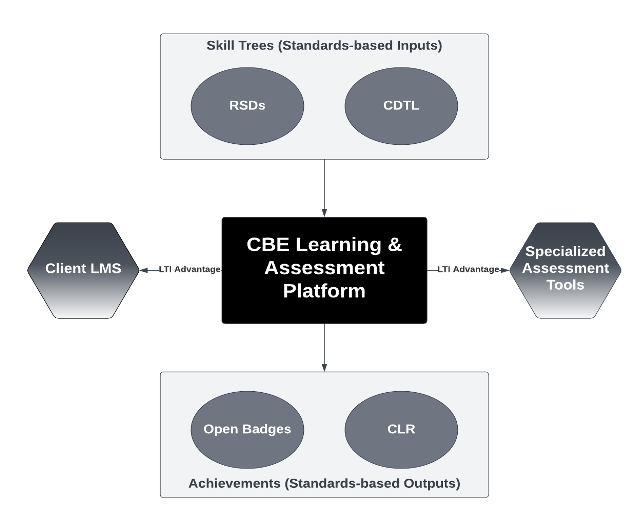
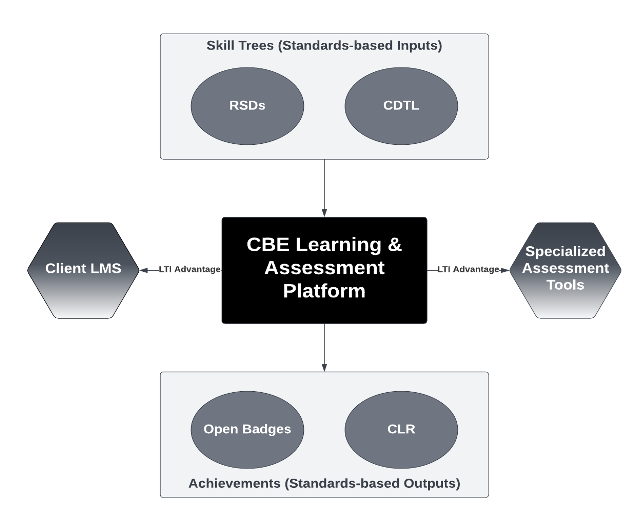
    • Separate skill tree: Most systems have learning objectives that are attached to individual courses. The course is about the learning objectives. One of the goals of CBE is to create more granular tracking of progress that may run across courses. A skill learned in one course may count toward another. So a CBE platform must include a skill tree as a first-class citizen of the architecture, separate from the course.
    • Mastery learning: This heading includes a range of features, from standardized and simplified grading (e.g., competent/non-yet) to gates in which learners may only pass to the next competency after mastering the one they’re on. Many learning platforms already have these features. But they are not tied to a separate skill tree in a coherent way that supports mastery learning. This is not a huge development effort if the skill tree exists. And in a true CBE platform, it could mean being able to get rid of the grade book, which is a hideous, painful, never-ending time sink for LMS product developers.
    • Integration: In a traditional learning platform, the main integration points are with the registrar or talent management system (tracking registrations and final scores) and external tools that plug into the environment. A CBE platform must import skills, export evidence of achievement, and sometimes work as a delivery platform that gets wrapped into somebody else’s LMS (e.g., a university course built and run on their learning platform but appearing in a window of a corporate client’s learning platform). Most of these are not hard if the first two requirements are developed but they can require significant amounts of developer time.
    • Evidence of achievement: CBE standards increasingly lean toward rich packages that provide not only certification of achievement but also evidence of it. That means the learner’s work must be exportable. This can get complicated, particularly if third-party tools are integrated to provide authentic assessments.

    The full white paper is here:

    (The download button is in the top right corner.)

    Getting the vendors to move

    Vendors are beginning to move toward support for CBE, albeit slowly and piecemeal. I emphasize that the problem is not a lack of capability on their part to support CBE. It’s a lack of perceived demand. Many platform vendors can support these changes if they understand the requirements and see strong demand for them. CBE-interested organizations can take steps to accelerate vendor progress.

    First, provide the vendors with this white paper early in the selection process and tell them that your decision will be partly driven by their demonstrated ability to support the architecture described in the paper. Ask pointed questions and demand demos.

    Second, go to interoperability standards bodies like 1EdTech and work with them to establish a CBE reference architecture. Nothing in the white paper requires new interoperability standards any more than it requires a radical, ground-up rebuild of a learning platform. But if a standards body were to put them together into one coherent picture and offer a certification suite to test for the integrations, it could help. (Testing for the platform-internal functionality like competency dashboards is often outside the remit of interoperability groups, although there’s no law preventing them from taking it on.)

    Unfortunately, the mere existence of these standards and tests doesn’t guarantee that vendors will flock to implement CBE-friendly architectures. But the creation process can help rally a group that demonstrates demand while the existence of the standard itself makes the standard vendors have to meet clear and verifiable.

    What’s still missing

    Beyond the learning platform architecture, I see two pieces that seem to be under-discussed amid the impressive amount of CBE interoperability and coalition-building work that’s been happening lately. I already wrote about the first, which is capturing real job skills in real-time at a level of fidelity that will convince employers your competencies are meaningful to them. This is a hard problem, but it is becoming solvable with AI.

    The second one is tricky to even characterize but it has to do with the content production pipeline. Curricular materials publishers, by and large, are not building their products in CBE-friendly ways. Between the weak third-party content pipeline and the chronic shortage of learning design talent relative to the need, CBE-focused institutions often either tie themselves in knots trying to solve this problem or throw up their hands, focusing on authentic certification and mentoring. But there’s a limit to how much you can improve retention and completion rates if you don’t have strong learning experiences, including formative assessments that enable you to track students’ progress toward competency, address the sticking points in learning particular skills, and so on. This is a tough bind since institutions can’t ignore the quality of learning materials, can’t rely on third parties, and can’t keep up with demand themselves.

    Adding to this problem is a tendency to follow the CBE yellow brick road to what may look like its logical conclusion of atomizing everything. I’m talking about reusable learning objects. I first started experimenting with them at scale in 1998. By 2002, I had given up, writing instead about instructional design techniques to make recyclable learning objects. And that was within corporate training—as it is, not as we imagine it—which tends to focus on a handful of relatively low-level skills for limited and well-defined populations. The lack of a healthy Learning Object Repository (LOR) market should tell us something about how well reusable learning object strategy holds up under stress.

    And yet, CBE enthusiasts continue to find it attractive. In theory, it fits well with the view of smaller learning chunks that show up in multiple contexts. In practice, the LOR usually does not solve the right problems in the right way. Version control, discoverability, learning chunk size, and reusability are all real problems that have to be addressed. But because real-world learning design needs often can’t be met with content legos, starting from a LOR and adding complexity to fix its shortcomings usually brings a lot of pain without commensurate gain.

    There is a path through this architectural mess, just like there is a path through the learning platform mess. But it’s a complicated one that I won’t lay out in detail here.

    Source link

  • AI Learning Design Workshop: Solving for CBE –

    AI Learning Design Workshop: Solving for CBE –

    I recently announced a design/build workshop series for an AI Learning Design Assistant (ALDA). The idea is simple:

    • If we can reduce the time it takes to design a course by about 20%, the productivity and quality impacts for organizations that need to build enough courses to strain their budget and resources will gain “huge” benefits.
    • We should be able to use generative AI to achieve that goal fairly easily without taking ethical risks and without needing to spend massive amounts of time or money.
    • Beyond the immediate value of ALDA itself, learning the AI techniques we will use—which are more sophisticated than learning to write better ChatGPT prompts but far less involved than trying to build our own ChatGPT—will help the participants learn to accomplish other goals with AI.

    In today’s post, I’m going to provide an example of how the AI principles we will learn in the workshop series can be applied to other projects. The example I’ll use is Competency-Based Education (CBE).

    Can I please speak to your Chief Competency Officer?

    The argument for more practical, career-focused education is clear. We shouldn’t just teach the same dusty old curriculum with knowledge that students can’t put to use. We should prepare them for today’s world. Teach them competencies.

    I’m all for it. I’m on board. Count me in. I’m raising my hand.

    I just have a few questions:

    • How many companies are looking at formally defined competencies when evaluating potential employees or conducting performance reviews?
    • Of those, how many have specifically evaluated catalogs of generic competencies to see how well they fit with the skills their specific job really requires?
    • Of those, how many regularly check the competencies to make sure they are up-to-date? (For example, how many marketing departments have adopted generative AI prompt engineering competencies in any formal way?)
    • Of those, how many are actively searching for, identifying, and defining new competency needs as they arise within their own organizations?

    The sources I turn to for such information haven’t shown me that these practices are being implemented widely yet. When I read the recent publications on SkillsTech from Northeastern University’s Center for the Future of Higher Education and Talent Strategy (led by Sean Gallagher, my go-to expert on these sorts of changes), I see growing interest in skills-oriented thinking in the workplace with still-immature means for acting on that interest. At the moment, the sector seems to be very focused on building a technological factory for packaging, measuring, and communicating formally defined skills.

    But how do we know that those little packages are the ones people actually need on the job, given how quickly skills change and how fluid the need to acquire them can be? I’m not skeptical about the worthiness of the goal. I’m asking whether we are solving the hard problems that are in the way of achieving it.

    Let’s make this more personal. I was a philosophy major. I often half-joke that my education prepared me well for a career in anything except philosophy. What were the competencies I learned? I can read, write, argue, think logically, and challenge my own assumptions. I can’t get any more specific or fine-grained than that. I know I learned more specific competencies that have helped me with my career(s). But I can’t tell you what they are. Even ones that I may use regularly.

    At the same time, very few of the jobs I have held in the last 30 years existed when I was an undergraduate. I have learned many competencies since then. What are they? Well, let’s see…I know I have a list around here somewhere….

    Honestly, I have no idea. I can make up phrases for my LinkedIn profile, but I can’t give you anything remotely close to a full and authentic list of competencies I have acquired in my career. Or even ones I have acquired in the last six months. For example, I know I have acquired competencies related to AI and prompt engineering. But I can’t articulate them in useful detail without more thought and maybe some help from somebody who is trained and experienced at pulling that sort of information out of people.

    The University of Virginia already has an AI in Marketing course up on Coursera. In the next six months, Google, OpenAI, and Facebook (among others) will come out with new base models that are substantially more powerful. New tools will spring up. Practices will evolve within marketing departments. Rules will be put in place about using such tools with different marketing outlets. And so, competencies will evolve. How will the university be able to refresh that course fast enough to keep up? Where will they get their information on the latest practices? How can they edit their courses quickly enough to stay relevant?

    How can we support true Competency-Based Education if we don’t know which competencies specific humans in specific jobs need today, including competencies that didn’t exist yesterday?

    One way for AI to help

    Let’s see if we can make our absurdly challenging task of keeping an AI-in-marketing CBE course up-to-date by applying a little AI. We’ll only assume access to tools that are coming on the market now—some of which you may already be using—and ALDA.

    Every day I read about new AI capabilities for work. Many of them, interestingly, are designed to capture information and insights that would otherwise be lost. A tool to generate summaries and to-do lists from videoconferences. Another to annotate software code and explain what it does, line-by-line. One that summarizes documents, including long and technical documents, for different audiences. Every day, we generate so much information and witness so many valuable demonstrations of important skills that are just…lost. They happen and then they’re gone. If you’re not there when they happen and you don’t have the context, prior knowledge, and help to learn them, you probably won’t learn from them.

    With the AI enhancements that are being added to our productivity tools now, we can increasingly capture that information as it flies by. Zoom, Teams, Slack, and many other tools will transcribe, summarize, and analyze the knowledge in action as real people apply it in their real work.

    This is where ALDA comes in. Don’t think of ALDA as a finished, polished, carved-in-stone software application. Think of it as a working example of an application design pattern. It’s a template.

    Remember, the first step in the ALDA workflow is a series of questions that the chatbot asks the expert. In other words, it’s a learning design interview. A learning designer would normally conduct an interview with a subject-matter expert to elicit competencies. But in this case, we make use of the transcripts generated by those other AI as a direct capture of the knowledge-in-action that those interviews are designed to tease out.

    ALDA will incorporate a technique called “Retrieval-Augmented Generation,” or “RAG.” Rather than relying on—or hallucinating—the generative AI’s own internal knowledge, it can access your document store. It can help the learning designer sift through the work artifacts and identify the AI skills the marketing team had to apply when that group planned and executed their most recent social media campaign, for example.

    Using RAG and the documents we’ve captured, we develop a new interview pattern that creates a dialog between the human expert, the distilled expert practices in the document store, and the generative AI (which may be connected to the internet and have its own current knowledge). That dialogue will look a little different from the one we will script in the workshop series. But that’s the point. The script is the scaffolding for the learning design process. The generative AI in ALDA helps us execute that process, drawing on up-to-the-minute information about applied knowledge we’ve captured from subject-matter experts while they were doing their jobs.

    Behind the scenes, ALDA has been given examples of what its output should look like. Maybe those examples include well-written competencies, knowledge required to apply those competencies, and examples of those competencies being properly applied. Maybe we even wrap your ALDA examples in a technical format like Rich Skill Descriptors. Now ALDA knows what good output looks like.

    That’s the recipe. If you can use AI to get up-to-date information about the competencies you’re teaching and to convert that information into a teachable format, you’ve just created a huge shortcut. You can capture real-time workplace applied knowledge, distill it, and generate the first draft of a teachable skill.

    The workplace-university CBE pipeline

    Remember my questions early in this post? Read them again and ask yourself whether the workflow I just described could change the answers in the future:

    • How many companies are looking at formally defined competencies when evaluating potential employees or conducting performance reviews?
    • Of those, how many have specifically evaluated catalogs of generic competencies to see how well they fit with the skills their specific job really requires?
    • Of those, how many regularly check the competencies to make sure they are up-to-date? (For example, how many marketing departments have adopted relevant AI prompt engineering competencies in any formal way?)
    • Of those, how many are actively searching for, identifying, and defining new competency needs as they arise?

    With the AI-enabled workflow I described in the previous section, organizations can plausibly identify critical, up-to-date competencies as they are being used by their employees. They can share those competencies with universities, which can create and maintain up-to-date courses and certification programs. The partner organizations can work together to ensure that students and employees have opportunities to learn the latest skills as they are being practiced in the field.

    Will this new learning design process be automagic? Nope. Will it give us a robot tutor in the sky that can semi-read our minds? Nuh-uh. The human educators will still have plenty of work to do. But they’ll be performing higher-value work better and faster. The software won’t cost a bazillion dollars, you’ll understand how it works, and you can evolve it as the technology gets better and more reliable.

    Machines shouldn’t be the only ones learning

    I think I’ve discovered a competency that I’ve learned in the last six months. I’ve learned how to apply simple AI application design concepts such as RAG to develop novel and impactful solutions to business problems. (I’m sure my CBE friends could express this more precisely and usefully than I have.)

    In the months between now, when my team finishes building the first iteration of ALDA, and when the ALDA workshop participants finish the series, technology will have progressed. The big AI vendors will have released at least one generation of new, more powerful AI foundation models. New players will come on the scene. New tools will emerge. But RAG, prompt engineering, and the other skills the participants develop will still apply. ALDA itself, which will almost certainly use tools and models that haven’t been released yet, will show how the competencies we learn still apply and how they evolve in a rapidly changing world.

    I hope you’ll consider enrolling your team in the ALDA workshop series. The cost, including all source code and artifacts, is $25,000 for the team. You can find an application form and prospectus here. Applications will be open until the workshop is filled. I already have a few participating teams lined up and a handful more that I am talking to.

    You also find a downloadable two-page prospectus and an online participation application form here. To contact me for more information, please fill out this form:

    You can also write me directly at [email protected].

    Please join us.

    Source link

  • Announcing a Design/Build Workshop Series for an AI Learning Design Assistant (ALDA) –

    Announcing a Design/Build Workshop Series for an AI Learning Design Assistant (ALDA) –

    Want to build an AI tool that will seriously impact your digital learning program? Right now? For a price that you may well have in your professional development budget?

    I’m launching a project to prove we can build a tool that will change the economics of learning design and curricular materials in months rather than years. Its total cost will be low enough to be paid for by workshop participation fees.

    Join me.

    The learning design bottleneck

    Many of my friends running digital course design teams tell me they cannot keep up with demand. Whether their teams are large or small, centralized or instructor-led, higher education or corporate learning and development (L&D), the problem is the same; several friends at large shops have told me that their development of new courses and redesigns of old ones have all but ground to a halt. They don’t have time or money to fix the problem.

    I’ve been asking, “Suppose we could accelerate your time to develop a course by, say, 20%?” Twenty percent is my rough, low-end guess about the gains. We should be able to get at least that much benefit without venturing into the more complex and riskier aspects of AI development. “Would a 20% efficiency gain be significant?” I ask.

    Answer: “It would be huge.”

    My friends tend to cite a few benefits:

    • Unblocked bottlenecks: A 20% efficiency gain would be enough for them to start building (or rebuilding) courses at a reasonable speed again.
    • Lower curricular materials costs: Organizations could replace more licensed courses with ones that they own. No more content license costs. And you can edit it any way you need to.
    • Better quality: The tool would free up learning designers to build better courses rather than running just to get more courses finished.
    • More flexibility with vendors: Many departments hire custom course design shops. A 20% gain in efficiency would give them more flexibility in deciding when and how to invest their budgets in this kind of consulting.

    The learning design bottleneck is a major business problem for many organizations. Relatively modest productivity gains would make a substantial difference for them. Generative AI seems like a good tool for addressing this problem. How hard and expensive would it be to build a tool that, on average, delivers a 20% gain in productivity?

    Not very hard, not very expensive

    Every LMS vendor, courseware platform provider, curricular materials vendor, and OPM provider is currently working on tools like this. I have talked to a handful of them. They all tell me it’s not hard—depending on your goals. Vendors have two critical constraints. First, the market is highly suspicious of black-box vendor AI and very sensitive to AI products that make mistakes. EdTech companies can’t approach the work as an experiment. Second, they must design their AI features to fit their existing business goals. Every feature competes with other priorities that their clients are asking for.

    The project I am launching—AI Learning Design Assistant (ALDA)—is different. First, it’s design/build. The participants will drive the requirements for the software. Second, as I will spell out below, our software development techniques will be relatively simple and easy to understand. In fact, the value of ALDA is as much in learning patterns to build reliable, practical, AI-driven tools as it is in the product itself. And third, the project is safe.

    ALDA is intended to produce a first draft for learning designers. No students need to see content that has not been reviewed by a human expert or interact directly with the AI at all. The process by which ALDA produces its draft will be transparent and easy to understand. The output will be editable and importable into the organization’s learning platform of choice.

    Here’s how we’ll do it:

    • Guided prompt engineering: Your learning designers probably already have interview questions for the basic information they need to design a lesson, module, or course. What are the learning goals? How will you know if students have achieved those goals? What are some common sticking points or misconceptions? Who are your students? You may ask more or less specific and more or less elaborate versions of these questions, but you are getting at the same ideas. ALDA will start by interviewing the user, who is the learning designer or subject-matter expert. The structure of the questions will be roughly the same. While we will build out one set of interview questions for the workshop series, changing the design interview protocol should be relatively straightforward for programmers who are not AI specialists.
    • Long-term memory: One of the challenges with using a tool like ChatGPT on its own is that it can’t remember what you talked about from one conversation to the next and it might or might not remember specific facts that it was trained on (or remember them correctly). We will be adding a long-term memory function. It can remember earlier answers in earlier design sessions. It can look up specific documents you give it to make sure it gets facts right. This is an increasingly common infrastructure component in AI projects. We will explore different uses of it when we build ALDA. You’ll leave the workshop with the knowledge and example code of how to use the technique yourself.
    • Prompt enrichment: Generative AI often works much better when it has a few really good, rich examples to work from. We will provide ALDA with some high-quality lessons that have been rigorously tested for learning effectiveness over many years. This should increase the quality of ALDA’s first drafts. Again, you may want your learning designs to be different. Since you will have the ALDA source code, you’ll be able to put in whatever examples you want.
    • Generative AI export: We may or may not get to building this feature depending on the group’s priorities in the time we have, but the same prompt enrichment technique we’ll use to get better learning output can also be used to translate the content into a format that your learning platform of choice can import directly. Our enrichment examples will be marked up in software code. A programmer without any specific AI knowledge can write a handful of examples translating that code format into the one that your platform needs. You can change it, adjust it, and enrich it if you change platforms or if your platform adds new features.

    The consistent response from everyone in EdTech I’ve talked to who is doing this kind of work is that we can achieve ALDA’s performance goals with these techniques. If we were trying to get 80% or 90% accuracy, that would be different. But a 20% efficiency gain with an expert human reviewing the output? That should be very much within reach. The main constraints on the ALDA project are time and money. Those are deliberate. Constraints drive focus.

    Let’s build something useful. Now.

    The collaboration

    Teams that want to participate in the workshop will have to apply. I’m recruiting teams that have immediate needs to build content and are willing to contribute their expertise to making ALDA better. There will be no messing around. Participants will be there to build something. For that reason, I’m quite flexible about who is on your team or how many participate. One person is too few, and eight is probably too many. My main criterion is that the people you bring are important to the ALDA-related project you will be working on.

    This is critical because we will be designing ALDA together based on the experience and feedback from you and the other participants. In advance of the first workshop, my colleagues and I will review any learning design protocol documentation you care to share and conduct light interviews. Based on that information, you will have access to the first working iteration of ALDA at the first workshop. For this reason, the workshop series will start in the spring. While ALDA isn’t going to require a flux capacitor to work, it will take some know-how and effort to set up.

    The workshop cohort will meet virtually once a month after that. Teams will be expected to have used ALDA and come up with feedback and suggestions. I will maintain a rubric for teams to use based on the goals and priorities for the tool as we develop them together. I will take your input to decide which features will be developed in the next iteration. I want each team to finish the workshop series with the conviction that ALDA can achieve those performance gains for some important subset of their course design needs.

    Anyone who has been to one of my Empirical Educator Project (EEP) or Blursday Social events knows that I believe that networking and collaboration are undervalued at most events. At each ALDA workshop, you will have time and opportunities to meet with and work with each other. I’d love to have large universities, small colleges, corporate L&D departments, non-profits, and even groups of students participating. I may accept EdTech vendors if and only if they have more to contribute to the group effort than just money. Ideally, the ALDA project will lead to new collaborations, partnerships, and even friendships.

    Teaching AI about teaching and learning

    The workshop also helps us learn together about how to teach AI about teaching and learning. AI research is showing us how much better the technology can be when it’s trained on good data. There is so much bad pedagogy on the internet. And the content that is good is not marked up in a way that is friendly to teach AI patterns. What does a good learning objective or competency look like? How do you write hints or assessment feedback that helps students learn but doesn’t give away the answers? How do you create alignment among the components of a learning design?

    The examples we will be using to teach the AI have not only been fine-tuned for effectiveness using machine learning over many years; they are also semantically coded to capture some of these nuances. These are details that even many course designers haven’t mastered.

    I see a lot of folks rushing to build “robot tutors in the sky 2.0” without a lot of care to make sure the machines see what we see as educators. They put a lot of faith in data science but aren’t capturing the right data because they’re ignoring decades of learning science. The ALDA project will teach us how to teach the machines about pedagogy. We will learn to identify the data structures that will empower the next generation of AI-powered learning apps. And we will do that by becoming better teachers of ALDA using the tools of good teaching: clear goals, good instructions, good examples, and good assessments. Much of it will be in plain English, and the rest will be in a simple software markup language that any computer science undergraduate will know.

    Wanna play?

    The cost for the workshop series, including all source code and artifacts, is $25,000 for your team. You can find an application form and prospectus here. Applications will be open until the workshop is filled. I already have a few participating teams lined up and a handful more that I am talking to.

    You also find a downloadable two-page prospectus and an online participation application form here. To contact me for more information, please fill out this form:

    [Update: I’m hearing from a couple of you that your messages to me through the form above are getting caught in the spam filter. Feel free to email me at [email protected] if the form isn’t getting through.]

    I hope you’ll join us.

    Source link