Tag: Legacy

  • Elite Universities With Legacy Admissions (edreformnow.org)

    Elite Universities With Legacy Admissions (edreformnow.org)

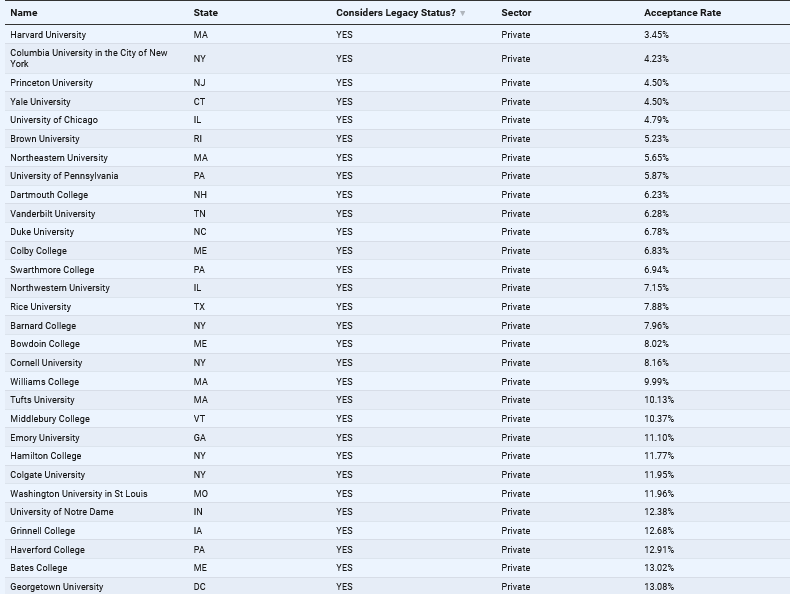
    Here is a short list of US universities with legacy admissions. These elite and highly selective schools give preferential treatment to applicants who are related to alumni, which rewards parents, grandparents, and relatives of students rather than rewarding deserving students for their skills and efforts.

    For a more exhaustive list, visit edreformnow.orgThe spreadsheet is here.

    California banned legacy admissions for private colleges in 2024. The practice is also under increased scrutiny in the wake of the recent U.S. Supreme Court ruling against college admissions policies that consider race.

    While it may not be just or fair, the process is not illegal in the
    United States, nor is there much public outcry about this elitist tradition.
    Without insider information, it’s also difficult to know how individual schools use legacy admissions and
    how the murky process operates.

    Source link

  • What legacy does Yale-NUS College leave in Singapore?

    What legacy does Yale-NUS College leave in Singapore?

    When Wee Yang Soh was considering his degree options, he felt his choices were limited. The Singaporean had been offered a place to study chemistry at the National University of Singapore (NUS), but he was wary of accepting.

    In his experience, school had felt like he was simply being “trained” to pass exams. “I didn’t want my university education to be like that,” he said. Soh liked the idea of liberal arts education but couldn’t afford the hefty tuition fees charged by the U.S. colleges offering those programs.

    So when, in 2011, NUS announced it would be opening a liberal arts college—the first of its kind in Singapore—in partnership with Yale University, Soh jumped at the chance to apply. He was part of the inaugural cohort of students enrolled at the college, graduating in 2017.

    Four years later, NUS suddenly declared that it would no longer be continuing the partnership, with plans to close the college once all existing students had graduated.

    While Yale-NUS College is not the only international partnership in Singapore that has come to an abrupt halt—having helped develop Singapore University of Technology and Design’s curriculum, the Massachusetts Institute of Technology was shown the door in 2017—it is among the most talked about. This unexpected announcement drew just as much attention, if not more, as the opening of the college had, with rumors swirling about the reasons for the decision.

    Today, as the college enters its final semester before shutting its doors for good, can liberal arts live on in Singapore? And are international partnerships off the table in a country increasingly embroiled in debates about national identity?

    Singapore’s government first began discussing the prospect of a liberal arts college in 2008. Policymakers saw the establishment of one as having multiple benefits—reducing the number of local students going abroad, diversifying pathways within the country’s higher education system and contributing to Singapore’s ambition to become an international education hub.

    So when Yale-NUS College opened in 2013, it seemed like the perfect fit. Unfortunately, this synergy didn’t last.

    “The context changed,” said Jason Tan, associate professor at Nanyang Technological University’s National Institute of Education. “For one thing, there’s no longer any official talk about establishing Singapore as an international education hub.”

    Although Singapore launched the Global Schoolhouse Project in 2002, an initiative that aimed to recruit 150,000 international students by 2015, by the mid-2010s, the numbers remained far below targets and talk of the scheme quieted as public debates around immigration heated up.

    Writing in the academic journal Daedalus in 2024, Pericles Lewis, the founding president of the college, suggested that things had gone a step further: “Singapore has not been immune to the forces of populism and nationalism that have affected most parts of the world,” he wrote.

    For a college in which international students represented about 40 percent of the student population, this was a problem.

    Throughout the college’s life, the governing party “showed itself to be highly sensitive to complaints about benefits reaped by foreigners, and to concerns of middle-class Singaporeans about the accessibility of higher education,” Lewis wrote.

    The institution also became central to debates about academic freedom in Singapore, with the last-minute cancellation of a course focused on protest generating backlash. To some, the college was a site of rare political activism and freedom in Singapore, which was both welcomed and feared, depending on your point of view.

    However, Linda Lim, professor emerita at the University of Michigan, argued that the college had little impact on the state of academic freedom in Singapore more widely.

    “From the beginning it was understood and even explicitly acknowledged that Yale-NUS College would practice and experience academic freedom only within the college walls and premises,” she said.

    “Yale may have flattered itself, or argued to mollify dubious faculty in New Haven, that Yale-NUS College would help advance academic freedom in Singapore—a naïve and neo-colonialist attitude.”

    Moreover, Soh believed claims of heightened student activism at the college were exaggerated, with intense media attention fueling public ire towards the institution.

    “From the first year, the Singaporean public and the government were already pretty afraid that politically motivated actions on campus would pose a problem for Singapore,” he said. “And they kept a very close eye on the college activities, to the point where it felt like a self-fulfilling prophecy.”

    At times, small incidents on campus, such as disagreements over new course curricula, made national news, he said. This “reinforced the idea that the students were political or dangerous and all of that stuff, when, really, everything that happened in college felt, at least to me, incredibly mundane and incredibly small and silly.”

    NUS College, a U.S.-style undergraduate honors college for NUS students, was established in 2022 in place of Yale-NUS College. While this new institution offers a residential experience, small class sizes and some shared curricula, it is a far cry from a traditional liberal arts college.

    Today in Singapore, “there’s more focus on interdisciplinary learning,” said Tan. “Across all of our universities, in one form or another, there’s this concern about future economic needs.

    “The future problems will require all those buzzwords—critical thinkers and flexible, adaptable people and people who possess this interdisciplinary pool of knowledge and so on.

    “That trend has pretty much superseded the excitement over having a liberal arts education for our undergrads.”

    For Lim, the closure of Yale-NUS College was a “cautionary tale” for international higher education institutions “who think they can be a beacon of light in authoritarian countries by collaborating with autocratic governments.”

    The college’s chief legacy, she continued, “is the quality of the students it educated and graduated.”

    Soh is currently undertaking a Ph.D. in the U.S. and credited the college and his professors for inspiring him to do so.

    “I hope to teach in the future as a professor,” he said. “I want my students to be able to treat education as not a stepping-stone to grades or to credentials, but as a way to reformulate how we think about and relate to this crazy world that we live in today.

    “I think the legacy lives on in me, but I can’t say that it lives on in Singapore or in NUS for sure. But I hope it does.”

    Source link

  • Legacy Admissions Hit Historic Low as More States Ban Practice at U.S. Colleges

    Legacy Admissions Hit Historic Low as More States Ban Practice at U.S. Colleges

    Legacy preferences in college admissions have plummeted to their lowest recorded level, with just 24% of four-year colleges still considering family alumni status in admissions decisions, according to a comprehensive new report from Education Reform Now. The dramatic decline signals a potential end to a controversial practice that critics have long condemned as perpetuating inequality in higher education.

    The report, authored by James Murphy, director of Career Pathways and Postsecondary Policy, found that 420 institutions continue to provide admissions advantages to children of alumni, marking a sharp decline from previous years. The practice has seen particularly steep drops since 2015, when nearly half of all four-year colleges considered legacy status. Between 2022 and 2023 alone, 92 colleges abandoned legacy preferences, representing an 18% decrease that coincided with the Supreme Court’s landmark decision to ban race-conscious admissions.

    This decline stems from both voluntary institutional decisions and new state legislation. In 2024, California, Illinois, Maryland and Virginia joined Colorado in restricting legacy admissions through state laws. The report indicates that 86% of colleges that ended legacy consideration did so voluntarily, while 14% were required by state legislation. Several more states are expected to introduce similar legislation in 2025.

    Legacy preferences remain most entrenched at selective private institutions, particularly in the Northeast. More than half of colleges that admit 25% or fewer applicants still provide advantages to alumni children. The practice is now rare at public institutions, with just 11% still considering legacy status. In 24 states, no public colleges provide legacy preferences at all. New York stands out as having the highest concentration of colleges maintaining legacy admissions, with one in seven U.S. institutions still using the practice located in the Empire State.

    The report challenges several common defenses of legacy admissions, including arguments that they help build campus community or are necessary for fundraising. It cites evidence that 76% of colleges successfully foster campus communities without legacy preferences, and questions whether wealthy institutions with multi-billion dollar endowments truly need to “trade admissions advantages for money.”

    The analysis also addresses claims that ending legacy admissions could hurt diversity, particularly following the Supreme Court’s affirmative action ruling. The report argues that legacy preferences disproportionately benefit white and wealthy applicants, citing research showing that Asian American applicants face significantly lower odds of admission compared to white applicants with similar qualifications at selective institutions. According to one study, Asian American applicants had 28% lower odds of attending elite schools than white applicants with similar academic and extracurricular qualifications.

    The report suggests that Congress could potentially impose additional endowment taxes on universities that maintain legacy preferences while offering reduced penalties to institutions that increase enrollment of Pell Grant recipients, community college transfers, and veterans. This approach would create financial incentives for institutions to abandon the practice.

    “The shame of belonging to this group of colleges that think children of alumni have somehow earned an extra advantage in admissions is likely to push more colleges to drop the practice,” Murphy writes. “This is not a club that most colleges belong to or will want to belong to.”

    The report also criticizes the Common Application for potentially enabling legacy admissions by requiring all applicants to identify where their parents earned bachelor’s degrees, even though this information is irrelevant for more than three-quarters of colleges. The report suggests that removing this question would be a significant step toward making college admissions more equitable.

    “Ultimately, the reason to eliminate legacy preferences is not to achieve some other goal,” the report concludes. “The reason to get rid of them is that they are profoundly unfair and make a mockery of merit. Legacy preferences award some of the most advantaged students an additional advantage in the college admissions process on the basis of ancestry alone.”

    Source link

  • Legacy admissions tumbled dramatically over past decade

    Legacy admissions tumbled dramatically over past decade

    Dive Brief:

    • The share of four-year colleges that use legacy admissions practices has fallen by roughly half since 2015, from 49% then to 24% by 2025, according to a study from the center-left nonprofit Education Reform Now
    • The group counted 420 institutions that give preferential treatment to applicants related to an alum. Meanwhile, 452 have stopped considering legacy ties since 2015. The number and share of institutions are both at their lowest since collection of the information began. 
    • The recent declines are due in part to revamped diversity commitments following the U.S. Supreme Court’s 2023 ban on race-conscious admissions, as well as a handful of new state laws prohibiting legacy admissions, the group said. 

    Dive Insight:

    The decline in legacy admissions has been swift, the study found. Just between 2022 and 2023, 92 colleges stopped considering legacy status — an 18% decline in one year. And even more have dropped legacy admissions since then. 

    Of the colleges that nixed the practice, 86% did so via voluntary institutional decision, while 14% were complying with legislation, according to the study.

    The report pulled from the Common Data Set and federal data, which began including legacy admissions policies in 2022. Historically, a clear data picture of an institution’s use of legacy status in admissions has been hard to come by. Colleges have at times also made ambiguous or erroneous entries in the Common Data Set. 

    Education Reform Now identified 12 states that have introduced proposals to ban on legacy admissions, and found that most focused on both public and private institutions. 

    Of the dozen states, five have passed bans, all in recent years: California, Colorado, Illinois, Maryland and Virginia. Only Maryland and California addressed private institutions. In several states, bills passed one legislative house but never made it to a vote in both. 

    Legacy admissions policies are concentrated in selective colleges. Among four-year institutions that accepted 25.5% or fewer of their applicants, 56.1% considered legacy status in admissions in the 2023-24 academic year. Nearly a third of colleges with acceptance rates between 25.6% and 50.4% also offered legacy preference, according to the group’s analysis of federal data. 

    Past research has found that legacy status can boost by more than threefold an applicant’s odds of acceptance to highly selective colleges. The practice originated, in part, from an effort in the early 20th century by elite, wealthy universities to keep Jewish applicants out

    One scholar in 2019 described legacy admissions as an “affirmative-action policy for rich white students,” which helps the rich and powerful exploit their position and ensure class domination for the next generation.”

    The practice has come under regulatory scrutiny as well. In 2023, the U.S. Department of Education opened a civil rights investigation into Harvard University’s legacy admissions policy after a group filed a complaint alleging the practice offered de facto preferential treatment to White applicants. 

    Defenders of the practice have pointed to the boost legacy admissions give to fundraising, which in turn can support need-based financial aid that serves to diversify student bodies. 

    Some elite universities, including Yale and Harvard universities, said they were reviewing their legacy policies in the months after the Supreme Court decision. For now, both continue the practice. Some 11% of Yale’s class of 2027 has legacy ties, according to the university’s figures. A survey by The Harvard Crimson found that its share is roughly 32%.

    Source link

  • The Trudeau Legacy | HESA

    The Trudeau Legacy | HESA

    I don’t know about you, but I find all the writing about the Trudeau legacy pretty goddamn annoying. Weeks and weeks of columnists yelling “resign!” followed by weeks and weeks of the same columnists yelling “he didn’t do it fast enough!” All true; all deeply boring. But since this is basically the blog of record for the sector, it would be weird to let the man leave without an assessment of his effect.

    So here goes:

    The early years

    A lot of people were probably more excited about Trudeau’s win in 2015 than they should have been. The Chretien/Martin regime of the late 1990s and early 2000s was the most pro-science /education in Canadian history. In comparison, the Conservative government of Harper government seemed pretty bad, even though its record on funding postsecondary education was much better than it usually got credit for (its attitude towards government scientists was a different matter entirely). A lot of people assumed that a new Liberal government was just going to reset to the status quo ante, even if that was never really very likely.

    It is worth recalling that , in the 2015 election, the Liberals were the party that promised the least, financially in terms of postsecondary education. Sure, in opposition, Trudeau mused about higher education a fair bit, which made him seem progressive without actually requiring him to do anything (remember his idea of targeting a rise in postsecondary attainment rates from 50% to 70%? Me neither until I started going through my files—it was never going to happen). But basically, he was coasting on the reputation of the previous Liberal administration.

    There was one great move early on, with respect to phasing out (untargeted) education tax credits and investing the proceeds in income-targeted student grants, a measure which allowed some provinces (like Ontario and New Brunswick) to at least temporarily (until vindictive Conservative governments came to power) re-arrange their aid programs to deliver targeted free-tuition programs for lower-income students. This saved the government money over the course of the Liberals’ first term (it was meant to be revenue-neutral, but that depended on an increase in spending in the 2019 budget which didn’t happen until the COVID emergency—see below).

    The Liberals did a lot of other stuff in that first Trudeau term; just not much that was either coherent or lasting. On research funding, the government asked former U of T President David Naylor to advise them on how to run research councils, and when he did they proceeded to take about two-thirds of his advice on the actual amount of funding and well under a quarter of what he recommended in terms of how to manage that funding (it totally ignored the bit about giving up its boutique funding programs, for instance). On its prime innovation strategy—the so-called “superclusters,” which still exist, now devoid of any regional dimension—which the deeply problematic techbro-loving Minister of the era, Navdeep Bains, would create a set of “made-in-Canada silicon valleys”, well…you can read about them here, but they are so embarrassing it’s probably better to pass over them in silence.

    There was a lot of money thrown at Skills Training in Budget 2017 and most of it seemed reasonably sensible, but it’s hard to work out how much good any of it did. This government—unlike the Martin/Chretien Liberals—really doesn’t like evaluating its own spending. And certainly the government never really followed this up or turned it into something coherent. An attempt to create a national training benefit in Budget 2019 which seemed like a promising idea at the time but has basically dissolved into thin air because there has been little attempt to promote the program(s). Steps were taken towards better funding for indigenous postsecondary education, but that effort subsequently got bogged in the details.

    And this is pretty much the story of Liberal policymaking in general in postsecondary education (and arguably a lot of other policy fields, too): lots of good ideas, not very good at sustaining the attention necessary to execute them properly and make them work. This is what happens when you govern according to the 24-hour news cycle and not the long-term success of the nation.

    The COVID Years (Second term)

    Less than six months after being narrowly re-elected in 2019, COVID arrived. Broadly speaking, the government’s initial instincts were pretty good: do anything to keep the economy going while we figured out how to live with the virus and waited for the vaccines to arrive. In higher education, that meant pouring a ton of money into an emergency student aid benefit (the Canada Emergency Student Benefit) than turned out to be actually necessary (see my take on what really happened during covid and emergency benefits). I’m not particularly inclined to see this as a failure: hindsight is easy, but given how crazy everything was in spring 2020 I’m inclined to give them a pass on one-time cash handouts. Same with the backstopping of university research expenditures in this period.

    What was less forgivable was the tendency to view the brief shift of the Overton Window towards government intervention either as something semi-permanent or as an invitation to extreme hubris. The decision to double the Canada Education Student Grant from $3000 per year to $6000 per year for 2020-21 was probably justifiable: extending it for another two years and then abruptly cancelling it in the 2023 budget was probably not. And then of course there was the WE Charity/Canada Student Summer Grant fiasco. Hubris combined with a lack of execution will kill you every time.

    Post-COVID (Third term)

    The Liberals narrowly won the 2021 election and then basically went to sleep until the summer of 2023 when it suddenly dawned on them that they were hated by pretty much the entire country, mainly because of inflation but especially housing inflation which was blamed (with some justification) on a rapid influx of international students, particularly (but not exclusively) to Ontario Community Colleges. The influx was not the Liberals’ fault in the least—for this you can blame some combination of a decade or more of provincial underfunding and some truly wild-ass empire-building by a handful of college Presidents—but they were somewhat slow to react. Somehow, they got tagged with responsibility for the problem, and so their Immigration Minister, Marc Miller, set out to solve it.

    And so in January 2024, with all of the wit and wisdom that comes from occupying the strategic intersection between arrogance and ignorance in which official Ottawa perpetually resides, by gum, the Trudeau introduced a solution (actually two: there was a second policy package in September which was designed specifically to screw with the college sector). It was a national solution to an essentially regional (southern Ontario) problem, and it hammered postsecondary finances across the country. Some of it was necessary; much of it was not. My estimate of the changes are in the range of $3-4 billion range, with job losses in the tens of thousands. And to a considerable extent, it was the violent, sudden change in international policy combined, deliberately adopted in a manner which was contemptuous of the sector, which is how this Government will be remembered by the sector.

    Meanwhile, the feds went on an epic bout of fumbling the research and innovation files. In election 2021, Trudeau promised a Canadian version of DARPA. Budget 2022 turned that into a new Canada Innovation Corporation, which was then basically punted into the long grass because, well, Trudeau couldn’t focus long enough to figure out how to make it work. Then, Inflation ate away the entire value of the big Naylor-induced research package of 2018. That led to a new research package in Budget 2024 worth $1.8 billion (88% of which does not come online until after the next election, it’s so anyone’s guess how much of it ever materializes), accompanied by a raft of new ideas from a panel chaired by Frédéric Bouchard about how to manage curiosity-driven research. The money has now been allocated (in theory), but the feds are not close to working out changes to management. All was supposed to be revealed in the 100% unlamented Fall Economic Statement, but again the Liberals punted. Couldn’t make a decision.

    (Simultaneously, the government utterly botched the roll out of the Strategic Science Fund. No one has ever written about this and I’m not going to tell tales out of school—at least not today—but trust me, this was a time-wasting fiasco of enormous proportions.)

    The Verdict

    At the end of the first term, I compared the Trudeau record with that of the Harper government, and noted that the difference wasn’t as big as you’d think—probably more about vibes than about money (I got some snotty “how dare you” comments from Liberal partisans on that one). And I think that’s still my verdict. The Trudeau government wanted to be known as “pro-Science” and “pro-education.” It just didn’t want to put in the money or the sustained policy attention required to actually be effective. Sometimes the casual inattention to policy details just made spending ineffective; sometimes (as in the case of international student visas) it hurt institutions.

    Either way, the cavalier attitude to substance began to wear thin a long time ago. I don’t think many in the post-secondary sector will view the Trudeau era with much fondness.

    Source link