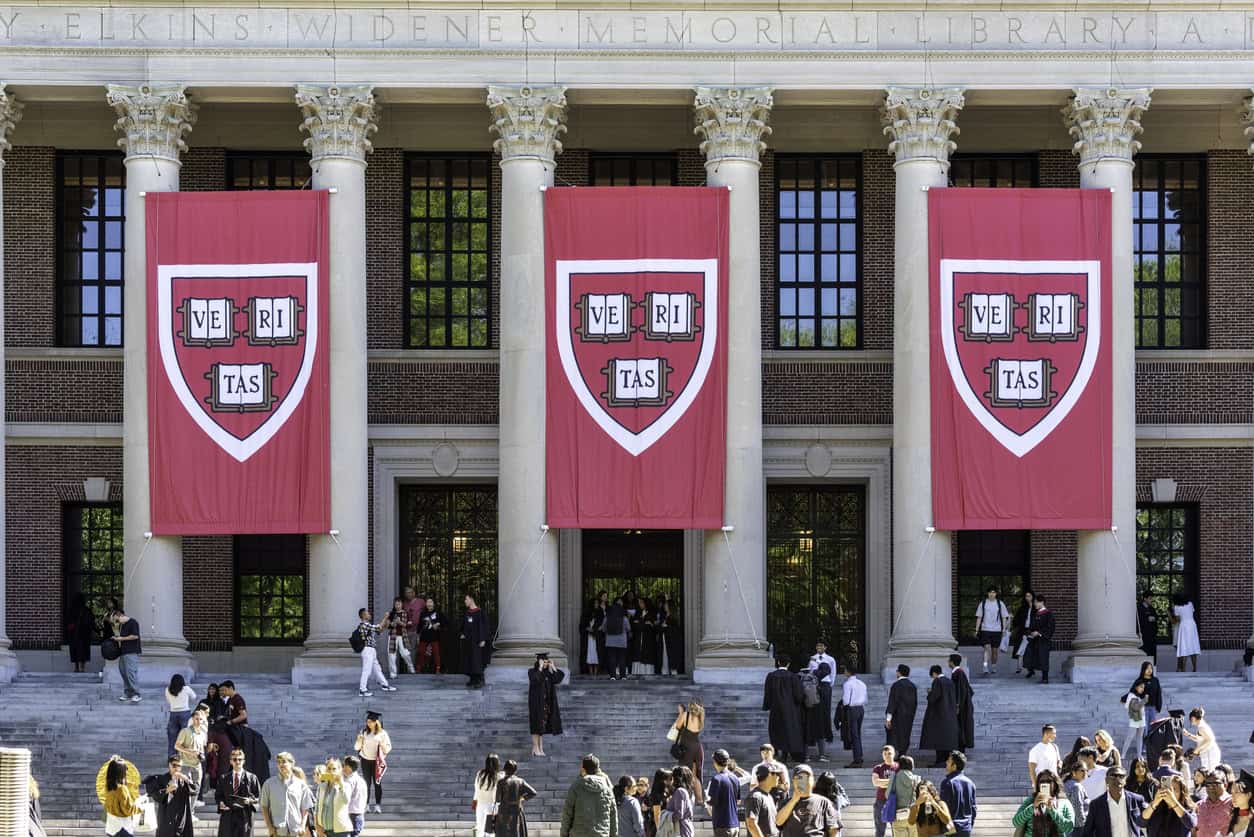
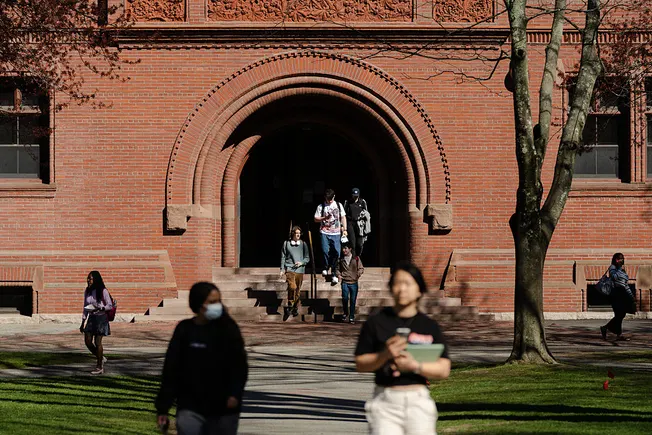
This week, the American Council on Education (ACE) was joined by 22 higher education associations filing an amicus brief in support of Harvard against the administration’s efforts to uphold Trump’s June 2025 proclamation barring international students from the institution.
“If the federal government may punish a university for its perceived ideology or that of its students, then the marketplace of ideas collapses into a monopoly of dogma,” the brief warns.
It urges the court to affirm the preliminary injunction issued by Judge Allison Burroughs last June, which blocked Trump’s attempt to prohibit foreign nationals seeking to study at Harvard from entering the US.
The signatories have said the proclamation represents an unprecedented executive overreach threatening institutional autonomy and academic freedom, as well as violating the First Amendment.
“Over the last year, the current administration has engaged in an unprecedented effort to coerce institutions of higher education to behave in a manner that reflects the administration’s preferred ideology, including by reshaping their faculty, curriculum and student body,” the document reads.
“When Harvard resisted the administration’s unlawful demands, the administration retaliated with extreme sanctions, including the proclamation issued in this appeal.”
The case arises from multiple attempts by the Trump administration bar international students from attending the Ivy League institution last spring.
Initial efforts were led by the Department of Homeland Security (DHS) attempting to strip Harvard of its SEVP Certification, which enables US institutions to enrol international students – a move halted by federal district judge Allison Burroughs.
Weeks later, Trump escalated efforts and issued his own presidential proclamation aimed at achieving the same result, which was met with a preliminary injunction from judge Burroughs, who said Trump’s directive implicated core constitutional protections.
Appealing judge Burroughs’ decision, the administration argued the proclamation was legal under the president’s immigration authorities – citing the familiar argument relating to national security concerns. This took the case to First Circuit appeals court, where it is now being heard.
The White House did not immediately respond to a request for comment.
Trump’s proclamation cites Harvard’s alleged “violent crime rates” and deficient reporting on foreign students as rationales for the directive, alongside its “entanglements” with the Chinese Communist Party and “discriminatory” admissions practices reducing opportunities for American students.
If the federal government may punish a university for its perceived ideology or that of its students, then the marketplace of ideas collapses into a monopoly of dogma
American Council on Education et al.
The brief argues that the proclamation is “fundamentally inconsistent with institutional autonomy – at Harvard and other educational institutions across the country” and that the administration’s actions are unconstitutional and set a dangerous precedent for all US colleges.
“The administration’s actions at issue in this case are directed at Harvard, but they reverberate throughout every state in the nation,” the brief states, arguing that punishing a university for its perceived ideology is “the antithesis of American values”.
It highlights the targeted nature of Trump’s directive, which would allow international students into the US seeking to study at any institution but Harvard – signalling the intervention is punitive, not regulatory, the amici said.
They emphasise the value of international students, “who … enrich and strengthen our community in innumerable ways”.
“But these benefits are unattainable when schools are prohibited from enrolling international students because they do not pass the government’s ideological litmus test.”
The brief contextualises the case within the administration’s long-running assault on Harvard, involving the freezing of federal grant funding, threats to Harvard’s tax-exempt status and requests for information regarding Harvard’s international students.
The administration’s appeal is expected to be considered in the coming months.
In the federal funding fight, judge Burroughs found in September 2025 that the administration acted unlawfully when it cut Harvard’s research grants – a case also heading to the court of appeal after the administration disputed the ruling.
Despite the ongoing attacks on America’s oldest institution, Harvard’s overseas enrolments rose to their highest level since 2002 this academic year, making up 28% of the total university population.
This audio is auto-generated. Please let us know if you have feedback.
After a tumultuous 2025, education policy and legal experts expect no let-up in 2026. The second Trump administration and its Education Department are continuing to reshape the direction of federal support for K-12, and courts are routinely hearing cases of great consequence for school district policies.
Continual change to the education landscape “makes it very difficult to plan and prepare, and to provide students with the quality public education they deserve,” said Sasha Pudelski, director of advocacy for AASA, The School Superintendents Association. “School district leaders are facing mounting uncertainty, and should brace for more in 2026.”
Here are four K-12 legal and policy trends for district leaders to monitor in the coming year.
Uncertainty around federal support
The Trump administration’s push to “return education to the states” means that superintendents can expect less federal support and more change in 2026. This ranges from less help with administering the National Assessment of Educational Progress and managing federally funded programs, to unpredictability around the availability of federal funds and the makeup of the U.S. Education Department, education policy experts said.
“Anything that they’re used to getting from the federal government, I would expect them to essentially expect less,” said Jonathan Collins, assistant professor of political science and education at Columbia University’s Teachers College.
Collins said districts in blue states can also anticipate being targeted for policies related to diversity, equity and inclusion — including programs that support diversifying the teacher workforce — as well as LGBTQ+ rights.
“You should expect them to turn up the heat,” Collins said of the federal government’s crackdown on Title VI and Title IX issues, which bar race- and sex-based discrimination, respectively, in federally funded education programs.
In the past, the federal government typically invoked the statutes to protect underserved students, but the Trump administration has instead used them to target DEI efforts and protections for LGBTQ+ students. “I think the nozzle on the gas is going to change to an even higher level this upcoming year,” Collins added.
A bigger religious footprint in public education
Recent years have seen a surge in First Amendment lawsuits related to the religious rights of parents and teachers, especially spurred on by the parental choice movement circling around issues like curriculum and LGBTQ+ culture in schools.
In 2025, for example, the U.S. Supreme Courtrequired a Maryland district to allow curriculum opt-outs for parents who don’t want their children exposed to LGBTQ+-related content. That ruling in Mahmoud v. Taylor set legal precedent for other districts’ policies on such opt-outs.
In 2026, additional rulings on similar issues are expected to influence district policies, according to education policy experts. For example, lawsuits are pending on LGBTQ+ student pronoun usage and state laws requiring the Ten Commandments to be displayed in classrooms.
Districts, especially those in red states, can expect “to exercise even more authority” over school prayer, teaching of the 10 Commandments, “and just any initiative or program or aspect of schooling that especially caters to Christianity,” said Collins. “I think you can expect to see an even bigger upsurge in those kinds of things happening.”
Religious-based organizations are also likely to continue pushing — under the mantle of the First Amendment — for the creation of religious public charter schools.
As a result of a deadlock due to Justice Amy Coney Barrett’s recusal in one such case, the Supreme Court kept in place an Oklahoma ruling that blocked what would have been the nation’s first religious public charter school. However, after that Catholic school’s failed launch, another religious charter was proposed for Oklahoma in November — this time by a Jewish organization. Whether that school succeeds, and what it could mean for other efforts to establish religious public schools, will be watched in 2026.
Expansion of right-to-education cases
While right-to-education lawsuits have been a constant in the education finance sector, the “right-to-education” legal argument is expanding to specific subject areas in the classroom, including literacy and civics education. The right to education is guaranteed under almost every state constitution, and it has so far been used routinely by students and advocacy groups to advocate for equitable education funding.
In recent years, that argument has expanded to “right-to-literacy” or “right-to-read” cases, with California and Detroit entering major settlements after students sued.
The legal argument is also being stretched to ensure civics education is taught, said Michael Rebell, executive director for the Center for Educational Equity and a professor of law and educational practice at Columbia University’s Teachers College.
In 2025, students applied “the right to education” legal argument to sue for a better civics education in Kentucky, for instance. In 2026, this legal argument could proliferate, Rebell said, with a decision expected any day now in the Kentucky case.
More AI policies and guidance
Following the explosion in the deployment of artificial intelligence across education and countless other sectors in 2025, districts can expect more guidance and policies related to AI tools in 2026, education experts said.
At least 31 states have already issued some kind of AI guidance or framework for schools, according to AI for Education, a for-profit provider of AI literacy training for educators.
However, the legal parameters for using the technology — including such concerns as data rights and privacy protections — still need to be ironed out at the federal level and across states and localities.
“It’s kind of the wild, wild west right now,” said Collins. “Expect that to also be a big cornerstone of what we see education policy-wise in this upcoming year.”
Last week, Emily Suski, a law professor and associate dean at the University of South Carolina, was named the next dean of the University of Arkansas School of Law. But on Wednesday, her offer was rescinded after state legislators reportedly objected to her signing a “friend of the court” brief that made legal arguments in support of trans athletes.
The following statement can be attributed to FIRE Legal Director Will Creeley:
The University of Arkansas’ shameful capitulation to political pressure betrays its commitment to Professor Suski and threatens the rights of all who teach, study, and work there. The message to every dean, professor, and researcher is unmistakable: Your job hinges on whether politicians approve of your views.
Political interference in academic decisionmaking must be rejected. When universities make hiring decisions based on politics, left or right, academic freedom gets weaker and campuses grow quieter.
by Kathryn Joyce, The Hechinger Report January 6, 2026
The West Shore school board policy committee meeting came to a halt almost as soon as it began. As a board member started going over the agenda on July 17, local parent Danielle Gross rose to object to a last-minute addition she said hadn’t been on the district’s website the day before.
By posting notice of the proposal so close to the meeting, charged Gross, who is also a partner at a communications and advocacy firm that works on state education policy, the board had violated Pennsylvania’s open meetings law, failing to provide the public at least 24 hours’ notice about a topic “this board knows is of great concern for many community members interested in the rights of our LGBTQ students.”
The committee chair, relentlessly banging her gavel, adjourned the meeting to a nonpublic “executive session.” When the committee reconvened, the policy was not mentioned again until the meeting’s end, when a lone public commenter, Heather Keller, invoked “Hamlet” to warn that something was rotten in the Harrisburg suburbs.
The proposed policy, which would bar trans students from using bathrooms and locker rooms aligned with their gender identity, was a nearly verbatim copy of one crafted by a group called the Independence Law Center — a Harrisburg-based Christian right legal advocacy group whose model policies have led to costly lawsuits in districts around the state.
“Being concerned about that, I remembered that we don’t partner with the Independence Law Center,” Keller said. “We haven’t hired them as consultants. And they’re not our district solicitor.”
To those who’d followed education politics in the state, Keller’s comment would register as wry understatement. Over the past several years, ILC’s growing entanglement with dozens of Pennsylvania school boards has become a high-profile controversy. Through interviews, an extensive review of local reporting and public documents, In These Times and The Hechinger Report found that, of the state’s 500 school districts, at least 20 are known to have consulted with or signed formal contracts accepting ILC’s pro bono legal services — to advise on, draft and defend district policies, free of charge.*
But over the last year, it’s become clear ILC’s influence stretches beyond such formal partnerships, as school districts from Bucks County (outside Philadelphia) to Beaver County (west of Pittsburgh) have proposed or adopted virtually identical anti-LGBTQ and book ban policies that originated with ILC — sometimes without acknowledging any connection to the group or where the policies came from.
In districts without formal partnerships with ILC, such as West Shore, figuring out what, exactly, their board’s relationship is to the group has been a painfully assembled puzzle, thanks to school board obstruction, blocked open records requests and reports of backdoor dealing.
Although ILC has existed for nearly 20 years, its recent prominence began around 2021 with a surge of “parents’ rights” complaints about pandemic-era masking, teaching about racism, LGBTQ representation and how library books and curricula are selected. In many districts where such debates raged, calls to hire ILC soon followed.
In 2024 alone, ILC made inroads of one kind or another with roughly a dozen districts in central Pennsylvania, including West Shore, which proposed contracting ILC that March and invited the group to speak to the board in a closed-door meeting the public couldn’t attend. (ILC did not respond to multiple interview requests or emailed questions.)
On the night of that March meeting, Gross organized a rally outside the school board building, drawing roughly 100 residents to protest, even as it snowed. The board backed down from hiring ILC, but that didn’t stop it from introducing ILC policies. In addition to the proposed bathroom policy, that May the board passed a ban on trans students joining girls’ athletics teams after they’ve started puberty and allowed district officials to request doctors’ notes and birth certificates to enforce it.
To Gross, it’s an example of how West Shore and other school boards without formal relationships with ILC have still found ways to advance the group’s agenda. “They’re waiting for other school boards to do all the controversial stuff with the ILC,” Gross said, then “taking the policies other districts have, running them through their solicitors, and implementing them that way.” (A spokesperson for West Shore stated that the district had not contracted with ILC and declined further comment.)
“It’s like a hydra effect,” said Kait Linton of the grassroots community group Public Education Advocates of Lancaster. “They’ve planted seeds for a vine, and now the vine’s taking off in all the directions it wants to go.”
Related: Become a lifelong learner. Subscribe to our free weekly newsletter featuring the most important stories in education.
ILC was founded in the wake of a Pennsylvania lawsuit that drew nationwide attention and prompted significant local embarrassment.
In October 2004, the Dover Area School District — situated, like West Shore, in York County, south of Harrisburg — changed its biology curriculum to introduce the quasi-creationist theory of “intelligent design” as an alternative to evolution. Eleven families sued, arguing that intelligent design was “fundamentally a religious proposition rather than a scientific one.” In December 2005, a federal court agreed, ruling that public schools teaching the theory violated the U.S. Constitution’s establishment clause.
During the case, an attorney named Randall Wenger unsuccessfully tried to add the creationist Christian think tank he worked for — which published the book Dover sought to teach — to the suit as a defendant, and, failing that, filed an amicus brief instead. When the district lost and was ultimately left with $1 million in legal fees, Wenger found a lesson in it for conservatives moving forward.
Speaking at a 2005 conference hosted by the Pennsylvania Family Institute — part of a national network of state-level “family councils” tied to the heavyweight Christian right organizations Family Research Council and Focus on the Family — Wenger suggested Dover could have avoided or won legal challenges if officials hadn’t mentioned their religious motivations during public school board meetings.
“Give us a call before you do something controversial like that,” Wenger said, according to LancasterOnline. Then, in a line that’s become infamous among ILC’s critics, Wenger invoked a biblical reference to add, “I think we need to do a better job at being clever as serpents.” (Wenger did not respond to multiple requests for comment.)
The following year, in 2006, the Pennsylvania Family Institute launched ILC with Wenger as its chief counsel, a role he remains in today, in addition to serving as chief operating officer. ILC now has three other staff attorneys and has worked directly as plaintiff’s attorneys on two Supreme Court cases: one was part of the larger Hobby Lobby decision, which allows employers to opt out of employee health insurance plans that include contraception coverage; the other expanded religious exemptions for workers.
ILC has financial ties and a history of collaborating with Christian right legal advocacy behemoth Alliance Defending Freedom, including on a 2017 lawsuit against a school district outside Philadelphia that allowed a trans student to use the locker room aligned with their gender. ILC has filed amicus briefs in support of numerous other Christian right causes, including two that led to major Supreme Court victories for the right in 2025: Mahmoud v. Taylor, which limited public schools’ ability to assign books with LGBTQ themes; and United States v. Skrmetti, which affirmed a Tennessee ban on gender-affirming care for minors. In recent months, the group filed two separate amicus briefs on behalf of Pennsylvania school board members in anti-trans cases in other states. In both cases, which were brought by Alliance Defending Freedom and concern school sports and pronoun usage, ILC urged the Supreme Court to “resolve the issue nationwide.”
In lower courts, ILC has worked on or contributed briefs to lawsuits seeking to start public school board meetings with prayer and to allow religious groups to proselytize public school students, among other issues. More quietly, as the local blog Lancaster Examiner reported — and as one ILC attorney recounted at a conference in 2022 — ILC has defended “conversion therapy,” the broadly discredited theory that homosexuality is a disorder that can be cured.
To critics, all of these efforts have helped systematically chip away at civil rights protections for LGBTQ students at the local level, seeding the policies that President Donald Trump’s administration is now trying to make ubiquitous through executive orders. And while local backlash is building in some areas, activists are hindered by the threat that the ILC’s efforts are ultimately aimed at laying the groundwork for a Supreme Court case that could formalize discrimination against transgender students into law nationwide.
But ILC’s greatest influence is arguably much closer to its Harrisburg home, in neighboring Lancaster and York counties, where nine districts have contracted ILC and at least three more have adopted its model policies.
The rural hillside and farmland in Lancaster County, Pennsylvania, are seen on Aug. 15, 2025. The local school district, Penn Manor, adopted anti-trans and anti-LGBTQ policies presented by the Independence Law Center, a Harrisburg-based Christian-right legal advocacy group.
A sign is seen in a residential neighborhood in Holtwood, Pennsylvania.
In Lancaster’s Hempfield district, it started with a 2021 controversy over a trans student joining the girls’ track team. School board meetings that had already grown tense over pandemic masking requirements erupted in new fights about LGBTQ rights and visibility. In the middle of one meeting, recalled Hempfield parent and substitute teacher Erin Small, a board member abruptly suggested hiring ILC to write a new district policy. The suddenness of the proposal caused such public outcry, said Small, that the vote to hire ILC had to be postponed.
But within a few months, the district signed a contract with ILC to write what became Pennsylvania’s first school district ban on trans students participating in sports teams aligned with their gender identity. Other ILC policy proposals followed, including a successful 2023 effort to bar the district from using books or materials that include sexual content, which immediately prompted an intensive review of books written by LGBTQ and non-white authors. (The Hempfield district did not respond to requests for comment.)
In nearby Elizabethtown, the path to hiring ILC began with a fraudulent 2021 complaint, when a man claimed, during a school board meeting, that his middle schooler had checked out an inappropriate book from the school library. Although it later emerged that the man had reportedly used a fake name and officials found no evidence he had children attending the school, his claim nonetheless sparked a long debate over book policies, which eventually led to the district contracting ILC as special legal counsel in 2024. Two anti-trans policies were subsequently passed in January 2025, and a ban on “sexually explicit” books, also based on ILC’s models, was discussed this past spring but has not moved forward to date. (The Elizabethtown district did not respond to requests for comment.)
Across the Susquehanna River in York County — where five districts have contracted ILC and two more have considered or passed its policies — the group’s influence has been broad and sometimes confounding. In one instance, as the York Dispatch discovered, ILC not only authored four policy proposals for the Red Lion Area School District, but ILC senior counsel Jeremy Samek, a registered Pennsylvania lobbyist, also drafted a speech for the board president to deliver in support of three anti-trans policies, all of which passed in 2024. (The Red Lion district did not respond to requests for comment.)
The same year, South Western School District, reportedly acting on ILC advice, ordered a high school to cut large windows into the walls of two bathrooms that had been designated as “gender identity restrooms,” allowing passersby in the hallway to see inside, consequently discouraging students from using them. (The district did not respond to requests for comment, but in a statement to local paper the Evening Sun, school board President Matt Gelazela cited student safety and said the windows helped staff monitor for vaping, bullying and other prohibited activities.)
In many districts, said Lancaster parent Eric Fisher, ILC’s growing relationships with school boards has been eased by the ubiquitous presence around the state of its sister organizations within the Pennsylvania Family Institute, including the institute’s lobbying arm, voucher group, youth leadership conference and Church Ambassador Network, which brings pastors from across Pennsylvania to lobby lawmakers in the state Capitol.
As a result, said Fisher, when ILC shows up in a district, board members often are already familiar with them or other institute affiliates, “having met them at church and having their churches put their stamp of endorsement on them. I think it makes it really easy for [board members] to say yes.”
But in nearly every district that has considered working with ILC, wide-scale pushback has also followed — though often to no avail. In June 2024, in Elizabethtown — where school board fights have been so fractious that they inspired a full-length documentary — members of the public spoke in opposition to hiring ILC at a ratio of roughly 5 to 1 before the board voted unanimously to hire the group anyway.
In the Upper Adams district in Biglerville, southwest of Harrisburg, the school board voted to contract ILC despite a cacophony of public comments and a 500-signature petition in opposition.
In Lancaster’s Warwick district, the school board’s vote to hire ILC prompted the resignation of a superintendent who had served in her role for 15 years and who reported that the district’s insurance carrier had warned the district might not be covered in future lawsuits if it adopted ILC’s anti-trans policies.
Since then, Warwick resident Kayla Cook noted during a public presentation about ILC this past summer, the mood in the district has grown grim. “We do not have any students at the moment trying to participate [in sports] who are trans. However, we have students who simply have a short haircut being profiled as being trans,” Cook said. “It’s tipped far into fear-based behaviors, where we are dipping our toes into checking the student’s body to make sure that they’re identifying as the appropriate gender.” (A district spokesperson directed interview requests to the school board, which did not respond to requests for comment.)
But perhaps nowhere was the fight as fraught as in Lancaster’s Penn Manor School District, which hired ILC to draft new policies about trans students just months after the suicide of a trans youth from Penn Manor — the fifth such suicide in the Lancaster community in less than two years.
Before the Penn Manor school board publicly proposed retaining ILC, in June 2024 — scheduling a presentation by and a vote on hiring ILC for the same meeting — district Superintendent Phil Gale wrote to the board about his misgivings. In an email obtained by LancasterOnline, Gale warned the board against policies “that will distinguish one group of students from another” and passed along a warning from the district’s insurance carrier that adopting potentially discriminatory policies might affect the district’s coverage if it were sued by students or staff.
In a narrow 5-4 vote, the all-Republican board declined to hire ILC that June. But after one board member reconsidered, the matter was placed back on the agenda for two meetings that August.
Members of the community publicly presented an open letter, signed by roughly 80 Penn Manor residents, requesting that, if policies about trans students were truly needed, the district establish a task force of local experts to draft them rather than outsource policymaking to ILC. One of the letter’s organizers, Mark Clatterbuck, a religious studies professor at New Jersey’s Montclair State University, said the district never acknowledged it or responded. (Maddie Long, a spokesperson for Penn Manor, said the district could not comment because of the litigation.)
That February, Clatterbuck’s son, Ash — a college junior and transgender man who’d grown up in Penn Manor — had died by suicide, shortly after the nationally publicized death of Nex Benedict, a nonbinary 16-year-old in Oklahoma who died by suicide the day after being beaten unconscious in a high school girls’ bathroom.
In the first August meeting to reconsider hiring ILC, Clatterbuck told the Penn Manor board, through tears, how “living in a hostile political environment that dehumanizes them at school, at home, at church and in the halls of Congress” was making “life unlivable for far too many of our trans children.”
Two weeks later, at the second meeting, Ash’s mother, Malinda Harnish Clatterbuck, pleaded for board members talking about student safety to consider the children these policies actively harm.
“ILC does not even recognize trans and gender-nonconforming children as existing,” said Harnish Clatterbuck, a pastor whose family has lived in Lancaster for 10 generations. “That fact alone should preclude them from even being considered by the board.”
A painted portrait of Ash Clatterbuck in his parents’ home in Holtwood, Pennsylvania.
Malinda Harnish-Clatterbuck walks a labyrinth made in 2023 by her late son, Ash, on their property in Holtwood.
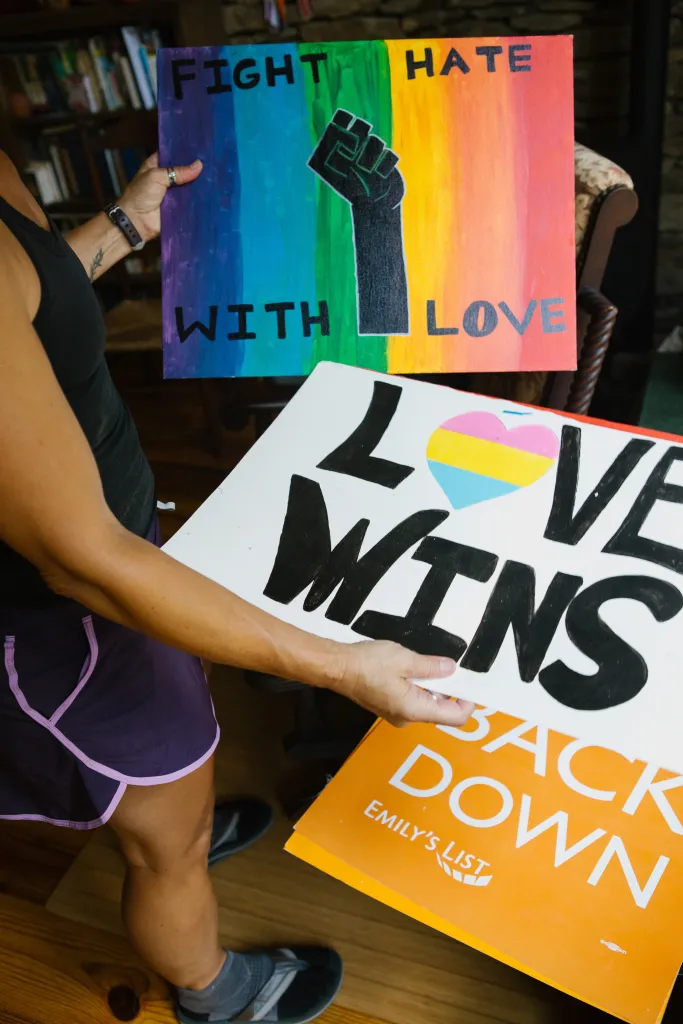
Hand-painted signs that once hung on the walls of Ash’s dorm room
Her husband spoke again as well, telling the board how Ash had frequently warned about the spread of policies that stoke “irrational hysteria around” trans youth — “the kind of policies,” Mark Clatterbuck noted, “that the Pennsylvania-based Independence Law Center loves to draft.”
Reminding the board that five trans youth in the area had died by suicide within just 18 months, he continued, “Do not try to tell me that there is no connection between the kind of dehumanizing policies that the ILC drafts and the deaths of our trans children.”
But the board voted to hire ILC anyway, 5-4, and in the following months adopted two of ILC’s anti-trans policies.
In anticipation of such public outcry, some school boards around Pennsylvania have taken steps to obscure their interest in ILC’s agenda.
Kristina Moon, a senior attorney at the Education Law Center of Pennsylvania, a legal services nonprofit that advocates for public school students’ rights, has watched a progression in how school boards interact with ILC.
When her group first began receiving calls related to ILC, around 2021, alarmed parents told similar stories of boards proposing book bans targeting queer or trans students’ perspectives, or identical packages of policies that included restrictions about bathrooms, sports and pronouns.
“At first, we would see boards openly talking about their interest in contracting with ILC,” said Moon. But as local opposition began to grow, “board members stopped sharing so publicly.”
Instead, Moon said, reports began to emerge of school boards discussing or meeting with ILC in secret.
In Hempfield, in 2022, the board moved some policy discussions into committee sessions less likely to be attended by the public, and held a vote on an anti-trans sports policy without announcing it publicly, possibly in violation of Pennsylvania’s Sunshine Act, as Mother Jones reported.
Across the state, in Bucks County, one Central Bucks school board member recounted in an op-ed for the Bucks County Beacon how her conservative colleagues had stonewalled her when she asked about the origins of a new book ban policy in 2022, only to have the board later admit ILC had performed a legal review of it “pro bono,” as PhillyBurbs reported.
Subsequent reporting by the York Daily Record and Reuters revealed the board’s relationship with ILC was more involved and included discussions about other policies related to trans student athletes and pronoun policy. (Both Central Bucks’ books and anti-LGBTQ policies were later cited in an ACLU federal complaint that cost the district $1.75 million in legal fees, as well as in a related Education Department investigation into whether the district had created a hostile learning environment for LGBTQ students.)
But the sense of backroom dealing reached an almost cartoonish level in York County, where, in March 2024, conservative board members from 12 county school districts were invited to a secret meeting hosted by a right-wing political action committee, along with specific instructions about how to keep their participation off the public radar. According to the York Dispatch, the invitation came from former Central York school board member Veronica Gemma, who (after losing her seat) was hired as education director for PA Economic Growth, a PAC that had helped elect 48 conservatives to York school boards the previous fall. (Gemma did not respond to interview requests.)
Gemma’s invitation was accompanied by an agenda sent by the PAC, which included a discussion about ILC and how board members could “build a network of support” and “advance our shared goals more effectively countywide.” The invitation also included the admonition that “confidentiality is paramount” and that each district should only send four board members or fewer — to avoid the legal threshold for a quorum that would make the meeting a matter of public record.
“Remember, no more than 4 — sunshine laws,” Gemma wrote.
In the wake of stories like these, Wenger’s 2005 suggestion that conservatives “become as clever as serpents” in concealing their intentions became ubiquitous in coverage of and advocacy against ILC — showing up in newspaper articles, in editorials and even on a T-shirt for sale online.
“I think it’s very obvious,” reflected Moon, “but if something has to be taking place in secrecy, I’m not sure it can be good for our students.”
But the lack of transparency shows up in subtler ways too, in the spreading phenomenon of districts adopting ILC policies without admitting where the policies come from. That was the case in Eastern York in 2025, where board members who had previously lobbied for an ILC pronoun policy later directed their in-house attorney to write an original policy instead, following the same principles but avoiding the baggage an ILC connection would bring.
In Elizabethtown (which did contract ILC), one policy was even introduced erroneously referencing clauses from another district’s code, in an indication of how directly districts are copy-pasting from one another.
In 2025, ILC attorney Jeremy Samek even seemed to acknowledge the trend, predicting that fewer districts might contract ILC going forward, since the combination of Trump’s executive orders on trans students and the general spread of policies similar to ILC’s meant “it’s going to be a lot easier for other schools to do that without even talking to us.”
In the face of what appears like a deliberate strategy of concealment, members of the public have increasingly turned to official channels to compel boards to disclose their dealings with ILC. Mark Clatterbuck did so in 2024 and 2025, filing 10 Right-to-Know requests with Penn Manor for all school board and administration communications with or about ILC and policies ILC consulted on and any records related to a set of specific keywords.
Thirty miles north, three Elizabethtown parents sued their school board in the spring of 2025, alleging it deliberately met and conferred with ILC in nonpublic meetings and private communications to “circumvent the requirements of the Sunshine Act.”
In both cases, and more broadly in the region, ILC critics are keenly aware that, by bringing complaints or lawsuits against the group or the school boards it works with, they might be doing exactly what ILC wants: furthering its chances to land another case before the Supreme Court, where a favorable ruling could set a dangerous national precedent, such as ruling that Title IX protections don’t cover trans students.
“They’re itching for a case,” said Clatterbuck. To that end, he added, his pro bono attorneys — at the law firm Gibbel Kraybill & Hess LLC, which also represents the Elizabethtown plaintiffs pro bono — have been careful not to do ILC’s work for it.
Largely, that has meant keeping the cases narrowly focused on Sunshine Act violations.
But in both cases, there are also hints of the larger issue at hand — of whether, in a repeat of the old Dover “intelligent design” case, ILC’s policies represent school boards imposing inherently religious viewpoints on public schools. After all, ILC’s parent group, the Pennsylvania Family Institute, clearly states its mission is to make Pennsylvania “a place where God is honored” and to “strengthen families by restoring to public life the traditional, foundational principles and values essential for the well-being of society.” And in 2024, the institute’s president, Michael Geer, told a Christian TV audience that much of ILC’s work involves working with school boards “on the transgender issue, fighting that ideology that is pervasive in our society.”
In the Elizabethtown complaint, the plaintiffs argue that district residents must “have the opportunity to observe Board deliberations regarding policies that will affect their children in order to understand the Board members’ true motivation and rationale for adopting policies — particularly when policies are prepared by an outside organization seeking to advance a particular religious viewpoint and agenda.”
The public has ample cause to suspect as much. Five current and former members of Elizabethtown’s school board are connected to a far-right church in town, where the pastor joined 150 other locals in traveling to Washington, D.C., on Jan. 6, 2021. Among them were current board members Stephen Lindemuth — who once preached a sermon at the church arguing that “gender identity confusion” doesn’t “line up with what God desires” — and his wife, Danielle Lindemuth, who helped organize the caravan of buses that went to Washington. (Stephen Lindemuth replied by email, “I have no recollection of making any judgmental comments concerning LGBTQ in my most recent preaching the past few years.” Neither he nor his wife were accused of any unlawful acts on Jan. 6.)
Another board member until this past December, James Emery, went through the church’s pastoral training program and in 2022 served as a member of the security detail of far-right Christian nationalist gubernatorial candidate Doug Mastriano.
School board meetings in Elizabethtown have also frequently devolved into religious battles, with one local mother, Amy Karr, board chair of Elizabethtown’s Church of the Brethren, recalling how local right-wing activists accused ILC’s opponents of being possessed by demonic spirits or a “vehicle of Satan.”
In Penn Manor, Clatterbuck similarly hoped to lay bare the “overtly religious nature” of the board’s motivation by including in his Right-to-Know requests a demand for all school board communications about ILC policies containing keywords like “God,” “Christian,” “Jesus,” “faith” and “biblical.”
For nearly a year, the district sought to avoid fulfilling the requests, with questionable invocations of attorney-client privilege (including one board member’s claim that she had “personally” retained ILC as counsel), sending back obviously incomplete records and protestations that Clatterbuck’s keyword request turned up so many results that it was too burdensome to fulfill. Ultimately, Clatterbuck appealed to the Pennsylvania Office of Open Records to compel the board to honor the request.
This fall, Clatterbuck received a 457-page document from the board containing dozens of messages that suggest his suspicions were correct.
In response to local constituents writing in support of ILC — decrying pronoun policies as a violation of religious liberty, claiming “the whole LGBTQ spectrum is rooted in the brokenness of sin” and calling for board members to rebuke teachers unions in “the precious blood of Jesus” — at least three board members wrote back with encouragement and thanks. In one example, board member Anthony Lombardo told a constituent who had written a 12-page message arguing that queer theory is “inherently atheistic” that “I completely agree with your analysis and conclusions.”
When another community member sent the board an article from an evangelical website arguing that using “transgendered pronouns … falsifies the gospel” and “tramples on the blood of Christ,” board member Donna Wert responded, “Please know that I firmly agree with the beliefs held in [this article]. And please know that heightened movement is finally being made concerning this, as you will see.”
To Clatterbuck, such messages demonstrate the school board’s religious sympathies, as well as how Christian nationalism plays out at the local level. While national examples of Christian right dominance, like Defense Secretary Pete Hegseth’s Crusader tattoos or Supreme Court Justice Samuel Alito’s “Appeal to Heaven” flag, get the most attention, Clatterbuck said, “this is what it looks like when you’re controlling local school boards and passing policies that affect people directly in their local community.”
But the local level might also be the place where advocates have the best chance of fighting back, said Kait Linton of Public Education Advocates of Lancaster.
Speaking ahead of a panel discussion on ILC at Elizabethtown’s Church of the Brethren last June — one of several panels PEAL hosted around Lancaster in the run-up to November’s school board elections — Linton emphasized the importance of focusing on the “hyperlocal.”
“With everything that’s happening at the national level,” Linton said, “we find a lot of folks get caught up in that, when really we have far less opportunity to make a difference up there than we do right here.”
PEAL’s efforts have been matched by other groups at the district level, like Elizabethtown’s Etown Common Sense 2.0, which local parent and former president Alisha Runkle said advocates against the sort of policies ILC drafts and also seeks to support teachers “being beaten down and needing support” in an environment of relentless hostility and demands to police their lesson plans, libraries and language.
They’re also reflected in the work of statewide coalitions like Pennsylvanians for Welcoming and Inclusive Schools, which helps districts share information about ILC policies — including a searchable map of ILC’s presence around the state — and resources like the Education Law Center, which has sent detailed demand or advocacy letters to numerous school districts considering adopting ILC-inspired policies.
This past November, that local-level work resulted in some signs for cautious hope. In Lancaster County’s Hempfield School District — one of the first districts in the state to hire ILC — the school board flipped to Democratic control. Among the new board members are Kait Linton and fellow PEAL activist Erin Small.
Across the river, in West Shore, the departure of three right-wing board members — one who resigned and two who lost their elections — left the board with a new 5-4 majority of Democratic and centrist Republican members. After the election, the board promptly moved to table three contentious policy proposals, including the anti-trans bathroom policy the board had copied from ILC and a book ban policy that drew heavily on ILC’s work.
While in other Lancaster districts — including Elizabethtown, Warwick and Penn Manor — school boards remained firmly in conservative control, there are also signs of growing pushback, as in Elizabethtown, where Runkle noted the teachers union has recently begun challenging the board during public meetings and local students have gotten active protesting book bans.
Similar trends have happened statewide, said the Education Law Center’s Kristina Moon, who noted that voters “were so concerned about the extremist action they saw on the boards that it was kind of a wake-up call: that we can’t sleep on school board elections, and we need to have boards that reflect a commitment to all of the students in our schools.”
While reports of ILC’s direct involvement with school boards seem to have waned in recent months, said Moon, that “does not mean the threat to our public schools is over. We see continued use of those discriminatory policies by school boards just copying the policy exactly as it was adopted elsewhere. And it causes the same harm in a district, whether the district is publicly meeting with ILC or not.”
Plus there are now Trump’s anti-trans executive orders, which have spread confusion statewide. And just this December, a legal challenge brought by another Christian right law firm, the Thomas More Society, is challenging the authority of Pennsylvania’s civil rights commission to apply anti-discrimination protections to trans students in public schools.
As a consequence, the Education Law Center has spent much of the past year trying to educate school and community leaders that executive orders are not the law itself, and they cannot supersede case law supporting the rights of LGBTQ students.
“We’re trying to cut through the noise,” Moon said, “to ensure that schools remain clear about their legal obligations to provide safe environments for all students … so they can focus on learning and not worrying about identity-based attacks.”
*Correction: At least 20 of Pennsylvania’s 500 school districts are known to have consulted with or signed formal contracts accepting the ILC’s pro bono legal services. This story previously reported 21.
Contact editor Caroline Preston at 212-870-8965, via Signal at CarolineP.83 or on email at [email protected].
This <a target=”_blank” href=”https://hechingerreport.org/clever-as-serpents-how-a-legal-groups-anti-lgbtq-policies-took-root-in-school-districts-across-a-state/”>article</a> first appeared on <a target=”_blank” href=”https://hechingerreport.org”>The Hechinger Report</a> and is republished here under a <a target=”_blank” href=”https://creativecommons.org/licenses/by-nc-nd/4.0/”>Creative Commons Attribution-NonCommercial-NoDerivatives 4.0 International License</a>.<img src=”https://i0.wp.com/hechingerreport.org/wp-content/uploads/2018/06/cropped-favicon.jpg?fit=150%2C150&ssl=1″ style=”width:1em;height:1em;margin-left:10px;”>
Join HEPI for a webinar on Thursday 11 December 2025 from 10am to 11am to discuss how universities can strengthen the student voice in governance to mark the launch of our upcoming report, Rethinking the Student Voice. Sign up now tohear our speakersexplore the key questions.
This blog was kindly authored by Utkarsh Leo, Lecturer in Law, University of Lancashire (@UtkarshLeo)
UK law students are increasingly relying on AI for learning and completing assessments. Is this reliance enhancing legal competence or eroding it? If it is the latter, what can be done to ensure graduates remain competent?
Studying law equips students with key transferable skills – such as evidence-based research, problem solving, critical thinking and effective communication. Traditionally, students cultivate doctrinal (and procedural) knowledge by attending lectures, workshops and going through assigned academic readings. Thereafter, they learn how to apply legal principles to varying facts through assessments and extracurriculars like moot courts and client advocacy. In this process, they learn how to construct persuasive arguments and articulate ideas, both orally and in writing. However, with widely available and accessible Gen AI, students are taking shortcuts in this learning process.
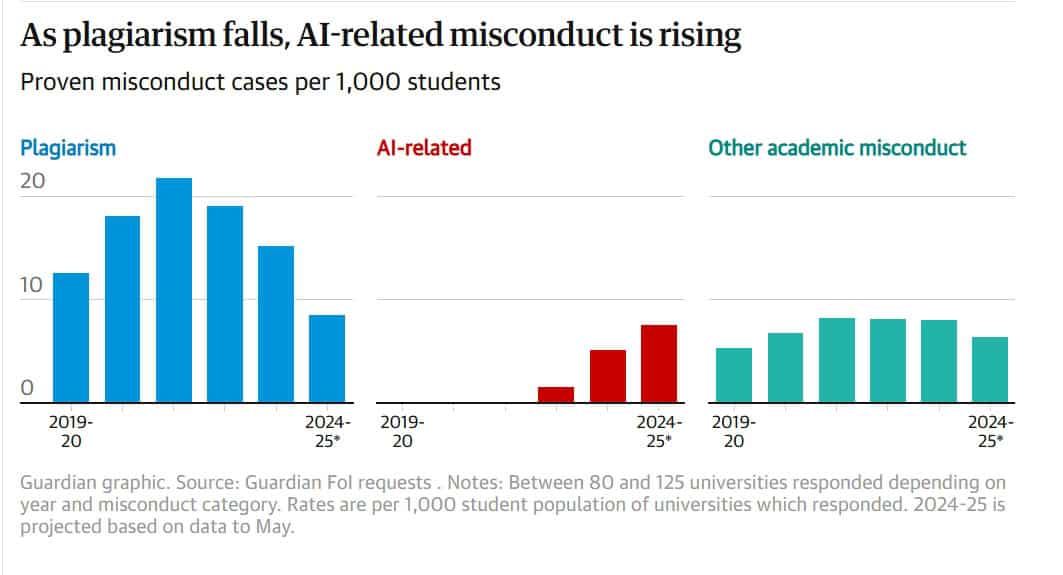
The HEPI/Kortext Student Generative AI Survey 2025 looked into AI use by students from a range of subjects. It paints a grim picture: 58% of students are using AI to explain concepts and 48% are using it to summarise articles. More importantly, 88% are using it for assessment related purposes – a 66% increase compared to 2024.
Students are relying on shortcuts largely due to rising economic inequality. Survey data published by the National Union of Students shows 62% of full-time students work part-time to survive. This translates into reduced studying time, limited participation in class discussions and extracurriculars. Understandably, such students may find academic readings (which are often complex and voluminous) as a chore, further reducing motivation and engagement. In this context, AI offers a quick fix!
Quick fixes, as shown above, promote overreliance: resulting in cognitive replacement. Most LLB first-year programmes aim to cultivate critical legal thinking: from the ability to apply the law and solve problems in a legal context to interpreting legislative intent to reading/finding case law and developing the skills to spot issues, weigh precedents and constructing legal arguments. Research from neuroscience shows that such essential skills are acquired through repeated effort and practice. Permitting AI usage for learning purposes at this formative stage (when students learn basic law modules) inhibits their ability to think through legal problems independently – especially in the background of the student cost-of-living crisis.
More importantly, only 9 out of more than 100 universities require law degree applicants to sit the national admission test for law (LNAT) – which assesses reasoning and analytical abilities. This variability means we cannot assume that all non-LNAT takers possess the cognitive tools necessary for legal thinking. This uncertainty reinforces the need to disallow AI use in first-year law programmes to ensure students either gain or hone the necessary skills to do well in law school.
Technical discussion
Furthermore, from a technical perspective, the shortcomings of AI summaries are well known. AI models often merge various viewpoints to create a seemingly coherent answer. Therefore, a student relying on AI to generate case summaries enhances the likelihood of detaching them from judicial reasoning (for example, the various structural/substantive principles of interpretation employed by judges). It risks producing ill-equipped lawyers who may erode the integrity of legal processes (a similar argument applies to statutes).
Alongside this, AI systems are unreliable: from generating fake case-law citations to suggesting ‘users to add glue to make cheese stick to pizza.’ Large language models (LLMs) use statistical calculation to predict the next word in a sequence – therefore, they end up hallucinating. Despite retrieval-augmented generation – a technique for enhancing accuracy by enabling LLMs to check web sources – the output generated can be incorrect if there is conflicting information. Furthermore, without thoughtful use, there is an additional concern that AI sycophancy will further validate existing biases. Hence, despite the AI frenzy, first year students will be better off if they prioritise learning through traditional primary and secondary sources.
How to ensure this?
Certainly, we cannot prohibit student’s from using AI in a private setting; but we can mitigate the problem of overreliance by designing authentic assessments evaluated exclusively through in-person exams/presentations. This is more likely to encourage deeper engagement with the module. Now more than ever, this is critical. Despite rising concerns of AI misuse and the inaccuracy of AI text detection primarily due to text perplexity (high false positives; especially for students for whom English is not their first language), core law modules (like contract law and criminal law) continue to be assessed through coursework (for either 50% or more of the total module mark).
However, sole reliance on in-person exams will not suffice! To promote deeper module engagement (and decent course pass rates), the volume of assessments will need to be reduced. As students are likely to continue working to support themselves, universities could benefit from the support and cooperation of professional bodies and the Office for Students. In fact, in 2023, the Quality Assurance Agency highlighted that universities must explore innovative ways of reducing the volume of assessments, by ‘developing a range of authentic assessments in which students are asked to use and apply their knowledge and competencies in real-life’.
To promote experiential learning, one potential solution could be to offer assessment exemption based on moot-court participation. Variables such as moot profile (whether national/international), quality of memorial submitted, ex-post brief presentation on core arguments, and student preparation could be factored to offer grades. Admittedly, not all students will pursue this option; however, those who choose to participate will be incentivised.
Similarly, summer internships or law clinic experiences can be evaluated through patchwork assessment where students can complete formative patches of work on client interviews, case summaries and letters before action, followed by a reflective stitching piece highlighting real world learning and growth.
Delayed use of gen AI – year II and onwards
It is crucial to emphasise that despite the critique of Gen AI, its vast potential to enhance productivity cannot be overlooked. Nevertheless, what merits attention is that such productivity is contingent on thoughtful engagement and basic domain specific knowledge – which is less likely to be found in first year law students.
Thus, a better approach is to delay approved use of AI until the second year of law. To ensure graduates are job ready, modules such as Alternative Dispute Resolution and Professional Skills could go beyond prompting techniques to include meaningful engagement with technology: through domain specific AI tools, contract review platforms and data-driven legal analytics ‘to support legal strategy, case assessment, and outcomes’.
Communication skills remain key
Above all, despite advances in tech, law will remain a people-centred profession requiring effective communication skills. Therefore, in the current climate, law school education should emphasise oral communication skills. Prima facie, this approach may seem disadvantageous to students with special needs, but it can still work with targeted adjustments.
In sum, universities have a moral responsibility to churn out competent law graduates. Therefore, they must realistically review the abilities of AI to ensure the credibility of degrees and avoid mass-producing surface-level lawyers.
Acknowledgement: I am grateful to Rachel Nir, Director of EDI at the School of Law and Policing, University of Lancashire, for her insightful comments and for kindly granting the time allowance that made this research possible.
The September ruling in Harvard University’s favor restoring roughly $2.2 billion in federal fundingstruck a short-term blow against the Trump administration’s use of civil rights investigations against universities.
The administration pulled the funding in April after Harvard rejected a series of sweeping demands, claiming it was suspending the funds because the university hadn’t adequately protected students from antisemitism.
In June, the U.S. Department of Health and Human Services’ civil rights office formally accused the university of violating Title VI, which bars discrimination on the basis of race, color or national origin in programs or activities receiving federal funding.
Yet in her 84-page order, U.S. District Judge Allison Burroughs foundthat none of the federal government’s grant termination letters specified how Harvard failed to respond to any acts of antisemitism in violation of Title VI.
“A review of the administrative record makes it difficult to conclude anything other than that Defendants used antisemitism as a smokescreen for a targeted, ideologically-motivated assault on this country’s premier universities,” Burroughs wrote. “Further, their actions have jeopardized decades of research.”
Harvard isn’t the only university facing Title VI accusations. The Trump administration isseeking $1.2 billion from the University of California, Los Angeles — plus an overhaul of its campus practices — after the U.S. Department of Justice accused the institution of violating Title VI. In both UCLA and Harvard’s cases, the Trump administration cited pro-Palestinian campus demonstrations and claims of antisemitism in its notices of violations.
The Justice Department didn’t make an official available for an interview.
These types of developments have set off a high stakes debate among legal experts about whether the Trump administration is weaponizing Title VI.
They trouble Jodie Ferise, a partner in the higher education practice at the Indiana law firm of Church Church Hittle and Antrim, who previously served as vice president and general counsel for the Independent Colleges of Indiana.
“Discrimination was always a disqualifier for federal funds, but when it’s just a pretext to bend higher education to the federal government’s will, that’s a problem,” Ferise said. “To sweep every single grant off the table seems more like extortion. Nothing about it is designed to make higher education better.”
In the Harvard ruling, Burroughs wrote that the administration failed to take the proper steps before pulling federal funding.
Title VI requires the federal government to notify an institution of its alleged violation and determine that it can’t come into compliance voluntarily before ending financial assistance to the university, the judge explained. Even then, the agency may terminate the funding only after the university has been given the opportunity for a hearing.
Burroughs concluded, “It is undisputed that Defendants did not comply with these requirements before issuing the Freeze Orders or Termination Letters.”
However, experts who spoke with Higher Ed Dive agree that Burroughs’ ruling is far from the last word on the issue. That case could eventually be headed to the U.S. Supreme Court, as the Trump administration vowed to appeal, though a settlement is not impossible.
Is the Trump administration using Title VI legitimately?
The Trump administration has warned dozens of colleges of potential Title VI violations. In March, the U.S. Department of Education’s Office for Civil Rights sent letters to 60 institutions of higher education warning them of potential enforcement actions if they failed to comply with Title VI to protect Jewish students.
“What’s been happening is not so much expanding Title VI as implementing it properly so there’s no double standard. For many years, Jewish students’ rights were not being protected,” said Kenneth Marcus,the founder and CEO of the Louis D. Brandeis Center for Human Rights Under Law, a research and legal advocacy group aiming to combat antisemitism.
As an official in the George W. Bush administrationand the first Trump administration, Marcus also strongly advocated for the use of Title VI to protect students who were harassed because of their ancestry, such as ethnic and religious characteristics.
“When Congress passed the Civil Rights Act of 1964, Title VI was an ingenious mechanism to ensure federal funds are not misused,” said Marcus in noting this was crucial to ensure institutions racially desegregated.
He added that Title VI can have a broad impact because it ensures students don’t face a hostile environment and have equal access to learning opportunities at their institutions.
But Harvard law professor Benjamin Eidelson takes a decidedly different view about the Trump administration’s use of Title VI. Eidelson, who co-authored a June Harvard Law Review article about Title VI and antisemitism,said in an email to Higher Ed Dive that “the recent enforcement actions and lawsuits have gone far, far beyond anything Title VI was meant to do.”
He added that Title VI was never meant to require imposing content-based speech restrictions in the name of curing a hostile environment.
“Nobody has a right under Title VI to have a campus free of protests that offend their moral or political convictions,” Eidelson said. “It’s so clear that fighting antisemitism is just the administration’s pretext for imposing ideological reform and demanding submission across the board. And Judge Burroughs rightly held that the First Amendment doesn’t allow that.”
Marcus, however, takes issue with the judge’s view that the Trump administration’s position is a smokescreen. Speaking of his conversations with administration officials, Marcus said, “There is no question in my mind that they’re furious with what’s happened to too many Jewish students and faculty members.”
The Brandeis Center was not a party to the case before Burroughs, but it hadsettled a separate Title VI federal lawsuit against Harvard earlier this year on behalf of several students.
Under the settlement, Harvard agreed to incorporate the International Holocaust Remembrance Alliance’s definition of antisemitism to assess complaints of harassment. While some have praised the adoption of the IHRA’s definition — which lists different examples of potential antisemitism— critics argue it can be used to target protected forms of speech and criticism against Israel.
But Gerard Filitti, senior counsel at The Lawfare Project, a nonprofit organizationthat has filed Title VI antisemitism lawsuits against colleges such as Columbia University,Carnegie Mellon University and TheCooper Union, said the cases he has seen involve legitimate antisemitic incidents and that there has been a double standard.
He said, for instance, that it would be unthinkable to have lecturers speak about white power on college campuses, but suggested the equivalent is happening with hate speech against Jews. “The 64,000-foot view is it’s always good when the government is doing what it can to combat antisemitism.”
Columbia’s$221 million settlement with the federal government this summer, after the administration formally accused it of violating Title VI, will deter future bad conduct, according to Filitti. But he added that the deal could have included more policies to address the root cause of antisemitism.
‘No one wants to send out invitations to their own funeral’
In Harvard’s case, the university established two task forces in January 2024 — one to combat antisemitism and anti-Israeli bias and another to fight anti-Muslim and anti-Arab bias. The university also began making policy changes aimed at ensuring that its campus is safe and welcoming for those students. Other universities have similarly set up task forces to combat antisemitism and taken actions such as hiring Title VI coordinators in recent months.
But the Trump administration is citing the findings of these task force reports when accusing universities of violating Title VI. And that doesn’t sit well with attorney Ferise, who suggested this tactic is already leading to a chilling effect among university administrators.
“If we are only inviting candid disclosure of their weak spots so as to prove our preexisting notion that they were evil actors with discriminatory intentions, that’s a real disincentive to lay bare any unpleasant truth,” she said. “No one wants to send out invitations to their own funeral.”
“Discrimination was always a disqualifier for federal funds, but when it’s just a pretext to bend higher education to the federal government’s will, that’s a problem.”
Jodie Ferise
Partner, Church Church Hittle and Antrim
The Brandeis Center’s Marcus acknowledged that university administrators at many institutions have taken actions to deter antisemitism, but said few have done enough. And, he added, “Sophisticated people in universities have known for some time that these task force reports can be used as evidence.”
Along similar lines, Filitti said the task force report contents are “precisely what plaintiffs are seeking in discovery anyway, so it saves six months of time and expense” to seek the findings out earlier.
But Harvard’s Eidelson noted in an email to Higher Ed Dive that these reports, including Harvard’s, often focus on how the university can better promote a sense of belonging for students who might feel marginalized.
“That is a fundamentally different question than the one that matters under Title VI, namely how the university has responded if and when students experience harassment that is ‘so severe, pervasive, and objectively offensive’ that it effectively bars the victim’s access to an educational opportunity or benefit,” Eidelson said, citing a 1999 Supreme Court ruling in Davis v. Monroe County Board of Education.
While these task force reports could theoretically be used to surface information relevant to a federal investigation, they “pose special risks of misuse, especially in the hands of unserious investigators,” Eidelson said. That’s because these task force reports are usually seeking to answer different questions than what matters under the law, he added.
What’s next?
The potential loss of federal funding is a real pressure point, lawyers on all sides point out.
“The power of the purse has always been an important tool in the government’s arsenal,” the Lawfare Project’s Filitti said. “The flip side is it’s meant to address discrimination and not be used for political purposes.”
But Ferise lamented that that ’s exactly what’s happening.
At Harvard, she pointed to the Trump administration sending “overbroad” demand letters seeking information about international students, including whether they have conduct violations or if they have obstructed “the school’s learning environment.”
“That’s not calculated to reveal who engaged in a bias incident,” Ferise said.
“What’s been happening is not so much expanding Title VI as implementing it properly so there’s no double standard.”
Kenneth Marcus
Founder and CEO, Louis D. Brandeis Center for Human Rights Under Law
Ferise added that it’s not just elite institutions that should fear these government investigations and enforcement actions.
“Every college and university should be concerned, but smaller schools don’t have the bandwidth” to fight these investigations in court, she said.
And that has led her to change the advice she now gives to her higher education clients.
“We represent several small, private institutions with large endowments for their size and a great deal of intentionality about inclusion. Not in a million years could any of them afford to litigate as Harvard has,” Ferise said.
“You never want to say ‘Lay low,’ but that is my advice now because you don’t want to end up on the administration’s radar. No one wants to be the first non-elite school that goes out of business.”
Two years ago, the Supreme Court dealt a devastating blow to opportunity in America when it gutted access to higher education for underrepresented groups. That decision was not only legally misguided but also turned a blind eye to the deep inequities that have long shaped our education system. Our colleges and universities scrambled to find lawful tools to ensure that their student bodies still reflected the breadth of talent and promise in this country.
One of those tools was Landscape, a program recently canceled by the College Board that gave admissions officers data about a student’s high school and neighborhood while explicitly excluding race or ethnicity.
Standardized test scores and GPAs never tell the whole story. Median family income, access to Advanced Placement courses, local crime rates and other key indicators help admissions officers see the full picture and provide crucial context to help identify high-achieving students from disadvantaged communities. These are students whom universities might otherwise overlook. Tools that give context level the playing field—not by lowering standards, but by lifting students up according to their merit and the obstacles they have overcome.
The Supreme Court, even in striking down diversity initiatives, still made clear that universities could explore race-neutral alternatives to achieve equity. The use of socioeconomic and geographic factors is exactly such an alternative. Despite U.S. Attorney General Pamela Bondi’s recent nonbinding guidance warning against the use of geographic indicators as “proxies” for race, make no mistake: Abandoning consideration of these elements of an applicant’s background is not a legal requirement but a political choice, reflecting fear rather than courage.
Without tools that account for the barriers students face, colleges will fall back on practices that overwhelmingly favor the privileged, shutting out low-income and first-generation students who have already beaten the odds. This spoils opportunity for millions, and our campuses and our nation will suffer for it. Diversity is not a box to check; it is a vital engine of education and democracy. Classrooms that bring together students from different walks of life prepare all graduates to lead a diverse society, foster innovation and strengthen our communities.
We cannot allow the Supreme Court’s decision—and the chilling effect in its wake—to undo decades of progress. And we cannot allow educational institutions to abdicate their responsibility in this moment of crisis. The data that provides broader context for applicants remains available, but without the will to use it, too many doors will remain closed for the students who need them most.
America has always promised to reward hard work and perseverance, no matter where you come from. That promise rings hollow if we allow the wealthy and well connected to monopolize educational opportunity. Colleges and universities must honor that promise by continuing to seek out and support students who have succeeded against the odds. Fairness demands it, equal opportunity requires it and the future of our country depends on it.
The authors all serve as state attorneys general: New York Attorney General Letitia James, Connecticut Attorney General William Tong, Delaware Attorney General Kathy Jennings, Illinois Attorney General Kwame Raoul, Minnesota Attorney General Keith Ellison, New Jersey Attorney General Matthew Platkin, Vermont Attorney General Charity Clark and Washington Attorney General Nick Brown.
This audio is auto-generated. Please let us know if you have feedback.
Dive Brief:
A federal judge dismissed a case Thursdaythat challenged the legality of the Biden administration’s gainful employment rule,which aims to ensure that graduates of career education programs earn enough to pay off their student loan debt.
U.S. District Judge Reed O’Conner— a George W. Bush appointee — rejected arguments from cosmetology school groups that the gainful employment rule overstepped the U.S. Department of Education’s authority and violated their constitutional rights.
Although the Biden-era rule survived the legal challenge,the Trump administration is considering potential changes to the gainful employment regulations in the coming months.
Dive Insight:
The Biden administration finalized the gainful employment rule in 2023. Under the rule, career education programs must prove that they provide graduates with an earnings bump and don’t leave borrowers with more debt than they can manage.
To do so, the gainful employment rule establishes two separate tests.Under one, the median program graduate must pay no more than 8% of their annual earnings or 20% of their discretionary income toward their debt. Under the other, at least half of a program’s graduates must outearn workers in their state with only a high school diploma.
College programs that fail either of these metrics in two out of three consecutive years risk losing access to federal financial aid. The rule primarily impacts programs at for-profit colleges, but also applies to certificates at all institutions.
Thursday’s ruling addresses two consolidated lawsuits against the rule. The cosmetology school groups had argued that the Education Department had overstepped its authority when issuing the regulations, as the Higher Education Act doesn’t define gainful employment.
However, O’Connor wrote that the Education Department’s rule follows the plain meaning of the statute.
“Although the 2023 Rule is in the form of an equation, it no less does the same work as the words ‘gainful employment,’ by ensuring the programs lead to profitable jobs, instead of loan deficits,” O’Connor wrote.
The plaintiffs had also alleged that they would be unfairly penalized by the rule, arguing that a large share of income in the cosmetology industry goes unreported because it is earned through cash tips. Because of that, they said, the Education Department’s calculations would fail to accurately capture how much their graduates earn.
O’Connor rejected those arguments, noting that the Education Department had cited studies showing that underreporting is not widespread.
National Student Legal Defense Network,an advocacy and legal group for students, praised the ruling Thursday.
“Higher education is supposed to offer students a path to a better life, not a debt-filled dead end,” Student Defense Vice President and Chief Counsel Dan Zibel said in a statement. “The 2023 Gainful Employment Rule reflects a common-sense policy to ensure that students are not wasting time and money on career programs that provide little value.”
Jason Altmire, president and CEO of Career Education Colleges and Universities, an association that represents the for-profit college sector, decried Thursday’s ruling but sounded optimistic about forthcoming regulatory changes under the Trump administration.
“Although we strongly disagree with the ruling today, we look forward to this issue being revisited by the current Department of Education,” Altmire said in a statement that day. “We are confident the Biden Gainful Employment Rule will be revised to incorporate a fairer accountability measure that will apply equally to all schools, ensuring all students can benefit.”
This blog was kindly written by Gary Attle, Consultant for Birketts LLP.
On Tuesday, HEPI and Cambridge University Press & Assessment will be hosting the UK launch of the OECD’s Education at a Glance. On Wednesday, we will be hosting a webinar on students’ cost of living with TechnologyOne – for more information on booking a free place, see here.
Read HEPI’s weekend blogs on governance and the Research Excellence Framework on the HEPI website here.
The Higher Education (Freedom of Speech) Act 2023 came into force, in part, on 1 August 2025. New and strengthened statutory duties were placed on higher education providers which are registered with the Office for Students (OfS), the higher education regulator in England. These duties require the governing bodies of registered higher education providers to take steps to secure freedom of speech (including academic freedom) for staff, students, members and visiting speakers and to promote the importance of freedom of speech/academic freedom. The Office for Students has a direct regulatory jurisdiction towards registered higher education providers under the provisions of the Higher Education and Research Act 2017 and as ‘principal regulator’ for those registered providers which are charities.
The current Government has indicated its intention to repeal the provisions in the 2023 Act which would have placed an express statutory duty on students’ unions for the first time to secure freedom of speech and a new regulatory power for the Office for Students to take enforcement action against students’ unions for breach of that duty. In a detailed statement to the House of Commons on 15 January this year, the Secretary of State noted the following:
“Student unions are neither equipped nor funded to navigate such a complex regulatory environment, and they are already regulated by the Charity Commission. However, I fully expect student unions to protect lawful free speech, whether they agree with the views expressed or not. I also expect HE providers to work closely with them to ensure that that happens and to act decisively to ensure their student unions comply with their free speech code of conduct.”
It is likely to be the case that a students’ union of a higher education provider which is a charity will be a separate charitable organisation itself, whether an unincorporated association of its members or an incorporated body. However, it would be prudent to check both the charitable status of the students’ union and its corporate status.
The Education Act 1994 (sections 20-22) places a statutory duty on the governing body of specified higher education ‘establishments’ in England and Wales to secure certain requirements in respect of students’ unions of those establishments. The duty extends to a range of governance and constitutional requirements, including ensuring that the students’ union operates in a fair and democratic manner, that it has a written constitution and has a complaints procedure. The governing body is required to approve the provisions of the constitution and review the constitution at intervals of not more than five years. In addition, highlighted for the purposes of this note, at least once a year the governing body of the establishment must bring to the attention of its students “any restrictions imposed on the union by the law relating to charities.”
Here, we turn to case-law of some vintage to illustrate what this might include. In 1971, the High Court in the case of Baldry -v- Feintuck [1972] WLR552 had to decide whether to grant injunctions against a number of individuals connected with the University of Sussex Students’ Union. The students’ union had passed resolutions for payments to be made in support of certain causes, including a campaign to oppose the then Government’s policy for the ending of free milk to school pupils. A student at the university and a member of the union brought legal proceedings against the students’ union officers and a member of staff at the university on the basis that such payments would be ultra vires the students’ union constitution. In granting the injunction against the President and Treasurer of the students’ union (only), the Judge noted as follows:
“although research, discussion and debate and the reaching of a corporate conclusion on social and economic problems formed part of the educational process, the proposed payments outside of the university, formed no part of that process…and no payment for political purposes could possibly be charitable.”
The Charity Commission updated its guidance on ‘Campaigning and political activity’ in November 2022 which it defines as follows:
Campaigning: “awareness raising and efforts to educate or mobilise the public’s support for an issue or to influence / change public attitudes” (including activities which seek to ensure existing laws are observed).
Political activity: “securing support for, or opposing, a change in the law or policy or decisions of central government, local government, or other public bodies, in this country or abroad”.
The basic legal position set out in the Charity Commission’s guidance is that campaigning and political activities by charities can be legitimate and valuable provided they are undertaken only in supporting delivery of the charity’s charitable purposes. The guidance helpfully explains this more fully and the factors which the charity trustees should take into account before deciding to undertake campaigning and/or political activities. The Charity Commission noted that its experience had been that charities had been over-cautious in their approach to such matters and that they were inclined to self-censor, although it noted that it would take regulatory action if there had been misuse of charitable resources.
A conservative mainland group whose lawsuit against Harvard University ended affirmative action in college admissions is now building support in Hawaiʻi to take on Kamehameha Schools’ policies that give preference to Native Hawaiian students.
Students for Fair Admissions, based in Virginia, recently launched the website KamehamehaNotFair.org. It says that the admission preference “is so strong that it is essentially impossible for a non-Native Hawaiian student to be admitted to Kamehameha.”
“We believe that focus on ancestry, rather than merit or need, is neither fair nor legal, and we are committed to ending Kamehameha’s unlawful admissions policies in court,” the website says.
Kamehameha’s Board of Trustees and CEO Jack Wong said in a written statement that the school expected the policy would be challenged. The institution — a private school established through the estate of Princess Bernice Pauahi Bishop to educate Hawaiians — successfully defended its admission policy in a series of lawsuits in the early 2000s. The trustees and Wong promised to do so again.
“We are confident that our policy aligns with established law, and we will prevail,” the statement said.
The campaign also drew criticism from the Office of Hawaiian Affairs, established in the late 1970s for the betterment of Native Hawaiians. OHA’s Board of Trustees called it an “attack on the right of Native Hawaiians to care for our own, on our own terms.”
“These attacks are not new — but they are escalating,” the trustees said in a written statement. “They aim to dismantle the hard-won protections that enable our people to heal, rise, and chart our future.”
Several groups have tried and failed in the past to overturn Kamehameha’s admissions policy. Federal courts, siding with Kamehameha, have ruled that giving preference to Native Hawaiians helps alleviate historical injustices they faced after the overthrow of the Hawaiian Kingdom in 1893.
In the 2006 decision upholding Kamehameha Schools’ admissions policy, a 9th Circuit Court of Appeals panel pointed to longstanding challenges Native Hawaiian students have faced in schools.
“It is clear that a manifest imbalance exists in the K-12 educational arena in the state of Hawaiʻi, with Native Hawaiians falling at the bottom of the spectrum in almost all areas of educational progress and success,” Judge Susan Graber wrote in the majority opinion.
These disparities persist. Just over a third of Native Hawaiian students in public schools were proficient in reading in 2024, compared to 52% of students statewide. Less than a quarter of Native Hawaiian students were proficient in math.
The state education department has also fallen short of providing families with adequate access to Hawaiian language immersion programs, according to two lawsuits filed against the department this summer. The Hawaiian immersion programs are open to all students, not just those of Hawaiian ancestry.
Moses Haia III, a lawyer and former director of the Native Hawaiian Legal Corp., said that improving outcomes for Hawaiian students is Kamehameha’s primary reason for existing. He said this new challenge appears to be based on ignorance of Hawaiʻi’s history.
“Ultimately, what I see is these people being uneducated,” Haia said of the mainland group. “Not knowing the history of Hawaiʻi, not knowing the reasons for Kamehameha’s existence, and just once again trying to push Hawaiians into this box… and wanting to be on top.”
Past Challenges
The U.S. Supreme Court ruled in 1976 that private schools can’t discriminate based on race in a case called Runyon v. McCrary, which involved Black school students trying to gain admission to private schools that had yet to integrate non-white students.
An anonymous student sued Kamehameha in 2003, invoking the 1976 ruling and alleging that the school’s policy of giving preference to Hawaiian children was discriminatory. The case eventually landed in the 9th U.S. Circuit Court of Appeals.
A majority of the appeals court judges sided with Kamehameha. They used a part of the Civil Rights Act that prohibits discrimination in the workplace as a legal framework for looking at the admissions policy.
Judge Graber wrote that a preference for Native Hawaiian students “serves a legitimate remedial purpose by addressing the socioeconomic and educational disadvantages facing Native Hawaiians, producing Native Hawaiian leadership for community involvement, and revitalizing Native Hawaiian culture, thereby remedying current manifest imbalances resulting from the influx of western civilization.”
But it was a narrow victory for Kamehameha, an 8-to-7 vote. Dissenting judges wrote that admitting mostly Hawaiian students didn’t create a diverse student body; others said that the policy was clearly discriminatory.
The anonymous student appealed to the U.S. Supreme Court. But Kamehameha entered a $7 million settlement with the student and their mother before the court decided whether to take up the case.
While the settlement safeguarded the admission policy from a ruling by the nation’s highest court it also meant lawyers punted the issue.
Another group of anonymous students challenged the admissions policy a few years later and again took that case to the Supreme Court. But the court declined to take up that case in 2011.
Students for Fair Admissions previously brought two landmark cases against Harvard and the University of North Carolina, arguing that the two schools’ race-conscious admissions policies discriminated against Asian American and white applicants. The Supreme Court ruled in 2023 that colleges cannot use race as a factor in their admissions, although the decision didn’t specify what this could mean for K-12 schools.
Last fall, the number of Black students enrolled at both universities fell, although some researchers cautioned that colleges might not see the full impact of the Supreme Court ruling until a few admissions cycles have passed.
The challenge to Kamehameha Schools’ admissions policies comes amid national pushback on efforts to promote diversity in schools. In February, the U.S. Department of Education said any colleges and K-12 schools using race-based practices in hiring and admissions could lose federal funding, although a court subsequently prevented the department from enforcing those requirements.
Kamehameha receives no funding from the federal government, according to its tax filings. The school, which is the state’s largest private landowner, has assets valued at about $15 billion.