The Alliance, which represents over 500 college leaders, has pledged its support for the AAUP in the case of AAUP v. Rubio, which seeks an injunction to halt the large-scale arrest, detention and deportation of students and faculty.
Submitted in a court document known as an amicus brief, the Alliance argued that recent efforts targeting international students and noncitizen staff had created a “climate of fear” that was “chilling the free exchange of ideas and isolating international students and scholars”.
“Recent actions have upended individual lives, undermined the safety of our institutions and jeopardised academic freedom in and beyond the classroom,” said Presidents’ Alliance CEO Miriam Feldblum on April 10.
“The uncertainty generated by visa revocations and terminations not only has immediate impacts but also threatens our long-term ability to recruit, retain and employ talented individuals from across the globe,” she added.
The court case comes amid growing alarm over the rising number of international student visas revocations and detentions.
As of April 10, over 100 US institutions have identified more than 600 international students and recent graduates who have seen their legal status changed by the State Department, according to monitoring by Inside Higher Ed.
The AAUP-led lawsuit was filed on March 25, challenging the Trump administration’s policy of arresting, detaining and deporting noncitizen students and faculty who participated in pro-Palestinian activism.
The lawsuit alleges that the administration’s “ideological-deportation policy” violates the first amendment right of freedom of speech and the Administrative Procedure Act, as well as being unconstitutionally vague.
Recent actions have upended individual lives, undermined the safety of our institutions and jeopardised academic freedom in and beyond the classroom
Miriam Feldblum, Presidents’ Alliance on Higher Education and Immigration
In coming together as a sector, Feldblum said she hoped the brief would “amplify the contributions of noncitizen students and scholars, whose ideas and breakthroughs fuel our economy and uphold the collaborative spirit that defines American education”.
In 2023, international students accounted for 6% of the total US higher education population and contributed over $50bn to the US economy, according to IIE.
The unprecedented attacks on international students in the US have provoked outrage across the globe, with the Alliance highlighting longer term impacts which threaten to stifle innovation, intensify ‘brain drain’ and jeopardise the competitiveness of higher education in the US.
When paired with declining visa issuance rates from several of the US’ primary sending countries and signs of plummeting interest in the US from postgraduate students, the need for sector-wide unity has never been so strong, say educators.
What’s more, the brief highlights the harmful impacts on US students who will lose out on global perspectives, enriched learning experiences and academic collaboration.
Scientific talent has already started leaving the US in response to research cuts and threats to academic freedom, with a recent poll revealing three quarters of US scientists were considering leaving the country.
Elsewhere, executive members of the US for Success Coalition have urged Congress to press the administration to stop immigration actions and travel restrictions that jeopardise the US’s global attractiveness, highlighting the contributions of international students to America’s “prosperity, safety and security”.
“International students are the most tracked and vetted visitors to this country,” said NAFSA CEO Fanta Aw.
“Deterring them from choosing the United States will not make us safer but will certainly deprive us of global talent at a time when competition for these students is increasing around the world,” she added.
The Coalition is encouraging students and leaders from all sectors including higher education, foreign policy and business, to reach out to members of congress with this message.
AAUP v. Rubio is scheduled to be heard in court on April 23.
On February 28, the Department of Labor (DOL) filed an appeal in Flint Avenue, LLC v. U.S. Department of Labor, which previously led a district court to strike down the agency’s overtime final rule set forth under the Biden administration. The action is the second pending appeal from DOL with respect to cases involving the Biden administration’s overtime rule and may be acting as a placeholder to provide time for the Trump administration to determine how they want to move forward with the Biden administration’s overtime rule.
Background
As a reminder, the Biden administration’s final rule implemented a phase-in approach to increasing the minimum salary threshold under the Fair Labor Standards Act (FLSA) overtime regulations. Specifically, the rule increased the minimum salary threshold, effective July 1, 2024, from the previous level of $684 per week ($35,568 per year) to a new level at $844 per week ($43,888 per year). This first increase used the same methodology set by the first Trump administration’s 2019 overtime rule to determine the new salary threshold level. The rule also aimed to increase the threshold a second time effective January 1, 2025; however, the Biden overtime rule was struck down in federal court before the second increase could take effect. This increase would have changed the minimum salary threshold again to $1,128 per week ($58,656 per year). Finally, the rule adopted automatic updates to the minimum salary threshold that would occur every three years.
Shortly after the Biden overtime rule was published, lawsuits were filed challenging the final rule. These lawsuits resulted in two district court orders to vacate the final rule. On November 15, 2024, a federal judge in the Eastern District Court of Texas ruled to vacate the Biden administration’s FLSA overtime final rule in State of Texas v. U.S. Department of Labor. Similarly, on December 30, 2024, another federal judge in the Northern District Court of Texas ruled to vacate the Biden administration’s overtime rule in Flint Avenue, LLC. Both rulings vacated all components of the rule, meaning both the July and January salary thresholds set under the final rule were no longer in effect and automatic updates to the minimum salary threshold would not take place.
DOL’s Appeals
Soon after the federal judge ruled in the State of Texas case, the Biden administration’s DOL filed an appeal. The appeal was filed in the 5th U.S. Circuit Court of Appeals, where it remained through the presidential transition. On February 24, the Department of Labor under the Trump administration requested an extension to file its opening brief in the State of Texas appeal. The 5th Circuit Court agreed to the extension, allowing for opening briefs to be filed by May 6, 2025.
Soon after, on February 28, DOL filed its second appeal to the 5th Circuit Court in the Flint Avenue case. Both actions may be intended to give time to newly confirmed Labor Secretary Lori Chavez-DeRemer to settle into her new role and determine how the Trump administration will move forward with litigation and the Biden administration’s rulemaking.
CUPA-HR will continue to keep members apprised of legal updates regarding the overtime regulations.
Tennessee lawmakers on Wednesday voted to advance a bill that would require public K-12 and charter schools to verify student immigration status and allow them to bar children who cannot prove they lawfully reside in the United States unless they pay tuition.
The 5-4 vote by the Senate Education Committee came despite the Legislature’s own fiscal analysis, which said the proposed legislation “may jeopardize federal funding to the state and to local governments” and violate the federal Civil Rights Act, which specifically prohibits discrimination based on national origin in programs receiving federal dollars. Three Republicans joined the committee’s sole Democrat in voting “no.”
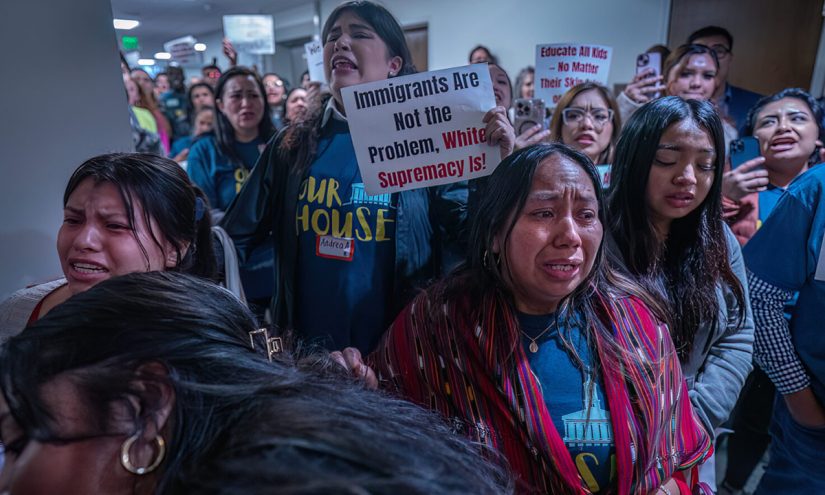
Immediately after the vote was cast, shouts of “so shameful” and “that’s trash” erupted inside the hearing room. Others, including school-age children in attendance, streamed out of the room in tears.
The bill (HB793/SB836) by Sen. Bo Watson, a Hixson Republican, and House Majority Leader William Lamberth, a Portland Republican, says that local school districts and public charter schools “shall require” students to provide one of three forms of documentation: proof of U.S. citizenship, proof the student is in the process of obtaining citizenship or proof they have legal immigration status or a visa.
Students who lack one of the three forms of documentation could then be barred by their local school district from enrolling unless their parents paid tuition.
Watson, the bill’s sponsor, said he brought the measure in response to the increasing cost to the state of providing English-as-a-second-language instruction.
“Remember, we are not talking about people who are here lawfully,” Watson said. “What I’m trying to discuss here is the financial burden that exists with what appears to be an increasing number of people who are not lawfully here.”
In response to a question from Sen. Raumesh Akbari of Memphis, the sole Democrat on the panel, Watson said he had received no formal request from any school official to introduce the measure.
“In an official capacity, this is one of those issues people do not talk about,” Watson said. “This is a very difficult bill to present. It is very difficult to have all these eyes on you.”
“In an unofficial capacity at numerous events, have people mentioned this problem to me? Absolutely,” Watson said.
Akbari responded: “I’m from the largest school district in the state. I have not had those conversations.”
“I am offended by this legislation,” Akbari said. “I find that it is so antithetical to the very foundation of this country….This is saying that babies – you start school at five years old – that you do not deserve to be educated.”
The bill’s sponsors have acknowledged the measure is likely to face a legal challenge if enacted. The proposed legislation, they have said, is intended to serve as a vehicle to potentially overturn the Supreme Court’s Plyler v. Doe decision, which established a constitutional right to a public school education for all children. The 1982 decision was decided by a 5-4 vote, Watson noted.
“Many 5-4 decisions taken to the court today might have a different outcome,” Watson said.
The proposed legislation is part of an unprecedented slate of immigration-related bills introduced in the Tennessee legislature this year as Gov. Bill Lee and the General Assembly’s GOP supermajority seek to align with the Trump Administration’s immigration policies.
Lee last month signed into law legislation to create a state immigration enforcement office to liaise with the Trump administration, create distinct driver’s licenses for noncitizens and levy felony charges at local elected officials who vote in favor of sanctuary policies.
Among nearly three dozen other immigration-related bills still being considered is one to require hospitals that accept Medicaid payments to report on the immigration status of their patients. Another bill would open up charitable organizations, including churches, to lawsuits if they have provided housing services to an individual without permanent legal immigration status and that individual goes on to commit a crime.
Following Wednesday’s hearing in the Senate Education Committee, hundreds congregated in a hallway of the Legislature, chanting “education for all” and pledged to return as the bill winds through the committee process.
The bill “instills fear and hopelessness in these students,” said Ruby Aguilar, a Nashville teacher who testified against the bill during the hearing. “Education is not merely a privilege, it is a shared human right every child should have access to.”
Tennessee Lookout is part of States Newsroom, a nonprofit news network supported by grants and a coalition of donors as a 501c(3) public charity. Tennessee Lookout maintains editorial independence. Contact Editor Holly McCall for questions: [email protected].
The Trump administration’s anti-DEI playlist has been booming out onto the quad since Inauguration Day. Executiveorders denounced “dangerous, demeaning, and immoral race- and sex-based preferences,” and the Department of Justice promised to investigate “illegal DEI” activities. The Department of Education asserted that universities have “toxically indoctrinated students” with ideas about “systemic and structural racism” before launching its “End DEI Portal.” Meanwhile, more than 30 states have considered or enacted laws curtailing DEI.
In sum, this is the year the culture war turned into a food fight. It’s understandably chaotic, but the chaos isn’t entirely warranted by the legal moves the administration is making. Behind all the angry words are sober laws that didn’t change on Inauguration Day. The administration’s attack on DEI is rooted in Title VI of the Civil Rights Act of 1964. Naturally, that seminal law doesn’t mention DEI. Here’s what it says:
“No person in the United States shall, on the ground of race, color, or national origin, be excluded from participation in, be denied the benefits of, or be subjected to discrimination under any program or activity receiving Federal financial assistance.”
The anti-DEI initiative is based on this law because, unlike other antidiscrimination laws, it prohibits differential treatment almost without exception. This has been especially true since Students for Fair Admissions vs. Harvard, the 2023 Supreme Court case that ended affirmative action based on race.
Why Title VI?
Title VI, which bars racial discrimination, is very different from the antidiscrimination laws covering sex and disability, since those laws often require the kind of differential treatment that is illegal in matters of race. For example, Title IX does not require that women and men try out for the same basketball team. To the contrary, it requires that men and women be given equal opportunity to benefit from the program, which in some cases requires the kind of separate-but-equal approach famously made illegal by the Supreme Court in Brown v. Board of Education. Disability laws are even more rooted in equitable practices like reasonable accommodation, accessible facilities and so on. Discrimination is avoided not by treating people the same but by treating people differently in certain defined ways.
One key difference between conservative and progressive approaches to antidiscrimination law is about equal versus equitable treatment. Conservatives lean toward equal treatment where possible, so the law that achieves that most clearly is found in Title VI and its constitutional corollary, the equal protection clause of the 14th Amendment. The resulting law is simple and powerful: no differential treatment based on race, color or national origin.
But it is also quite narrow. It doesn’t make DEI illegal, and it won’t “dismantle DEI.” That would require new laws, restricted funding and so on. All that may happen, and some already has—but it can’t be achieved with Title VI, even in the hands of an energetic Office for Civil Rights.
Political Rhetoric vs. Legal Reality
The yawning gap between political rhetoric and legal reality is perfectly embodied in the Education Department’s new “End DEI Portal.” Its provocative name appears in the press release—but not on the portal itself, which never mentions DEI (save for in the domain name). The portal is a complaint form for “illegal discriminatory practices at institutions of learning” based on civil rights law. It’s a tool constructed by lawyers that differs little from the Biden-era complaint form.
To be sure, the “End DEI Portal” name will induce people to report practices that aren’t illegal—and that will have a chilling effect. But its implementation sticks to the letter of the law. There are many other examples like it.
OCR’s Dear Colleague letter is made with the same ingredients: Heated political language condemns DEI programs, while legal language tracks Title VI. The upshot is that, in the department’s view, differential treatment based on race, color or national origin violates the law. OCR followed up with an FAQ document laying this out in detail. It is rooted in law familiar to every civil rights lawyer, and it follows a strict reading of Title VI law that comes from Students for Fair Admissions.
Problems Still to Be Solved
Well before the 2024 election, several public universities ended race-based scholarships, and Duke University transformed a race-based scholarship into a program open to all. In a sense, it’s surprising that scholarships based on race or national origin survived this long. The federal regulations implementing Title VI mention financial aid nine times in the section prohibiting discrimination on the basis of race, and this language has been the same since at least 1980.
But even simple things can be uncertain in law. A related regulation allows that universities “may take affirmative action to overcome the effects of conditions which resulted in limiting participation by persons of a particular race, color, or national origin.” This would seem to open the door to scholarships and perhaps other practices based on race. But Title VI of the Civil Rights Act never mentions affirmative action, and the 14th Amendment’s equal protection clause may forbid it.
Because of the obvious risks, university programs have long been designed not to classify people by race, color or national origin—but some common practices are in for some scrutiny. Consider a donor who has made a restricted gift to provide scholarship support to students from a specific country—it doesn’t matter if it’s Canada or Kenya. Since Title VI bars preference by national origin, can the university no longer offer that scholarship? If so, how should it be altered to conform to Title VI? Possibilities like this almost seem absurd, but they are among the issues colleges are working out right now.
Race-based housing or mentoring programs are certainly open to challenge, but it remains to be seen how many such programs there really are. It isn’t illegal for a student club, house, activity or even a scholarship program to be of interest mainly to students of one race. It becomes a problem when a college compels behavior or allocates resources based on race. Take housing as an example. Ethnically themed houses are pretty common, and many are open to anyone. If selection is race-neutral, these should be fine. But it will be no surprise if OCR chooses to investigate housing assignment processes to confirm that they are actually race-neutral.
The State Attack on DEI
Over all, the law hasn’t changed much at the federal level, though its enforcement is sure to be more focused. When all the dust has settled, this may be true at the state level, too. I won’t describe the legislation pending in all the different states, but a quick look at Iowa’s DEI laws may shed some light.
Iowa’s HSB60 is titled “An Act prohibiting private institutions of higher education that participate in the Iowa tuition grant program from establishing diversity, equity, and inclusion offices.” The bill, which closely follows the structure and language of similar legislation passed for Iowa’s public universities last year, does what the title says, so the question is— what is the definition of “diversity, equity, and inclusion” under Iowa law? For both private and public universities, DEI is defined as carrying out policies or procedures “on the basis of” or “with reference to” race, color or ethnicity—and in some cases gender identity, sex or sexual orientation. The definition also includes promoting “as the official position” of the college any of a series of concepts associated with DEI.
That certainly seems comprehensive—perhaps DEI is indeed illegal in Iowa. But both pieces of legislation explicitly do not apply to academic course instruction, research or creative works, student organizations, invited speakers, performers, or health services. You can drive a truck through these exceptions—a truck roughly the size of a college. These expansive exceptions are probably commanded by the First Amendment, which is one of the reasons why “illegal DEI” in Iowa ends up being pretty similar to “illegal DEI” in the Trump executive orders. It’s shaped like an admittedly very expansive reading of Title VI—with a little Title IX on the side.
DEI and Religious Liberty
Free speech is the First Amendment protection that comes to mind most naturally in higher education, but another one might become important for some colleges: the free exercise clause guaranteeing religious liberty. Some colleges state their commitment to diversity in unmistakably religious terms. One can imagine a practice rooted in religious belief that arguably violates the letter of Title VI—for example, distributing certain committee memberships in a representational way, perhaps by national origin. Or, for a college with long-standing missionary connections, scholarships directed to students from certain international religious communities.
Practices like this could result in a direct collision of the free exercise clause of the First Amendment and the equal protection clause of the 14th Amendment. A very similar scenario was briefly discussed in a recent Supreme Court case, but the court did not resolve it. We may not know the answer unless it comes up. Because the free exercise clause protects not just beliefs but also actions—up to a point—certain practices related to diversity could conceivably have more constitutional protection if they are faith-based.
So Why Are Some Universities Ditching DEI?
Over all, it looks like getting into compliance with the law will require small but meaningful adjustments—and perhaps a lot of them. But this doesn’t explain why some universities are retreating from DEI altogether. I can think of four reasons why some are making this move. Three just reflect the reality of 2025, but the fourth may be an unforced error.
First, state legislatures control public university funding, so even those that don’t pass anti-DEI laws can express their displeasure through the budget. When an institution like the University of Akron cancels race-oriented programs that are clearly protected under the First Amendment and the Jan. 21 executive order, the real reason may be the State Senate’s opposition to DEI.
Second, research universities rely on big pipelines of grant money from agencies like the National Institutes of Health and the National Science Foundation. Those pipelines have been shown to be fragile, so when a private research university in a very blue state reduces its DEI program, as the University of Southern California appears to have done, it may be out of concern for research grants. Exactly how these funding streams relate to DEI has yet to be fleshed out, but it’s understandable if universities are connecting the two.
Third, the executive branch may also use its hiring discretion to roll back DEI. In February, the interim U.S. attorney for the District of Columbia wrote in a letter to the dean of Georgetown Law School that his office would not hire anyone “who is a student or affiliated with a law school or university that continues to teach and utilize DEI.” There are potential legal problems with this, but it’s hard to see how universities can compel the federal government to hire their graduates. The retreat from DEI may be motivated in part by factors like this.
A fourth explanation is that some university leaders are confusing political language with changes in the law. This is a critical mistake: We believe in rule of law, not rule by law. The law only changes when Congress changes it. The administration’s DEI executive orders did not purport to change the law; neither did the Office for Civil Rights or the Department of Justice. They are expressing sharp views on what the law is—and, in their view, what it has been since the Students for Fair Admissions case in 2023.
From that perspective, everyone is playing with the same legal cards they had before Inauguration Day. What matters now is our collective commitment to play those cards according to the rules of the game. There’s a lot of change coming, and the courts are destined to be very busy.
Dan Currell was a senior adviser in the Office for Civil Rights in the first Trump administration.
SUPAI, Ariz. — Kambria Siyuja always felt like the smartest kid in Supai.
Raised by educators in this tribal village at the base of the Grand Canyon, she started kindergarten a little ahead of her peers. Her teachers at Havasupai Elementary School often asked Siyuja to tutor younger students and sometimes even let her run their classrooms. She graduated valedictorian of her class.
But once she left the K-8 school at the top of her grade, Siyuja stopped feeling so smart.
“I didn’t know math or basic formulas,” she said. “Typing and tech? Nonexistent.”
Siyuja, now 22, wiped tears from her face as she sat alongside her mother and grandmother — the educators of the family — one afternoon last year in the Havasupai Tribal Council chambers. The trio wept as they recalled Siyuja’s move as a teenager to a private boarding school 150 miles away in Sedona, Arizona, which she’d chosen to attend because the federal agency that runs Havasupai Elementary, the only school in her village, provides no options for high school.
Kambria Siyuja, right, plans to teach in Supai, like her mother, Jackie Siyuja, middle, who teaches at the tribe’s preschool program. Grandmother and Havasupai Tribal Council chair Bernadine Jones, left, previously taught at the elementary school. Their tribe’s seal is reflected from a window onto a wall in the council chambers. Credit: Matt Stensland for The Hechinger Report
Once there, however, Siyuja discovered how little she’d learned at the Supai school. She had only superficial familiarity with state and U.S. history, and knew none of the literature her peers had read years earlier. She was the only freshman who’d never taken pre-algebra.
Last year, eight years after Siyuja graduated, the K-8 school still did not offer pre-algebra, a course that most U.S. public school students take in seventh or eighth grade, if not earlier. It had no textbooks for math, science or social studies. The school’s remoteness — on a 518-acre reservation the government forcibly relocated the Havasupai people to more than 150 years ago — makes it a challenge to staff, and chronic turnover required the few educators who remained to teach multiple grades at once. Only 3 percent of students test proficiently in either English language arts or math.
“I know they struggle a lot because of how few resources we have down here,” said Siyuja of Supai, which visitors must reach either by an 8-mile hike or helicopter. “But what are they teaching here?”
In 2017, six Havasupai families sued the federal government, alleging that the Bureau of Indian Education, which operates Havasupai Elementary and is housed within the Interior Department, deprived their children of their federal right to an education. The tribe, in a brief supporting the lawsuit, argued that the bureau had allowed Havasupai Elementary to become “the worst school in a deplorable BIE system” and that court intervention was required to protect students from the agency.
The families eventually secured two historic settlements that fueled hopes across Indian Country that true reform might finally improve outcomes both in Supai and perhaps also at BIE schools throughout the U.S.
Related: Become a lifelong learner. Subscribe to our free weekly newsletter featuring the most important stories in education.
So far, the settlements have brought new staff to Supai, and the BIE had to reconstitute the school board. Teachers now must use lesson plans, and they finally have a curriculum to use in English, science and math classes. A new principal pledged to stay longer than a school year.
“We now have some teachers and some repairs to the building that are being done,” said Dinolene Kaska, a mother to three former students and a new school board member. “It has been a long time just to get to this point.”
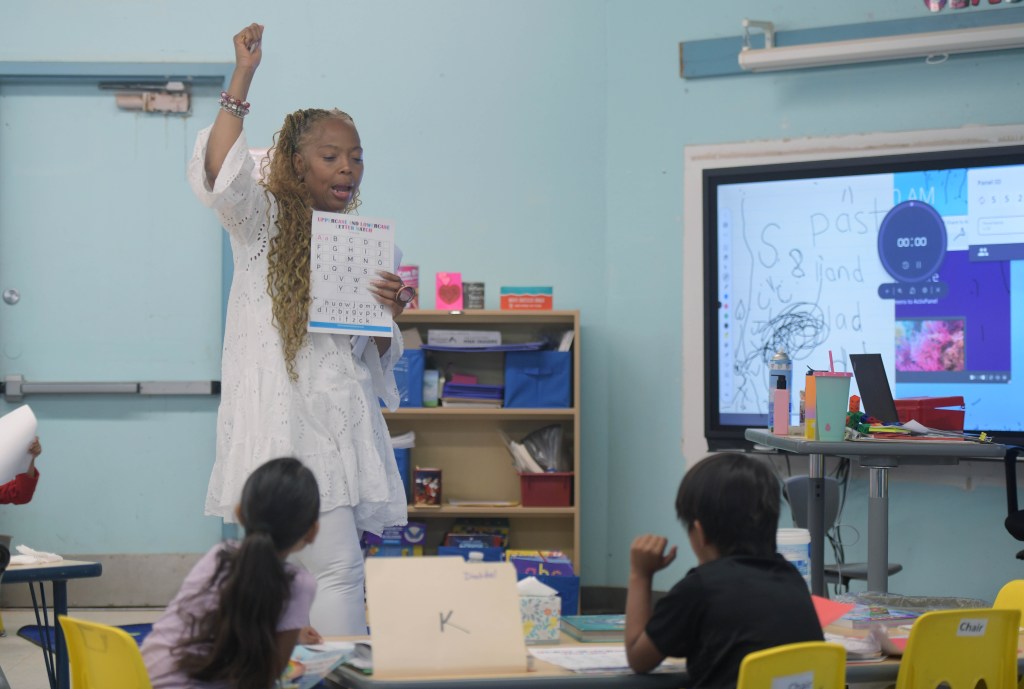
Valencia Stinson leads a kindergarten class through a lesson matching lowercase letters with their corresponding uppercase letters. Credit: Matt Stensland for The Hechinger Report
The legal wins followed an effort to reform the BIE as a whole. In 2014, federal officials unveiled a sweeping plan to overhaul the beleaguered bureau, which had long struggled to deliver better student outcomes with anemic funding. If the BIE were a state, the schools it operates would rank at or very near the bottom of any list for academic achievement.
But in the past decade, and after a nearly doubling of its budget, the BIE has finally started to make some progress. Graduation rates have improved, staff vacancies are down and the bureau built its own data system to track and support student achievement across its 183 campuses in 23 different states. Now, those milestones could be at risk.
President Donald Trump, in his seismic restructuring of the federal government, laid off thousands of workers that will trigger deep cuts to the BIE, among other agencies that work directly on Indian Country. The White House in January also issued an executive order to turn the BIE into a school choice program, draining the bureau of funding and, according to some advocates in Washington, D.C., threatening the government’s long-established trust responsibility to tribal nations. It also remains unclear how the policy would benefit families in isolated communities like Supai where other schooling options are scant or nonexistent.
“Tribes in rural areas don’t have a lot of school choice,” said Quinton Roman Nose, executive director of the Tribal Education Departments National Assembly, a nonprofit that works with tribal education agencies. “For Native students, that’s not a good model. I don’t think it’s going to work for so many.”
Brian Schatz, a Hawaii Democrat and vice chairman of the Senate Committee on Indian Affairs, said the Trump administration’s actions are devastating. “What Trump is doing to the federal government isn’t just reckless — it’s arson,” he said in a statement to The Hechinger Report. “We will do everything we can to ensure that this manufactured chaos does not have lasting impacts on our trust and treaty responsibilities to Native communities.”
Last fall, as conservative critics called for dismantling the BIE and converting its funding into vouchers, longtime director Tony Dearman defended the bureau. He also pitched a new, five-year strategic direction that will emphasize tribal sovereignty and cultural education — both promises the bureau made in its reform agenda more than a decade ago.
“We have really built the capacity of the BIE,” Dearman said. “It’s just taken a while. Anything in the government does.”
Still, he insisted that the BIE could fulfill the government’s obligation to deliver a quality education to tribal nations. “I truly believe that we can handle the trust responsibility with the support from Congress through appropriations,” Dearman said.
For decades, the Department of the Interior, which manages natural resources and wildlife, placed control of schools on tribal reservations within its Bureau of Indian Affairs. The agency oversees law and justice across Indian Country, as well as agriculture, infrastructure, economic development and tribal governance. The agency’s poor management of schools, meanwhile, had been well documented, and in 2006, an internal shakeup resulted in the creation of the BIE.
Almost from the start, the new bureau faced criticism.
In 2008, the Government Accountability Office dinged the BIE for stumbling in its early implementation of the No Child Left Behind education law. A year later, the Nation’s Report Card found Native students in traditional public schools performed much better than those in BIE schools. (About 92 percent of Native students attend traditional public schools and 8 percent attend BIE schools.) Senators scolded the bureau after only 1 in 4 of its schools could meet the new federal education standards. A 2011 report, “Broken Promises, Broken Schools,” cataloged the deterioration of BIE schools, estimating it would cost $1.3 billion to bring every educational facility to an “acceptable” condition.
In 2013, then-Interior Secretary Sally Jewell assembled a study group to diagnose the root causes of academic failures in BIE schools. A year later, the group released the Blueprint for Reform. At its unveiling, Arne Duncan, then the federal education secretary, had damning words for why the BIE needed to change, calling it “the epitome of broken” and “utterly bankrupt.”
The blueprint, issued through a formal secretarial order, called for dramatically restructuring the BIE over two years, starting with its management of tribally controlled schools. In 1988, as part of a renewed focus on tribal sovereignty, Congress had created a grant program to help tribes take control of their respective BIE schools, and as of 2014, a full two-thirds of campuses had already converted.
The 70-page blueprint proposed transforming the agency from a top-down operator of schools into more of an educational services and support center. It would create a division within the BIE to focus on assisting principals with the day-to-day operation of schools. New regional directors and offices would oversee tribally controlled schools, BIE-operated campuses and schools on the sprawling Navajo Nation.
The plan also pitched the addition of “school support solutions teams” at each regional office that would assist with teacher and principal recruitment, school facilities, financial management and technology. A new Office of Sovereignty and Indian Education would help tribes convert their schools to local control and encourage them to shape culture and language classes. Other proposed changes included allowing tribes to tie staff pay to student performance and creating incentives to replicate successful tribally controlled schools.
The study group, however, did not address whether the bureau needed additional funding to pull off the reforms. And without additional funding, the BIE faced deep cuts as budget negotiations pressured then-President Barack Obama to require all federal agencies to reduce their spending by 20 percent.
That essentially tasked the BIE with achieving a turnaround of its failing schools with a fifth less funding. By the time of the blueprint, those cuts were already phasing in: Between 2011 and 2014, for example, the number of full-time administrators located on or near Indian reservations to oversee school spending fell from 22 to 13, leaving the remaining staff to still split 64 reservations among them.
“It was a terrible set up,” said one former top agency official who worked at the BIE during the blueprint’s release. The official, like many of the more than 75 interviewed by The Hechinger Report for this story, spoke on the condition of anonymity because of the DOI’s large role in tribal communities and worries that criticizing the agency could cost them jobs or contracts.
Famous for its turquoise waterfalls — Havasupai means “people of the blue-green water” — Supai village greets visitors at the banks of Havasu Creek.
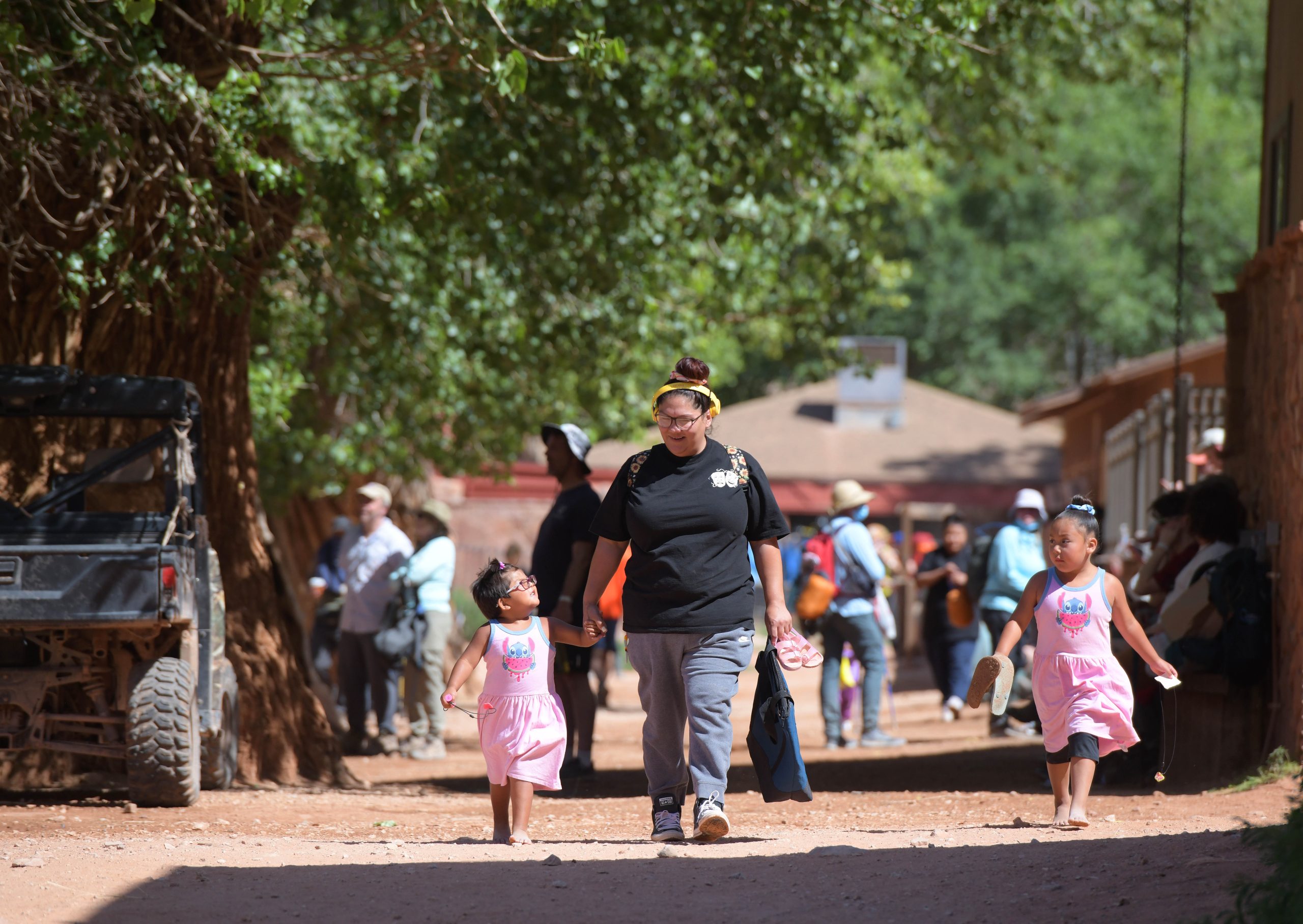
The creek and waterfalls feed a hidden canyon oasis here. Trees bursting with blooms of apricot and pomegranate offer much-welcome shade for backpacking tourists and the mules carrying their gear. Tribal elders wind their way through Supai’s unmarked dusty roads as children on the preschool playground shield their eyes from sand swirling around the adjacent helipad. Benches, some made from milk crates, ring the town square at the front gate of Havasupai Elementary.
Eight years ago, lawyer Alexis DeLaCruz sat on one of those benches in Supai town square. She had recently started working at the Native American Disability Law Center, a firm based in Farmington, New Mexico, that represents Native Americans with disabilities. The firm had recently hosted a training on special education law for parents, and several from Supai, incensed about their kids’ education, traveled out of the canyon to attend. They convinced DeLaCruz and two colleagues to book a helicopter ride into the village to hear directly from parents about their experiences with the BIE.
Parents described how their children couldn’t tell the difference between North and South America and, despite BIE regulations requiring Native culture in all curriculum areas, the students never had a class in Havasupai culture, history or language. Because of a teacher shortage, children learned in classes that combined students from three or even four grades. The school had 10 principals in as many years. The BIE closed Havasupai Elementary for nearly a month in 2015 because of insufficient staffing.
About 100 students each year enroll in Havasupai Elementary School, one of 183 schools that the Bureau of Indian Education manages on 64 tribal reservations across the U.S. Credit: Matt Stensland for The Hechinger Report
Siyuja, who graduated from the school in 2016, remembered cooks and janitors stepping in as teachers — and then having to leave class midday to check on school lunch or plumbing problems.
Until Siyuja reached the fourth grade, Havasupai Elementary, which serves about 80 students, had two tribal members on staff. They led culture and language classes, and Siyuja still owns a copy of the Havasupai dictionary they gifted her as a child. But then they left, and most of the other teachers soon followed, during the 2011-12 school year, she recalled.
That’s when Obama tasked federal agencies with cutting a fifth of their administrative budgets, hollowing out the BIE’s ability to support its schools. In Supai, the already revolving door of educators suddenly started spinning much faster, Siyuja said.
“We were just in this constant loop of relearning the same thing over and over,” she said.
It wasn’t until college, at Fort Lewis College in Colorado, where Siyuja chose to study education, that she learned it was not normal for a school to lump so many grades together in one classroom. “That’s one of the major big no-nos,” she said. (In an email, a BIE spokesperson said, “Many schools implement implement multi-grade instruction as an intentional and effective educational model,” particularly in rural and remote locations, “to enhance individualized learning, maximize resources and promote peer collaboration.”)
In January 2017, nine students from six families sued the BIE and the Interior Department, naming as defendants Dearman, Jewell — who did not respond to interview requests — her deputy assistant secretary and the Havasupai Elementary School principal. The lawsuit listed all plaintiffs under pseudonyms to protect their identity, and the two families involved in the lawsuit who spoke with The Hechinger Report for this story asked to remain anonymous even after the settlements were signed. Some of the students still attend BIE schools, and parents remain worried about exposing any of their children’s privacy, even as adults.
The families hinged their case on a well-established federal right to education for Native American children.
There is no federal right to education in the Constitution, according to a landmark 1973 Supreme Court decision. But for Native Americans, congressional statutes, executive orders, treaties and other Supreme Court opinions dating back virtually to this nation’s founding have cemented education as a major component of the government’s trust responsibility — a set of legal and moral obligations to protect tribal sovereignty and generally look out for the welfare of tribal members. In 1972, lawmakers made it even more clear with the Indian Education Act, which says that the “federal government has the sole responsibility for the operation and financial support” of tribal schools. They also required the BIA — the BIE had not yet been established — to work with tribes to create a system of schools of “the highest quality.” To this day, the BIE pitches itself as a provider of a “world class education.”
DeLaCruz, not long after filing the Havasupai case, started imagining what impact it could have beyond that tiny community.
“Most cases in our legal system end in money,” she said. “This isn’t the same calculus. We’re weighing what we think we can get in place that won’t just make a difference for students now but frankly for generations to come.”
The lead plaintiff in the case was a sixth grader described in the lawsuit as Stephen C. Diagnosed with ADHD, he had never received counseling as mandated in his Individualized Education Program, or IEP, a legal document detailing the interventions and supports that a student with a disability will get from their school. None of the fifth grade teachers the school hired stayed more than two weeks, the lawsuit said, and Stephen C. was taught in a combined sixth, seventh and eighth grade class.
His teacher’s attention split among kids across three grades, Stephen C. started to act out. The school sent him home three to four times a week for behavior issues related to his disability, the lawsuit alleged. Even as an eighth grader, he could barely read or write.
In its friend-of-the-court brief, the Havasupai Tribe said its “people have been isolated at the bottom of one of the world’s most rugged canyons and for more than a century have been forced to depend on the federal government to educate their children.
“Although the days of forced removal and assimilation are over,” the brief continued, “the BIE is still failing its students.”
The federal government didn’t entirely dispute the claims of Stephen C. and his co-plaintiffs.
The BIE and DOI, in June 2017, formally petitioned the U.S. District Court of Arizona to dismiss the case, arguing that the students couldn’t prove the BIE failed or refused to comply with its regulations for what counts as a “basic” education. Also, by that point Stephen C. and four other plaintiffs all had graduated or transferred from Havasupai Elementary, making them ineligible to pursue compensatory educational services, according to the government.
But Lisa Olson, an attorney for the U.S. Department of Justice, also acknowledged the BIE’s shortcomings.
“We are not saying there’s no accountability here. We are just saying that it’s for Congress and the executive to resolve these problems,” Olson said during a November 2019 hearing before U.S. District Judge Steven Logan. “The agency doesn’t dispute that its efforts have been unsatisfactory and they have fallen short.”
Olson asked Logan to consider the many challenges of providing instruction in Supai: There was no funding for an agency helicopter to transport teachers in and out, for example, and new hires often failed their background checks or took other positions before the FBI checks were completed.
“There’s nothing we can do to change that,” she said.
Passengers load into a helicopter at a landing zone next to the preschool’s playground in a central part of Supai village. Credit: Matt Stensland for The Hechinger Report
Logan seemed unmoved. “So what you are basically saying, counsel, is it is the problem of the parents, and they need to make better decisions about where they have children so they can be properly educated?” he said. Olson responded, saying, “It is not the parents’ fault, but we need the cooperation of the parents and the community.” She continued, “I’m saying that BIE is doing its best and tries to enlist the support of parents and the tribe.”
The families also presented a secondary argument — that the complex trauma of Native American children qualifies them for services and protections of the sort that are guaranteed for students with disabilities. They argued that exposure to adversity — specifically, the long-lasting trauma from this nation’s official policy to separate Native children from their families in order to eradicate their cultures and seize tribal land — limited their ability to access the benefits of a public education. To this day, Havasupai families must ship their children away to attend high school, often in other states, and the BIE has no plans to open one in the canyon.
The government warned Logan against following that line of logic, cautioning that it would set a dangerous precedent linking childhood adversity to a student’s ability to learn. The families filed their lawsuit under the Rehabilitation Act of 1973, which prevents discrimination against people with disabilities in federal programs. It does not include adversity or trauma on its list of qualifying conditions, and its applicable regulations expressly note that social disadvantage, such as homelessness or family violence, do not count as impairments, the government noted.
Expanding that definition would threaten to impose “unwieldy” obligations on high-poverty schools across the U.S., the government’s attorneys argued.
“The alleged ‘forced relocation, loss of homes, families and culture,’ and poverty within the Havasupai community … do not constitute a physical or mental impairment,” the motion to dismiss reads.
In August 2020, the federal court issued a mixed decision. Logan allowed the case to continue for students with disabilities. The families also persuaded the court that complex trauma — including interaction with juvenile justice systems, extreme poverty and a denial of access to education — qualifies as a protected disability in the rehabilitation law. But he dismissed the general education claims, deciding that the older students, including Stephen C., had aged out of the school and no potential remedy would be precise enough for a court to enforce.
The Havasupai families cheered Logan’s ruling, but only in part. As they continued to pursue the special education claims, the Havasupai families challenged his decision to dismiss the rest of the case. A three-judge panel of the U.S. Court of Appeals for the 9th Circuit, which includes Arizona, heard their arguments in February 2022.
“The agency is attempting to comply,” Laura Myron, a Justice Department attorney, told the judges. There are, she added, “numerous, practical obstacles to operating a school at the bottom of the Grand Canyon.”
Kathryn Eidmann, president and CEO of Public Counsel, a pro bono public interest law firm, represented the Havasupai families and argued that their ancestors never chose to permanently live in such an isolated location. The government restricted the tribe to the reservation to make way for Grand Canyon National Park.
Hoai-My Winder, new principal at Havasupai Elementary Schools, holds a student’s hand while walking with him during recess. Credit: Matt Stensland for The Hechinger Report
“The obstacles that the government is pointing to that make compliance hard are entirely problems of the government’s own making,” Eidmann said.
In a short five-page decision, the 9th Circuit panel allowed the older students to continue their lawsuit against the BIE. They clarified that judges — namely, Logan — could indeed compel an agency to comply with its own regulations.
The three judges also ruled that the students could seek monetary compensation for the educational services they never received.
Tara Ford, also a pro bono attorney on the Stephen C. case, said at the time that the ruling would reverberate across Indian Country: “Students who have been harmed by the Bureau of Indian Education’s broken promises now have a path to hold the federal government accountable for its failures.”
By then, the students and government had settled the special education claims. Their deal provided each student with $20,000 for compensatory services and required the BIE to follow anti-discrimination provisions of the Rehabilitation Act while creating its first-ever complaint process for parents to challenge suspected discrimination. After the 9th Circuit ruling, however, negotiations to settle the rest of the Stephen C. case stretched beyond a year.
The eventual deal, signed in May 2023, established an $850,000 compensatory education fund for any student who attended Havasupai Elementary since 2011. The BIE estimates about 215 kids could qualify to use that money, meaning each child would receive roughly $4,000, less than some families had hoped for. It also agreed to pay stipends to help recruit and retain teachers in Supai, build additional housing for staff and hire a cultural instructor from the community. The BIE also had to form a new school board.
A year after the case closed, Breanna Bollig, a fellow at the California Tribal Families Coalition, wrote in a legal publication that it could change Native education far beyond Supai.
“The BIE could be held accountable at every other BIE school through similar lawsuits,” Bollig wrote. “Perhaps the federal right to education for Indian children can even be used to improve inadequate and inequitable state public schools that Indian children attend.”
Billy Vides stopped counting at 19.
That’s how many principals he worked with in his first three years as a teacher at Havasupai Elementary. He stayed two more years, submitting his resignation in June.
A longtime educator in Phoenix public schools, Vides first heard of Supai from a pair of grandmothers at an early learning conference. He had considered retiring, but knew he would miss working with kids. Vides searched online for Havasupai, bookmarked an article calling it “America’s Worst Tribal School” and sent in his application.
“I wanted to make a difference,” he said.
The BIE hired Vides in 2019 as a kindergarten and first grade teacher. On his first day, the interim principal assigned him to a combined kindergarten, first, third and fourth grade class. The ages didn’t mix well, he said, and the older kids bullied and sometimes assaulted the younger children.
Joy Van Est, a special education teacher who quit in June, said many of her students’ IEPs had not been updated for several years. It took her four months, the entirety of her tenure there, to update every child’s support plan.
As part of the settlement, an independent monitor every six months must visit Supai and inspect whether the BIE has complied with its own regulations at the school. The monitor must review 104 specific requirements covering student-to-teacher ratios, curriculum taught in each subject, textbooks, grading rules and more. In its first report following a January 2024 visit, the monitor found the bureau in violation of 72 of those requirements.
The school had a curriculum for just one subject — English language arts — and no textbooks for math, science and social studies, the compliance report reads. Teachers used no lesson plans, in any subject, and the school had no librarian. Only one tribal member taught at the school, leading culture and language classes once a week for 45 minutes.
The compliance officer granted the BIE some credit for hiring a school counselor and physical education teacher. However, once-a-week P.E. classes only happened if the part-time teacher could catch a helicopter flight. The counselor started in November 2023, but staff shortages required her to cover teachers’ classrooms too often for her to do any counseling work, the compliance officer found.
The compliance report seemed to have some impact: In the spring, the BIE went on a hiring spree to replenish the beleaguered staff in Supai. A second counselor and special education teacher — Van Est — plus a few additional teachers meant Havasupai Elementary was fully staffed for the first time in years.
A more recent work plan for the school, updated in December, documented further changes: The bureau hired enough staff to meet class size caps. Teachers now submit weekly lesson plans, and the school selected a curriculum and purchased computers for all grades.
The recent recruits include Hoai-My Winder, the school’s new principal. Winder had been working for the Department of Defense, as an administrator at an elementary school in Japan. She previously taught and worked as an assistant principal in Las Vegas, where her family settled after fleeing Vietnam during the fall of Saigon.
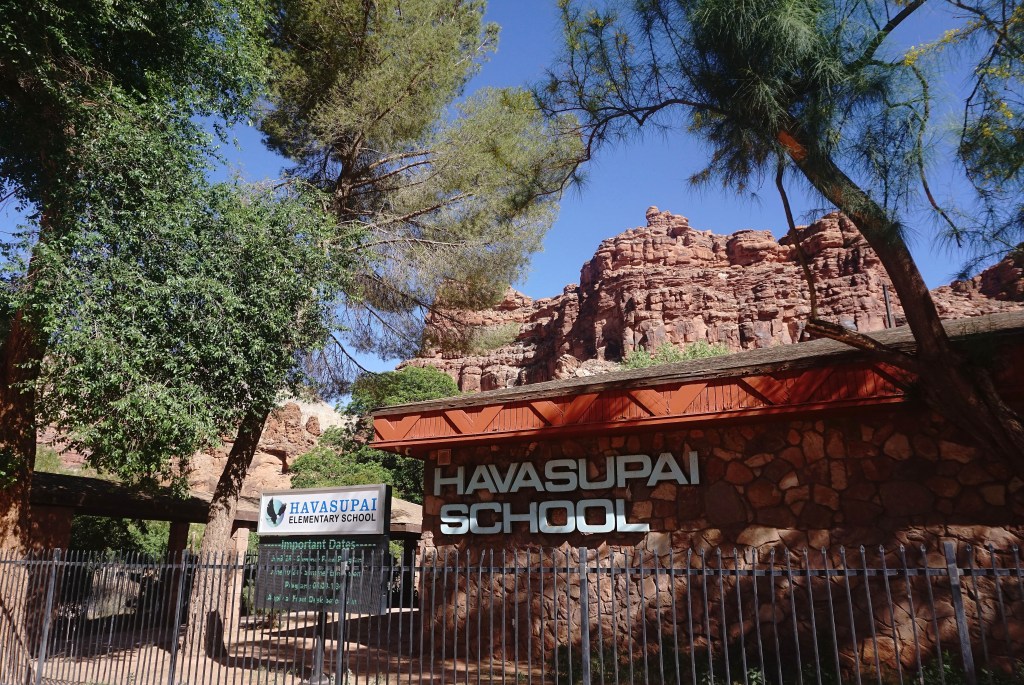
Havasupai Elementary School enrolls students from kindergarten through eighth grade. The Bureau of Indian Education directly operates the campus in Supai village, which visitors must reach via an 8-mile hike or helicopter ride. Credit: Matt Stensland for The Hechinger Report
“Day Six!” Winder hollered one afternoon this past May as she entered the spiked gates that separate Havasupai Elementary from the rest of the village. It was her tally of the number of days she’d been principal — both at Havasupai Elementary and ever.
While her husband unpacked boxes in their new home, Winder took inventory at her new school. She discovered 40-year-old math textbooks on classroom shelves. Havasupai teachers at some point had created a Supai dictionary and draft curriculum for language instruction; Winder found it collecting dust in a box.
As she met with parents and tribal members during her first week, ahead of the eighth grade graduation ceremony that afternoon, Winder repeated a pledge to stay at Havasupai Elementary for at least five years, maybe 10.
Felicia Siyuja, the longtime school secretary, stood next to Winder as families packed into the cafeteria for the ceremony. As the aroma of frybread wafted from the kitchen, Siyuja tapped the mic before addressing the 13 students sitting in the front row.
“I also want to apologize,” she told the soon-to-be freshmen. “All the teachers and principals rotating for all these years. It was hard for me as a grown-up. I can’t imagine how it was for you.”
Eighth graders wearing turquoise-and-gold colored gowns prepare for their graduation ceremony at Havasupai Elementary School. The tribal village, at the base of the Grand Canyon, is famous for its turquoise waterfalls. Credit: Matt Stensland for The Hechinger Report
Aside from Winder and her supervisor, the BIE would not allow The Hechinger Report to interview school staff on the record. But six current or former Havasupai teachers, most of whom spoke on the condition of anonymity, placed blame on the bureau for Havasupai Elementary’s dysfunction.
“The BIE is the problem,” said one teacher. “The BIE lacks humility.”
The educator, who now works at another BIE school, said he never received cultural training to prepare him for working with Native children and families. Several colleagues resigned before winter break his first year in Supai, making him the most veteran teacher on staff.
“I had no curriculum. No student names, no mentor, no oversight or guidance,” he said. “You don’t want to be yet another teacher who comes and goes. After three years, it gets old. It’s just exhausting.”
In a February 10 email, a BIE spokesperson wrote that cultural training, including language preservation, had been scheduled for later that month.
Van Est, who joined the bureau specifically to support its mission of uplifting tribal communities, said last summer that she no longer believed it was capable of doing that job. “The entity that has most recently oppressed the Havasupai people is making absolutely no effort to use education as a tool for repair, as a gold mine for building their future,” she said.
The BIE blames Havasupai Elementary School’s isolation and lack of housing for its troubles.
Even before the Stephen C. lawsuit, the BIE offered lucrative stipends to lure educators to Supai. It also guarantees housing, in theory, but in a pinch has forced teachers to room together. And a recent hiring spree, to satisfy the settlement, has made housing even tighter.
Dearman said a recent housing needs analysis determined the BIE now needs 30 beds in Supai, but has only 12. One teacher simply didn’t return to their position this fall when the bureau couldn’t secure housing for more than a few weeks.
“That puts a major strain on us being able to keep staff there,” Dearman said about the housing shortage. “We have housing needs at other locations as well. However, Havasupai is so isolated that if you’re not able to stay in our quarters there, there’s no other options.”
He said that it’s hard for some educators to uproot their lives to live in Supai. “It’s a difficult place to come in and out of. It really is,” Dearman said.
Poverty surrounds many BIE schools on tribal reservations, largely as a result of former government policies to eradicate Native peoples. In Supai, nearly 40 percent of the tribe lives in poverty, almost four times the national average. Tourism provides an economic bedrock for the Havasupai economy, though many families rely on government assistance.
Vides, the teacher, struggled with his decision to quit. His wife had remained 300 miles away in Phoenix, raising their 3-year-old daughter without him. He missed a lot of her firsts, and felt torn between her and the Havasupai children.
“It was difficult. I was grieving for the future of these students,” Vides said.
“Either the system is continually broken,” he added, “or the system is working successfully to slowly eradicate this tribe.”
Long before Trump’s executive order in January, some conservatives had pushed school choice as a solution to the BIE’s troubles. In 2016, the right-wing Heritage Foundation proposed turning the BIE into an education savings account, or ESA, which would grant families a portion of their child’s per-pupil funding to spend on private school tuition, home-school supplies and other educational expenses. That same year, the late Arizona Sen. John McCain introduced legislation offering ESAs equal to 90 percent of what the BIE spends on each student.
The bill didn’t advance, but Heritage resurrected the idea last year in its Project 2025 transition plan for the next president. Notably, the conservative think tank — despite citing the BIE’s poor track record as justification for converting much of its funding into vouchers — also proposed granting it even more authority over the education of all Native American students, in all U.S. public schools.
In his January order, Trump required the BIE to identify “any available mechanisms” for families to tap federal funding for private and faith-based schools, as well as to report on the performance of its schools and identify alternatives for families to consider. The agency has until April to submit its plan, for implementation this fall. The White House did not respond to several requests for comment.
In certain tribal communities across Arizona, some parents have started to consider opting out of the BIE system. The state passed a universal school voucher program in 2022, giving any family who wants roughly $7,400 to spend on private or parochial schools or other options. Christian academies on the Gila River Indian Community, a reservation near Phoenix, have already used the program to recruit students.
The walls of Havasu Canyon surround the village of Supai, where water from Havasu Creek later connects to the Colorado River at the Grand Canyon. Credit: Matt Stensland for The Hechinger Report
But in Supai, some residents worry the ESA option is meaningless. The closest private schools, in Kingman, are more than two hours away. Internet access in the village is virtually nonexistent, a hurdle for any parents trying to teach their kids at home.
The National Indian Education Association, an advocacy group, has yet to issue a position on Trump’s order but said in a statement that it’s “closely monitoring” potential impact on cultural preservation and access to education for Native students. In the past, the group has said BIE is the best option to fulfill the federal government’s responsibility to educate Native students. It blames its poor results on Congress — the branch of government holding the purse strings.
“The BIE in general, they just have a difficult time,” said Roman Nose, with the national group for tribal education departments. He noted that Department of Defense schools — the only other K-12 system run by the federal government — receive more funding. And Roman Nose worried how the recent federal layoffs and school choice proposal could further erode BIE’s ability to fulfill the trust responsibility.
The BIE lost dozens of employees in the recent layoffs, sources told ICT. Among those laid off were approximately 30 from non-school positions in the BIE agency offices, excluding kindergarten through 12th grade schools.
“There won’t be any progress made during this administration,” Roman Nose said. “It’s a difficult job, but these are treaty obligations.”
Dearman, the bureau’s longtime director, insisted that the BIE could fulfill the government’s obligation to deliver a quality education to tribal nations.
Under his leadership, the BIE has secured some financial wins for its schools. Lawmakers now funnel about $235 million into the bureau for school construction – it has asked for more than $400 million – and $150 million for replacing older campuses, according to the agency. Counselors and teachers now make the same amount as their counterparts in Department of Defense schools. And Dearman, a longtime champion of early childhood education, has expanded the bureau’s popular preschool program into more schools.
Traditional beadwork decorates an eighth grader’s graduation cap at a Havasupai Elementary School ceremony. The school’s mascot is the eagle. Credit: Matt Stensland for The Hechinger Report
Graduation rates have also climbed. Last year, according to the bureau, 75 percent of its high schoolers earned a diploma on time — a 31 percentage point jump since 2014 and slightly above the national average for Native American students. As of 2021, the last time the BIE reported achievement data, 17 percent of students tested on grade level in English language arts, and 11 percent in math. For three states where the BIE runs two-thirds of its schools, students have posted 8 percentage point increases on English exams and 13-point increases on math exams since 2016, according to the bureau.
The U.S. Government Accountability Office, which has tracked the BIE’s “systemic management weaknesses” since 2013, recently reported that it had achieved substantial progress on school construction and safety. The bureau’s oversight of special education, distance learning and school spending remain open problems, the GAO found, while also noting in its report — released just days before Trump’s recent layoffs — that meager staffing “has been a challenge for BIE for over a decade.”
DeLaCruz left the Native American Disability Law Center in October to work on education litigation for the Tulalip Tribe in northern Washington state. A little more than a year after closing the Havasupai case, she hesitated to call either settlement a win.
Still, she noted in an email that the creation of a school board at Havasupai Elementary had been a big step forward: “The fact there is a community-led School Board to ask questions and voice concerns to the BIE is vital to improving education at Havasupai Elementary School.”
Kambria Siyuja works during her summer break at Supai’s preschool program. Siyuja graduated from Havasupai Elementary School down the road and plans to teach there after graduating from Fort Lewis College next year. Credit: Matt Stensland for The Hechinger Report
The morning after the eighth grade graduation ceremony, Kambria Siyuja walked past her old elementary school as the sun crawled over the rust-red walls of Supai Canyon.
She greeted parents dropping off their sleepy toddlers at the federal Head Start preschool. Siyuja has worked there every summer break in college, hoping to decide whether to pursue a job in early learning or teaching down the road, at Havasupai Elementary.
Her grandmother, Bernadine Jones, attended Havasupai Day School in the 1960s, when it only offered K-2 classes, before attending and graduating from a Phoenix high school. She eventually returned to Supai and taught at her old school and the village preschool for 20 years. Siyuja’s mother teaches at the tribal Head Start program.
Academically, Siyuja finally feels prepared to be a teacher.
“It’s really weird taking a class in college and learning stuff they should have taught me at that elementary school,” she said. “Now I’m really able to understand math, and also teach math.”
This winter, Siyuja returned home for break with big news. Not only had she finally finished remedial math and qualified for a math class this past semester that would earn her full college credit, she’d passed it, receiving a B.
Siyuja also recently learned she qualified for about $3,500 from the Stephen C. settlement. She said she had planned to use the money to pay for her spring semester of college, but as of February, had not heard back from a BIE representative about the payment.
She graduates from Fort Lewis College, the former site of a notorious Indian boarding school, in 2026.
Despite her misgivings about the BIE, she said she views becoming an educator at the school as the best way possible to help her community. “I just want the younger kids to have a much better education than we got.”
Contact staff writer Neal Morton at 212-678-8247 or [email protected].
This story about the Bureau of Indian Education was produced by The Hechinger Report, a nonprofit, independent news organization focused on inequality and innovation in education, in collaboration with ICT (formerly Indian Country Today). Sign up for the Hechinger newsletter. Sign up for the ICT newsletter.
The Hechinger Report provides in-depth, fact-based, unbiased reporting on education that is free to all readers. But that doesn’t mean it’s free to produce. Our work keeps educators and the public informed about pressing issues at schools and on campuses throughout the country. We tell the whole story, even when the details are inconvenient. Help us keep doing that.
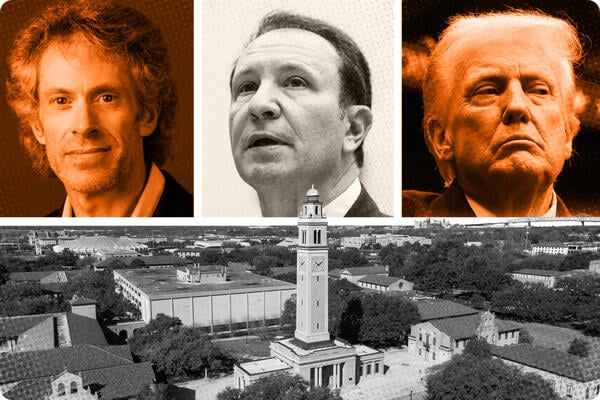
In a Jan. 14 lecture, Ken Levy, Holt B. Harrison Distinguished Professor of Law at Louisiana State University, dropped f-bombs against then–president-elect Donald Trump and Louisiana governor Jeff Landry and told students who like Trump that they need his “political commentary.”
Some students found the apparent attempt at political humor funny, according to an audio recording of the class obtained by Inside Higher Ed from a student who supports Levy.
But at least one student in the administration of criminal justice class who subsequently complained, according to LSU, wasn’t amused—and neither were the university and the governor. An LSU spokesperson said the institution “took immediate action to remove Professor Levy from the classroom after complaints about the professor’s remarks.”
Levy got a lawyer and took immediate action himself, pulling LSU into court instead of waiting for the university to take further steps internally regarding his job.
In the month since that lecture, state district court judges have twice ruled that Levy should return to the classroom, only for a state appeals court to twice overrule that. The back-and-forth nature of the case has attracted attention in Louisiana and in law circles, including via headlines such as “The LSU Law School Professor Free Speech Hot Potato Saga Continues.”
Landry also continues to discuss the case. A Republican governor who’s repeatedly insertedhimself in LSU affairs, Landry used social media in the fall to call on the university to punish one of Levy’s law school colleagues for alleged in-class comments about Trump-supporting students. Landry has now repeatedly posted about Levy, recently saying an alleged exam he gave was incendiary and suggesting that “maybe it’s time to abolish tenure.”
In and Out
In the lecture in question, Levy referenced Landry’s previous criticism of his LSU colleague Nick Bryner, adding that he “would love to become a national celebrity [student laughter drowns out a moment of the recording] based on what I said in this class, like, ‘Fuck the governor!’”
Levy also referenced Trump. “You probably heard I’m a big lefty, I’m a big Democrat, I was devastated by— I couldn’t believe that fucker won, and those of you who like him, I don’t give a shit, you’re already getting ready to say in your evaluations, ‘I don’t need his political commentary,’” Levy told students. “No, you need my political commentary, you above all others.”
A few days after that lecture, LSU notified Levy he was suspended from teaching pending an investigation into student complaints, according to a letter from the university provided by Levy’s attorney, Jill Craft.
On Jan. 28, Craft filed a request for a temporary restraining order against LSU to get Levy back in the classroom. The filing alleged that a student complained to the governor, not LSU, and calls were then made to LSU. A state district court judge granted the restraining order Jan. 30 without a hearing.
In the first reversal, a panel of appellate judges wrote Feb. 4 that the lower court shouldn’t have approved the return-to-teaching part of the temporary restraining order without a full evidentiary hearing. But after the lower court held a two-day hearing last week, a different group of appellate judges overruled Levy’s return to teaching again—without explaining why.
Local journalists who covered last week’s hearing reported that district court judge Tarvald Anthony Smith kicked an LSU deputy general counsel out of the courtroom because the lawyer told the law school dean, who was a scheduled and sequestered witness, about a student witness’s earlier testimony. The testimony was reportedly that the student had recorded a conversation with the dean.
Smith ruled Feb. 11 that LSU policy required the university to keep Levy in class during the investigation of his comments, WBRZ reported. But a Feb. 4 statement from university spokesman Todd Woodward to Inside Higher Ed suggested the investigation was already over: “Our investigation found that Professor Levy created a classroom environment that was demeaning to students who do not hold his political view, threatening in terms of their grades and profane.” The university didn’t make anyone available for an interview about the case.
Amid this legal back-and-forth, Landry continues to denounce Levy on social media. Last week, Landry posted on X an alleged exam from Levy that included potential sexual and other crimes committed by various fictitious individuals and asked students at the end to “discuss all potential crimes and defenses.” The narrative included a teen who put his penis into pumpkins on Halloween and was seen by trick-or-treating children, and a powerful Republican and suspected pedophile who invited the children inside to dance for him.
“Disgusting and inexcusable behavior from Ken Levy,” Landry wrote on X regarding what he claimed was Levy’s test. “Deranged behavior like this has no place in our classrooms! If tenure protects a professor from this type of conduct, then maybe it’s time to abolish tenure.” Asked about this document, Craft said she believes the assignment was part of the sex crimes portion of Levy’s criminal law exam years ago, but she did not confirm it.
After the latest appellate ruling in LSU’s favor, Landry wrote on X that “Levy should stay far, far away from any classroom in Louisiana!”
Craft said Levy has received death threats on X due to Landry’s comments there. “This seems to be a situation entirely of the governor’s making,” she said. “He has been active on social media, trying to accuse my client of all kinds of bad things. He’s a lawyer himself. He attacked the courts and the judge.”
Landry’s office didn’t respond to requests for comment.
Craft also said Levy’s roughly 80 students remain with another 80 in another professor’s classroom.
“I’m not sure how he can handle office hours for 160 law students,” Craft said of that second professor. The university says it’s doubled the number of student tutors for the course.
No Longer the U.S.?
Craft said Levy was set to return to the classroom Feb. 13, but Louisiana’s First Circuit Court of Appeal issued its two-sentence order around 9:30 a.m. that appeared to stay the part of the lower court’s order that returned Levy to teaching.
LSU again kept Levy out of the classroom Tuesday, Craft said. But she said the rest of the lower court order remains in place, at least for now, and that prevents LSU from taking further employment action against Levy due to his expression.
“This is a critical issue, and I feel like we have got to, as a nation, understand that there has to be academic freedom, there has to be free speech in this country, and there have to be protections against governmental intrusions without due process,” she said. “We take all that away and we are no longer the United States of America.”
Over the years, elite institutions shifted from
fostering open debate to enforcing ideological conformity. But as
guest Ilya Shapiro puts it, “the pendulum is swinging back.” He
shares his firsthand experience with cancel culture and how the
American Bar Association’s policies influence legal education.
Shapiro also opines on major free speech cases before the Supreme
Court, including the TikTok ownership battle and Texas’ age
verification law for adult content.
Shapiro is a senior fellow and director of
constitutional studies at the Manhattan Institute. He previously
(and briefly) served as executive director and senior lecturer at
the Georgetown Center for the Constitution and as a vice president
at the Cato Institute. His latest book, “Lawless:
The Miseducation of America’s Elites,” is out now.
Enjoy listening to our podcast? Donate to FIRE today and
get exclusive content like member webinars, special episodes, and
more. If you became a FIRE Member
through a donation to FIRE at thefire.org and would like access to
Substack’s paid subscriber podcast feed, please email [email protected].
The case will be heard at London’s High Court April 1-3, the Independent Schools Council (ISC), which represents private schools in the UK, revealed this week.
It’s the latest step in its furious battle to overturn a policy – key to the Labour party’s election manifesto before it regained power in July 2024 – to start levying VAT on private school fees.
The ISC said its case, led by prominent human rights barrister Lord Pannick KC, would argue that the VAT policy “impedes access to education in independent schools” and is therefore incompatible with the European Convention on Human Rights.
In the case, the ISC is supporting six families impacted by the policy, and the defendent in UK Chancellor Rachel Reeves.
The case is being heard on an expedited basis following a successful argument from Lord Pannick that parents needed certainty because they are already feeling the effects of the policy.
ISC CEO Julie Robinson said the organisation’s aim was to “protect the rights” of families and young people “who are having their choice removed from them”.
“This is an unprecedented tax on education – it is right that its compatibility with human rights law is tested,” she continued. “We believe the diversity within independent schools has been ignored in the haste to implement this damaging policy, with families and, ultimately, children, bearing the brunt of the negative impacts this rushed decision is already having.”
This is an unprecedented tax on education – it is right that its compatibility with human rights law is tested Julie Robinson, ISC
Reeves confirmed in October that the party would be slapping a 20% tax on fees for January 2025, leading to fears from independent boarding schools that their intake of international students could plummet.
Experts predicted that although some schools would choose to swallow the loss of revenue, most would be forced to raise their fees an average of 10-15% to cover costs.
An online private school told The PIE News earlier this month that it has seen a “five-fold” surge in interest from parents since the VAT policy was announced last year.
CEO of Minerva’s Virtual Academy, Hugh Viney, credited the rise in demand to the VAT policy, as he said the school’s fees are “good value” and much less than most private schools at under £8,500 per year – a price that has always included VAT and is therefore unchanged by the new legislation.
On August 16, the U.S. Supreme Court ruled against the Biden administration’s request to partially overturn preliminary injunctions from lower courts that block the Department of Education from enforcing the administration’s April 2024 Title IX final rule. The decision leaves the preliminary injunctions from the lower district courts in place, preventing the new Title IX rule from taking effect in 26 states and hundreds of schools in other states.
Background
Shortly after the Biden administration’s Title IX final rule was published, over two dozen states and advocacy groups filed lawsuits challenging the rule. Over the course of the summer, decisions from lower district courts across the country placed preliminary injunctions on the final rule, leading to the blocking of the final rule in 26 states, as well as at hundreds of schools where members of the Young America’s Foundation, Female Athletes United and Moms for Liberty are in attendance.*
After several preliminary injunctions were issued, the Biden administration appealed to the Supreme Court with an emergency request asking the court to limit the scope of the preliminary injunctions placed by the lower courts. Specifically, the Biden administration asked the Supreme Court to limit the scope of the preliminary injunctions to only block provisions of the Title IX final rule related to gender identity, arguing that the lower courts’ decisions to grant the preliminary injunctions were based on concerns with the expanded protections for transgender students. The Biden administration had hoped that by limiting the scope of the preliminary injunctions, other provisions like the new grievance procedures and training requirements would be able to take effect on August 1.
Supreme Court’s Decision
In a 5-4 decision, the Supreme Court rejected the Biden administration’s plea to limit the scope of the preliminary injunctions, leaving in place the lower courts’ rulings. The majority opinion stated that the Biden administration did not provide a strong enough argument to sway the Supreme Court to overturn the lower courts’ decisions, and they argued that the gender identity provisions the Biden administration had hoped to limit the scope of the preliminary injunctions to were “intertwined with and affect other provisions of the rule.”
Looking Ahead
With the Supreme Court’s decision, the preliminary injunctions from the lower courts are still in place. Further decisions from the district courts on the legality of the final rule are still pending. The Title IX rule could return to the Supreme Court in the future, however, depending on how lower courts rule on the legality of the final rule and whether those decisions are appealed.
CUPA-HR will keep members apprised of any updates on the legal challenges against the Biden administration’s Title IX rule.
*The 26 states where the rule is blocked from being enforced by the Department of Education are Alabama, Alaska, Arkansas, Florida, Georgia, Idaho, Indiana, Iowa, Kansas, Kentucky, Louisiana, Mississippi, Missouri, Montana, Nebraska, North Dakota, Ohio, Oklahoma, South Carolina, South Dakota, Tennessee, Texas, Utah, Virginia, West Virginia, and Wyoming. The final rule is also blocked from taking effect at hundreds of colleges and universities across the country, including in states that did not challenge the Title IX final rule. A list of those schools can be found here.
Over the past several months, the Biden administration announced and implemented several vaccine and testing mandates for federal workers, federal contractors and private employers. States and business stakeholders quickly responded with lawsuits against the administration’s mandates, which continue to be challenged in courts around the country. To keep CUPA-HR members apprised of the legal challenges, we have detailed below the most recent litigation updates for the federal contractor vaccine mandate, the Occupational Safety and Health Administration (OSHA)’s Emergency Temporary Standard (ETS), and the Centers for Medicare and Medicaid Services’ (CMS) vaccine mandate for healthcare workers — all three of which are on hold pending the various lawsuits’ outcomes.
Federal Contractor Vaccine Mandate
On September 9, President Biden issued Executive Order 14042 (EO), “Ensuring Adequate COVID Safety Protocols for Federal Contractors,” as part of his “Path Out of the Pandemic” plan. The EO tasks the Safer Federal Workforce Task Force with implementing guidance that requires all federal contractors to mandate COVID-19 vaccinations for their employees. The current effective date is January 4, 2022, meaning all covered contractor employees must be fully vaccinated by January 18, 2022. A federal court recently enjoined the government from implementing the EO, however, so it remains unclear when, if ever, the mandate will go into effect.
Numerous lawsuits have been filed against the mandate arguing that the Biden administration does not have authority to require vaccinations, and two federal courts have already issued decisions. On November 30, the U.S. District Court for the Eastern District of Kentucky issued a preliminary injunction against the mandate, stopping enforcement in Kentucky, Ohio and Tennessee only. On December 7, a federal judge at the U.S. District Court for the Southern District of Georgia granted a motion for a nationwide preliminary injunction against the vaccination mandate for federal contractors, halting enforcement for federal contractors in all states. The Biden administration is expected to challenge this decision.
OSHA Emergency Temporary Standard
On November 5, OSHA issued its COVID-19 Vaccination and Testing ETS requiring employers with 100 or more employees to implement vaccination or testing policies for their workers. As it currently stands, the ETS requires covered employers and employees to be fully vaccinated by January 4, 2022. A federal court has enjoined OSHA from implementing the ETS, however, and it remains unclear whether the ETS will be in effect on January 4 or anytime thereafter.
Over three dozen lawsuits were filed against the rule, with at least one in all 12 circuit courts in the country. On November 6, the U.S. Court of Appeals for the 5th Circuit granted an emergency motion to stay the ETS, and on November 12, it extended the stay while it further reviewed the motion for a permanent injunction, ordering OSHA to stop implementation and enforcement of the ETS until further court order. Due to the high volume of cases at various circuit courts, a lottery was held on November 18 to determine which circuit court would hear the case to make a sweeping decision, which the 6th Circuit won, meaning the stay remains in place until the 6th Circuit makes a decision on the motion. It is likely the stay will remain in place until at least December 10; that said, the 6th Circuit can decide to lift the stay before that if it chooses to do so.
CMS Vaccine Mandate for Healthcare Workers
On November 5, the Centers for Medicare and Medicaid Services (CMS) issued a rule requiring healthcare workers in facilities that receive Medicare or Medicaid funds be vaccinated against COVID-19 by January 4, 2022. This rule also has been stayed by federal courts.
Four lawsuits were filed against CMS challenging the agency’s authority to issue the rule. On November 29, the District Court for the Eastern District of Missouri blocked implementation and enforcement in the 10 states that challenged the rule: Missouri, Nebraska, Arkansas, Kansas, Iowa, Wyoming, Alaska, South Dakota, North Dakota and New Hampshire. On November 30, the District Court for the Western District of Louisiana issued a preliminary injunction blocking enforcement of the mandate nationwide, except in the 10 states impacted by the Missouri ruling. Decisions in the two other lawsuits are still pending.
CUPA-HR continues to monitor the ongoing litigation for all of the vaccine and testing mandates and will keep members apprised of any decisions that will impact institutions’ compliance efforts.