Tag: Lessons

  • English lessons: Review of Nick Gibb’s book on educational reform after 2010 – by HEPI Director Nick Hillman

    English lessons: Review of Nick Gibb’s book on educational reform after 2010 – by HEPI Director Nick Hillman

    • HEPI Director Nick Hillman reviews Reforming Lessons: Why English Schools Have Improved Since 2010 and How This Was Achieved by Nick Gibb and Robert Peal.
    • On Tuesday, 9 September 2025, HEPI will be hosting the launch of the OECD’s flagship Education at a Glance report. Book a place (in person or online) here.

    This is the second book on education in a row that I have reviewed on the HEPI website that comes from a right-of-centre perspective. The previous review (of a book by the President of the New College of Florida) garnered some pointed attacks underneath – ‘No doubt we’ll soon be seeing articles offering a “more balanced” perspective on Putin and Orban’s records in office’. So let me start by noting HEPI has also run many reviews (by me and others) of books written by left-of-centre authors as well as centrist authors, such as Sam Friedman and Aaron ReeveSimon KuperFrancis Green and David KynastonMelissa Benn, and Lee Elliot Major and Stephen Machin.

    Let me also note that we are always on the lookout for reviews of recent books that are likely to be of interest to HEPI’s audience, irrespective of where on the political spectrum the authors of the books in question or – indeed – the reviewers sit. When we started running book reviews on the HEPI site many years ago, they tended to receive less engagement than other output, but that has changed over the years and they are often now among our most-read pieces. We hope this remains true on our brand new website. So the door is wide open. Come on in.

    Now down to business. Reforming Lessons is a defence of the changes wrought by the long-standing and thrice-appointed Minister for Schools, Nick Gibb, and to a lesser extent his boss Michael Gove, co-written by Gibb himself. The other author is Robert Peal, who was one of a group of young state-school teachers (often, like Peal, powered by Teach First) who made up the advancing phalanx for the school reforms that were implemented by the Coalition and subsequent Conservative Governments. (John Blake, the Office for Students’s Director for Fair Access and Participation was another member of this front line and merits a mention in the book, as was Daisy Christodoulou, who has contributed a Foreword and who features multiple times.)

    At the risk of further brickbats, it would be absurd for HEPI to have ignored this particular book at this particular time, for it is currently a huge talking point among educationalists. But is not just about education; it is also a book about the practice of politics. As the authors themselves write, it is an account of ‘the virtues of a subject-specialist minister driven by conviction in a specific cause rather than personal ambition.’ It fulfils this brief very well indeed, so it should be read far beyond the education world, especially by aspiring ministers in any field where they want to make a difference. But, and I do not mean this to be in any way rude, I suspect it was not – in one important sense – all that hard for Gibb and Peal to make their case.

    This is because the key international data on school performance, which come from the OECD’s comparative PISA (the Programme for International Student Assessment), show England forging ahead, including against other parts of the UK, between 2009 and 2022. So Gibb and Peal had a secure evidence base on which to build their story.

    We may argue that PISA is not a perfect measure: it tests only a small number of disciplinary areas and to a fairly basic level of knowledge and it has not always been completed the same way (sometimes on paper and sometimes on screen), but it is better than anything else we have when it comes to comparing school systems – and infinitely better than anything we have in higher education. So anyone who wants to shoot down the book’s central claim that Nick Gibb succeeded as a Minister will struggle to find equally robust performance data for their argument – though they could presumably focus on other evidence such as on an apparent narrowing of the curriculum (though Gibb and Peal get their defence on this in first – see pages 123 and 124).

    Near the start, the book takes a look at how any education changes begun in 2010 had to be extremely cost-effective – cost-cutting or else free – given the dire fiscal position which led every major political party to promise drastic spending cuts at that year’s general election. Gibb and Peal also paint a picture of the ineffectiveness and wastefulness of the expensive centralised initiatives based on existing orthodoxies that preceded the Coalition. The multi-billion pound Building Schools for the Future programme was perhaps the archetype for, as Gibb shows, tens of millions of pounds were spent on building individual schools with open-plan classrooms where staff struggled to teach and pupils struggled to learn. Another challenge during the 2000s is that schools were overwhelmed with bureaucracy: in 2006/07 alone, we are told, there were around 760 missives to schools from Whitehall and quangos – four-per-day for the whole school year.

    Yet Nick Gibb is far from being a free-for-all libertarian right-winger. He is, rather, someone who wants to use the power of the state to drive policy, including how to teach reading (synthetic phonics) as well as how to shape other aspects of the school curriculum. It is easy to see how this approach could have gone wrong but Gibb’s primary goal is always to follow the evidence as he sees it, and I cannot be the only parent who was amazed by how quickly their children started to read during their initial school years in the second half of the 2010s. Gibb has given more thought to schooling than any other modern politician and he rejects many of the ideas of his colleagues as much as those from the political left: he did not favour a wave of new grammar schools, he did not want GCSEs to be replaced by O-Levels and he opposed Rishi Sunak’s Advanced British Standard.

    The book might begin and end somewhat immodestly and uncollegiately by reminding readers that many commentators picked out education as the one and only really big success of the Coalition and Conservative years, yet this is not by any stretch of the imagination a selfish book. Nick Gibb shows how his worldview was built upon teachers like Ruth Miskin, academics like ED Hirsch and others – even his researcher Edward Hartman gets a namecheck (or rather two) for introducing him to Hirsch. He shows how his agenda was carried forward by people like Hamid Patel, Katharine Birbalsingh and Jon Coles.

    Political colleagues like Michael Gove and David Cameron are given credit for changing Whitehall’s approach to schooling. The triumvirate of advisers, Dominic Cummins, Sam Freedman and Henry de Zoete all receive praise, as does Nick Timothy for his stint in Number 10 as Theresa May’s Joint Chief of Staff. Andrew Adonis garners the most praise of all for starting ‘the revolution we undertook whilst in office’, and Kenneth Baker is lauded for getting the successful City Technology Colleges (the forerunners of academies) off the ground in the 1980s. Gibb and Peal note there have been ‘squabbles’ between Conservatives and Lib Dems over who designed the Pupil Premium policy but they do not join in, concluding instead that ‘we should celebrate that it was jointly pursued and agreed upon by the Treasury’.

    There is high praise even for the man who temporarily displaced Gibb as the Minister for Schools, David Laws, especially for the design of the school accountability measure Progress 8 as well as for Lord Nash, who oversaw academies and free schools from the House of Lords. Gibb admits he did not agree with Nicky Morgan, who replaced Michael Gove as the Secretary of State for Education in 2014, on pushing ‘character education’ as a discrete concept but he excuses her on the grounds that ‘she had been transferred to Education from the Treasury with no notice, so never had the luxury of time I had enjoyed to read up on education philosophies.’

    The tales from Gibb’s period as a backbench MP and then Shadow Minister also remind us that the most effective Ministers have typically learnt their briefs in the years before they take office rather than on the job. They then stay in post long enough to make a difference (or, in Gibb’s case, do the job more than once). Even for bold reforming ministers, like Gibb and Gove, good policy tends to be patient policy. In contrast, many of Gibb’s predecessors as the Minister for Schools (who include the current Minister for Skills, Jacqui Smith, who did the job in 2005 to 2006) were not in post for long enough to make a major sort of difference. Gibb’s account of his time in office also serves to remind us that it is wrong to think effective ministers must have worked in the field they are overseeing before entering Parliament: Gibb was an accountant, not a teacher, just like David Willetts, the well-respected Minister for Universities and Science during the Coalition, was a civil servant rather than an academic or scientist.

    The book is peppered by illustrative and illuminating anecdotes. The one I found most shocking is about a visit Nick Gibb made in the mid-1990s to a school in Rotherham, where he was fighting a by-election: a headteacher ‘explained how she had completed an “audit” of her school library, removing any old-fashioned books that simply conveyed information.’ (A few years later, Tory party HQ abolished their library altogether, so it was not just schools that fell down this hole.) The second most shocking anecdote, at least to me, concerns the first draft of the rewritten National Curriculum for primary schools: ‘when the first draft of the curriculum was sent out for informal consultation amongst maths subject associations, it returned with all 64 mentions of the word “practice” expunged from the document.’ The funniest anecdote is one about Gibb visiting a successful academy that had converted from being an independent school: ‘On my train up to Yorkshire, I saw a pupil’s tweet expressing disappointment to find out the politician visiting her school was not Nick Clegg, as she had been led to believe, but instead “some random” called Nick Gibb.’

    Personally, I dislike the language used by those who talk of an educational ‘blob’, not least because it paints all educationalists in the same negative light. Gibb dislikes the term too, and he was uncomfortable with his political colleagues throwing it about. He is pro-teachers and there were always some classroom teachers who held out against the knowledge-light ‘progressivist ideology’ even at its height. Gibb’s reforms were designed to dilute the educational orthodoxy of unions and quangos and to give power to trusted headteachers as well as to multi-academy trusts instead – the mantra was ‘high autonomy and high accountability’. His core goals were to find the best resources and teachers, then to free school leaders to make the biggest differences they could and finally to encourage others to emulate them, especially via high-performing multi-academy trusts. If Blair’s mantra was ‘education, education, education’, Gibb’s was ’emulation, emulation, emulation’.

    But while rejecting the ‘blob’ term, the book does help one to understand how the moniker came to gain such currency. Gibb tells a story, for example, of how, as an MP and a member of the Education Select Committee, he was summoned to the ‘salubrious offices in Piccadilly’ of the Qualification and Curriculum Authority. Once there, the Chief Executive and Chairman demanded Gibb stop asking parliamentary questions about their work. It was an error of immense proportions – perhaps if they had known Gibb had circulated anti-communist propaganda in Brezhnev’s Russia, they would have had a better idea of how tough he is under the polite demeanour. Either way, the scenario served to remind Gibb not to back down in battles once he became a minister.

    One surprise in the book is the degree to which Gibb thinks his reforms have deep roots and are here to stay. He makes a persuasive case for this, especially in the Conclusion, when he notes how embedded and successful some multi-academy trusts now are. Yet his book also recounts how Scotland and Wales have in recent years moved in the opposite direction to England, downplaying knowledge in their school curricula (and suffering the consequences in international comparisons). So one-way travel is surely not guaranteed.

    Keith Joseph talked of a ‘ratchet effect’ in British politics and it might be too early to tell if the Gibb / Gove reforms are locked in or whether the pendulum could now swing back. What I saw after the 2024 general election from my vantage point of being a long-standing Board member of the National Foundation for Educational Research (NFER) gives me less confidence that educational policy is now settled. Despite Gibb’s belief his reforms will last, even he notes in passing the recent attempt to water down the freedoms enjoyed by academies. What is taught in schools, and how, will surely continue to be fervently debated and it is why HEPI has sought to focus minds in higher education on the important Curriculum and Assessment Review under Professor Becky Francis.

    The book is all about the pipeline to higher education but it is not really about higher education except near the end, where the authors take a look at teacher training. Those running university education departments were among the people who did not take Nick Gibb seriously while in Opposition or in Government and they too paid the price for it:

    ‘Of all the different sectors of the education establishment, university education faculties were – by a stretch – the most difficult with which to work. … the main message I received whenever I visited university education faculties was, as Jim Callaghan had been told 40 years previously, “keep off the grass”. Meetings I had usually consisted of being talked at for 90 minutes in a boardroom with no appetite or opportunity for discussion. If I, as a minister, showed any interest in what they thought, they would mistily invoke the virtues of “academic independence”, and insist the government had no place stepping on their hallowed turf.’

    At the very end of the book, Gibb bemoans the fact that, when it comes to ‘the evidence revolution in English education’, ‘university education faculties have been – with one or two exceptions – notable only by their absence’. And when it comes specifically to school teaching, Gibb regards universities as part of the problem rather than the solution. (So perhaps we should not be surprised that Gibb and Peal do not mention the short-lived attempt by Theresa May’s Government to get universities to sponsor academies.) As Universities UK prepare to release new research on public perceptions of higher education institutions, I was left wondering whether there might be lessons for how the higher education sector can best engage with Ministers and officials. 

    While Twitter / X may often be a sewer today, Gibb argues that various education bloggers and tweeters (often from the political left) played a vital role in shoring up his reforms, for example in helping Michael Wilshaw sort out Ofsted, who we are told ‘succeeded where Chris Woodhead could not.’ Gibb may point the finger of blame at those who pushed the ‘progressivist ideology’ that he has fought against but when it comes to A-Level grade inflation, for example, he does not limit his criticism to the Blair / Brown Governments, also complaining about his Conservative predecessors. Yet despite the ferocious attacks he was subjected to as a Minister, Gibb does not respond in kind, confident instead that his policies rested on evidence from the UK and overseas rather than polemic.

    This is a lengthy book and a very very good one, though it does not stop me wanting to know more about what Gibb thinks in one or two areas. For example, we surely do not talk enough about demographics in education. Yet it was the growing number of young people that was part of the reason why the Treasury and others accepted lots of brand new schools called ‘free schools’, just as it was the falling number of school leavers prior to 2020 which helped persuade the Treasury to remove student number caps for undergraduates in England. Gibb does acknowledge the impact of changes to the birth rate in boosting his agenda, but personally I would like to have read more than the single paragraph on page 155 about it.

    Churchill is said to have remarked, ‘history will be kind to me, for I intend to write it’. I kept thinking of this as I was reading the book, so it is perhaps too much to expect a deep dive into educational areas that the Conservatives failed to fix in their 14 years in charge. For me, these are: the educational underperformance of boys relative to girls, which does not merit any specific mentions; the current crisis in the supply of new teachers, which gets less than a page of dedicated text; and post-COVID truancy rates, which gets a paragraph and a couple of other fleeting mentions. But Nick Gibb is, and will rightly remain, one of the most important Ministers of recent decades – and to think he never even made it into the Cabinet.

    Source link

  • Lessons From the Military for Solving North Carolina’s Child Care Crisis – The 74

    Lessons From the Military for Solving North Carolina’s Child Care Crisis – The 74


    Join our zero2eight Substack community for more discussion about the latest news in early care and education. Sign up now.

    The U.S. military faced a new threat to national security toward the end of the 20th century. This threat affected the recruitment and retention of our nation’s armed forces, reducing their capacity to defend the denizens of the United States and our interests overseas. 

    The threat wasn’t the Cold War; it wasn’t tension in the Middle East; and it wasn’t international or domestic terrorism.

    The threat was a lack of affordable, accessible, high-quality child care.

    The makeup of the armed forces changed following the shift from a national draft to an all-volunteer military after the war in Vietnam. More service members had families in the late 1970s and 1980s — many of them with young children. And many more of those families included two working parents than in previous decades.

    The child care crisis faced by the military 40 to 50 years ago was similar to the one civilians face today. More families with working parents increased the demand for child care. Thousands of children languished on waitlists, forcing families to consider forms of supervision that lacked consistent standards for safety, teacher training, student/teacher ratios, and curricula. Teachers were poorly compensated, and turnover was high.

    Back then, as now, parents couldn’t afford the fees necessary to cover the costs of addressing these challenges, and limited public investment wasn’t enough to fill the gap.

    Graphic by Lanie Sorrow

    Because the child care crisis was seen as a threat to the collective future of Americans, elected officials took action. Congress passed the Military Child Care Act of 1989, which put a priority on affordability, accessibility, and quality in child care for service members.

    With the end of child care stabilization efforts that were undertaken during the pandemic, North Carolinians now face a similar threat to our own collective future. The military’s approach offers lessons for where we can go from here, in our communities and across our state.

    An experiment in universal child care

    The Military Child Care Act wasn’t the first time the military had taken the lead on child care. During World War II, women entered the workforce in massive numbers, filling the roles of men who were drafted to serve in the military. This raised the question of who would care for children when both parents were working outside the home to defend American interests.

    Congress responded with the Lanham Act of 1940, creating a nationwide, universal child care system to support working families with children through age 12. Federal grants were issued to communities that demonstrated their need for child care related to parents working in the defense industry.

    The program distributed $1.4 billion (in 2025 dollars) between 1943 and 1946 to more than 600 communities in 47 states. The grants could be used to build and maintain child care facilities, train and compensate teachers, and provide meals to students.

    In his 2017 analysis of the Lanham Act’s outcomes for mothers and children, Chris M. Herbst, of Arizona State University’s School of Public Affairs, found that “the Lanham Act increased maternal employment several years after the program was dismantled.”

    An image of Rosie the Riveter from a 1943 issue of the magazine Hygeia (published by the American Medical Association) demonstrating the need for child care.

    Herbst also found that “children exposed to the program were more likely to be employed, to have higher earnings, and to be less likely to receive cash assistance as adults.”

    One lesson Herbst took from his research was that the Lanham Act was successful because of the broad support it received from parents, advocates for education and women, and employers. He noted: “Each group was committed to its success because something larger was at stake.”

    Today’s military-operated child care model

    While the Lanham Act was a short-lived national experiment that hasn’t received much study, the military’s child care program since adoption of the Military Child Care Act of 1989 has become a widely acclaimed model for publicly subsidized early care and learning, serving about 200,000 children each year.

    Four categories of child care are available through military-operated child care programs: Child Development Centers (CDCs), Family Child Care (FCC), 24/7 Centers, and School Aged Care (SAC). The official military child care website describes each program type:

    • Child Development Centers (CDCs) — CDCs provide child care services for infants, pretoddlers, toddlers, and preschoolers. They operate Monday through Friday during standard work hours, and depending on the location offer full-day, part-day, and hourly care.
    • Family Child Care (FCC) —  Family child care is provided by qualified child care professionals in their homes. Designed for infants through school agers, each FCC provider determines what care they offer, which may include full-day, part-day, school year, summer camp, 24/7, and extended care. 
    • 24/7 Centers — 24/7 Centers provide child care for infants through school age children in a home-like setting during both traditional and non-traditional hours on a regular basis. The program is designed to support watch standers or shift workers who work rotating or non-traditional schedules (i.e., evenings, overnights, and weekends). 
    • School Aged Care (SAC) — School age care is facility-based care for children from the start of kindergarten through the end of the summer after seventh grade. This program type operates Monday through Friday during standard work hours. SAC programs provide both School Year Care and Summer Camp.

    Requirements for military-operated child care programs are typically more stringent than state requirements. For one thing, they must be accredited by one of the following: National Association for the Education of Young Children (NAEYC), National Early Childhood Program Accreditation (NECPA), the Council on Accreditation (COA), or the National Accreditation Commission (NAC).

    For context, the requirements for licensed child care in North Carolina are relatively stringent compared with other states, but still fall below the requirements for NAEYC accreditation, which is widely recognized as the national standard. Only 110 programs in our state are NAEYC-accredited — many of which are Head Start or military-operated programs — out of about 5,300 total state-licensed programs.

    Military-operated child care programs offer families hourly, part-day, full-day, extended, or overnight care, plus afterschool and summer programs.

    Fees are on a sliding scale based on income, ranging from $45 to $224 per week.

    The maximum rate is on par with the national average for civilian child care in 2023, meaning that almost every family using military-operated child care programs is paying less than the national average for typically higher-quality early care and learning.

    The Department of Defense budgeted about $1.8 billion for child care in 2024 — about 0.2% of its $841.4 billion total budget.

    Military child care in North Carolina

    In addition to military-operated child care programs, service members may be eligible for Military Child Care in Your Neighborhood (MCCYN), a fee assistance program for families who can’t access military-operated child care. MCCYN pays a portion of the cost of enrolling children in early care and learning programs that meet the military’s high-quality standards in their community.

    North Carolina is one of 19 locations where military families may be eligible for MCCYN-PLUS, which expands the MCCYN program to child care programs that participate in state or local Quality Rating and Improvement Systems (QRIS) in places where nationally accredited care is not available.

    Both programs rely on the availability of high-quality child care in civilian communities. That’s a challenge in North Carolina, which was already facing a child care shortage before the pandemic. Our state has lost almost 6% of licensed child care programs since February 2020, with more expected to close because stabilization grants have ended.

    According to the NC Military Affairs Commission, there are 12 military bases and more than 130,000 active-duty military members in North Carolina, giving us the fourth-largest active-duty military population in the nation.

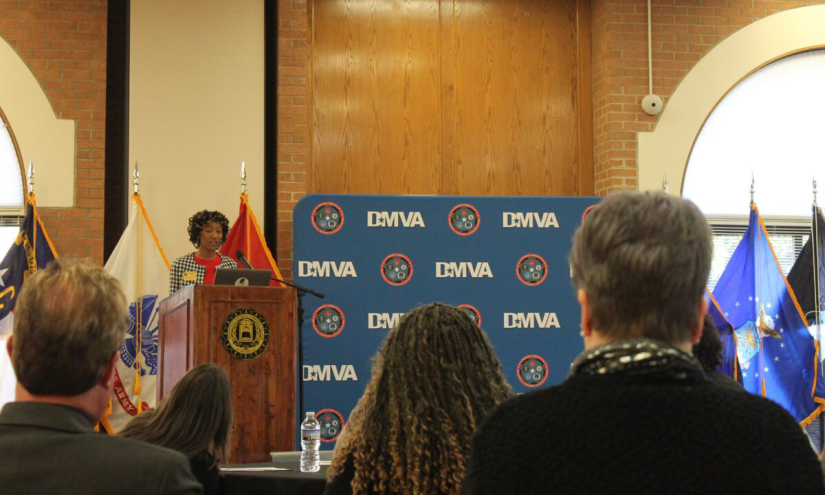
    In January 2025, Fayetteville Technical Community College hosted the state’s first N.C. Military Community Childcare Summit, organized by the North Carolina Department of Military and Veteran Affairs (NCDMVA) to discuss the problem that military communities are having with access to community-based child care.

    The first N.C. Military Community Childcare Summit in January 2025.( Katie Dukes/EdNC)

    The summit culminated in a screening of Take Care, a documentary about North Carolina’s child care crisis produced by the state Department of Health and Human Services and featuring EdNC’s early childhood reporter, Liz Bell.

    Along similar lines, at the North Carolina Defense Summit in April 2025, the theme was “Spouse Resilience,” and the summit included a panel and presentation on child care.

    Higher compensation for higher quality

    The issues of spouse resilience and child care are inextricably linked for Angie Mullennix, who works for The Honor Foundation at Fort Bragg, helping members of the U.S. Special Operations Forces (SOF) transition to careers in the private sector after their military service.

    Mullennix served in the U.S. Army for four years after high school and has previously worked for the Department of Public Instruction as the state military liaison. Her husband recently retired from the SOF himself. They have two teenage children.

    “If you look at the number of military spouses in North Carolina who have degrees and credentials and could be in the workforce, from nurses to lawyers, lots of them are staying at home,” Mullennix said.

    “A big reason why about 40% of (military) spouses do not work is because of child care not being available to them,” Mullennix said, noting that lack of child care is also a barrier to workforce participation among the civilian population.

    When Mullennix’s children were under the age of 5, she used hourly child care on base, which was available at no cost when her husband was away on assignment.

    “You ask any parent in the world, I don’t care who they are, there’s nothing more important than their child’s safety — then their education,” Mullennix said. “And yet, the two things we think are the most important, we put (their providers) at the lowest pay and ask them to do quality care.”

    That’s what sets military child care apart from civilian early care and learning for Mullennix: high quality standards and higher pay for early childhood educators, including benefits. She sees lessons in this for North Carolina.

    “You gotta pay them to keep them, there’s no secret behind that,” Mullennix said. “If you pay them high, you can also set the standards really high.”

    And because workforce participation — and military readiness — is directly tied to the accessibility and affordability of high-quality child care, not investing in it threatens our collective future.

    “North Carolina, or any state that doesn’t offer child care, is shooting itself in the foot,” Mullennix said.

    Lessons from military child care

    Policymakers at every level who are seeking to end the child care crisis can learn much from the military child care model. One report on the topic offers these lessons:

    1. Do not be daunted by the task. It is possible to take a woefully inadequate child care system and dramatically improve it.
    2. Recognize and acknowledge the seriousness of the child care problem and the consequences of inaction. 
    3. Improve quality by establishing and enforcing comprehensive standards, assisting providers in becoming accredited, and enhancing provider compensation and training. 
    4. Keep parent fees affordable through subsidies. 
    5. Expand the availability of all kinds of care by continually assessing unmet need and taking concrete action steps to address it. 
    6. Commit the resources necessary to get the job done. 

    That report was published 25 years ago by the National Women’s Law Center, but its lessons hold up today. Similar lessons have been highlighted in more recent articles published by The New York Times, The 74 Million, and New America, along with the final report published by Mission: Readiness before the Council for a Strong America dissolved last year.

    EdNC ran these lessons by Susan Gale Perry, CEO of Child Care Aware of America, and Linda Smith, director of policy for the Buffett Early Childhood Institute at the University of Nebraska — and one of the primary architects of the military child care system.

    Both agreed these are the right takeaways for policymakers across North Carolina to consider.

    Lesson 1: Do not be daunted by the task

    Gale Perry said the top lesson for her is: “Start where you are, know that change is possible, and have a goal post in mind.”

    She pointed out that the military’s goal wasn’t a fully publicly funded child care system. It was a system that acknowledged Americans’ values around the role of parents in raising young children — and paying for their care and education. But also that their employers and the government “have a role in offsetting that cost, so that we can ensure that child care is quality, and it is stable, and that the families can actually afford it.”

    Smith said there was no “silver bullet” when she and her colleagues were tasked with solving the military’s child care crisis in the 1990s — and there isn’t one for the civilian child care crisis today.

    We had to redo the standards, we had to look at the workforce, we had to look at the health and safety issues, we had to look at the fees and how we could bring those fees down. We had to look at the infrastructure of all of it. We’ve got to start thinking about the interconnectedness of all of these things if we’re going to be successful in this country.

    Smith said people think that because she worked for the secretary of defense, “I could just tell all the bases what to do, and that would magically happen, which is so not true. It wasn’t just like we could give an order and everybody jumped.”

    She said you just have to start where you are, and move up.

    Lesson 2: Acknowledge the seriousness of the problem and the consequences of inaction

    “The military understood very early the link between people getting to work and child care,” Smith said.

    As the military shifted away from relying on conscription and became a more welcoming workplace for women, the need for child care became evident. Smith described working on a base where children were routinely left in cars when their parents were unexpectedly called into work.

    “So (military leaders) really got the connection to their guys going to work very quickly, and I think that we still haven’t all understood that in this country,” Smith said, though she notes businesses have started making that connection since the pandemic.

    “The other thing the military understood was that a pilot is every bit as important as the mechanic who works on the plane, and so they invest in all of their people,” Smith said.

    She and her team had to design a program that worked for everyone, or it wouldn’t work for anyone.

    Lesson 3: Improve quality

    Smith said quality was of critical importance when she was designing the military’s child care system in the 1990s, especially after child abuse and neglect scandals that came to light in the 1980s.

    She and her team studied the child care standards of all 50 states and created a set of military standards that fell squarely in the middle. Then they set about training the 22,000 early childhood educators they already had — most of whom were military spouses — to meet those standards.

    That was a six-month training program. Then there was an 18-month training to get them to move beyond those standards toward national accreditation. They hired highly qualified trainers to work with educators at each site.

    “And if you didn’t do it, guess what? You’re fired!” Smith said.

    There was an incentive to participate in the training, beyond keeping their jobs — higher compensation.

    “Maybe some were grumpy about it, but we didn’t have to fire people,” Smith said.

    North Carolina already has some tools in place to help educators advance their education and improve their compensation, specifically through the WAGE$ and TEACH programs — both of which were highlighted in the report that identified these lessons.

    “(The military) realized they had to get serious about quality and quality standards. And I would say that’s a lesson for us now, particularly in a climate that is deregulatory,” Gale Perry said. “And while I’m for sensible regulatory reform, I think we have to be really thoughtful about not wanting stacks of child deaths in child care sitting on a desk waiting to be investigated.”

    Lesson 4: Keep parent fees affordable through subsidies

    Smith said that while designing the military’s child care program, she and her team figured out that there was no way parents could afford the actual cost of high-quality child care. So they set up a subsidized system that would provide a 50% match — on average — to parents’ fees, paid directly to child care programs.

    “We had to, on average, match parent fees dollar-for-dollar, with the higher-income people paying more and the lower-income paying less,” Smith said. “So a major, for example, would pay two-thirds of the cost, and a private would pay one-third, but the average was 50/50.”

    Smith pointed out that we’re already subsidizing child care in ways that are hidden — through the public benefits and social programs that early childhood educators often rely on because of low compensation, and through lack of workforce participation.

    Lesson 5: Expand the availability of all kinds of care

    Gale Perry said the military’s model really stands out to her for its ability to assess unmet needs and take action to improve.

    “In the early 2000s when there were the wars in Iraq and Afghanistan, there were a lot of deployments of National Guard and Reserve who did not live on post and did not have access to on-post child care,” Gale Perry said. “That is really when the military got in the business of thinking about, how do we help build capacity and make child care accessible for military families off post?”

    That’s when the MCCYN came about, subsidizing high-quality early care and learning in a broader array of settings in the communities where service members live.

    Smith said that the Military Child Care Act was originally targeted toward child care centers, but she recalls briefing the assistant secretary of defense on the potential effects of that strategy when they were designing the system:

    I remember saying we need to apply all of this to family child care, to school-aged care, to part-day preschools, because if we don’t, all the parents are going to have a demand on these centers that we can’t meet, right? Because if you lower the cost in the centers and you improve the quality, why would somebody go to another place when they get it cheaper and better over here?

    She made the case for educators in every setting getting the same access to training and the same level of compensation, because that’s what would work best for everyone.

    “Everything applies to everybody,” Smith said. “And I think that was one of the smartest policy decisions we made.”

    Lesson 6: Commit the resources necessary to get the job done

    “There was this perception that we just had a lot of money and we threw it at” child care, Smith said. But that wasn’t the case.

    “When they passed the Military Child Care Act, it didn’t come with an appropriation,” Gale Perry said. “So they had to fight equally hard for the funding, and a lot of the funding actually ended up coming from local base commanders making the decision to invest in child care.”

    Now the military submits a budget request to Congress each year, and depends on those appropriations.

    For state and local policymakers seeking to solve the civilian child care crisis without public investment, the woman credited with solving the military’s own child care crisis 35 years ago has a message.

    “It’s gonna cost. There’s no way it doesn’t cost,” Smith said.


    This article first appeared on EdNC and is republished here under a Creative Commons Attribution-NoDerivatives 4.0 International License.


    Get stories like these delivered straight to your inbox. Sign up for The 74 Newsletter

    Source link

  • Beyond Hype and Fluff: Lessons for AI from 25 Years of EdTech

    Beyond Hype and Fluff: Lessons for AI from 25 Years of EdTech

    • This blog is by Rod Bristow is CEO of College Online which provides access to lifelong learning, Chair of Council at the University of Bradford, Visiting Professor at the UCL Institute of Education, Chair of the Kortext Academic Advisory Board and former President at Pearson.

    I am an advocate for education technology. It is a growing force for good, providing great solutions to real problems:

    • Reducing teacher workload through lesson planning, curriculum development, homework submission and marking, formative assessments, course management systems and more;
    • Improving learning outcomes through engaging, immersive experiences, adaptive assessments and the generation of rich data about learning;
    • Widening access to content and tools through aggregation platforms across thousands of publishers and millions of textbooks; and
    • Widening access to courses and qualifications for the purpose of lifelong learning using online and blended modes of delivery.

    Products and services that solve these problems will continue to take root.

    All that said, we have not seen the widespread transformation in education that technology promised to deliver, and investors have had their fingers burned. We could argue this results from unrealistic expectations rather than poor achievement, but there are lessons to be learned.

    According to HolonIQ:

    2024 saw $2.4 billion of EdTech Venture Capital, representing the lowest level of investment since 2015. The hype of 2021 is well and truly over, with investors seeking fundamentals over ‘fluff’.

    From HolonIQ

    The chart says it all. Steady growth in investment over the last decade culminated in a huge peak during Covid. Hype and ‘fluff’ overtook rational thinking, and several superficially attractive businesses spiked and then plummeted in value. In education, details and evidence of impact (or efficacy) matter. Without them, lasting scale is much harder to achieve.

    The pendulum has now swung the other way, with investors harder to convince. Investors and entrepreneurs need to ask the question, ‘Does it work?’ before considering how it scales. If they do, they will see plenty of applications that both work and scale, and better-educated investors will be good for the sector.

    One of the biggest barriers to scale is the complexity of implementation with teachers, without whom there is little impact. Without getting into the debate about teacher autonomy, most teachers like to do their own thing. And products which bypass teachers, marketed directly to consumers, often struggle to show as much impact and financial return.

    Will things be different with AI? The technology, being many times more powerful, will handle much greater flexibility of implementation for teachers than we have seen so far. AI has even greater potential to solve real problems: widening access to learning, saving time for teachers and engaging learners through adaptive digital formative assessment and deeply immersive learning experiences through augmented reality.

    But risks of ‘over-selling’ the benefits of AI technologies are potentially heightened by its very power. AI can generate mind-boggling ‘solutions’ for learners which dramatically reduce workload. Some of these are good in making learning more efficient, but questions of efficacy remain. Learning intrinsically requires work: it is done by you, not to you. Technology should not try to make learning easy, but to make hard work stimulating and productive if it is to sustain over the long term.

    There is a clear and present danger that AI will undermine learning if high-stakes assessments relying on coursework do not keep pace with the reality of AI. This is a risk yet to be gripped by regulators. There is also little evidence that, for example, AI will ever replace the inspiration of human teachers, and those saying their solutions will do so must make a very strong case. Technology companies can help, but they can also do harm.

    New technologies must be grounded in what improves learning, especially when unleashing the power of AI. This is entirely possible.

    There are many areas of great promise, but none more so than the enormous expansion in online access to lifelong learning for working people who are otherwise denied the education they need. There are now eight million people (mainly adults) studying for degrees online and tens of millions of people taking shorter online skills courses. Opening access to lifelong learning to everyone remains education’s biggest unmet need and opportunity. Education technologies can be ‘designed in’ to the entire learning experience from the beginning, rather than retrofitted by overworked teachers. Widening access to lifelong learning could deliver a greater transformation to the economy and society than we have seen in 100 years.

    Learning tools and platforms are one thing, but what do people need to learn in a world changed by AI? Much has been written about the potential for technology and especially AI to change what people need to learn. A popular narrative is that skills will be more important than knowledge; that knowledge can be so easily searched through the internet or created with AI, there is no need for it to be learned.

    Skills do matter, but these statements are wrong. We should not choose between skills and knowledge. Skills are a representation of knowledge. With no knowledge or expertise, there is no skill. More than that, in a world in which AI will have an unimaginable impact on society, we should remember that knowledge provides the very basis of our ability to think and that human memory is the residue of thought.

    Only a deeper understanding of learning and the real problems we need to solve will unleash the huge potential for technology to unlock wider access, a better learning experience and higher outcomes. To simultaneously hold the benefits and the risks of AI in a firm embrace, we will need courage, imagination and clarity about the problems to be solved before we get swept up in the hype and fluff. The opportunity is too big to put at risk.

    Source link

  • Practical Lessons for Leaders in Crisis (opinion)

    Practical Lessons for Leaders in Crisis (opinion)

    Crises are an inevitable part of leadership, challenging the resilience of both leaders and institutions. In these moments, leaders must make tough decisions under immense pressure, and how we respond can shape the outcome of the crisis and the legacy we leave behind. It’s not just about surviving the storm but also about learning from it, adapting and coming out stronger on the other side.

    The lessons shared in this essay provide practical guidance to help higher education leaders face crises with clarity and purpose, from fostering open communication to prioritizing the well-being of your team. These insights reflect hard-earned experiences and are grounded in the values that carry us forward, even when the path feels uncertain.

    Be the Buffalo

    Have you heard the story of the buffalo? When a storm approaches, many animals instinctively run away from the storm. But because storms move swiftly, by running away, they can prolong their exposure when the storm catches up to them. Buffalo, however, face storms head-on, running into them instead of away from them, minimizing their time in adversity.

    In crisis leadership, this means confronting the situation directly often resolves it faster and builds resilience. Sometimes, that means intentionally thinking about what is happening, giving yourself time to process it and trying to accept the reality. Avoid the temptation to ignore problems or hope they dissipate on their own. Acknowledge reality, process the pain and release its grip on your focus. Facing a crisis with courage and clarity accelerates recovery and strengthens leadership.

    Keep the End in Mind

    From the moment the crisis begins, envision what recovery looks like. Protect your institution and team while safeguarding critical relationships. This mindset helps you pivot from managing the immediate challenges to laying the groundwork for a return to normalcy and stability. Avoid impulsive decisions that can have long-term consequences.

    Equally important is how you support your team, particularly those who are on the front lines of the crisis, feeling its weight acutely. By keeping the end in mind, you can better prioritize your team’s well-being. For instance, ensure they have the resources, communication and guidance they need to navigate the storm. Protect them from unnecessary fallout by taking on more external pressure when possible. A team that feels supported and valued during a crisis will emerge better and more unified in its aftermath.

    Also stay mindful of your future self—the leader who will look back on this period and assess the outcomes and the approach. Treat every interaction carefully, knowing that future collaboration often depends on how you conduct yourself during difficult times.

    Do the Next Right Thing

    In a crisis, the path forward often feels murky and overwhelming and the pressure to anticipate every possible scenario can be paralyzing. Simplify your focus: Break the challenge into manageable steps and identify the next critical decision. For instance, in a financial crisis, the next right thing might be to prioritize cost-cutting measures. Ask, “What is the next right thing?” and then focus on that.

    In other words, break the challenge into manageable steps and identify the next critical decision. Not every decision carries the same weight; some choices will matter more than others in the short term. Taking a moment to identify what requires immediate action versus what can wait is essential. Trust your instincts and lean on your values.

    Remember, no single decision will end a crisis, but a series of thoughtful, well-executed actions can. By consistently doing the next right thing, you’ll build momentum, foster confidence and guide your institution toward recovery.

    Rise Above the Fray

    Crises test your composure. When you’re down and out and your back is against the wall, it is natural to want to fight back—to stand up for yourself or defend your organization. While the instinct to protect or retaliate can be strong, rising above the fray—staying calm, measured and professional—reflects well on you and your organization. Your actions during a crisis set the tone for your team and how external stakeholders perceive your leadership. By maintaining your composure, you can instill a sense of control and confidence in your team and stakeholders.

    During a crisis, emotions often run high and others may act in ways that disappoint or frustrate you. These moments are as much a reflection of their character as they are a test of your own. Respond with integrity and intention, ensuring actions align with your values. Anchor yourself fairly and professionally, leading by example. How you act in these moments defines your leadership and shapes your legacy.

    Seek Help Early

    No leader faces a crisis alone. When a storm comes, take a moment to think, “Who might be able to help me?” Asking for help from legal counsel, crisis communication experts or trusted advisers is essential. These professionals offer critical perspectives and solutions. By involving them early, you give yourself and your team the advantage of informed, strategic guidance.

    Equally important is leaning on your network and reaching out to colleagues who have faced similar challenges for their lessons learned, moral support and practical insights to help you navigate the complexity of the crisis. Asking for help is a strength, not a weakness, and ensures you emerge from the crisis with relationships and trust intact.

    Rethink Public Relations in the Age of Social Media

    There was a time when saying “no comment” or ignoring a media inquiry was the worst kind of public relations. Traditional public relations strategies may not apply in today’s social media–driven world. Not every media inquiry or rumor warrants a response. Prioritize credible sources and local media relationships critical to your institution’s reputation.

    Avoid the trap of engaging with nonconstructive voices. Strategic silence can sometimes be the best action, allowing your focus to remain on the broader recovery effort.

    Support the Core and Reassure the Whole

    Crises often pressure a core team—typically leadership and crisis managers. Support these individuals with clear communication, resources and guidance. A supported core team can act decisively and confidently, which is essential for effective crisis management.

    At the same time, safeguard your broader community—your students, employees and other stakeholders—by shielding them from unnecessary distractions, allowing them to stay focused on the institution’s vision and mission. Clear, empathetic communication reassures stakeholders and sustains trust, morale and well-being.

    This Too Shall Pass—Find the Lessons

    Crises feel all-encompassing at the moment—when you’re in the thick of it, it is easy to think life will never be the same again—but they are temporary. Remind yourself that leadership and life will return to normal.

    Once the storm passes, reflect on the experience. Adversity shapes us, often in ways we don’t immediately recognize. What lessons has this crisis taught you about leadership, resilience and institutional dynamics? Growth frequently emerges from adversity, preparing you for future challenges.

    Take Care of Yourself

    When a crisis hits, dealing with that crisis becomes your sole focus. Self-care during a crisis is both essential and challenging. Your capacity to lead diminishes without rest, nutrition and mental reprieve. Prioritize habits that sustain you while giving yourself grace. Some things—like a full inbox or a missed task—can wait.

    Strong habits built before crises ensure you have the reserves needed for long-term endurance. Leadership, like endurance, depends on maintaining your strength for the long haul.

    Manage Stakeholders Thoughtfully and Lead With Humility

    Crises reshuffle priorities; stakeholder needs will inevitably shift. Identify the most impacted and influential, tailoring communication to meet their needs. Internal stakeholders often need reassurance, while external groups may require clarity, particularly when misinformation or media scrutiny complicates the narrative.

    Crises also remind us of our fallibility. Adopt humility and seek diverse perspectives to uncover blind spots and improve decision-making. Leading with humility signals strength, not weakness. It demonstrates that you value thoughtful, intentional leadership over impulsive reactions and earns the trust and respect of those you serve.

    Final Thoughts

    Crisis leadership is both a test and a teacher. The lessons it imparts— about resilience, humility and strategic focus—are hard-earned but invaluable. By embracing these principles, leaders can survive crises and emerge more self-aware and better prepared for future challenges.

    Janet N. Spriggs, Ed.D., is president of Forsyth Technical Community College in North Carolina. Paula Dibley, Ed.D., is chief officer of student success and strategic innovation at Forsyth Technical Community College.

    Source link

  • Lessons of the Fountain Pen (opinion)

    Lessons of the Fountain Pen (opinion)

    For the past two years, during the twilight of my academic career, I have become a devotee of the fountain pen, often pondering this seemingly retro act of putting pen to paper.

    Composing again by hand forced me to admit how often I succumb to the internet’s never-ending temptations. In the past, some of my best prose has come forth at 40,000 feet, while I was strapped in for a long flight—with no contact outside the streaking metal tube. But the wily digital devil never rests. Most jets now offer Wi-Fi, enticing you to check your email or the Yankees–Red Sox score as you cross the North Atlantic.

    My longing to write by hand, though, was undermined by largely illegible penmanship, a lifelong consequence of my naturally lefty self having been forced to write right-handed. No pen ever seemed to work for me, and I have tried most. Gel pens are the worst, producing a script that even I cannot decipher. Even so, during a research trip to Europe in fall 2022, where Wi-Fi was often unavailable, I found myself relying on a bound notebook during the day and my computer at night. The illegibility of my notes and journal entries made typing them out especially onerous and time-consuming, all the more so after I had returned home two months later. Then I remembered a fountain pen that my mother had gifted me so long ago—was it for my 50th birthday in 2005?—that its ink cartridges had dried up. A trip to Staples yielded a small pack, and I realized right away that there was enough friction between the nib and page to slow me down—enough for me to be able to decipher what I had written.

    Like most brainstorms, this one proved ephemeral. To write by hand and then enter text into a computer—with my mediocre keyboarding skills—was just too burdensome. Those who started their academic journeys during the typewriter era will remember with a whiff of despair those late-night, hours-long sessions spent typing the final draft. Correction tape, erasable bond, Wite-Out—my heart sinks just listing those essential tools from another era. If you want a taste of those times, just sample the acknowledgments in academic books or dissertations from the decades before computers, in which women, typically wives, are thanked for having typed the manuscript. The acknowledgements from Sacvan Bercovitch’s The American Jeremiad, which I just pulled from a shelf, reflect more rarefied academic circumstances, as the author notes the grant provided by the English Department at Columbia University “for the typing of the manuscript.”

    And then a light went off as I sat in my study, one that has changed my life as a writer. After struggling with incipient carpal tunnel syndrome a few years ago, I purchased voice recognition software. Dragon Naturally Speaking was powerful, especially if you spoke in complete phrases and sentences. My copy of the software is now old—it will not work with Windows 11—but proved a godsend with unexpected benefits. While dictating my notebook pages, I could hear the awkward sentences; I could conjure the better word on the spot, and I could detect those places where the tone needed adjusting. Sometimes inspiration would bless me and a new sentence or two would emerge like Athena.

    I’m no neo-Luddite longing to smash all computers, even when Windows or MS Word betray me, as they so often do. I recognize the realities and benefits of our digital age. But wielding a fountain pen these past two years has prompted me to wonder whether some challenges the humanities face regarding writing and reading might be overcome by heeding the pen’s simple lessons.

    The Importance of Touch

    For millennia the act of writing has been tactile. From Babylonian cuneiform on clay tablets to elaborate Medieval script on vellum and modern calligraphy on heavyweight wedding stationery, writing has always meant touching the surface, with words being physically imprinted as the pen journeys across. When I write well, my hands seldom leave the page. And when I stop to consider the right word or a more felicitous phrase, my pen often poises a mere quarter inch above, ready to strike.

    Compare this to composing on a laptop, where pauses can lead to disaster. Distractions fill your field of vision—apps, task bars, weather forecasts and seemingly never-ending notifications that another email has arrived or another appointment looms. When you grasp for the right combination of words, it’s all too easy to seek them beyond the screen, or, even worse, to succumb to the program suggesting what it believes should come next. And unless you are vigilant about shutting off endless features, the software will insist upon indicating that you just misspelled a word or used a questionable grammatical construction. Most of us then dutifully correct the “mistake,” only to lose the rhythm and even essence of our prose. More and more, the virtual page seems to be doing the writing.

    The Value of Tangibility

    We have all had the experience of composing and revising a document on a computer only to lose the effort because of a crash, a software freeze or a moment of forgetfulness in which we clicked “no” instead of “yes.” What might have seemed so real to us for an hour or more vanishes like a genie who returns to his bottle without granting our wish.

    When I compose by hand, my efforts are right in front of me. The crossed-out word—which turns out to be the right one—can still be recovered. The history of moving paragraphs, those arrows and circles that sometimes fill the page, are not lost as they would be in computer drafting. Even more satisfyingly tangible for me, however, is the physical evidence of my labors: the blue ink stains on my right hand, the ritual of refilling my pen from the bottle when I have gushed out a pool of words, the celebratory occasion when I empty a bottle of ink and need to open a new one. A similar mood of celebration arises when I fill the last page of my wide-ruled notebook and place it on the shelf next to its predecessors. Scrolling through thousands of documents and folders on my computer is certainly a humbling experience, as they represent the literal steps in a multidecade academic journey, but I regret not having found my fountain pen niche many years before. What a collection those notebooks would’ve been.

    The Pleasures of Portability

    Coinciding with my return to compositional roots has been my regular presence at a place where my words seem to flow so easily, the Hall Street Bakery in Grand Rapids. During my sabbatical, I was there at least five days a week and now continue to show up on nonteaching days. All I need is my notebook, a folder with ideas or drafts, a full pen and my regular—a large house coffee and a cranberry-almond scone—to set me up for a solid hour of writing. Conversations bubble from nearby tables, kids run around hopped up on sugar, drivers retrieve DoorDash orders—all set against the occasional counterpoint of the hissing espresso machine—and I am in my element. No need for Wi-Fi passwords or the elusive table next to an electrical outlet. I can walk across the room to speak with someone, order a refill, visit the men’s room—all without fearing that my laptop will disappear. And spilling coffee on my notebook or dropping it onto the floor is a minor inconvenience, not an expensive technological catastrophe. Traveling light, I can sweep up my possessions in an instant and head out the door.

    The Relevance to Reading

    In thinking about writing as a physical act that produces something you can hold, I recognized anew how relevant these same qualities are to reading. We seem today to be awash in words, yet paradoxically find ourselves in the midst of a reading crisis that extends from the youngest learners to those at America’s universities.

    An article by Rose Horowitch in The Atlantic, “The Elite College Students Who Can’t Read Books,” convinced me that my experience with the fountain pen might be relevant to the challenges she describes.

    Horowitch reports that students at elite colleges, who have already proven their ability to read complex texts, seem less and less able (or willing) to read long literary works. She mostly ascribes this to high schools emphasizing standardized tests, to teens distracted by smartphones and to college students who view their educations in strictly transactional terms, as means to specific, often exceedingly specific, ends—which seldom include pushing through Middlemarch.

    She may be right, but the teachers and faculty she interviewed offer little beyond assigning shorter texts: Kate Chopin’s The Awakening instead of Jane Austen’s Pride and Prejudice. Toni Morrison’s The Bluest Eye instead of Ralph Ellison’s Invisible Man. A book or two at most from The Iliad or Paradise Lost.

    Let me argue, though, that the very elements I associate with composing by hand—its tactile and tangible nature, its simple conveniences—should be drawn upon when encountering long, complex and sometimes life-changing texts. And that the cool distance of the digital interface works against these very qualities.

    Yes, I know it is possible to put all your books on a single device where you can search and annotate the texts. Even if you lose your Kindle, your digital library can be retrieved from the cloud. Yet the experience of reading on the screen tends to flatten all writing, making each screen much like any other, so that the unique feel and heft of Moby-Dick, for example, is lost, making Melville’s incandescent prose indistinguishable from any Substacker’s, and probably less visually enticing.

    Even if you can resist distraction on your laptop, you never get the sensory experience unique to each book: how it feels in your hands, how its page design pulls you in or pushes you away, how its very smell when brand-new or decades old can evoke its distinctive qualities, how the satisfying sound of turning pages reaches a crescendo when you get to the end and close the cover with a resonant thump. Like the angry slam of a telephone receiver, it’s a sound beyond our digital age. And it all leads to a final moment when you place the book on a shelf to stand as a tangible reminder of your ever-changing reading life—no internet connection required.

    The physical book, that container that our society, try as it might, cannot cast into the electronic darkness, will live on. At least I hope so. A recent visit to my university’s beautiful library leaves much room for doubt. In the popular Mary Idema Pew Library Learning and Information Commons—sorry, but that’s its official name, sans commas—hundreds of students gather at any given time. But to stroll through its busy floors soon makes this book lover feel like Diogenes in search of an honest man. My lamp has seldom shined upon a student with a physical book in hand; instead, they tap and scroll their way through reading assignments in much the same way they engage daily life.

    I see them as we share the bus that travels between our university’s two campuses, filling each moment with the small screens they find far more interesting than the passing world—the season’s first snowflakes, the glow cast upon the road as dusk approaches, the deer in a harvested cornfield who look up with more curiosity than my fellow travelers.

    With a sigh—and nod to the deer—I open my copy of Uncle Tom’s Cabin, touching its familiar pages with my ink-stained hands, and try to remember to text my wife that I’m on my way.

    After 37 years as a professor of English at Grand Valley State University, Rob Franciosi recently retired to devote his time to writing.

    Source link

  • Lessons from innovating in our student support model

    Lessons from innovating in our student support model

    Over the last ten years – and particularly since the pandemic – the complexity of student wellbeing issues in higher education has increased significantly. It became clear to us at the University of Exeter that the traditional model of academic tutoring alone was no longer sufficient to meet the needs of our students.

    Like many other higher education institutions, we had long utilised an academic support model where most academic staff were allocated groups of tutees to provide both academic and pastoral support alongside a range of professional services in areas such as welfare, wellbeing, accessibility and financial support. Our review and research into higher education institutions best practice – both in the UK and internationally, and drawing on approaches from schools and further education providers, identified a clear need for dedicated expertise to provide pastoral support at Exeter.

    This led to the development of our Pastoral Mentor model, which we began piloting in autumn 2023. By 1 August 2025, we will have rolled out Pastoral Mentors to every department. Our model was described briefly in Wonkhe last year but you can also read more about it in the Journal of Learning Development in Higher Education. In summary, Pastoral Mentors are dedicated, non-teaching student support staff embedded in departments, serving as a friendly first point of contact for students facing challenges affecting their studies. They proactively reach out to students based on engagement and attainment data, offer a non-judgmental space for conversations, and connect students with specialist support services as needed. Our pastoral mentors work closely with discipline based staff and wider support services to identify the best way to assist students and ensure that the help they need is connected and timely.

    Lessons from transformation

    While institutions will adopt different approaches to student support, in this piece we reflect on what we’ve learned from implementing institutional change at Exeter, and share the key principles which underpin our model – offering insights we hope will be useful for others working in this space.

    Early identification is key. The earlier students identify they are struggling the easier it is to provide support and put remedies in place. Often, the causes of student failure and drop out begin as relatively low-level challenges, but these can escalate over time – non-attendance leads to missed submissions, which in turn result in failed modules, referrals and potentially withdrawal. If we can identify students whose attendance pattern drops early and support them to get back into the classroom, we can mitigate against many of these larger issues.

    Data is key to this. All institutions now hold large amounts of data on our students; attendance, engagement with the VLE, submissions, grades. We need to use this to support students and at Exeter we developed a bespoke engagement dashboard to enable us to identify students who might be struggling.

    Clear lines of responsibility are vital. It’s no good having access to data if it’s not clear who is going to act on it. Our Pastoral Mentors are responsible for using the engagement dashboard to identify students of concern and do the initial reach out. They then are responsible for linking students who require more specialist support with the correct service, not just telling the student who to contact but in some cases making that contact for them or following up with the student later to ensure they have accessed the support they need. It’s vital that students don’t slip through the net – whether because no one acts on the data or because they fall unnoticed between services.

    Clear escalation processes need to be established. It’s critical to have a clear understanding of where one person’s responsibility ends and when a student should be confidently referred to a specialist. We’ve developed well-defined escalation processes so that our Pastoral Mentors don’t feel pressured to take on issues beyond their expertise and remit, and to ensure we make full use of the specialist staff elsewhere in the institution – helping to maintain the integrity of the overall support ecosystem.

    Presence is a must. Early feedback from our students’ union and students’ guild highlighted the importance of face-to-face, named support, with students finding it easier to seek help from someone they already know. Our Pastoral Mentors are present in departments, they attend welcome and transition events, informal department gatherings and department social events for students. Students should know who the Pastoral Mentor is before they need help to facilitate that first conversation. As a core part of the education team, Pastoral Mentors also become specialists in the rhythm and challenges of the discipline and can thus provide contextualised support and advice relevant to the students’ programme.

    Clarity of message for students is essential. Students are often put off seeking support because they fear disciplinary or fitness to study processes, in particular international students sometimes do not seek support from traditional academic tutors because they do not want to disclose problems to those teaching them or marking their work. Our Pastoral Mentors aim to decouple support from formalised processes around unsatisfactory progress or visa compliance and rather focus on reaching out compassionately, emphasising the importance of a students’ wellbeing and success. Students have reported that this enhanced their sense of belonging and mattering, making it easier to seek support early.

    Supporting colleagues through change

    Institutional change is never easy and while many staff recognise the need to enhance our student support offer to students, it remains an emotive issue. Some departments embraced the new model from the outset, while others found the transition more difficult. There’s never “enough” evidence, particularly when the change you are implementing is both transformative and innovative.

    As academics we often spend a lot of time seeking and compiling evidence to support a theory, but sometimes we have to be brave enough to enact change because it’s the right thing to do and have confidence that we can bring people along over time. If everyone waits for the evidence from others, innovation will never happen. We have found that co-creation is powerful; in order to address the “evidence” challenge, we had to deploy compassion and communication rather than additional data.

    We have to meet colleagues where their concerns lie, not t diminish those concerns but to listen to and recognise both the opportunities and risks associated with change. At Exeter, we adopted a phased co-creation model for our Pastoral Mentor approach, being open with departments that we didn’t have all the answers upfront and that we needed to work together to meet students’ needs. Through this iterative approach we were able to take all our departments with us at a pace that suited them and subsequent feedback on the roll out has been overwhelmingly positive.

    Student support is an emotive area, and it’s important to recognise existing best practice alongside the benefits of change. While we should acknowledge the great work many have done and continue to do, it is also important to recognise the pressure providing pastoral support can put on colleagues. We were keen to ensure that specialising support wasn’t seen as a criticism but a way to relieve pressure on colleagues and ensure more sustainable support for our whole community.

    Source link

  • The National Audit Office’s review of UKRI has lessons for the government

    The National Audit Office’s review of UKRI has lessons for the government

    It should come as little surprise – given the scale and complexity of the challenge – that the government sees investing in research and innovation (R&I), and the accompanying promise of new technologies and ideas, as key to achieving its complex policy goals of growing the economy, transitioning to clean power, and modernising the NHS.

    After all, history shows that state backing of R&I to overcome a range of problems – particularly in times of crisis – is hardly a novel idea. If the rapid technological advances witnessed in the 1940s to support the war effort are receding further into the past, then memories of the mass Covid-19 vaccine rollout at least remain fresh.

    With this in mind, the government’s commitment “to promote innovation and harness the full potential of the UK’s science base” through “protecting record funding for research and development” is merely the latest example of those in power acknowledging the vast capacity of R&I to transform society.

    This tradition at least partly explains the strong international reputation the UK has accumulated over the years in the field of R&I, with UK Research and Innovation (UKRI) – the country’s largest single public funder of R&I – at the forefront.

    In 2023–24, UKRI assessed 28,866 applications for competitive grant funding, ultimately spending £6 billion on R&I grants. Its recently approved projects have included funding for very early-stage research in microbial fuel cells and hydrogen purification, and the development of bone stem cell and biomaterial technology to reduce infection rates and the cost of hip repairs.

    In short, UKRI plays a critical role in the country’s R&I ecosystem, supporting cutting-edge work that feeds not only into the government’s environmental and health policy ambitions, but in other areas too.

    And by looking at the effectiveness of UKRI’s grant support, the National Audit Office (NAO) has identified some lessons for government that can serve a very useful, and much broader, purpose when it comes to tackling the major challenges facing the country.

    Lessons learned

    First is the importance of taking a planned and coordinated approach to R&I, which involves using good quality information on funding and knowing how to build a base to innovate in each research area. Government departments should be aware of other organisations with related objectives, determine whether they are also putting funds or resources into trying to innovate in that area, and identify potential linkages with their own workstreams.

    This “portfolio” approach to innovation is a key component in well-managed risk taking, which brings us to our second lesson: the need to establish a clear and effective risk appetite, and put in place the organisational cultures and processes that can support bold decision-making. Innovation – the act or process of doing something that has not been done before – goes hand-in-hand with risk. Embracing it requires the knowledge and the confidence in accepting that things may not turn out quite as intended, or may even fail together.

    The head of the NAO said as much in his recent address in Parliament, where he called on the government to unlock the vast opportunities for boosting productivity and strengthening resilience in the public sector by adopting a fast-learning approach when investing in innovation: in other words, learning quickly what works and what does not, so that failed projects can be promptly scrapped in favour of redirecting energy and resources to more promising ideas.

    Ultimately, a coherent, comprehensive and clearly communicated risk appetite can help organisations reap substantial rewards, more than offsetting the disappointment of unsuccessful ventures.

    Third is the caveat that while a clear plan, coordination and risk appetite can lead to successes, the full benefits of innovation cannot be realised without effective monitoring and evaluation. As well as evaluating programmes on a macro level, organisations should regularly draw together learning by theme (such as in a specific research area), with the support of strong data systems. Doing so can ensure that they effectively capture cumulative learning and develop a well-rounded understanding of which innovations are working well, which ones are not, and why.

    Across the whole of government

    Arguably the most important lesson of all, however, is remembering that these insights cut across the whole of government and need not be strictly applied to the domain of R&I. The projects funded by UKRI may be operating on the frontier of scientific and technological research, but this does not mean that what we learn about their approaches to innovation cannot be applied to other government contexts.

    If government is to achieve its long-term policy goals, it must do more to identify the public spaces where innovation is lacking, and take measures to reverse this trend. This includes breaking down the barriers that are preventing some organisations from adopting the right culture to allow innovation to flourish. It would do well to start with taking on board some of the lessons learned from UKRI’s approach.

    Source link

  • Labour is learning the wrong lessons from Reform on immigration

    Labour is learning the wrong lessons from Reform on immigration

    The working classes are an easy foil for the dreams of conservative politicians. They are the salt of the earth, proper people who do real stuff, unlike the woke metropolitan elite who sit around and think things but are removed from the real world.

    As Joel Budd points out in his new book Underdogs The Truth About Britain’s White Working Class, they are to the conservative imagination “sensible truth-tellers and bulwarks against left-wing nonsense.” Even more so they are the consensus position on immigration “The mass immigration that the elite has tolerated is crushing their wages, burdening the public services they rely on and filling their neighbourhood with strangers.” As Budd also points out this, well, isn’t true. In 2024 they voted for Starmer’s Labour Party who campaigned on public finances, NHS, and inflation.

    New Labour old problems

    It is with this in mind that Labour’s response to Reform’s election performance is as wrong as it is entirely predictable. Its wrongness could have significant consequences for universities.

    Let’s start with the big results. In May’s local elections in England Reform gained 677 councillors,ten councils, two mayors, and an MP. The votes are spread across the country but as John Curtice points out for the BBC there is an education faultline.

    Reform did best in places that most overwhelmingly voted for Brexit. University graduates overwhelmingly did not vote for Brexit. Reform received less than 20 per cent of the vote in wards where more than two in five people have a degree compared to 43 per cent in wards where over half of adults have few qualifications. As Curtice states

    In summary, Reform did best in what has sometimes been characterised in the wake of the Brexit referendum as ‘left-behind’ Britain – places that have profited less from globalisation and university expansion and where a more conservative outlook on immigration is more common.

    The policy solution alighted on by outriders in the Labour Party has so far been to say that Reform has done well therefore Labour should do things that appeal to the kind of people that vote for Reform. Or, at least, the kind of things Labour assumes appeal to the people that vote for Reform. And one of the key assumptions is that getting immigration down, whoever those immigrants might be, including students, is necessary for their electoral survival.

    Blue Labour redux

    University of Oxford graduate, and Blue Labour standard bearer, Jonathan Hinder MP has said he would not be “that disappointed” if universities went bust because of reducing international student immigration. Presumably he does not mean his own alma mater. Jo White, of the Red Wall Caucus, has urged Labour to “take a leaf out of President Trump’s book” when it comes to immigration. The end of the Labour Party which purports to be closer to its working class roots is moving rapidly and decisively against immigration. Tightening restrictions on graduates, and by extension making the UK a less attractive place to study, has been reported as an idea winning favour at the Home Office.

    The issue with the general public is that it is complicated. On its own, reducing student immigration will not win Labour a single vote in Runcorn in Helsby where Reform most recently won an MP. For a start Runcorn does not have a university so it will certainly not address immigration issues brought up during the election. Runcorn does however have several organisations that benefit from a vibrant university sector. SME net-zero collaboration with Lancaster. INEOS which benefits from the proximity of a university workforce and industrial collaborations. And Riverside College, amongst other examples, as a franchise partner of the University of Staffordshire.

    It is also worth making entirely clear that people in Runcorn also go to university. It’s a particular fault of both an understanding of class and an understanding of universities that this conflation is often made.

    Immigration, immigration, immigration

    If reducing student immigration will not make a material difference perhaps it will signal a vibes shift that will bring places like Runcorn on side. Again, here is where the working class will let you down. Analysis of the British Election Study collated by Joel Budd demonstrates that “Young white working-class people are not as liberal as young white middle-class people. But when it comes to immigration and race, they resemble them more closely than they resemble old white working-class people.” Again, there is just not a long term winning strategy in discouraging student and graduate migration.

    For universities this might be comforting but it isn’t the point.

    The extent to which anyone is willing to defend student immigration is the question of the extent to which they are willing to defend the value of universities. The value of universities is felt in exports and jobs but it is most directly felt on the extent to which the effects of a university make a place feel better. The thing that Boris Johnson, or at least his advisors, understood that higher education consistently has not is that people see politics through their places. Crime. Clean high streets. Local shops. Good jobs. Green spaces. Feeling safe to go out at night. And the myriad of tangible things that make up a place.

    In policy terms the absolute antithesis of levelling up are reforms which will depress international student numbers. The last thing Runcorn needs is a poorer Liverpool and weaker universities. The challenge for universities is to tilt the scale toward being popular not just being valuable. So popular as to make decisions on cutting student immigration culturally and electorally harder not just economically wrongheaded.

    The question then is how can universities do things in places that feel like they are doing good as well as actually doing good.

    A day like today is not for soundbites

    A key question is how infrastructure can be use toward a broad and good civic end. For example, of all of the things that the University of Liverpool did during Covid (of which there were many I have direct experience of, having worked there), the one that looms largest in my memory is when it gave up its car parks for NHS staff. Not the vaccines it helped develop or the PPE it manufactured but a low cost, high kindness gesture that resonated with people at the time. The other part of this is how largely universities loom in local communities. The extent to which their infrastructure, offices, shops, cafes, and other buildings and amenities are dispersed across the towns, cities, and localities so their presence has a resonance with the lives of people from day to day. People will often be aware of a university where it precedes the word hospital. There are opportunities for other collaborative infrastructures.

    Universities tend to be pretty good at turning their research into lectures, experiments, and days out for young people in an education setting. They are less good at making their research experiential for adults. Light Years by the University of Durham (full disclosure: I volunteer in supporting this work) has taken research to places people actually gather, places of worship, highstreets, and places of local interest across Durham county, as opposed to just the city.

    And it’s harder to articulate or even work out, but the extent to which local people feel universities are on their side matters. The cultural closeness universities build to their populations is not always about what they do but whether local people feeling it’s “their” or “the” university. There is no magic bullet for this beyond the slow grind of knowing a local place and acting with it.

    The political vibes risk overtaking a political reality. The key to Labour winning back its voters is to make tangible differences in the places they live. The economic headroom for them to do that runs through higher education institutions and their success. The permission to do so depends on people feeling like universities are a thing worth saving even with difficult political trades offs.

    Source link