Tag: Leverage

  • Teachers unions leverage contracts to fight climate change

    Teachers unions leverage contracts to fight climate change

    This story first appeared in Hechinger’s climate and education newsletter. Sign up here

    In Illinois, the Chicago Teachers Union won a contract with the city’s schools to add solar panels on some buildings and clean energy career pathways for students, among other actions. In Minnesota, the Minneapolis Federation of Educators demanded that the district create a task force on environmental issues and provide free metro passes for students. And in California, the Los Angeles teachers union’s demands include electrifying the district’s bus fleet and providing electric vehicle charging stations at all schools. 

    Those are among the examples in a new report on how unionized teachers are pushing their school districts to take action on the climate crisis, which is damaging school buildings and disrupting learning. The report — produced by the nonprofit Building Power Resource Center, which supports local governments and leaders, and the Labor Network for Sustainability, a nonprofit that seeks to unite labor and climate groups — describes how educators can raise demands for climate action when they negotiate labor contracts with their districts. By emphasizing the financial case for switching to renewable energy, educators can simultaneously act on climate change, improve conditions in schools and save districts money, it says. 

    As federal support and financial incentives for climate action wither, this sort of local action is becoming more difficult — but also more urgent, advocates say. Chicago Public Schools has relied on funding for electric buses that has been sunsetted by the Trump administration, said Jackson Potter, vice president of the Chicago Teachers Union. But the district is also seeking other local and state funding and nonprofit support.

    Bradley Marianno, an associate professor in the College of Education at the University of Nevada, Las Vegas, said that educator unions embracing climate action is part of a move started about 15 years ago in which more progressive unions — like those in Chicago, Los Angeles and elsewhere — focus on “collective good bargaining,” or advocating for changes that are good for their members but also the broader community. But this approach is unlikely to catch on everywhere: “The risk lies in members feeling that core issues like wages and working conditions are being overlooked in favor of more global causes,” he wrote in an email. 

    I recently caught up with Potter, the CTU vice president, about the report and his union’s approach to bargaining for climate action. Collaborating with local environmental and community groups, the Chicago Teachers Union ultimately succeeded in winning a contract that calls for identifying schools for solar panels and electrification, expanding indoor air quality monitoring, helping educators integrate climate change into their curriculum, and establishing training for students in clean energy jobs, among other steps. 

    This interview has been edited for length and clarity. 

    The report talks about contract negotiations being an underused — and effective — lever for demanding climate action. Why do you see that process as such an opportunity for climate action?

    On the local level, our schools are 84, 83 years old on average. There is lead paint, lead pipes, mold, asbestos, PCBs, all kinds of contamination in the HVAC system and the walls that require upgrades. By our estimate, the district needs $30 billion worth of upgrades, and right now I think they spend $500 million a year to just do patch-up work. We’re at a point where it’s a system fail of epic proportions if we can’t figure out a way to transition and make things healthier. And so if you’re going to do a roof repair, put solar on it, have independence from fossil fuels, clean air in areas that have faced environmental racism and contamination. 

    We’re also dealing with a legacy of discrimination and harm, and that is true of the nation. So how do we get out of this and also save the planet and also prevent greater climate events that further destabilize vulnerable communities and put people at risk? It made sense for us to use our contract as a path to do both things — deal with this local crisis that was screaming for new solutions and ideas, in a moment when the climate is on fire, literally.  

    How challenging was it to get educators to view climate issues as a priority? There are so many other things, around pay and other issues, on the table. 

    When we started, it almost felt like people in the membership, in the community, viewed it as a niche issue. Like, ‘Oh, isn’t that cute, you care about green technology.’ As we figured out how to think about it and talk about it and probe where people were having issues in their schools, it became really obvious that when you started talking about asbestos, lead and mold remediation — and helping communities that have been hit the hardest with cumulative impacts and carcinogens and how those things are present in schools — that became much more tangible. Or even quality food and lunch and breakfast for students who are low-income. It went from bottom of the list to top of the list, instantaneously. 

    Your contract calls for a number of climate-related actions, including green pathways for students and agreements with building trade unions to create good jobs for students. Tell me about that. 

    We’re trying to use the transformation of our facilities as another opportunity for families and students in these communities that have been harmed the most to get the greatest benefit from the transformation. So if we can install solar, we want our students to be part of that project on the ground in their schools, gaining the skills and apprenticeship credentials to become the electricians of the future. And using that as a project labor agreement [which establishes the terms of work on a certain project] with the trades to open doors and opportunities. The same goes for all the other improvements — whether it’s heat pumps, HVAC systems, geothermal. And for EV — we have outdated auto shop programming that’s exclusively based on the combustible engine reliant on fossil fuels, whereas in [the nearby city of] Belvidere they are building electric cars per the United Auto Workers’ new contract. Could we gain a career path on electric vehicles that allows students to gain that mechanical knowledge and insight and prepares them for the vehicles of the future? 

    The report talks about the Batesville School District in Arkansas that was able to increase teacher salaries because of savings from solar. Have you tried to make the case for higher teacher salaries because of these climate steps?  

    The $500 million our district allocates for facility upgrades annually comes out of the general fund, so we haven’t at all thought about it in terms of salary. We’ve thought about it in terms of having a school nurse, social worker, mental health interventions at a moment when there is so much trauma. We see this as a win-win: The fewer dollars the district has to spend on facility needs means the more dollars they can spend on instructional and social-emotional needs for students. In terms of the Arkansas model, it’s pretty basic. If you get off the fossil fuel pipelines and electric lines and you become self-sufficient, essentially, powering your own electric and heat, there is going to be a boon, particularly if there are up-front subsidies. 

    Math and climate change 

    When temperatures rise in classrooms, students have more trouble concentrating and their learning suffers — in math, in particular. That’s according to a new report from NWEA, an education research and testing company.

    The report, part of a growing body of evidence of the harms of extreme heat on student performance, found that math scores declined when outdoor temperatures on test days rose above 80 degrees Fahrenheit. Students in high-poverty schools, which are less likely to have air conditioning, saw declines up to twice as large as those in wealthier schools. 

    The learning losses grew as temperatures rose. Students who took tests on 101-degree days scored roughly 0.06 standard deviations below students who tested when temperatures were 60 degrees, the equivalent of about 10 percent of the learning a fifth grader typically gains in a school year. 

    It’s not entirely clear why student math scores suffer more than reading when temperatures rise. But Sofia Postell, an NWEA research analyst, said that on math tests, students must problem-solve and rely on their memories, and that kind of thinking is particularly difficult when students are hot and tired. Anxiety could be a factor too, she wrote in an email: “Research has also shown that heat increases anxiety, and some students may experience more testing anxiety around math exams.”

    The study was based on data from roughly 3 million scores on NWEA’s signature MAP Growth test for third to eighth graders in six states. 

    The report urged school, district and state officials to take several steps to reduce the effects of high heat on student learning and testing. Ideally, tests would be scheduled during times of the year when it wasn’t so hot, it said, and also during mornings, when temperatures are cooler. Leaders also need to invest in updating HVAC systems to keep kids cool. 

    “Extreme heat has already detrimentally impacted student learning and these effects will only intensify without action,” wrote Postell. 

    Mea culpa: A quick note to say I got two things wrong in my last newsletter — the name of the Natural Resources Defense Council was incorrect, as was the number of hours of learning California students have missed so far this year. It’s more than 54,000. 

    Contact editor Caroline Preston at 212-870-8965, via Signal at CarolineP.83 or on email at [email protected].

    This story about teachers unions was produced by The Hechinger Report, a nonprofit, independent news organization focused on inequality and innovation in education. Sign up for the Hechinger newsletter on climate and education.


    The Hechinger Report provides in-depth, fact-based, unbiased reporting on education that is free to all readers. But that doesn’t mean it’s free to produce. Our work keeps educators and the public informed about pressing issues at schools and on campuses throughout the country. We tell the whole story, even when the details are inconvenient. Help us keep doing that.

    Join us today.

    Source link

  • Negotiating the Future: How HBCUs and MSIs Can Leverage Strategic Enrollment Management for Institutional Resilience

    Negotiating the Future: How HBCUs and MSIs Can Leverage Strategic Enrollment Management for Institutional Resilience

    Dwight SanchezIn today’s hyper-competitive higher education landscape, the challenges facing Historically Black Colleges and Universities (HBCUs) and Minority Serving Institutions (MSIs) are immense. Declining birth rates, changing student expectations, shifting public sentiment, and persistent underfunding place extraordinary pressure on institutions that have long served as lifelines for students of color and first-generation learners. Yet amid these challenges lies an opportunity. By reimagining Strategic Enrollment Management (SEM) through the lens of negotiation theory, HBCUs and MSIs can increase their strategic agility, strengthen institutional partnerships, and yield more robust enrollment outcomes.

    SEM as Negotiation

    Strategic Enrollment Management isn’t merely about admissions and financial aid—it’s about aligning institutional mission with market realities in ways that are both student-centered and data-informed. Viewed through the lens of negotiation, SEM becomes a dynamic system of interdependent relationships: with prospective students, families, community influencers, K-12 schools, alumni, faculty, and internal staff. Drawing from 3D Negotiation: Powerful Tools to Change the Game in Your Most Important Deals by David Lax and James Sebenius, and Essentials of Negotiation by Lewicki, Saunders, and Barry, three principles become especially relevant: setupdeal design, and tactical interaction.

    • Setup involves determining who needs to be at the table, what interests are at stake, and which parties have influence over enrollment decisions. For HBCUs, this means engaging not just students, but parents, clergy, high school counselors, and community mentors who shape the decision-making ecosystem.
    • Deal Design refers to how institutions create value through the student’s experience. It’s not just about price; it’s about crafting offers that resonate emotionally and practically with underserved populations. This might include mentorship programs, clear career pathways, and intentional support systems.
    • Tactics, while often emphasized, should follow—not lead—strategy. Scripts matter less than systems, and strategic enrollment leaders must know when to pivot from persuasive messaging to coalition-building and issue reframing.

    The Cultural Context

    The diversity within HBCUs and MSIs also means that enrollment negotiations occur across varied cultural, economic, and generational dimensions. Chapter 11 of Essentials of Negotiation reminds us that in international and cross-cultural negotiations, assumptions can be fatal. For instance, assuming that all Black or Latino students respond similarly to recruitment strategies ignores regional, familial, and economic differences. Strategic enrollment leaders must develop cultural humility and data literacy to avoid overgeneralization and instead build nuanced personas that guide outreach.

    Equally important is the political environment. Public perceptions of DEI initiatives, affirmative action, and federal funding can dramatically alter an institution’s appeal and perceived legitimacy. In this context, setup becomes a shield—anticipating changes, diversifying recruitment pipelines, and framing the institutional value proposition in ways that transcend political cycles.

    Leadership and Accountability

    Leading enrollment through this lens requires a shift from short-term performance metrics to long-term strategy. Enrollment managers must adopt a leadership posture that blends transformational vision with collaborative execution. As Lewicki et al. note in Chapter 10, multiparty negotiations (such as cross-department SEM committees) require clear roles, shared goals, and open channels of communication. Leaders must foster psychological safety while holding teams accountable to institutional KPIs—bridging the often-siloed worlds of marketing, academic affairs, and student support.

    Professional development plays a critical role here. Too often, enrollment teams are equipped with tactical training (CRM usage, phone scripts, event planning) but lack exposure to systems thinking, data storytelling, or negotiation dynamics. Embedding professional learning communities and creating leadership pipelines within SEM units allows HBCUs and MSIs to develop internal change agents who can sustain innovation over time.

    The Path Forward

    HBCUs and MSIs are more than educational institutions—they are engines of social mobility and cultural affirmation. But to thrive, they must adopt a strategic posture that sees every element of SEM as a negotiation: from brand positioning to student engagement, from financial structuring to internal alignment.

    Consider this: An HBCU looking to boost STEM enrollment among underrepresented males recognizes that traditional outreach and scholarship packages have limited impact. Instead of only increasing merit aid, the institution reframes its offer through negotiation theory. They partner early with high schools, launch a summer bridge program co-led by STEM faculty and alumni, and guarantee every enrolled student a faculty mentor and paid internship by year two. They also engage parents and community leaders as ambassadors—tapping into local trust networks. At the internal level, they align academic and student affairs teams through shared enrollment metrics and regular scenario planning meetings, increasing accountability and cohesion.

    This isn’t just marketing—it’s “setup” and “deal design” in action. It expands the scope of stakeholders, adds value beyond dollars, and creates a win-win proposition for the student, family, and institution. It also reflects a broader institutional willingness to act as a proactive negotiator in shaping its market position.

    By leveraging the principles of negotiation—particularly setup, value creation, and coalition building—enrollment leaders can develop strategic enrollment plans that are not only adaptive but transformative. In doing so, they ensure their institutions remain vital pathways for generations of students yet to come.

    Dwight Sanchez is the Executive Director of Enrollment Management at the University of Maryland School of Pharmacy.

    Source link

  • Leverage expands services to Türkiye

    Leverage expands services to Türkiye

    “The Turkish young, sitting at the centre of Europe and Asia, are true globalists. Their appetite for winning on the international stage is a delight to watch,” said Akshay Chaturvedi, CEO of Leverage Edu announcing the news that the edtech firm, which specialises in study abroad services, will be launching its services in Türkiye.

    “To fuel those dreams, we are incredibly excited to launch LeverageTürkiye — starting with our AI tools for counsellors, the Leverage Edu consumer app for students, Student-ops 360 for partners, and a line-up of special exclusive products tailored to meet that ‘education to career’ arc.”

    With over 50,000 Turkish students pursuing higher education abroad in 2024 – a number that continues to climb – the country has emerged as a critical player in the global education landscape.

    Leverage Edu CEO and founder, Akshay Chaturvedi with Ali Can Cirak, regional manager, business development.

    Factors fuelling this growth include Türkiye’s youthful population, where more than 50% of its citizens are under 30, and an increasing demand for globally recognised degrees in fields such as engineering, medicine, and business.

    The Turkish young, sitting at the centre of Europe and Asia, are true globalists
    Akshay Chaturvedi, Leverage Edu

    “Türkiye represents a very dynamic opportunity, just given where it sits on our planet,” said Chaturvedi. “As a country with a vibrant young population and increasing global mobility, it not only offers immense potential for growth but also serves as a bridge linking two of the most dynamic educational ecosystems in the world – the East and the West – hence an important first-level brick on top of which we’d like to build much more.” 

    To support its Turkish students and partners, Leverage is deploying a dedicated team on the ground in Türkiye, including a country manager to oversee operations and drive business success in the region. Additionally, several university representative desks will be dedicated to Turkish students.

    In the coming months, Leverage’s ancilllary services Fly Finance and Fly Homes will also be available in Türkiye.

    “We are committed to creating many win-wins, for students and institutions alike,” Chaturvedi added.

    Source link

  • Leverage Student Ambassadors and UGC in Education Marketing

    Leverage Student Ambassadors and UGC in Education Marketing

    Reading Time: 11 minutes

    Authenticity has become a cornerstone of successful education marketing campaigns. Nothing speaks louder to prospective students than real experiences shared by current students. That’s why we recommend the combined use of two powerful tools: student ambassador programs and user-generated content (UGC). 

    These strategies harness the voices of your students to create compelling, authentic narratives that resonate. In this blog, we’ll explore the enrollment-boosting potential of student ambassadors and UGC for education marketing, the benefits they offer, and actionable steps to integrate them into your strategy. Let’s get started!

    Struggling with enrollment?

    Our expert digital marketing services can help you attract and enroll more students!

    Understanding the Role of a Student Ambassador

    What is a student ambassador? A student ambassador is a current student who represents your institution in various capacities, from marketing and recruitment to campus events. These individuals are typically chosen for their enthusiasm, communication skills, and ability to connect with diverse audiences. 

    What do student ambassadors do? As the face of your school, student ambassadors embody its culture and values, offering prospective students and their families an authentic glimpse into campus life. 

    The roles of student ambassadors are varied. They may host campus tours, participate in Q&A sessions during open houses, or even create content for your social media platforms. By sharing their personal experiences, they help humanize your institution, breaking down barriers and building trust.

    HEM Image 2HEM Image 2

    HEM Image 3HEM Image 3

    Source: University of Waterloo

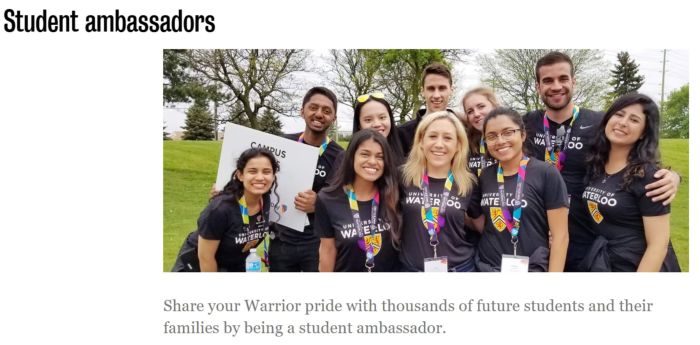
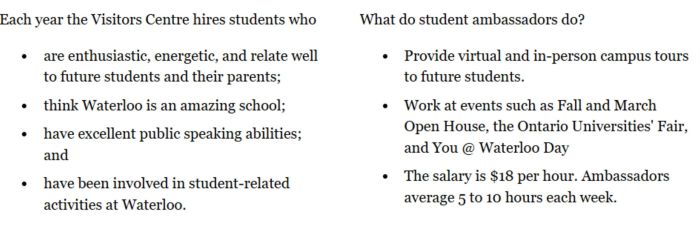
    Example: On its website, the University of Waterloo has a dedicated page for members of its community who are interested in its student ambassador program. This page details the role of a student ambassador, the requirements for candidates, their workload, and compensation. When you launch your student ambassador program, use site content to provide vital information to potential candidates and the students they’ll support in their roles. Use social media to keep your audience updated on the application process and involve student ambassadors in content creation to establish a relationship between them and the rest of your student body. 

    Reach out for help implementing effective enrollment-boosting digital marketing strategies! 

    What Is User-Generated Content (UGC)?

    User-generated content (UGC) refers to any content created by your students, alumni, or even staff, rather than your marketing team. This can include photos, videos, testimonials, social media posts, or blogs that showcase their authentic experiences. Unlike polished advertising campaigns, UGC is often raw and unfiltered, making it highly relatable and trustworthy.

    Now that audiences are bombarded with promotional material, UGC stands out. It delivers a level of authenticity that professionally crafted content simply cannot replicate. For prospective students, seeing someone “just like them” thriving at your institution can be the deciding factor in their enrollment journey.

    HEM Image 4HEM Image 4

    Source: University of Oxford | TikTok

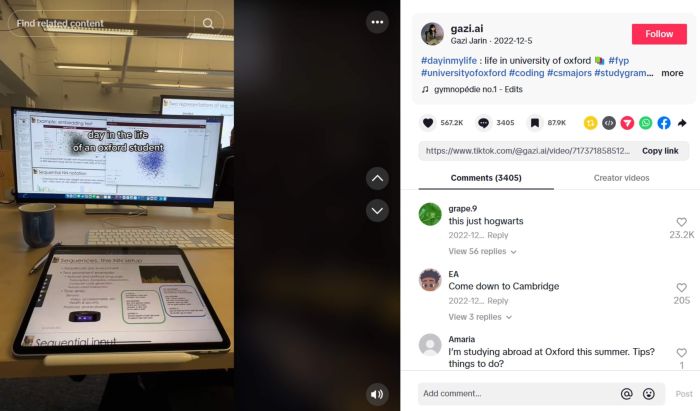
    Example: Take a look at the comments on this TikTok video. The bottom one shows how many prospective students are turning to current students for advice and insights into their journey with your institution. This “day in the life” video from a University of Oxford student offers a glimpse into campus life from a personal perspective. Videos shared on a student’s personal page often feel more genuine since they don’t come across as promotional content.

    That’s not to say your school shouldn’t engage with these posts! Use hashtags, like #universityofoxford, to find UGC created by your community and reshare it on your school’s profile. To encourage more of this content, promote specific hashtags and even run contests or challenges to inspire creativity and engagement.

    The Benefits of Student Ambassadors and UGC

    Though their methodology is different, both student ambassador programs and UGC help to tell your school’s unique story authentically.

    These methods are particularly effective at humanizing your school’s brand. Discover some more of the unique benefits you can see when you combine these strategies correctly.

    • Authenticity and Trust: Both student ambassadors and UGC provide unfiltered insights into your institution. Prospective students are more likely to trust the words of a peer than a marketing brochure. When real students share their stories, it creates a sense of transparency and trust.
    • Increased Engagement: Content created by student ambassadors and peers often performs better on social media platforms. Audiences are more likely to engage with posts that feel genuine and relatable. This increased engagement can translate to higher visibility for your institution.
    • Cost-Effectiveness: Leveraging the voices of your students can reduce the need for extensive advertising budgets. While there may be costs associated with training or compensating ambassadors, the return on investment through increased applications and enrollment often outweighs the initial expenditure.
    • Community Building: By involving students in your marketing efforts, you foster a sense of pride and belonging. Ambassadors feel more connected to your institution, and their enthusiasm is infectious, positively influencing both their peers and prospective students.

    How to Build a Successful Student Ambassador Program

    Building a student ambassador program involves creating a structured initiative that aligns with your school’s marketing goals and fosters authentic engagement. A successful program requires careful planning, clear objectives, and ongoing support to empower ambassadors as true representatives of your institution. Here, we’ll walk you through the essential steps to design and implement a program that connects with prospective students and amplifies your school’s story.

    Define Clear Objectives

    Clear objectives are the cornerstone of a student ambassador program, aligning with your marketing goals and guiding ambassadors toward success. Start by clearly outlining the program’s purpose. For example, increasing applications, enhancing campus tour experiences, or boosting social media engagement. 

    This clarity of intent should be paired with measurable goals, to help ambassadors understand what success looks like. Measurable goals could be increasing tour attendance by 20% or generating a set number of social media posts each month 

    Tailor these objectives to match the unique strengths of each ambassador, assigning roles that play to their talents, such as public speaking for campus tours or storytelling for blog posts and videos. Providing a clear role description that details their responsibilities, tasks, and time commitments is equally critical to avoid confusion and set expectations. 

    To foster motivation, explain the “why” behind their tasks, helping them see how their efforts impact prospective students, build trust in the institution, and contribute to enrollment goals. Regular check-ins or feedback sessions can also ensure ambassadors stay on track, allowing for adjustments and maintaining engagement. With clearly defined objectives and the right support, ambassadors can confidently represent your institution and drive meaningful results.

    Recruit the Right Ambassadors

    Select ambassadors who reflect the diversity and values of your institution. Look for individuals who are enthusiastic, articulate, and comfortable sharing their experiences. Peer recommendations, faculty referrals, and application processes can help identify the best candidates.

    Foster Collaboration

    Facilitate collaboration between ambassadors and your marketing team. Regular meetings can help align their content with your broader campaigns while maintaining authenticity. Ambassadors should feel supported but not micromanaged.

    HEM Image 5HEM Image 5

    Source: University of Windsor

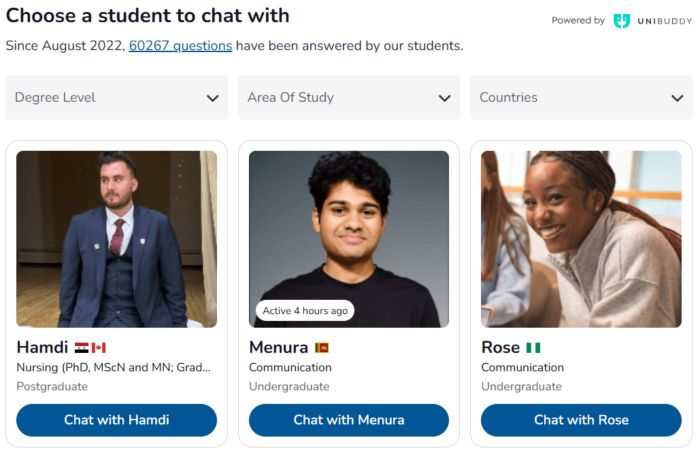
    Example: The University of Windsor demonstrates trust in its student ambassadors with a unique feature on its website. It allows current and prospective students to select an ambassador to chat with for answers to their school-related questions. To replicate this success, implement a comprehensive training program to ensure consistency and quality. Clear expectations enable your ambassadors to take on key responsibilities confidently, delivering a strong return on your investment.

    Provide Comprehensive Training

    • Familiarize Ambassadors with Your Institution’s Key Messaging and Values
      Begin by familiarizing ambassadors with your institution’s key messaging and values. This includes providing them with a clear understanding of your school’s mission, vision, and what sets it apart from competitors. Equip them with talking points about academics, extracurricular offerings, campus facilities, and student life, ensuring consistency in how they communicate your brand. Role-playing exercises can be particularly effective here, helping ambassadors practice delivering messages in a variety of scenarios, such as open houses, campus tours, or online Q&A sessions.
    • Train Ambassadors on Social Media Best Practices
      Training should also include social media best practices, especially if ambassadors are creating content for your platforms. Teach them how to craft posts that are engaging and aligned with your school’s tone and style. Provide guidelines on appropriate language, photo and video quality, and compliance with privacy policies.
    • Develop Public Speaking Skills
      Since many ambassadors will engage with prospective students and families in person, public speaking training is invaluable. Help them refine their communication skills with workshops that focus on clarity, confidence, and storytelling. Encourage them to share personal anecdotes about their experiences at your school, as these authentic stories are often the most memorable. Practice sessions with constructive feedback can significantly boost their comfort in delivering presentations or handling impromptu questions.
    • Build Soft Skills for Diverse Audiences
      Effective training also involves building soft skills like empathy, adaptability, and cultural awareness, especially for ambassadors interacting with diverse audiences. 

    Include scenarios that challenge them to navigate different cultural perspectives or address sensitive questions tactfully. By fostering these skills, you ensure ambassadors can create welcoming and inclusive experiences for prospective students and their families.

    • Incorporate Interactive Training Methods
      To make training engaging and practical, use a mix of interactive methods such as role-playing, group discussions, and hands-on activities. Incorporate real-world examples and success stories from past ambassadors to inspire new recruits and show them what’s possible. Providing a training manual or digital resource hub can also serve as a handy reference for ambassadors as they grow into their roles.
    • Provide Ongoing Support and Refreshers
      Finally, ongoing support and refreshers are critical. Schedule periodic check-ins to provide additional guidance, address challenges, and celebrate successes. The more prepared they are, the more effectively they’ll represent your school.

    Empower Ambassadors to Create

    Empowering student ambassadors to create their own content is one of the most effective ways to showcase the authentic, lived experiences that resonate with prospective students. By trusting ambassadors with creative freedom, you enable them to craft content that feels genuine and relatable—qualities that polished marketing campaigns often struggle to replicate.

    Start by encouraging ambassadors to focus on their personal experiences and unique perspectives. Heartfelt testimonials are another powerful form of content. Whether it’s a written story, a video, or a social media post, ambassadors sharing their personal journeys—why they chose your school, how it’s impacted their lives, and what they’ve learned—can create an emotional connection with viewers. 

    To provide inspiration and structure, consider giving student ambassadors a content calendar – a detailed content plan that outlines the where, what, and when of your posts. Highlighting diverse voices within your ambassador team ensures a broad range of experiences and perspectives are represented, appealing to a wider audience.

    Celebrate Their Contributions

    Recognize and reward your ambassadors for their efforts. This can range from financial compensation to exclusive perks like access to networking events or career development opportunities. Publicly celebrating their work reinforces their value and motivates others to get involved.

    HEM Image 6HEM Image 6

    Source: New York University

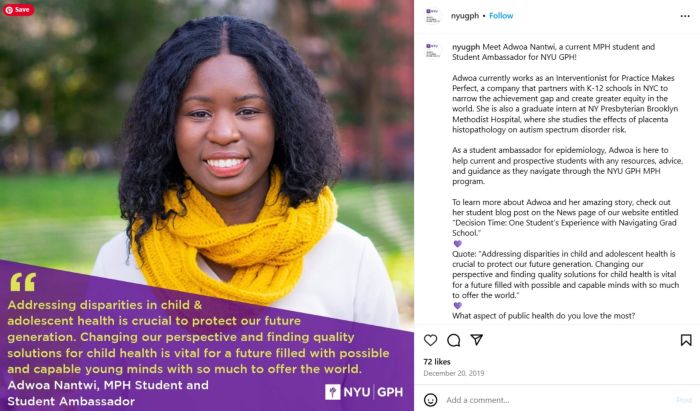
    Example: Here, New York University’s School of Global Public Health welcomes a new student ambassador, celebrating her accomplishments in the field, describing her role in the NYU community, and directing the audience to her student blog post. In addition to monetary rewards, student ambassadors appreciate public acknowledgments of their contributions. 

    Measure Success

    Track the impact of your ambassador program using metrics such as social media engagement, website traffic, and application rates. Use this data to refine your approach, ensuring continuous improvement.

    Incorporating UGC into Your Marketing Strategy

    A UGC marketing campaign can be a goldmine for schools looking to leverage their communities to tell their story. By encouraging students to share their experiences, you tap into a wealth of relatable and engaging material that resonates with prospective students. Let’s explore how to integrate UGC into your marketing strategy for maximum impact.

    Create Opportunities for UGC

    Encourage your students to share their experiences by hosting contests, themed hashtag campaigns, or student takeovers on social media. The more accessible you make the process, the more likely students are to participate.

    HEM Image 7HEM Image 7

    Source: Caleontwins | TikTok

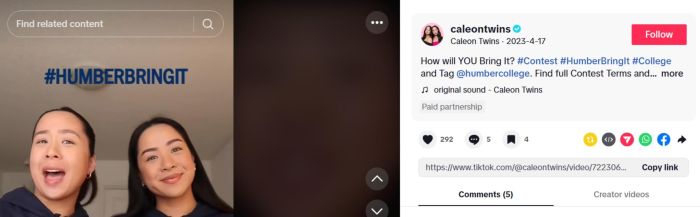
    Example: Here, Humber College has paid well-known influencers to promote a contest called Humber Bring It. The aim was to showcase all the unique skills students brought to their community. In their video, the Caleon twins shared all the essential details of the contest such as the deadline, prizes for winners (a 5000 dollar tuition credit or a laptop), and the hashtag that each contestant should use. Contests like this are the perfect way to create a UGC buzz around your institution. 

    Showcase UGC Across Platforms

    To maximize the impact of user-generated content (UGC), feature it prominently across your marketing platforms. Incorporate student stories, photos, and videos on your website’s homepage, within program pages, and in blog posts to provide a genuine glimpse into campus life. Social media channels are another natural home for UGC, where they can drive engagement and create relatable touchpoints with prospective students. Consider integrating this content into admissions brochures, emails, and campus tour presentations to ensure consistent messaging.

    Before sharing any UGC, prioritize student consent. Always seek permission from contributors, clearly explaining where and how their content will be used. Providing written guidelines and gaining explicit agreement ensures transparency and builds trust. By celebrating your students’ experiences respectfully and prominently, you showcase your school’s vibrant community and also create a foundation of authenticity and ethical storytelling that resonates with your audience.

    Maintain Quality Control

    While UGC is inherently less polished, maintaining a level of quality ensures it aligns with your institution’s values and messaging. Begin by establishing clear guidelines for students contributing content. 

    These guidelines should outline your school’s tone, branding, and expectations for appropriateness, while still encouraging creativity and individuality. For example, provide tips on photography and video basics, such as lighting and framing, to enhance visual appeal without compromising authenticity.

    Review content before publication to ensure it represents your school positively. This doesn’t mean heavily editing or sanitizing the material—rather, it’s about ensuring the content reflects your institution’s culture, is free of inappropriate language or imagery, and avoids unintentional misrepresentation.

    Offering feedback to students can also be a valuable learning experience, helping them refine their work while staying true to their voice. By balancing authenticity with quality, you showcase the best of your community in a way that’s both relatable and professional.

    Engage with UGC Creators

    Show appreciation for students who contribute content by engaging with their posts, sharing their work, or even spotlighting them in dedicated campaigns. This not only boosts their morale but also encourages others to participate.

    Use UGC to Tell Stories

    Go beyond individual posts by weaving UGC into cohesive narratives. For example, compile videos and testimonials into a series showcasing different aspects of campus life. Storytelling adds depth and emotional resonance to your campaigns.

    Bringing It All Together

    Student ambassador programs and UGC are avenues for building authentic connections with your audience. By leveraging the voices of your students, you showcase your institution’s unique story in a way that resonates deeply with prospective students and their families.

    At Higher Education Marketing, we specialize in helping schools like yours unlock the potential of these strategies and many others. Whether you’re just starting or looking to refine your approach, our expertise ensures your campaigns drive meaningful engagement and results.

    Your students are your greatest storytellers. Let their voices elevate your brand and inspire the next generation to join your community.

    Struggling with enrollment?

    Our expert digital marketing services can help you attract and enroll more students!

    Frequently Asked Questions 

    What is a student ambassador

    A student ambassador is a current student who represents your institution in various capacities, from marketing and recruitment to campus events.

    What do student ambassadors do? 

    As the face of your school, student ambassadors embody its culture and values, offering prospective students and their families an authentic glimpse into campus life.

    Source link