Tag: leverages

  • This math platform leverages AI coaching to help students tackle tough concepts

    This math platform leverages AI coaching to help students tackle tough concepts

    eSchool News is counting down the 10 most-read stories of 2025. Story #5 focuses on a math platform that offers AI coaching for maximum impact.

    Math is a fundamental part of K-12 education, but students often face significant challenges in mastering increasingly challenging math concepts.

    Many students suffer from math anxiety, which can lead to a lack of confidence and motivation. Gaps in foundational knowledge, especially in early grades and exacerbated by continued pandemic-related learning loss, can make advanced topics more difficult to grasp later on. Some students may feel disengaged if the curriculum does not connect to their interests or learning styles.

    Teachers, on the other hand, face challenges in addressing diverse student needs within a single classroom. Differentiated instruction is essential, but time constraints, large class sizes, and varying skill levels make personalized learning difficult.

    To overcome these challenges, schools must emphasize early intervention, interactive teaching strategies, and the use of engaging digital tools.

    Last year in New York City Public Schools, Franklin Delano Roosevelt High School (FDR) teachers started using a real-time AI math coaching platform from Edia to give students instant access to math support.

    Edia aligns with Illustrative Mathematics’ IM Math, which New York City Public Schools adopted in 2024 as part of its “NYC Solves” initiative–a program aiming to help students develop the problem-solving, critical thinking, and math skills necessary for lifetime success. Because Edia has the same lessons and activities built into its system, learning concepts are reinforced for students.

    FDR started using Edia in September of 2024, first as a teacher-facing tool until all data protection measures were in place, and now as an instructional tool for students in the classroom and at home.

    The math platform’s AI coaching helps motivate students to persevere through tough-to-learn topics, particularly when they’re completing work at home.

    “I was looking for something to have a back-and-forth for students, so that when they need help, they’d be able to ask for it, at any time of the day,” said Salvatore Catalano, assistant principal of math and technology at FDR.

    On Edia’s platform, an AI coach reads students’ work and gives them personalized feedback based on their mistakes so they can think about their answers, try again, and master concepts.

    Some FDR classes use Edia several days a week for specific math supports, while others use it for homework assignments. As students work through assignments on the platform, they must answer all questions in a given problem set correctly before proceeding.

    Jeff Carney, a math teacher at FDR, primarily uses the Edia platform for homework assignments, and said it helps students with academic discovery.

    “With the shift toward more constructivist modes of teaching, we can build really strong conceptual knowledge, but students need time to build out procedural fluency,” he said. “That’s hard to do in one class session, and hard to do when students are on their own. Edia supports the constructivist model of discovery, which at times can be slower, but leads to deeper conceptual understanding–it lets us have that class time, and students can build up procedural fluency at home with Edia.”

    On Edia, teachers can see every question a student asks the AI coach as they try to complete a problem set.

    “It’s a nice interface–I can see if a student made multiple attempts on a problem and finally got the correct answer, but I also can see all the different questions they’re asking,” Carney said. “That gives me a better understanding of what they’re thinking as they try to solve the problem. It’s hugely helpful to see how they’re processing the information piece by piece and where their misconceptions might be.”

    As students ask questions, they also build independent research skills as they learn to identify where they struggle and, in turn, ask the AI coach the right questions to target areas where they need to improve.

    “We can’t have 30 kids saying, ‘I don’t get it’–there has to be a self-sufficient aspect to this, and I believe students can figure out what they’re trying to do,” Carney said.

    “I think having this platform as our main homework tool has allowed students to build up that self-efficacy more, which has been great–that’s been a huge help in enabling the constructivist model and building up those self-efficacy skills students need,” he added.

    Because FDR has a large ELL population, the platform’s language translation feature is particularly helpful.

    “We set up students with an Illustrative Math-aligned activity on Edia and let them engage with that AI coaching tool,” Carney said. “Kids who have just arrived or who are just learning their first English words can use their home languages, and that’s helpful.”

    Edia’s platform also serves as a self-reflection tool of sorts for students.

    “If you’re able to keep track of the questions you’re asking, you know for yourself where you need improvement. You only learn when you’re asking the good questions,” Catalano noted.

    The results? Sixty-five percent of students using Edia improved their scores on the state’s Regents exam in algebra, with some demonstrating as much as a 40-point increase, Catalano said, noting that while increased scores don’t necessarily mean students earned passing grades, they do demonstrate growth.

    “Of the students in a class using it regularly with fidelity, about 80 percent improved,” he said.

    For more spotlights on innovative edtech, visit eSN’s Profiles in Innovation hub.

    Laura Ascione
    Latest posts by Laura Ascione (see all)

    Source link

  • Parents, advocates alarmed as Trump leverages shutdown to gut special education department

    Parents, advocates alarmed as Trump leverages shutdown to gut special education department

    Two months after Education Secretary Linda McMahon was confirmed, she and a small team from the department met with leadership from the National Center for Learning Disabilities, an advocacy group that works on behalf of millions of students with dyslexia and other disorders. 

    Jacqueline Rodriguez, NCLD’s chief executive officer, recalled pressing McMahon on a question raised during her confirmation hearing: Was the Trump administration planning to move control and oversight of special education law from the Education Department to Health and Human Services?

    Rodriguez was alarmed at the prospect of uprooting the 50-year-old Individuals with Disabilities in Education Act (IDEA), which spells out the responsibility of schools to provide a “free, appropriate public education” to students with disabilities. Eliminating the Education Department entirely is a primary objective of Project 2025, the conservative blueprint that has guided much of the administration’s education policy. After the department is gone, Project 2025 said oversight of special education should move to HHS, which manages some programs that help adults with disabilities. 

    But the sprawling department that oversees public health has no expertise in the complex education law, Rodriguez told McMahon.

    “Someone might be able to push the button to disseminate funding, but they wouldn’t be able to answer a question from a parent or a school district,” she said in an interview later. 

    For her part, McMahon had wavered during her confirmation hearing on the subject. “I’m not sure that it’s not better served in HHS, but I don’t know,” she told Sen. Tim Kaine, D-Va., who shared concerns from parents worried about who would enforce the law’s provisions.

    But nine days into a government shutdown that has furloughed most federal government workers, the Trump administration announced that it was planning a drastic “reduction in force” that would lay off more than 450 people, including almost everyone who works in the Office of Special Education Programs. Rodriguez believes the layoffs are a way that the administration plans to force the special education law to be managed by some other federal office.

    Related: Become a lifelong learner. Subscribe to our free weekly newsletter featuring the most important stories in education. 

    The Education Department press office did not respond to a question about the administration’s plans for special education oversight. Instead, the press office pointed to a social media post from McMahon on Oct. 15. The fact that schools are “operating as normal” during the government shutdown, McMahon wrote on X, “confirms what the President has said: the federal Department of Education is unnecessary.”’

    Yet in that May meeting, Rodriguez said she was told that HHS might not be the right place for IDEA, she recalled. While the new department leadership made no promises, they assured her that any move of the law’s oversight would have to be done with congressional approval, Rodriguez said she was told. 

    The move to gut the office overseeing special education law was shocking to families and those who work with students with disabilities. About 7.5 million children ages 3 to 21 are served under IDEA, and the office had already lost staffers after the Trump administration dismissed nearly half the Education Department’s staff in March, bringing the agency’s total workforce to around 2,200 people. 

    For Rodriguez, whose organization supports students with learning disabilities such as dyslexia, McMahon’s private assurances was the administration “just outright lying to the public about their intentions.”

    “The audacity of this administration to communicate in her confirmation, in her recent testimony to Congress and to a disability rights leader to her face, ‘Don’t worry, we will support kids with disabilities,’” Rodriguez said. “And then to not just turn a 180-degree on that, but to decimate the ability to enforce the law that supports our kids.”

    She added: “It could not just be contradictory. It feels like a bait and switch.”

    Five days after the firings were announced, a U.S. district judge temporarily blocked the administration’s actions, setting up a legal showdown that is likely to end up before the Supreme Court. The high court has sided with the president on most of his efforts to drastically reshape the federal workforce. And President Donald Trump said at a Tuesday press briefing that more cuts to “Democrat programs” are coming.

    “They’re never going to come back in many cases,” he added.

    Related: Hundreds of thousands of students are entitled to training and help finding jobs. They don’t get it

    In her post on X, McMahon also said that “no education funding is impacted by the RIF, including funding for special education,” referring to the layoffs. 

    But special education is more than just money, said Danielle Kovach, a special education teacher in Hopatcong, N.J. Kovach is also a former president of the Council for Exceptional Children, a national organization for special educators.

    “I equate it to, what would happen if we dismantled a control tower at a busy airport?” Kovach said. “It doesn’t fly the plane. It doesn’t tell people where to go. But it ensures that everyone flies smoothly.”

    Katy Neas, a deputy assistant secretary in the Office of Special Education and Rehabilitative Services during the Biden administration, said that most people involved in the education system want to do right by children.

    “You can’t do right if you don’t know what the answer is,” said Neas, who is now the chief executive officer of The Arc of the United States, which advocates for people with intellectual and developmental disabilities. “You can’t get there if you don’t know how to get your questions answered.”

    Families also rely on IDEA’s mandate that each child with a disability receives a free, appropriate public education — and the protections that they can receive if a school or district does not live up to that requirement.

    Maribel Gardea, a parent in San Antonio, said she fought with her son’s school district for years over accommodations for his disability. Her son Voozeki, 14, has cerebral palsy and is nonverbal. He uses an eye-gaze device that allows him to communicate when he looks at different symbols on a portable screen. The district resisted getting the device for him to use at school until, Gardea said, she reminded them of IDEA’s requirements.

    “That really stood them up,” she said.

    Related: Trump wants to shake up education. What that could mean for a charter school started by a GOP senator’s wife

    Gardea, the co-founder of MindShiftED, an organization that helps parents become better advocates for their children with disabilities, said the upheaval at the Education Department has her wondering what kind of advice she can give families now.

    For example, an upcoming group session will teach parents how to file official grievances to the federal government if they have disputes with their child’s school or district about services. Now, she has to add in an explanation of what the deep federal cuts will mean for parents.

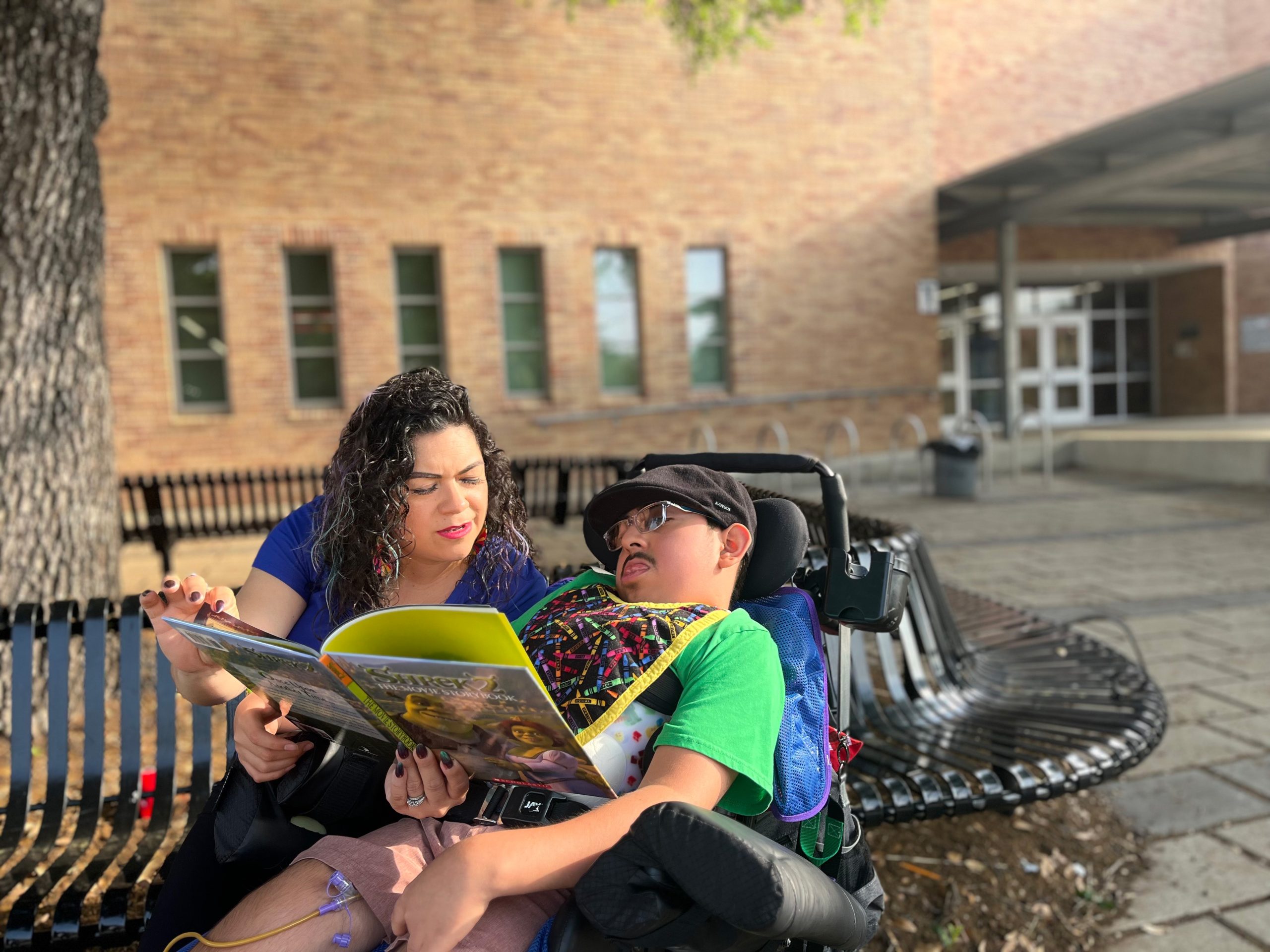
    Voozeki Gardea, who attends school in the San Antonio area, uses an eye-gaze communication device with the assistance of school paraprofessional Vanessa Martinez. The device verbalizes words and phrases when Voozeki looks at different symbols. Credit: Courtesy Maribel Gardea

    “I have to tell you how to do a grievance,” she said she plans to tell parents. “But I have to tell you no one will answer.”

    Maybe grassroots organizations may find themselves trying to track parent complaints on their own, she said, but the prospect is exhausting. “It’s a really gross feeling to know that no one has my back.”

    In addition to the office that oversees special education law, the Rehabilitation Services Administration, which is also housed at the Department of Education and supports employment and training of people with disabilities, was told most of its staff would be fired.

    “Regardless of which office you’re worried about, this is all very intentional,” said Julie Christensen, the executive director of the Association of People Supporting Employment First, which advocates for the full inclusion of people with disabilities in the workforce. “There’s no one who can officially answer questions. It feels like that was kind of the intent, to just create a lot of confusion and chaos.”

    Those staffers “are the voice within the federal government to make sure policies and funding are aligned to help people with disabilities get into work,” Christensen said. Firing them, she added, is counterintuitive to everything the administration says it cares about. 

    For now, advocates say they are bracing for a battle similar to those fought decades ago that led to the enactment of civil rights law protecting children and adults with disabilities. Before the law was passed, there was no federal guarantee that a student with a disability would be allowed to attend public school.  

    “We need to put together our collective voices. It was our collective voices that got us here,” Kovach said.

    And, Rodriguez said, parents of children in special education need to be prepared to be their own watchdogs. “You have to become the compliance monitor.” 

    It’s unfair, she said, but necessary. 

    Contact staff writer Christina Samuels at 212-678-3635 or [email protected].

    This story about special education was produced by The Hechinger Report, a nonprofit, independent news organization focused on inequality and innovation in education. Sign up for the Hechinger newsletter.

    The Hechinger Report provides in-depth, fact-based, unbiased reporting on education that is free to all readers. But that doesn’t mean it’s free to produce. Our work keeps educators and the public informed about pressing issues at schools and on campuses throughout the country. We tell the whole story, even when the details are inconvenient. Help us keep doing that.

    Join us today.

    Source link