Tag: levy

  • The proposed international student levy could be the tipping point for a fragile sector

    The proposed international student levy could be the tipping point for a fragile sector

    • Professor Duncan Ivison is President and Vice-Chancellor of the University of Manchester.

    Almost one year into the Labour government’s term, its vision for higher education is emerging. One exciting aspect of it is the role they see universities playing in helping to drive their agenda for inclusive growth. The recently announced R&D funding commitments, including regional ‘innovation clusters’, and the Industrial Strategy, all point to the role that higher education will play in driving innovation through world-class research and producing the highly skilled graduates our life sciences, technology, defence, and creative industry sectors – among others – will require. This is good news for the sector.

    Baroness Smith, Minister for Skills, and Lord Vallance, Minister for Science, have made clear that they see the core principles that will shape the UK’s higher education sector over the next five years. This includes contributing to economic growth, conducting the highest quality curiosity-driven research, helping build national capabilities in key sectors, contributing to the economic and social well-being of the regions in which we’re based, and being a global force for UK soft power through international collaborations.   

    This is a compelling vision and one that –  at least for the University of Manchester – we are keen to support,  including through our forthcoming Manchester 2035 strategy.   

    But in politics, vision quickly runs up against political reality, and we can also see now some of the challenges the sector will face, not least in relation to immigration and the difficult fiscal situation the government faces. The recent Immigration White Paper makes that clear.

    One of the more contentious aspects of the White Paper – in addition to reducing the graduate visa route from 24 months to 18 – is the proposal for a 6% levy on international student fees.

     Of course, for those of us familiar with Australian higher education policy, it is, as Yogi Bera once said, déjà vu all over again.  The Australian government proposed a 2% levy on international fee income in 2023, but it was never implemented. The main purpose of that levy was to redistribute fee income from the larger, research-intensive metropolitan universities to those (mainly in the regions) who struggled to attract international students. It stalled in the Australian parliament after fierce criticism from some parts of the sector, as well as the government deciding to pursue its aims through other means.

    In the UK, on the other hand, the levy seems designed to do two things. First, to generate additional revenue for the Department of Education in a very difficult fiscal environment. And second, to make manifest the contribution that international students make to the UK.

    There are several things wrong with this approach if indeed these are the main justifications for it. But I recognise it’s something currently being explored, rather than already decided, and so I offer my thoughts here as part of the consultations now underway.

    First, it’s striking that for a government seeking to position itself as a champion of global free trade and economic growth, they are proposing what is essentially a tax on one of the UK’s most successful export industries (worth ~£22 billion a year from higher education alone).

    Second, the fact that the government doesn’t feel the public understands the contribution that international students make to the UK is deeply concerning. The short answer is that they make a massive contribution: in fact, their financial contribution and talent has been crucial not only in helping the UK maintain its global standing as a higher education powerhouse, but also to the regional and local economies in which universities are based.  

    There are other more specific problems with the levy too, at least for a university like mine.

    For one thing, a levy assumes universities can simply pass on the additional cost to our students. But this neglects the fact that we are operating in a highly competitive international market, and a significant price increase will make us less attractive to some of the fastest-growing parts of it. Moreover, many international students might not appreciate that they are now being asked to cross-subsidise other parts of the UK’s education system, in addition to the significant contribution they are already making. One perverse consequence of a 6% increase in fees might be that we end up abandoning our efforts to diversify the countries from which we recruit and focus only on those who can afford higher fees.  This will only deepen the risk that successive governments have been keen for us to mitigate.

    Moreover, at Manchester at least, we have already factored in increases to our international fees to account for rising costs over the next five years. Adding 6% on top of that would be unworkable.  So, we would either have to absorb most, if not all, of the levy (plus inflation), or increase our fees substantially and lose market share. Assuming that we would see very little of the levy come back to us – the history of hypothecated funding is not encouraging in this regard – this would be a major financial blow.  It would also, as a result, likely generate much less income than the Department hopes.  For a sector already teetering on the edge of fiscal implosion, this could be the tipping point. To put it into context: for the University of Manchester, a 6% levy would mean a potential loss of ~£43M of revenue p.a by 2029/30, wiping out the slim margin we have for reinvesting in our teaching and research. The levy does nothing to address the structural challenges facing the higher education sector. In fact, it is likely to make things worse.

    But it would also undermine our ability to do the very things the government wants us to do more of. Already, international student fees help us bridge the financial gap between what we receive to teach all our students and what it actually costs, as well as the gap between the full costs of research and what funding councils and charities provide. This is under threat if we get our higher education policy settings wrong. And let’s be clear: it would hurt local students and local economies most. Almost half our students remain in Manchester after they graduate, contributing hugely to our city and region.

    We are keen to contribute to the government’s vision for higher education.  For example, we are spending ~£21M p.a. on helping disadvantaged students with their cost of living and studies. And from this year, we will be investing more than ever before in accelerating the commercialisation of our research and generating more student and staff start-ups, scale-ups and job creation for Greater Manchester and the country.

    I understand the challenges the government faces on immigration and funding higher education. There should be no tolerance of shonky providers serving as a front for migration workarounds. And universities need to prove they are operating as efficiently as possible and collaborating in new and transformative ways – as I’ve argued elsewhere and as we’re doing with Liverpool and Cambridge.

    An alternative approach to a levy would be to develop specific compacts with clusters of universities based on delivering against the government’s core priorities for HE in concrete ways – building on the new ‘innovation clusters’ in the recent R&D announcement. We’re already doing this in Greater Manchester, given the excellent collaborative culture that exists between the universities, further education colleges, and the Combined Authority. It’s a model we could scale nationally.  I look forward to the discussions to come in the weeks ahead.

    Source link

  • How to design an international student tuition fee levy

    How to design an international student tuition fee levy

    “The Government will explore introducing a levy on higher education provider income from international students, to be reinvested into the higher education and skills system. Further details will be set out in the Autumn Budget.”

    35 words that have put the sector into a spin, spun out tens of thousands of words of analysis and rebuttal, and set into motion a shared panic that the government is not only going to reduce the number of international students but tax the students that universities manage to recruit.

    Design

    The only things that we know about the levy is that the government has used a six per cent tax on international fees as an “illustrative example” in its technical annex, the government assumes this cost would be passed on to international students, and that passing on these costs will depress international student numbers by around 7,000. In terms of the levy design there is the promise that the money will be ringfenced for higher education and skills but which parts and how is not defined. It is of course also not guaranteed.

    The sector’s response has been to point out that reducing the number of international students and devaluing the unit of resource they bring with them will put additional financial pressure on universities. The impact will also be uneven with the largest recruiters of international students paying the highest levy.

    The government has made a hugely consequential policy signal with no details, scant impact assessment, and no analysis of the consequences. However, if a levy of some form is going to happen the sector should think carefully about which kinds of levy they believe would be preferable. Not all levies are built equally.

    Australia

    The idea for a levy seems to have come from the Australian Universities Accord. The UK government does not seem to have noticed that the idea was heavily edited and caveated in the final report but in the interim report it was noted that:

    The Review notes various submissions support establishing a specific fund that could be used for future infrastructure needs, as well other national priorities. This could include consideration of a levy on international student fee income. The use of this revenue for sectoral-wide priorities could reflect the collaborative nature of the sector in building a strong and enduring system. The Review notes further examination is required, including consideration of some level of co-investment from governments.

    There is a little bit more detail here but not much. Like the UK version the fund would be hypothecated toward higher education and used to fund things on a system wide basis. The politics on the face of it appear progressive that the institutions that benefit most from private capital, the flow of international students, pay a proportion of it back to fund public goods in the wider higher education system. The less progressive element is that international students pay once to their institution, they would then pay a levy which their provider would pass on to them in increased fees, and they then prop up an education system of a nation in which they are not permanently resident.

    The University of Melbourne did some follow up work looking at the implications of such a levy. Some of the issues they picked up are whether this would be a levy on all international students in all kinds of education, whether it is reasonable to distribute funding from high income to low income institutions, whether the idea of a levy in and of itself would dampen demand, and whether the impact of taxing income from individual providers is more harmful than the collective benefits they may receive from a shared fund.

    Depending how the government chooses to apply its levy we would expect to see very different results. An Australian model which redistributes funding from the wealthiest institution to the least wealthy would have a very different set of consequences to a levy which took a six per cent flat tax and put it into a general fund for infrastructure. It feels odd within a market based higher education system to make one provider dependent on the success of another. It also feels odd to make international students who are studying at a specific institution responsible for the health of the wider sector.

    Some would see an intra-university levy as a recognition that the success of the system is the success of each provider. Some would see it as an unjustifiable tax on the most financially successful institutions.

    New Zealand

    Australia’s Antipodean partner already has a form of student levy.

    New Zealand’s Export Education Levy is charged as a proportion of the fee international fee-paying students pay to their providers. Depending on the kind of institution this is charged at between .5 per cent and .89 per cent of tuition fees.

    The levy has a direct relationship between funders and beneficiaries. Although it is a tax on learners, and by extension a tax on providers, the funding is used for the development of the export education sector, a recovery scheme should a provider be unable to continue teaching, the administration of the international element of The Education (Pastoral Care of Tertiary and InternationalLearners) Code of Practice 2021 (this includes a range of safety, wellbeing and advice support), and the funding of the International Student Contract Dispute Resolution Scheme (a scheme for students to resolve disputes with their providers on contracts and financial issues.)

    This system has been in place with some variations and the occasional suspension since 2002. The international education system is much smaller in New Zealand than the UK and the amount of funding the levy raises is modest at close to three million dollars in 2022/23. The model in operation here is a relatively small tax to fund things which providers have a shared interest in. It’s not a direct cash transfer between providers but a collective pot to reinvest into the economic commodity of international education. The scheme was suspended during COVID-19 as a measure to support the sector, so its financial impacts are clearly not negligible, but post COVID-19 international enrolments are recovering strongly. Whether they would have recovered even more strongly without a levy is impossible to know.

    This is a light-touch, shared endeavour, we all should have some investment in international education, kind of a levy and it is not the only levy New Zealand has.

    The Student Service Levy is a fee applied to all student fees to fund non-academic services. The University of Auckland surveys students every year on what they would like their fees to be spent on and in 2024, in descending order by amount, funding was spent on sports, recreation and cultural activities, counselling services and pastoral care, health services, child care services, clubs and societies, careers advice, legal advice, financial advice, and media.

    This is a general levy but the principle has broader applications. It would be entirely possible to levy international student fees to pay for non-academic services. For example, university access budgets are effectively paid for by a levy on fees. This system seems fairer in some ways than a general levy. The place where a student studies is the primary beneficiary of their fees. From a policy perspective it would allow the government to move institutional behaviour toward things they care about by stipulating what the fee could be spent on. However, given that international student fees subsidy much of university work already it would again feel like they are paying twice. Additionally, if providers didn’t have to redistribute their funding on a national basis the providers with the most international students would be able to spend the most on non-academic elements.

    Where else

    It is also worth stating the government’s proposed levy would not function like the Apprenticeship Levy. The Apprenticeship Levy is a tax on employer’s payroll but employers are able to access the funds they contribute to spend on apprenticeships with any underspend clawed back by the government. Plainly, if government allowed providers to access the fees they contribute to the levy for the education of their own students there would be no point in having a levy in the first place beyond giving universities the political coverage to raise fees. Presumably, not an outcome the government is intending.

    The argument against a levy of international student fees will dominate the sector for months to come. Should a levy come to pass universities would be well disposed to think of which kinds of levy they might prefer. A model which redistributes funding across providers and if so which providers and for what projects. A model which internally redistributes funding toward student support. Or, likely the least popular, a model which allows the government to reinvest the funding broadly and perhaps outside of higher education.

    In making the case of the harm a levy could cause the sector may also win over more sympathy if it can explain which kinds of levies in which places have what kinds of effects depending on how they are applied. A levy may generally be a bad idea but some versions are much more harmful than others.

    Source link

  • Plotting the impact of an international fee levy

    Plotting the impact of an international fee levy

    There’s not many in the higher education sector that would have welcomed any part of the recent immigration white paper.

    The reduction in the graduate route time limit would have been difficult enough. The BCA changes to duties on providers in order to sponsor international students will cause many problems. The possibility of financial penalties linked to asylum claims for those on student visas was as unexpected as it is problematic.

    But it is the levy that has really attracted the ire of UK higher education.

    The best form of defence

    On one level it is simply a tax – on the income from international student fees, which is one of a vanishingly few places from which universities can cross-subsidise loss-making activity like research and teaching UK-domiciled students.

    Yes, the funds raised are promised variously to “skills and higher education” or just “skills”, and the suggestion seems to be that the costs will be passed on entirely to international students via rises in tuition fees. There’s not any real information on the assumptions underpinning this position, or credible calculations by which the proportion of students that may be deterred by these rises and other measures has been estimated.

    But details are still scant – the government has, after all, only promised to “explore” the introduction of a levy – and used the idea of a six per cent levy on international tuition fees as an “illustrative example”. We have to look forward to the Autumn statement (not even the skills white paper – remember joined-up, mission-led, government?) for more – and do recall that the white paper is a consultation and responses need to be made in order to finesse the policy.

    Thinking about impact

    There’s no reliable way to assess the impact of this policy with so little information, but we do know a lot about the exposure of each university to the international market.

    For starters here’s a summary of provider income from overseas fees since 2016–17 – both for individual providers and (via the filters) for the sector as a whole.

    [Full screen]

    The story has been one of growth pretty much anywhere you care to look – with only limited evidence of a cooling off in the most recent year of data. Some institutions have trebled their income from this source over the eight years of available data, with particular growth in postgraduate taught provision.

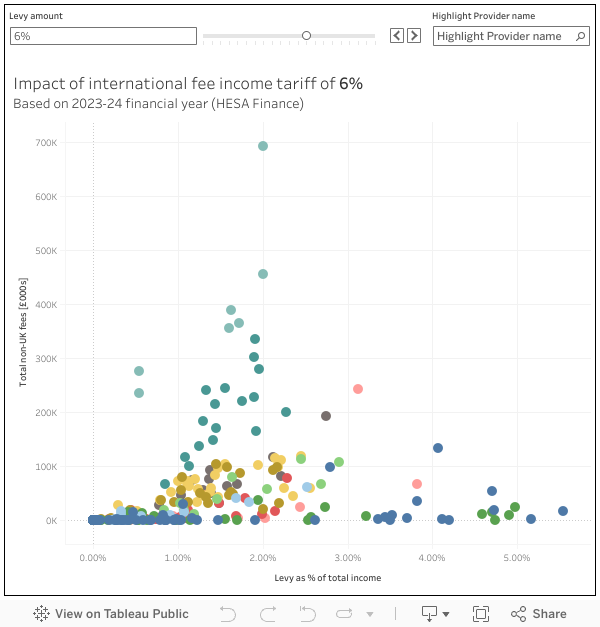
    In considering the financial impact of a potential levy I have used the most recent (2023–24) year of financial data – showing the total non-UK fee income on the vertical axis and the proportion of total income represented by the value of the levy on the horizontal. By default I have modelled a levy of six per cent (you can use the filter to consider other levels).

    [Full screen]

    Who’s up, who’s down?

    In the majority of large universities the cost of levy is equivalent to around two per cent of total income. In the main it is the Russell Group that sees substantial income from international fees – the small number of exceptions (most notably the University of Hertfordshire and the University of the Arts London) would see a levy impact of closer to three per cent of total income.

    What we can’t realistically model is university pricing behavior and the impact on recruitment. Universities generally charge what the market will stand for international courses – and this value is generally higher for providers that are better known from popular league tables.

    Subject areas and qualifications also have an impact (the cost of an MBA, for example, may be higher than a taught creative arts masters – a year of postgraduate study may cost more than a year of an undergraduate course), as does the country from which students are arriving (China may be charged more than India, for example).

    Some better off universities in the middle of the market may choose to swallow more of the cost of the levy in order to increase their competitiveness for applicants making decisions on price – this would put pressure on the currently cheaper end of the market to follow suit as well as direct competitors, and may lower the overall floor price for particular providers (though, to be fair, private providers are still better positioned to undercut should they have access to funds from investment or other parts of the business).

    There is an obvious impact on the quality of the provision if providers do cut the amount of fee income – and this as well could have an impact on the attractiveness of the whole sector. For more hands-on courses in technical or creative subjects, provision may become unviable overall – surrendering the soft power of influence in these fields.

    A starting point

    It’s not often that we see a policy proposal on university funding launched with so little information. Generations of politicians have learned that university funding policy changes are the equivalent of poking a wasps nest with a sharp stick – it may be something that needs doing but the short term pain and noise is massive.

    It could be that it is a deliberate policy to let the sector (and associated commentariat) go crazy for a month or so while a plan is developed to avoid the less desirable (for ministers) consequences. But the idea that international students will gladly pay more to support an underfunded sector is one that has been at the heart of university activity for decades – the only real change here is that the government feels it can put some of the profits to better use than some of our larger and better-known providers.

    In all of this there appears to have been little consideration of the fairness of putting extra costs onto the fees of international students – particularly where they personally don’t see any value from their additional spend. But this has been an issue for a good few years, and it seems to have taken the possibility of a tariff (which could be considered unfair to cash-strapped universities too) to drive this problem further up the sector’s agenda.

    Source link

  • ‘What the hell just happened?’ Australia’s flirtation with a levy on international students – By Professor Andrew Norton

    ‘What the hell just happened?’ Australia’s flirtation with a levy on international students – By Professor Andrew Norton

    • This blog has been kindly written for HEPI by Andrew Norton, Professor of Higher Education Policy at Monash Business School, Monash University.
    • The thoughts of Nick Hillman, HEPI’s Director, on the levy can be read on the Research Professional News website here.

    For an Australian reader the UK immigration white paper’s proposal for a levy on international student fee revenue sounds familiar. In mid-2023 just such a levy was suggested for Australia by the interim report of a major higher education policy review. Like its UK version, the idea was to reinvest levy revenue in education. While the interim report lacked white paper status, education minister Jason Clare liked the idea enough to mention it in his report launch speech

    But now the levy has vanished from the Australian policy agenda. When the Universities Accord final report was released in February 2024 the levy idea was there but postponed, shunted off until after other major funding reforms that will start in 2027 at the earliest. So far as I can find, the Minister – newly reappointed this week after Labor’s election victory on 3 May – has not mentioned the idea in public for 18 months.

    So what happened? Predictably, the universities that stood to lose the most from the levy opposed it. But the bigger reason was that between mid-2023 and late 2023 the politics of international education in Australia were turned upside down. In a few months international education went from a valuable export industry to a cause of Australia’s housing shortages. International student numbers had to be cut. 

    As originally proposed in Australia the international student levy was not linked to migration policy. Some reduction in student demand was predicted, as levy costs were passed on through higher fees. But this was a policy side-effect, not its goal. If too many international students were deterred the levy would not raise enough money to achieve its domestic objectives. The Government needed more effective ways of bringing international student numbers back down. 

    Between October 2023 and July 2024 the Australian Government introduced, on my count, nine measures to block or discourage would-be international students. 

    Among the Government’s nine measures was one that delivered it international student revenue much more quickly than the proposed levy. The Government more than doubled student visa application fees from A$710 (~£330) to A$1,600 (~£745), claiming that the money would be spent on policies benefiting domestic students. During the 2025 election campaign Labor said it would increase visa fees again, to A$2,000 (~£930). The UK’s £524 fee looks cheap by comparison. 

    Higher visa fees and other migration measures had two big advantages over the once-proposed levy from the perspective of the Australian Government – legal ease and speed in delivering on migration goals. In Australia, many migration changes can be made by ministerial determination without parliamentary review. The levy required legislation. Australia’s system of sending controversial legislation to often-bruising Senate inquiries increases political costs, even when the bill ultimately passes.

    What visa fees lack is the Robin Hood element of the Australian levy as proposed. In 2023 the University of Sydney alone earned 14% of all university international student fee revenue. The top six universities received more than half of the total. Levy advocates argue that these gains are built on past taxpayer subsidies and prime real estate. Profits built on these foundations can legitimately be taxed for the wider benefit of Australian higher education. 

    In Australia generally, and under Labor governments especially, an egalitarian political culture gives these levy arguments some resonance. But for the foreseeable future migration is a bigger issue than university funding, and visa policies a more straightforward way of bringing down international student numbers than levies. Perhaps the levy idea will return, but the government’s long silence on the subject suggests that this will not happen anytime soon.

    Source link