For unions and nonprofit organizations committed to civic engagement and economic justice, this represents a unique opportunity: mobilize borrowers in ways that align with their values, rather than against them. Messaging that highlights fairness, personal responsibility, and stewardship—core Christian principles—can resonate deeply while framing student debt as a challenge to both economic and moral accountability.
These borrowers are approaching peak voting age, meaning that engagement now could influence local and national politics in the coming election cycles. Institutions like the University of Phoenix show the scale of the opportunity: over one million borrowers owe more than $21 billion nationwide, suggesting that faith-aligned organizing strategies could have broad impact.
The strategy is clear: educate borrowers about their rights, expose predatory practices, and organize them into civic action, all while respecting their values and beliefs. Done thoughtfully, this approach can build trust and spur meaningful participation in democracy, turning a population long overlooked into an informed, motivated constituency.
The coming years will test whether unions and nonprofits seize this moment. Hundreds of thousands of conservative, Christian borrowers could become a powerful force for accountability and change—but only if engagement is value-driven, strategic, and timely.
KISSIMMEE, Fla. — It’s not a rebrand. But the Moms for Liberty group that introduced itself three years ago as a band of female “joyful warriors” shedding domestic modesty to make raucous public challenges to masks, books and curriculum, is trying to glow up.
The group’s national summit this past weekend at a convention center outside Orlando leaned into family (read: parental rights), faith — and youth. The latter appeared to be a bid to join the cool kids who are the new face of conservatism in America (hint: young, Christian, very male), as well as a recognition of the group’s “diversity,” which includes grandparents, men and kids.
But even as the youth — including 20- and 30-something podcasters and social media influencers, as well as student members of the late Charlie Kirk’s Turning Point USA — brought a high-energy vibe, stalwart members got a new assignment. Where past Moms for Liberty attendees were urged to run for school board, this year they were encouraged to turn their grievances into legal challenges.
Moms for Liberty CEO and co-founder Tina Descovich acknowledged that while many of them had experienced backlashes as a result of running for school board or publicly challenging books, curricula and policies, they needed to continue the fight. (The more pugnacious co-founder, Tiffany Justice, is now at Heritage Action, an arm of right-wing think tank The Heritage Foundation.)
“You have lost family, you have lost friends, you have lost neighbors, you’ve lost jobs, you’ve lost whole careers,” she said. Yet she insisted that it was vital that they “shake off the shackles of fear and stand for truth or we are going to lose Western civilization as a whole.”
Related: Become a lifelong learner. Subscribe to our free weekly newsletter featuring the most important stories in education.
The gathering held up “the free state of Florida” as an example of Republican policies to be emulated, including around school choice and parental rights. The state’s attorney general, James Uthmeier, boasted of having created a state Office of Parental Rights last spring, describing it as “a law firm for parents.”
He trumpeted the state’s lawsuit against Target over the “market risks” of LGBTQ+ pride-themed merchandise and encouraged parents to reach out with potential legal actions. “If you’re identifying one of these wrongs that’s violating your rights and then subjecting our kids to danger and evil, then we want to know about it,” he said. “And we’re going to bring the heat in court to shut it down.”
Tina Descovich, CEO and co-founder of Moms for Liberty, was interviewed on Real America’s Voice, a conservative news and entertainment network that set up a remote studio outside of the Sun Ballroom at the Moms for Liberty national summit. Credit: Laura Pappano for The Hechinger Report
The shifting legal landscape, not just in Florida but nationally, had speakers gushing about the opportunity to file new challenges, particularly in the wake of the Supreme Court decision in Mahmoud v. Taylor in June. It gives parents broad power to object to school materials, including with LGBTQ+ themes, and the right to remove their children from public school on days when such materials are discussed.
“This is where we need to take that big Supreme Court victory and start fleshing it out,” said Matt Sharp, senior counsel at Alliance Defending Freedom, a Christian law firm. He added that they were “needing warriors, joyful warriors, to file cases to start putting meat on the bones of what that does.”
The directive to file suit was not just around opt-out policies, which were the basis for the Mahmoud case. (Moms for Liberty has opt-out forms and instructions on its website.) Rather, attendees were also urged to file lawsuits in support of school prayer; against school policies that let students use different names and pronouns without parental consent (what Moms for Liberty terms “secret transitions”); and to give parents access to surveys students take at school, including around mental health.
“We need people willing to stand up legally and be, you know, named plaintiffs,” Kimberly S. Hermann, president of the Southeastern Legal Foundation, a conservative policy group, said on a panel featuring two moms who sued their school districts. Winning a lawsuit or even just bringing one in one state, said Hermann, can get other school districts and states to adopt policies, presumably to avoid lawsuits themselves.
“One offensive litigation can have this amazing ripple effect,” she said. She and others made clear that there is staff to provide support. The legal groups will “stand with you,” said Sharp, “whether you’re passing the law or passing the local policy all the way to litigating these cases.”
Even as speakers criticized public schools particularly around LGBTQ+ issues, not as a form of inclusion but as foisting views into classrooms, they relished the chance to infuse their values into schools.
Filing these lawsuits is more than “just fighting for your role as parents,” Sharp told parents in a breakout session. “You’re ultimately fighting for your kids’ ability to be in their schools and make a difference, to be the salt and light in those classrooms with their friends and to take our message of freedom, of faith, of justice and to really spread it all across the schools.”
Overall, this year’s Moms for Liberty event lacked the obvious drama of recent years. The flood of protesters in 2023 in Philadelphia required a large police presence and barricades around the hotel, along with warnings not to wear Moms for Liberty lanyards on the streets.
This year, there were no protests. That was partly because the event was held in a secluded resort convention center that could accommodate 800 (larger than the 500-ish of past hotels). But the group failed to fill the venue or attract much media attention. There was on-location broadcast by Real America’s Voice, a conservative news and entertainment network, from a set outside the Sun Ballroom. (Steve Bannon interviewed Descovich on his show, “The War Room.”)
It also didn’t draw opposition because protesters had a bigger target. Saturday saw “No Kings” rallies across the country, with thousands decrying what they see as President Donald Trump’s authoritarianism. “I forgot it was happening since they’re mostly ignored these days,” state Sen. Carlos Guillermo Smith, (D-Orlando) and a senior advisor to LGBTQ+ rights group Equality Florida, said in a text message about the Moms for Liberty event. Liz Mikitarian, founder of the national group, Stop Moms for Liberty, which is based in Florida, said the moms “are still a threat” but not worth organizing a protest against.
It was also a quieter affair than last year’s in Washington, D.C. There, Trump’s appearance fed a party atmosphere with Southern rock, sequined MAGA outfits and a cash bar. (This year, Trump appeared, but only in a prerecorded video message.)
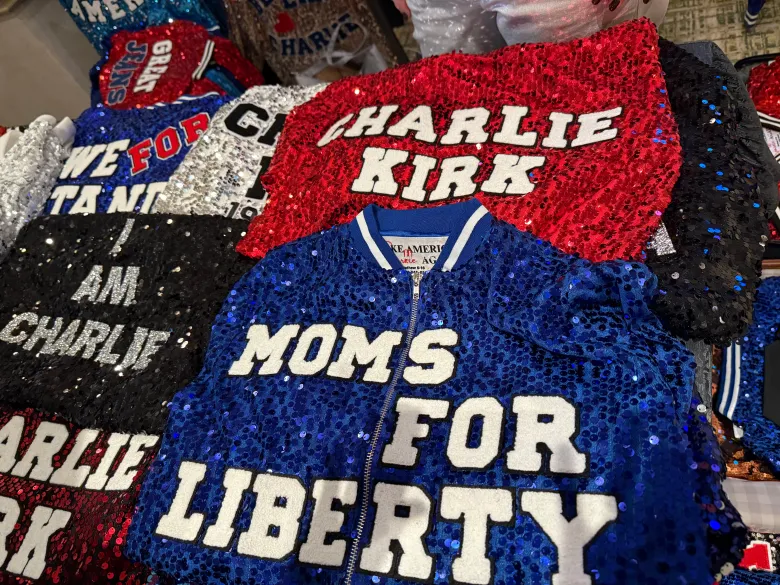
Sequined merchandise for sale at the Moms for Liberty gathering by the company Make America Sparkle Again included tops and jackets that paid tribute to Charlie Kirk, the slain founder of Turning Point USA. Credit: Laura Pappano for The Hechinger Report
The three-day event, of course, aired familiar grievances in familiarly florid language — conservative school choice activist Corey DeAngelis railed against teacher unions over the “far-left radical agenda that they’re trying to push down children’s throats in the classroom.” Other sessions covered the expected — the alleged dangers of LGBTQ+ policies, in sports, restrooms, school curricula and books — but there was also discussion of concerns (shared on left and right) over youth screen use, online predators and artificial intelligence.
The event made room for MAHA, the Make America Healthy Again movement led by Robert F. Kennedy Jr., the secretary of Health and Human Services. Descovich interviewed Dr. Joseph Ladapo, the Florida surgeon general who is working to eliminate all vaccine mandates for the state’s schoolchildren.
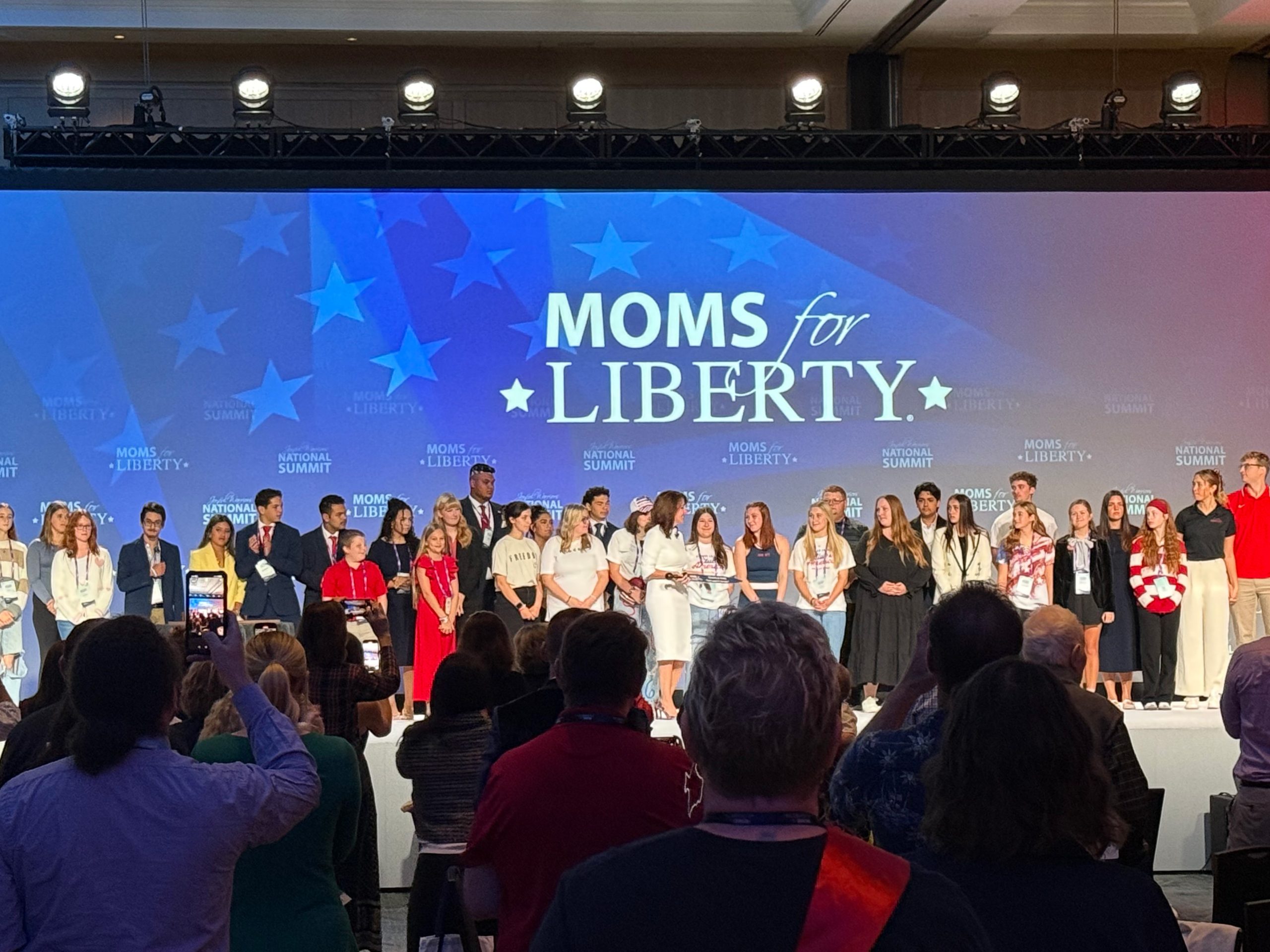
But the move by Moms for Liberty to attract young conservatives elevated the energy in the room. It was apparent not only in a tribute to Kirk, the slain founder ofTurning Point USA, which trains young conservatives on high school and college campuses. About 40 Florida TPUSA members took the ballroom stage to accept the “Liberty Sword,” the group’s highest honor, posthumously awarded to Kirk.
It also showed up in a breakout session of mostly conservative social media influencers and podcasters who offered tips on using humor and handling online trolls: Lydia Shaffer (aka the Conservative Barbie 2.0), Alex Stein, Gates Garcia, Kaitlin Bennett, Angela Belcamino (known as “The Bold Lib,” who said she was surprised to have been invited), and Jayme Franklin, who in addition to her podcast is the Gen Z founder of The Conservateur, a conservative lifestyle brand that The New Yorkercalled “Vogue, But for Trumpers.”
They have built huge followings based on their compulsion to provoke. “We need to go back to biblical values of what it means to be a real man and what it means to be a real woman,” urged Franklin. “People want that guidance, and that needs to begin at church. We need to push people back into the pews.”
Their inclusion, like that of conservative commentator Benny Johnson, who moderated a panel, “Fathers: The Defenders of the Family,” appeared to recognize a need to expand the base — and be edgier. Johnson charged out on stage and trumpeted that “God’s first commandment to us was, ‘Go, be fruitful, multiply.’ Go make babies!!!!” He quipped that “right-wing moms, they’re happier, right?” and asked the crowd, “Any trad wife moms out there?”
The phrase is shorthand for a woman who embraces a traditional domestic role, often with an emphasis on fashion and style. Johnson — who credited Kirk for prodding him to find Jesus, get married and become a father (he has four children) — argued that Republicans, especially those in Gen Z, should embrace the traditional nuclear family identity as a winning political move.
“We are the party of parents. We are the party of children,” he said, adding that traditional values were already dominating culture and politics. “We live in a center-right country. And I’m tired of pretending that we don’t,” he said, and showed a map of red and blue votes in the 2024 presidential election. “This is the shift. You live in a red kingdom.”
Contact editor Caroline Preston at 212-870-8965, via Signal at CarolineP.83 or on email at [email protected].
The Hechinger Report provides in-depth, fact-based, unbiased reporting on education that is free to all readers. But that doesn’t mean it’s free to produce. Our work keeps educators and the public informed about pressing issues at schools and on campuses throughout the country. We tell the whole story, even when the details are inconvenient. Help us keep doing that.
Liberty University, one of the largest Christian universities in the United States, has built an educational empire by promoting conservative values and offering flexible online degree programs to hundreds of thousands of students. But behind the pious branding and patriotic marketing lies a troubling pattern: Liberty University Online has become a master’s degree debt factory, churning out credentials of questionable value while generating billions in student loan debt.
From Moral Majority to Mass Marketing
Founded in 1971 by televangelist Jerry Falwell Sr., Liberty University was created to train “Champions for Christ.” In the 2000s, the school found new life through online education, transforming from a small evangelical college into a mega-university with nearly 95,000 online students, the vast majority of them enrolled in nontraditional and graduate programs.
By leveraging aggressive digital marketing, religious appeals, and promises of career advancement, Liberty has positioned itself as a go-to destination for working adults and military veterans seeking master’s degrees. But this rapid expansion has not come without costs — especially for the students who enroll.
A For-Profit Model in Nonprofit Clothing
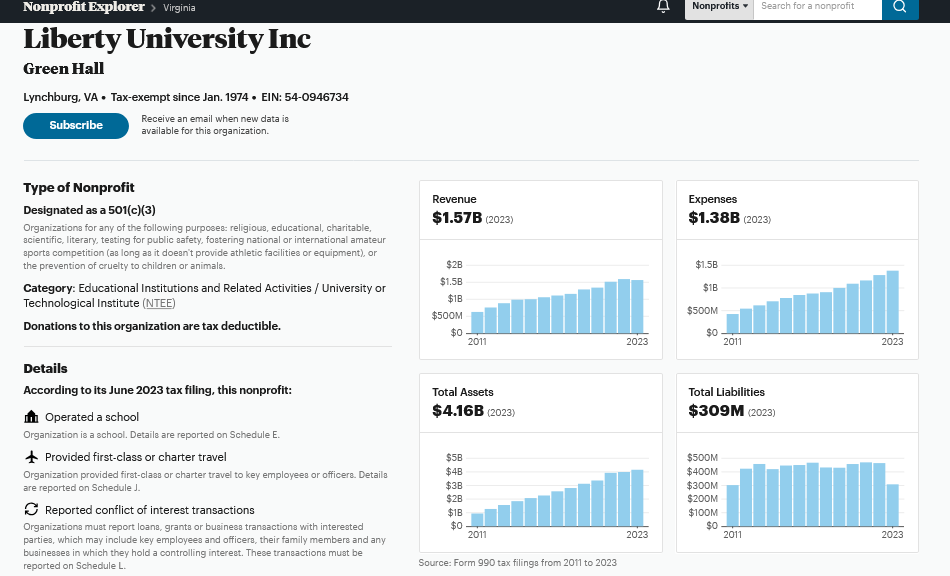
Though technically a nonprofit, Liberty University operates with many of the same profit-driven incentives as for-profit colleges. Its online programs generate massive revenues — an estimated $1 billion annually — thanks in large part to federal student aid programs. Students are encouraged to take on loans to pay for master’s degrees in education, counseling, business, and theology, among other fields. Many of these programs are offered in accelerated formats that cater to working adults but often lack the rigor, support, or job placement outcomes associated with traditional graduate schools.
Federal data shows that many Liberty students, especially graduate students, take on substantial debt. According to the U.S. Department of Education’s College Scorecard, the median graduate student debt at Liberty can range from $40,000 to more than $70,000, depending on the program. Meanwhile, the return on investment is often dubious, with low median earnings and high rates of student loan forbearance or default.
Exploiting Faith and Patriotism
Liberty’s marketing strategy is finely tuned to appeal to Christian conservatives, homeschoolers, veterans, and working parents. By framing education as a moral and patriotic duty, Liberty convinces students that enrolling in an online master’s program is both a personal and spiritual investment. Testimonials of “calling” and “purpose” are common, but the financial realities can be harsh.
Many students report feeling misled by promises of job readiness or licensure, especially in education and counseling fields, where state licensing requirements can differ dramatically from what Liberty prepares students for. Others cite inadequate academic support and difficulties transferring credits.
The university spends heavily on recruitment and retention, often at the expense of student services and academic quality.
Lack of Oversight and Accountability
Liberty University benefits from minimal federal scrutiny compared to for-profit schools, largely because of its nonprofit status and political connections. The institution maintains close ties to conservative lawmakers and was a vocal supporter of the Trump administration, which rolled back regulations on higher education accountability.
Despite a series of internal scandals — including financial mismanagement, sexual misconduct cover-ups, and leadership instability following the resignation of Jerry Falwell Jr. — Liberty has continued to expand its online presence. Its graduate programs, particularly in education and counseling, remain cash cows that draw in federal loan dollars with few checks on student outcomes.
A Cautionary Tale in Christian Capitalism
The story of Liberty University Online is not just about one school. It reflects a broader trend in American higher education: the merging of religion, capitalism, and credential inflation. As more employers demand advanced degrees for mid-level jobs, and as traditional institutions struggle to adapt, schools like Liberty have seized the opportunity to market hope — even if it comes at a high cost.
For students of faith seeking upward mobility, Liberty promises a path to both spiritual and professional fulfillment. But for many, the result is a diploma accompanied by tens of thousands in debt and limited economic return. The moral reckoning may not be just for Liberty University, but for the policymakers and accreditors who continue to enable this lucrative cycle of debt and disillusionment.
The Higher Education Inquirer will continue to investigate Liberty University Online and similar institutions as part of our ongoing series on higher education debt, inequality, and regulatory failure.
Liberty University, one of the largest Christian universities in the world, presents a striking contrast between its largely white residential campus and a more diverse, working-class population studying online. This divide highlights ongoing questions about race, access, and culture in American higher education—especially in religious institutions that promote traditional values while navigating a changing demographic and social landscape.
A Whiter Campus
As of 2021, Liberty’s Lynchburg, Virginia, residential campus remains overwhelmingly white. Seventy-four percent of students living and studying on campus are white, with only 4% identifying as Black or African American, 5% as Latino, and 2% as Asian or Pacific Islander. Less than 1% of residential students identify as Native American. In contrast to the national trend of increasing diversity on college campuses, Liberty appears to be growing whiter. In fact, the number of African American students on campus has declined in recent years, raising concerns about how welcoming the university is to students of color.
This demographic imbalance is not new. Liberty University has a long history of racial segregation and discrimination, particularly in its formative years under founder Jerry Falwell Sr., who defended segregation in the 1960s and opposed civil rights legislation. While Liberty’s public stance has changed over the decades, the legacy of those positions still casts a long shadow.
A More Diverse Virtual World
Meanwhile, Liberty University Online (LUO) paints a different picture. In 2017, only 51% of its undergraduate population identified as white, compared to 15.4% who were Black or African American. Hispanic and Latino students made up 1.7%, and students of two or more races, 2.3%. A significant 26.5% of LUO students were categorized as “race/ethnicity unknown,” potentially obscuring additional diversity. These students come from all 50 states, Washington, D.C., and 86 countries, with more than 30,000 military students and over 850 international students among them.
LUO students are also disproportionately older, more likely to be working full-time, and often seeking degrees for career advancement or personal growth rather than the traditional “college experience.” Many are first-generation college students or part of the educated working-class navigating life through faith, family, and financial constraints. In contrast to the traditional campus, LUO’s virtual classrooms are where Liberty more closely resembles the multiracial and socioeconomically diverse America it often claims to serve.
The Racial and Class Divide
This bifurcation between Liberty’s on-campus and online populations underscores a larger tension within the university: a cultural and racial divide that mirrors the broader fissures in U.S. society. The residential campus, steeped in conservative Christian traditions and a homogeneous student body, promotes a culture aligned with white evangelicalism. Meanwhile, its online division serves a more varied student population—many of whom are drawn to Liberty for its affordability, flexibility, and religious identity, but may not share in the campus culture or feel represented by its leadership and branding.
Reports of problems faced by Black students on campus—including concerns over campus climate, lack of representation among faculty, and curriculum that minimizes racial history—suggest that Liberty’s commitment to diversity is uneven at best. While the university has made modest gestures toward inclusion, critics argue that these efforts are often performative and fail to address systemic issues rooted in the institution’s founding principles.
Conclusion
Liberty University’s dual identity—as a white-dominated, conservative campus and a more diverse, online workforce training hub—raises difficult but necessary questions about race, class, and the role of religion in higher education. For an institution that claims to train “Champions for Christ,” the challenge remains whether it can reconcile these differences or if the divide will only grow starker in the years ahead.
The Higher Education Inquirer has recently received a Freedom of Information (FOIA) response regarding student loan debt held by former Liberty University students. The FOIA was 25-01939-F.
A former Title IX investigator at Liberty University is suing the private evangelical institution, alleging he was fired for reporting sexual harassment within the office to his superiors, USA Today reported.
Peter Brake, a former investigator in Liberty’s Title IX office from 2019 to 2024 (including a three-and-a-half-year leave of absence for active military duty), alleges he was fired in June after he raised concerns about “multiple violations of law” to his supervisor and reported instances of sexual harassment of coworkers by another investigator, according to a copy of the lawsuit.
Brake also alleged that the same investigator, Nathan Friesema, was inappropriately directing the outcome of Title IX cases, including asking leading questions and embellishing complaints.
(Friesema did not respond to a request for comment from Inside Higher Ed sent via LinkedIn.)
Brake’s lawsuit alleges that Friesema subjected a coworker in the Title IX office to inappropriate jokes, including about sexual assault. Brake eventually brought the concerns to Liberty University president Dondi Costin in late 2023 and to his supervisor, Ashley Reich. However, Brake alleges that he was then “interrogated” by LU’s human resources department and fired.
“Liberty University has received news of this lawsuit by a former employee, and we are reviewing details of the case. Liberty takes all allegations of wrongdoing seriously and has impartial measures in place to assure the fair and equal treatment of all employees. While we will not respond to these allegations in the media at this time, we disagree with the lawsuit’s claims and are prepared to defend ourselves in court,” a Liberty spokesperson wrote by email.
The lawsuit comes less than a year after the U.S. Department of Education determined that LU failed to comply with federal campus crime–reporting requirements and officials discouraged victims from coming forward, weaponizing LU’s code of conduct against sexual abuse survivors.
Liberty was hit with a $14 million fine for various violations last March and is required, per an agreement with ED, to spend $2 million on campus safety and compliance improvements. The university is also on postreview monitoring through April 2026 to ensure it enacts improvements.
This audio is auto-generated. Please let us know if you have feedback.
A worker who was fired by Liberty University for disclosing her transgender status and announcing her intention to transition may proceed with her employment discrimination case against the institution, a Virginia district court judge ruled Feb. 21 (Zinski v. Liberty University).
The case involved a worker who was hired in February 2023 as an IT apprentice at the university’s IT help desk. She received positive performance reviews until July of that year, when she emailed Liberty’s HR department, explaining that she was a transgender woman, had been undergoing hormone replacement therapy and would be legally changing her name, according to court documents. An HR representative promised to follow up with her.
Shortly thereafter, after hearing nothing, the worker reached out again and was scheduled for a meeting later the same day. She was presented with a letter terminating her employment and explaining that her decision to transition violated Liberty’s religious beliefs and its Doctrinal Statement.
In response to the worker’s lawsuit, Liberty University argued that Title VII of the Civil Rights Act of 1964 (among other laws) allow religious employers to discriminate on the basis of religion, contending that the worker’s firing was religion-based rather than sex-based in discriminatory nature.
While Judge Norman Moon appreciated that the case presents a “novel question of law in the Fourth Circuit,” he ultimately found current case law didn’t fully or clearly support the university’s argument.
“If discharge based upon transgender status is sex discrimination under Title VII generally, it follows that the same should be true for religious employers, who, it has been shown, were not granted an exception from the prohibition against sex discrimination,” Judge Moon said in his order denying the university’s motion to dismiss the case. “They have been entitled to discriminate on the basis of religion but on no other grounds.”
Judge Moon pointed out that “no source of law … answers the question before us,” but “we find that a decision to the contrary would portend far-reaching and detrimental consequences for our system of civil law and the separation between church and state.”
“This case — and the law it implicates — points to the delicate balance between two competing and laudable objectives: eradicating discrimination in employment, on the one hand, and affording religious institutions the freedom to cultivate a workforce that conforms to its doctrinal principles, on the other,” Moon wrote. “We find that our holding today — that religious institutions cannot discriminate on the basis of sex, even if motivated by religion — most appropriately maintains this balance.”
Late last year, a group of Arizona State University alumni gathered on the rooftop of the Canopy Hotel — high enough to see the headlights snake through the city of Tempe, but low enough to feel the pounding bass line of Mill Avenue’s nightlife.
Though the setting was casual, the conversation was anything but. A simple question had brought them together: What obligations do alumni have to their alma mater?
For most graduates, the answer is simple. Come back for Homecoming, buy the sweatshirt, scribble a check when the fundraising office calls. Thanks for your generosity!Click.
But for the assembled Sun Devils — spanning the classes of ’85 to ’24 — their connection to ASU is more than rah–rah nostalgia. They feel a duty to protect what made the university worth attending in the first place.
And so, that evening, they formed ASU Alumni for Free Speech. Their mission? “To promote and strengthen free expression, academic freedom, and viewpoint diversity, both on campus and throughout the global ASU community.”
The group’s inaugural chairman is Joe Pitts, ASU class of ’23 — whose beard, broad shoulders, and sage intellect belie his youth. For him, alumni should be more than mere spectators or “walking check books,” as he puts it, “endlessly giving and expecting little in return.” Instead, they should be invested stakeholders.
Pitts says it’s now fashionable to view a college diploma as little more than a fancy receipt. People think, I paid my tuition, endured the required courses, and behold: I’m credentialed! A neat little market transaction — no lingering ties, no ongoing investment.
But this mindset, Pitts argues, is both morally bankrupt and pragmatically wrong-headed. As a practical matter, he says, “the value of your degree is tied to the reputation of your school — if your alma mater improves over time, your degree becomes more prestigious. If it declines, so does the respect it commands.”
And in the cutthroat world of status-signaling and social capital that matters — a lot.
ASU alumni have already petitioned the Arizona Board of Regents, urging them to adopt a policy of institutional neutrality, which would prevent the university from taking positions on current political issues and weighing in on the cause-du-jour.
As a moral matter, “spending four years (or even more) at a university inevitably shapes you in some way,” Pitts says. “And in most cases, it’s for the better — even if we don’t exactly realize it at the time.” Think about it: how many unexpected friendships or serendipitous moments of clarity, insight, rebellion, and revelation do we owe our alma mater?
To discard that connection the moment you graduate — to treat it like an expired gym membership — isn’t just ungrateful. It’s a rejection of one’s own formation.
But beyond these considerations, Pitts insists that what united them on the Canopy Hotel rooftop last year was — love, actually. Not the saccharine, Hallmark kind or the fleeting thrill of a Tinder rendezvous, but the sort of love that drives men to build cathedrals and forge legacies.
Echoing St. Thomas Aquinas, Pitts says, “We love ASU, and to love is to will the good of the other — not to sit idly by.” And what is the good? It’s a campus where students unapologetically speak their minds; where professors dare to probe the perilous and the provocative; where administrators resist the temptation to do their best Big Brother impression!
Fortunately for ASU Alumni for Free Speech, their alma mater is already a national leader when it comes to free speech on campus — though, as Pitts notes, that’s “a damn low bar.”
ASU ranks 14 out of 251 schools in FIRE’s 2025 College Free Speech Rankings, and has maintained a “green light” rating from FIRE since 2011, meaning its official policies don’t seriously imperil free expression. In 2018, ASU adopted the Chicago principles, committing to the “free, robust, and uninhibited sharing of ideas” on campus.
The university didn’t stop there. This spring, ASU will launch a Center for Free Speech alongside an annual Free Speech Forum.
But despite these credentials, the specter of censorship still lingers at ASU, and the numbers tell the tale:
68% of ASU students believe shouting down a speaker is at least rarely acceptable.
35% believe violence can sometimes be justified to silence speech.
37% self-censor at least once or twice a month.
Over one-third of surveyed ASU faculty admit to self-censorship in their writing.
And so — like the cavalry cresting the hill — ASU Alumni for Free Speech arrives just in time.
“When controversy inevitably arises on a campus of 100,000 students,” Pitts argues, “the defense of free expression shouldn’t be left solely to outside organizations or political bodies. Instead, those speaking up should be people who genuinely care about ASU and have its best interests at heart.”
ASU Alumni for Free Speech aims to be that voice. “In the long run, we want to have a seat at the table,” Pitts explains. “We want to build relationships not just with the ASU administration but also with the Arizona Board of Regents.”
Along with FIRE, ASU alumni have already petitioned the Arizona Board of Regents, urging them to adopt a policy of institutional neutrality, which would prevent the university from taking positions on current political issues and weighing in on the cause-du-jour.
Pitts and the rest of ASU Alumni for Free Speech are tired of playing cheerleader. They’re here to ensure that ASU flourishes not just today, but for every Sun Devil yet to step onto Palm Walk for the first time.
“Sometimes that may look like applause,” Pitts says. “Other times, that may look like criticism.”
In either case, he insists, it’s an act of love.
If you’re ready to join ASU Alumni for Free Speech, or if you’re interested in forming a free speech alumni alliance at your alma mater, contact Bobby Ramkissoon at [email protected]. We’ll connect you with like-minded alumni and offer guidance on how to effectively protect free speech and academic freedom for all.
Responding to changing demographics, beliefs, and norms, US religious colleges must reflect what’s popular and profitable: Christian evangelism, prosperity theology, contemporary technology, and international outreach. Like other areas of higher education, Christian higher education must focus on the realities of revenues, expenses, and politics, as well as religious dogma.
While a number of Christian colleges and seminaries close each year, and many more face lower enrollment and financial woes, one conservative Christian university stands out for robust enrollment, stellar finances, and political pull: Liberty University. There are other older schools, particularly Catholic schools with more wealth and prestige, but that’s changing. And it could be argued that those schools are religious in a historical sense rather than a contemporary sense.
Two Liberties
Liberty University is an educational behemoth, and has the advantage of being a nonprofit school that uses proprietary marketing strategies. The brick-and-mortar school, with an enrollment of less than 20,000 students, is predominantly straight, white, and middle-class. The school also has a strict honor code called the Liberty Way, which prohibits activity that may be counter to conservative Christian beliefs.
The growing campus includes a successful law school that serves as a pipeline to Christian businesses and conservative government. The Jesse Helms School of Government and the ban of a Young Democrats club reflect its conservative principles. Liberty also houses the Center for Creation Studies and Creation Hall, with a museum to promote a literal interpretation of the Christian Bible, to include the stories of God and the beginning of time, Adam and Eve, Noah and the Ark, and Moses and the Ten Commandments.
Liberty University Online (LUO), an international Christian robocollege with about 100,000 students, is more diverse in terms of age, race/ethnicity, nationality, and social class. Despite a lower than average graduation rate, the online school is thriving financially, and excess funds from the operation help fund the university’s growing infrastructure, amenities, and institutional wealth. Liberty spends millions on marketing and advertising online, using its campus as a backdrop. And those efforts result in manifold profits.
Liberty History
Liberty University was founded in 1971 by Jerry Falwell Sr., a visionary in Christian marketing and promotion, who used technology the technology of the time–television–to gain adherents and funders. Fawell’s vision was not to create a new seminary, but to educate evangelical Christians to be part of the fabric of professional society, as lawyers, doctors, teachers, and engineers.
Responding to the political and cultural winds, Falwell Sr. moved away from his segregationist roots as he built his church Liberty University. It was not easy going for Liberty in the early years, which had to rely on controversial supporters. The minister also used the abortion question, the homosexual question, and conservative Christian evangelism in Latin America and Africa to energize his flock and to create important political alliances during the Ronald Reagan era. Information about those years are available at the Jerry Falwell Library Archives.
During the Reagan era and beyond, Falwell’s idea of a Moral Majority proposed that Church and State should not be divided, and those thoughts of a strong Christian theocracy have spread for more than four decades.
Under Donald Trump’s second term, Liberty University should be expecting to get closer to that goal of a Christian theocracy. For the moment, LU has the political power and the economic power that few other schools have to enjoy.