
Higher education is designed to prepare students for their future lives and careers by imparting technical and soft skills, but what about practical, hands-on tasks, like managing a home or vehicle?
A 2023 survey found that young adults lack practical life skills, with two-thirds (68 percent) of millennials and Gen Z unable to change their car oil, nearly half (48 percent) unable to change a tire and 46 percent unable to tie a tie. Eighty percent of Gen Z respondents said they do not feel like they have figured out adulting.
A workshop series at George Mason University in Virginia, titled Now What?, helps build students’ practical knowledge and well-being by giving them life advice and skills, such as how to change a tire.
In this episode of Voices of Student Success, host Ashley Mowreader spoke with Ethan Carter, associate director of programs, well-being and assessment, and graduate student assistant Dianna Philipps, to learn more about the program offerings and how it supports student success.
An edited version of the podcast appears below.
Inside Higher Ed: I wonder if we can just start by talking about the inspiration for this program. Where did the idea come from?
Ethan Carter: I came up with the idea, because as a [student activities] programmer, it is difficult to replicate things. When I thought a lot about being a college student—which was several years ago—I was like, “Man, what were the things that I wish I had known back then?” And so I kind of tried to think about something catchy, and I said, “Well, there were lots of things— I would do something, and then I’d be like, ‘So now what?’’ And so I was like, “Oh, that would be a really good little catchy phrase.”
Also, from a programming standpoint, it is very adaptable to what we want to do. I don’t have to replicate my programs, but we can have the theme of Now What?, and seeking what students would want to know more about in their lives. Not that what I wanted to learn was bad. It was just, things change.
Inside Higher Ed: When you address that question of Now What?, what are some of the themes you all have talked about? What has programming looked like practically?
Dianna Philipps: One of our main ones would be the “how to change a tire” one. I feel like most people on campus have a car, [but] they don’t really think of the things that come with having a car.
So when you see the tire-changing [workshop], you’re like, “Oh, what if I do get a flat tire? Like, maybe I should learn how to handle that if I’m on my own on the road or something.” I feel like things like that really stand out to students when they see it.
Inside Higher Ed: Something I thought was cool is that your roles focus on well-being and recreation and this program is an interesting intersection of those two ideas. I wonder if you can talk about how this contributes to students’ well-being and thriving on campus.
Carter: When you work on a college campus, and the big theme behind the campus is about well-being, you try and find out, where do you fit? And for us, it wasn’t just in the fitness realm. We wanted to think about something that was what we would consider our niche.
I settled on practical well-being because it is adaptable and relatable. Recreation is usually seen as something that does provide movement, but I wanted to capitalize on that and build off of the aspect of, just, living in general can be tough. It also opens the door for us to be able to partner, because a lot of our programs within themselves are not things that we run, and it’s not our expertise, but it is a place where we can be a hub and connect individuals, which kind of ties in with the well-being aspect, like, you need to find your own well-being.
Inside Higher Ed: Who are those partners across campus, and how do they participate in this?
Carter: Anyone and everyone is actually who we get to partner with. The [change a] tire one is done with our facilities group and specifically the auto shop—they help us with any vehicle-based activities that we have going on.
We’ve also connected with Student Health Services for ones that are related to health insurance, with anything about self-care. And then we did another [event] with academics for a little bit, talking about preparing for exams and test-taking and things like that.
One of my other favorite [events] is intercollaboration within a department. So like, how to do a hike, how to change a flat tire on a bike.
I think we had one more connection, oh, with dining. Dining teaches us how to cook, and so we’ve done a Super Bowl one where we made a special dip and some other little fun delicacies.
Inside Higher Ed: What have you learned from students and their feedback as you’ve done the events over the past year or so? What did they enjoy about it?
Philipps: I would say the main feedback is that it was very helpful for them. I think most of the people who have come to one event, they’re the ones who continue going to each of the events. I think it just helps them learn the things that they don’t know, because they’re like, you don’t know what you don’t know until you, I guess, go to the event. So that kind of helps them a lot.
Inside Higher Ed: There are knowledge gaps for all students as they come on college campuses—whether that’s academic preparedness or just life skills that you might not know. If you’ve never owned a car before, you might not know how to jump your car or change a tire, or if you’ve never had a full-size kitchen before, you might not know how to cook a Super Bowl dish. So I think it’s really cool that you all give them the opportunity to identify what they don’t know, but then also just close those gaps and help them feel like they’re not left behind or unsure of what they do next.
Carter: I would also add that they’ve enjoyed putting their hands on the tools that help them.
We do one [workshop] on how to use hand tools, and sometimes the power drill is the [tool] that we get to play around with. Other times it’s a hammer and nail. Sometimes we play around with a tape measure. And I’ve appreciated the vulnerability of the students and admitting like, “Hey, this is what I don’t know,” and it provides an opportunity for me to talk more about like, “Hey, this is what I was feeling when I was a college student.”
When you are thinking about all the resources that are available to you on campus, it’s important that you’re able to admit that you don’t know how to do something, and then go out and ask someone, because most of the time, most of those tools are readily available for you on campus. You just have to be pointed in the right direction, and people can’t give you what they don’t know you need. So that would be something else that I would say has been a great benefit for me in connecting with other campus partners and connecting with those students.
Inside Higher Ed: I remember when I was a college student, I was really afraid of the makers’ studio, where the VR lab and the 3-D printing are. It just felt so intimidating to go in and actually try things out. But once you have an experience like this, where it’s a little more hands-on and assisted, you feel like you have the skills to do it.
I bet there’s also an element of introduction to staff on campus. Maybe students have never met a facilities manager before, and now, after changing a tire with them, they can ask for help in other ways. Or if you’ve never talked to the Student Health Center, now you feel more comfortable talking about health insurance or other things like that.
If you had to give advice or insight to another college or university that was looking to replicate your idea, what would you say you’ve learned? Or what are some best practices for people to know?
Carter: First one is, what I actually tell the students all the time, is to be yourself within your organization. You maybe have a limited budget, and you only have certain resources available to you, so it’s important for you to not try and go and do what everybody else is doing. It’s important for you to do what you’re able to do, and then to connect with your students and allow them to be part of the construction of what your program is going to be.
It may start out as just being something where you’re looking at budgets, and then another student comes in—because you are making this for the students. So if you don’t have the student audience that is available for what you’re providing, like, it isn’t super helpful.
So do that, and then the adaptability aspect: Be OK with something not working. Because when you hear “no” or no one comes, that is good information; you know not to do that anymore. A lot of people get offended by that and are like, “Oh, I’m a horrible programmer” or whatnot.
It could be that you’re doing it at the wrong time, or it’s just that students are not available for that. Why would we do something that’s related to budget and all the students that need to do the budget stuff are in class in the a.m., so maybe I should try it in the evening. Things of that nature. So be OK not always having everything get hit out of the ballpark. And then if you do find something, you try and make it better as you go.
Inside Higher Ed: You mentioned that this is a different sort of programming and something that you all can adapt to reflect student needs. I’ve heard a lot from people who work on college campuses that post-COVID, it’s just been harder to get students to show up for things or feel like you’re being responsive to their needs. Have you felt like this has accomplished that goal in being adaptable, but also engaging students?
Carter: I would say it depends, and it really depends on what’s going on and what the particular group you’re working with is all about. So, Dianna, if you don’t mind sharing some of your ideas to try and help us get some people coming.
Philipps: One of the main ones would be changing locations. Especially if you’re on a bigger campus, trying to make it more central so it can target different types of people, either coming from class or coming from the dining hall or things like that.
Just back to what Ethan had said about being creative with it, and if something doesn’t work, look at what did work, keep that and then change what didn’t work. You can learn from that. See what things people are actually going to, what they actually need help with. So, again, being adaptable to things.
Inside Higher Ed: You mentioned earlier that students who come to one event might come to multiple—like, they really appreciate the skills that they’re building. Have you seen that that’s true of a handful of students or more?
Carter: It makes you feel good when you see somebody that you’ve seen before; it kind of increases your self-esteem. You’re like, “Oh, I did something, right?”
I think the bonus is that they invite their friends and they make them aware. I think that a lot of times, even as an adjunct professor, I’ve had to change my perspective of it isn’t what the student looks like, because most of the time when I’ve talked to my students, they look like they don’t care about my class. But then I mentioned that to them, and they’re like, “No, you’re one of the coolest professors that I’ve ever had.” I’m like, “I can’t tell from looking at your face.”
So when we’re doing our programming, it may not be that the students don’t like it, they just may not be aware, which is why we’ve tried really, really hard to go to the students to make the things available—not just putting a flier in front of their face, but providing them an opportunity where they can go and do something.
I would say we’ve gotten the greatest number of students coming to things when we went to another class with content that was in line with what we were doing; we were complimenting what an instructor was teaching. And then the students are like, “We had no idea that this was going on; what other programming do you have available?”
So I would say that that has been super, super helpful, going to the students and just becoming more and more visible, shaking hands and getting to know people, which, again, it seems like it’s common sense, but you do have to become visible in a way that is helpful and not harmful.
Inside Higher Ed: You mentioned working with other staff on campus; have faculty been a partner in this work as well?
Carter: We have gotten to work with them. And like I said, when we invite ourselves to their class, it doesn’t work out so well. When we are paying attention to what it is that they’re teaching and ask them, “Hey, this is something that we’re offering. Is there, maybe, 15 or 20 minutes that we can come and complement some of the stuff that you’re teaching?” That actually ends up being a two-way thing, because usually that instructor is willing to come over to our workshops and provide some informational knowledge, and so that has been super, super helpful with that. So having a crossover is good.
Inside Higher Ed: This series is all about helping Gen Z prepare for unknown futures and navigate their world after college. When we talk about the role of higher education, I think we talk a lot about careers, about students building life skills like critical thinking and things like that. But there’s also this idea of helping students just be people, having that practical wellness. I wonder if you can tie this all together—why this is important for colleges and universities to do, and how this is foundational to not only the students’ success, but also just being responsive to their needs?
Carter: We have a saying in our well-being practices—our goal is to help students to live just as they breathe.
When you think about well-being and the holistic aspect of it, it’s important that people realize that eating well can be tied into you, just coming and sitting in a facility, being around people. It can also be exercise. It can also be yoga. It can also be about you being able to get the job done, or even going through a bout of anxiety and finding out you know how to be resilient in that space, or how to ask for help.
When it comes to our programming, we want to do what’s going to help people to be the best version of themselves. And that’s a journey that students have to take, and we’re on that journey with them.
We want to walk alongside the student and provide the things that they need, to help them to feel like, “Hey, you know, I feel like I’m a better adult,” and at the end of the day, want to come back and give to other students. So being a human being is what we’re all about, and we want to support that in the best way possible, through our programming. And if we don’t have the programming, we can point them to other services and other individuals on a college campus, because that’s what universities are here for.
In higher education, the more that we acknowledge the humanity of others, I think the better off that we’ll be, as opposed to trying to figure out things in a box. We’re not people built in boxes; we’re people with unique qualities and differences.
Philipps: I would add that these events also teach us how to ask for help. Because I feel like that’s a big thing, especially when we’ll have actual careers and stuff, you don’t know everything as much as you may think you do. So just having that skill of asking for help, or just even getting assistance collaborating with others, is really important, and I think we get that from these events.
Get more content like this directly to your inbox. Subscribe here.

It was quite the paradox really.
Sat in a glorious space in Lisbon specifically designed for groups of students to organise events where they can eat (inexpensively) and talk together, we met a Medical student leader from Portugal and a Pharmacy student leader from Moldova who were both thinking hard about their future.
The first thing we noticed was how refreshing it was to meet student leaders from healthcare backgrounds – in systems where self-governing faculty and school communities are nurtured and valued, talented students from a broad range of disciplines go on to become policy actors that can change universities, communities, countries and even continents.
Freedom of movement had allowed Valeria to pursue both a bachelor’s and master’s in Pharmacy at the University of Lisbon – something that a funding system had helped her switch to after completing a first year in Human Resources management. But given the economic situation back home, she feels real pressure to stay.
Meanwhile Sofia – in the process of combining being a city-wide student leader with completing her fifth year in medical school – was looking at salaries for doctors across the EU and the world, and was wondering whether Portugal could ever offer the career conditions that would allow her to practice comfortably.
Portugal has a particularly acute version of a problem impacting countries across Europe, including the UK – a so-called demographic winter that combines a growing proportion of pension-age people that need to be supported by the tax revenues of a shrinking number of working-age people.
Around 30 per cent of young Portuguese people now live and work abroad, representing the highest emigration rate in Europe – and Portugal’s TFR (total fertility rate), the average number of children born per woman, has remained stubbornly below the replacement level of 2.1 since the 1980s.
It all creates a hugely difficult feedback loop – fewer young workers means declining tax revenues, which constrains public investment in services that might otherwise entice them to stay, which then prompts more to leave.
That means that governments need immigration – but despite political pleas to value diversity as an extension of the European ideal, the pace and volume of that immigration, coupled with the ageing of the electorate, then emboldens far-right parties like Portugal’s Chenga! (“Enough!”) – which has gone from securing just 1.3 per cent of the vote and a single seat in the Assembly of the Republic in 2019 to just under 20 per cent of the vote and 50 seats last year.
Despite Brexit ending formal freedom of movement with the EU, we are of course experiencing our own internal migration patterns that mirror these issues. Graduates from economically disadvantaged regions consistently flow toward London and other major economic hubs, rarely returning to their hometowns. Our internal “brain drain” exacerbates demographic decline in already struggling regions, with rural areas, post-industrial towns, and coastal communities particularly affected.
The prospect of university campus closures in our demographically challenged regions threatens to accelerate this pattern – creating a parallel to Portugal’s feedback loop but on a national scale. Without coordinated government planning to create and retain talent in these areas through strategic investment, improved infrastructure, and meaningful employment opportunities, the UK risks a deepening divide between its prosperous urban centres and increasingly hollowed-out regions and towns.
To get birth rates up, back in January we’d heard how Hungary’s populist President was implementing a pronatalist strategy using education policy – offering student loan forgiveness for female graduates who have children after studies, with full debt cancellation for mothers of three+ children, as well as lifetime income tax exemptions for women with four+ children.
But even if you set aside the politics of programmes like that, the big question is whether they work. Having previously offered returning expatriates tax reductions of up to 70 per cent for five years – 90 per cent for those relocating to the economically disadvantaged south – in Italy Giorgia Meloni’s government has been forced into a dramatic retreat, citing the unsustainable €1.3 billion annual cost and limited evidence of efficacy.
It puts all Portugal’s higher education sector in real difficulty. Both student and university leaders know that modernised higher education and skills systems are central to any country’s economic future. But if the expenditure involved only ends up boosting the Netherlands’ or Germany’s economies, sustaining low fees and circa 50 per cent participation rates will get harder and harder.
Just over a year ago, the centre-right minority coalition led by Prime Minister Luís Montenegro of the Social Democratic Party (PSD) and the CDS People’s Party (CDS–PP) responded with a multi-year graduate tax holiday – workers aged 18-26 (up to 30 for master’s/PhD holders) qualify for income tax exemptions over five years, and additional benefits exist for graduates moving to rural areas through the “Incentivo à Fixação de Jovens no Interior” program, including extra tax deductions and housing support.
But the benefits are pretty small when weighed against the rising cost of living, especially in major cities – base salaries remain uncompetitive, and they don’t fix the country’s acute housing problem, which sees students, graduates and migrants fighting for substandard housing in a country whose tourism-dependant economy has tended to turn much of its cities’ property portfolio into holiday lets.
And following the collapse of the coalition earlier this year, a fresh general election is to be staged – and pretty much all of the country’s student groups have the cost and availability of housing as a top priority.
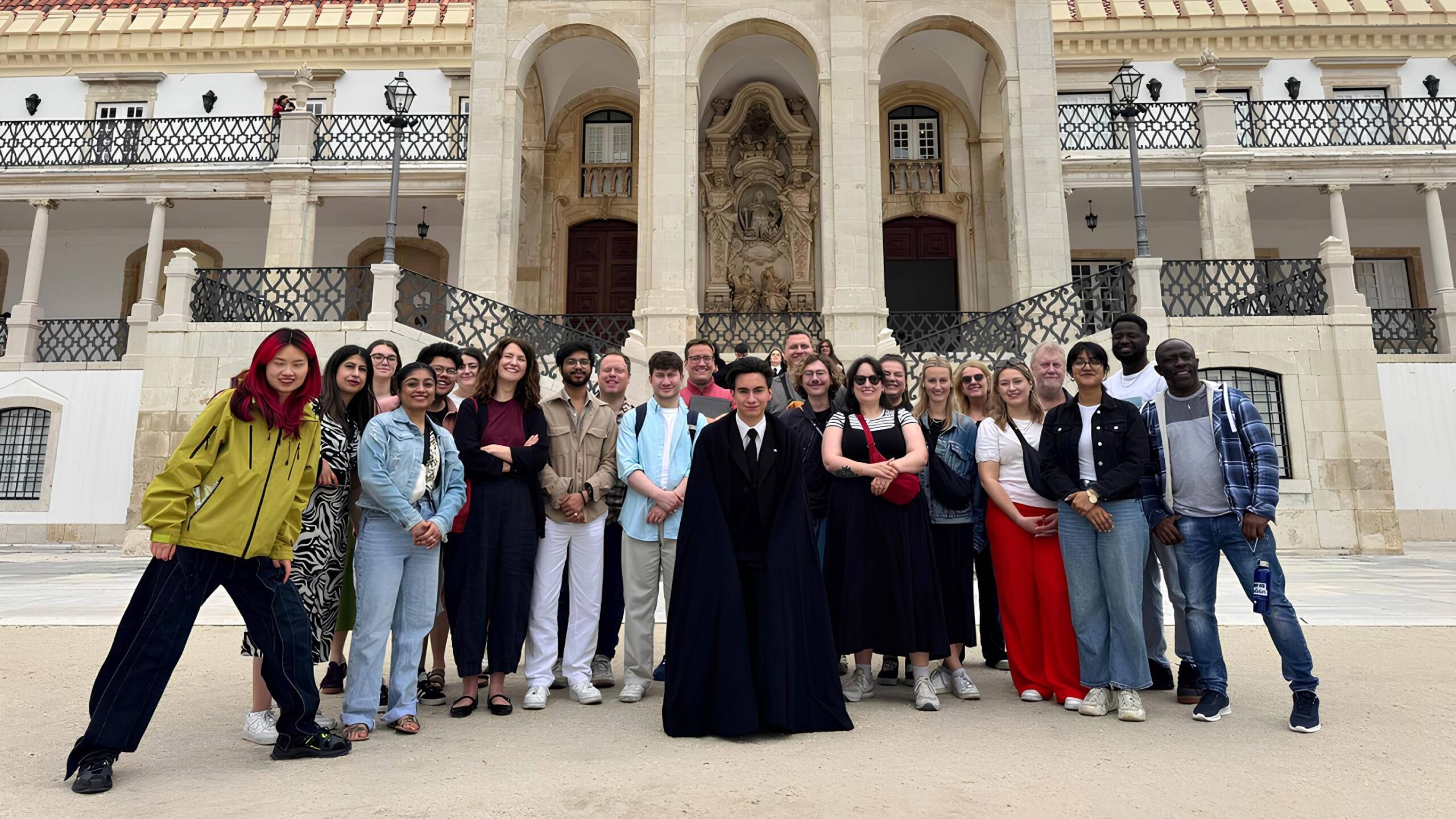
It was one of the many issues we ended up discussing on our two-day study tour to Portugal, where 30 UK student leaders (and the staff that support them) traversed Lisbon, Coimbra, Barcelos and Porto to build connections, share ideas and identify solutions to the problems besetting both students and the higher education systems in which they are partners.
So many of the issues faced by students sounded familiar – the obvious difference each time being that at least the Portuguese government is trying.
Its National Higher Education Accommodation Plan (PNAES) launched in 2022, and aims to deliver over 18,000 new student beds by 2026 with a €486 million investment. Then in September 2024, Prime Minister Luís Montenegro’s “Student Accommodation Now” emergency programme added 709 beds, and a €5.5 million credit line was established for universities to secure additional housing – all because the failure to provide housing “frustrates people’s efforts” and “stifles their ability to develop their talent”. The Prime Minister put it like this:
It is repugnant, from a civic point of view, that a student can battle for twelve years to enter higher education, only to find they cannot attend because they have nowhere to stay near the institution that accepted them.
In one of the groups I was in, one of the student leaders asked us what our own politicians had said about student housing and its role in educational opportunity, and what was in our countries’ student housing strategies. Our delegates’ faces turning blank, I had to admit that the the closest we’d got to a plan back home was former minister Robert Halfon repeatedly saying that it wasn’t his problem and was actually students’ fault:
…the government has no role in the provision of student accommodation…applicants who require student accommodation should take its availability into account when making decisions about where to study.
Housing isn’t the only thing they’ve been working on in Portugal. In 2022, the government set up an independent commission to evaluate the implementation of its Legal Framework for Higher Education Institutions (RJIES) – their equivalent to England’s Higher Education and Research Act.
Led by an 8-person panel that included two student reps, the commission’s recommendations included the creation of a single, consolidated legal instrument – a Statute for higher education students – that would define their rights and duties clearly and comprehensively, standardise protections across all institutions, and recognise the diversity of student profiles (including student workers, student parents, and students in volunteer roles).
Mental health was also prioritised – the Commission recommended strengthening support through dedicated student mental health services integrated into broader academic and social support strategies, and the revised RJIES now explicitly includes a duty for higher education institutions to contribute to student wellbeing, and specifically mentions their responsibility to guarantee mental health services. Universities will be also expected to hit psychologists:students ratios.
The Commission found that while student participation is formally recognised, in practice it can be marginal or symbolic – and recommended ensuring real, effective participation of students in institutional governance (General Councils, Academic Senates, Scientific and Pedagogical Councils), strategic planning processes, and evaluation and quality assurance activities.
The resulting arrangements will strengthen student voting power significantly – in the overhauled election process for rectors and presidents, students will hold at least 20 per cent of the weighted voting power.
And the new law explicitly details the competencies and election process for student ombudspeople – Portugal introduced university-level complaints adjudication in 2007 to tip the balance towards students, and will now mandate consistency in the role and broader student participation in their election.
Given the distance (both in time and governance) of the OIA from students and their problems, and the sorry state of independent adjudication in Scotland and NI, we really do now feel miles behind as a country on student rights protection.
After a visit to the (very) student city of Coimbra, the bus rolled into the Barcelos campus of the Polytechnic of Cávado and Ave – Portugal’s newest public higher education institution. IPCA had been formed as part of a national strategy to expand and decentralise higher education in Portugal – with regional provision aimed at driving regional development and addressing the need for skilled professionals in emerging industries.
The student leaders we met both from IPCA’s SU and FNAEESP (the National Federation of Polytechnic Higher Education Student Associations) were exercised about RJIES reform – partly because the status of polytechnics had become a key issue in the debate.
We tend to bristle at mentions of a binary divide, but Portugal maintains one – and FNAEESP reps were clear in their position, firmly favouring preservation with what they called “sharper clarification” to ensure polytechnics maintained their focus on vocational, technical education and practice-oriented research.
They also pushed for a “symmetrical structure” where both types of institutions would face equivalent requirements without compromising their distinct missions:
The polytechnic sector isn’t asking to become something it’s not… we’re asking for recognition of what we already are – institutions providing high-quality technical and professional education that drives regional development.
When we explained that our abolition of the binary had happened over thirty years ago, one of the reps perceptively asked us if that had raised the profile of the provision, or just hidden it. When we then explained the way in which large parts of the UK’s politics seem to ignore the technical and professional provision on offer in the sector – centring their critiques about “too many students at university” in assumptions about what a “university” is – we got a wry smile.
The upshots in Portugal are that the binary divide will be maintained but made more flexible, allowing polytechnics that offer doctoral programs to adopt the title “Polytechnic University” while preserving their focus on advanced technical education and applied research for regional development.
That will come with stricter requirements – including improved staff-to-student ratios (one PhD holder per 20 students instead of 30) and a broader range of degree offerings that maintain an applied, professional focus – and the updated RJIES framework will preserve the distinctive applied mission, partly to maintain public understanding and support for the investment that part of the system needs.
Even in huge universities like the University of Lisbon, the previous evening we’d seen a similar commitment to the prominent status of technical education. Opposite Team Wonkhe’s hotel was Técnico, which we’d only realised was the university’s Science and Technology faculty when leafing through a strategy brochure. The brand police would never let that happen in the UK.
Its stunning Alameda campus is located at the top of the hill overlooking Fonte Luminosa, and was designed just as António de Oliveira Salazar’s Estado Novo regime was keen to build symbols of national pride and progress.
But during the dictatorship, the SU building had become a central hub for meetings, discussions, and coordination of resistance to the authoritarian government – which forced anyone who wanted to work in academia to be vetted by the political police, who had the right to arrest anyone deemed to be against the regime.
For a long time higher education had not been an instrument for growth or for people to improve their lives and prospects, but was about maintaining the hegemony of the ruling upper class. Even when Estado Novo eventually opened up universities to a broader range of the population, centres of research were created outside the universities so that young people would not get any new ideas.
Fernando Rosas, one of the founders of the socialist party Bloco de Esquerda, recalls 4 December 1968, when students broke into a building and had a “political picnic” to protest against the terrible food in the cafeteria:
That day, I woke up politically. Until then I had not been interested in such matters. But I heard the speeches about nutrition and the colonial wars, became an activist and later one of the leaders of the student union… what we in the student union did was part of the foundation of the military movement that then led to the revolution. We trained them to be engineers but also taught them to fight for freedom.
Photos up around the building tell the tales of struggles to end daily oppression, ensure universal access to education, healthcare, and political rights, and build a fraternal, inclusive and participatory society. After the Carnation Revolution at Tecnico, students’ votes carried equal weight to teachers, with student groups collectively voting on grades despite teacher assessments being reduced to suggestions:
We gained freedom to design our own curricula and research without fear of imprisonment or censorship.
Today the demonstrations might be gone, and on Thursday’s evidence we can’t say that the food has got much better – but the spirit of democracy lives on. Reforms to the curriculum at Tecnico introduced amidst austerity (which we look at elsewhere on the site here) focus on interdisciplinarity and student choice, with student associative activity – sharing power with eachother and with the university – embedded carefully into every level of the student experience, from programme to faculty to university to city to country to continent.
At the central university level, three of Lisbon’s values are familiar – intellectual freedom and respect for ethics, societal innovation and development, and social and environmental responsibility – but when we spoke with vice-rector João Peixoto, a less familiar fourth emerged as something just as important:
Students are part of the power system – they have a say, they have votes, and we cannot ignore them…democratic participation is not just something we say; it’s something we do, every day, in every council, with every voice heard.
Students across the university have voting rights, sit on councils, shape curricula, and deliver through students’ associations a large part of what we’d give a professional services department to “provide” – not as guests or consumers, but as citizens of the university community:
Our history reminds us: students fought for democracy in Portugal, and today, they still have a seat in deciding its future.
The way that culture had paid forward into the future culture of the country was vivid in Portugal’s history. That culture’s relative weakness, dismissal and continued erosion in the UK’s system should cause us to worry a lot about our future.

The University of North Carolina at Chapel Hill’s provost is stepping down next month to return to the faculty there, a development that news articles last week suggested is tied to his disagreement with hiring practices at the School of Civic Life and Leadership, or SCiLL.
In a statement Friday to Inside Higher Ed, Chris Clemens, the outgoing provost, said, “I made the decision to step down as provost. During my time as provost, I’ve been able to address challenges I care deeply about and make meaningful progress. However, the issues that have arisen in recent days are not ones I can solve, and I don’t feel the same passion for them.”
His statement didn’t explain what these recent issues are, and Chapel Hill spokespeople didn’t provide further information beyond campus chancellor Lee Roberts’s April 3 announcement that Clemens had decided to step down.
Clemens will return May 16 to being the Jaroslav Folda Distinguished Professor of Physics and Astronomy, Roberts said in that announcement. Clemens has been provost since early 2022, starting under former chancellor Kevin M. Guskiewicz, who’s now president of Michigan State University. Roberts credited Clemens with, among other things, helping establish the School of Data Science and Society, the Program for Public Discourse, and SCiLL.
SCiLL was established after Chapel Hill’s Board of Trustees passed a resolution in January 2023 asking the campus administration to “accelerate its development” of this new school. The then–board chair called SCiLL an effort to “remedy” a shortage of “right-of-center views” on campus. Controversy quickly ensued. Faculty said they didn’t know a whole school was in development.
The Republican-controlled State Legislature then passed a law requiring Chapel Hill to establish the school and hire 10 to 20 faculty from outside the university, plus make them eligible for tenure. It became one of many civics or civil discourse centers—critics have called them conservative centers—that Republican lawmakers and higher education leaders have established at public universities in recent years.
In January 2025, Clemens canceled the latest SCiLL tenure-track faculty searches before reversing course days later. Articles in The Assembly and the conservative Real Clear Investigations have now implied that Clemens’s departure was connected to his involvement in the disagreements over hiring within SCiLL.
Clemens, a self-described conservative, had been an advocate for SCiLL. The Real Clear Investigations article was titled, before the headline was changed, “In North Carolina, Academic Conservatives Have Met the Enemy and It Is … Them.”
In his Friday statement, Clemens said, “I look forward to returning to the faculty to resume work on optical design technology, with a particular focus on applications for the SOAR telescope and astronomy. This will allow me to spend more time in the classroom—an aspect of academic life I have greatly missed.”

This week on the podcast – recorded live at our Secret Life of Students event in London – we get across the financial crisis facing universities in Scotland. Can the SNP hold its “free education” line forever?
Plus there’s clips, highlights and reflections from our Secret life of Students event in London – where we’ve been discussing student health, what students learn, the time crunch that prevents meaningful engagement and what universities can do to “make the space” to innovate in the student interest.
With Jimena Alamo, President at University of Bath Students’ Union, Mark Peace, Professor of Innovation in Education at King’s College London, Debbie McVitty, Editor at Wonkhe and presented by Jim Dickinson, Associate Editor at Wonkhe.
Additional £10m funding from the Scottish Government
Breaking out of Borgentown – the case for hope in higher education

Postcard views, luxurious watches, delicious cheese and chocolate — the country that comes to mind is idyllic Switzerland in central Europe.
But this seemingly perfect country comes at a price: its high cost of living. According to Coop and Carrefour, two leading supermarket chains in Switzerland and France, one chocolate bar in Switzerland costs more than one and a half times as much as the same chocolate bar in neighbouring France.
“The price of chocolate with regards to its quality in Switzerland is fair and for me worth paying,” said Andrina Deragisch, a 17-year-old student of Kantonsschule Zürich Nord, a Swiss high school.
Chocolate’s price is affected by various factors, most importantly the price of the cocoa bean. Nowadays that is at an all-time high due to climate change, plant-affecting pests in Africa and East Asia and packaging prices and taxes. Its price is four to five times higher than a year ago, according to Migros, the second-largest retail company in Switzerland. But what makes the difference in Switzerland?
“The most significant factor is the labour,” says Richie Gray, global head of SnackFutures, the Corporate Venture Capital Hub of Mondelez that invests in businesses in the snack industry.
Workers in Switzerland are paid well, which makes them able to keep up with the high cost of living. This leads to a high-end price of chocolate in comparison to neighbouring countries. To avoid such high labour costs, Mondelez moved Toblerone’s production to Slovakia in 2023, imitating various international companies such as Nestlé and Barry Callebaut, that have shifted a great part of their production operations to Eastern Europe and Asia.
According to the 2017 “Swiss Manufacturing Survey“ from the University of St. Gallen, 46% of the interviewed firms are considering outsourcing parts of their manufacturing operations to China, Germany or Eastern Europe.
As a result, the Swiss manufacturing industry is seeing rising unemployment; the number of jobs has already fallen by 10% since 1990, and lower taxes from the international companies to Swiss authorities. In further development this leads to reduced purchasing power of customers and state incomes, weakening the country’s economy.
According to data from the Federal Statistical Office and the National Institute for Statistics and Economic Studies, the average Swiss person earns a little over 6,750 Swiss francs (CHF) monthly whereas in France, average wages are about 2,570 CHF a month. Switzerland counts as one of the best-earning countries in the world, creating a high-quality of life for its population.
According to Human Development Reports, Switzerland’s Human Development Index placed first among the whole world, providing wealth, comfort, material goods and exceptional healthcare and education.
High productivity and competitiveness shape the Swiss labour market, said Christian Gast, chief economist at Swissrock, an asset management company based in Zurich. “Switzerland is considered to be fully employed, with only 1.3% of the entire population having no job,” he said.
The demand for labour results in high pay. Moreover, when people earn more, they have more money to spend on products like chocolate.
Another factor is the strong Swiss franc. The European Central Bank reports that the exchange rate between the Swiss franc and the euro has constantly increased from 0.87 EUR per Swiss franc in 2018 to around 1.06 EUR per Swiss franc today.
“If you’re coming from another country, you need more of your own currency to buy a Swiss franc,” Gast said.
But what makes the Swiss currency so strong?
“Our fiscal policy is strongly regulated,” Gast said. “This means the expenses of the government are largely balanced with its incomes.”
If there is a stable relationship between expenses and income, there is little debt result and interest rates remain low. This makes Switzerland attractive to international investors. Purchases are made within the country, boosting its economy and simultaneously its prices.
However, where does Switzerland’s well-working economy with excessive prices for services and products originate from? The small country in the heart of Europe with no environmental advantages developed into a financial powerhouse with banks as its mines.
According to the Swiss Bankers Association, Swiss banks held over a quarter of all assets present in all the banks across the globe in 2018. This means that 27.5% of global revenue, amounting to US.$6.5 trillion was stored in Swiss banks.
“There are barely any countries with more international banks than Switzerland,” Gast said. Since World War II, countless wealthy people have chosen to store their money in Swiss banks as Switzerland has a proven track record for its secrecy, neutrality and stable political system.
But wouldn’t there be frustration towards such high living costs among the population? On average, prices in Switzerland are 58.4% times higher than in the rest of the countries in the European Union. Consider that in the United States, Donald Trump won a second term as president in part because he promised lower prices and affordable living costs. However, Swiss people tend to accept the high prices in the country since the quality of life is also so high.
Additionally, the inflation rates in Switzerland are low — the price level has been relatively constant or only increasing minimally. According to the Federal Statistical Office, inflation rates were only at 1.1% in 2024, whereas in the United States it was at 2.9% in December 2024. People in the United States are displeased with the sudden higher prices which means they want a solution to solve this. At the same time, Swiss people have not experienced a drastic change and therefore are not as keen to make prices lower.
As Swiss people consume around 10kg of chocolate per person each year, there’s no doubting its popularity. We are both very fond consumers of Swiss chocolate and eat at least one bar of chocolate a week. The sweetness and comforting feeling of chocolate melting on your tongue is a sensation nobody can resist.

Arguably, the most recognisable example of translational research in recent years was the swift development and rollout of the COVID-19 mRNA vaccine. The world was waiting for this research to meet its real-world ambition. Many members of the public would recognise that some of this research was undertaken at Oxford University and, with some exceptions, would also recognise the beneficial impact of the vaccine for both individuals and society. Following the rollout, there was even a public discussion that touched upon the idea of interdisciplinarity. How could the benefits of the COVID-19 vaccine be communicated to communities who felt reluctant to have the jab or distrustful of medical science?
However, there was another piece of research that was translated into real-world effect with serendipitous timing.
In 2013, Professor Andrew Ellis was working at the Aston Institute of Photonic Technologies. Ellis had previously worked at BT, where his observations and experience suggested that the ‘capacity’ needed in the telephone infrastructure had and would increase consistently over time and was consistently underestimated. Ellis recalls an ongoing refrain of ‘surely we have enough capacity already’. This continued to be true once the copper phone lines were used to deliver data for home internet usage.
At this point, most residential properties were on ADSL (Asymmetric Digital Subscriber Line) internet connections. That is where copper wires are used to deliver broadband internet. Homes were typically working at speeds of around 8 megabits per second (Mbps).
The Government had developed a strategy setting out that the majority of residential properties should be able to work at speeds of ‘at least 2 Mbps per second and 95% of the UK receiving far greater speeds (at least 24 Mbps) by 2017’. Fibre broadband was beginning to be rolled out, which used fibre optic cables to transmit data much more quickly. However, these fibre optic cables were generally only used to reach the street cabinet, with copper wires connecting the street cabinets to individual homes, restricting the broadband speed that could be achieved.
From his previous work, Ellis could see that this ambition was neither competitive internationally nor of sufficient use long-term when demand for emerging applications was taken into account. He demonstrated that capacity was falling well below the predicted need and that the UK was slipping down the league table for connectivity in economically developed countries. Estonia, Poland, Korea and Norway were all streaking ahead.
Ellis contacted MPs working on this strategy via the Industry and Parliament Trust. Two breakfast meetings and a dinner meeting were held to discuss the lack of ambition in the strategy. However, only the fortuitous attendance of a senior civil servant at the dinner meeting led to a policy breakthrough. Further momentum and publicity were generated by a meeting organised by the Royal Society to discuss ‘Communication networks beyond the capacity crunch’, including a presentation by Dr Andrew Lord.
Ellis was lobbying for an increase in ambition. There was resistance to this as there was no additional money to spend on improving infrastructure outside of the spending review cycle. Ellis convinced the Government that no additional spending was needed to change the ambition. Changing a number in a policy document wouldn’t (on this occasion) cost the government any more money. (The terms ‘pure-fibre’ and ‘full-fibre’ were also coined at these meetings, meaning using fibre optics cables to the street cabinet and from the cabinet to individual homes.)
With the Government changing their ambition, providers such as Clear Fibre, Gigaclear and BT Openreach would need to improve the infrastructure to deliver faster broadband to our homes.
It was estimated that upgrading the whole UK to full fibre would cost £40-60 billion as part of the EU-funded Discus project. Research by the AiPT team showed that it would be closer to £8-10 billion if the network was reconfigured according to their research proposals, a one-for-one replacement of network equipment from copper to fibre-based ones. Further, research demonstrated that fibre is also more energy efficient.
Optical networks were using about 2% of the electricity in the developing world. (Ellis explained that BT objected to this figure, stating that it was, in fact, 1.96%!) Not only was a full-fibre network faster, it was also more energy efficient. (This now pales in significance to the energy consumption that will increasingly be needed to power AI data centres.)
BT began rolling out full-fibre broadband to 80% of the UK. In 2019, BT hired heavily for this work, much of which was completed in the first few months of 2020. The increased activity and presence of BT vans helped fuel the 5G coronavirus conspiracy!
In a moment of serendipity, this meant that by the 23rd of March 2020, when the then Prime Minister, Boris Johnson, announced the first lockdown, there was enough access capacity for many of us to begin working at home. As we got used to Zoom and Teams, multiple people were using video calls in one household for work and homeschooling. Not only did this allow for a relatively smooth transition to remote working, but it allowed our children to continue accessing their education and for us to keep in touch with friends and family (Zoom quiz, anyone?) The societal shift to remote working, prompted by lockdowns but enabled by full-fibre, remains both contested in terms of productivity and profound in terms of impact.
I asked Andrew what challenges he faced when trying to inform industry and policy of his research. He noted three key barriers:
Whilst the success of the COVID vaccine development may have made global headlines, the work of the AiPT’s team (Andrew believes that others lobbied on the same topic, including Professor Dimitra Simeonidou at the University of Bristol, Professor Polina Bayvel CBE at University College London and Professor Sir David Payne at Southampton University) quietly allowed many of us to continue working and to be connected to our colleagues, friends, and family throughout the pandemic. Further, as Professor Sarah Gilbert, Professor of Vaccinology at the Jenner Institute and lead scientist on the vaccine project, explains, the ability to work remotely with trial volunteers (giving them information via video instead of in-person presentations) and collaborating with colleagues across the globe was vital in the vaccine production itself.

In Spring 2023, 150 students from humanities and social sciences at our university stepped up to share something deeply personal -their reasons for pursuing higher education.
Through brief, heartfelt recorded monologues, they opened a window into what university truly means to them.
We ended up with nearly 160 pages of raw, unfiltered transcripts. Inspired by the power of verbatim theatre, where authentic dialogue bridges the gap between characters and audience, we have curated a collection of student voices.
These firsthand accounts cut through the cliches narratives often associated with university life. Instead, they reveal the real stories, struggles, and aspirations driving students forward in today’s complex world of higher education. This is their voice, their truth, shared directly with you.
From “screaming at the back of the car” and “crying tears of joy” to “relief” and “apprehension”, we got a glimpse into the rollercoaster of emotions students felt when they got their university acceptance letters.
For most, it was the first big decision of their adult lives, and it was not an easy one. One student said:
…going to university was the scariest and the best thing, the best decision, that I’ve made so far in my 19 years of existence.
Another felt the decision to enter higher education was made:
…not with trepidation as a reasonable person [but] with courage and self-assuredness that only ignorance and youth can bestow in such abundance.
Dealing with such conflicting emotions is rarely simple. So, it is not a surprise that some of the surveyed students thought about dropping out, especially in their first year. They found their degrees “boring” or “very difficult” or wondered “was the amount of work something I was prepared for?”
A recurring thread in many students’ reflections during this study was the dilemma between entering the workforce immediately or pursuing higher education. No doubt pursuing higher education is largely viewed as the “only option towards a better paying career” and a “comfortable job without a lot of physical demands”.
While some of them questioned whether university “is worth all the debt”, most agreed that the skills acquired through higher education are crucial for getting “further in life” and earning “more than the minimum wage”.
But their testimonies revealed other considerations that go beyond material gains and jobs prospects.
In our survey, students made it loud and clear – it is also about the love and passion for what they do. “Studying what I truly love”, “something I’d enjoy studying every single day of my life”, and chasing that “passion and interest to grow as a person” often took priority, leaving material gains or “just getting into a certain job” in the background.
Just working a job for working sake didn’t feel like a good use of my time.
Students, while contemplating their future, felt that:
…university does feel like a good safety net to hop into… [the] perfect avenue to give myself more options to explore different careers.
We also saw several students entering higher education determined to “dig, dig, dig [to find out their] passions”.
For some students, university felt like a “clear, logical” move toward their career goals. For others, it was more than a decision – they felt it was “compulsory” or even a personal “duty”.
There were also students who approached their university pursuits with less conviction.
I didn’t have anything else to do, so I ended up going to university.
I was not ready for the 9 to 5 life.
When else in my life would I be able to just decide to move away [from home] and receive funding from the government to help me?
Some expected higher education to create for them “a pathway towards finding some meaning in my life”. Others choose their university because its name was the same “as my great grandmother’s”.
As we see when it comes to university studies, students bring a whole mix of ambitions to the table. So, it is no surprise that choosing a subject or a university is a deeply personal issue influenced by several factors.
Among these, university rankings often emerged as a decisive factor. Many students associated high rankings with better career prospects, with one stating:
…it is a lot more important where the university stands in ranking over what degree you’re doing.
Another shared:
I wouldn’t have been able to live with myself if I hadn’t at least tried [to enter an Oxbridge institution]
…highlighting the importance for them of the prestige tied to certain universities. This sentiment was echoed by another student who observed:
…people were looked down on if they didn’t apply to Oxford and Cambridge.
However, it is worth noting that some students in our sample cautioned against making decisions based solely on rankings. They acknowledged that prioritising rankings over programme suitability can lead to dissatisfaction.
I realised that I can’t force myself to like a subject or excel in a subject that I don’t enjoy.
…one student reflected, emphasising the importance of choosing a programme aligned with personal interests and strengths. Others recognised that decisions “purely because of rankings,” without considering the nature of the programme, may result in regret, as students risk enrolling in courses they ultimately dislike.
Reading through the transcripts, it became clear that students do not make their choices in a vacuum. Instead, they are influenced by a network of factors, including family, friends, mentors, and the vast array of information available online. These influences collectively shape the way students see their future and guide their decisions.
Family, as expected, is a primary source of influence and will be discussed in detail in a separate section. Friends, however, also play a significant role. As one student shared:
…it feels like you are doing something big with your friends [from which you] didn’t want to be left out.
Mentors were another important factor. One student explained:
…before coming to university, I spoke to people who were in the positions that I wanted to be in,”
…highlighting the impact of role models on their decisions. Additionally, many students turned to platforms like YouTube for guidance. One student described their process, saying:
I watched so many videos… YouTube videos on people’s experiences in different towns from Manchester to London to Liverpool, to Bristol to Birmingham.
This underscores the significant role of online content in shaping their choices.
Surveyed students also highlighted factors such as facilities, location and the associated lifestyle as significant influences on their university decisions. One student remarked that it was more important studying in London than having a good university ranking.
Since all students surveyed for this project were studying at a London institution, their comments frequently referenced the “dynamic lifestyle” of London, described as “the place to be” where “everything is happening”.
For many, being in London was about more than academics. It was about the opportunity to “see new things […] and explore different cultures”, “take part in so many events”, live in a place which is “buzzing 24/7” where they can “randomly, spontaneously […] see Wicked”, reflecting the unique cultural vibrancy that London offers.
Prospective students were looking for everything that matters to them, and this highlights the importance of providing students with proper guidance to navigate wisely the labyrinth of educational choices.
Several students commented on the importance of universities’ open days. Initially perceived as an “excuse to have a day off school”, one student recounted that it was during an open day that university became a “real option” for them.
Surveyed students express enthusiasm for these events, describing them as the “first actual experience” and an opportunity to “envision my new life”. During these visits, they engaged with current students and staff, feeling “the passion within the department”.
More importantly, they feel heard. As one student remarked:
[I got the opportunity] to talk about things that interested me with someone that was interested in hearing my perspective.
University has given me the space to explore who I am as a person.
To these students, university was the bridge to adulthood. It was for them the place to find “freedom” and “independence” – two words frequently encountered in the transcripts of their recordings.
They leave home with some apprehension, that is true, but they embrace it. And they “love that element of university”, are “really excited for the independence that university promised”, and “do not regret it”. Many viewed university as the opportunity to “learn how to live life without living with your parents”. It is striking to see so many young people eager to learn
…important life skills such as cooking, cleaning, and shopping.
University has given me the space to explore who I am as a person.
Expressions such as “get out of my shell”, “without hiding in the closet”, and “without feeling scrutinised by my parents” frequently appeared in the monologues. Moving away to study at university provided a unique opportunity to embrace independence.
As one student put it, university offered the chance to “do what I wanted to do, how I wanted to do it, exactly when I wanted to do it”. Several of the students in this study deliberately chose universities far from home, often making these decisions “without telling my parents”.
For the young individuals in this study, university is seen as more than just an academic journey. It represents a transformative space for personal growth. It is described as a place to “grow as a person in terms of independence, but also experiences”.
Students also view university as a setting that provides the “freedom and encouragement to be myself, fully and unapologetically, both personally, professionally, and creatively”.
While friends, mentors, and lifestyle factors shape many aspects of students’ choices, family remains a key part of the narrative. From these monologues, we see its role as both inspiring and constraining.
Constraining in that students appear to enter higher education out of guilt or obligation to their families.
One student mentioned pursuing higher education studies due to “the cultural aspect and expectation within my family”, another to make “the family proud and happy despite not sharing the sentiment”, and another simply because it is “what my family wanted me to do anyway, so… I just end up doing it”.
The desire to enter higher education was coerced by a feeling that otherwise they would have “wasted everything that my parents have done for me”, and “disappoint them”, and that “would have been the worst thing”.
Prior academic attainment of family members was also sometimes perceived as limiting students’ choices. In terms of degree choice, students mentioned that families with a background in certain fields “wouldn’t agree with me exploring [other] degrees” and “I feel like my parents just don’t understand that there are opportunities outside of this field”.
Other students whose families had completed higher education claimed that their decision to join university was so that they would not be the “odd one out” or to prove that ”they are not dumb”, and that their intellectual ability reflects “somehow that of my family’s or my post-code’s”.
My mum always wanted me to have a lot more. More choice in my life and so university really allows me that.”
Family can also serve as a source of power and inspiration, fueling students’ academic journeys. Many said their family’s academic achievements and backgrounds inspired them to join university and choose specific subjects.
One student cited the “admiration” for their grandfather’s life and job as “primarily the reason” to choose their subject. Another passionately spoke of wanting to “follow my parents’ first steps”. Another enthusiastically praised their parent’s commitment “to spend whatever they have saved in their lives to afford what they think is important” for their children.
It was been fascinating to see what university meant for students whose family did not attend university. To them university was the opportunity to “take advantage of opportunities many of the members of my family didn’t have”, as “it was just seen as something unattainable for us of this economic class, race and learning difficulties”.
The dialogues shared within families hold immense power. In these intimate moments, life altering decisions often take shape. A student recalled their mother’s wisdom:
…university is not just about getting that qualification […] It’s personal worth. And once you have that education, no one can take it away from you.
Another reflected on the life-story of their mother, her unfinished studies, and the aspirations that span generations:
Oh child, you know when you graduate, it’s going to be like I’m graduating as well […] which I guess is true because the amount of support that I had from my mum and my family has been like insane.
I can go to university so I can get one step closer to my dreams.
For some of the students surveyed, university was more than a path to knowledge – it was a journey for recognition, a way to overcome societal barriers, and to “fulfil [their] dreams in life”.
One student said their studies will help them reach “the standing in society” they think they deserve, and will allow them “to be taken more seriously”. A student with a disability told us it is a means to “overcome low expectations that people in the society have for people like me”.
For this student, it is their “liberation mechanism” to “escape the oppression that I felt I was facing and move my life towards a more success-oriented trajectory”.
In their testimonies, students expressed dreams of becoming Supreme Court judges, CEOs, working in politics or international organisations. They acknowledged that without university education, as one student said,
…I just didn’t have the confidence to dream big
…I do feel proud when I say hey, I’m a [. . . ] student. It’s kind of nice when people are like, wow!
Reading the transcripts felt like tuning into the unfiltered thoughts of students standing at the crossroads of their academic and professional lives. Their stories form a vivid tapestry of dreams, ambitions, and doubts about joining university each one unique, each one unfiltered.
Our aim was not to evaluate their motivations or rank the importance of the influences they shared with us. Instead, we gave space for their voices to be heard. Because listening to these stories matters.
It reveals the beautiful complexity behind their decisions and helps us understand them better. And perhaps, it will inspire us to create a learning environment that truly supports them, one that meets them where they are and helps them get where they are going.
We would like to thank Lyubomir Vasilev for valuable research assistance and helpful comments and discussion. Financial support for this project was provided by the Queen Mary University of London’s Westfield Fund for Enhancing the Student Experience. Authors: Dr. Emmanouil Noikokyris, Reader in Economics and Finance Education, School of Economics and Finance, Queen Mary University of London; Emanuela Nova, Strategic Project Manager, School of Economics and Finance, Queen Mary University of London