Tag: List

  • Dartmouth Joins Growing List of Elite Universities Rejecting White House Academic Compact

    Dartmouth Joins Growing List of Elite Universities Rejecting White House Academic Compact

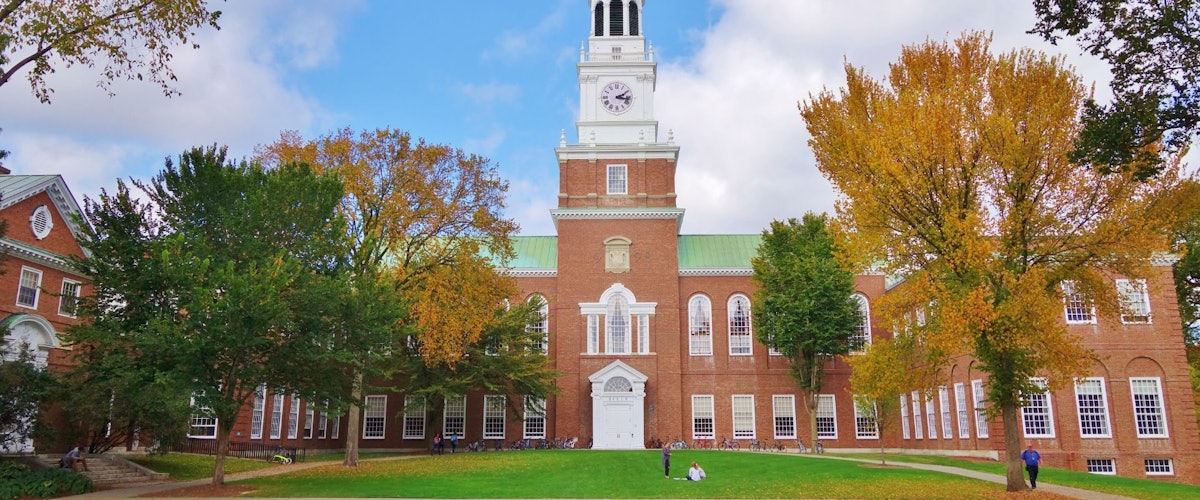
    Dartmouth CollegeFile photoDartmouth College has declined to sign the Trump administration’s “Compact for Academic Excellence in Higher Education,” becoming the latest prestigious institution to prioritize institutional autonomy over preferential federal funding access.

    In a statement released Saturday, Dartmouth President Dr. Sian Beilock firmly articulated the college’s position ahead of Monday’s deadline, emphasizing that governmental oversight—regardless of political affiliation—represents an inappropriate mechanism for directing the mission of America’s top research universities.

    “I do not believe that the involvement of the government through a compact—whether it is a Republican- or Democratic-led White House—is the right way to focus America’s leading colleges and universities on their teaching and research mission,” Beilock stated.

    The compact, extended to nine select institutions, promised enhanced access to federal research dollars in return for compliance with several administration policy mandates. These requirements included adopting the administration’s gender definitions for campus facilities and athletics, eliminating consideration of race, gender and various demographic factors from admissions decisions, and restricting international student enrollment.

    Despite rejecting the compact’s terms, Beilock expressed openness to dialogue, indicating her willingness to explore how to strengthen the traditional federal-university research partnership while maintaining higher education’s focus on academic excellence.

    The decision followed significant campus pressure, with nearly 500 Dartmouth faculty members and graduate students signing a petition advocating for rejection, according to the Valley News.

    In her statement, Beilock emphasized the fundamental principle at stake: “Universities have a responsibility to set our own academic and institutional policies, guided by our mission and values, our commitment to free expression, and our obligations under the law.”

    She framed institutional independence as essential to rebuilding public confidence across political lines and preserving American higher education’s global preeminence.

    Dartmouth’s decision aligns with rejections announced last week by peer institutions including the Massachusetts Institute of Technology, Brown University, the University of Pennsylvania and the University of Southern California, suggesting a coordinated defense of academic autonomy among elite research universities.

    Source link

  • You’re not on the list

    You’re not on the list

    The pause in accepting applications to the Office for Students register is to be lifted on 28 August and, as Jim Dickinson notes, new providers now have a whole set of extra conditions that will apply to them.

    As was spotted at the consultation, it will become odd that 430 or so “old” providers have less stringent rules than those who join the register afresh. OfS is very clear – the new rules protect students and taxpayers.

    Meanwhile DfE is suggesting raising the stakes of the register by requiring both larger providers who teach via franchise, and those who want to deliver courses funded by the Lifelong Learning Entitlement (LLE) to join the register..

    Why a Register?

    One of the enduring regulatory mechanisms of English higher education is the list or register. From the outset of the regulated and funded system after the First World War there’s been a list that you needed to be on. These were invariably linked to hierarchies of status and funding. There were criteria with serious cut-offs: getting on the UGC funding list, making the list to be one of the colleges of advanced technology, or one of the polytechnics, or one of the colleges to be incorporated (and funded by PCFC) or to be allowed onto the HEFCE list.

    The intention with the OfS register was slightly different. It was both more encompassing, many more providers were due to join, including those that didn’t want funding (or the encumbrances of funding) as there was no opt out. But it turned out that you could opt out; many providers have existed (some might say flourished) outside the register via the franchise route. Even benefits that were supposed just to be for those on the register – say the use of “university” in your title – have been granted to providers not on the register.

    What’s recently vanished is the idea of a new (possibly lighter touch) category of registration for providers to offer the LLE. Back at the start of the OfS a registered (basic) category fell away. Given concerns about the behaviour of a few providers in the current registration categories, an Approved-lite wasn’t plausible.

    Consultation

    As you’d expect, the OfS says “We have decided to implement our proposals in broadly the form on which we consulted” There are tweaks, of course, particularly splitting out the initial tests on governance and management. These are at the heart of many of the problems we’ve seen – in particular how governance interacts with directors who may also be the proprietors of a for-profit business.

    Being on the register is a major kitemark: the guarantee of quality. The framing of the new conditions is that the old ones weren’t sufficient. We can see that the Department for Education has been working around the register – the replacement for the DET (the FE training course, which was the source of many problems) being limited to providers with degree awarding powers, and those without TEF Gold and Silver going through a tougher process to run LLE modules.

    A group of providers who have previously tried to get on the register will have to try again. OfS has stopped formally refusing applications.

    We can see some of the providers who now franchising were refused in the past and so could the Public Accounts Committee (who were not amused). OfS took the unusual step of publishing a case note on Oxford Business College’s application to register, clearly indicating there was no way they were getting on the list, but only after OBC had withdrawn their application and DfE turned off the funding taps. It’s worth noting that OBC’s purported governance arrangements (including a former VC as its chair) seemingly vanished away when it started to unravel. OfS has reduced the period before you can apply again, but it’s clear they want to stop half-baked applications.

    Leaving the Register

    There remains an issue in that it turns out that that threat of being removed from the register isn’t much of a threat if you are exiting HE and entering administration. OfS used the formulation “The provider no longer wishes to access the benefits of OfS registration” for the first colleges that left, Applied Business Academy as “The provider is no longer able to provide higher education” and Brit College as “The provider will no longer seek to meet the conditions required to remain registered as a higher education provider in England”. Brit, another registered provider, has had its courses de-designated by the DfE.

    If the loophole of providing HE while not being on the register is closed, then there will be plenty of pressure on the system. We’ve seen plenty of complaints about the time it takes to register and we will need to see whether OfS’ proposals make this better. OfS’s performance data does not record a time taken to resolve an application, but we’ve seen some take four years. Clearly they think that some providers are under-prepared for the registration process and also that they want to speed up the refusal (or forced withdrawal) process.

    We can only see some of the issues that OfS and DfE are dealing with; these new conditions and processes are designed to close loopholes. As an example, we saw OfS refuse registration to Spurgeon’s College because its finances were poor, only to have to admit them a few months later after they had secured a loan. Spurgeon’s is now in administration. There’s increased requirements for financial information in the application process. It’s hard to look at the list of prohibited behaviours linked to C5 on student fairness without imagining a lot of these have been reported to OfS at some point.

    Gas panic

    The OfS register sits in the background – on the web site this is literally the case as it lurks under “for providers” and “regulatory resources”. The way it manifests itself could do with a spruce up – the web version is marked in “beta” mode (as it has from 2022) and parts of the functionality and data need an overhaul. Checking the OfS register is never quite like looking up whether your engineer has a safe gas certificate, but an increasing number of students have found their HE experience has blown up.

    It’s hard to argue against protecting students and taxpayers, but the 429 providers already on the register should take a look at these conditions As Jim Dickinson notes there’s a challenge here on fairness for all providers and it’s hard to imagine that OfS won’t want to see both the fairness and governance and management aspects of the new E conditions apply to all providers pretty soon.

    Source link

  • Kansas Colleges Say Employees Can’t List Pronouns in Emails

    Kansas Colleges Say Employees Can’t List Pronouns in Emails

    Kansas public university leaders have ordered employees to remove “gender-identifying pronouns or gender ideology” from their email signatures. The officials say they’re complying with new state prohibitions against diversity, equity and inclusion.

    In March, the Republican-controlled Kansas Legislature passed Senate Bill 125, a nearly 300-page piece of budget legislation. The following month, Gov. Laura Kelly, a Democrat, signed it into law. A spokesperson from the governor’s office didn’t respond to Inside Higher Ed’s request for comment on why.

    According to a few lines on page 254, the Kansas secretary of administration must certify that all state agencies—including colleges and universities—have eliminated all positions, policies, preferences and activities “relating to diversity, equity and inclusion.”

    SB 125 also specifically requires the secretary to certify that agencies have “removed gender identifying pronouns or gender ideology from email signature blocks on state employee’s [sic] email accounts and any other form of communication.” The law doesn’t define DEI or gender ideology.

    Kansas isn’t the first state with a GOP-controlled legislature this year to pass nonfinancial public higher ed provisions by inserting them into budget legislation. Among other things, Indiana lawmakers required faculty to undergo “productivity” reviews and post syllabi online, and Ohio lawmakers stressed that boards of trustees have “final, overriding authority to approve or reject any establishment or modification of academic programs, curricula, courses, general education requirements, and degree programs.”

    Ross Marchand, program counsel at the Foundation for Individual Rights and Expression, told Inside Higher Ed the new Kansas law is unconstitutional.

    “No one knows how to interpret this, and it’s overly broad,” Marchand said. “And both of these issues are fatal for First Amendment purposes.”

    Citing the law, the Kansas Board of Regents issued guidance in June directing universities to comply by the end of this month. On July 9, Kansas State University provost Jesse Perez Mendez wrote to K-State’s campuses that “all faculty, staff and university employees—including student employees—are asked to review and update their signature blocks accordingly.”

    On Tuesday, the University of Kansas’s chancellor, provost and chief health sciences officer wrote to KU’s campuses that “all employees shall comply with this directive by removing gender-identifying pronouns and personal pronoun series from their KU email signature blocks, webpages and Zoom/Teams screen IDs, and any other form of university communications.”

    The leaders also warned against efforts to circumvent the ban.

    “Your KU email account is your only official means for sending emails related to your employment at the university,” they wrote. “Do not use an alternate third-party service, such as Gmail, to conduct university business or communications.”

    They told supervisors that “employees who have not complied with the new proviso by July 31 should be reminded of it and the deadline.” They told supervisors to contact human resources about those who continue to refuse—while also telling KU community members to “please consider submitting a Support and Care referral” if they “know of a student, staff, or faculty member who needs assistance as a result of this new requirement.”

    A KU spokesperson shared the university’s new policy banning pronouns from email signatures. While it broadly says it applies to “all employees and all affiliates that use ku.edu and kumc.edu email addresses,” it also says “this policy shall not apply to or limit or restrict the academic freedom of faculty.”

    Joseph Havens, a KU undergraduate student researcher who has he/him/his listed in his email signature, said fellow students are unhappy with the order and are now adding their pronouns in protest. He said he doesn’t know how this will go over after July 31, but “I’m kind of excited to see the drama.”

    Havens said listed pronouns help people to avoid assumptions, and helped him personally to avoid misgendering a professor. “It seems very likely to me that the university’s hands are tied on this,” he said. But “in a lot of ways it feels like they agree with it.”

    KU is “in some way complicit,” he said.

    Source link

  • College Employees in Kansas Can’t List Pronouns in Emails

    College Employees in Kansas Can’t List Pronouns in Emails

    College Employees in Kansas Can’t List Pronouns in Emails

    Ryan Quinn

    Wed, 07/23/2025 – 05:25 PM

    Lawmakers in Topeka, like those in some other state capitals, used a budget bill to order nonfinancial changes to public higher ed. DEI was the target this time.

    Byline(s)

    Source link

  • Brown fires new salvo in war against student journalist over list of DEI admins

    Brown fires new salvo in war against student journalist over list of DEI admins

    After news surfaced that the Trump administration plans to pull $510 million in federal funding from Brown University over its DEI programs, student journalist Alex Shieh had the chutzpah to identify administrators who appear to work in DEI through student newspaper The Brown Spectator. The university — which had already been investigating Shieh for the crime of publishing an interactive organizational chart — took aim at him again.

    Brown threatened Shieh with sanctions over his journalism, claiming the report on federal funding was “false” because the government had not yet told Brown of its plans.

    This, just weeks after Brown President Christina Paxson promisedBrown will always defend academic freedom and freedom of expression.”

    Making matters worse, this wasn’t the first time Brown came after Shieh for his journalism. On March 15, Shieh sent each of Brown’s 3,805 administrators a personalized DOGE-style email asking them what they’d done in the past week. He also asked them to explain how Brown students, who pay nearly $100,000 to attend, would be impacted if their role was cut. Ever since, Brown has had Shieh in its crosshairs.

    Tell Brown to Stop Railroading Alex Shieh

    Page (Two-Column)

    Every student deserves due process, and no student should face discipline for investigating institutional structures.


    Read More

    First, Brown launched a preliminary review into Shieh’s reporting, threatening him with a litany of charges, including one for “emotional harm” to the administrators on his email — an exceedingly broad and vague charge that runs roughshod over First Amendment principles. Brown also demanded he return “confidential information” he allegedly accessed without permission, while refusing to tell him what in his reporting was confidential.

    On April 7, just one day after he published the list of possible DEI administrators, Brown officially charged him with “misrepresentation” and “violation of operational rules.” How did he misrepresent himself? By identifying himself as a reporter in the email. Brown’s logic was that because it did not recognize The Spectator as an official student organization, anyone holding themselves out to be a journalist at The Spectator is a liar.

    The second charge was no better. The university argued Shieh had violated rules by accessing a university system and obtaining a report showing reporting relationships, both of which he was allowed to do. That report, Brown claims, included “non-public” information that no student is permitted to publish. How this should be a mystery is itself a mystery, as Google reveals org charts that are publicly available.

    FIRE wrote Brown a letter demanding it drop the misrepresentation charge and produce real evidence that Shieh accessed “non-public” information. We argued that the university’s refusal to abide by its own due process guarantees makes clear that what it really wants is to silence journalism it doesn’t like.

    In a testament to how little Brown values its own promises, the university replied that this targeted investigation into a student journalist was not a free speech issue. But despite this less-than-credible response, Brown actually did drop the misrepresentation charge. Good news, right? Not so fast.

    Rather than produce the requested evidence that Shieh had accessed private information, the university added a new charge, alleging Shieh violated its trademark policy by including the word “Brown” in the name The Brown Spectator, which he and others were helping to restart in April 2025 after it ceased publishing in 2014.

    Brown needs to cut its losses, drop the charges, and stop this chilling investigation into protected student expression.

    On May 2, FIRE wrote Brown a second letter, telling the school to knock it off.

    We explained that this new charge misrepresents trademark law and violates Brown’s free speech promises by attempting to use fair trade practices as a tool to censor non-commercial journalism about news and events taking place at Brown University. It is settled law that trademarks don’t trump the First Amendment or provide infinite control over a word (in this case, literally the word for a color), indeed, mark owners cannot stop the non-commercial use of their mark in a noncompeting industry. And nobody would mistake Shieh or The Brown Spectator for the official voice of Brown University.  

    Brown’s vendetta against Shieh has officially passed the point of Ivy League parody. Brown needs to cut its losses, drop the charges, and stop this chilling investigation into protected student expression. The university’s own promises demand it.

    Join us in calling for Brown to uphold the free press on campus.

    Source link

  • List of Schools Where Student Visas Have Been Revoked Increases to 46. Arizona State Tops List.

    List of Schools Where Student Visas Have Been Revoked Increases to 46. Arizona State Tops List.

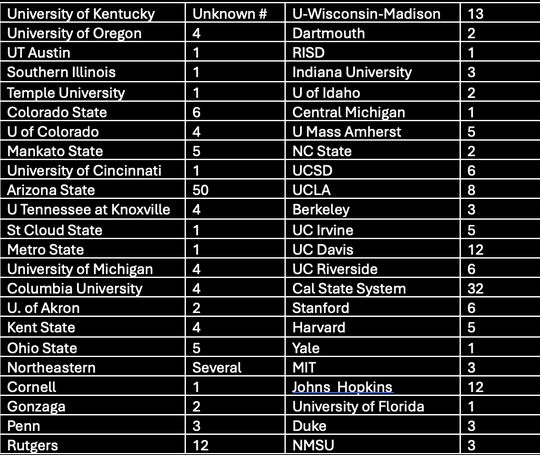
    According to WeAreHigherEd.org, there are now 46 schools where student visas have been revoked.  Arizona State tops the list at 50, followed by the University of Wisconsin-Madision (13), UC Davis (12), Rutgers (12), and Johns Hopkins (12) . The website includes profiles of a number of those students who have been detained. If you know of someone who has been abducted, you can report it here.

    Source link

  • Higher Education Inquirer Asks State Department for List of Student Visa Revocations

    Higher Education Inquirer Asks State Department for List of Student Visa Revocations

    The Higher Education Inquirer (HEI) has requested a list of more than 300 students who have had their visas revoked.  The State Department has acknowledged receipt.  We hope other media outlets will follow suit.  At this point, we only know of a handful of these cases.  We will keep the public informed as this story develops. 


    Source link

  • List of Government Contractors Involved with the Student Loan Portfolio

    List of Government Contractors Involved with the Student Loan Portfolio

    Thanks to Alan Collinge and Student Loan Justice for this information on government contractors for the US Department of Education’s Student Loan Portfolio. 

    Source link