Tag: listen

  • Skills England has a new way to talk about skills, and the sector needs to listen

    Skills England has a new way to talk about skills, and the sector needs to listen

    Although on one level tertiary education policy has never been more concerned with skills, we’ve never really had a proper understanding of what skills actually are or how they fit together with either jobs or courses.

    While – as a select and very well-informed group of attendees at The Festival of Higher Education were delighted to learn – there are any number of conceptualisations of what a skill (or a group of skills) might be, matching skills needs to jobs or to courses has never been easy to do in a reliable way.

    To be a bit less abstract, if we want anyone to train our future workforce we need to know what we want them to be trained in. And, not only do we not know that because we can’t predict the future – we also don’t know that because we simply do not have the vocabulary or frameworks of understanding we need to pose the right questions. Employers and industries cannot talk to course providers and prospective employees about this stuff because each of these groups has spoken a different language.

    Until today!

    Into this ontological hellscape comes Skills England. The release of the UK Standard Skills Classification (UK-SSC) – alongside a wonderfully whizzy UK Skills Explorer tool – is, in a quiet way, the most significant thing to happen to the skills landscape in a generation: not least because, for the first time we are able to see it.

    Before this, the skills landscape was, (at best) uneven. SOC codes helped us understand occupational requirements for jobs, SIC codes helped us understand the kind of work that goes on in particular industries, and HECoS codes gave us an understanding of what areas particular courses of study cover. All of this was useful, but none of it really linked together and – as you’ve probably spotted – none of it talked about actual skills.

    So what is a “skill”? Well, it might be “a capability enabling the competent performance of a job-related activity”: an occupational skill. Or it could be a more generic competence, “a fundamental ability that contributes to the capability to carry out tasks associated with a specific job”: a core skill.

    Skills England has identified 3,343 occupational skills (within 22 domains, 106 areas, and 606 groups). Occupational skills combine with knowledge (4,926 of these are defined) and core skills (just 13) to give someone the capability to do one or more of 21,963 identified occupational tasks.

    UK-SSC levels diagram

    So what?

    The existence of these definitions should make it a lot easier to translate employer and industry needs, into opportunities that strategic government support, and an offer of courses that satisfies these needs.

    Let’s give an example. Imagine the government decides that any future transition away from carbon-based power requires batteries and electrical components, and notices that we have quite a lot of the rare-earth metals and other minerals that we need to make these somewhere under the ground in the UK. We need to get them out, and we need to train the people that can do that. And we currently only have one school of mining with a little over a hundred students.

    Because we can map the UK-SSC to Standard Industrial Classification (SIC) codes, we can very easily run up a list of the key skills we need to train people in.

    [Full screen]

    That way, when we get to specifying what the new mining schools we are going to open actually need to teach, and we get to working with industry to decide what skills they need to do all this mining we have an agreed list. A starting point, sure, but one that saves a lot of time.

    You will note that this is not just training people how to dig stuff up. There are research jobs, planning jobs, management jobs, and a fair few design jobs that need to be done. The bar chart aspect here gives us an indication as to how important each skill is to employers in this industry.

    From specification to commission

    So if we know what skills we need, how do we get people training in them? Or do we have people training in them already?

    UK-SSC also maps to HECoS codes, which are the language we use in higher education to think about subject areas. So, to continue our example, let’s think about analysing mineral deposits – helping us figure out where to start digging holes.

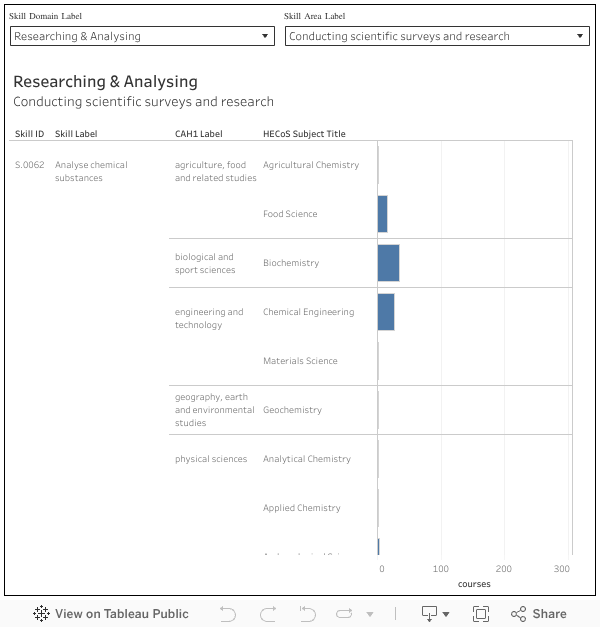
    “Analyse mineral deposits (S.0091)” is within the “researching & analysing” domain, and the “conducting scientific surveys and research” area. And we can use one of the mappings developed by Skills England to check out whether we have any courses in related subjects currently being offered in the UK higher education sector that might help.

    I’m sorry to say I’ve been messing around with the data behind Discover Uni again. This maps individual courses to HECoS codes – so it lets us see how many courses are in subject areas linked to the skill we are interested in.
    [Full screen]

    Setting the filters appropriately and scrolling down we can see that we are not well-served with educational opportunities in this space. There are 19 subject areas associated with this skill, and only a few have courses that are being tagged with them. Notably there are 14 courses in environmental geosciences, 8 in geology, and 3 in archeological sciences. Nobody (not even the Camborne School of Mines!) is tagging themselves with the specific engineering-related disciplines of minerals processing or quarrying.

    This neatly demonstrates that a linking vocabulary can only take us too far if subject coding (or any other kind of data collection) is done in a less-than-complete way. Using this very basic desk analysis we can see that there is probably a case for more specialist mining provision – and based on that we can suggest that there may be a cause for government investment. But it could equally demonstrate that tagging courses with HECoS code to power a course comparison website that hardly anyone looks at is not a way of generating a comprehensive picture of what is on offer.

    And this is just a starting point. We can drill down from these occupational skills into job tasks, knowledge concepts, and core skills from here – all of which would help us specify what we need to train people to do in detail fine enough to design and run a suitable course for them.

    So how has this been done?

    If you are imagining a bunch of very diligent and smart people at Skills England and the University of Warwick taking a bunch of pre-existing information and pulling together this vocabulary you are probably most of the way there. Starting from six existing sources a combination of expert input and large language models refined and deduplicated entries within:

    • A list of skills generated by (Skills England predecessor) the Institute for Apprenticeships and Technical Education
    • A list developed by the the Association of Graduate Careers Advisory Services
    • A list from the National Careers Service
    • A list from the Workforce Foresighting Hub in Innovate UK
    • And two international comparators – the European Skills, Competences, Qualifications, and Occupations (ESCO) level 4 skills, and the (US based) O*NET detailed work activities.

    A similar approach generated and tested all of the mappings and hierarchies that have been made available to download and play with.

    And core skills?

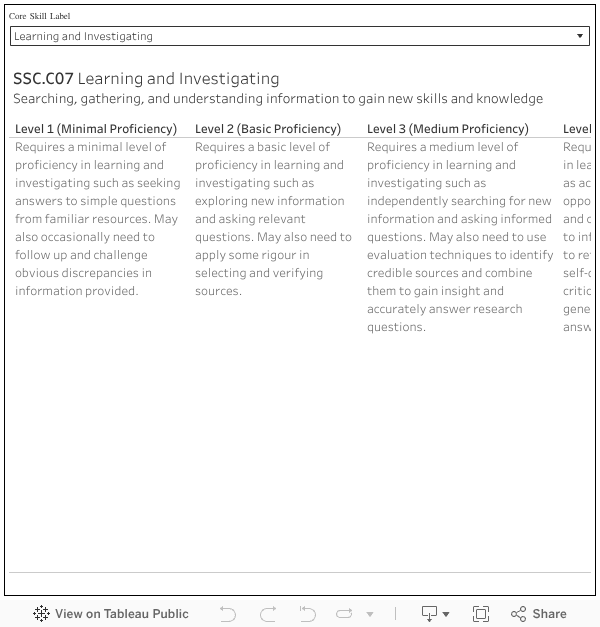
    As above there are just 13 of these, but these are assigned levels of proficiency in language that feels a lot like grade descriptors (note, these are not FHEQ levels but I bet somebody, somewhere, is thinking about a mapping).
    [Full screen]

    Each of these core skills also maps, to a greater or lesser extent, to each of the occupational skills – so our old friend “Analyse mineral deposits (S.0091)” requires level 4 “learning and investigating”, level 3 “planning and organising”, and level 2 “listening”.

    You can’t help but think that forward-looking course leaders will be incorporating these definitions into their learning outcomes in the years to come. Proficiency levels may also be coming to the occupational skills definitions, and there’s even an idea of creating basic curricula for benchmarking and general use.

    Skills for the future

    There’s an old XKCD cartoon about standards that has become a meme – and it highlights that just because someone has combined everyone’s needs into a single standard there is nothing to say anyone will actually use that one rather than whatever language they’ve been speaking for years.

    The UK-SSC attempts to avoid this in two ways. Firstly it maps to other vocabularies that people are already using in linked areas, and does so by design. And secondly it bears the imprinteur of the government, suggesting that at least one influential body will be using it every time it talks about skills.

    And there’s another aspect that helps drive adoption. It will iterate – based on job vacancy data, workforce foresight, feedback from employers, even via public community forums (Stack Exchange, Discord!). And the links to other vocabularies will iterate too. The plan is that this will happen on a five year cycle, but with a first update next year.

    Make no mistake, this is a major intervention in the skills landscape – and it has been done diligently and thoughtfully. If your job involves anything from designing courses to working with employers and local skills improvement plans, if you are a professional body, or working on subject benchmark statements, you need to get on board.


    Source link

  • Autistic Students are Building Community: Colleges Just Need to Listen

    Autistic Students are Building Community: Colleges Just Need to Listen

    As dangerous myths about autism circulate on the national stage, many colleges echo a quieter, yet similarly misguided assumption: that autistic students are socially isolated or incapable of forming meaningful relationships. But the 43 autistic college students we interviewed tell a very different story—one grounded in connection, authenticity, and community, built on their own terms.

    Dr. Karly Isaacson (Ball) Three years ago, we launched the Postsecondary Education: Autistic Collegians’ Experiences of Success (PEACES) national study, drawing participants from both community colleges and four-year institutions across the U.S. We invited autistic students—both self-identified and formally diagnosed—to share their experiences through annual surveys, in-depth interviews, and photo-based storytelling activities. To date, we’ve gathered over 1300 survey responses, nearly 80 interviews, and nearly 70 photo reflections across three waves of data collection, with a fourth wave launching in fall 2025.Dr. Brett Ranon NachmanDr. Brett Ranon Nachman

    As we analyzed the second wave of interviews, one theme stood out: the central role of friendship. Again and again, students described how meaningful friendships shaped their college experiences, not in spite of their autism, but through it. We used this analysis to publish a journal article on autistic college student friendship earlier this month. In this op-ed, we describe three key ways in which autistic college students foster meaningful friendships: engaging in autistic spaces, practicing autistic authenticity, and bonding over shared interests. We hope that understanding how autistic college students think about and experience friendship can ultimately guide colleges in creating more supportive, inclusive environments for this largely misunderstood, minoritized student population.Dr. Bradley E. CoxDr. Bradley E. Cox

    1. Autistic spaces offer connection without explanation.
      Contrary to the common myth that autistic students are inherently socially disconnected, many participants in our study described finding deep connections in spaces designed by and for autistic people. Whether through formal autism support programs (ASPs), campus disability centers, or informal sensory-friendly spaces, students emphasized how these environments allowed them to engage with others who shared similar communication styles, sensory needs, and lived experiences. These spaces didn’t just accommodate difference—they affirmed it.

      Catherine T. McDermottCatherine T. McDermottFor some students, these autism affirming communities were a lifeline, especially during vulnerable transitions like receiving a new autism diagnosis or navigating the pressures of living on one’s own for the first time. One student shared how knowing there was “somewhere to turn” in these difficult periods made all the difference. Others described naturally gravitating toward autistic peers before even knowing their friends’ diagnoses, drawn together by shared ways of thinking and being. Still, not every student stumbled into connection. Several expressed frustration that their schools offered few avenues to find others like them on campus. As one student put it, “you feel like the black sheep of the campus because there’s not really anything for you.” Institutions that take autistic students seriously must prioritize not just services, but creating autistic spaces on campus that are intentional, visible, and community-driven.

    2. Practicing authenticity builds deeper relationships.
      For many autistic students, friendship flourished not when they tried to hide who they were, but when they stopped trying. Students described how letting go of masking (a strategy that some autistic people use to appear non-autistic), led to stronger, more affirming relationships. As one student put it, “the more authentic in myself that I become, the stronger my relationships become.” College, for many, provided a rare opportunity to explore what it meant to show up fully as themselves, autism and all. This wasn’t always easy. Several students shared fears of judgment or past experiences of exclusion, and some still found themselves masking in certain spaces. But when peers responded with respect and curiosity—whether during a class presentation, a theater performance, or an informal hangout—autistic students said they felt “seen,” “heard,” and “valued” when they presented their autistic characteristics and were met with acceptance. Vulnerability often became a gateway to connection. One participant recounted the anxiety of playing pool with friends, worried about motor difficulties, only to be met with patience and encouragement. These moments of openness helped students discern who was safe, who cared, and who was worth pursuing as a friend. Practicing authenticity didn’t always come without cost—but for many, it made friendship more meaningful and sustainable.
    3. Shared passions spark connection.
      While autistic spaces and identity-based connections were vital, students also emphasized another major source of friendship in doing what they love. Shared interests—from playing Dungeons & Dragons to Taylor Swift fandoms—created natural entry points for relationship-building. Nearly every autistic college student we interviewed was involved in a club, job, or hobby that helped them find “their people.” These weren’t just time-fillers or a line to add to a resume—they were genuine community builders.

    Many autistic students created their own spaces when they couldn’t find an existing affinity group or organization. One started a disability advocacy club; another launched an American Sign Language (ASL) group; a third founded a fiber arts circle. Whether through casual gaming nights, photography collaborations, or cat playdates, students built friendships by doing things they genuinely cared about—often with people who shared their pace, humor, and communication style. As one student shared, it meant everything to have even “just one person to go to coffee with who actually cared about the topic.” In these spaces, autistic passions weren’t sidelined—they were celebrated. And when peers leaned into those interests too, genuine friendships blossomed.

    In a time when public discourse too often distorts what it means to be autistic, colleges have a unique opportunity—and responsibility—to listen to autistic students themselves. Our research shows that autistic students are not only capable of forming meaningful friendships, but that they do so in ways that are intentional and creative. Colleges that invest in spaces for connection, support students in showing up authentically, and celebrate shared interests will not only dismantle outdated stereotypes—they will foster communities where all students can thrive.

    Dr. Karly Isaacson (Ball) is a Postdoctoral Research Associate at Michigan State University for Project PEACES.

    Dr. Brett Ranon Nachman is an Assistant Professor of Higher Education at the University of Pittsburgh and Director of Research for College Autism Network. 

    Dr. Bradley E. Cox is an Associate Professor of Higher, Adult, and Lifelong Education (HALE) at Michigan State University and Founder of the nonprofit College Autism Network.

    Catherine T. McDermott is a consultant for Project PEACES and Founder of McDermott Autism Services.


    Source link

  • Voters want AI political speech protected – and lawmakers should listen

    Voters want AI political speech protected – and lawmakers should listen

    This essay was originally published in 24sight’s The Vox Populi section on June 24, 2025.


    As artificial intelligence plays a growing role in political discourse, lawmakers across the country have rushed to propose new regulations over fears that misinformation will proliferate with the new technology. But new polling suggests these efforts may not fully reflect public sentiment and serve as a red flag for lawmakers when their state legislatures reconvene in the fall.

    A recent national survey conducted by Morning Consult for the Foundation for Individual Rights and Expression finds that American voters strongly support prioritizing free speech when crafting AI regulations, even amid growing concerns about AI’s impact.

    Sixty percent of voters say AI-generated content poses a greater threat to elections than government regulation of it. Yet when pressed to choose between stopping deceptive content and protecting free speech, voters side with free speech, 47% to 37%. That support cuts across political lines.

    These numbers also tell a complicated story: Americans are uneasy about AI, but they’re more concerned about the government using AI regulation as a tool to silence dissent, just like many Americans feel about the government regulating content on social media. Our most recent survey shows a striking 81% worry that rules governing election-related AI content could be misused to suppress criticism of elected officials. And over half fear that making it a crime to publish altered political content could chill legitimate political commentary.

    These aren’t abstract fears. Across the country, lawmakers have introduced, and even enacted, bills that would target the mere sharing of AI-generated political content, no matter the context or intent. In Texas and Vermont, for example, proposed legislation cast such a wide net that distributing satire, parody, criticism, or even memes would have been banned or otherwise ensnared in regulation. Ordinary citizens, not just political campaigns, would face penalties for posting altered images of politicians online.

    Americans have the right to speak, joke, criticize, and comment freely, regardless of whether they use AI as an expressive tool in doing so. When lawmakers write vague or sweeping rules about what people can say about candidates, they silence the very public discourse that elections foster.

    Indeed, 28% of voters say government regulation of AI-generated or AI-altered content would make them less likely to share content. That’s not just a statistic, it’s a warning sign. Lawmakers risk silencing voters when their voices matter most. And the effect is even greater among young people, who are significantly more likely to engage with and create AI-generated content. When nearly a third of voters, especially the next generation of political voices, are deterred from participating in public discourse, we’re not just regulating technology — we’re shrinking the space for political engagement.

    Not every datapoint in the polling breaks in favor of free speech. Protecting speech commands broad support, yet many voters also favor checks on misinformation. In the same FIRE survey, while 77% of voters think preserving the right to freedom of speech should be the government’s main priority when making laws that govern the use of AI, 74% of voters believe it’s more important to protect people from misinformation than it is to protect free speech.

    Even so, the poll suggests many voters want any effort to curb misinformation to have firm safeguards for open debate. Many bills on the table this year definitely missed that mark.

    Technologies evolve. The principles of the First Amendment do not. In our system of government, the answer to bad speech isn’t censorship. It’s more speech.

    Source link

  • Read and Listen to Inspiring CUPA-HR Content From 2021 – CUPA-HR

    Read and Listen to Inspiring CUPA-HR Content From 2021 – CUPA-HR

    by CUPA-HR | January 5, 2022

    Throughout 2021, HR practitioners have proven their resilience time and again by positively impacting higher education not only in response to the ever-evolving pandemic, but also in building more flexible, diverse and inclusive workplaces. CUPA-HR captured many of these higher ed success stories, as well as leadership advice, helpful resources and workforce data trends in the following articles, podcasts and blog posts.

    As you read and listen to the inspiring work your HR colleagues are doing at colleges and universities around the country, we encourage you to jot down ideas to take into the year ahead: 

    Retention and Engagement 

    Develop to Retain: Tools and Resources for Higher Ed Professional Development (The Higher Ed Workplace Blog)

    Maintaining Culture and Connection for Remote Employees (The Higher Ed Workplace Blog)

    Stay tuned for an article in the upcoming winter issue of Higher Ed HR Magazine: “Four Areas HR Can Address Now to Boost Retention and Engagement.”

    Future of Work 

    New Report Highlights Changes to the Professional Workforce in the Wake of the Pandemic (The Higher Ed Workplace Blog)

    New Report Highlights Changes to Faculty Workforce in the Wake of the Pandemic (The Higher Ed Workplace Blog)

    Navigating Compliance With a Multi-State Workforce (The Higher Ed Workplace Blog)

    Determining Remote Work Eligibility and Talking to Leadership About Flexible Work (CUPA-HR Soundbite)

    Diversity, Equity, and Inclusion 

    5 CHROs Use CUPA-HR’s DEI Maturity Index to Energize Their DEI Efforts (The Higher Ed Workplace Blog)

    A Mission for Greater Faculty Diversity — Oakland University’s Diversity Advocate Program (Higher Ed HR Magazine)

    Can HR Investigators Be Anti-Racist? — Action Steps to Overcome Racial Bias When Conducting Workplace Investigations (Higher Ed HR Magazine)

    Juneteenth — How Will Your Institution Observe the Day? (The Higher Ed Workplace Blog)

    Supporting the LGBTQ+ Community in Higher Ed — 3 Learning Resources for HR (The Higher Ed Workplace Blog)

    Three Ways HR Can Promote Cultural Appreciation Over Appropriation (The Higher Ed Workplace Blog)

    Boost Your Pay Equity Know-How By Tapping Into These Resources (The Higher Ed Workplace Blog)

    Mental Health

    Mental Health Month Focus: Resources (The Higher Ed Workplace Blog)

    Strategies to Become More Resilient in Work and Life (The Higher Ed Workplace Blog)

    HR Care Package — Resources for Self-Care (The Higher Ed Workplace Blog)

    HR Leadership 

    CUPA-HR Conversations: Higher Ed HR Turns 75 (CUPA-HR Podcast)

    Why Psychological Safety Matters Now More Than Ever (Higher Ed HR Magazine)

    Opening Doors for Strategic Partnerships With Academic Leadership (Higher Ed HR Magazine)


    Source link