Greenville, Wis – December 8, 2025 – School Specialty®, a leading provider of learning environments, supplies and science curriculum to the preK-12 education market, today announced the acquisition of Nasco Education U.S., a trusted name in specialized, curated education solutions for K-12 schools. This strategic acquisition enhances School Specialty’s ability to serve its core customers by enhancing its value proposition to schools across the country.
“We estimate that nearly two-thirds of Nasco Education U.S.’s customers are already School Specialty buyers,” said Ryan Bohr, CEO of School Specialty. “Like School Specialty, Nasco Education U.S. has been an industry fixture of supplying schools for decades. Combining our companies will bring procurement efficiencies to our customers and expand the scope of products available to them.”
School Specialty has more than 60 years of leadership in transforming classrooms into future-ready learning spaces for preK-12 educational institutions, serving five in every six school districts nationwide and curating products from hundreds of trusted brands. Nasco Education U.S. offers a broad selection of specialized products, including hands-on, activity-based resources that support instruction across subjects like science, math, and the arts. Both companies share a deep commitment to providing high-quality, relevant resources that empower teachers and students.
Both organizations will operate independently for the near term. School Specialty expects to integrate the businesses gradually to ensure a seamless experience for the longstanding customers of both organizations.
“Together, we will be able to provide even greater support, innovation, and value to schools nationwide, helping them deliver the best possible learning experiences for their students,” said Ryan Bohr, CEO of School Specialty.
About School Specialty, LLC
With a 60-year legacy, School Specialty is a leading provider of comprehensive learning environment solutions for the pre-K12 education marketplace in the U.S. and Canada. This includes essential classroom supplies, furniture and design services, educational technology, sensory spaces featuring Snoezelen, science curriculum, learning resources, professional development, and more. School Specialty believes every student can flourish in an environment where they are engaged and inspired to learn and grow. In support of this vision to transform more than classrooms, the company applies its unmatched team of education strategists and designs, manufactures, and distributes a broad assortment of name-brand and proprietary products. For more information, go to SchoolSpecialty.com.
About Nasco Education U.S.
Nasco Education U.S. is a leading developer and distributor of instructional materials, offering a wide range of hands-on learning products for the preK-12 education market with 80+ years of experience. Nasco Education U.S. provides schools and educators with the educational materials needed to create impactful classroom experiences that enhance student engagement and academic performance. For more information, go to NascoEducation.com.
eSchool Media staff cover education technology in all its aspects–from legislation and litigation, to best practices, to lessons learned and new products. First published in March of 1998 as a monthly print and digital newspaper, eSchool Media provides the news and information necessary to help K-20 decision-makers successfully use technology and innovation to transform schools and colleges and achieve their educational goals.
Families that eagerly await the annual U.S. News & World ReportCollege Edition may place too much reliance on it. They may be assuming that the complexities of college selection can be made easy by a magazine’s rankings.
Some families rely on the rankings because they seek an easy way out of the stress of college selection. Families, especially students, would be better served to put time into the hard work necessary to identify the colleges that fit them best. College rankings are among the tools that may be used to make this task less burdensome, but there are no shortcuts for College List building that wouldn’t detract from a student’s educational potential.
The College Rankings Publications
Since 1983, U.S. News & World Report (U. S. News) has published an annual College Edition that ranks American colleges in various categories. Although U. S. News is the most popular, they are not alone in this market niche. Other publications that release annual college rankings include Forbes, Princeton Review, Money, Barron’s, Kiplinger’s, College Atlas, the Economist, and the New York Times. They are all reputable, unbiased sources that base their analyses on the same data (the Common Data Set) but arrive at different rankings based on their distinctive methodologies.
The Current Rankings Controversy
The U.S. News College Edition is published annually in September. Each year, this sets off an undeserved avalanche of criticism that The Atlantic’s Derek Thompson calls a “National Carpfest.” The 2023 rankings are causing more carping than usual, mainly from law and medical schools, which aren’t our concern here. However, two undergraduate colleges, the Rhode Island School of Design and Colorado College, have stated that they will no longer cooperate with U.S. News because they feel that the rankings reinforce social inequities. Other schools have also expressed dissatisfaction with U.S. News and college rankings in general.
This mini-movement against magazine rankings has prompted speculation that colleges will abandon them. This is unlikely. By and large, rankings are useful to colleges. However, U.S. Education Department Secretary Miguel Cardona essentially called for abandonment at a recent conference. He said that colleges should:
“Stop worshiping at the false altar of U.S. News and World Report. Rankings disincentivize the wealthiest institutions from enrolling and graduating more underserved students. That’s because doing so harms their selectivity, a factor in the U.S. News formula. Colleges, not some for-profit magazine,should set the higher education agenda.”
To some, it’s incongruous that Secretary Cardona blames the magazines for the fact that college rankings are misused. His position draws attention to a common criticism of college administrations. Many institutions adopt policies and practices based on the likelihood that they will raise their position in the rankings. They are
accused of assigning a higher priority to their position in the rankings than to more important considerations.
Administrators engage in practices to manipulate their data in order to generate improved metrics for rankings calculations. Many administrators do this routinely because a rise in rank helps them justify tuition and salary increases. It is not illegal, but it is unethical. Consequences are rare, but occasionally a college gets called out for it in the media, as have Baylor and, more recently, Columbia. This is not a good look for a high prestige institution.
In their response to Secretary Cardona, U.S. News observed that colleges simply don’t like to be compared to each other by objective third-parties. They asserted that he should require colleges to be more transparent with their data, stating:
“More openness from colleges would allow prospective students and their families to make meaningful comparisons between institutions based on factors such as financial information, admissions data, and outcome statistics.”
Rankings As Perceived By Parents and Students
The rankings publications are entitled to publish anything they wish about colleges without fearing legal repercussions. They benefit from freedom of the press and are fully protected by the first amendment. Concerns arise not about the college rankings themselves but in the way that many families perceive and use them.
The main concern is that many families fail to understand that rankings can’t take into account the qualitative factors that matter most to students. Each student has their own combination of financial resources, talents, preferences, experiences, goals, and personal characteristics. Finding a student’s best-fit colleges should be the result of a subjective analysis by the student that accommodates these factors. It can’t be done properly by using only a formula-driven calculation — the methodology used by the publishers. Rankings can serve as useful information in a student’s college search — but only in a secondary role behind subjective analysis.
When purchasing a product like a car or TV, a publication that assists decision-making like Consumer Reports is a resource that can be relied upon. They conduct research, analyze, and test products. They rank them from the best-buy on down.
That choosing a college is not like buying a TV is an obvious understatement, but the magazines can only rank colleges as if they were three-dimensional products. The important non-quantifiable features can’t be validly compared in this manner.
Rankings as a Reference Source
College rankings can also serve as handy reference sources for a wide range of information about colleges. U.S. News devotes substantial effort every year to compiling and analyzing information relating to more than 3,000 colleges — about 75% of the U.S. total. All of the rankings publications generate comparisons of institutions of similar types on a level playing field! These comparisons are based on mathematical models that incorporate the factors that, in the assessment of the publishers, contribute most to the quality and value of a college education.
Understanding Rankings Methodologies
Families should decide for themselves how much credence to place on college rankings. To help make this decision, they should review a publication’s methodology. As an example, a summary of the indicators used in the U.S. News formula for undergraduate colleges and the weights assigned to them is provided below in Table A.
Table A
U.S. NewsRanking Indicators & Weights
RANKING INDICATOR
INDICATOR WEIGHT %
GRADUATION AND RETENTION RATES
22.0
AVERAGE SIX-YEAR GRADUATION RATE
17.6
AVERAGE FIRST-YEAR STUDENT RETENTION RATE
4.4
SOCIAL MOBILITY
5.0
PELL GRANT GRADUATION RATES
2.5
PELL GRANT GRADUATION RATE COMPARED WITH ALL OTHERS
2.5
GRADUATION RATE PERFORMANCE
8.0
UNDERGRADUATE ACADEMIC REPUTATION
20.0
PEER ASSESSMENT SURVEY
20.0
FACULTY RESOURCES FOR 2021-22 ACADEMIC YEAR
20.0
CLASS SIZE INDEX
8.0
FACULTY COMPENSATION
7.0
PERCENT FACULTY WITH TERMINAL DEGREE IN THEIR FIELD
3.0
PERCENT FACULTY THAT IS FULL TIME
1.0
STUDENT-FACULTY RATIO
1.0
STUDENT SELECTIVITY FOR THE FALL 2022 ENTERING CLASS
7.0
MATH AND READING/WRITING PORTIONS OF SAT/ACT SCORES
5.0
HIGH SCHOOL CLASS STANDING IN TOP 10%
2.2
FINANCIAL RESOURCES PER STUDENT
10.0
AVERAGE ALUMNI GIVING RATE
3.0
GRADUATE INDEBTEDNESS
5.0
TOTAL
100.0
Source: U.S. News & World Report – College Edition September 2023
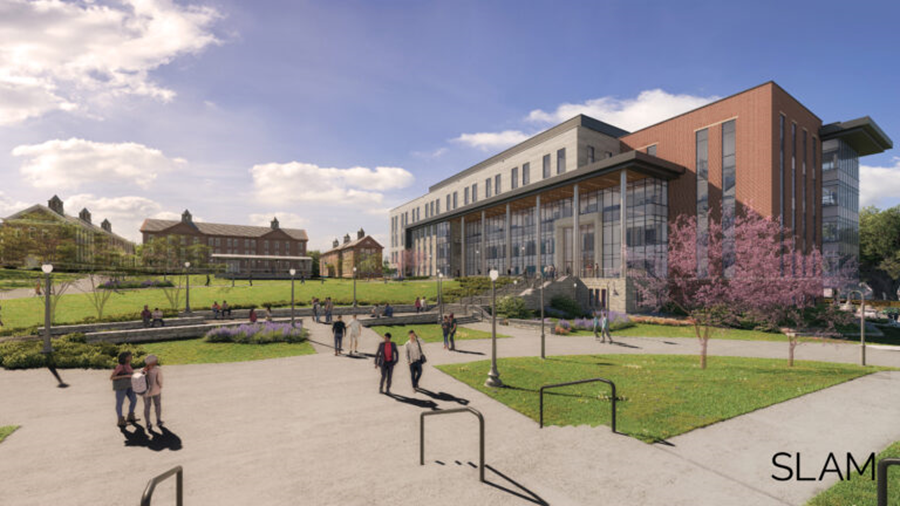
Artist’s Rendition of Providence’s New School of Nursing Scheduled for Completion 2025
Providence College (PC) is a private four-year Catholic college located on an urban campus two miles west of downtown Providence, RI. It has a total undergraduate enrollment of 4,298 and admissions are selective, with a 2022-23 acceptance rate of 47%. The college offers 72 bachelor’s degrees, has an average graduation rate of 85%, and a student-faculty ratio of 11:1. All classes are taught by full-time professors and half of all classes have fewer than 20 students. PC is ranked #1 by U.S. News & World Reports in Regional Universities North.
The School of Nursing
PC made an major announcement last September. For the first time in its 105-year history, the college will offer academic programs in nursing and health sciences, which will be offered through the newly established School of Nursing and Health Sciences. Last year, the Rhode Island Board of Nurse Registration and Nursing Education granted formal approval to the college for a bachelor of science degree program in nursing. PC began accepting applicants for the program during the 2022-23 admissions season and the first students will matriculate in fall 2023.
This summer, PC will begin construction of a new School of Nursing and Health Sciences facility on the current site of Fennel Hall. The five-story, 125,000-square-foot School of Nursing and Health Sciences will be the largest on campus when it is completed in 2025.
The facility will include space to support technologically advanced clinical simulations and health assessment laboratories. It will have a 7,000-square foot suite that simulates a hospital floor for acute-care patients. Under the supervision of instructors, students will learn how to use medical equipment, perform diagnostic tests, and update records on digitally controlled mannequins, which are full-body patient simulators that mimic human anatomy and physiology. The Clinical Simulation Suite will make it possible for 50% of a nursing student’s required clinical experience to take place on campus.
The building also will feature a 100-seat auditorium-style classroom, student study areas, research labs, and “makerspace” for collaboration. There will also be a student advising and career center, faculty offices, a chapel, a plaza and pavilion, and a dining facility. The School of Nursing will anchor the eastern end of the campus and serve as a center for all PC students.
For the first year of the nursing program, enrollment will be limited to 50 freshmen. Fifty current health science majors will also be included, increasing the size of the class to 100 students. Enrollment will be capped at 75 students per year for each of the two programs, making it a modest program at first compared with peer institutions. The focus will remain on the academic excellence of the student body and faculty in order to raise the school’s reputation. Upon graduation of the initial class in 2027, the School will receive full accreditation from the state. PC then plans to increase enrollment at a faster pace.
Upon successful completion of PC’s bachelor of science in nursing program, graduates will be eligible to enter professional nursing practice as Registered Nurses (RN’s) after earning a satisfactory score on the National Council Licensure Examination for Registered Nurses. Graduates will also be well-prepared for advanced study in nursing at the graduate and doctoral level.
The college’s administration has stated that the plan for the School of Nursing fully conforms with the college’s mission of service, but notes that other factors also contributed to its development. The largest generational cohort in American history, the baby boomers, now demands more and more from healthcare institutions at a time when college enrollment is declining. PC is seeking to draw students from a shrinking pool of applicants by attracting them to the fast-growing health care field. According to the Bureau of Labor Statistics, employment in healthcare is expected to grow 13% from 2024 to 2030 — faster than any other major employment field. The Department of Labor forecasts about 2 million new jobs in the field over the next decade.
PC’s Commitment to the Liberal Arts
PC places a high value on a liberal arts education. The majority of undergraduates declare majors in the liberal arts. Regardless of major field of study, undergraduate students are required to complete a core curriculum of Mathematics, Philosophy, Theology, Natural Science, English, Fine Arts, Social Science, and the Development of Western Civilization — the program that best exemplifies PC’s commitment to a sound education in the liberal arts.
The Development of Western Civilization is a two-year program of courses for all underclassmen at PC. The class meets three days a week, with one day for seminar work or exams. It is taught by a team of professors who specialize in literature, art, theology, philosophy, or history. The program has three semesters of standard lecture with topics ranging from ancient history to the modern world. The fourth and final semester of the program is organized into colloquia and specialized courses that focus on each student’s interests.
Although the School of Nursing will be a center for the study of the biological sciences, PC will remain a citadel of the liberal arts. Dr. Kyle McInnis, the inaugural dean of the School of Nursing and Health Sciences, noted that, “The School of Nursing and Health Sciences will not define the college. PC’s culture, mission, and commitment to academic excellence will define it. PC nursing program graduates will be set apart from others in their field because of the liberal arts education they will receive.”