Tag: LLE

  • What we still need to talk about when it comes to the LLE

    What we still need to talk about when it comes to the LLE

    The Lifelong Learning Entitlement (LLE) has been promoted as a transformational change that will broaden access to flexible education and training.

    Though there have been several delays to implementation, the recent Post-16 Education and Skills White Paper has solidified the government’s commitment to delivering the LLE as planned.

    In theory, the LLE could open the door for learners who never imagined higher study, while unlocking a pipeline of talent for the high-skill jobs our economy desperately needs.

    For most undergraduates, the student finance process will remain largely the same with new features added to their application portal. For providers, it is a major operational shift that will require new systems, administration processes and advice and guidance. And while the policy spotlight has been fixed on modular learning, there are other opportunities that could be easily missed.

    The appetite for modular learning

    Modular learning has been pitched as the new frontier of flexibility. In its latest publication, the OfS shared outcomes from their Call for Evidence on how to measure student outcomes in modular study. While the report offers guidance for curriculum designers and quality assurance teams, the policy agenda has shifted since 2023, and demand is still uncertain. The OfS’ own short course trial indicated that demand was limited and the Modular Acceleration Programme has yet to deliver clear lessons.

    A 30-credit bundle would cost around £2,383 (assuming a £9,535 fee is applied to the parent course), this rate for a single module looks questionable compared to cheaper, industry-recognised certificates. With a credit transfer consultation not due until spring 2026, a national framework remains distant, and it is still unclear whether there is broad sector support for such a framework. If a national framework were to be implemented, some HEIs may see this as a challenge to their institutional autonomy and academic distinctiveness.

    If interest in modularity grows, providers will still need to consider whether employers will value standalone modules as much as full qualifications, the duration it will take to stack credits (accumulation to a full award), and the validity of earlier modules when pursuing a professional qualification. These factors will determine whether development in modular learning is a worthwhile investment.

    The target audience

    The rhetoric often frames modular study as a boon for employers. But there’s a problem: if staff are encouraged to take out loans for training their employer needs, it could be seen as a pay cut because the loans will need to be paid back with interest by the employee.

    It is in our view that CPD should sit in the employer-funded training budget, or within the forthcoming Growth and Skills Levy. Employers are of course important – but in terms of helping providers ensure there is labour market currency in a course. The learner will be accountable for the loan and so it should ultimately be viewed in terms of its benefit to the learner and not the employer; any digression from this may risk employers using the LLE as a replacement for their CPD budget, with employees picking up the bill.

    If you take out employer-driven training from this, there are three main group of learners that may be attracted to modular learning:

    • Top-uppers – employees whose employers have funded some modules and who now want to complete a qualification.
    • Passionate learners – individuals happy to pay for a module to support their career or for the joy of learning.
    • Mature learners – carers, full-time workers, and others who need smaller, flexible entry points into HE.

    The bigger opportunities hiding in plain sight

    While modularity dominates discussion, two quieter reforms within the LLE could prove even more transformative.

    Priority additional entitlement (PAE) will expand to include areas such as teaching, social work, and healthcare – vital for sustaining public services. Learners who have already used up their entitlement will still be able to access loans in these areas for full degrees.

    And the removal of the equivalent and lower qualification (ELQ) rule means graduates with residual funding and/or those that use PAE can now retrain at the same or lower level (up to level 6, at least). This opens retraining and reskilling opportunities that were previously out of reach.

    Together, these changes could unlock the mature learner market – carers, career-changers, full-time workers, those who exhausted loan entitlement on a previous degree, or NEET graduates looking for a route back into the labour market.

    It also raises another question on whether the LLE should have been capped at age 60 as many in their sixties could still make meaningful contributions in teaching, health, and social care if they had the funding to retrain.

    Our recommendations

    For the sector to take full advantage of the LLE, we recommend that providers plan for continuity – ensure there is a seamless transition from higher education student finance (HESF) to LLE for mainstream undergraduates. Operational teams should have a firm understanding of the in service changes detailed in key guidelines such as the Course Service Management Definition. This is important in distinguishing the differences between technical requirements and aspirational aspects of the policy.

    Within this technical preparation, there is a need to treat modular learning as an evolving opportunity – demand, delivery, and impact are still emerging. The Post-16 Education and Skills White Paper confirmed there will be some interaction between the LLE with the forthcoming Growth and Skills Levy, likely initially through “apprenticeship units” and Higher Technical Qualification modules beingt tied to occupational standards. Providers should anticipate how this might unfold in priority areas such as artificial intelligence, digital skills, and engineering, and plan strategically for early implementation.

    Within all of this we need to make it clear that the LLE is for the learner – the LLE should be a learner entitlement, not a subsidy for corporate upskilling. Mapping how different funding streams (e.g. LLE, Growth and Skills Levy, Skills Bootcamps, Adult Skills Fund) interact will be vital. Institutions must ensure that learners receive clear advice and that funding follows the purpose of study, whether employer-driven or learner-led. There’s an opportunity to radically expand access – the expanded entitlement and ELQ reform present major opportunities for retraining and second-chance learning. To unlock this market, provision must be genuinely flexible, accessible, and clearly explained. Institutions should design modular and part-time routes that accommodate work and caring responsibilities while demystifying the complex funding landscape through transparent guidance.

    Further considerations for long-term success

    The sector has been encouraged to explore modular learning, however, for many HEIs modularity is best viewed as an enabler rather than a standalone offer. The real prize of the LLE lies in the funding flexibilities in widening access to learning, retraining pathways, and mature learner opportunities sitting just beneath the headlines.

    If we want the LLE to deliver on its promise, we need to first ensure that all HEIs feel confident in transitioning to a new funding system to minimise disruptions to students. Following this, to truly achieve long-term transformation, we need to ask the hard questions about the purpose of modularity, the dichotomy between learner- and market-driven education, and the cultural shift required to draw more people into different higher-level learning, no matter where they are in life.

    Source link

  • The latest LLE guidance: What do we need for it to succeed?

    The latest LLE guidance: What do we need for it to succeed?

    On 9 July 2025, the Department for Education released updated guidance on the Lifelong Learning Entitlement (LLE), launching a flexible, unified student finance system for post-18 learners in England.

    This means that from September 2026, learners can apply for funding to begin modules and courses from January 2027, with access to up to £38,140 of tuition loan finance and maintenance support for in-person studies. Crucially, the LLE supports modular study for specific courses, allowing learners to access 30-credit modules that form part of, or can stack towards, full qualifications.

    This announcement comes just months after HEPI and Instructure jointly published a Policy Note calling for a coherent lifelong learning strategy that unites the LLE with the upcoming Growth and Skills Levy, avoiding fragmentation between further and higher education. HEPI and Instructure’s analysis highlights the importance of:

    • A user‑friendly, low‑burden loan application process for modular study
    • A regulatory approach that supports modular learning without excessive bureaucracy
    • Enabling employer-funded pathways alongside individual loans 
    • Increased awarding of qualifications at Levels 4/5 as solid progression markers 

    So does the latest iteration of the LLE deliver on its potential to close skills gaps, improve employment opportunities and social mobility and welcome a broader range of learners into education? 

    What works, what doesn’t, and who is responsible? 

    Let’s start by acknowledging where the LLE has got it right. Unlike with previous higher education loans, learners can fund individual 30‑credit modules throughout their lives, rather than for a one-off qualification. This allows for flexibility to pursue new learning opportunities which align with career aspirations, upskilling requirements on both the learner and employer’s behalf, as well the learner’s personal circumstances. However, the LLE in its current form is still quite restrictive, and Instructure would like to make these recommendations to the following stakeholders.

    The DfE should widen loan eligibility 

    In reality, the range of modules eligible for LLE funding is still quite limited.  Funded modules must comply with a select list of priority skills areas outlined by the Government, offer at least 30 credits (roughly 300 hours of study) and form part of an established parent course. What’s more, modules from institutions that are rated ‘good’ or ‘outstanding’ by Ofsted or have a Gold or Silver TEF award, will have an easier time getting approved for LLE funding – those outside of this criteria will have to submit more evidence.

    However, the skills most in demand by employers, such as Generative AI development, Environmental Social and Governance (ESG) and green skills, are by nature, newer skill areas. In their infancy, these skills may not have have many, if any, available 30-credit modules which form part of an established parent course, and are offered by an institution that’s been highly-rated by TEF or Ofsted.

    Therefore we recommend the DfE considers funding modules which are smaller units of study, such as 15-20 credit microcredentials. These credentials could be offered by learning providers which may not have achieved industry accolades just yet but do have credibility upskilling learners in emerging skills areas.

    Lastly, while online modules are tuition-eligible, maintenance loans are not. We recommend that the Government extend maintenance support to fully online learners to improve access and social mobility.

    EdTech companies and learning providers need to be ‘credit-aware’

    In order to help become eligible for the LLE, we urge learning providers to design modular content intentionally, ensuring it is credit-bearing and responsive to labour market needs.

    Furthermore, EdTech should support flexible and credential-rich delivery. Virtual Learning Environment (VLE) platforms specifically should facilitate diverse delivery models, including asynchronous and hybrid formats, and support digital credentials and e-portfolio pathways.

    In short, the latest LLE guidance sets the foundation for modular pathways and stackable credentials in selected subject areas – a more viable option for many learners who are at varying stages of their learning journey. However, the LLE must be aligned with effective funding and regulation, coupled with coordinated action from providers, employers, and edtech partners – if this crucial policy is to meet its full potential.

    Instructure is a partner of HEPI and works with UK universities to pioneer flexible, modular and digital-first lifelong learning pathways.

    Source link

  • Podcast: Student experience, LLE, civic

    Podcast: Student experience, LLE, civic


    By submitting you agree to our terms and conditions

    Source link

  • The LLE finally gets a Labour overhaul

    The LLE finally gets a Labour overhaul

    If you still imagined that the Lifelong Learning Entitlement (LLE) would mean that a student studying any module from any course would be eligible for 30 credits of funding, it’s long past time to disabuse yourself of that notion.

    Under the latest plans, eligibility only extends to short courses dealing with those subjects identified as national priorities – via a somewhat tenuous link to the industrial strategy – along with HTQ modules. Everything else in higher education will be funded by year of study, as is currently the case.

    If you were thinking that this latest round of changes – taking us even further away from the initial dreams of Boris Johnson (or even Philip Augar) – completes the long gestation of the LLE in full detail you will be disappointed. For instance, the credit transfer nettle has yet to be grasped – with a consultation due in early 2026, not far in advance of the September 2026 soft launch. And there are, as we shall see, a number of other issues still dangling.

    It’s a continuation of DfE’s gradual retreat from a universal system of funding that was supposed to transform the higher education landscape. No variable intensity, a vast reduction in modular availability – it just allows some of the short courses that universities and colleges already offer to be funded via the loan system (a measure, lest we forget, of dubious attractiveness to learners).

    A bridge to nowhere

    The Lifelong Learning Entitlement (originally known as the Lifelong Loan Entitlement) was announced by Prime Minister Boris Johnson on 29 September 2020, as a part of the government’s lifetime skills guarantee:

    we’ll expand and transform the funding system so it’s as easy to get a loan for a higher technical course as for a university degree, and we’ll enable FE colleges to access funding on the same terms as our most famous universities; and we’ll give everyone a flexible lifelong loan entitlement to four years of post-18 education – so adults will be able to retrain with high level technical courses, instead of being trapped in unemployment.

    Like most of Boris’ wheezes it was originally somebody else’s idea – in this case Philip Augar. He had a few more specifics:

    The government should introduce a single lifelong learning loan allowance for tuition loans at Levels 4, 5 and 6, available for adults aged 18 or over, without a publicly funded degree. This should be set, as it is now, as a financial amount equivalent to four years’ fulltime undergraduate degree funding. Learners should be able to access student finance for tuition fee and maintenance support for modules of credit-based Level 4, 5 and 6 qualifications. ELQ rules should be scrapped for those taking out loans for Levels 4, 5 and 6.

    But it makes more sense to think of the idea as being 100 per cent Boris in that it was a massive infrastructure initiative that he had no clue how to actually deliver (in all honesty, not much of Augar was deliverable either – perhaps that was the attraction). As has proved to be the case.

    As you were

    Let’s start by looking at what’s unchanged, following the latest revisions. The timeline for getting started remains as was: applications from September 2026 for courses and modules starting in January 2027. This still feels extremely optimistic. Plus – as has been the case for a while – a staggered rollout of standalone modules is planned, rather than an enormous platter of bitesize options spread out to pick from come next September.

    The use of the current plan 5 student loan model, with its 40-year term and nine per cent repayment rate above what is currently around minimum wage, is still there – with all the peculiarities this will inevitably engender. If anyone was expecting a large scale shake-up of the student finance system any time soon, this should serve as an enormous hint that no radically new model is arriving in the short to medium term.

    Also retained from DfE’s planning under the Conservatives is the system of “residual eligibility”, meaning how much loan is available to those who have already, for example, studied one undergraduate degree. You still get the equivalent of four years overall, though with lots of wrinkles.

    The aspiration for each member of the public to have an LLE personal account continues – this will still include, in theory, information on one’s loan balances, an application tracker, and advice and guidance on career planning.

    And in broad strokes the government’s rationale for the LLE persists: more flexible routes through tertiary education, support for upskilling and retraining throughout one’s career, and the promise of more learner mobility between institutions.

    Picking winners

    The LLE is replacing England’s entire student funding system, and so funding for full years of study at levels 4 to 6 – such as degrees or higher technical qualifications – will flow through it. In many cases, though, this is just a shift on paper.

    What’s always been the more significant change is how it will bring the funding of individual modules into scope, along with the resulting interplay between single modular courses and larger programmes of study in a learner’s lifelong journey.

    Modular provision that would be eligible had previously been defined as “modules of technical courses of clear value to employers” – this is now rejigged to:

    modules of higher technical qualifications, and level 4, 5 and 6 modules from full level 6 qualifications, in subject groups that address priority skills gaps and align with the government’s industrial strategy.

    We flagged this link between the LLE and the industrial strategy priority areas when the latter was published last month – and the updated LLE policy paper does say that DfE has worked with Skills England to assess skills priorities, though there is no detail on this.

    What we very much don’t get is a mapping between LLE subjects and the industrial strategy sectors (the IS-8), or the priority sub-sectors and their corresponding links to certain regions or clusters which is, y’know, what the industrial strategy is all about. Arguably the main bone thrown to the industrial strategy is the concept of the government “picking winners” – but note there is no stumping up of public funds to support this.

    So we get a list of which subject groups will be in scope for modular study:

    • computing
    • engineering
    • architecture, building and planning, excluding the landscape gardening subgroup
    • physics and astronomy
    • mathematical sciences
    • nursing and midwifery
    • allied health
    • chemistry
    • economics
    • health and social care.

    Common Academic Hierarchy (CAH) fans will be delighted to spot that this appears to have been done (with the curious landscape gardening exception) at the very top level. These are very broad subject groups, which will contain multiple subjects with questionable relevance to the industrial strategy.

    While on the face of it there is some ambiguity about whether this subject list refers to only level 6 qualifications, or to these and higher technical qualifications (HTQs), the accompanying provider preparation guide makes clear that the subject groups here are for level 6 qualifications only – and provision via HTQ modules covers many other subject areas, which in some cases overlap. This currently includes subjects such as business and administration, education and early years, legal and accounting, and many others – but these will need to go through the HTQ approval route.

    The provider preparation guide suggests that institutions should be looking at their current degree provision, working out where it aligns to the priority skills gaps areas that DfE has identified, and then proceeding from there in thinking about what could be modularised. All modular study, remember, needs to form part of an existing designated full course which the provider delivers – we’re a long way from some of the previous visions of universities coming up with new stand-alone bitesize offers.

    All the other funding eligibility rules for modular provision remain – they must have a single qualification level at level 4, 5 or 6, they must be at least 30 credits (though bundling up modules to meet that minimum is allowed), and a standardised transcript of some form to be determined must be delivered upon completion, to facilitate credit transfer.

    But there is one change to eligibility rules – modular provision must not be delivered through franchised arrangements. This had always sounded like a recipe for disaster. The government has been gradually setting its face against a lot of existing franchising activity, given concerns about quality and reports of fraud.

    Getting approved

    The previous plan for approving modules (outside of HTQs) for LLE eligibility was what was being labelled a “qualifications gateway”, which the Institute for Apprenticeships and Technical Education consulted on last January. This terminology has been scrubbed entirely out of the policy paper now, with just a note that “we will set out details on how level 4 to 6 Ofqual regulated qualifications could enter the market and access LLE funding.”

    But there’s a new approval process in town – providers who are interested in delivering modular provision from January 2027 will need to submit an expression of interest, from this month.

    This process will involve an “assurance check” – seemingly run centrally by DfE, rather than Skills England as might have previously been expected. There’s a wonderful flowchart in the provider guide, which you may or may not be able to read depending on how enormous your screen is:

    That’s right – TEF! Providers with gold or silver will have access to a “simpler and quicker approval process” for modular provision. Those who do not will be asked to provide additional information around “readiness, capability and successful delivery of the parent course.”

    Hang on, you cry, doesn’t the fact a provider is registered with the Office for Students demonstrate that it has “readiness” and “capability” to deliver courses of any type? Well, yes, it does. It is possible that DfE simply doesn’t trust OfS to make this kind of judgement – which would point to a rather larger issue with higher education regulation – or it could be that this is a last gasp attempt to give TEF awards some regulatory relevance.

    This is also the case for those rated “good” or “outstanding” for Ofsted provision – and if Ofsted inspects your skills provision and you have a TEF award, they both need to make the grade. Now headline Ofsted assessments were supposed to disappear from September 2025, which makes this all a bit confusing.

    If you don’t deliver HTQs or appropriate level 6 qualifications, it’s noted that modular provision is anticipated to “gradually expand when appropriate to do so” and so you may, one day, come in line for eligibility.

    Regulatory issues

    One of the areas the previous version of the policy paper promised was further information on the regulation of modular funding. This, rather oddly, is no longer listed under “next steps”, given that the update we do get is relatively slim.

    What we might have expected was a follow-up to the Office for Students’ call for evidence on positive outcomes for students studying on a modular basis – a call for evidence which closed in November 2023, and we’ve heard little of since. As DK set out at the time, the quasi-consultation asked how things like the B3 conditions could apply to individual modules, and the regulator’s initial thinking seemed to be that completion would still be a valuable metric for regulation, as would progression – though exactly how progression was assessed would need to be refined.

    There’s still no news on this complicated issue. The new section of regulation focuses more on registration categories, while noting that DfE “will refine the existing regulatory framework to ensure it is proportionate, is targeted [and] supports a high quality, flexible system.” If you were thinking that a whole new approach to learning would need a new oversight framework, the direction of travel suggests not.

    The bigger regulatory news is that, likely to the surprise of few, the idea of having a third registration category for smaller providers offering level 4 and 5 qualifications has been scrapped. Instead the government will extend the current system of advanced learner loan funding for levels 4 to 6 until the end of summer 2030. This will give unregistered providers more time to apply for OfS registration in one of the two existing categories, though OfS is scheduled to consult in autumn 2025 on proposals to disapply some conditions of registration for providers in the further education statutory sector (which already has a regulator looking after most of this stuff).

    Maintenance chunks

    As expected, student maintenance support will be available on a pro-rata basis (depending on course, location, and personal circumstances) in an equivalent way to the existing undergraduate offer. Because this support is intended to deal with “living costs”, DfE has decided to continue to restrict availability to students attending in person – there’s nothing for online or distance learning.

    Additional targeted grants (most likely this just refers to existing disabled students’ allowance and such like) will still be available – but there’s more to come on this later this year, alongside more guidance on maintenance generally. We can perhaps hope that a forthcoming announcement modifying the decades-old system (or even just the parental income thresholds) is playing a part in this delay.

    That feeling of entitlements

    Another area where things have mostly stayed the same is the personal entitlement for tuition fee funding equivalent to four full-time years (480 credits, currently £38,140) of traditional study – with the welcome clarification that where a provider charges less than the maximum the cash value rather than the credit value will be deducted from the total. Maximum borrowing is for 180 credits a year (which would just about cover a year of an accelerated degree). And for existing graduates (with the frankly wild caveats as before) there will be an entitlement to funding equivalent to unused residual credits.

    But what happens when your balance reaches £0? No more learning for you? Not quite – a “priority additional entitlement” may be available (fees plus maintenance) in order to complete a full course in a small number of subjects (medicine, dentistry, nursing and midwifery, allied health professions, initial teacher training, social work).

    For those who follow career paths that require five years or more of study (veterinary surgery, architecture part 2, an integrated masters in Scotland) there will be a “special additional entitlement” of up to two years, again covering fees and maintenance. There’s also additional entitlements for those who take foundation years, placement years, or study abroad years. It’s by-and-large a smoothing-out of some of the unintended consequences with existing provision where representations had been made.

    Plus, importantly, the government will now play a part in mitigating circumstances – if you are resitting a year because of “compelling personal reasons” (illness, bereavement) you will have the costs of your study covered. And resits on longer courses will be covered anyway.

    The credit transfer question

    “The LLE and modular provision will provide a pathway to strengthen opportunities for credit transfer and learner mobility,” the new version of the paper states. While no-one would deny that the LLE could be a “pathway to strengthen opportunities,” especially given how tepid the phrasing is, there has still been essentially no progress on the thorny question of credit transfer.

    The largely new section on “recognition of prior learning, credit transfer, and record of learning” sets out aspirational areas where the government thinks it can work collaboratively with the sector – to promote pathways between providers, to improve guidance for both incoming and outgoing learners, and to generally square the recognition of prior learning circle despite all the intractable problems therein.

    Interestingly, DfE also wants institutions to embed all this into “broader strategies for widening access”. It’s not immediately clear how this will come off – but we get the note that this year will bring an update on “proposed changes that will start to embed this flexibility and greater learner mobility across LLE funded provision.” This might be a reference to the post-16 education and skills white paper.

    To facilitate all this flexibility, DfE had previously said it would be introducing a “standardised transcript template.” Tellingly, this has now been revised down to “a standardised transcript as part of modular funding designation.” So it appears the plan is now to look at enforcing this standardisation for the (potentially scant) modular provision that the LLE will generate, while sidestepping the much bigger question of how portability between modules and larger qualifications including degrees will work. This is a substantial scaling down in ambition – and yet it’s still a complicated thing to get agreed implemented in little over a year.

    What’s next

    As is probably coming across, there is still an awful lot yet to be confirmed. Secondary legislation to implement the LLE fee limits and funding system still needs to be laid. Fee loan limits for non-fee capped provision are pending confirmation. The Student Loans Company needs to get its systems ready.

    There will be another consultation too, in addition to OfS’ further education one. While it’s not mentioned in the updated policy paper, the accompanying provider preparation guide reveals that the Department for Education will consult on “learner mobility across LLE-funded provision in early 2026” (maybe this will be the moment when credit transfer finally gets sorted out once and for all). Opening a consultation in early 2026 when big chunks of the whole shebang are supposed to be ready to go that September does not necessarily inspire confidence.

    And the drip-by-drip announcements about the policy plumbing of the LLE mean that it’s a long time since the government has really restated its belief that there is demand out there for modular provision, or committed to working to drum some up. Really it’s baffling why this week’s announcements haven’t been packaged up with the skills white paper, as surely they must form part of a wider vision. Some clarity within this about overlaps and interplay with the apprenticeship levy would have been welcome too.

    The provider preparation guide entreats institutions to start thinking about how they will market modular provision, which is a tricky question given the absence of demand that pilots have demonstrated. But one of the examples given is particularly problematic:

    if you seek to target mature students, do you need to start building relationships with local employers and/or recruitment agents, rather than only relying on existing recruitment channels?

    This isn’t a new addition to the guidance – but since the last update, Bridget Phillipson has told Parliament that the government will “take immediate action on the use of agents to recruit students,” adding that “the government can see no legitimate role for domestic agents in the recruitment of UK students,” following the Sunday Times franchising investigation fallout. So DfE is at the same time banning the use of domestic agents – or at least it said it would – while acknowledging that recruitment to modular provision might be tricky without them.

    It’s of a piece with much of the preparation guide – the responsibility to iron out the holes in the LLE’s business case is being passed onto providers. Supposedly over the rest of the year universities and colleges should be reviewing everything from accommodation to wrap-around support, while building up relationships with employers and potentially rewriting their academic regulations. All while plenty remains unclear at the sector level. It would be unsurprising to see providers reluctant to leap into the approvals process right away, and instead assess how others fare.

    Given all this, it’s perhaps unsurprising that the ambition of the LLE has diminished a little bit each time the policies around it have been updated. We’re a long way from where we started.

    Probably the most damning assessment you could make is that, were Labour to have opted to cancel the whole LLE and just allow students to take out loans for a handful of higher education short courses tenuously linked to industrial strategy priorities, the sector would be in a very similar situation to the one it is in now. And – given clear indications of lack of student demand, and common sense assessments of the general public’s appetite for more tuition fee debt wrapped up in confusing bitesize-but-lifelong repayment obligations – few would think it was a good idea.


    Source link

  • Excluding Level 7 modules from the LLE is a huge, missed opportunity

    Excluding Level 7 modules from the LLE is a huge, missed opportunity

    Ahead of a House of Lords debate on the topic of lifelong learning later this week, today’s blog features two posts on the topic.

    Elsewhere on the site, Professor Harriet Dunbar-Morris, Pro Vice-Chancellor Academic and Provost at The University of Buckingham, highlights what is, in her view, a critical flaw in the LLE: the unfair funding gap facing students on accelerated two-year degree programmes, despite their clear benefits for employability and skills development. You can read that piece here.

    And below, Dr. Michelle Morgan explores the gaps in the Government’s Lifelong Learning Entitlement (LLE), questioning why postgraduate taught courses have been left out and what this means for students, universities, and businesses.

    So the Government has announced that the Lifelong Learning Entitlement (LLE) will come into effect in September 2026.

    The government is arguing that the LLE will allow people to develop new skills and gain new qualifications at a time that is right for them. The LLE will focus on:

    • full courses at level 4 to 6, such as degrees, technical qualifications, and designated distance learning and online courses
    • modules of high-value technical courses at levels 4 to 5.

    It is argued that it will help drive sustained economic growth, break down barriers to opportunity broaden access to high-quality, flexible education and training, and support greater learner mobility between institutions.

    However, yet again the sector’s postgraduate taught (PGT) provision has been ignored. By excluding this level of study, the ambitions of the Government will not be as great as they could be, and it is a huge, missed opportunity for higher education and this is why.

    The first problem: Declining PGT participation of UK-domiciled students

    In the past 10 years, the higher education sector has increasingly relied on international master’s students to fund itself.  EU and non-EU PGT students are nearly all undertaking master’s degrees, whereas for UK-domiciled students, a master’s degree only constitutes around 55% of those on PGT courses. Taught courses include master’s, postgraduate certificates, diplomas, and institutional credits and postgraduate certificates in education.

    For Master’s participation, 2019/20 was a pivotal year as non-EU participation surpassed UK-domiciled for the first time. In each year since 2021/22, UK-domiciled Master’s enrolments have declined (see Table 1). Although we do not have Higher Education Statistics Agency (HESA) return data to view for 2022/23 and 2023/24, there is a strong sense across the sector that we will see a decline in master’s participation, especially among international students.

    Source: Who’s studying in HE? | HESA

    The decline is the same pattern that occurred leading up to 2010/11. The only reason why master’s participation continued to increase then was due to non-EU enrolments. The response by the Government to re-energise the UK-domiciled market after the Higher Funding Council for England’s (HEFCE, which was then the regulator) Phase 1 and 2 of the Postgraduate Support Scheme was to bring in the Postgraduate Loan. As soon as this happened, you could hear an audible sigh of relief across the sector, and there was an attitude of ‘that will solve the problem so let’s just focus on growing the master’s market’. The sector did not consider the demand for master’s qualifications by business and industry, especially small and medium enterprises (SMEs).

    Employer demand for Master’s graduates

    There are disciplines where a master’s is required for career progression such as professional accreditation. However, as the 11 University Postgraduate Experience Project found, which was one of 20 projects funded as part of the HEFCE Phase 1 Postgraduate Support Scheme, many SMEs did not need master’s graduates. Most useful to them was for higher education to provide short courses and modules that provided their staff with advanced skills in key areas such as Business and IT and emerging ones such as Generative AI. According to the Department for Business and Trade’s report on Business population estimates for the UK and regions in 2024, there were 5.6 million UK businesses in 2024 of which 5.5 million were SMEs, accounting for 99.8% of all businesses. By ignoring the needs of business and industry, we are losing an opportunity to engage with a critical market.

    Funding and repayment

    As soon as the Postgraduate Loan was introduced, most universities immediately raised their fees. The aim of the £10,000 loan was to cover fees and some maintenance. Although the loan for September 2024 English starters is now £12,471, for many this will not come close to covering their costs. What is also not factored into any discussion is that someone who has both an undergraduate and a postgraduate loan must pay them back concurrently. This equates to 9% for the undergraduate loan and 6% for the postgraduate, or 15% of someone’s salary on top of tax, National Insurance and any other employee-related costs. Although employers’ national insurance contributions are increasing next year, if there is any tax or National Insurance increase for the individual next year, this will further reduce their disposable income.

    The Postgraduate Loan also differs between UK countries. In England, the loan does not cover stand-alone postgraduate certificates and diplomas, unlike in Scotland, where non-master’s postgraduate taught course participation is 56% compared to 44% in England. If they were included, then maybe the LLE as it stands would not be quite as restricted. The English loan system is not agile enough to support engagement in short or non-master’s courses, and English universities plan their finances for master’s enrolments and anticipated completions. A student should not have to register and enrol on a master’s if they only want or need to do a postgraduate certificate or diploma. If an individual needs a master’s for professional accreditation, this will not stop them from doing a master’s. In fact, we may see an increase in integrated degrees being undertaken where a master’s is incorporated into the undergraduate degree as a result.

    Additionally, we have just had the announcement that undergraduate loans are slightly increasing, but no announcement has been made for postgraduate loans. The current system hinders engagement. It also adopts a deficit model approach, as these qualifications are deemed exit qualifications if someone fails to achieve the Master’s.

    Ability to participate in master’s study

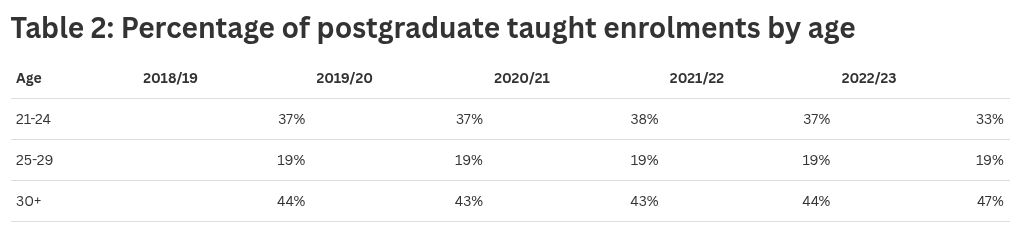
    What is also overlooked in discussions are the debt levels of undergraduate alumni and how this could explain the decreasing number of UK-domiciled 21-24-year-old participants. The majority of PGT enrolments are for the age group of 30 years and over.

    table visualization

    Source: Who’s studying in HE? | HESA

    When the Postgraduate Loan was introduced in 2016, only one cohort had graduated under the £9,000 a year fee regime introduced in 2012.  We now have 10 cohorts who graduated under that regime. It is maybe not a surprise therefore that the largest group investing in postgraduate taught study are those with the smallest amount of undergraduate debt.

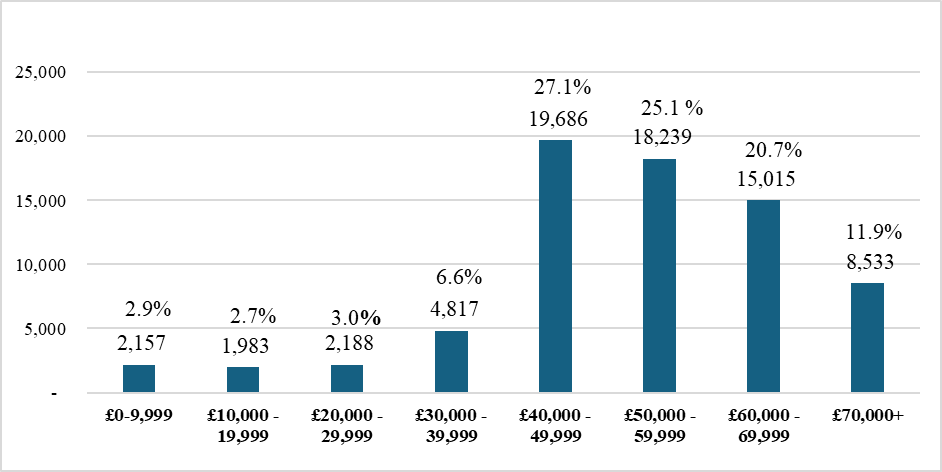
    Last year, I got the results of a Freedom of Information request from the Student Loan Company regarding the debt levels for English-domiciled recipients entering postgraduate Master’s study in 2021/22 (see Figure 1). Of the 72,618, 74.8% had debt in excess of £40,000 and 11.9% over £70,000. This debt will include any repeated years as well as longer length undergraduate courses such as integrated degrees with placements. With the recent announcement that fee levels will rise by £285 to £9,535 in 2025/26, this will increase individual debt.

    Figure 1: Debt levels of 72,618 English-domiciled master’s students who also have an undergraduate loan (fee and maintenance) in 2021/22 only 

    The recent Times and Sunday Times showed how parental financial support differs by student groups and universities. The universities where parents pay the most – up to £30,000 – are mainly Russell Groups. And when you explore postgraduate taught participation by ethnicity,  66% are White. How will the factors highlighted above enable widening participation at the postgraduate level which delivers advanced skills, competencies and knowledge?

    We need a rethink

    The LLE that will be introduced will not super-proof the pipeline for longevity of postgraduate taught study nor provide the advanced skills that are accessible, meaningful and needed for the individual, society or business and industry.

    So we need to start thinking now about the long-term implications of student debt, and social and economic needs so we can develop policy, strategy and practice. To do this though, the sector needs to start thinking about how we can reimagine and do things differently, Government needs to listen to key stakeholders, and we must proactively work together and not against one another.

    Source link

  • The LLE and Five-year Integrated Masters Degrees

    The LLE and Five-year Integrated Masters Degrees

    By Ian Blenkharn, Director of Education and Student Services at the University of Bath.

    Like most institutions across the sector, the University of Bath is carefully considering the potential opportunities, implications and challenges posed by the new Lifelong Learning Entitlement (LLE). 

    Bath is somewhat unusual in having both a high proportion of integrated master’s courses and a high proportion of students studying programmes with a placement year (nearly two-thirds of Bath students undertake a placement during their time with us). This means we have a large number of students studying five-year, integrated masters programmes with a year on placement.

    This raises important questions for us, as it will for others across the sector. The information so far published about the LLE seems to suggest that we will be able to charge students for the full, five-year integrated-masters-with-placement programme, which has a total of 600 credits under the CATS credit accumulation framework. However, it isn’t yet clear whether students, who are automatically entitled to a ‘digital wallet’ to cover up to 480 credits of higher education study, will be able to pay for the entirety of their programme without access to private funding.

    For those programmes offered at Bath, the shortfall would be the cost of the placement year – either 15% or 20% of the maximum regulated fee. Perhaps not a deal-breaker for those with access to the Bank of Mum and Dad. However, it could deter some students for whom the chance to work for a year in industry provides unparalleled opportunities to build social capital, experience and confidence to compete in the graduate jobs market. We know that such opportunities are transformative for our students. The prospect of this becoming the preserve of students who can privately fund their tuition risks not only the viability of the programmes we offer but also the social mobility benefits they afford students from widening participation backgrounds.

    The decision by the Labour government to defer the implementation of the LLE to January 2027 means there is some time to clarify the situation for both universities and students. However, we will have students applying in September 2025 for deferred entry in 2027, so the time to clarify the situation is shorter than it first appears. 

    It is imperative that everyone has clarity on this issue (and many others associated with the LLE) before we enter the 2025/2026 recruitment cycle. This is so universities can appropriately advise students on how much their course will cost and whether their Lifelong Learning Entitlement will be sufficient to cover those costs. At the moment, far too many unanswered questions are swirling around the LLE, as evidenced by the 400+ sector participants who logged on to the Higher Education Strategic Planners Association (HESPA)-organised seminar on the LLE with representatives from the Student Loans Company. The sector, and most importantly the students who will be pioneers of the new LLE system, need these questions answered as soon as possible.

    Source link