Tag: London

  • Arizona State University’s London campus – Campus Review

    Arizona State University’s London campus – Campus Review

    In this episode, the vice-chancellor of James Cook University Simon Biggs and HEDx’s Martin Betts interview Lisa Brodie, the dean of an innovative new independent college in the UK, ASU London.

    Please login below to view content or subscribe now.

    Membership Login

    Source link

  • Why international education must be central to the Square Mile’s success

    Why international education must be central to the Square Mile’s success

    Earlier this month, the City of London staged one of its most time-honoured traditions: the annual parade marking the inauguration of its new civic leader. But this year’s event was historic for more than its pageantry.

    For the first time in 697 years, the Lord Mayor’s Show became the Lady Mayor’s Show, as Dame Susan Langley DBE took office under a title that signals both continuity and change.

    The Lady Mayor’s pledge to “un-square the Square Mile” – to make the City more open, inclusive and innovative – could also not be more timely. If she is serious about modernising the mayoralty, then championing international education must be at the heart of her agenda.

    Education as trade and investment

    The City of London is not just a major global financial centre; it is a thoroughly international student city. As well as being home to the large multi-faculty institution of City St George’s, University of London, the City also boasts the Guildhall School of Music and Drama and has historic links to several prestigious further and higher education providers across the capital.

    The overseas students that these institutions collectively attract feed a talent pipeline underpinning every sector of the City’s economy. According to research by the Higher Education Policy Institute (HEPI), just one year’s cohort of international students in the Cities of London and Westminster brings in £352 million of net benefits annually, equating to £2,940 per resident.

    London’s businesses understand this importance. New research from London Higher shows 90% of firms in the capital say global graduates are essential for filling skills gaps and driving innovation, and more than half admit they would consider relocating if access to this talent were curtailed.

    From financial services to tech companies and the creative industries, London’s employers value the language skills, cultural awareness and global networks that international graduates provide. These are the assets that give the Square Mile its competitive edge in a fiercely global marketplace.

    Storm clouds ahead

    However, these assets are under threat. Headwinds facing UK higher education are stiffening: financial pressures, rising operating costs and ongoing policy uncertainty around visas and an international fee levy are all working to lessen London’s overseas appeal. Universities are continually being asked to do more with less, while negative rhetoric around immigration risks deterring the very global talent that the City needs to thrive.

    Universities are continually being asked to do more with less, while negative rhetoric around immigration risks deterring the very global talent that the City needs to thrive

    Should the City of London’s higher education institutions start losing ground in the international education export market then the ripple effects will be felt far beyond their campuses – from student housing markets, restaurants and local coffee shops to the big city businesses that rely on a steady flow of skilled graduates with the nous to operate in a globally connected world.

    Convening power

    This is where the Lady Mayor’s convening power matters. Her role is not merely ceremonial. As the elected head of the City of London Corporation, she is a global ambassador for the UK’s financial and professional services sector, tasked with driving growth and innovation through diplomacy and engagement.

    In an era when rival financial centres such as New York, Singapore and Dubai are doubling down on talent attraction, London cannot afford to be complacent. A modern mayoralty should see universities and colleges as strategic assets in the City’s success, not peripheral players around its financial prowess. Opening the doors of Mansion House for events that champion education as a cornerstone of competitiveness would send a powerful signal of support.

    Advocacy for higher education is not a fringe issue. It is ultimately about future-proofing the City for the challenges that lie ahead. Higher education fuels innovation, entrepreneurship and cultural capital – all the qualities that the City prizes in its pursuit of growth and prosperity. Alumni of London’s institutions go on to become global decision-makers in a variety of sectors and industries and carry with them an affinity for the City that often translates into investment and influence later down the line.

    A new narrative for growth

    At a time when the City’s economy is crying out for high-level skills – and the UK government is doubling down on local responsiveness through a civic policy lens – the Square Mile has a golden opportunity to lead by example under its new Lady Mayor: forging partnerships between business and education, supporting pathways into high-demand sectors and amplifying the City of London’s message as a welcoming destination for learners and workers from all backgrounds – particularly women inspired by their new figurehead.

    The Lady Mayor has said herself that, “The City is not about walls to keep people out, but about welcoming people in.” That ethos should extend to students as much as to investors because, if we fail to keep London open to global talent, we risk diminishing the City’s universities and weakening the very foundations of the Square Mile’s success.

    The Lady Mayor’s tenure in Mansion House offers a chance for the City to reset its narrative and show that international education is a strategic lever for the City’s growth. By championing international students and forging stronger ties between academia and industry, the City can secure its place as the world’s most connected financial hub – thriving on openness, talent and ideas.

    If the City of London wants to remain the beating heart of global commerce, then it must also be the beating heart of global learning.

    Source link

  • Higher education postcard: Queen Mary University of London

    Higher education postcard: Queen Mary University of London

    Down on the Mile End Road in London, within the sound of Bow bells (and hence properly Cockney) you will find what used to be the People’s Palace, and is now Queen Mary University of London.

    The institution we see today has four antecedents: the medical schools at the London and at St Bartholomew’s hospitals, Westfield College, and Queen Mary College. The name which survives is that of the last-founded college: as this is also the largest campus by far, it does confirm that possession is nine-tenths of the law.

    The medical schools were the earliest to be founded: the London Hospital Medical College in 1785 and St Bartholomew’s Hospital Medical College in 1843 (although a lecture theatre had been in place in Barts since 1791). I’ve told a little of the story of medical education in London when I wrote about St George’s. At the end of the eighteenth century and into the nineteenth, hospitals were slowly putting medical education on a more formal footing, and the London Hospital was at the forefront.

    Next to come on the scene was Westfield College. Established in 1882, Westfield was a residential college for women. I’ve written about it before for Wonkhe, so for now I’ll keep the focus on the East End.

    And on 14 May 1887 Queen Victoria formally opened the People’s Palace on the Mile End Road. The picture below, from the Illustrated London News, shows the Great Hall, which was the only element which had been completed at the time. It had a capacity for 2000 people seated, and was most magnificent.

    The People’s Palace would host art exhibitions and concerts, and would have library and reading rooms, gardens and a swimming pool. Associated with it was a technical institute which would teach higher skills associated with East London’s industries and crafts. The technical institute was to be funded by the Draper’s Company; the People’s Palace was built following public subscriptions, much of it coming from the great and the good.

    (This, by the way, was the model for the technical and recreative institutes founded in south London soon thereafter, and which I wrote about in relation to London South Bank University.)

    In 1896 the People’s Palace Technical Schools became East London Technical College. I can’t be certain about this, but I imagine it had by that time been taken over by the relevant London borough, following enabling legislation in the early 1890s. It was by then supporting people studying for the civil service entrance examinations, and also for the University of London’s BSc degree examinations. The first students graduated early in the twentieth century.

    On 17 May 1907 the Morning Post reported that

    The East London College has been admitted by the Senate as a school of the University [of London] in the Faculties of Arts, Science, and Engineering for period of three years on the understanding that the governing body of the school shall do their utmost to satisfy the Senate upon certain points of educational organisation and finance.

    You’ll spot the associated name change – and this also gives us an earliest date for the picture on the postcard (look at the sign!).

    In 1910 the membership of the university was renewed for a further five years, and in 1915 granted without time limit. East London College was properly a school of the University of London. It was strong in science and engineering, particularly in aeronautical engineering. It had a wind tunnel – which was very new technology then – and was the first department of aeronautical engineering in the UK.

    The 1930s became a little exciting for the college, for good reasons and bad.

    The bad reason was a fire in the early hours of Wednesday 25 February 1931, which destroyed the Great Hall of the People’s Palace. So the illustration from 1897 is, sadly, all you’ll get of this today.

    But at a similar time, the college was considering seeking a royal charter, and it looks like the fire crystallised things. The Drapers’ Company facilitated the People’s Palace and the college becoming a single corporate body, and in 1934 a royal charter was granted. This was also the occasion for a change of name. East London College being felt by some, apparently, to be a bit déclassé. And so Queen Mary College – named for the then Queen, Mary of Teck – was born on 12 December 1934.

    And on 13 February 1937 the rebuilt People’s Palace was opened by the new King George VI and Queen Elizabeth (who most readers will know of better as the late Queen Mother.) The full-page spread from the Illustrated London News below gives some of the flavour. I wonder whether this was part of a post-abdication-crisis public relations push to ensure that the new King was perceived in a positive light? The tale of Margaret Paxton, who gave flowers to the Queen, and was descended from the child who gave flowers to Queen Victoria in 1897, is a publicist’s dream, and will no doubt have taken a bit of work to manage.

    Through the following decades Queen Mary College was forging links with the two medical schools – for example, a joint hall of residence was opened in Woodford in 1974. Further changes happened in the 1980s – firstly some changes to provision, when the University of London reshuffled. Queen Mary lost Classics and Russian, but gained lab science subjects from Westfield, Chelsea, Queen Elizabeth and Bedford colleges. This was only a precursor to the larger changes to come: in 1989 Westfield College merged with Queen Mary, which became Queen Mary and Westfield College. The merged college was based on the Mile End and associated campuses – the Westfield College buildings were sold off.

    Ten years later the two medical schools merged with the college to form the Barts and the London School of Medicine and Dentistry. This was simply one part of a general rationalisation of medical education in London which saw the small independent schools brought within the ambit of larger institutions.

    Let’s add a couple of things to bring the story up to date.

    Firstly, in 2012 Queen Mary joined the Russell Group, along with three other universities (pop quiz – without googling, can you name the other three?). It’s an unusual Russell Group in that its entry profile is much more reflective of its neighbourhood. It continues to do good things for the east London population.

    Secondly, in 2013 it formally changed its name from Queen Mary and Westfield College to Queen Mary, University of London. Which is tricky for dinosaurs like me who still think of it as QMW (and while were at it, Royal Holloway continues in my head to be RHBNC). But I will need to learn to deal with modernity as it approaches.

    The college has a good site on its history if you want to read more.

    Nine Nobel prize winners are connected with the college: six in physiology or medicine, one each in literature and physics, and one winner of the Nobel peace prize (pop quiz part two: again without googling, can you name the peace prize winner? I met them once…)

    And finally, here’s a jigsaw of the postcard. The card was written and posted, but it seems to have been stuck in an album or scrap-book at some point so the back is half covered in the remnants of brown paper. Anyway, it was posted at Paddington to an address in the Regent’s Park neighbourhood of London. All I can make of the written message is

    …before I left. I will certainly call and see you one day. I am not going ‘til next Tuesday…

    Source link

  • New HEPI and University of London Report: Rethinking Placement: Increasing Clinical Placement Efficacy for a Sustainable NHS Future

    New HEPI and University of London Report: Rethinking Placement: Increasing Clinical Placement Efficacy for a Sustainable NHS Future

    Author:
    Professor Amanda Broderick and Robert Waterson

    Published:

    The NHS faces a growing clinical placement crisis that threatens the future of its workforce. A new HEPI and University of London report calls for bold, system-wide reform to ensure students get the real-world experience they need to deliver safe, high-quality care.

    HEPI and the University of London’s new report, Rethinking Placement: Increasing Clinical Placement Efficacy for a Sustainable NHS Future, which has been published with the support of the Council for Deans of Health, warns that the NHS cannot meet its ambitious workforce goals without bold reform of how students gain real-world experience. Co-authored by Professor Amanda Broderick and Robert Waterson of the University of East London, the report calls for a shift from simply creating more placements to delivering better ones—equitable, flexible, digitally enabled and aligned with the future of healthcare.

    Drawing on innovation across London and beyond, the authors propose practical steps including simulation-based learning, new supervision frameworks and community-based models that can expand capacity without compromising quality. With over 106,000 vacancies across secondary care, the report urges policymakers, universities and NHS providers to act now to secure a sustainable, skilled and compassionate workforce for the next decade and beyond.

    You can read the press release and access the full report here.

    Source link

  • Higher education postcard: London South Bank University

    Higher education postcard: London South Bank University

    On 12 May 1888 the London Evening Standard reported as follows:

    A meeting is to be held at the Mansion House at twelve o’clock, on June 8, to consider the projected South London Polytechnic Institutes. It is stated that Lord Salisbury, Lord Rosebery, and Sir Lyon Playfair have agreed to be present in order to lend their support to the scheme.

    We’ve met Sir Lyon Playfair before – sometime secretary to the Department of Science, he advised on the question of a maritime school for Southampton, which ultimately became Southampton Solent University. Lord Rosebery and Lord Salisbury were both eminent politicians, Salisbury a Tory, Rosebery a Liberal. In 1888 Salisbury was Prime Minister. Rosebery would be Prime Minister soon too – he succeeded Gladstone in 1894, the following year being replaced himself by Salisbury. Clearly the support of these figures was significant. But what was going on?

    Enter Mr Edric Bayley. Bayley was a solicitor living in Southwark: partner at a local practice, he was becoming a man of some substance. In 1892 and 1895 he was elected as a member of the London County Council, representing Southwark West for the Progressive Party. Prior to that, in 1887, he had established a group – the South London Polytechnic Institutes Council or, in some accounts, Committee. This sought to use funds under the control of the Charity Commissioners to create technical and recreative institutes in New Cross, Borough and Battersea. This seems to have been the scheme referred to in the Evening Standard article. In 1888 the Charity Commissioners agreed to match funds up to £150,000 for this scheme. And do the game was most definitely afoot.

    The New Cross institute became Goldsmiths College; the Battersea one became Battersea Polytechnic and in due course the University of Surrey.

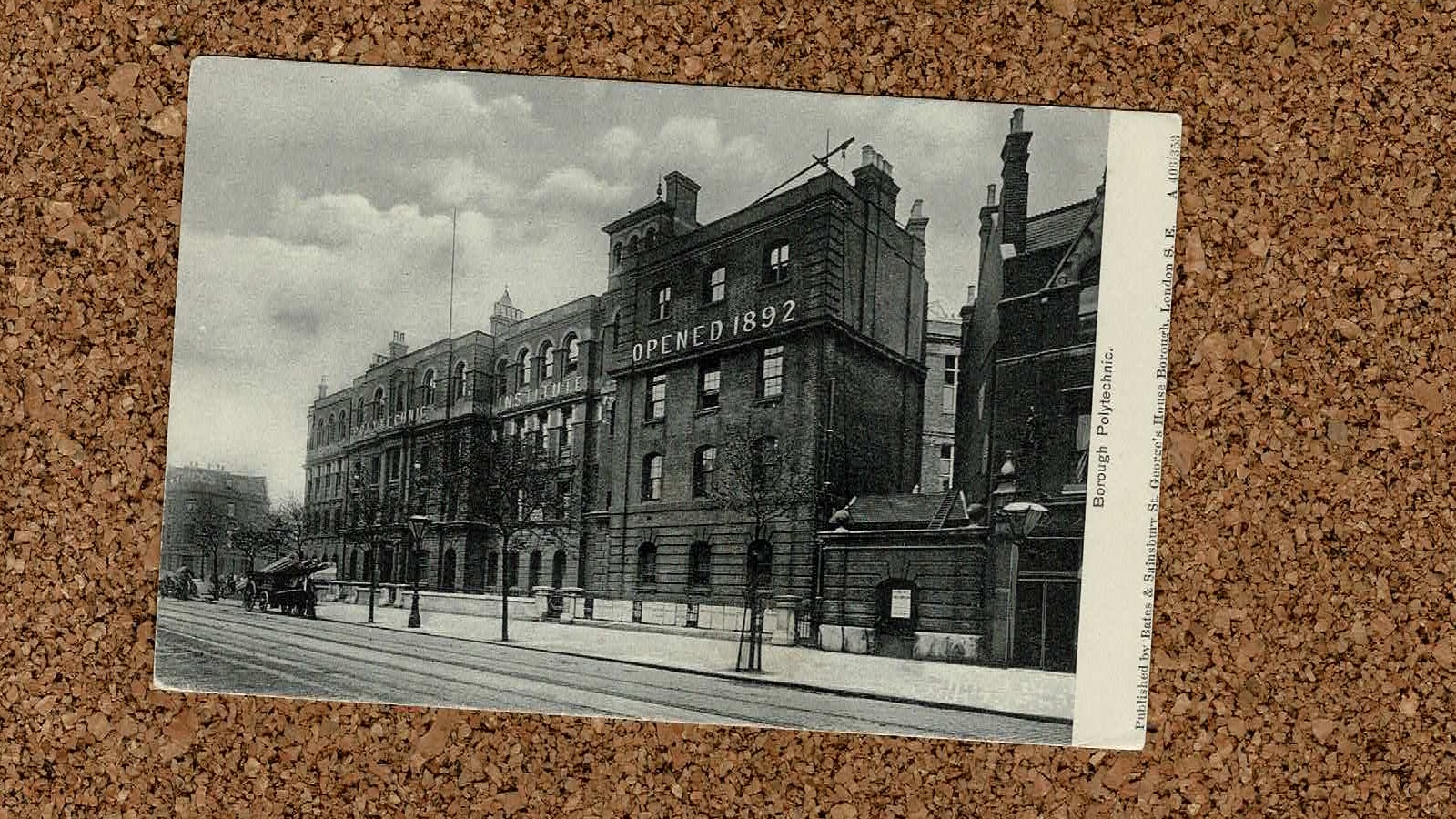
    The Borough story goes like this. In 1890, anticipating success, buildings were purchased: these had previously been the base of the British and Foreign School Society; the South London Polytechnic Institutes (Borough Road Site) Act 1890 authorised the purchase. In 1891 sufficient funds had been raised to proceed with the overall scheme, and an act of Parliament passed to create a legal basis for the new institutions. And in 1892 Lord Rosebery opened the polytechnic. His speech was notable for suggesting that by forbidding smoking in the new polytechnic, they would be unable to compete favourably with public houses. And that the structures against dancing and dramatic performances similarly might be too severe.

    It’s worth looking at this extract from his speech – reported in The Globe of Friday 30 September 1892. Not only because it gives a lovely flavour of Rosebery’s speech-making, but also for the slight hint, maybe, of Johnsonian populism.

    The polytechnic was a technical and recreative institute, which means that as well as technical courses, it also had a gymnasium, and offered facilities for clubs and so on. Obviously as long as they weren’t dramatic or involved dancing. The model was the People’s Palace in the east end, which became Queen Mary College. And that’s a story for another time.

    And so the Borough Polytechnic Institute started to do what it did, which was to educate people. Very successfully too, with the National Bakery School, for example, being an early innovation.

    In 1970 the Borough Polytechnic Institute became the Polytechnic of the South Bank, and incorporated a number of other institutions: the Brixton School of Building, the City of Westminster College, and the National College of Heating, Ventilating, Refrigeration and Fan Engineering. In 1975, when education colleges were being brought into existing HEIs, the Battersea College of Education and some of the provision at Rachel MacMillan College of Education joined the polytechnic.

    In 1987 the polytechnic shuffled its name, becoming the South Bank Polytechnic. In 1992 it became South Bank University and in 2003 it became London South Bank University.

    Finally, here’s a jigsaw of the card. It’s unposted, which means I can’t be sure of the date, but it looks to be pre-World War One.

    Source link

  • How we’re working across London to build a more diverse higher education leadership pipeline

    How we’re working across London to build a more diverse higher education leadership pipeline

    In 2021, I piloted a city-wide mentoring programme for global majority ethnic staff working in London universities.

    It was born from the bilateral North London Leadership Programme between London Metropolitan University and City St George’s, University of London. Four years later the Global Majority Mentoring Programme is flourishing – but world events show us that we need interventions like these as much as we ever did.

    The Global Majority Mentoring Programme is London Higher’s flagship commitment to championing equality, diversity and inclusion across the capital. It is a cross-institutional scheme that aims to improve career progression for global majority ethnic staff; give mentees a senior mentor from a different institution, outside their institutional hierarchy; and build professional networks across the capital to foster pan-London collaboration. Over 300 participants from 20 institutions have engaged with the scheme, with representation from small specialist institutions, large multi-faculty universities, and everything in between.

    London remains the most ethnically diverse region in the UK. Ten of London’s 32 boroughs (plus the City of London) have a majority non-white population. Newham is London’s most diverse borough, with a population that is 69.2 per cent non-white. In the boroughs of Brent, Redbridge, Harrow and Tower Hamlets, the figure is also above 60 per cent.

    You could also call the capital a microcosm of the wider HE sector. London has the largest concentration of diverse higher education providers in the country. A citywide initiative here has a real opportunity to effect meaningful and visible change. Our universities are proudly outward-looking and global, from research links to equitable international partnerships, yet they are also firmly rooted in place and contributors to local growth, regeneration and prosperity. However, lasting change doesn’t happen overnight; London’s higher education sector was not, and still is not, truly representative of the city it serves.

    Mentoring individuals from global majority ethnic backgrounds aligns with London-wide policy aims and ambitions: there’s a clear evidence base to support this. Along with the London Anchor Institutions’ Network, we’re striving to meet the clear priorities that have been set out for London’s post-pandemic recovery and regeneration, addressing systemic issues of social and economic unfairness. The London Growth Plan and upcoming Inclusive Talent Strategy encapsulate these priorities.

    Growing the pipeline

    We are all acutely aware of the wider narrative around EDI. The second Trump administration’s efforts in the US show us what can happen when a populist government takes up “anti-woke” as a cause. There may be disagreement about the form that EDI work should take and some people may fundamentally disagree with the legitimacy of EDI work as part of a public service agenda.

    However, in a sector in which there is a visible lack of diversity – in all its forms – that worsens, the further upstream in the talent pipeline you go, we need to continue to work to understand the practical and cultural barriers to leadership and drive to overcome them, learning together as we go. A theme that has consistently emerged throughout the programme is gaining a better knowledge of HE, and its systemic complexities and barriers.

    Mentoring programmes like ours create space and connections to make sense of personal experience and explore shared challenges. Participants report feeling a greater sense of empowerment and increased confidence. And tangible impacts on mentees include promotions, collaborations across universities, joint research bids, and even funded PhDs happening as a result of their participation in the scheme.

    Future-proofing

    Career progression and leadership opportunities were identified as key issues from the outset, so it seems appropriate that the programme is supported by Minerva, an executive search and recruitment firm specialising in education. As headhunters responsible for significant appointments, Minerva is in a position of influence to shape the composition of senior university leadership and their boards.

    The programme ensures that a diverse talent pool is in the Minerva team’s line of sight, and can understand more about the challenges global majority colleagues face in moving up the ladder. Minerva also runs yearly masterclass for participants to demystify the executive search process – providing insights into a world that is largely unknown to many of them. This includes a breakdown of recruitment, explanations of things such as the “informal coffee” interview stage, tips on negotiating, conveying a personal brand and profile raising.

    We also tailored a leadership development programme alongside the University of Westminster and Blue Whistle Learning that has been taken up internationally, in countries like the Philippines and South Africa.

    It is my hope that the initiatives like this are viewed not as political footballs or shiny nice-to-haves, but for what they are – interventions based on robust evidence that meet local and sectoral needs and broaden opportunities for collaboration.

    Higher education, especially in London, does not exist in a bubble. It is critical that universities continue to position themselves as integral to driving wider policy change in service of society. A more diverse sector does not mean a watered-down one – it means one that is informed by more voices and perspectives, and therefore better equipped to succeed in tackling the challenges laid out before it.

    This article is one of four exploring London Higher’s Global Majority Mentoring Programme – you can find the others here

    Source link

  • London Mayor slams proposed international tuition fee levy

    London Mayor slams proposed international tuition fee levy

    In a keynote address earlier this week at Imperial Global Ghana – Imperial College London’s overseas branch campus in Accra – Sadiq Khan warned that proposals for a new levy on international university fees would hit the UK’s finances hard, describing the policy as “an act of immense economic self-harm”.

    The UK government is currently considering a new levy on income that English universities generate from international students as part of its immigration whitepaper, which could not only put students off coming  from overseas but also create a substantial extra financial burden for already stretched universities.

    International students contribute about £12.5 billion to London, and another £55bn to the national economy every year, Khan pointed out. For this reason, the government should not make it difficult for these students to study in the UK, Khan said at the event – which formed part of his trade mission to Ghana.

    With 5% of students in London’s higher education institutions coming from Africa, Khan stressed the need to ensure that international students are not frustrated. 

    “Closing our economy to global talent would be an act of immense economic self-harm. One that would slow down growth and leave working people in Britain worse off than before. At a time when President Trump is attacking international students, we should be welcoming them,” he added.

    Khan said the international students also bring a longer-term labour market value, as many stay after their studies to work in key economic sectors from tech and AI to finance and creative industries. For this reason, he disagreed with the view that, “we should pull up the drawbridge to international students or punish universities that choose to welcome people from around the world”.

    On Imperial College opening up a hub in Ghana, he said London is ready to contribute to the development effort of Ghana, “not as a patron, but as a partner. In a genuinely reciprocal relationship that brings benefits to us both”.

    President Trump is attacking international students, we should be welcoming them
    Sadiq Khan, Mayor of London

    The vice-chancellor of the University of Ghana, Nana Aba Appiah Amfo, said the university is committed to providing to its  students with a transformative experience that goes beyond the classroom to nurture innovation, leadership and practical problem solving, adding that “this commitment is rooted in our strategic plan, which prioritises student success, impactful research and strategic partners”.

    “One such partnership, rich in promise and results, is with Imperial College London. What began as a collaboration between two researchers has evolved into a university-wide alliance, advancing work in climate change, diagnostics, and entrepreneurship. It is a powerful model of what mutual trust and shared purpose can achieve,” Amfo added.

    She said the Student Venture Support Programme has become the flagship agenda of the partnership which was launched in 2022 with the Imperial College and is  equipping students with skills, mentoring and funding to turn ideas into viable ventures. 

    To date, it has supported over 400 students and more than 115 startups, spanning four universities across Ghana.

    Despite Khan’s strong opposition to the levy, it looks likely to go ahead.

    At last week’s BUILA conference, skills minister Jacqui Smith doubled down on the need for the levy, saying it would reinforce public confidence in the UK’s international education sector.

    Source link

  • Anatomy of a higher education merger – City St George’s, University of London

    Anatomy of a higher education merger – City St George’s, University of London

    Depending on how you look at it, mergers are either very common or very unusual in UK higher education.

    Dig deep enough into the annals of any institutional history and you will most likely find at some point that the institution as we know it today emerged from the combination or absorption of various nineteenth or twentieth-century mechanics institutes, colleges of teaching or technical colleges.

    But recent history of the sector has seen only a handful of mergers, most notably the merger of what was then Victoria University of Manchester and the University of Manchester Institute of Science and Technology (UMIST) in 2004, and the merger of the University of Glamorgan and University of Wales, Newport, to become the University of South Wales in 2013. More recently we’ve seen the merger of the Institute of Education into University College London, the merger of Writtle College with Anglia Ruskin University, recounted in detail on Wonkhe here, and the merger in 2024 of City, University of London and the medical school St George’s, University of London to create City St George’s, University of London.

    The mergers paradox

    Seen from the birds-eye view of Whitehall the relative recent paucity of higher education mergers can be puzzling to some. In the private sector mergers and acquisitions are a well-trodden path to gaining market share, reducing overheads, and generally creating the kind of organisational powerhouse before which others cower and cringe. Arguably, larger institutions can support a wider breadth of education and research activity, can have a greater impact on their external landscape, and are more protected from external change and financial twists of fortune.

    But for higher education institutions there is much more to take into consideration than the goal of organisational heft and security – there is a public service mission, and the institution’s values and culture, which may be best served by remaining the same size or pursuing only modest growth. And there is the administrative complexity and effort of undertaking major organisational change, when in some cases, institutional leaders argue, the benefits of scale can be realised through strategic collaboration rather than full merger.

    While it may look from the outside like the UK has a puzzlingly large number of universities and other providers of HE compared to our geographical footprint and population, we’re not a global outlier in that regard. Prospective students enjoy a broad choice of large multi-faculty institutions with a wide range of extra-curricular services and opportunities, and smaller, cosier, and more specialist offerings – indeed, higher education policy in recent decades has trended towards increasing the numbers of higher education providers.

    Yet at times of financial challenge, such as those the sector is currently experiencing, talk inevitably turns to mergers and whether the sector as a whole would be more resilient if merger or acquisition was a more readily available tool in the financial sustainability arsenal. And here lies what might be termed the merger paradox – financially healthy institutions tend not to see a need for mergers or be motivated to pursue one even where a strategic business case might be made; whereas financially distressed ones are less likely to be an appealing prospect for a merger partner.

    In the case of both Writtle and St George’s, their governing bodies were astute enough to realise that their institutions would not thrive in the long term, and to start considering merger well before reaching a point of crisis.

    Being financially challenged is not the primary driver to merge with another institution,” says Richard Mills, Director, Head of Finance Consulting and lead for public sector M&A for KPMG in the UK. “Returns on investment take a long time to realise, and sometimes things get worse before they get better. The driver has to be strategic fit – for higher education a merger needs to be about strengthening the academic portfolio, and you need to be really clear on the vision and strategy for the merged organisation.”

    Having the strategy in place, and a plan for the legal and financial aspects of managing a merger is only the beginning. “You need to consider the implications of integrating systems, processes, and culture,” says Margaret Daher, Director and major higher education change specialist at KPMG. “The worst case scenario is a Frankenstein model of bolt-ons rather than one organisation emerging. The work of a merger is much greater than the initial negotiations and the creation of a new legal entity – but that initial work can be so consuming that you end up risking letting the dual running of two distinct entities under one institution become an unintentional status quo.”

    City St George’s story

    Elisabeth Hill, Deputy President and Provost at City St George’s, joined what was then City, University of London in September 2022, and was given responsibility for delivery – and realising benefits from – the planned merger with St George’s, University of London which was under discussion at that point.

    The merger was very much about strategy, not finances,” says Elisabeth. “City has always been a University focused on business and professional practice. When Anthony [Finkelstein] took up his post as President he saw the potential to expand the range of professions that we serve to include broader aspects of health as well as medicine. Being a larger institution gives us greater capacity, greater resilience, and a greater opportunity across a breadth of disciplines to leverage interdisciplinary and multidisciplinary work internally and have a greater impact externally. All six of our academic schools already had some kind of interesting relationship with health and medicine so you could see how strengthening the breadth of health and medicine could align with City.”

    At the very early stages of discussion, the governing bodies of both institutions had agreed some “red lines” – primarily to give security to the Council of St George’s that the institution’s long history would not simply be assimilated into City and disappear. The incorporation of St George’s into the new institution’s name was seen as essential, as was the idea that the merger was a combination of two universities rather than the incorporation of one by another, although it was agreed that in practice City’s structure and policies would become the reference point for subsequent work to establish the new institution.

    Once it was clear that there was a strategic rationale and appetite to pursue merger for both Councils, a lot of “due diligence” work was required to make sure that the new institution would have the finances, and the expertise, to function and would be compliant in legal and regulatory terms. While neither institution felt itself to be in immediate financial peril, neither had the luxury of a financial cushion to support major investment, and it had to be clear that the combined finances of the two institutions would be sufficient both to fund the merger itself and to realise its planned benefits. Taking on space in the midst of a hospital site meant that City’s Council and executive team had to do a lot of work to establish risks and compliance expectations around estates maintenance and health and safety to ensure that they would not be putting City at risk as a result of the envisaged merger.

    At this stage both institutions had to carefully manage their very distinctive relationship, i.e. having agreed to merge in principle, but not yet having merged. A tightly negotiated “transfer agreement” set out the conditions under which the merger would operate including the conditions whereby either party could legitimately back out and what information each was obliged to share, in some cases with reference to competition law. Also at this stage, work began with the Department for Education, Office for Students, Privy Council, and General Medical Council among others to work through the academic and legal governance issues of transferring powers and duties from one higher education institution to another. Further work was undertaken to understand the implications for students and prospective students and their likely response to the merger and any related impact.

    A key thing was that there was little in terms of pre-defined process for dealing with a university merger of this type,” reflects Elisabeth. “At times it felt like we were making it up – albeit in a very thoughtful and evidence-informed way – as we went along. It was especially helpful to have people with insights from other sectors on our Council that we could draw on where useful or relevant in our sector and context. External bodies were very supportive, and we drew on significant external support, which is an absolute necessity in this kind of work. I don’t know how you could effect something like this without broader insight, guidance and expertise.”

    Integration – two becoming one

    The new City St George’s, University of London formally came into being on 1 August 2024, but the work of integration is ongoing. “We decided to leave most of the integration work until after the formal point of merger,” says Elisabeth. “By that time, we had been talking about merging for two years and there was a sense that some people were tired of the discussion and needed to see that it was really happening. And on a pragmatic level it is much easier to work through the integration challenges when everyone is under one metaphorical roof, there’s one vice chancellor, one senior team – so we judged that this approach would provide certainty and signal an ability to move forward, replacing uncertainty with certainty. Once we had access to all the detail of the information about St George’s programmes it also became clear that we weren’t going to have to deal with a lot of overlap, which was helpful because it meant we could deliver on a cultural expectation that we would respect the St George’s heritage, which by implication is fundamentally about the academic programmes and research.”

    Key priorities for integration were about bringing together St George’s and City’s School of Health & Psychological Sciences into one academic unit, whose executive dean was appointed through an external recruitment process. There was also a mapping process to establish the university professional functions and roles, and assign some functions to the new school, and some to the university. An early priority was confirming directors of professional services for the merged institution, who were then tasked with managing the integration of their teams. This work is now underway.

    While that integration work continues, Elisabeth points out that City St George’s like most universities, has a whole range of other strategic change agendas on the go, including portfolio review, curriculum management, creation of a student services hub, and replacement of some university professional services systems. There is also a root and branch review of professional services under way, looking at the location and effectiveness of roles and functions. That means it’s harder to attribute impact specifically to the merger process, but it’s also harder for people to blame the merger as the sole cause of unpalatable disruption.

    There is active discussion at City St George’s Council about what above-baseline success measures for the merger should be. Some members of St George’s Council have joined an enlarged City St George’s Council and work is underway to establish the culture of the new institution and supporting processes, and the information needed by Council members to ensure their understanding of the combined institution and support informed decision making around strategic developments and operational priorities.

    Institutionally, leadership continues to think on a day-to-day basis about the kind of integrated community it wants to have at the level of both school and university and what sorts of interventions will help people forge that community. Leaders are taking care to have visibility across all university campuses, putting effort into building relationships, undertaking more formal “road shows” to share strategy, hosting talks, and holding informal sessions with different staff groups. The two students’ unions have also merged – a separate merger in its own right – and continue to maintain an active presence on both sites, strengthening student representation and opportunities from the outset.

    So what would Elisabeth say to another senior leader preparing for a merger? “It’s extremely intense, and for most people it starts outside your normal realm of expertise. You have to be prepared to run business as usual alongside all the additional work on merging, and you have to support staff and students to stay focused on the things they should be focusing on and not getting distracted either by opportunities for future alignment or deferring things to post-merger.”

    Perhaps the most important lesson for any leader considering merger is having to be prepared to navigate the challenge of sticking to institutional and professional values while actually achieving what can be an intensely challenging process on a human level:

    We always wanted to be respectful of context and history, to collaborate, be true to our values, and true to the commitments we made and the ethos of how the merger would be discussed and planned,” says Elisabeth. “But you can’t always be as collaborative as you might want to be – otherwise the risk is you fail to get to the point of merger agreement. At least one of the parties has to be pushing for progress and ensuring that decisions are made at any one time.”

    Seven merger fundamentals

    Having worked on the City St George’s merger, Margaret Daher and Richard Mills would strongly advise boards and executive teams to recognise that a merger is a serious strategic endeavour – it needs to be owned and delivered by resolute staff and managers. Their experience and studies of successful mergers highlights seven fundamentals which need to be got right, although they add that often these are still ignored.

    1. Create and communicate a strong, clear vision. From the start, all staff should be informed of the compelling strategic rationale behind the merger, the transition process and the expected changes, and encouraged to engage in two-way feedback to increase the sense of involvement.
    2. Select new leaders early and let them lead. By identifying and publicising the new leadership team, the merged entity can effectively cut links with past loyalties, provide clarity on leadership and lines of reporting, building cultural alignment and engagement.
    3. Place an emphasis on integration planning. Having a robust and long-term post-merger integration plan is essential to overcoming fragmented ways of working, legacy structures and cultural issues, thereby reducing the risk of indefinitely dual running.
    4. Do the due diligence. Giving proper consideration to short- versus long-term benefits, and carrying out robust due diligence to understand risks fully and test the plans will help the organisations set their sights on opportunities at an early stage, and incorporate anticipated issues into post-merger integration plans so they are monitored and addressed.
    5. Win over stakeholders and develop cultural alignment. Staff are the people that make services happen, so it is vital to overcome any resistance to change. A comprehensive change management approach needs to be adopted, “change champions” should be chosen at an early stage, and given the responsibility and authority to influence and motivate their colleagues. Understanding cultural differences and how to achieve alignment is critical.
    6. Develop both the structure and people. Make sure that the new merged organisation has the resources and the skills to manage the transition process by investing in suitable capability, as well as instituting structural and procedural changes such as mixed work schedules and cross-site working that can encourage collaboration and generate a new culture.
    7. Have patience to achieve long term objectives. Mergers are highly challenging and integration is unlikely to happen quickly. To succeed every level of the organisation requires dedicated resources, experienced people, and strong pre- and post-merger planning, all of which take time to develop and deploy.

    While there are obvious practical and cultural hurdles to overcome, what recent examples demonstrate is that with the right vision, case for change and supporting business rationale, a merger can be the strategic solution for long term sustainability.

    This article is published in association with KPMG as part of our Radical Efficiency series. You can view other articles in the series here.


    Source link