By the time the morning bell rings at Rosewood STEM Magnet, Urban Planning and Urban Design, Monika Heidi Duque has already been in her classroom for hours — reviewing lesson plans, setting out materials, and greeting students by name.
Duque, who has taught at the award-winning, urban planning-themed LAUSD elementary school in West Hollywood for 18 years, was one of four teachers named as finalists by the state education department for the 2026 California Teachers of the Year in October. She was the only LAUSD teacher to receive the honor.
Duque works hard to create a free-flowing vibe in her first-grade classroom to promote the creativity of her students, describing the scene as the “best kind” of messy.
“It’s a place where my students are able to wonder, to be curious, to take risks, to be able to make things with their hands and minds,” said Duque, who has been a teacher in Los Angeles Unified since 2000.
“It’s a place where you can tell learning is happening,” she said of her classroom.
The veteran teacher’s freewheeling approach is apparent in her classroom but there’s a method to the mayhem. Everything her students do is somehow tied back to the school’s theme of urban planning and urban design, topics Duque admits could be heady for her 6-year-old students, were it not for her approach to the subjects, which links them to kids’ everyday lives.
On a recent school day, students in Duque’s class were drawing pictures of designs for a new community space in Griffith Park after she noticed a news report about the city’s struggle to repurpose the area formerly used for pony rides.
Students drew pictures of their ideas for the space, coloring construction paper using markers and drawing their visions for forests and lazy rivers that could be installed in L.A.’s historic park.
In subsequent parts of the project, Duque said, students will create three-dimensional models of their ideas for the part using recycled materials such as cardboard and paper.
“We’re making an arcade that’s called Fun Time, and then we put a petting zoo next to it called Pig Pig,” said Ben, a student in Duque’s class, who was working on a drawing with a few classmates. “I wonder if it will really happen.”
Duque often pulls ideas for lessons from real-life events in L.A., finding the sprawling and diverse city offers no shortage of inspiration for classroom activities tied to urban planning.
“I just keep my eyes and ears to the news, and I just see what’s happening in our community, and I just get ideas from there,” she said.
A favorite lesson from a few years ago was based on an experience the teacher had while walking her dog in Griffith Park, when a coyote approached the two and nearly attacked Duque’s pet.
Feral coyotes are common in L.A. and such experiences aren’t unusual, but this event inspired Duque to create a lesson for students to create outfits for pets to repel predatory coyote attacks.
Students created costumes for pets that featured things known to deter coyotes, such as flashing lights. One student liked the project so much she created a picture book about the lesson with her parents, a copy of which Duque keeps displayed on the wall in her class.
“It’s another example of how I really look at what’s in our city, what’s in the news, and what’s relevant to kids and our lives,” the teacher said.
Duque’s relentless curiosity and enthusiasm make her a natural leader among her colleagues at Rosewood, said the school’s principal, Linda Crowder.
“She is a lifelong learner,” Crowder said. “She gets something and she runs with it.”
Did you use this article in your work?
We’d love to hear how The 74’s reporting is helping educators, researchers, and policymakers. Tell us how
This article is part of Bright Spots, a series highlighting schools where every child learns to read, no matter their zip code. Explore the Bright Spots map to find out which schools are beating the odds in terms of literacy versus poverty rates.
This story is part of The 74’s special coverage marking the 65th anniversary of the Los Angeles Unified School District. Read all our stories here.
When The 74 started looking for schools that were doing a good job teaching kids to read, we began with the data. We crunched the numbers for nearly 42,000 schools across all 50 states and Washington, D.C. and identified 2,158 that were beating the odds by significantly outperforming what would be expected given their student demographics.
Seeing all that data was interesting. But they were just numbers in a spreadsheet until we decided to map out the results. And that geographic analysis revealed some surprising findings.
For example, we found that, based on our metrics, two of the three highest-performing schools in California happened to be less than 5 miles apart from each other in Los Angeles.
The PUC Milagro Charter School came out No. 1 in the state of California. With 91% of its students in poverty, our calculations projected it would have a third grade reading rate of 27%. Instead, 92% of its students scored proficient or above. Despite serving a high-poverty student population, the school’s literacy scores were practically off the charts.
PUC Milagro is a charter school, and charters tended to do well in our rankings. Nationally, they made up 7% of all schools in our sample but 11% of those that we identified as exceptional.
But some district schools are also beating the odds. Just miles away from PUC Milagro is our No. 3-rated school in California, Hoover Street Elementary. It is a traditional public school run by the Los Angeles Unified School District. With 92% of its students qualifying for free- or reduced-price lunch, our calculations suggest that only 23% of its third graders would likely be proficient in reading. Instead, its actual score was 78%.
Still, as Linda Jacobson reported last month, the district as a whole has been making impressive gains in reading and math over the last few years. In 2025, it reported its highest-ever performance on California’s state test. Moreover, those gains were broadly shared across the district’s most challenging, high-poverty schools.
Our data showed that the district as a whole slightly overperformed expectations, based purely on the economic challenges of its students. We also found that, while Los Angeles is a large, high-poverty school district, it had a disproportionately large share of what we identified as the state’s “bright spot” schools. L.A. accounted for 8% of all California schools in our sample but 16% of those that are the most exceptional.
All told, we found 45 L.A. district schools that were beating the odds and helping low-income students read proficiently. Some of these were selective magnet schools, but many were not.
INTERACTIVE
Map of Los Angeles Area Bright Spots
Some of the schools on the map may not meet most people’s definition of a good school, let alone a great one. For example, at Stanford Avenue Elementary, 47% of its third graders scored proficient in reading in 2024. That may not sound like very many, but 97% of its students are low-income, and yet it still managed to outperform the rest of the state by 4 percentage points. (It did even a bit better in 2025.)
Schools like Stanford Avenue Elementary don’t have the highest scores in California. On the surface, they don’t look like they’re doing anything special. But that’s why it’s important for analyses like ours to consider a school’s demographics. High-poverty elementary schools that are doing a good job of helping their students learn to read deserve to be celebrated for their results.
Did you use this article in your work?
We’d love to hear how The 74’s reporting is helping educators, researchers, and policymakers. Tell us how
California’s community college–to–four-year university transfer pipeline has not delivered the outcomes students need. While 80 percent of community college students intend to transfer, just 19 percent reach a California State University campus within four years. The gap is stark. While there have been numerous statewide efforts to define clear pathways to California State University and the University of California, time and time again it’s taken local innovation and collaboration between sending and receiving colleges to make a real difference.
In Los Angeles, which enrolls a quarter of the state’s students, educators and partners have spent nearly a decade working to support student-centered transfer innovations by focusing attention on implementation of the associate degree for transfer (A.D.T.), a 2+2 pathway intended to offer community college students guaranteed admission to the CSU and an efficient path to graduation. Cross-sector education and workforce collaboratives like the L.A. Compact and the L.A. Region K–16 Collaborative, both convened by UNITE-LA—a nonprofit advancing equitable education and career pathways—have stewarded this work.
In 2017, UNITE-LA brought together leaders from California State University, Northridge; the L.A. Community College District; and other local public and private universities to attempt to solve a common challenge: re-engaging students who stopped out. Recognizing that institutions had a shared responsibility to support this student population, California’s first reverse-transfer program was born.
CSUN Connections went further than traditional reverse-transfer models by helping disengaged students seamlessly transfer their credits to a partnering community college, apply them to an A.D.T. when available and then transfer back to CSUN to complete their bachelor’s with all the benefits of an associate degree. This work required us to take stock of the student data and identify where institutional and systemwide policy barriers, including degree offerings, residency requirements and program misalignments, were costing students additional time and money
Concurrently, campus partners wanted to better understand A.D.T. pathway availability and student outcomes from a regional perspective. Recognizing that the benefits of the A.D.T. unravel when such degrees are not locally available or, when available, rendered inaccessible by enrollment impaction, 16 community colleges and four CSUs engaged in historic data sharing to assemble a clearer picture.
The findings were clear: The A.D.T. was not yielding the desired results. Students who earn the A.D.T. transfer to CSU at half the rate of non-A.D.T. earners. A.D.T. earners often did not complete their degree in two years, and many did not enter CSU in the same field of study. This is due, in part, to the fact that A.D.T.s are not offered locally in many high-paying fields in popular majors like STEM and health. Students of color, especially L.A.’s African American student population, were even less likely to earn the degree, transfer or enter high-demand fields.
In response, UNITE-LA convened a 2021 community of practice focused on improving transfer pathways in the region, asking, to what extent do our educational systems yield inequities in transfer, and for whom? Why is this happening? And how might we bring change? The group surfaced systemic challenges and also revealed that meaningful solutions must be developed at the campus level.
From 2022 to 2024, UNITE-LA piloted a new approach: the Student-Centered Transfer Redesign Process. In partnership with California State University, Dominguez Hills; Cal Poly Pomona; and their feeder community colleges, campus administrators and staff in academic affairs, student services and enrollment management worked together alongside faculty to diagnose barriers and design strategies to improve transfer and bachelor’s attainment.
The process went beyond policy change—it built campus capacity. Participants gained deeper understanding of equity gaps, stronger cross-campus relationships and hands-on tools for problem solving. Empathy interviews with transfer students shifted the focus from what students did or didn’t do to what they experienced, learned and overcame. This perspective is critical to making a student-ready system instead of making students conform to existing policies that don’t serve them.
For example, through the Transfer Redesign Process, CSUDH looked at data-backed recommendations of the statewide AB 928 Committee and assessed the viability of expanding its campus emergency aid program for prematriculated transfer students. Such aid could help incoming transfer students navigate unexpected expenses associated with transfer, such as moving costs, childcare costs and additional transportation expenses like up-front parking or transit pass fees.
In another example, Cal Poly Pomona sought to partner with a feeder community college to implement eTranscript in order to create faster and more consistent transcript and data-sharing processes to support transfer student success. As noted in a recent study of five public institutions in California, despite improvements in available technology, transcript sharing remains a highly manual process that can delay transfer students in receiving final credit-evaluation decisions that are needed for accurate advisement and on-time course registration.
These efforts underscore a core lesson: Localized collaboration is essential for effective implementation of state policy, to diagnose new challenges as they arise, to develop responsive solutions from the ground up and then to advocate for the scaling of innovations that work. The size of California’s higher education systems and complexity of degree pathways require more robust investments to support this type of cross-campus work. State-funded initiatives like the K–16 Collaboratives have provided flexible funding to make it possible in places like Los Angeles. But sustained, dedicated funding is key to turning localized innovation into statewide reforms that reach all Californians. With the state’s Cradle-to-Career Data System, the new Master Plan for Career Education and proposed Education Interagency Council, California has an opportunity to embed these lessons statewide.
Los Angeles is fortunate in that it has a coalition of education leaders willing to cut through the bureaucracy and advance change for the well-being of students. It’s taken data sharing, relationship building, intermediaries and a creative blend of funding, but our students deserve systems that work. Campuses deserve resources to improve them. By aligning funding, policy, practice and partnership, we can ensure their success—and, in turn, the prosperity of our communities and our state.
Adam Gottlieb is the director of postsecondary strategy and policy at UNITE-LA.
La joven de 18 años de Houston iba a comenzar clases este otoño en la Universidad de Texas en Tyler, donde le habían concedido una beca de 10.000 dólares al año. Esperaba que eso le permitiera alcanzar su sueño: un doctorado en Química, seguido de una carrera como profesora o investigadora.
“Y entonces se produjo el cambio en la matrícula estatal, y fue entonces cuando supe con certeza que tenía que dar un giro”, dijo Ximena. (The Hechinger Report se refiere a ella solo por su nombre de pila porque ella teme represalias por su situación migratoria).
Aunque Ximena pasó sus primeros años en el norte de México, la mayoría de sus recuerdos son de después de mudarse a Estados Unidos con su padre. Ha asistido a escuelas en Estados Unidos desde el jardín de infancia y, para ella, el 12.º grado consistió principalmente en explicar conceptos avanzados de química a sus compañeros de clase y dirigir laboratorios como asistente de enseñanza.
Pero en junio, los sueños de Ximena se vieron truncados cuando la oficina del fiscal general de Texas y la administración Trump colaboraron para poner fin a las disposiciones de una ley estatal que ofrecía a miles de estudiantes indocumentados como ella tasas de matrícula más bajas en las universidades públicas de Texas. Los funcionarios estatales y federales argumentaron con éxito ante los tribunales que la política vigente desde hacía mucho tiempo discriminaba a los ciudadanos estadounidenses de otros estados que pagaban una tasa más alta. Ese razonamiento se ha replicado ahora en demandas similares contra Kentucky, Oklahoma y Minnesota, como parte de una ofensiva más amplia contra el acceso de los inmigrantes a la educación pública.
En la UT Tyler, la matrícula y las tasas estatales para el próximo año académico ascienden a un total de 9.736 dólares, frente a los más de 25.000 dólares que pagan los estudiantes de fuera del estado. Ximena y su familia no podían permitirse el elevado coste de la matrícula, por lo que la joven se retiró. En su lugar, se matriculó en el Houston Community College, donde los costos para los estudiantes de fuera del estado son de 227 dólares por hora semestral, casi tres veces más que la tarifa para los residentes en el distrito. La escuela solo ofrece clases básicas de química de nivel universitario, por lo que, para prepararse para un doctorado o para trabajar en investigaciones especializadas, Ximena seguirá necesitando encontrar la manera de pagar una universidad de cuatro años en el futuro.
Su difícil situación es precisamente lo que los legisladores estatales de ambos partidos políticos esperaban evitar cuando aprobaron la Texas Dream Act o Ley de Sueños de Texas, una ley de 2001 que no solo abrió las puertas de la educación superior a los estudiantes indocumentados, sino que también tenía por objeto reforzar la economía y la mano de obra de Texas a largo plazo. Con esa ley, Texas se convirtió en el primero de más de dos docenas de estados en aplicar la matrícula estatal a los estudiantes indocumentados, y durante casi 24 años, esta política histórica se mantuvo intacta. Los legisladores conservadores propusieron repetidamente su derogación, pero a pesar de los años de control de un solo partido en la legislatura estatal, no hubo suficientes republicanos que apoyaran la derogación, incluso esta primavera, días antes de que la oficina del fiscal general de Texas y el Departamento de Justicia federal decidieran ponerle fin.
Ahora, a medida que se acerca el semestre de otoño, los estudiantes inmigrantes están sopesando si darse de baja de sus cursos o esperar a que se aclare cómo les afecta el acuerdo de consentimiento firmado por el estado y el Departamento de Justicia. Los defensores de los inmigrantes temen que las universidades de Texas estén excluyendo a posibles alumnos que se encuentran en situación legal y siguen reuniendo los requisitos para pagar la matrícula estatal a pesar de la sentencia judicial, incluidos los beneficiarios del programa de Acción Diferida para los Llegados en la Infancia (DACA), los solicitantes de asilo y los que tienen Estatus de Protección Temporal o TPS, porque el personal de la universidad carece de conocimientos sobre inmigración y no ha recibido directrices claras sobre quién debe pagar exactamente la matrícula más alta.
En el Austin Community College, que presta servicio a un área tan grande como el estado de Connecticut, los miembros del consejo de administración no están seguros de cómo aplicar correctamente la sentencia judicial. Mientras esperan respuestas, hasta ahora han decidido no enviar cartas a sus estudiantes solicitándoles información confidencial para determinar las tasas de matrícula.
Una valla publicitaria que promociona el Austin Community College en español se encuentra en una autopista que conduce a Lockhart, Texas. Credit: Sergio Flores for The Hechinger Report
“Esta confusión perjudicará inevitablemente a los estudiantes, porque lo que vemos es que, ante la falta de información y la presencia del miedo y la ansiedad, los estudiantes optarán por no continuar con la educación superior o se esconderán en las sombras y se sentirán como miembros marginados de la comunidad”, afirmó Manuel González, vicepresidente del consejo de administración del ACC.
Por su parte, los expertos en políticas públicas advierten de que la mano de obra de Texas podría verse afectada, ya que los jóvenes con talento, muchos de los cuales han cursado toda su educación en el sistema de escuelas públicas del estado, ya no podrán permitirse los títulos de asociado y licenciatura que les permitirían seguir carreras que ayudarían a impulsar sus economías locales. En virtud de la Ley Texas Dream, los beneficiarios estaban obligados a comprometerse a solicitar la residencia permanente legal lo antes posible, lo que les daba la oportunidad de mantener puestos de trabajo relacionados con sus títulos. Sin la condición de residentes, es probable que sigan trabajando, pero en empleos peor remunerados y menos visibles.
Relacionado: ¿Te interesa recibir más noticias sobre universidades? Suscríbete a nuestro boletín quincenal gratuito deeducación superior.
“Es una visión muy cortoplacista en lo que respecta al bienestar del estado de Texas”, afirmó Barbara Hines, antigua profesora de Derecho que ayudó a los legisladores a redactar la Ley Texas Dream.
A principios de siglo, casi dos décadas después de que los niños indocumentados obtuvieran el derecho a asistir a la escuela pública en Estados Unidos, los estudiantes inmigrantes y sus defensores seguían frustrados porque la universidad seguía estando fuera de su alcance.
Para el mayor general retirado de la Guardia Nacional del Ejército Rick Noriega, un demócrata que en ese momento formaba parte de la Legislatura de Texas, esa realidad le tocó de cerca cuando se enteró de que un joven trabajador de su distrito quería matricularse en el community college local para estudiar mecánica aeronáutica, pero no podía permitirse pagar la matrícula fuera del estado.
Noriega llamó a la oficina del rector de la escuela, que pudo proporcionar fondos para que el estudiante se inscribiera. Pero esa experiencia le llevó a preguntarse: ¿cuántos niños más de su distrito se enfrentaban a las mismas barreras para acceder a la educación superior?
Así que colaboró con un sociólogo para encuestar a los estudiantes de las escuelas secundarias locales sobre el problema, que resultó ser muy frecuente. Y el distrito de Noriega no era una excepción. En un estado que durante mucho tiempo ha tenido una de las mayores poblaciones de inmigrantes no autorizados del país, los políticos de todos los partidos conocían a electores, amigos o familiares afectados y querían ayudar. Una vez que Noriega decidió proponer la legislación, un republicano, Fred Hill, pidió ser coautor del proyecto de ley.
Para los defensores de la Ley Texas Dream, el mejor argumento a favor de la matrícula estatal para los estudiantes indocumentados era de carácter económico. Después de que el estado ya hubiera invertido en estos estudiantes durante la educación pública K-12, tenía sentido seguir desarrollándolos para que, con el tiempo, pudieran ayudar a satisfacer las necesidades de mano de obra de Texas.
“Habíamos gastado todo ese dinero en estos jóvenes, y ellos habían hecho todo lo que les pedimos —en muchos casos, eran superestrellas, los mejores de su promoción y cosas por el estilo— y luego se topaban con este obstáculo, que era la educación superior, cuyo costo era prohibitivo”, dijo Noriega.
La legislación fue aprobada fácilmente por la Cámara de Representantes de Texas, que en ese momento estaba controlada por los demócratas, pero el Senado, liderado por los republicanos, se mostró menos complaciente.
“Ni siquiera pude conseguir una audiencia. Me dijeron rotundamente: “No, esto no va a salir adelante””, afirmó Leticia Van de Putte, la entonces senadora estatal que patrocinó la legislación en su cámara.
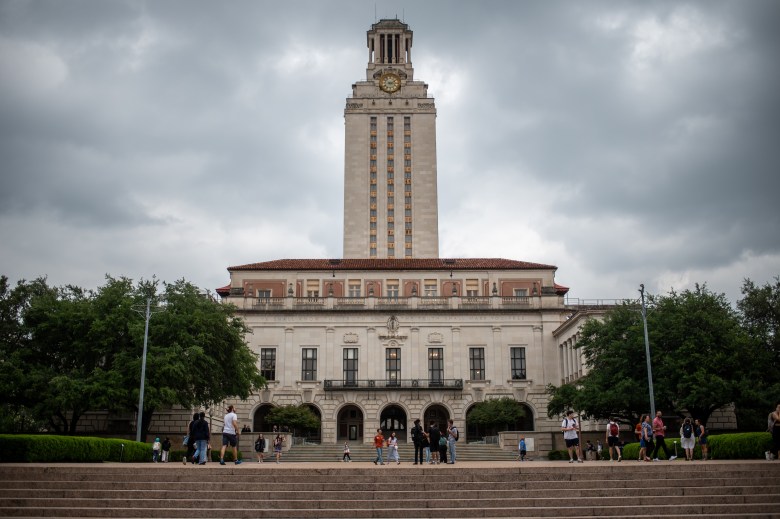
Las nubes cubren el cielo detrás de la torre de la Universidad de Texas en Austin. Credit: Sergio Flores for The Washington Post via Getty Images
Para persuadir a sus colegas republicanos, añadió varias restricciones, entre ellas la de exigir a los estudiantes indocumentados que vivieran en Texas durante tres años antes de terminar la escuela secundaria o recibir un GED. (Se estimó que tres años era el tiempo medio que tardaría una familia en pagar suficientes impuestos estatales para compensar la diferencia entre la matrícula estatal y la matrícula fuera del estado). También incluyó la cláusula que obligaba a los estudiantes indocumentados que accedían a la matrícula estatal a firmar una declaración jurada en la que se comprometían a solicitar la tarjeta de residencia tan pronto como pudieran.
Van de Putte también recurrió a los grupos empresariales de Texas para insistir en los argumentos económicos a favor del proyecto de ley. Y convenció a la comunidad empresarial para que pagara los autobuses que llevarían a pastores evangélicos conservadores latinos de Dallas, San Antonio, Houston y otras zonas del estado a Austin, para que pudieran llamar a las puertas en apoyo de la legislación y rezar con los senadores republicanos y su personal.
Después de eso, la Ley Texas Dream fue aprobada por abrumadora mayoría en el Senado estatal en mayo de 2001, y el entonces gobernador Rick Perry, republicano, la promulgó como ley al mes siguiente.
Sin embargo, en 2007, incluso cuando los defensores de los derechos de los inmigrantes, los grupos religiosos y las asociaciones empresariales formaron una coalición para defender a los inmigrantes contra las políticas estatales perjudiciales, la legislatura de Texas comenzó a presentar una serie de propuestas generalmente contrarias a los inmigrantes. En 2010, las encuestas sugerían que los tejanos se oponían de manera abrumadora a que los estudiantes indocumentados pagaran las tasas de matrícula estatales.
En 2012, un nuevo grupo de políticos de derecha fue elegido para ocupar cargos públicos, muchos de ellos opuestos filosóficamente a la ley y muy críticos al respecto. La defensa de la política por parte de Perry se volvió en su contra durante las primarias presidenciales republicanas de 2012, cuando su campaña fue objeto de críticas después de que, durante un debate, dijera a los oponentes de la igualdad en las matrículas: “No creo que tengan corazón”.
Aún así, ninguno de los muchos proyectos de ley presentados a lo largo de los años para derogar la Ley Texas Dream tuvo éxito. E incluso el gobernador Greg Abbott, un republicano partidario de la línea dura en materia de inmigración, se mostró en ocasiones ambiguo sobre la política, y su portavoz afirmó en 2013 que Abbott creía que “el objetivo” de la matrícula estatal independientemente del estatus migratorio era “noble”.
Los observadores legislativos afirman que algunos republicanos del estado siguen apoyando la política. “Es una cuestión bipartidista. Hay republicanos que apoyan la matrícula estatal”, afirmó Luis Figueroa, director de asuntos legislativos de la organización sin fines de lucro Every Texan, dedicada a la investigación y la defensa de políticas públicas. “Pero no pueden decirlo públicamente”.
Mientras tanto, a medida que el tema se volvía más controvertido políticamente en Texas, la Texas Dream Act acabó amplificando un debate más amplio que finalmente condujo a la creación del DACA, el programa de la era Obama que ha dado a algunos inmigrantes indocumentados acceso a protecciones contra la deportación y permisos de trabajo.
Incluso antes del DACA, muchos inmigrantes trabajaban, y los que siguen sin papeles a menudo siguen haciéndolo, ya sea como contratistas independientes para empleadores que hacen la vista gorda ante su estatus migratorio o creando sus propios negocios. Un estudio de mayo de 2020 reveló que los residentes no autorizados constituyen el 8,2 % de la población activa del estado y que, por cada dólar gastado en servicios públicos para ellos, el estado de Texas recuperaba 1,21 dólares en ingresos.
Pero sin el permiso legal inmediato para trabajar, los graduados universitarios indocumentados que se habían beneficiado de la Ley Dream de Texas se vieron limitados a pesar de sus títulos. A medida que la lucha por la equidad en las matrículas se extendía a otros estados, también lo hacía la lucha por una solución legal que apoyara a los estudiantes beneficiados.
Cuando estos jóvenes, cariñosamente apodados “soñadores o dreamers”, pasaron a primer plano para defenderse más públicamente, su difícil situación despertó simpatía. En 2017, el mismo año en que Trump comenzó su primer mandato, las encuestas dieron un giro y mostraron que la mayoría de los tejanos apoyaba las matrículas estatales para los estudiantes indocumentados. Más recientemente, las investigaciones han indicado una y otra vez que los estadounidenses apoyan una vía para que los residentes indocumentados traídos a Estados Unidos cuando eran niños obtengan la residencia legal.
Pero los argumentos en contra de la matrícula estatal, independientemente del estatus migratorio, también ganaron popularidad: los críticos sostenían que la política es injusta para los ciudadanos estadounidenses de otros estados que tienen que pagar tasas más altas, o que los estudiantes indocumentados están ocupando plazas en escuelas competitivas que podrían ser ocupadas por estadounidenses.
El Departamento de Justicia se apoyó en una retórica similar en la demanda que acabó con la igualdad en las matrículas en Texas, alegando que la ley estatal queda invalidada por la legislación federal de 1996 que prohíbe a los inmigrantes indocumentados acceder a la matrícula estatal basada en la residencia. Ese argumento se ha convertido en un modelo, ya que la administración Trump ha presentado demandas para desmantelar las políticas de matrícula estatal de otros estados para los residentes indocumentados.
En Kentucky, el fiscal general del estado, el republicano Russell Coleman, ha seguido los pasos de Texas y ha recomendado que el consejo estatal que supervisa la educación superior retire su normativa que permite el acceso a la matrícula estatal en lugar de luchar por defenderla en los tribunales.
Al mismo tiempo, la administración Trump ha encontrado otras formas de recortar las oportunidades de educación superior para los estudiantes indocumentados, revocando una política que les había ayudado a participar en programas de formación profesional, técnica y para adultos, e investigando a las universidades por ofrecerles becas.
En Texas, el repentino cambio de política con respecto a las matrículas estatales está causando caos. Las dos universidades más grandes del estado, Texas A&M y la Universidad de Texas, están utilizando diferentes directrices para decidir qué estudiantes deben pagar las tasas fuera del estado.
“Creo que las universidades son las que se encuentran en esta situación realmente difícil”, dijo Figueroa. “No son expertos en inmigración. Han recibido muy poca orientación sobre cómo interpretar el decreto de consentimiento”.
En medio de tanta confusión, Figueroa predijo que es probable que surjan futuras demandas. Los estudiantes y organizaciones afectados ya han presentado mociones ante los tribunales para defender tardíamente la Ley Texas Dream contra el Departamento de Justicia.
Mientras tanto, los jóvenes estudiantes se enfrentan a decisiones difíciles. Una estudiante, que pidió permanecer en el anonimato debido a su condición de inmigrante indocumentada, estaba leyendo las noticias en su teléfono antes de acostarse cuando vio un titular sobre el resultado del caso judicial del Departamento de Justicia.
“Me eché a llorar porque, como alguien que ha luchado por salir adelante en sus estudios, ahora que estoy en la educación superior, ha sido una bendición”, dijo. “Así que lo primero que pensé fue: “¿Qué voy a hacer ahora? ¿Hacia dónde va mi futuro? ¿Los planes que tenía para mí tendrán que detenerse por completo?””.
La joven, que vive en San Antonio desde que tenía 9 meses, se había matriculado en seis cursos para el otoño en la Universidad Texas A&M-San Antonio y no estaba segura de si abandonarlos. Sería su último semestre antes de obtener sus títulos en psicología y sociología, pero no podía imaginar pagar la matrícula fuera del estado.
“Estoy en el limbo”, dijo, como “muchos estudiantes en este momento”.
Comunícate con la editora Caroline Preston al 212-870-8965 o [email protected].
The Hechinger Report provides in-depth, fact-based, unbiased reporting on education that is free to all readers. But that doesn’t mean it’s free to produce. Our work keeps educators and the public informed about pressing issues at schools and on campuses throughout the country. We tell the whole story, even when the details are inconvenient. Help us keep doing that.
ALBUQUERQUE, N.M. — La casa de Maggi, situada en un barrio residencial de esta ciudad, es un refugio para las familias locales. Es un lugar donde, tras solo unas semanas en el programa de cuidado infantil familiar de Maggi esta primavera, un niño en edad preescolar empezó a llamarla “mamá” y a su marido “papá”. Los niños que han terminado el programa de Maggi siguen rogando a sus padres que los lleven a su casa en lugar ir de al colegio.
En los últimos meses, cada vez son menos las familias que acuden a la guardería: se han intensificado las medidas de control de la inmigración y las políticas migratorias han cambiado rápidamente. Tanto Maggi como las familias que dependen de ella, algunas de las cuales son inmigrantes, ya no se sienten seguras.
“Hay mucho miedo en la comunidad latina, y todos ellos son buenas personas, gente buena y trabajadora”, dijo Maggi, de 47 años, en español a través de un intérprete una mañana reciente, mientras observaba a un recién nacido dormir en lo que solía ser su sala de estar. Desde que comenzó su propio negocio de cuidado infantil hace dos años, ha dedicado casi cada centímetro de su espacio común a crear un oasis colorido y lleno de juguetes para los niños. Maggi no entiende por qué tantos inmigrantes corren ahora el riesgo de ser deportados. “Llevamos aquí mucho tiempo”, dijo. “Hemos estado trabajando honestamente”.
Los inmigrantes como Maggi desempeñan un papel crucial en el cuidado infantil en el hogar, así como en el sistema de cuidado infantil más amplio de Estados Unidos, que cuenta con más de 2 millones de trabajadores, en su mayoría mujeres. (The Hechinger Report no utiliza el apellido de Maggi por motivos de seguridad, tanto para ella como para las familias que utilizan sus servicios). Es muy difícil encontrar y retener a los cuidadores, no solo porque el trabajo es duro, sino también por los salarios bajos y las prestaciones limitadas. A nivel nacional, los inmigrantes representan casi el 20 % de la mano de obra dedicada al cuidado infantil. En la ciudad de Nueva York, los inmigrantes representan más del 40 % de la mano de obra dedicada al cuidado infantil. En Los Ángeles, casi el 50 %.
Maggi juega con una de sus pupilas en el patio trasero de su guardería. Maggi dirige una de las pocas guarderías que ofrecen atención las 24 horas del día, los 7 días de la semana, en su ciudad. Credit: Jackie Mader/The Hechinger Report
La guerra de largo alcance de la administración Trump contra la inmigración, que incluye cuotas diarias para la detención de inmigrantes, nuevas restricciones a los permisos de trabajo y la detención de residentes legales, amenaza el ya frágil sistema de cuidado infantil de Estados Unidos. Los proveedores inmigrantes, especialmente aquellos que atienden a familias inmigrantes, se han visto especialmente afectados. Al igual que Maggi, los proveedores de cuidado infantil de todo el país están viendo cómo las familias desaparecen de su cuidado, lo que amenaza la viabilidad de esos negocios. En Estados Unidos, uno de cada cuatro niños menores de seis años tiene al menos un progenitor nacido en el extranjero. Algunos niños que podrían beneficiarse de cuidadores experimentados se encuentran ahora en casa con hermanos mayores o parientes ancianos, perdiéndose la socialización y la preparación para el jardín de infancia que los centros de cuidado proveen. Algunos trabajadores inmigrantes, independientemente de su situación, tienen demasiado miedo para ir a trabajar, lo que agrava la escasez de personal. Recientemente, la administración anunció que prohibiría el acceso de los niños indocumentados a Head Start, el programa de cuidado infantil financiado por el gobierno federal para niños de familias con bajos ingresos.
Relacionado: Los niños pequeños tienen necesidades únicas y proporcionarles los cuidados adecuados puede ser un reto. Nuestro boletín gratuitosobre educación infantil hace un seguimiento de estos temas.
“Las políticas antiinmigrantes pueden y van a debilitar toda nuestra infraestructura de cuidado infantil”, afirmó Karla Coleman-Castillo, analista política sénior del Centro Nacional de Derecho de la Mujer. Los programas domiciliarios, en particular, se verán afectados, ya que suelen atender a más familias inmigrantes. “Cualquier cosa que amenace la estabilidad de la capacidad y la comodidad de las familias para acceder a la educación infantil, y la comodidad de los educadores para incorporarse o permanecer en el mercado laboral, va a afectar a un sector ya de por sí precario”.
Para Maggi, las consecuencias no se han hecho esperar. En febrero, solo unas semanas después de que se anunciaran los primeros cambios, su matrícula pasó de 15 niños al día a siete. Algunas familias regresaron a México. Otras se pusieron tan nerviosas que no se atrevían a desviarse de sus rutas de trabajo ni siquiera para dejar a sus hijos rápidamente. Algunas ya no querían dar su información al estado para obtener ayuda para pagar la guardería.
En mayo, solo dos niños, un bebé y un niño de 4 años, estaban matriculados a tiempo completo, junto con seis niños que acudían a la guardería antes o después del colegio. Maggi acepta a niños que pagan de forma privada y a aquellos que pagan con subsidios de cuidado infantil a través del programa estatal para niños de bajos ingresos. Gana unos 2.000 dólares al mes por el bebé y el niño en edad preescolar, y unos doscientos más cada semana por el cuidado después de la escuela, lo que supone una reducción significativa con respecto a los 9.000 o 10.000 dólares de finales de 2024. Para los padres que no reciben subsidios estatales, mantiene sus tarifas bajas: menos de 7 dólares la hora. “Me dicen que soy barata”, dice Maggi con una leve sonrisa. Pero ella no está dispuesta a subir sus tarifas. “Yo era madre soltera”, dijo. “Recuerdo que me costaba mucho encontrar a alguien que cuidara de mis hijos cuando tenía que trabajar”.
Como muchos proveedores de cuidado infantil que emigraron a Estados Unidos siendo adultos, Maggi comenzó su carrera en un campo completamente diferente. Cuando era una joven madre, Maggi se licenció en Derecho en una universidad de México y trabajó en la fiscalía del estado de Coahuila, en el norte del país. Su trabajo le obligaba a trabajar muchos fines de semana y hasta altas horas de la noche, haciendole difícil cumplir con sus obligaciones como madre soltera. “Me siento muy mal por no haber podido pasar más tiempo con mis hijas”, añade. “Me perdí gran parte de su infancia”.
Durante un año, cuando sus hijas estaban en la escuela primaria, Maggi las matriculó en un internado, las dejaba allí los domingos por la noche y las recogía los viernes por la tarde. Algunos fines de semana, se llevaba a las niñas a su oficina, aunque sabía que no era un lugar adecuado para ellas. Maggi anhelaba un trabajo diferente en el que pudiera pasar más tiempo con ellas.
Hace unos 15 años, cuando la violencia se recrudeció en México, Maggi empezó a pensar seriamente en emigrar. Su primo fue secuestrado y los policías con los que trabajaba fueron asesinados. Maggi recibió amenazas de muerte de los delincuentes a los que había ayudado a procesar. Entonces, un día, unos hombres la detuvieron y le dijeron que sabían dónde vivía y que tenía hijas. “Fue entonces cuando dije: esto no es seguro para mí”.
En 2011, Maggi y las niñas emigraron a Estados Unidos, llevándose todo lo que cupo en cuatro maletas. Terminaron en El Paso, Texas, donde Maggi vendía gelatina y tamales para ganarse la vida. Tres años más tarde, se mudaron a Albuquerque. Maggi conoció a su marido, se casaron y poco después dieron la bienvenida a un hijo, su cuarto hijo.
En Albuquerque, Maggi se estableció en una vida dedicada al cuidado infantil profesional, lo que le resultó natural y le permitió pasar más tiempo con su familia que lo que había podido en México. Ella y su marido se sometieron a un intenso proceso de selección y se convirtieron en padres de acogida. (Nuevo México no exige que las personas tengan un estatus migratorio legal para ser padres de acogida). Maggi matriculó a su hijo menor en un centro Head Start, donde los administradores la animaron a empezar a trabajar como voluntaria. Le encantaba estar en el aula con los niños, pero sin permiso de trabajo no podía convertirse en profesora de Head Start. En su lugar, después de que su hijo empezara la escuela primaria, empezó a ofrecer cuidados infantiles de manera informal a familias que conocía. Maggi obtuvo la licencia del estado hace dos años, tras un largo proceso que incluyó varias inspecciones, una verificación de antecedentes y una formación obligatoria en RCP y principios de cuidado infantil.
Maggi no tardó en crear un negocio muy respetado que cubría una necesidad acuciante en Albuquerque. El suyo es uno de los pocos programas de cuidado infantil de la zona que ofrece atención las 24 horas del día, los 7 días de la semana, algo poco habitual en el sector a pesar de la gran necesidad que existe. Los padres que confían en ella son profesores, cuidadores de personas mayores y personas que atienden llamadas al 911.
En la sala de estar de Maggi, los niños se mueven libremente entre áreas de aprendizaje cuidadosamente seleccionadas con estanterías repletas de juguetes de colores, materiales de arte colocados en una mesa en miniatura y filas de libros. Los pósters educativos de sus paredes refuerzan los colores, los números y las formas. Le encanta exponer a los niños a nuevas experiencias, y con frecuencia los lleva de excursión a tiendas de comestibles o restaurantes. Es cariñosa, pero tiene grandes expectativas para los niños, insistiendo en que recojan lo que ensucian, sigan las instrucciones y digan “por favor” y “gracias”.
“Quiero que tengan valores”, dijo Maggi. “Les enseñamos a respetar a los animales, a las personas y a los demás”.
A finales de 2024, el negocio de Maggi estaba floreciendo y ella esperaba seguir creciendo.
Aún no se han publicado datos sobre hasta qué punto las políticas de inmigración de la actual administración han afectado a la disponibilidad de servicios de cuidado infantil. Pero las entrevistas con los proveedores de cuidado infantil y las investigaciones apuntan a lo que puede suceder en el futuro, y que ya está sucediendo.
Después de que una política de 2008 permitiera al Servicio de Inmigración y Control de Aduanas verificar el estatus migratorio de las personas detenidas por la policía local, se produjo un marcado descenso en la matriculación en guarderías tanto de niños inmigrantes como no inmigrantes. También se produjo una disminución en la oferta de trabajadores de guarderías. Aunque las mujeres eran una minoría entre los deportados, los investigadores descubrieron que la política provocó temor en las comunidades de inmigrantes y muchos abandonaron sus rutinas normales.
En el sector del cuidado infantil, eso es problemático, según los expertos. Los inmigrantes que trabajan en este sector suelen tener un alto nivel de formación y están muy capacitados para interactuar positivamente con los niños, incluso más que los trabajadores nativos. Si una parte cualificada de la mano de obra es esencialmente “purgada” porque tiene demasiado miedo de ir a trabajar, eso reducirá la calidad del cuidado infantil, afirma Chris Herbst, profesor asociado de la Universidad Estatal de Arizona que ha estudiado el efecto de la política de inmigración en el cuidado infantil. “Como resultado, los niños recibirán un servicio deficiente”.
Los programas domiciliarios como el de Maggi se encuentran entre los más vulnerables. Los hijos de inmigrantes son más propensos a estar en esos entornos de cuidado infantil. Sin embargo, en la década anterior a la pandemia, el número de programas domiciliarios disminuyó en un 25 % en todo el país, en parte debido a las dificultades financieras para mantener este tipo de negocios.
Una mañana reciente, Maggi estaba de pie en su sala de estar, vestida con una bata blanca adornada con coloridas mariquitas de dibujos animados. El año pasado, la sala habría estado llena de niños. Ahora está en silencio, salvo por la charla de Kay, la única niña en edad preescolar a la que cuida cada día. (The Hechinger Report no utiliza el nombre completo de Kay para proteger su privacidad). Mientras la pequeña se sentaba en una de las mesitas a hacer una manualidad, Maggi acunaba al bebé, que acababa de despertarse de la siesta. Los ojos del bebé se fijaron en el rostro de Maggi mientras ella lo mimaba.
“¡Hola, chiquito!”, le dijo en español. Él esbozó una sonrisa y el rostro de Maggi se iluminó.
Mientras una de sus hijas se encargaba de alimentar al recién nacido, Maggi siguió a Kay al exterior. La niña de preescolar saltaba del arenero a los columpios y a la casita de juegos, con Maggi siguiéndola diligentemente y jugando a su lado.
Los defensores y expertos afirman que el aumento de las medidas de control de la inmigración puede causar estrés y traumas a los niños pequeños. En Estados Unidos, uno de cada cuatro niños menores de seis años tiene al menos un progenitor nacido en el extranjero. Credit: Jackie Mader/The Hechinger Report
Finalmente, Kay se detuvo y apoyó la cabeza en la cadera de Maggi. Maggi le acarició suavemente la cabeza y le preguntó si estaba lista para mostrar sus habilidades preescolares. Las dos se sentaron en una mesita a la sombra y Kay observó con entusiasmo mientras Maggi sacaba pequeños juguetes de plástico. Kay apiló tres tortugas de plástico. “¡Mamá, mira! ¡Son amigas!”, dijo Kay, riendo.
Kay llegó al programa de Maggi después de que su madre la sacara de otro programa en el que sentía que no la trataban bien. Aquí, Kay es tan feliz que se esconde cuando su madre viene a recogerla. Sin embargo, a Kay le falta un aspecto clave de la experiencia del cuidado infantil. Normalmente, la niña tendría varios amigos de su edad con los que jugar. Ahora, cuando le preguntan quiénes son sus amigos, nombra a las hijas adultas de Maggi.
A Maggi le preocupan aún más los niños que ya no ve. La mayoría están ahora al cuidado de sus abuelos, pero es poco probable que esos familiares sepan cómo estimular el desarrollo y la educación de los niños, dijo Maggi. Muchos no pueden correr con los niños como ella lo hace, y es más probable que recurran a las tabletas o la televisión para entretenerlos.
Ha visto los efectos en los niños que abandonan su programa y regresan más tarde habiendo retrocedido. “Algunos de ellos están haciendo bien las cosas conmigo, y luego, cuando regresan, se han quedado atrás”, dijo. Por ejemplo, un niño al que Maggi solía cuidar acababa de empezar a caminar cuando su madre lo sacó de la guardería a principios de este año, al comienzo de la campaña de represión de la inmigración. Al estar al cuidado de un familiar, Maggi descubrió que ahora pasan gran parte del día sentados en casa.
Antes de que comenzara la segunda administración Trump, el panorama de la atención infantil parecía prometedor en Nuevo México, un estado con una tasa de pobreza infantil crónicamente alta. En 2022, Nuevo México comenzó a implementar una serie de cambios en las políticas de atención infantil. Los votantes aprobaron una enmienda constitucional que garantiza el derecho a la educación infantil temprana, con financiación sostenida para apoyarla. El estado ahora permite que las familias que ganan hasta el 400 % del nivel federal de pobreza, o casi 125.000 dólares al año, puedan optar a la guardería gratuita. Eso incluye a la mayoría de los hogares del estado. Entre otros cambios está que ahora se paga más a los proveedores por los niños que inscriben a través del programa de asistencia del estado.
El aumento ha sido útil para muchos proveedores, incluida Maggi. Antes de la pandemia, recibía unos 490 dólares al mes del estado por cada niño en edad preescolar inscrito en su programa, frente a los 870 dólares al mes que recibe ahora. Si inscribe a bebés que cumplen los requisitos para recibir asistencia para el cuidado infantil, recibe 1.100 dólares al mes, casi 400 dólares más que antes de la pandemia. Sin embargo, necesita que los niños estén inscritos para recibir los pagos. El hecho de que su programa funcione las 24 horas del día, los siete días de la semana, le ayuda. Gana dinero extra del estado cuando cuida a los niños por las tardes y los fines de semana, y recibe una mensualidad para cubrir los gastos de los niños en acogida que recibe.
Los defensores del cuidado infantil en Nuevo México están preocupados porque la política de inmigración afectará al progreso del sector. “Me preocupa que podamos perder centros de educación infantil que podrían ayudar a las familias trabajadoras”, afirmó Maty Miranda, organizadora de OLÉ Nuevo México, una organización sin ánimo de lucro dedicada a la defensa de los derechos. “Podríamos perder a valiosos profesores y los niños perderían esos fuertes vínculos”. Las medidas de control de la inmigración han tenido “un enorme impacto emocional” en los proveedores del estado, añadió.
Las autoridades estatales no respondieron a una solicitud de datos sobre cuántos proveedores de cuidado infantil son inmigrantes. En todo el estado, los inmigrantes representan alrededor del 13 % de la población activa total.
Muchos educadores locales de la primera infancia están asustados debido a la aplicación más extrema de las leyes de inmigración, al igual que lo están los niños a su cargo, dijo Miranda. “A pesar del miedo, los maestros me dicen que cuando entran en sus aulas, intentan olvidar lo que está pasando fuera”, añadió. “Son profesionales que intentan continuar con su trabajo”.
Maggi dijo que está tan ocupada con los niños que permanecen a su cuidado que no tiene tiempo extra para trabajar en otro empleo y obtener más ingresos. No especula sobre cuánto tiempo podrá sobrevivir su familia, sino que prefiere centrarse en la esperanza de que las cosas mejoren.
El mayor temor de Maggi en este momento es el bienestar de los hijos de los inmigrantes a los que ella y tantos otros proveedores de servicios a domicilio atienden. Sabe que algunos de sus niños y familias corren el riesgo de ser detenidos por el ICE, y que ese tipo de interacciones, para los niños, pueden provocar trastornos de estrés postraumático, alteraciones en el desarrollo cerebral y cambios de comportamiento. Algunos de los padres de Maggi le han dejado números de emergencia por si son detenidos por los funcionarios de inmigración.
Muchos de los niños a los que Maggi cuida después de la escuela tienen la edad suficiente para comprender que la deportación es una amenaza. “Muestran miedo, porque sus padres están asustados”, dijo Maggi. “Los niños están empezando a vivir con eso”.
En medio de los vertiginosos cambios políticos, Maggi intenta seguir mirando hacia adelante. Está trabajando para mejorar sus habilidades en inglés. Su marido está obteniendo una credencial para poder ayudarla más en su programa. Sus tres hijas están estudiando para convertirse en educadoras de la primera infancia, con el objetivo de unirse al negocio familiar. Con el tiempo, quiere atender a niños de preescolar inscritos en el programa estatal, lo que le proporcionará una fuente de ingresos estable.
A pesar de toda la incertidumbre, Maggi dice que la sostiene un propósito mayor. “Quiero que disfruten de su infancia”, dijo en una tarde soleada, mirando con cariño a Kay mientras la niña dejaba sus pequeños zapatos rosas a un lado y saltaba a un arenero. Es el tipo de infancia que Maggi recuerda en México. Kay se rió encantada cuando Maggi se agachó y vertió arena fresca sobre los pies de la pequeña. “Una vez que creces, no hay vuelta atrás”.
The Hechinger Report provides in-depth, fact-based, unbiased reporting on education that is free to all readers. But that doesn’t mean it’s free to produce. Our work keeps educators and the public informed about pressing issues at schools and on campuses throughout the country. We tell the whole story, even when the details are inconvenient. Help us keep doing that.
The Los Angeles Community College District (LACCD) may be facing state takeover within two years due to overextended hiring and budget mismanagement, as discussed during a May 2025 meeting of the Los Angeles Valley College (LAVC) Academic Senate. Faculty warned that the looming financial crisis could result in mass layoffs—including tenured staff—and sweeping program cuts.
Start Minutes LAVC Academic Senate
“R. Christian-Brougham: other campuses have brand new presidents doing strange things. If we don’t do things differently as a district, from the mouth of the president in two years we’ll be bankrupt and go into negative. Chancellor has responsibility C. Sustin asks for confirmation that it is the Chancellor that can and should step in to curb campus budgets and hirings. R. Christian-Brougham: the Chancellor bears responsibility, but in the takeover scenario, the Board of Trustees – all of them – would get fired E. Perez: which happened in San Francisco C. Sustin: hiring is in the purview of campuses, so they can’t directly determine job positions that move forward? R. Christian-Brougham: Chancellor and BoT could step in and fire the Campus Presidents, though. E. Perez: in next consultation with Chancellor, bringing this up. C. Maddren: Gribbons is not sitting back; he’s acting laterally and going upward E. Thornton: looping back to the example of City College of San Francisco: when the takeover happened there the reductions in force extended to multiple long-since-tenured members of a number of disciplines, including English. For this and so many other reasons, it was a reign of terror sort of situation. So we really need to push the Chancellor.”
The dire financial outlook comes as new scrutiny falls on LAVC’s Media Arts Department, already under fire for years of alleged fraud, resume fabrication, and manipulation of public perception. Central to these concerns is the department’s chair, Eric Swelstad, who also oversees a $40,000 Hollywood Foreign Press Association (Golden Globe) grant for LAVC students—a role now drawing sharp criticism in light of mounting questions about his credentials and conduct.
Over the past two months, a troubling wave of digital censorship has quietly erased years of documented allegations. In May 2025, nearly two years’ worth of investigative reporting—comprising emails, legal filings, and accreditation complaints—were scrubbed from the independent news site IndyBay. The removed content accused Swelstad of deceiving students and the public for over two decades about the quality and viability of the Media Arts program, as well as about his own professional qualifications.
In June 2025, a negative student review about Swelstad—posted by a disabled student—disappeared from Rate My Professor. These incidents form part of what appears to be a years-long campaign of online reputation management and public deception.
An AI-driven analysis of Rate My Professor entries for long-serving Media Arts faculty—including Swelstad, Arantxa Rodriguez, Chad Sustin, Dan Watanabe, and Jason Beaton—suggests that the majority of positive reviews were written by a single individual or a small group. The analysis cited “Identical Phrasing Across Profiles,” “Unusually Consistent Tag Patterns,” and a “Homogeneous Tone and Style” as evidence:
“It is very likely that many (possibly a majority) of the positive reviews across these faculty pages were written by one person or a small group using similar templates, tone, and strategy… The presence of clearly distinct voices, especially in the negative reviews, shows that not all content comes from the same source.”
A now-deleted IndyBay article also revealed emails dating back to 2016 between LAVC students and Los Angeles Daily News journalist Dana Bartholomew, who reportedly received detailed complaints from at least a dozen students—but failed to publish the story. Instead, Bartholomew later authored two glowing articles featuring Swelstad and celebrating the approval of LAVC’s $78.5 million Valley Academic and Cultural Center:
* *”L.A. Valley College’s new performing arts center may be put on hold as costs rise,”* Dana Bartholomew, August 28, 2017.
Among the most explosive allegations is that Swelstad misrepresented himself as a member of the Writer’s Guild of America (WGA), a claim contradicted by official WGA-West membership records, according to another redacted IndyBay report.
This appears to be the tip of the iceberg according to other also scrubbed IndyBay articles
Other questionable appointments, payments, and student ‘success stories’ in the Los Angeles Valley College Media Arts Department include:
* **Jo Ann Rivas**, a YouTube personality and former Building Oversight Committee member, was paid as a trainer and presenter despite reportedly only working as a casting assistant on the LAVC student-produced film *Canaan Land*.
* **Diana Deville**, a radio host and LAVC alumna with media credits, served as Unit Production Manager on *Canaan Land*, but her resume claims high-profile studio affiliations including DreamWorks, MGM, and OWN.
The film *Canaan Land*, made by LAVC Media Arts students, has itself raised eyebrows. Filmmaker Richard Rossi claimed that both it and his earlier student film *Clemente* had received personal endorsements from the late Pope Francis. These assertions were echoed on *Canaan Land*’s GoFundMe page, prompting public denials and clarifications from the Vatican in *The Washington Post* and *New York Post*:
Censorship efforts appear to have intensified following the publication of a now-removed article advising students how to apply for student loan discharge based on misleading or fraudulent education at LAVC’s Media Arts Department. If successful, such filings could expose the department—and the district—to financial liability.
But the highest-profile financial concern is the 2020 establishment of the **Hollywood Foreign Press Association’s $40,000 grant** for LAVC Media Arts students, administered by Swelstad:
As a disreputable academic administrator with a documented history of professional fraud spanning two decades and multiple student success stories that aren’t, future grant donors may reconsider supporting the Department programs – further pushing the Los Angeles Valley College and by extension the district as a whole towards financial insolvency.
[Editor’s note: The first installment of Corruption, Fraud and Scandal at Los Angeles Community College District is here.]
“HR has been weaponized against our faculty for speaking out and complaining about
discrimination.” This was a public comment made by Los Angeles Community College District
Academic Senate President Angela Echeverri at the March 2025 Meeting of the LACCD Board
of Trustees.
Echeverri’s remarks were not isolated either and were echoed by Deborah Harrington (California
Community Colleges’ Success Network Executive Director), “Our HR leadership is not living up
to the standards that we deserve. Our members remain quite frustrated.” More reporting can be
read in Pierce College student newspaper ‘The RoundUp’ and LACCD Youtube Live-Streamed
meetings.
These accusations come three years after longtime administrator Annie G. Reed (Annie Goldman
Reed) left her position as Omsbudsman/Associate Dean of Students at Los Angeles Valley
College was promoted to Interim Dean of Employee and Labor Relations collecting an annual
salary of $284,935.00 in pay and benefits in 2022 according to Transparent California last year of
reporting.
A survey of public records including news articles, lawsuits, accreditation complaints, and emails
to show that Annie G. Reed has a long history of this sort of behavior across multiple LACCD
campuses – going back to the 2000s.
In an October 27, 2010 article ‘Grade Grievances Give Students Voice’ by Lucas Thompson in
‘The Los Angeles Valley Star’ Annie G. Reed is quoted as cautioning students against using their
rights to challenge unfair grades stating, “It’s worthwhile if a student really thinks they have the
proof to forward with the process . . . It’s their right to, [but] we don’t encourage frivolous
[cases], because that’s a waste of college resources.”
The article further quoted disgraced ex-College President Sue Carleo who left the institution in
2013, with the College finances in the red and on Warning Status with the Accreditation
Commission of Junior and Community Colleges. Carleo warned that students should simply
view mis-grading as “Human Error.” (https://archive.org/details/cavgchm_002210/mode/2up?
q=Annie+Reed+LAVC)
When the ACJCC placed Los Angeles Valley College on Accreditation Warning it cited multiple
standards violations and specifically;
College Recommendation 5:
To fully meet the Standards, the college should ensure that records of complaints are
routinely maintained as required by the Policy on Student and Public Complaints Against
Institutions
(Standards II.B.2, II.B.2.c, II.B.3.a, II.B.4)
This came after Annie G. Reed failed to have student records or complaints available for
inspection to the visiting Accreditation Team.
Three years later Reed was again in hot water when a student filed an Accreditation Complaint in
June 2016, specifically documenting multiple faculty members in the Los Angeles Valley
College Media Arts Department engaging in fraud and deceptive practices – supported by sixty
pages of documentation.
The complaint further stated that Reed refused to facilitate student complaints as was her role
and threatened action for ‘disrupting the peace of the campus’ by making complaints. This was
followed by a second accreditation complaint by another student regarding the same issues and a
student Facebook Group discussing issues.
Reed’s response was to suspend the first student running a smear campaign that he was potential
active shooter citing the complaints he brought, suspend a thirty-year old single mother in the
Facebook Group for Academic dishonesty after she forgot to have a college transcript from when
she was eighteen-years old sent to LAVC, and then threatened the second student who brought an
Accreditation Complaint for vandalizing school property.
[Below: Text exchange between LACCD students alleging that administrator Annie Reed created a smear campaign against them.]
Student 1 was suspended for a year (though not expelled by the Board of Trustees after
investigation) a semester short of graduating. Student 1 would have earned six associate degrees
and eight occupational certificates. Student 2, was ordered to pay a substantial amount of
financial aid back to the college as “restitution.” Several months later, she was subjected to a
reversal of hours by LAVC Grant Director Dan Watanabe in the Media Arts Department, for a
campus job she worked and ordered to pay back several thousand dollars. Student 3 ended up
going to Los Angeles City College to take final classes needed to graduate and was nearly
refused graduation by Department Chair Eric Swelstad.
These actions also happened right before and after LAVC Media Arts Faculty Eric Swelstad,
Chad Sustin, Adrian Castillo, Dan Watanabe, and LAVC President Erika Endrijonas lobbied the
LACCD Board of Trustees to approve construction of a new Media Arts Building that was later
reported by The Los Angeles Times to be a massive racketeering scheme – Aug 4, 2022, Teresa
Watanabe, ‘Corruption and fraud beset long-delayed L.A. Valley college theater project, lawsuit
alleges.’ (https://www.latimes.com/california/story/2022-08-04/corruption-alleged-in-long
delayed-la-valley-college-theater-project)
These actions mirrored the treatment of a student who sued LAVC’s Media Arts Department in
2009, alleging the same type of fraud and misconduct by nearly all the same Department Faculty.
Enrique Caraveo vs Los Angeles Valley College, Eric Swelstad, Joseph D’Accurso, Arantxia
Rodriguez, Dennis J. Reed among others. Filing Date: 05/18/2009 (https://unicourt.com/case/ca
la2-enrique-caraveo-vs-los-angeles-valley-college-et-al-621337)
In that case, Caraveo stated:
46. When plaintiff complained about the above referenced matters, Swelstad and other Valley
College officials retaliated against plaintiff by refusing to grant him a Certificate and creating a
hostile learning environment for him in class.
47. On or around June 2007 plaintiff satisfied the requirements to get a Cinema Arts Production
Certificate (“Certificate”) at Valley College.
54. On or about October 2008, Swelstad denied plaintiff the certificate via a letter even though
plaintiff has fulfilled the requirements to get the Certificate.
55. On or about October 13, 2008, plaintiff notified Delahoussaye and Reed that plaintiff had
fulfilled all requirements for the Certificate and that they should take care of the matter as soon
as possible. On or about October 13, 2008, Yasmin Delahoussaye and Dennis Reed denied
request.”
Dennis Reed, was at the time the Dean over the Media Arts Department and the husband of
Annie G. Reed. Dennis Reed was later profiled in LAist Magazine on April 27, 2016 article ‘Jerk
Driver Who Ran Cyclists Off Glendale Road Charged With Assault, Lying To Police’ (https://
laist.com/news/justice-delivered-almost)
More to the point – Dennis Reed also oversaw a grant program at Los Angeles Valley College
Media Arts Department known as IDEAS – Institute for Developing Entertainment Arts and
Studies at LAVC. The Grant was run by Dan Watanabe. (https://archive.org/details/
cavgchm_002241/mode/2up?q=Annie+Reed+LAVC)
Watanabe was also named in the Accreditation Complaint for Wage Theft, Improper use of funds
and fraud in the successor grant ICT Doing What Matters, due to the college receiving Grant
Money but immediately eliminating the curriculum the grant application said they would provide
and like Caraveo’s complaint not providing in class training or labs. The complaints to
Accreditation and the LACCD Personnel Commission by students also questioned the legitimacy
of a number of professional experts, including Robert Reber – who was listed as both a ‘student
worker’ and ‘professional expert’ in 2008. Student 1 further provided evidence to both that Dan
Watanabe had asked him to falsify his resume claiming fictitious jobs and cited an employee in
the LAVC Payroll office as being behind it (that employee immediately denied it and Student 1
refused).
Dennis Reed had also spent years lobbying for the approval of the VACC building –
unsuccessfully.
In short, Annie G. Reed’s retaliation and cover-up in 2016, may have been to help realize her
husband’s failed building project as well as preemptively shutdown any investigations or audits
that might trigger further scrutiny regarding how the IDEAS Grant was administered under his
time as area Dean.
Reed’s behavior of covering up abusive behavior towards members of the LACCD Community
was also not limited to retaliation against students.
In 2017, then LACCD Board President Andra Hoffman accused former Board President Scott
Svonkin of abusive behavior and demanded sanctions. According to an article in the Los Angeles
Daily News, ‘LA Community College board postpones sanction hearing vote against former
4
president’ August 28, 2017, Annie G. Reed again inserted herself into the matter to cover-up for
Svonkin.
“The allegations do not strike me as related to governing and seem best suited for mediation,”
said Annie Reed, a district employee for 22 years and a representative of Teamsters Local 911. “I
don’t ever recall a time, or a place, where he has treated his colleagues poorly.”
Others disagreed, including two former women board members who did not speak at the
downtown meeting.
They said Hoffman’s critics — who they said weren’t present during the abuse — had a tendency
to blame the victim, while ignoring Svonkin’s allegedly brusque treatment of employees.”
(https://www.dailynews.com/2017/07/13/la-community-college-board-postpones-sanction
hearing-vote-against-former-president/)
Her behavior is further documented in a series of lawsuits against the LACCD District.
Filed October 03, 2024 Dr. Christiana Baskaran (Plaintiff), Linda Silva; Dr. Ruth Dela Cruz,
Dr. Adriana Portugal, vs LACCD (including defendant Annie Reed). (https://trellis.law/doc/
219882998/complaint-filed-by-dr-christiana-baskaran-plaintiff-linda-silva-plaintiff-dr-ruth-dela
cruz-plaintiff-et-al-as-to-los-angeles-community-college-district-defendant-board-trustees-los
angeles-community-college-district-defendant-los-angeles-c)
“[other defendants] Annie Reed to discriminate against female faculty and staff, refused to
investigate immediately or to take preventative action. Then Defendants and EMPLOYER
DEFENDANTS retaliated against PLAINTIFFS and others to try and prevent them from
complaining to authorities. When PLAINTIFFS opposed these illegal practices, they continued
to retaliate against them.”
24. As set forth herein, ALL Defendants were officers, agents. Defendants and directly or
indirectly used or attempt to use their official authority or influence for the purpose of
intimidating, threatening, coercing, commanding, or attempting to intimidate, threaten, coerce, or
command PLAINTIFF and others for the purpose of interfering with the right of that person to
disclose to an official agent matters within the scope of this article. EMPLOYER
DEFENDANTS aided and abetted MARY GALLAGHER, ARMANDO RIVERA-FIGUEROA,
ANN HAMILTON, JAMES LANCASTER, JOCELYN SIMPSON, JIM LANCASTER, ANNIE
REED and Victoria Friedman District Complaince Officer, Genie-Sarceda-Magruder Interim
Director Office for Diversity, Equity and Inclusion, Rick Von Kolen to violate this statute.
28. . . .Dr Hamilton admitted to other illegal activity such as planting drugs on employees to
destroy their reputation and get them fired. Dr Silva filed a grievance against Dean Hamilton to
try and get her to stop the illegal activity, the union did nothing.
32. Ms. Silva complained to Human Resources filed a title IX complaint, made a report to the
police and was retaliated against.
Filed October 19, 2023 Sara Adams, An Individual VS California Institute of Technology,
California Corporation. (https://trellis.law/case/23stcv25556/sara-adams-an-individual-vs
california-institute-technology-california-corporation)
“21. On April 7, 2023, Mr. Wu continued to report the pay disparity to Annie Reed, Upon
information and belief, Annie Reed is Caltech’s Employee and Organizational Development
Consultant (Human Resources Department).
22. Annie Reed spoke about the report of pay disparity to Ofelia Velazquez-Perez, Caltech’s
Senior Director, Total Rewards and Director of Employee and Organizational Development
(Employee Relations).”
Filed March 08, 2021, Mitra Hoshiar, an individual, Plaintiff, v. Los Angeles Community
College District, (https://trellis.law/case/21stcv08950/mitra-hoshiar-vs-los-angeles-community
college-district-an-unknown-entity)
“28. On December 3, 2015, PLAINTIFF then filed a discrimination complaint against Sheri
Berger (“Berger”), VP of Academic Affairs, and Fernando Oleas (“Oleas”), Pierce Union
President. During PLAINTIFF meeting with Dean Barbara Anderson (“Anderson”) at
Anderson’s office on June 10, 2015, Berger and Oleas stopped by and started making remarks of
PLAINTIFF’s accent for reading the graduates’ names on the ceremony with a non-American
accent.
29. Thereafter, On December 11, 2015, in meeting with Dean Annie Reed in conjunction with the
non-collegiality investigation Walsh, Union Grievance Rep and Oleas stopped by at
PLAINTIFF’s office in order to prevent PLAINTIFF from Union Representation. They made
PLAINTIFF to Barbara Anderson, whom was PLANTIFF’s chosen union rep and request for
Anderson to not join the meeting because Walsh and Oleas had to choose who could be the union
representation in the meeting.
30. Based on what had transpired on December 11, 2015, on December 14, 2015, Plaintiff filed a
Whistleblower/Retaliation Complaint at the District’s Complaint at the District’s Compliance
Office against Walsh, Oleas, and McKeever (department and union delegate), and other members
of her department. No action was taken by the Compliance Office.
Annie G. Reed’s, current interim Dean of Labor and Employee Relations, has been involved in
covering up wrongdoing in the Los Angeles Community College District for decades. Her targets
have involved employees, students, faculty, and even a trustee. And so far has never been held
accountable.
Multiple stories were published on newswire IndyBay, the news outlet branch of the San
Francisco Bay Area Independent Media Center between 2023 and 2024. They were then
scrubbed (along with other stories) over the weekend of May 18, 2025.
Recently, newly appointed Chancellor, Dr. Alberto J. Roman has been alerted to Ms. Reed’s
disturbing history – it remains to be seen whether he will take corrective action, or continue to
6
keep around the same problematic individuals that resulted in his predecessor’s resignation after
a vote of no-confidence by the LACCD Academic Senate.
Seven-hundred Marines in California have been ordered to assist in Los Angeles and they’re expected to arrive over the next 24 hours, a U.S. official confirmed. The Marines are from the 2nd Battalion, 7th Marines at Twentynine Palms, California, whom U.S. Northern Command had said Sunday were on a “prepared to deploy status” if the Defense Department needed them.
In a stunning escalation that has drawn comparisons to authoritarian crackdowns, former President Donald Trump has ordered 2,000 California National Guard troops into Los Angeles to quell protests sparked by ICE raids across the region. Despite opposition from California Governor Gavin Newsom and local officials, Trump bypassed state authority by invoking federal powers under Title 10 of the U.S. Code—stopping short of the more drastic Insurrection Act but still raising serious constitutional questions.
The protests began after ICE agents detained dozens of individuals in workplace raids across South L.A. County. The response from the public was immediate and fierce, with large demonstrations erupting near ICE facilities and federal buildings. As tensions grew, federal officers deployed tear gas and non-lethal weapons against demonstrators, while arrests mounted and reports of detainee mistreatment surfaced.
What makes this moment particularly alarming is the way Trump has redefined protest as “rebellion,” authorizing military support for federal law enforcement without a state request. Defense Secretary Pete Hegseth has even threatened to deploy active-duty Marines from Camp Pendleton—a move unseen since the 1992 Rodney King unrest. Legal experts and civil rights advocates have sounded the alarm, calling the federal takeover of California’s National Guard unprecedented and chilling.
The implications for higher education, especially for undocumented and mixed-status students, are profound. Campuses in Southern California are already on edge, with many students fearing ICE presence and military escalation. Faculty and staff in sanctuary campuses and immigrant advocacy networks warn that the militarization of civil immigration enforcement could further chill free speech, academic freedom, and student organizing.
Law professors like Erwin Chemerinsky have warned that Trump’s actions bypass both precedent and constitutional norms: “It is using the military domestically to stop dissent.” Georgetown’s Steve Vladeck noted that the National Guard’s role may technically be limited to support functions, but the symbolism and real-world consequences of armed troops on city streets are undeniable.
Trump’s invocation of rebellion in response to protest mirrors earlier moments of U.S. history where power was used to silence dissent. But this time, it is playing out amid a polarized political landscape, weakened democratic institutions, and a rising authoritarian movement—with the academy, once again, caught in the crossfire.
As protests continue, California’s colleges and universities—long sites of political activism—face renewed pressure. The presence of federal troops, surveillance, and threats of repression may signal a dangerous new phase in the government’s approach to dissent. What was once unthinkable is becoming reality: a nation where protesting immigration raids can be construed as rebellion, and soldiers patrol streets not in a time of war, but in a time of political theater.
The focus of these articles was corruption, fraud and scandal in the Los Angeles Community College District, primarily at Los Angeles Valley College’s Media Arts Department.
A few of these articles summarized.
Erika Endrijonas faces new questions in LACCD fraud | May 2, 2023 |
Pasadena City College President-Superintendent Erika Endrijonas being fired from the institution and trying to get a job at Santa Barbara City College, Mt. SAC, and Los Angeles City College. Endrijonas had been subjected to a vote of no confidence by the Pasadena Academic Senate, Pasadena Full-Time Faculty Union, protests by Part-Time Faculty, and finally the vote to reduce her contract by the newly elected board of trustees.
The article dived into Endrijonas’s tenure at her previous institution – Los Angeles Valley College. Endrijonas was announced in her new role at PCC in December 2018, the same week that a jury in Van Nuys awarded a former LAVC employee $2.9 million jury award for illegal retaliation and abuse. A few months earlier, the Los Angeles Times published a major story about the Valley Academic and Cultural Center – a project meant to be Endrijonas’s crowning achievement – being an alleged massive racketeering scheme.
Further it documented the Media Arts Department the VACC would house had a lengthy history of lawsuits and accreditation complaints against the faculty for not providing the education and training advertised – negating the need for the new building. The building’s approval vote happened in August 2016, the lawsuit happened in 2009, and the Accreditation Complaints happened in June 2016.
Dozen LAVC Cinema Students Narratives challenge Erika Endrijonas’s LACCD Success Story | May 5, 2023 |
This article covered a release of an email thread from a dozen students in 2016 that was ultimately sent to the Accreditation Commission for Junior and Community Colleges in 2016, substantiating that there was widespread fraud in the department. Classes were not scheduled by Department Chair Eric Swelstad, training was not provided, labs were not held, etc . . .
Van Nuys/Los Angeles College Screenwriting Professor Faked Writer’s Guild Membership | May 17, 2023 |
Revealed that LAVC Media Arts Department Chair Eric Swelstad faked his membership in the Writer’s Guild of America – West, and then used it in multiple professional bios.
Los Angeles Valley College perpetuated wage theft against students on Julie Su’s watch | May 19, 2023 |
Documented how Grant Director Dan Watanabe engaged in wage theft against students for two years from 2013 – 2016.
Two Los Angeles Film Professors Bilked Taxpayers Over $3.5 Million Dollars | May 21, 2023 |
Described how LAVC Media Arts Department Founder Joseph Dacursso’s retirement first as Department Chair, then as a full-time faculty in 2012, left Department Chair Eric Swelstad and Arantxa Rodriguez to engage in petty infighting and squabbling that spilled over into scheduling decisions. In short, two faculty members collected six-figure-salaries while putting students in the middle of department in-fighting.
LAVC Omsbudsman Stalked Whistleblowers | August 8, 2023 |
Described how LAVC’s Dean of Students, Annie G. Reed (Goldman) retaliated and stalked students that went to Accreditation, going as far as running a smear campaign that one of them was a potential school shooter. Worse, she began stalking him after he left school – including on social media.
[Image: Annie G. Reed Goldman, Dean of Labor and HR at LACCD]
Further articles questioned where Academic Degrees were given out to students who had not completed Academic classes and criteria, the role of Jo Ann Rivas turned YouTube Personality ‘AuditLA’ who was on the Los Angeles Valley College Citizen’s Building Oversight Committee, whether a number of students with falsified resumes received payments from a Grant as ‘Professional Experts’ etc . . .
The scrubbing of these articles coincided with the formal appointment of Alberto J. Roman as the new Chancellor of the Los Angeles Community College District, following the retirement of disgraced administrator Francisco Rodriguez.
It also came with the publication of two final articles. One about Annie G. Reed’s being named as a Defendant in a lawsuit by former faculty at Los Angeles City College, who came to her about an administrator engaging in illegal behavior – including planting drugs on employees to get them fired.
The second article, probed Los Angeles Valley College Department Chair, Eric Swelstad’s professional bio again and provided evidence that he repeatedly lied and engaged in deceptive advertising and practices for two decades. It provided students who held loans with information about student borrower defenses.
The censorship also came months after Jo Ann Rivas aka AuditLA, herself probed by the articles, launched a barrage of attacks for about a week in January about a former student who had grievance’s against the school. Rivas had previously engaged in a similar barrage in July 2020.
This was not the first time that an attempt was made to censor this news stream.
In 2020, an attempt was made to hack the community news feed account on Twitter/X.com @LACCDW. Then a week before the LACCD Board of Trustees election in November 2020, Twitter suspended the community newsfeed altogether. It was only restored two years later after Twitter’s sale and the re-evaluation of previous suspended accounts.
In a final update – The Valley Academic and Cultural Center, despite having a 2018 completion date, remains unfinished. According to minutes of the LAVC Work Environment Committee Minutes from 2025-05-08;
“The Valley Academic and Cultural Center (VACC) is as of Friday, May 8th, about 80% complete. They are still patching the roof. There are still some critical items like stage protection net.”