Tag: Making

  • Making SEISA official | Wonkhe

    Making SEISA official | Wonkhe

    Developing a new official statistic is a process that can span several years.

    Work on SEISA began in 2020 and this blog outlines the journey to official statistics designation and some key findings that have emerged along the way. Let’s firstly recap why HESA needed a new deprivation index.

    The rationale behind pursuing this project stemmed from an Office for Statistics Regulation (OSR) report which noted that post-16 education statistics lacked a UK-wide deprivation metric. Under the Code of Practice for Statistics, HESA are required to innovate and fill identified statistical gaps that align with our area of specialism.

    Fast forward almost six years and the UK Statistics Authority have reiterated the importance of UK-wide comparable statistics in their response to the 2024 Lievesley Review.

    Breaking down barriers

    While higher education policy may be devolved, all nations have ambitions to ensure there is equal opportunity for all. Policymakers and the higher education sector agree that universities have a pivotal role in breaking down barriers to opportunity and that relevant data is needed to meet this mission. Having UK-wide comparable statistics relating to deprivation based on SEISA can provide the empirical evidence required to understand where progress is being made and for this to be used across the four nations to share best practice.

    In developing SEISA, we referred to OSR guidance to produce research that examines the full value of a new statistic before it is classed as an ‘official statistic in development’. We published a series of working papers in 2021 and 2022, with the latter including comparisons to the Indices of Deprivation (the main area-based measure utilised among policymakers at present). We also illustrated why area-based measures remain useful in activities designed to promote equal opportunity.

    Our research indicated that the final indexes derived from the Indices of Deprivation in each nation were effective at catching deprived localities in large urban areas, such as London and Glasgow, but that SEISA added value by picking up deprivation in towns and cities outside of these major conurbations. This included places located within former mining, manufacturing and industrial communities across the UK, like Doncaster or the Black Country in the West Midlands, as well as Rhondda and Caerphilly in Wales. The examples below come from our interactive maps for SEISA using Census 2011 data.

    An area of Doncaster that lies within decile 4 of the English Index of Multiple Deprivation (2019)

    An area of Caerphilly that lies within decile 5 of the Welsh Index of Multiple Deprivation (2019)
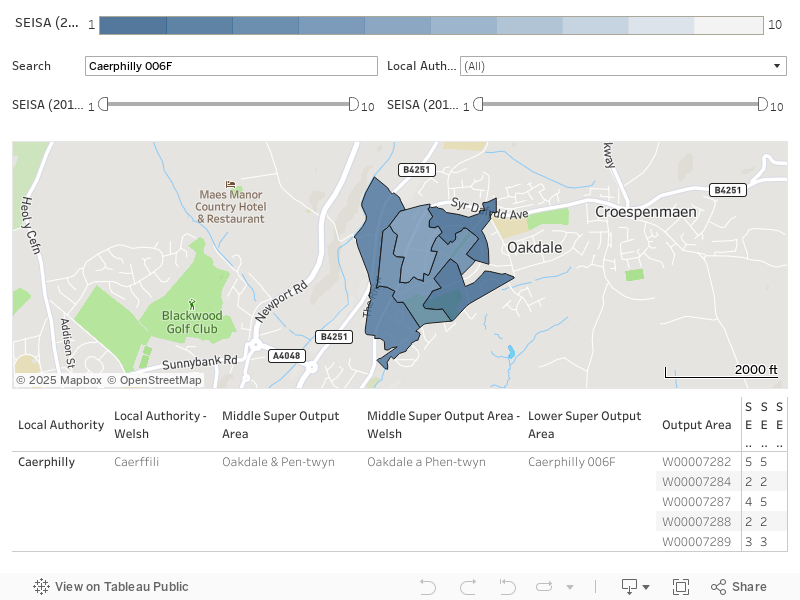
    We also observed that SEISA tended to capture a greater proportion of rural areas in the bottom quintile when compared with the equivalent quintile of the Index of Multiple Deprivation in each nation.

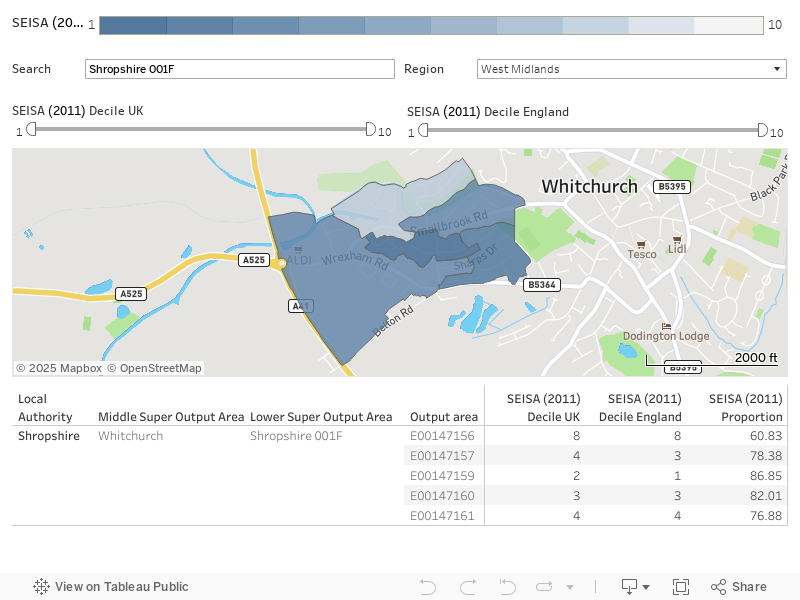
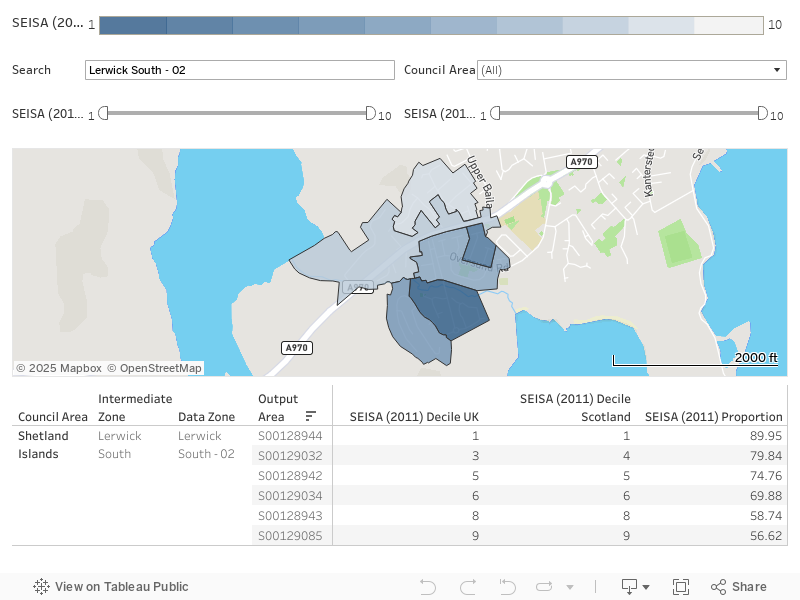
    Furthermore, in Scotland, the bottom quintile of the Scottish Index of Multiple Deprivation does not contain any locations in the Scottish islands, whereas the lowest quintile of SEISA covers all council areas in the country. These points are highlighted by the examples below from rural Shropshire and the Shetland Islands, which also show the benefit that SEISA offers by being based on smaller areas (in terms of population size) than those used to form the Indices of Deprivation. That is, drawing upon a smaller geographic domain enables pockets of deprivation to be identified that are otherwise surrounded by less deprived neighbourhoods.

    A rural area of Shropshire that is placed in decile 5 of the English Index of Multiple Deprivation (2019)
    An area of the Shetland Islands that is within decile 7 of the Scottish Index of Multiple Deprivation (2020)
    Becoming an official statistic

    Alongside illustrating value, our initial research had to consider data quality and whether our measure correlated with deprivation as expected. Previous literature has highlighted how the likelihood of experiencing deprivation increases if you are a household that is;

    • On a low income
    • Lives in social housing
    • A lone parent family
    • In poor health

    Examining how SEISA was associated with these variables gave us the assurance that it was ready to become an ‘official statistic in development’. As we noted when we announced our intention for the measure to be assigned this badge for up to two years, a key factor we needed to establish during this time period was the consistency in the findings (and hence methodological approach) when Census 2021-22 data became available in Autumn 2024.

    Recreating SEISA using the latest Census records across all nations, we found there was a high level of stability in the results between the 2011 and 2021-22 Census collections. For instance, our summary page shows the steadiness in the associations between SEISA and income, housing, family composition and health, with an example of this provided below.

    The association between SEISA and family composition in Census 2011 and 2021-22

    Over the past twelve months, we’ve been gratified to see applications of SEISA in the higher education sector and beyond. We’ve had feedback on how practitioners are using SEISA to support their widening participation activities in higher education and interest from councils working on equality of opportunity in early years education. The measure is now available via the Local Insight database used by local government and charities to source data for their work.

    It’s evident therefore that SEISA has the potential to help break down barriers to opportunity across the UK and is already being deployed by data users to support their activities. The demonstrable value of SEISA and its consistency following the update to Census 2021-22 data mean that we can now remove the ‘in development’ badge and label SEISA as an official statistic.

    View the data for SEISA based on the Census 2021-22 collection, alongside a more detailed insight into why SEISA is now an official statistic, on the HESA website.

    Please feel free to submit any feedback you have on SEISA to [email protected].

    Read HESA’s latest research releases and if you would like to be kept updated on future publications, you can sign-up to our mailing list.


    Source link

  • Making Higher Education More Affordable: The Role of Financial Aid Strategies

    Making Higher Education More Affordable: The Role of Financial Aid Strategies

    Key Takeaways:

    • Financial aid optimization transforms financial resource allocation into a strategic enrollment tool, aligning affordability for students with institutional goals.


    • By leveraging real-time data and tools like Liaison Othot, institutions can craft tailored financial aid strategies that address individual student needs and enrollment strategies.


    • Optimization enables proactive adjustments to financial aid strategies, ensuring accessibility while supporting student retention and institutional sustainability.


    • Strategic financial aid leveraging balances affordability for students with long-term enrollment and revenue objectives.


    The rising costs of higher education and fear of long-term debt have left many prospective students and their families questioning whether they can afford to pursue their academic dreams. For institutions, this presents a dual challenge: attracting diverse students and ensuring enrollment goals align with their mission. An effective and aligned financial aid optimization strategy offers a powerful tool to meet a campus’s enrollment goals. By combining institutional funds with federal and state resources effectively, colleges and universities can increase access and affordability in higher education while achieving broader enrollment objectives.

    From offering enough aid to make tuition manageable to continuously refining financial aid strategies based on real-time information, optimizing plays a pivotal role in strategic enrollment management (SEM). It transforms financial aid awarding from a static process into a dynamic tool that not only attracts and enrolls students but also supports their retention by effectively meeting their financial needs.


    What Is Financial Aid Optimization?

    Financial aid optimization transforms the allocation of financial resources into a critical enrollment tool. By aligning the overall enrollment leveraging strategy—regularly and in real-time at the individual level—optimization allows campuses to address student affordability needs in a unique and tailored way.

    At its core, optimization is a dynamic, data-informed process. Institutions develop annual plans for allocating financial aid (leveraging), basing decisions on previous cycles’ successes and challenges. Unlike traditional static leveraging models, modern optimization approaches incorporate continuous adjustments informed by real-time data. This lets colleges and universities respond proactively to shifting enrollment trends and keeps their financial aid strategies effective throughout the year.


    How to Make Higher Education More Affordable and Accessible

    More accessible higher education starts with understanding the financial challenges students face. For many undergraduates, the cost of tuition, housing, books, and other expenses can make college seem out of reach, even with federal and state aid. For example, a student from a low-income household may find that even the maximum Pell Grant award leaves a significant financial gap. Similarly, a middle-income family might struggle to cover tuition despite not qualifying for significant need-based aid.

    Financial aid leveraging allows institutions to tackle these challenges head-on by creating tailored aid packages that remove financial barriers for students. This approach relies on a mix of need-based and merit-based strategies, often informed by tools like FAFSA data and predictive analytics.

    One of the key advantages of financial aid optimization is its flexibility. Institutions can use data to fine-tune aid offerings based on unique student needs and behaviors. For instance, Liaison’s Othot platform, a cloud-based predictive and prescriptive analytics tool designed specifically for higher ed, can analyze factors such as a student’s location, academic profile, and campus engagement to build aid packages thatneeds. This granularity ensures that the financial aid awarding strategy not only meets the affordability threshold for students also aligns with the overall enrollment strategy being employed on the campus. An aligned optimization approach ensures that the affordability component is integrated into the strategy for specifically targeted cohorts or students, maximizing the likelihood of their enrollment.

    Optimization also lets institutions adapt aid policies for entire cohorts or demographic groups. For example, schools can address rising inflation in high school GPAs by recalibrating merit-based awards to prioritize equity and maintain fairness in their financial aid distribution. This adaptability keeps aid plans relevant as the dynamics of higher education continue to shift. By relying on data and continuously streamlining their financial aid models, institutions can make higher education more attainable for all students while maximizing their impact.


    The Strategic Impact of Financial Aid Optimization

    Financial aid optimization goes beyond simply helping students cover tuition—it’s about achieving a delicate balance between affordability for students and sustainability for institutions. By carefully crafting aid packages that meet the financial needs of students without overextending institutional resources, colleges and universities can enhance their enrollment efforts while maintaining financial health.

    For example, reallocating funds for strategic distribution among students could result in higher net tuition revenue (NTR) without sacrificing enrollment numbers. This demonstrates how strategic adjustments can yield significant results when financial aid decisions are guided by data, tailored to meet institutional priorities, and aligned to overall enrollment strategies.

    Retention and persistence are critical factors to consider when determining how to optimize financial aid. An effective leveraging model doesn’t stop at enrollment and the conclusion of a successful first year—it considers the long-term success of students. By analyzing which cohorts are more likely to persist and graduate, institutions can refine their aid offerings to improve outcomes for all students. This approach ensures that financial aid strategies not only attract students but also support their success throughout their academic journey.


    Aligning Financial Aid With Student Success and Institutional Goals

    Financial aid optimization is a powerful way to make higher education more accessible while helping institutions achieve their objectives. By combining institutional, federal, and state resources with data-driven optimization tools, colleges and universities can craft aid strategies that address affordability, bolster student retention, and maximize their impact.

    Institutions looking to enhance their financial aid and enrollment can benefit from Liaison’s suite of solutions, including Othot. Whether your team is just beginning to explore financial aid leveraging or has years of experience, Liaison’s tools provide the flexibility and insights needed to meet your unique goals. From devising an initial plan to optimizing existing processes, our solutions are designed to assist schools at every stage of their journey. Contact us today to learn more.


    Source link

  • Making Sense of the Loneliness Epidemic – CUPA-HR

    Making Sense of the Loneliness Epidemic – CUPA-HR

    by Julie Burrell | August 21, 2024

    Editor’s Note: This is the first of two posts that will explore the loneliness epidemic and practical ways HR can help combat it in the workplace.

    Loneliness can be as bad for you as smoking 15 cigarettes a day, according to a Surgeon General’s report from last year.

    The report identifies loneliness as a national epidemic experienced by about one in two adults. Loneliness is “associated with a greater risk of cardiovascular disease, dementia, stroke, depression, anxiety, and premature death.” That means human connection is as necessary for your long-term survival as food and water.

    Feeling isolated can also decrease general well-being. People who say they’re lonely are more likely to experience sadness, worry, stress, anger and physical pain, according to a recent Gallup poll. Their research shows that over one in five people globally feel lonely “a lot.”

    When Loneliness Is Worrisome

    Of course, we have all felt lonely sometimes, when changing jobs, getting a divorce, moving to a new city, or recovering from an illness. But when does a temporary feeling of loneliness become chronic?

    Chronic loneliness occurs when the feeling of isolation goes on for a long time and the inability to connect to other people is constant or prolonged. Chronic loneliness can occur even among very social people — you can still feel lonely in a crowd — and is often connected to self-doubt or low self-esteem.

    Taking Away the Stigma 

    Feeling lonely can come with a sense of shame. However, it’s important to understand that loneliness isn’t about who you are, but about a lack of deep social connection driven by factors in our sociocultural environment.

    Even though loneliness has been on rise since before COVID-19, the pandemic and recent political divisiveness have contributed to the epidemic. Social media is likely exacerbating the problem. People who report more than two hours of social media use a day are twice as likely to report feelings of isolation (versus people who use social media less than a half hour).

    The good news is that loneliness can be addressed in part by deliberately strengthening engagement in our workplaces, communities and other social networks.

    While workplace changes alone won’t combat political and social divisions, it’s still a key starting point for helping to decrease loneliness — especially considering how much time we spend at work. When implementing programs targeted at the loneliness epidemic, it can be best to frame your efforts as a positive: increasing social connection.

    One Small First Step

    Efforts to boost connection may help increase employees’ job satisfaction. The Surgeon General’s report stresses that “supportive and inclusive relationships at work are associated with employee job satisfaction, creativity, competence, and better job performance.” Connection at work prevents stress and burnout and can even be linked to fewer missed days of work after injury or illness.

    In the next post in this two-part series, we’ll focus on concrete steps that higher ed HR can take to combat loneliness at work, including for hybrid and remote employees.

    But you can take a meaningful first step by making a small personal change, such as tracking how much time you spend on social media, practicing short mindfulness sessions, or scheduling one phone-free lunch per month with a work friend. Even a positive interaction with a colleague you don’t know well, a barista or cashier, or someone in line with you at the coffee shop can have lasting mental health benefits by expanding your “relational diversity” — the variety of relationship categories you have daily.


    Source link

  • Making Online Learning More Engaging in Higher Education – Edutechniques

    Making Online Learning More Engaging in Higher Education – Edutechniques

    With my recent work in Maynooth University (MU) in Ireland and my ten years of refining and teaching the courses we offer in the MAET program at Michigan State University (MSU), Ive been pontificating and procrastinating on what is current state of play with making more engaging online content in the higher education realm.

    Using Multiple Platforms for Collaboration/Communication

    At MSU we utilise Slack alongside our Brightspace D2L learning platform. This is the latest in a long line of platforms we have added to encourage collaboration and communication amongst our students. Discussion forums on LMS are by default….not the best..and not conducive to authentic engagement. We have found with Slack that engagement is up due to the interface and the fact that Slack has an app. Threads are logical and embedding multimedia works well. At Maynooth University, I taught the blended course TL517 Digital Technology in Higher Education which was delivered in Moodle, the old course framework had a weekly requirement to post to Moodle. I mixed it up a bit by incorporating live Microsoft Team activities along with collaborative Padlets. Padlet gave the students a different visual approach to communicating their thoughts and collaborating with others. The use of breakout rooms in Microsoft Teams gave the students the opportunity to navigate smaller groups in socially constructing knowledge and understanding.

    MORE INTERACTIVE CONTENT

    Quite logical and predictable, right? However, from my time in MU, the majority of online learning courses are merely substitutions of the analog courses that were delivered within the university walls. Working with lecturers to comb through their content to pinpoint areas that may become more interactive with technology is a very rewarding process. This process might be framed by the ABC protocols or just evolve organically through conversations.

    HUMANISE THE PROCESS

    When I am teaching an online course I always start with creating a video introducing myself and detail my professional and personal history. I also tell the students about my hobbies and interests. Seeing my face and hearing my voice always gives a human element to a potentially impersonal first impressions of an online course. It is also important to empathise with students online and realise the stress and pressures of real life that students are going through. Being flexible and empathetic with deadlines (to a certain degree) is greatly appreciated.

    CONSISTENT WORD-OLOGY

    When sorting out a course layout I like to organise the different activities in to action verbs. If a unit is mainly research based then the title will be “Research: “. If a unit involves creating something, then the title will be “Create”. If a unit involves reading to gain knowledge, then the title could be “Learn” or “Inquire”. Consistent wording enables the learner to understand what each unit of a course entails.

    VISUALS, VISUALS, VISUALS

    If the LMS allows I will create an interface of a grid of icons (which Moodle and other LMSs allow). If a student opens a course and encounters a wall of text it is usually quite daunting. A nice array of colourful yet not distracting icons makes a world of difference. Obviously, videos, infographics, images, and other elements that break down walls of text are all beneficial to the end user.

    CREATE ALL THE THINGS

    If we still adhere to the adage that to create is to know, then creating artefacts of learning in an online environment makes a lot of sense. I was surprised that the lecturers at MU were overjoyed when I asked them to create infographics to present their understandings of the concepts we had just read about. They immediately could see them using infographics with their students in their field. Something that I have used in K-12 education for a long time had not found its way to higher education and made me realise that certain pedagogical approaches that I may deem mainstream may be innovative in other realms.


    Discover more from Edutechniques

    Subscribe to get the latest posts sent to your email.

    Source link

  • Classroom Games and Tech – Ed-Tech to Engage and Inspire: Google Slides Template for Making Card Games

    Classroom Games and Tech – Ed-Tech to Engage and Inspire: Google Slides Template for Making Card Games


    Here’s a template I use when I create prototypes for my card games. It has 9 cards on each page, outlined in gray dotted lines. 

    Click here to make a copy in your Google Drive.

    I’ve used this method for years, from early stage prototypes to later versions. I’ve even sold some print-and-play games that I laid out completely in Google Slides. (Here’s an example of a free version of one game I made completely in Google Slides.)

    Here are some tips, all of which are just pointing out features of Google Slides that make it useful for layouts in general:

    • Use Word Art for large letters or numbers, as shown on my example image. 
    • If you use ctrl-c and ctrl-v to copy and paste a card or contents of a card, you can use the arrow keys to move it around. Each tap of an arrow key moves a selected object 1/12″. Moving on a grid like that makes it easy to copy, paste and move objects over or down to the next card quickly, still keeping everything lined up.
    • Use the shapes in Google Slides’ shape menu as building blocks for more complex shapes. For quick prototypes, you’ll be surprised how easy it is to make some functional images and icons to help with early playtesting.
    • When you’re done laying out the cards, you can just print them and cut them out. If you need to make them available to others, you can download the whole slideshow as a PDF. I’ve found some fonts will change size slightly and mess up the layout when you convert, so take a look at the file before sending it off to anyone. 

    Contact me if you have questions about using this template. I’ll update this post with more information as I get questions.

    Source link

  • Making international academic spaces international – ProfHacker

    Making international academic spaces international – ProfHacker

    In this post on making international academics spaces truly international, Maha Bali (Egypt) teams up with Laura Czerniewicz (South Africa), Catherine Cronin (Ireland) and Tannis Morgan (Canada) to offer tips for conferences and journals.

    This article was co-authored by Maha Bali (Associate Professor of Practice at the Center for Learning & Teaching at the American University in Cairo, Egypt @bali_maha), Catherine Cronin (Strategic Education Developer at the National Forum for the Enhancement of Teaching and Learning in Higher Education, Ireland @catherinecronin), Laura Czerniewicz (Director of Centre for Innovation in Learning and Teaching, University of Cape Town, South Africa @czernie), and Tannis Morgan (Director of the Centre for Teaching, Learning, & Innovationat the Justice Institute of British Columbia, Canada @tanbob).

    Introduction

    Is the title of this piece an oxymoron? Aren’t international academic spaces international by definition? Unfortunately not: “international” too often (one might venture, almost inevitably) means the Global North, and indeed it usually means Europe and the USA. So, for example, announcements at European conferences of international speakers more often than not means those from the US (not even Canada, sometimes). This is a problem for obvious reasons: it perpetuates the skewed geopolitics of knowledge, renders invisible voices, views, and epistemologies from the Global South or even from peripheries within the North. Everyone is the poorer for it.

    Much lip service is paid to diversity and inclusion of diverse voices and knowledge, but little action is taken on the ground to truly challenge the status quo. But it is really a non-negotiable in the context of all that technology affords us today. It is unethical to claim to be international and to exclude, in practice, full participation. It is unacceptable to claim lack of awareness of international actors in all fields of knowledge when we have the resources and networks with which to find them. The reputation and credibility of such spaces (organisations, events and publications) is at stake

    By academic spaces we mean conferences, workshops, summits, journals, organisations and other academic structures which claim to be international. What follows are practical suggestions for genuine inclusion practices to ensure that international really means international.

    Money matters

    The issues here are about acknowledging limited access to funding, recognising real costs, and being aware of punitive exchange rates. What can be done?

    • Ensure that there is funding to bring participants to events. This should be a cost built into the budget of an event, like any other cost. It should prioritize offering funding to those unlikely to be funded by their own institutions or organisations, or who are unaffiliated. Otherwise, an event will be international in theory, but much less so in practice.
    • Be creative about funding structures in order to enable more people to attend. This could include sliding scales for participation (such as different registration fees), allowing people to pay more for their ticket in order to help support someone else to attend (e.g. via a scholarship fund), funded fellowships (e.g. CC Summit and Digital Pedagogy Lab), etc. See further ideas from Ashe Dryden.

    • Where speakers are paid to speak at an event, pay real costs. This includes travel to and from airports, visas, incidental costs, etc. Otherwise participants will have to subsidise their participation, usually at their own expense.

    • When organising accommodation conference special rates, include safe low cost accommodation options.

    • Be mindful of exchange rates. For example, be considerate when eating out at conferences with colleagues from countries where the exchange rates are unfavourable. Some of us have had meals with colleagues and have been appalled by the cost.

    • Many of us don’t drink, so when splitting bills, don’t include alcohol. Some of us won’t go out for dinner because of this cost.

    Genuine participation

    • Pay attention to who is invited to speak There has been, thank goodness, a great deal of attention paid to avoiding “manels” (i.e. all-male panels), although these continue. Our focus here is about including voices from the periphery. Think “outside of the box” about who is invited to speak (see point below about going beyond existing narrow networks). Think about who is invited to speak as keynotes, as well as in plenaries and on panels. Who is signalled as being the experts and who is signalled as being there to learn? In addition, make a conscious effort to make space for new voices.
    • Include a variety of epistemologies and criteria for acceptance. Ensure that criteria are explicit in welcoming and encouraging diversity. One way is to ensure that a Call for Proposals directly cites the work of a wide range of authors. We have seen journal CfPs on issues related to diversity and inclusion that cite exclusively white male authors on the topic. Mind you, any such reference list should be suspect.

    • Pay attention to roles. Think carefully about the roles. Ensure that the “experts” are not all from the Global North and “participants” from the periphery. Ensure that sessions are organized to ensure participants from the North have multiple opportunities to listen to those from the South, and those from the South can hear each other. In addition, ensure that membership of the conference committee, the core team of key conference organisers, and even the conference chairs is diverse. Diverse does not mean a token person from one or two minority groups, but a representative number of participants across relevant minority groups.

    • The shape of the programme. Ensure diversity across the programme. We can think of examples of events where all the Global South participants were in one panel or one stream. This is a form of marginalisation. Include a diversity of contributors on boards, and in leadership/facilitation positions.

    • Formats Small and poorer institutions are unlikely to fund someone to attend an event where the person is not speaking. Events where people go to learn/participate, or Unconference type events, are often unfundable internally — so funding needs to be provided. For many, funding is only available if they are making a contribution that is published in official proceedings, so try to provide them.

    • Lead times How early is the call put out? Many people in Global South people need longer times to get visas, local funds, etc. There are even instances where an invited speaker has not had sufficient time to get a visa, and thus could not travel to participate.

    • Language Consider how a variety of languages can be enabled. Some conferences put in place strategies to enable participation, through technology, buddy systems, etc.

    • Participation guidelines How are the values of the conference (re: safety, inclusion, respect) communicated to participants and others? What avenues are provided so that those who experience exclusion or marginalisation have an opportunity to communicate this to/with conference organisers — before, during, or after the event. The Mozilla Festival (#mozfest) provides one such exemplar of participation guidelines: https://mozillafestival.org/guidelines

    • Offer onsite childcare options or make your event child-friendly. It is much more complex for parents to travel to international (or really any conference not within driving distance) conferences far from home without the option of bringing their children with them. Yes, this is complicated to arrange. But some events do it, so it is not impossible.

    New networks

    • Disrupt “old boys’ networks” Ensure diverse leaders and organizers. This does not mean token diversity (as in 3-4 non-North people in a team of 20, but as international as you want your event to be), and in roles that allow taking action — not just for image. For example, some of us are on several editorial boards but are never consulted on anything related to diversity or anything else. There are cases of other editorial boards where we do have a role.
    • Enable social networking Provide opportunities for people to join up and meet one another at events. Offer a local person to host a handful of people at a local restaurant, for example.

    • Facilitate virtual participation Plan for and design that provisions exist for virtual or hybrid participants and presenters. There are several ways to do this, e.g. see http://virtuallyconnecting.org/ for an effective way of doing this.

    Above all, do not just celebrate diversity by paying lip service to it. Recognize that it takes hard work and a rethinking of the way things have been done in the past, and often some degree of discomfort. Learn from other examples. Accept that this will always be an aspiration and keep reflecting on what you do and iterate towards improving it. You are challenging hegemonic world systems of knowledge and it will take time to do it right. Keep involving diverse participants and organizers to choose the ways that they believe will help to achieve this. Useful links

    [Header image from Pixabay CC0 https://pixabay.com/en/continents-flags-silhouettes-human-975936]


    Source link