

ALLENTOWN, Pa., July 23, 2025 — In a bizarre scene, a police officer in Allentown, Pennsylvania, drove his patrol cruiser down a sidewalk at a man who was protesting police misconduct by filming outside a police station.
Today the Foundation for Individual Rights and Expression filed a lawsuit defending Phil Rishel’s rights to film and criticize police activity in public spaces — behavior that is protected by the First Amendment — without being assaulted or retaliated against for doing so.
“The retaliation over my speech confirms that there is a huge issue with the culture of the Allentown Police Department,” said Phil. “These officers have a disdain for the rights of the people they’re sworn to protect — and I hope my lawsuit changes things for the better.”
Since 2015, the City of Allentown, Pennsylvania, has paid at least $2 million related to claims of police misconduct. In 2023, Phil began protesting in Allentown by non-disruptively recording police activity while standing on public sidewalks outside local police precincts.
COURTESY PHOTOS OF PHIL RISHEL
On March 26, 2024, Phil went to the Hamilton Street police station, where he stood on a public sidewalk and recorded what he could see in plain view. Approximately 15 minutes after he arrived, an officer approached him and briefly paused while looking at a “No Trespassing” sign. Phil responded, “Yeah, that’s a nice sign. Too bad it doesn’t apply to the public sidewalk.” The officer then silently walked away from Phil into the depths of the garage and up a vehicle ramp. Phil called out after him about his disregard of a sign next to the ramp that read: “PEDESTRIANS MUST USE STAIRS ONLY.”
About 10 minutes later, the officer drove his patrol car out of the garage and sharply turned onto the sidewalk towards Phil while blaring the siren. The officer pursued him down the sidewalk, even driving around a lamppost in his way and back onto the sidewalk to chase Phil. The officer then exited the car, went into the office, and emerged with a police sergeant. They accused Phil of loitering and banned him from the public sidewalk under threat of arrest.
The next day, Phil returned to the same public sidewalk outside the Hamilton Street station’s parking garage and picked up where he left off, recording police activity in plain view. The same sergeant threatened to arrest him for returning and told him that filming the police “is not a First Amendment right,” while also claiming that Phil’s profanity the previous day constituted disorderly conduct. Ultimately, he charged Phil with disorderly conduct and loitering via a criminal citation sent in the mail.
At the hearing on the criminal charge, the sergeant testified that Phil was in an area closed for construction and blocked pedestrian traffic and the parking garage entrance, but none of this was true, as shown by the video Phil took that day. Based on the sergeant’s testimony, the court found Phil guilty on the loitering charge, although the conviction was reversed on appeal. The disorderly conduct charge was dismissed by the lower court based on longstanding Pennsylvania case law.
The First Amendment protects citizens’ right to film police officers and their activities. It also protects individuals who verbally criticize police and their actions, even by cursing or using profane language.
FIRE’s lawsuit seeks to enforce these established constitutional rights for Phil and other Allentown citizens. The complaint seeks a declaration that the Allentown police violated First Amendment rights, an injunction against the City of Allentown for failing to provide adequate training to its police officers about protecting and respecting First Amendment rights, and an award of damages to Phil for the treatment he received.
“Citizens trying to hold police officers accountable should not be punished,” said FIRE attorney Zach Silver. “Public officials, including police officers, must uphold the law and respect citizens’ right to record police and to use harsh language, not bully them into silence.”
The Foundation for Individual Rights and Expression (FIRE) is a nonpartisan, nonprofit organization dedicated to defending and sustaining the individual rights of all Americans to free speech and free thought—the most essential qualities of liberty. FIRE educates Americans about the importance of these inalienable rights, promotes a culture of respect for these rights, and provides the means to preserve them.
CONTACT
Katie Stalcup, Communications Campaign Manager, FIRE: 215-717-3473; [email protected]
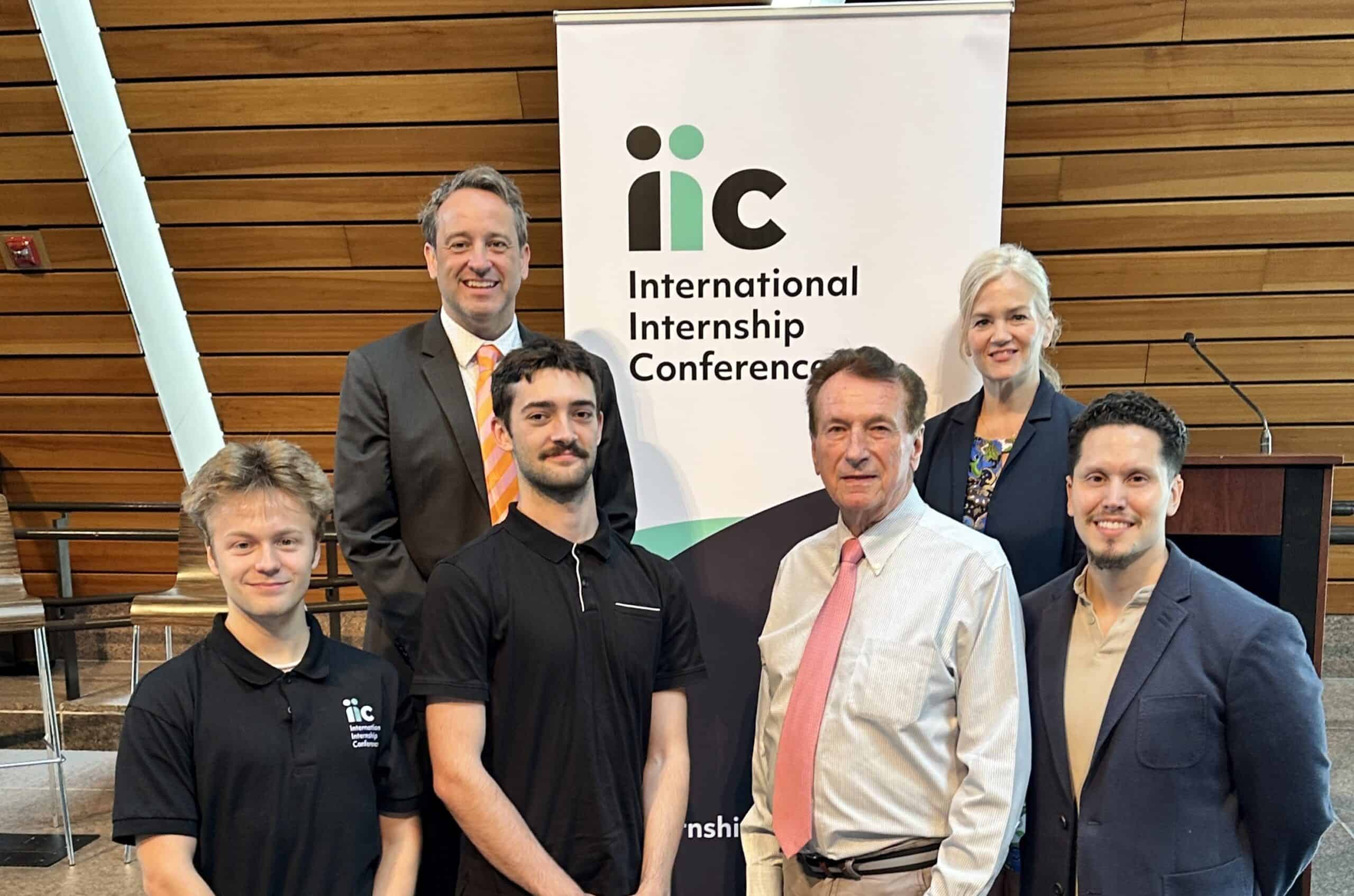
Welcoming delegates with a lyric from Minnesotan, Bob Dylan, International Internship Network founder and conference organiser, Matt Byrnes, set a reflective tone: “Come in… I’ll give you shelter from the storm.”
“We’re in the midst of a storm in post-secondary education,” explained Byrnes, who believes that IIC can offer colleagues a refuge from the onsalught on recent policy decisions that are impacting international education globally.
“IIC fosters an environment of tranquillity and confidence, where attendees explore study abroad solutions and partnerships that benefit their institutions and students,” he said.
Attendees from across the globe gathered to engage in sessions that ranged from employer site visits to focused panels and social receptions. Delegates included international internship providers, faculty, government representatives, employers, and students.
Central to the program was the conference’s annual debate. This year’s square off was entitled ‘Man vs Machine’ and tackled questions surrounding AI’s role in internship design and delivery. Moderated by The PIE‘s Maureen Manning, the session featured Kate Moore, principal and co-founder of the Global Career Center (GCC), Balaji Krishnan, vice provost at the University of Memphis, Greg Holz, assistant director for global engagement at the Univerity of Central Missouri, and Rishab Malhotra, founder and CEO of AIDO.
The panellists brought diverse perspectives, from AI ethics and corporate supervision to startup innovation and campus life. They debated how technology can support rather than supplant the human experience in relation to international expeiences.
Krishnan emphasised the importance of ethical frameworks in guiding AI development, warning against unchecked reliance on algorithmic tools without human oversight. Malhotra noted that while artificial intelligence can optimise logistics and placement processes, it cannot replicate human empathy or intercultural sensitivity – qualities central to global internships. Meanwhile, Holz offered a perspective from the corporate side, suggesting that when used thoughtfully, AI can streamline operations and free up supervisors to provide more meaningful mentorships. Moore closed by framing technology as an enabler rather than a replacement; a tool, not a teacher.
These discussions reflected a core concern echoed throughout the conference: how to maintain the integrity and purpose of internships while leveraging digital tools to scale access and impact.
Byrnes commented on the relevance of the conference’s direction: “IIC’s focus on the future of internships and technology is on point. At a time when academia is pivoting to prepare students for how AI is transforming the workplace, IIC attendees return to their campuses with much more knowledge about emerging technologies and how they can evolve internship programs to meet the needs of their students.”
The event also highlighted the important role of government partnerships in advancing work-integrated learning. International Experience Canada (IEC), one of the central partners of the conference, stated: “We congratulate IIC for its role as a leading organisation in advancing dialogue and partnerships on international experiential education, work-integrated learning and internships, and as one of IEC’s newest recognised organisation partners.”
Tech knowledge alone is not enough. We must support students to think critically, navigate complexity, and adapt with agility
Maria Angeles Fernandes Lopez, Universidad de Camilo Jose Cela
Throughout the three-day event, many delegates indicated to the PIE that it is not a question of whether technology will shape the future of internships, but rather how to ensure that these tools enhance, not eclipse, the human dimensions of learning: mentorship, reflection, and cross-cultural understanding.
“Tech knowledge alone is not enough. We must support students to think critically, navigate complexity, and adapt with agility,” asserted Maria Angeles Fernandes Lopez, vice rector at Universidad de Camilo Jose Cela, the host institution for the IIC in 2026. At the passing of the torch ceremony at the conclusion of the conference, Byrnes and Lopez indicated their hope to build on the momentum and dialogue sparked in Minneapolis on the intersection between technology and humanity.

Proponents of sex definition legislation say it protects women and girls from sex discrimination based on “immutable biological differences” that can be seen before or at birth. Advocates have used the same argument in recent years to interpret Title IX, the federal civil rights law preventing sex discrimination in education programs, to separate transgender students from girls and women athletic teams and spaces.
The Texas legislation, for example, says “biological differences between the sexes mean that only females are able to get pregnant, give birth, and breastfeed children” and that “males are, on average, bigger, stronger, and faster than females.” These differences, it says, “are enduring and may, in some circumstances, warrant the creation of separate social, educational, athletic, or other spaces in order to ensure individuals’ safety and allow members of each sex to succeed and thrive.”
The language closely mirrors an executive order issued by President Donald Trump upon his return to the Oval Office in January. That order established that “it is the policy of the United States to recognize two sexes, male and female.” The order said “these sexes are not changeable and are grounded in fundamental and incontrovertible reality,” and that the concept of “gender identity” is “disconnected from biological reality and sex and existing on an infinite continuum.”
The language was also reflected in a draft resolution agreement proposed to the Maine Department of Education by the U.S. Department of Education after a short, one-month investigation by the federal agency’s Office for Civil Rights found the state was violating Title IX in its policy allowing transgender students to participate in girls’ and women’s sports teams.
The agreement, which Maine refused to sign, would have had the state department and public schools define “females” and “males” in their policies and require the state to publicize the definitions on its website.
The Maine agency would have been required to notify schools that “there are only two sexes (female and male) because there are only two types of gametes (eggs and sperm); and the sex of a human — female or male — is determined genetically at conception (fertilization), observable before birth, and unchangeable.”
“Gender” would be the same as “sex” under the agreement.
The case is currently pending with the U.S. Department of Justice, which took over enforcement of the investigation and its findings after the state refused to sign the agreement.
The agreement would have also required the state to change its records to erase transgender girls’ athletic accomplishments on girls’ sports teams, which is also a potential side effect of the legislation in 13 states defining sex.
Those opposing recent sex definition laws say they are transphobic, as they don’t recognize transgender people’s gender identity.
“These laws could have dangerous implications for transgender people when it comes to bathrooms, identity documents, and other areas of law or policy,” MAP said, “but because these government gender regulation laws are often vaguely written, the actual impact of these laws remains to be seen in each state.”
John Perkins is THE economic hitman. A conman. Perkins arranged meetings with world leaders specifically to create debt traps. Death economies. When the world leaders failed to comply, it was made clear that Perkins had serious force behind him. He calls them his jackals: the CIA.
John Perkins was a chief economist who leveraged the World Bank, the United Nations, and the IMF to extract valuable resources around the globe in regions like the Middle East and South America. His actions expanded wealth inequality. And as a result, there was an assassination attempt on Jon’s life. The United States has been exploiting various regions of the world for decades. Now China is following and setting debt traps across Africa, the Middle East, Russia, and beyond.
In this episode, Marc dives deep into the life and experiences of John Perkins, the renowned author of Confessions of an Economic Hitman. John shares his eye-opening journey as a former chief economist and self-described “economic hitman,” revealing how he orchestrated debt traps to exploit nations globally. From negotiating billion-dollar deals to witnessing the devastating consequences of these actions, Perkins paints a haunting picture of the “death economy” and its enduring legacy.
The conversation also explores China’s adoption of similar strategies, modern-day debt traps, and the technological evolution of economic warfare, including AI and drones. Perkins introduces his transformative vision of a “life economy,” offering hope for a sustainable and equitable future.