Tag: Management

  • Change Management in Higher Ed Isn’t a One-Off, It’s a Leadership Discipline

    Change Management in Higher Ed Isn’t a One-Off, It’s a Leadership Discipline

    Heraclitus once said, “The only certainty in life is change.”  I don’t often quote ancient philosophers, but that line feels especially true in the context of higher education.”

    We hear a lot about change and change management in higher ed, but we don’t hear enough about how to successfully navigate it and use it as a springboard to propel institutions forward. But change in our industry is no longer episodic; it’s constant. From evolving student expectations to emerging technologies and shifting funding models, institutions are facing wave after wave of disruption. The sheer volume of change within higher education makes effective change management not just important, but essential to success.

    Too often, change management in higher education is treated like a checklist: a one-and-done plan that lives and dies with the project at hand. A new technology platform. A revised advising model. A restructured academic department. Each initiative gets a task force, a timeline, maybe a town hall or two. Then it ends.

    This reactive, fragmented approach may get things over the finish line, but it can also lead to burnout, resistance, and a lack of long-term adoption. Change fatigue is real, and without a strategic change management plan, it can lead to staff turnover and a revolving door of changes that fail to realize their full potential. Institutions get stuck in a perpetual loop of short-term fixes and long-term frustration.

    We can’t continue to treat change management in higher education as a one-time initiative but need to start thinking of it as a core leadership discipline.

    Higher ed change management deserves a seat at the table

    Higher ed leaders are navigating an environment where agility is essential. Budgets are tighter. Competition is fiercer. Student needs are more complex. And digital transformation is an ongoing reality that will drive constant change.

    But too often, higher education views change management as a reactive function, kicking in when something is already in motion, such as implementing a new CRM, redesigning an advising model, or centralizing key functions and departments. The focus is often on damage control: How do we minimize pushback, smooth over disruptions, and reach the finish line without too much friction?

    Start by elevating change management to the strategic level, not only giving it a seat at the leadership table, but also providing it with the same structure, dedicated resources, and strategic oversight as any other core function. Schools that do this are better equipped to:

    • Improve cross-campus alignment
    • Reduce resistance and increase buy-in
    • Accelerate the adoption of new systems or models
    • Minimize disruption to students and staff
    • Deliver better outcomes, faster

    The bottom line? In this climate, the ability to manage change effectively is a competitive advantage. If you want your institution to be resilient, you need to be deliberate about how you manage change.

    Build the muscle: 3 strategies for better change management in higher ed

    To help get you started, here are three practical ways you can help your institution build confidence, strengthen its change management muscle, and create a culture that’s ready to adapt.

    1. Create a change management playbook and use it

    Successful change management cannot be ad hoc or reactive.  A change management playbook brings clarity and consistency. It outlines the steps, tools, and best practices for managing change from start to finish. When creating your playbook, consider:

    • Stakeholder mapping: Who are the executive sponsors? Who is affected? Who are the influencers? Who needs to be consulted early and often?
    • Communication protocols: What do different audiences need to know and when? How will you keep them informed and engaged? How will the messages be delivered? How will we gather feedback?
    • Training and support: What tools, resources, or guidance will people need to succeed in the new environment?

    Having a playbook doesn’t mean every change looks the same. It means every change follows a thoughtful, proactive approach, building institutional memory and contributing to a proven, repeatable model. It also sends a clear signal to your campus community: We take change seriously, and we’re investing in doing it well.

    Don’t silo your playbook. Make it a shared resource across IT, academic affairs, student services, and marketing. The more aligned your teams are, the more cohesive your change efforts will be.

    2. Appoint change champions across the institution

    Change doesn’t stick because a VP says so. It sticks because people at every level understand it, own it, and advocate for it.

    That’s why identifying change champions is essential. Change champions are individuals with influence in their peer groups who understand the value of the change and are willing to help others navigate the transition. They can be faculty, staff, or student leaders. When building your network, identify advocates across departments and at all levels.

    Empower these individuals with context, talking points, and direct lines of communication to leadership. Let them surface concerns early and share success stories along the way. Peer advocacy goes a long way in building trust, momentum, and reinforcing key messages.

    The result? Change doesn’t feel imposed. It feels supported, even co-owned.

    3. Make Communication your top priority

    Communication is the lifeblood of effective change management in higher education. But too often, it’s treated as an afterthought. You can’t lead change in silence, and exceptional leaders should communicate early and often

    Your institution should approach communication with intention and discipline:

    • Start with the “why” behind the change. People are more likely to support change when they understand its purpose.
    • Tailor messages to each audience. Faculty care about different things than students or staff. Don’t send one-size-fits-all emails and expect engagement.
    • Use multiple channels. Email, intranet, in-person forums, social media, video — different people absorb information in different ways.
    • Be transparent, even when things aren’t going according to plan. Share what you know, when you know it. When things change, explain why.

    Clear, frequent communication is one of the most powerful tools you for building trust and reducing resistance. And remember: Communication is a two-way street. Build feedback channels into your plan. Listen actively. Adapt as needed.

    Change management as a strategic function

    So, what does it look like when an institution treats change management as a true leadership discipline? It looks like this:

    • A standing change management office or role, reporting into strategy or operations.
    • A centralized playbook that guides every major initiative.
    • Regular training and coaching for leaders on how to lead through change.
    • KPIs and feedback loops that track engagement, adoption, and outcomes.
    • An inclusive culture where stakeholders are part of the process, not just recipients of it.

    In this model, change is no longer a disruption. It’s a capability. Something your institution can do reliably, thoughtfully, and at scale.

    Lead like change is the constant

    If you take one thing away from this, let it be that change management isn’t a project, it’s a leadership discipline. It deserves the same strategic attention as budgeting, enrollment planning, or accreditation. Because, when done right, it unlocks the potential of your people, your technology, and your mission.

    Change will keep coming, and by making change management a core part of how your institution operates every day, you can take control of it and effectively drive your desired outcomes.

    Innovation Starts Here

    Higher ed is evolving — don’t get left behind. Explore how Collegis can help your institution thrive.

    Source link

  • How we designed a space where our students connect, collaborate, and flourish

    How we designed a space where our students connect, collaborate, and flourish

    Key points:

    Our charter school, Westbrook Academy, has been serving middle and high school students in the South Los Angeles area for the past six years and stands as a beacon of opportunity for our community. With a student body comprising nearly 99 percent Black and Latinx individuals hailing from historically under-resourced communities, we confront the realities of poverty and the accompanying insecurities head-on.

    Despite the odds, our 400 students consistently demonstrate remarkable resilience and a profound capacity for excellence. Our institution is supported by generous donors and funding sources. Operated and managed by the education nonprofit LA Promise Fund, which provides students with academic and enrichment opportunities that support our mission to spark passion, empower leadership, and prepare them for their chosen college and career paths.

    At one point, our high school students were learning in a church because we didn’t have a traditional classroom set-up. We also lacked the equipment that a traditional high school might have. This changed when we moved into our forever home in South Gate, where an on-campus Empowerment Center serves as a modern, welcoming “student hub.”

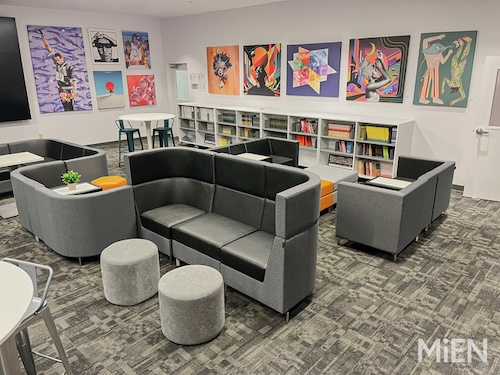
    Designed and outfitted by MiEN and Meteor Education, the Empowerment Center is where kids go to hang out, collaborate, and/or participate in school club activities. The hub is also set up with two wellness rooms where students can go to debrief and disconnect from a long day or just the stresses of being a student. It’s there for the students’ use.

    Here are the steps we took to create a space that consistently makes jaws drop and impresses parents who never thought their children would have access to such a warm, welcoming communal space on campus:

    • Add some flexibility into the process. Our original goal was to open the Empowerment Center’s doors in time for the 2023-24 school year, but getting it done the right way would require a bit more time. Our partners were willing to listen to us in terms of what we wanted to create, but within the realistic timelines. That was really cool.
    • Acknowledge the financial limitations. We largely relied on fundraising for this project and knew that some things just weren’t going to be realistic. To other schools in similar situations, I’d recommend staying flexible enough to hit the timelines and get all of the bases covered while keeping student needs in mind. We can have all the bells and whistles, but at the end of the day, if the car runs, the car runs. We know we can always add a new paint job later.
    • Get the right partners onboard early. As we went through the steps of designing the Empowerment Center, we learned a lot about architecture, planning, and construction. Through it all, having the right partners in its corner helped the school achieve its goals within budget and on time. It was really great to have our design and furniture partners sharing their best practices and other insights with us. We knew what we wanted to do, and a lot of the ideas came from our families and students. We just needed them to show us how we could get those ideas as close to reality as possible.
    • Make it personal. Special features we wanted in our Empowerment Center included a huge, interactive flatscreen TV that students, teachers, and guest speakers use to interact and work together. There’s also a large selection of donated books, the latest technology tools, and artwork that was personally selected by an art curation team. They were able to secure artists from the LA community to create and share visuals that our students are really familiar with. For example, some of the artwork spotlights female empowerment (i.e., with photos of authors like Octavia Butler) and the importance of acknowledging indigenous people. Everything in the hub is meant to spark curiosity. 
    • Brace yourself for some jaw-dropping moments. At our ribbon-cutting ceremony last year, our parents’ jaws were on the floor. They just never thought these resources would be available to their kids. A lot of them grew with us being in the church and a co-located space, and then we asked them to trust us to deliver on our promise, and now we’re able to show that as the reward for supporting us. We feel really proud that our parents were just over the moon about it.

    Hitting it out of the park

    Reflecting on the process we put in place to get our modern student hub designed, built, and open for business, I can say that the end result is an engaging, collaborative space that can be used for hanging out, structured learning, or a little of both. I think we really hit the ball out of the park with this innovative space.

    Student, teacher, and family feedback on the Empowerment Center has been extremely positive. Everyone loves it, and students are always excited to come and spend time in the modern, comfortable space that’s equipped with the technology and tools they need to be able to learn and engage.

    Latest posts by eSchool Media Contributors (see all)

    Source link

  • Negotiating the Future: How HBCUs and MSIs Can Leverage Strategic Enrollment Management for Institutional Resilience

    Negotiating the Future: How HBCUs and MSIs Can Leverage Strategic Enrollment Management for Institutional Resilience

    Dwight SanchezIn today’s hyper-competitive higher education landscape, the challenges facing Historically Black Colleges and Universities (HBCUs) and Minority Serving Institutions (MSIs) are immense. Declining birth rates, changing student expectations, shifting public sentiment, and persistent underfunding place extraordinary pressure on institutions that have long served as lifelines for students of color and first-generation learners. Yet amid these challenges lies an opportunity. By reimagining Strategic Enrollment Management (SEM) through the lens of negotiation theory, HBCUs and MSIs can increase their strategic agility, strengthen institutional partnerships, and yield more robust enrollment outcomes.

    SEM as Negotiation

    Strategic Enrollment Management isn’t merely about admissions and financial aid—it’s about aligning institutional mission with market realities in ways that are both student-centered and data-informed. Viewed through the lens of negotiation, SEM becomes a dynamic system of interdependent relationships: with prospective students, families, community influencers, K-12 schools, alumni, faculty, and internal staff. Drawing from 3D Negotiation: Powerful Tools to Change the Game in Your Most Important Deals by David Lax and James Sebenius, and Essentials of Negotiation by Lewicki, Saunders, and Barry, three principles become especially relevant: setupdeal design, and tactical interaction.

    • Setup involves determining who needs to be at the table, what interests are at stake, and which parties have influence over enrollment decisions. For HBCUs, this means engaging not just students, but parents, clergy, high school counselors, and community mentors who shape the decision-making ecosystem.
    • Deal Design refers to how institutions create value through the student’s experience. It’s not just about price; it’s about crafting offers that resonate emotionally and practically with underserved populations. This might include mentorship programs, clear career pathways, and intentional support systems.
    • Tactics, while often emphasized, should follow—not lead—strategy. Scripts matter less than systems, and strategic enrollment leaders must know when to pivot from persuasive messaging to coalition-building and issue reframing.

    The Cultural Context

    The diversity within HBCUs and MSIs also means that enrollment negotiations occur across varied cultural, economic, and generational dimensions. Chapter 11 of Essentials of Negotiation reminds us that in international and cross-cultural negotiations, assumptions can be fatal. For instance, assuming that all Black or Latino students respond similarly to recruitment strategies ignores regional, familial, and economic differences. Strategic enrollment leaders must develop cultural humility and data literacy to avoid overgeneralization and instead build nuanced personas that guide outreach.

    Equally important is the political environment. Public perceptions of DEI initiatives, affirmative action, and federal funding can dramatically alter an institution’s appeal and perceived legitimacy. In this context, setup becomes a shield—anticipating changes, diversifying recruitment pipelines, and framing the institutional value proposition in ways that transcend political cycles.

    Leadership and Accountability

    Leading enrollment through this lens requires a shift from short-term performance metrics to long-term strategy. Enrollment managers must adopt a leadership posture that blends transformational vision with collaborative execution. As Lewicki et al. note in Chapter 10, multiparty negotiations (such as cross-department SEM committees) require clear roles, shared goals, and open channels of communication. Leaders must foster psychological safety while holding teams accountable to institutional KPIs—bridging the often-siloed worlds of marketing, academic affairs, and student support.

    Professional development plays a critical role here. Too often, enrollment teams are equipped with tactical training (CRM usage, phone scripts, event planning) but lack exposure to systems thinking, data storytelling, or negotiation dynamics. Embedding professional learning communities and creating leadership pipelines within SEM units allows HBCUs and MSIs to develop internal change agents who can sustain innovation over time.

    The Path Forward

    HBCUs and MSIs are more than educational institutions—they are engines of social mobility and cultural affirmation. But to thrive, they must adopt a strategic posture that sees every element of SEM as a negotiation: from brand positioning to student engagement, from financial structuring to internal alignment.

    Consider this: An HBCU looking to boost STEM enrollment among underrepresented males recognizes that traditional outreach and scholarship packages have limited impact. Instead of only increasing merit aid, the institution reframes its offer through negotiation theory. They partner early with high schools, launch a summer bridge program co-led by STEM faculty and alumni, and guarantee every enrolled student a faculty mentor and paid internship by year two. They also engage parents and community leaders as ambassadors—tapping into local trust networks. At the internal level, they align academic and student affairs teams through shared enrollment metrics and regular scenario planning meetings, increasing accountability and cohesion.

    This isn’t just marketing—it’s “setup” and “deal design” in action. It expands the scope of stakeholders, adds value beyond dollars, and creates a win-win proposition for the student, family, and institution. It also reflects a broader institutional willingness to act as a proactive negotiator in shaping its market position.

    By leveraging the principles of negotiation—particularly setup, value creation, and coalition building—enrollment leaders can develop strategic enrollment plans that are not only adaptive but transformative. In doing so, they ensure their institutions remain vital pathways for generations of students yet to come.

    Dwight Sanchez is the Executive Director of Enrollment Management at the University of Maryland School of Pharmacy.

    Source link

  • Agency Information Collection Activities; Submission to the Office of Management and Budget for Review and Approval; Comment Request; Borrower Defense to Loan Repayment Universal Forms

    Agency Information Collection Activities; Submission to the Office of Management and Budget for Review and Approval; Comment Request; Borrower Defense to Loan Repayment Universal Forms

    A Notice by the Education Department on 05/19/2025

    Department of Education[Docket No.: ED-2025-SCC-0002]

    AGENCY:

    Federal Student Aid (FSA), Department of Education (ED).

    ACTION:

    Notice.

    SUMMARY:

    In accordance with the Paperwork Reduction Act (PRA) of 1995, the Department is proposing a revision of a currently approved information collection request (ICR).

    DATES:

    Interested persons are invited to submit comments on or before June 18, 2025.

    ADDRESSES:

    Written comments and recommendations for proposed information collection requests should be submitted within 30 days of publication of this notice. Click on this link www.reginfo.gov/​public/​do/​PRAMain to access the site. Find this information collection request (ICR) by selecting “Department of Education” under “Currently Under Review,” then check the “Only Show ICR for Public Comment” checkbox. Reginfo.gov provides two links to view documents related to this information collection request. Information collection forms and instructions may be found by clicking on the “View Information Collection (IC) List” link. Supporting statements and other supporting documentation may be found by clicking on the “View Supporting Statement and Other Documents” link.

    FOR FURTHER INFORMATION CONTACT:

    For specific questions related to collection activities, please contact Carolyn Rose, 202-453-5967.

    SUPPLEMENTARY INFORMATION:

    The Department is especially interested in public comment addressing the following issues: (1) is this collection necessary to the proper functions of the Department; (2) will this information be processed and used in a timely manner; (3) is the estimate of burden accurate; (4) how might the Department enhance the quality, utility, and clarity of the information to be collected; and (5) how might the Department minimize the burden of this collection on the respondents, including through the use of information technology. Please note that written comments received in response to this notice will be considered public records.

    Title of Collection: Borrower Defense to Loan Repayment Universal Forms.

    OMB Control Number: 1845-0163.

    Type of Review: A revision of a currently approved ICR.

    Respondents/Affected Public: Individuals and Households.

    Total Estimated Number of Annual Responses: 83,750.

    Total Estimated Number of Annual Burden Hours: 217,750.

    Abstract: On April 4, 2024 the U.S. Court of Appeals of the Fifth Circuit granted a preliminary injunction against 34 CFR 685.400 et seq. (“2023 Regulation”) enjoining the rule and postponing the effective date of the regular pending final judgment in the case. The current Borrower Defense to Repayment application and related Request for Reconsideration are drafted to conform to the enjoined provisions of the 2023 Regulation. This request is to revise the currently approved information collection 1845-0163 to comply with the regulatory requirements of the borrower defense regulations that are still in effect, 34 CFR 685.206(e) (“2020 Regulation”), 34 CFR 685.222 (“2016 Regulation”), and 34 CFR 685.206(c) (“1995 Regulation”) (together, the “current regulations”). These regulatory requirements are distinct from the 2023 Regulation’s provisions. The revision is part of contingency planning in case the 2023 Regulation is permanently struck down. The Department of Education (“the Department”) is attaching an updated Borrower Defense Application and application for Request for Reconsideration. The forms will be available in paper and electronic forms on studentaid.gov and will provide borrowers with an easily accessible and clear method to provide the information necessary for the Department to review and process claim applications. Also, under the current regulations, the Department will no longer require a group application nor group reconsideration application.

    Dated: May 13, 2025.

    Brian Fu,

    Program and Management Analyst, Office of Planning, Evaluation and Policy Development.

    [FR Doc. 2025-08857 Filed 5-16-25; 8:45 am]

    BILLING CODE 4000-01-P
    Published Document: 2025-08857 (90 FR 21296)

    Source link

  • Optoma Announces Launch of the New 3-Series Interactive Displays with Google Certification and AI-Enabled Tools

    Optoma Announces Launch of the New 3-Series Interactive Displays with Google Certification and AI-Enabled Tools

    FREMONT, CA – Optoma, a world-leading provider of visual solutions, today announced its latest Creative Touch 3-Series Interactive Displays designed to empower educators and business professionals with new tools and features to enhance learning, make presentations more effective, and increase collaboration in classrooms, lecture halls, boardrooms, remote working and other business environments.

    With Google’s Enterprise Device Licensing Agreement (EDLA) Certification and added functionality, the new 3-Series empowers professionals and educators to deliver dynamic and impactful content by providing cutting-edge tools that streamline management and elevate engagement. The advanced capabilities of the new 3-Series simplify planning and workflow through wireless collaboration, screen sharing, and innovative meeting solutions in both corporate and educational environments alike, all packed into a robust yet user-friendly platform.

    The 3-Series: Purpose-Built for Corporate and Education Environments

    New features and key highlights include:

    Google EDLA Certification: Ensures compatibility and optimized performance with thousands of educational applications and services available directly from the pre-installed Google Play Store allowing users to experience the full Google Suite for real-time collaboration from practically anywhere in the world.  Without compatibility issues or the hassle of connecting an external PC, users can easily access the entire suite of Google-based applications they are accustomed to – including Google Drive, Google Docs, YouTube, and more!

    The Optoma Solution Suite (OSS®): User-friendly software featuring Artificial Intelligence (AI) enabled tools, such as Sticky Notes* and AI Handwriting Recognition, the OSS package also includes:

    • Whiteboard: Unleash creativity through a digital whiteboard packed with tools that make learning and sharing ideas engaging – facilitating collaboration in real-time from anywhere.
      • Smart Sketch tool is ideal for drawing diagrams as it recognizes shapes and drawings and converts them into clipart images.
      • Floating Toolbar and Infinity Canvas allow you to seamlessly switch between tools to suit your tasks with a virtually limitless writing space.
      • Innovative Annotation and Highlighter Tools make underlining key points or annotating complex diagrams a breeze.
    • File Manager: Easily save, organize, or move files from local storage to networkable storage or to popular cloud services in seconds.
    • Display Share: Connect any device to wirelessly broadcast, share, or stream your content to the big screen. Bringing your own device has never been easier.

    Exceptional Performance: Seamless performance with an 8-core processor, Android 14 OS, and Zero Bonding screen for that natural writing experience.

    “We are excited to announce our new 3-Series and partnership with Raptor Technologies which truly embodies our commitment to supporting education through cutting-edge visual solutions, enhanced software packages and safety and security,” said Maria Repole, Head of Marketing at Optoma.

    A value-added solution, Optoma Management Suite (OMS®) is available out of the box on the 3-Series Interactive Displays, with a free trial available.** OMS offers IT administrators and technicians a real time remote platform to monitor, manage, diagnose, and update multiple or entire fleets of displays simultaneously that are either on the same network or connected through the cloud. OMS makes it easy to broadcast emergency messages, alerts, or announcements across displays worldwide.

    Optoma is thrilled to partner with Raptor® Technologies, the leading innovator in school safety solutions, redefining the landscape of school security with its Raptor School Safety Software Suite. By integrating Raptor’s software with Optoma’s interactive displays, school administrators and students can receive real-time alerts and emergency notifications using CAP protocols to improve the overall safety of the school.

    To experience a demonstration and learn more about Optoma’s new Creative Touch 3-Series Interactive Displays, please schedule a demo or visit: https://www.optomausa.com/products/interactive-flat-panel-displays-3-series/education https://www.optomausa.com/products/interactive-flat-panel-displays-3-series/corporate

    *Some AI features may require the use of an Optoma (OSS) account.

    **Free trial licenses are available for a limited time. Please register your OMS® Cloud account at https://oms.optoma.com or speak with your local representative.

    OMS and OSS are registered trademarks of Optoma Corporation

    DLP is a registered trademark of Texas Instruments

    About Optoma Technology, Inc.  

    Optoma combines cutting-edge technology and innovation to deliver remarkable visual display products designed to connect audiences with engaging video experiences. From the company’s ProScene projectors to its Creative Touch interactive, Professional LCD and LED displays, Optoma’s suite of products can meet the demands of nearly any professional environment, including conference rooms and classrooms, digital signage, corporate, houses of worship, retail, simulation environments and control rooms. Optoma Technology is the U.S. headquarters for The Optoma Group, with continental headquarters also in Europe and Asia. For more information, visit optomausa.com.   

    eSchool News Staff
    Latest posts by eSchool News Staff (see all)

    Source link

  • Operations with Cloud Based Higher Education Management Solutions

    Operations with Cloud Based Higher Education Management Solutions

    Cloud based higher education management solution

    In the education industry, cloud-based technologies are driving a major revolution. Over 70% of colleges use cloud solutions to streamline operations and cut expenses as they balance budgets. Recent studies show that institutions that have adopted Cloud based higher education management solutions have seen an average reduction of 30% in reduce operational costs in higher educations, enabling them to reinvest in areas that enhance the student experience and drive academic success. 

    Keeping on budget while managing admissions, money, HR, and learning systems is no small task. Often caught handling costly, ineffective, error-prone fragmented systems are IT teams are assigned. Still, there is a smarter road forward. Higher education management solutions housed on clouds are meant to streamline your life. These tools are meant to combine all those disparate systems, automate tedious chores, and clear the mess of documentation. Consider it your default method for simplifying university processes.

    In this blog, we’ll dive deep into how cloud based higher education management solutions are optimizing university operations, enabling smarter decision-making, and unlocking efficiencies that were once unimaginable with legacy systems.

    Cloud based higher education management solutions: why?

    Cloud technology is improving campus operations, including:

    • Automating and removing paper workflows saves institutions up to 30%.
    • Efficiency: Real-time data and better cooperation boost productivity.
    • Scales smoothly: A rise in students? Program expansion? Your needs shape cloud systems.
    • Upgraded Security: Multi-factor authentication, encryption, and compliance safeguard data.

    Disjointed Systems Breakup


    Even the most efficient teams can be slowed by obsolete technologies and paper processes. To reduce redundancies and streamline operations, cloud solutions combine these systems into a single, easy platform. IT teams can focus on strategic innovations instead of segregated platform troubleshooting.

    Future-Ready Change

    Agility and resilience are essential for the future of higher education. Enabling seamless scalability, strengthening cybersecurity measures, and fostering innovation, cloud-based systems guarantee that your institution remains at the forefront. Not only do these solutions address current challenges, but they also establish your campus as a leader in adapting to the constantly changing educational landscape.

    Improving Efficiency with Creatrix Campus Cloud-Based Solutions

    Creative Campus provides a complete solution for your university. The automation of financial operations and real-time course registration are meant to simplify and improve your work.

    The platform’s easy design and customized modules let you solve campus issues. Because it’s cloud-based, Creatrix Campus integrates across departments, fosters collaboration, and supports growth without costly infrastructure updates.

    Source link

  • Smart Campus Energy Management and Green Campuses

    Smart Campus Energy Management and Green Campuses

    Introduction: How Educational Technology Promotes Green Campuses

    Sustainability is now a requirement, not a slogan, especially concerning educational institutions given the tremendous environmental impact of paper-based systems! Textbooks and administrative paperwork from colleges and institutions contribute to worldwide paper consumption. Panic not, the good news is that technology and smart campus energy management is making a difference.

    Universities may encourage sustainability by using innovation that eliminates waste, conserves energy, and optimizes resources. With the correct tools, becoming green may become the norm. Creatrix Campus’s educational innovations in the form of smart campus energy management are turning campuses into eco-friendly centers while improving efficiency.


    Benefits of Educational Technologies for Eco-friendly Campus Management


    Paperless Classrooms and Administration

    Reducing paper waste is a simple but effective way for institutions to become green. Paperwork is massive in conventional classrooms and administrative systems due to the proliferation of various forms of paper-based documentation. However, campuses may reduce paper use, simplify operations, and save time by moving digital!

    Paperwork is a thing of the past with cloud-based tools for resource optimization that manage student work, grades, and attendance. With a few clicks, students may turn in their work online, instructors can digitally grade and comment, and attendance can be kept tabs. In addition to enhancing efficiency, all of this helps save environment. On top of that, everything is well-organized and simple to find, which simplifies administrative duties.


    Controlling Energy Consumption Using Intelligent Devices

    Energy regulation is crucial to a sustainable campus. Smart campus energy management have increased university energy efficiency. Smart meters, IoT devices, and cloud-based energy management software can analyze energy usage, identify inefficiencies, and reduce carbon footprint on campuses.

    According to a new study out of the National Renewable Energy Laboratory, campuses can save 30% on their energy bills by implementing smart campus energy management solutions. Colleges can significantly reduce their energy use by installing smart lighting, HVAC systems, and energy-efficient equipment.

    Additionally, facilities staff may reduce waste and promote eco-friendly practices across the board by making smarter decisions on energy usage based on data-driven insights. It’s about more than just cutting costs; it’s about making a better, more sustainable future for generations to come.


    Learn to Reduce Carbon Footprint Online

    More than just a convenient way to attend classes, online learning changes the atmosphere. Universities may substantially reduce travel by going digital, reducing traffic, carbon emissions, and cars on the road. Online education reduces carbon footprints by up to 90% compared to on-campus instruction, according to The Global e-Sustainability Initiative.

    But it’s not just about travel cuts!  Online learning minimizes the need for environmentally harmful paper books, handouts, and other materials! Students get to access course materials instantaneously from anywhere, saving resources and giving the planet a respite.

    Students can get degrees from home while protecting the environment—a win-win!


    Sustainable Resource Management

    Building a green campus requires efficient resource management. AI and IoT-powered smart campus energy management systems are changing how universities measure and optimize resource use. Educational institutions may now make smarter judgments about water, electricity, paper, and plastic to reduce waste and save money.

    Real-time data and predictive analytics helped institutions employing smart campus energy management systems cut energy use by 15% reports The International Energy Agency. It’s not just about turning off lights in empty classrooms—it’s about using energy-hungry equipment sparingly and conserving water in dorms and cafeterias.

    Cloud-based technologies and AI-powered analytics help colleges improve their sustainability initiatives and achieve lasting impact! Understanding how and when resources are used helps institutions reduce waste, save money, and promote sustainability.


    Environment Awareness

    Environmental knowledge is crucial to creating tomorrow’s leaders on campuses. Sustainability in the curriculum and green campus projects can teach students to be eco-friendly. This approach may even help students become environmental activists.

    According to a National Environmental Education Foundation research, 79% of students think their institutions should address sustainability, and 67% prefer to work for green companies. University environmental awareness programs teach lifelong habits and educate students to take responsibility for their ecological footprint.


    Remote Collaboration Encouragement

    Carbon footprint reduction doesn’t require face-to-face interaction. Virtual classrooms and cloud-based technology let students and teachers communicate anytime, anywhere, minimizing travel and meetings. Trust us, remote collaboration for group tasks or faculty discussions saves time, cuts travel emissions, and makes their workspace more flexible and sustainable.

    Remote work and collaboration tools reduce travel and their organization’s environmental effect, according to 60% of McKinsey respondents.  


    Data-driven Sustainability Planning

    Sustainability requires educated decisions, not just good intentions. Data helps higher eds design better, more customised sustainability plans. Leveraging AI and IoT for green campus operations aids to analyze real-time energy, waste, and resource allocation data to improve.

    According to a Gartner report, 70% of organizations utilizing data analytics have improved their sustainability initiatives, from waste reduction to energy optimization. Same with universities. Educational technologies let institutions track success, identify areas for development, and make long-term environmental decisions. Data-driven sustainability is a game-changer, not a buzzword.


    Conclusion

    University greening can jump forward with technology. Sustainable, eco-friendly education is possible through paperless classrooms in universities, smart campus energy management, and online learning. By using cloud-based tools for resource optimization, institutions lower their environmental footprint and inspire future leaders.

    Is your organization ready to impact? Greening your campus is easy with Creatrix Campus and its creative solutions. Connect with us.

    Source link

  • Engineering College Management Software: Features

    Engineering College Management Software: Features

    Engineering college management software is an essential tool that automates the higher education sector from admission to graduation and beyond. It helps institutions achieve their mission and goals, increase student enrollment, and streamline college administration. For engineering colleges and higher education institutions, this software provides a comprehensive suite of features across web and mobile platforms, enabling them to manage records, enhance the student learning experience, improve operational efficiency, and reduce costs.

    The program is customizable, scalable, and versatile. It provides accurate administrative and academic information to college leadership, improving decision-making. Administrative, professor, and student communication is improved by this program, improving efficiency and effectiveness.


    Why Choose Engineering College Management Software?

    Managing admissions, academic progress, and finances are just a few of the many hats an engineering college administrator must wear. By providing a unified, user-friendly platform, Engineering College Management Software streamlines operations, increases productivity, and keeps campuses one step ahead of the competition. This allows institutions to concentrate on what’s important—providing a high-quality education and boosting student success—by automating laborious operations and providing real-time insights.


    Why Is It Game-Changing? Benefits of Engineering College Management Software


    • Reduces Difficulty: From enrolling students to keeping tabs on their classes, you may do it all from a central location.
    • Access Data Effortlessly: Make better decisions and respond faster with access to real-time analytics.
    • Efficient Communication: Facilitate the easy connection of staff, students, and professors to encourage collaboration.
    • Preparing for the Future: It is designed to be easily expanded to accommodate your growing institution.
    • Saves Money and Time: Reduces human effort and administrative burdens by automating routine tasks.
    • Tracking progress and offering timely interventions can greatly enhance student support, leading to better outcomes.

    The engineering college management software isn’t just software—it’s a smarter way to run your campus.


    Key Features of Engineering College Management Software

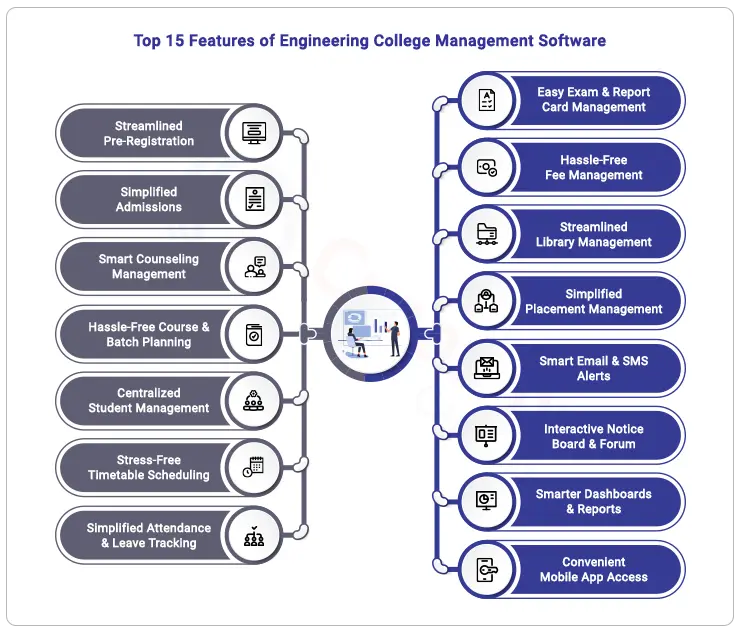
    The strong features of Engineering College Management Software simplify operations, improve student experience, and improve engineering institution decision-making. These characteristics, from pre-registration to placements, help engineering colleges compete in a competitive academic environment. See it closer:


    top-15-features-of-engineering-college-management-software


    1. Streamlined Pre-Registration Process

    • Use simple web forms to manage inquiries and registrations.
    • Gather students’ personal, contact, and course information.
    • Receive real-time status updates and automatic follow-up reminders.
    • Use dashboards and reports to keep track of inquiries and encourage student enrollment.


    2. Simplifying Admissions, One Click at a Time

    • Let students apply online and breeze through the admissions process.
    • Break it down: Create multiple phases for a clear, step-by-step journey.
    • Use entrance tests and ratings to admit the best-fit students effortlessly.
    • Offer flexible, personalized tuition payment options.
    • Keep everyone in the loop with instant email, SMS, and push notifications.
    • Say goodbye to manual work—generate admission forms, letters, and templates in a snap.


    3. Streamlined Counseling, Smarter Decisions

    • Automatically assign requests to counselors for faster, smoother processing.
    • Dive deep into admission standards and rules to guide applicants better.
    • Set clear fee discount policies for specific student groups.
    • Simplify seat allocation for government and management quotas with ease.


    4. Hassle-Free Course & Batch Planning

    • Easily set up lesson plans and manage courses across batches without the stress.
    • Create class schedules that actually work—no conflicts, no headaches.
    • Keep tabs on course progress and student performance in real-time, effortlessly.


    5. All-in-One Student Management Hub

    • Centralize student demographics and enrollment details in one place.
    • Automate emails and notifications to keep everyone informed.
    • Schedule personalized meetings and check-ins to support student success.
    • Monitor progress and learning outcomes to foster academic growth.


    6. Stress-Free Timetable Scheduling

    • Auto-generate timetables that work like magic—no conflicts, no chaos.
    • Juggle faculty and classroom availability with ease.
    • Get a clear picture of faculty workloads across programs and subjects.
    • Create classroom-specific timetables without breaking a sweat.


    7. Simplified Attendance & Leave Tracking

    • Track attendance for students and staff on the go—web or mobile, your choice.
    • Use RFID or biometric systems for attendance that’s automatic and hassle-free.
    • Generate detailed attendance and leave reports in seconds.
    • Streamline leave applications and approvals without manual back-and-forth.


    8. Exams & Report Cards Made Easy

    • Run online exams and assessments without the usual stress.
    • Let the system do the math—automate mark calculations with predefined weightages.
    • Create professional marksheets and report cards with built-in approval steps.
    • Manage result announcements for students and parents with zero fuss.


    9. Hassle-Free Fee Management

    • Choose from multiple invoicing options for tuition and other charges.
    • Automate recurring invoices to simplify scheduled payments.
    • Collect fees effortlessly with integrated online payment gateways.
    • Send students automated fee reminders so no deadlines are missed.


    10. Streamlined Library Management

    • Search the catalog like a pro with advanced search and barcode/QR integration.
    • Reserve and renew books on the go using a mobile app.
    • Automate issuing, returns, renewals, and fines with smart rules.
    • Get all the library stats you need with detailed reports and dashboards.


    11. Placement Made Simple

    • Plan placements with ease—set criteria, schedule assessments, and more.
    • Keep students updated with placement trends and training notifications.
    • Organize tests, interviews, and group discussions without the hassle.


    12. Smart Alerts via Email & SMS

    • Set up automated email and SMS alerts in just a few clicks.
    • Schedule reminders and updates to go out like clockwork.
    • Use an internal mailbox to keep communication streamlined and organized


    13. Interactive Online Notice Board & Forum

    • Schedule and share event updates and important announcements effortlessly.
    • Spark instant discussions and engage students and faculty in lively forums.
    • Post images, collect feedback, and keep the conversation flowing with comments.


    14. Smarter Dashboards, Sharper Insights

    • Dive into everything you need with one-click reports and dashboards.
    • Keep an eye on attendance, leaves, exams, fees, and more—all from one spot.
    • Stay on top of your finances with clear, detailed income and expense reports.


    15. Convenient Mobile App Access

    • Keep everything at your fingertips—access data on the go.
    • Mark attendance, approve leave, and manage student information anytime.
    • Create assessments, check grades, and send instant notifications with ease.


    Ready to Revolutionize Your Engineering Campus?

    Ready to take your engineering college to the next level? Creatrix Campus is the ultimate cloud-based education management system for managing everything from admissions to campus operations, designed with your unique needs in mind. Whether it’s simplifying administrative tasks, enhancing student engagement, or keeping faculty workloads in check, we’ve got it all covered. With real-time data, seamless integrations, and an intuitive interface, your institution will be equipped to tackle the challenges of today and embrace the opportunities of tomorrow.

    So, why wait? Let’s talk about how Creatrix Campus can streamline your operations and drive your institution’s success, all while giving you the flexibility and control you need to thrive. Your engineering campus deserves the best—let’s make it happen!

    Source link

  • Centralized Education Management Systems: Revolutionizing Education

    Centralized Education Management Systems: Revolutionizing Education

    There is a huge change happening in higher education. Because technology changes so quickly, higher eds have to be able to deal with new problems and meet the changing needs of students, teachers, and managers. Centralized education management systems or Integrated software solutions are no longer a nice-to-have; they’re necessary for making schools more streamlined, efficient, and ready for the future.

    This blog post examines how these centralized education management systems change higher education, deal with problems, and make room for new ideas.


    Understanding Integrated Software Solutions

    Centralized education management systems or integrated software solutions centralize admissions, curriculum creation, faculty management, student services, compliance, and more.

    Instead of managing several technologies that don’t communicate, your institution runs like a symphony. Tracking student progress and managing teacher duties is simple, saving time and resources.

    According to Educause (2023), 68% of institutions that use integrated platforms see a considerable operational efficiency boost in the first year.


    Addressing Core Challenges in Higher Education

    Higher education has obstacles. You may struggle with uncertain enrollment trends, changing accreditation standards, and student needs. However, centralized education administration systems are changing how institutions handle these concerns.


    Deconstructing Obstacle Walls

    Data scattered between platforms is bothersome. Integration solutions function as a bridge, connecting all departments, including admissions, professors, and administration, to ensure that all individuals are on the same page. For the Purpose of Assisting You Now we’re going to be really honest: manual processes can be really draining—automation handles everyday jobs diligently, so your teams can focus on improving learning outcomes or planning strategic projects!


    Students First!

    Students today expect more than lectures, homework, and tests. With centralized education management system technologies, institutions may develop tailored learning pathways, track student progress, provide 24/7 support, and keep students engaged until the end!

    Integrated solutions cut administrative tasks by 30%, according to McKinsey. Not only does it save time, but it also redirects energy toward important things like helping students succeed and moving higher education forward.


    Benefits of integrated software in higher education institution

    These are the genuine benefits of higher education integrated software solutions. Beyond saving time, the centralized education management systems improve student performance, institution efficiency, and success.

    EDUCAUSE found that integrated centralized education management systems in higher education boosted operational efficiency by 25% and student satisfaction. Pretty amazing, huh?

    Let’s list the main benefits:

    Data analytics for improving higher education decision-making

    Everything in One Place: No more platform switching or tab-searching. Your data, tools, and workflows are connected and available with integrated software. Imagine it’s like having everything you need under a single roof.

    Decisions Based on Data: Park the decisions based on guessing and grab the Data analytics for improving higher education decision-making! You can make smart, informed decisions using real-time data and analytics. You’re always informed when tracking student progress or preparing ahead.

    Greater Cooperation: Things get lost when departments in your colleges don’t communicate and sync up! Integrating systems makes it easy for students, instructors, and staff to connect and collaborate. Eliminating barriers lets everyone shine.

    Student Success: Students matter. Personalizing learning journeys with integrated solutions helps students focus, stay on track, and succeed. Lower barriers, more wins!


    AI and Analytics: Their Role

    AI and analytics underpin integrated software. They don’t just process data—they make sense of it. They don’t just process data—they make sense of it.

    • Predictive Analytics: Identifying at-risk students early and offering on-time help!
    • Personalization: AI-powered tools craft tailored learning experiences for students.
    • Resource Optimization: Analytics ensure efficient use of campus facilities and resources.

    According to a survey by Gartner, institutions leveraging AI in education reported a 45% improvement in student retention rates. These tools are more than enhancements—they’re enablers of smarter, data-driven decisions.


    Overcoming Implementation Challenges

    Integrated software solutions in higher education have these actual benefits. Besides saving time, they boost student performance, institution efficiency, and success.

    Transformative technology like integrated software solutions might make technology implementation seem daunting. Every organization confronts problems, and overcoming them is part of progress. Good news? You’re not alone.

    Integrated systems adoption might be difficult, but strategic institutions can make it happen. These important areas may present obstacles and how to overcome them:

    Train and Adopt: Getting everyone on board is difficult. Faculty, staff, and students must master the new system, which takes time. A solution? Provide good training and support. Focus on important users, start small, then grow. Users grow more comfortable, smoothing the transition.

    Moving unorganized data from outdated systems to a new platform can be a headache. Before migrating, clean and organize data to simplify. A coordinated migration plan with your software provider reduces disruptions.

    Change resistance: Hard. Resistance often originates from fear of the unknown or a lack of understanding of how the new system would benefit the institution. As a last step, communicate with stakeholders, show the system’s long-term value, and include decision-makers early!

    Customization requires: Every institution has unique needs, so, keep in mind, a generic solution may not work! Find a customizable system that gets tweaked to however you need. Ask questions and customize the system with the software vendor.

    Planning, patience, and help are needed to overcome these obstacles. Successful organizations deploy with strategy, training, and flexibility. This vacation has long-term benefits.

    EDUCAUSE found that higher education integrated systems increased operational efficiency by 25% and student satisfaction.


    Practical Uses and Success Stories

    Change is coming from integration. Uniformed systems are benefiting institutions globally, as shown in these success stories.

    • Creatrix Campus reduces manual faculty management work by 40% at National University of Singapore.
    • Oxford uses statistics to engage and retain students.
    • Integration of centralized education management systems helped Otago University speed accreditation by simplifying compliance tracking!


    Future Higher Education Integrated Software Trends

    Due to these advances, experts expect over 70% of higher education institutions to have fully embraced integrated software platforms by 2030. Here are some software of the trends you can look for.


    • Blockchain technology is transforming credentialing by creating secure, tamper-proof academic records.
    • Adaptive learning systems give pupils customized content.
    • Global collaboration tools include bridging campuses to allow knowledge sharing.


    Closing Thoughts

    Higher education can transform operations, engagement, and innovation. Integration software solutions or centralized education management systems enable transformation, not just tools.

    Creatrix Campus is happy to help institutions reach their potential with smarter, more connected technologies. Ready to elevate your campus? Let’s chat Improving operational efficiency in universities with software.

    Source link

  • Enrollment Management Software: Enhance Student Experience

    Enrollment Management Software: Enhance Student Experience

    Tune In To Our Audio Blog


    Introduction

    Enrollment management is the core function of any educational institution. It involves not merely processing applications but also influencing students’ futures and facilitating a smooth experience from the initial expression of interest in your institution. This work can frequently appear daunting for registrars.

    You are responsible for the daily management of extensive documentation, the navigation of complex systems, and the pursuit of ensuring that each student feels supported and welcomed. Nevertheless, it is clear that a straightforward routine can be transformed into a substantial inconvenience by manual procedures, communication failures, and data management complications.

    Enrollment management software is thus critically essential in this context. This robust solution is engineered to confront the difficulties you encounter directly, facilitating process optimization and improving the student experience. We will be addressing student enrollment issues faced by registrars during registration and investigate how an appropriate software solution might significantly benefit both your staff and the students you assist. Let us engage collaboratively to address these concerns.


    Common Pain Points in Enrollment Management


    Since we are all aware that enrollment management is a genuine challenge, let us discuss some of the most significant sore points you encounter. And rest assured, you are not alone in this. A whopping 67% of registrars report feeling overwhelmed by manual processes and documentation, as indicated by a recent survey conducted by the National Association of Student Personnel Administrators (NASPA). We can deconstruct a few of these “student enrollment issues” for you!


    Manual Procedures and Paperwork

    Manual data entry can be inordinately time-consuming, as we are all aware. No matter how diligently you propel, you appear to make minimal progress when endeavoring to swim upstream. Disorganized spreadsheets, handwritten notes, and stacks of forms not only impede productivity but also heighten the probability of errors. In reality, organizations that implement manual processes may allocate up to 30% more time to administrative duties than those that adhere to automated systems. Imagining the potential of that additional leisure!


    Lack of Real-Time Data Access

    How frequently do you wait for info before making a big decision? Real-time data is essential in today’s fast-paced educational environment. Working with obsolete or delayed data might slow your response to student needs and strategic opportunities. According to a recent research, 56% of registrars said delayed data retrieval hindered decision-making. Yikes!


    Communication Gaps

    Communicating can be like playing broken telephone. Departments and students can lose vital information, causing confusion and frustration. Critical updates may not reach the appropriate people at the right time. Eduventures found that 43% of enrollment officers have communication gaps, which affect student happiness and engagement.


    Poor Application Tracking

    How often have you yearned for a magic wand to effortlessly track application statuses? Finding a needle in a haystack might be difficult without a system. Incomplete applications, missing paperwork, and inability to track progress can stress registrars and students. College and University Professional Association for Human Resources (CUPA-HR) found that 62% of registrars struggle with application monitoring, delaying admissions and missing student prospects.


    Few Reports and Analytics

    Let’s conclude with data analysis—or lack thereof. How can you examine trends and patterns to inform enrollment plans if your reporting capabilities are limited? You must estimate what works and what doesn’t without complete data. According to an AACRAO poll, 70% of registrars want better reporting tools to guide their strategy.

    That’s it. These typical issues can severely affect enrollment management and the student experience. Do not worry! The correct enrollment management software can address these issues. Explore how it can streamline your procedures and improve everyone’s experience.


    How Can Universities Reduce Pain Points in the Student Enrollment Process Using Enrollment Management Software?


    Say Goodbye to Paperwork with Automation

    It’s no secret that entering data by hand and dealing with piles of papers can be a real pain. By bettering these steps, enrollment management software takes that load off your shoulders. You could save a lot of time if you let the software do the boring work. That way, you could focus on what really matters: helping kids and making their experience better.


    Have insights at your fingertips in real time

    Delayed data can make it hard to make quick choices. When you use registration management software, you can get to important data at any time. You don’t have to wait for reports or changes anymore. You can get instant information that helps you make decisions right away.


    Talk to people in other departments without any problems

    Communication is very important in a busy registration office, which we all know. These systems come with built-in ways to talk to each other and kids, so everyone stays in touch. There will be less confusion and knowledge will flow more easily, which is good for everyone.


    Master Application Tracking

    There shouldn’t be any element of guesswork involved in monitoring applications. Using the application tracking features provided by enrollment management software, you can easily keep tabs on the status of each application in real time.

    The outcome = you can stay organized plus give ultimate experience to applicants that they demand.


    Master the Art of Advanced Reporting for Radical Insights

    Data is your greatest ally when enhancing enrollment strategies. Enrollment management software’s powerful reporting and analytics features help you gain valuable insights into patterns and outcomes. This simply implies that you may influence your organization’s success through data-driven decisions.


    Advanced Reporting Provides Powerful Insights

    Data is your best friend for enrollment strategy improvement. Advanced reporting and analytics in enrollment management software let you analyze trends and outcomes. You can use data to make decisions that affect your institution’s success.


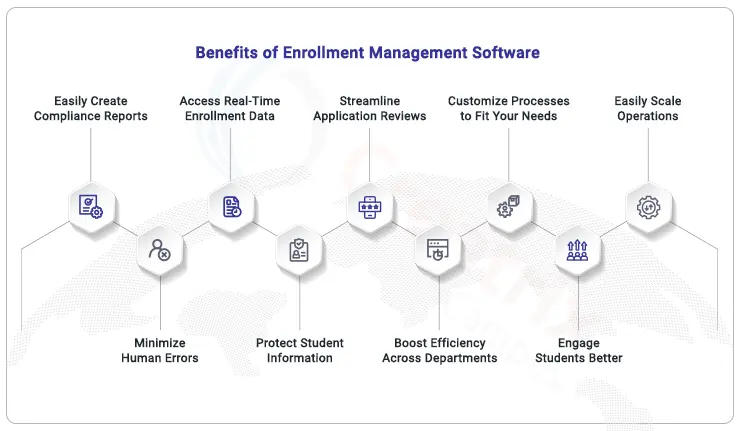
    What Enrollment Management Software Can Do for You, Registrar! Additional Benefits


    benefits-of-enrollment-management-software


    Easily Create Compliance Reports: No more scrambling during audits. With built-in reporting tools, you’ll have audit-ready reports at your fingertips.

    Create Compliance Reports with No Effort: No more rushing through audits. Built-in reporting features will let you have audit-ready reports right at hand.

    Reduced Human Errors: Automate data entry and tracking to greatly lower errors that might pass through in-hand procedures. 

    Access Real-Time Enrollment Data: Real-time updates will keep you current with enrollment figures, so guiding quick, wise selections.

    Secure Student Data: Forget data breaches. Cloud storage ensures security and compliance, providing you peace of mind.

    Make Reviewing Applications Easy: Let the program indicate critical details so you may focus on the big picture instead of sorting through heaps of papers.

    Get Everyone on One Agenda: Forget about departmental conflicts. Centralized data guarantees that everyone has the same information, so facilitating smooth teamwork.

    Create Methodologies That Fit You: Customize the system to fit the demands of your university so the enrolling process seems seamless, quick, and completely customized.

    Engage Students More: Use the software’s chat features to keep students up to date and interested throughout the whole process.

    Scale operations easily: The software adapts to your needs, so you don’t have to worry about losing accuracy or speed as the number of enrollments goes up or down.


    Wrapping It Up: Boost Enrollment Management with the Right Tool from Creatrix Campus

    At the heart of improving the student experience is how well you manage enrollment. We know the pain points—manual processes, communication breakdowns, and keeping track of every application can slow you down. As a registrar, you’re juggling enough already. Why not make things easier?

    Enrollment management software helps. We simplify operations, improve collaboration, and provide real-time data access, so you can focus on delivering a successful student journey. When modernizing your system, Creatrix Campus includes everything a modern registrar needs to ease the process. Contact our staff for more!

    Source link