Tag: Manhattan

  • CUNY Plans to Buy Manhattan Campus

    CUNY Plans to Buy Manhattan Campus

    Cash-strapped Metropolitan College of New York is planning to sell its Manhattan campus to the City University of New York for $40 million, a regulatory filing first reported by Bloomberg shows.

    The two institutions signed a letter of intent on Monday, according to the regulatory filing, which notes that proceeds will be used to pay off a portion of MCNY’s $67.4 million outstanding debt. 

    MCNY agreed to sell the site last year as part of a forbearance agreement with bondholders.

    Metropolitan College of New York has struggled to keep up with debt in recent years and failed to maintain the agreed-upon ratio of liquid assets, according to a regulatory filing from July. The small college enrolled fewer than 500 students, according to the latest state data, and posted a deficit of more than $7 million in fiscal year 2023, publicly available financial data shows.

    CUNY is purchasing 101,542 square feet across three floors in the shared building, which officials told Bloomberg they intend to use as a temporary site for the Hunter-Bellevue School of Nursing amid ongoing construction projects. The sale will require approval from bondholders as well as Metropolitan College’s accreditor, the Middle States Commission on Higher Education.

    Source link

  • Pay Attention to “The Manhattan Statement” (opinion)

    Pay Attention to “The Manhattan Statement” (opinion)

    Earlier this month, the Manhattan Institute released a statement with a proposed “new contract” for higher education and called on President Trump to write the terms of that contract into “every grant, payment, loan, eligibility, and accreditation” and then revoke federal funding for colleges and universities if they aren’t following them. To maintain public funding, universities would, for example, have to “advance truth over ideology,” “cease their direct participation in social and political activism,” and “adhere to the principle of colorblind equality, by abolishing DEI bureaucracies, disbanding racially segregated programs, and terminating race-based discrimination in admissions, hiring, promotions, and contracting.”

    Another term of the proposed contract would require universities to enact “swift and significant penalties, including suspension and expulsion, for anyone who would disrupt speakers, vandalize property, occupy buildings, call for violence, or interrupt the operations of the university.”

    You may be thinking: Well, think tanks and political actors publish things like this all the time. What’s the big deal?

    This proposed list of reforms was led by the Manhattan Institute’s Christopher Rufo, who has been the architect of many of the attacks on higher ed that we have seen come out of the White House and the Department of Education over the last six months.

    But what is more concerning is it was signed by Congresswoman Virginia Foxx—former chair of the House Education and Workforce Committee who oversaw the first subpoena sent to a higher education institution under the pretext of fighting antisemitism on campus. It was also endorsed by Education Secretary Linda McMahon, who posted on X to congratulate the Manhattan Institute for “envisioning a compelling roadmap to restore integrity and rigor to the American academy!”

    All this brings to mind Project 2025—an initiative led by another conservative think tank, the Heritage Foundation, which Democrats warned the American people about before the election and that has since been largely followed as a policy agenda for the Trump administration. You may remember that the education chapter of this conservative platform was written by the director of Heritage’s Center for Education Policy, Lindsey Burke—the same person now serving as the deputy chief of staff for policy and programs at the U.S. Department of Education.

    As predicted, the policy proposals in Project 2025 mirror those being pursued by the current leadership at the Department of Education. Providing universities more flexibility on accreditation; rescinding the Biden administration’s Title IX regulations; eliminating the disparate impact standard in civil rights cases; phasing out existing income-driven repayment plans; eliminating GEAR UP; transferring programs from the Office of Career, Technical and Adult Education to the Department of Labor; and capping indirect cost rates for federal science grants are just a few of the policies in Project 2025 that have started to come to fruition in the Trump administration.

    We now have another road map that college leadership and policymakers need to be ready to push back on. As noted above, the Manhattan Institute’s agenda is comprised of pledges for colleges and universities that include ending participation in social and political activism; abolishing diversity, equity and inclusion programs; ending race-based decisions in hiring, promotions and contracting; and enacting restrictions on free speech. In other words, it is a road map for a new level of federal interference into the administration of colleges and universities. It is not a road map for reforms that will help students. Rather, it is an attempt to undermine the independence of our higher ed institutions by dictating policies—those based on a specific political ideology—in exchange for federal funding.

    What’s next? Just like the proposals in Project 2025, Christopher Rufo’s proposals have had a pretty good track record of being implemented by the Trump administration. If the past is prologue, we can expect to see new language in program participation agreements that ties Title IV funds to restrictions on academic freedom; new accreditation rules that prohibit standards around diversity, equity and inclusion; and certifications sneaked into grant terms and conditions that threaten strict penalties for activities that do not align with this administration’s ideology.

    Higher education institutions have been far from perfect, and some may even have drifted from their missions of serving all students in the best way possible. But what students deserve is a reform agenda that leads to student success, college completion and strong postsecondary outcomes. That is the agenda that should be endorsed by our nation’s leading education official. What the Manhattan Institute is proposing is not an agenda that is in our country’s best interest.

    We need an agenda that makes access to a college degree or credential of value affordable and accessible. We need an agenda that allows a range of viewpoints to thrive across college campuses and fosters intellectual diversity. We need an agenda that ensures college campuses are inclusive communities and that they serve all students, and we should have a contract between the federal government and colleges and universities that protects investments in our nation’s future and success—not one that threatens disinvestment and opens the door for political interference and federal intrusion.

    Amanda Fuchs Miller served as the deputy assistant secretary for higher education programs at the U.S. Department of Education in the Biden-Harris administration. She is the president of Seventh Street Strategies, which advises higher ed institutions, nonprofit organizations and foundations on policy and advocacy strategies.

    Source link

  • The Dangers of the Manhattan Statement

    The Dangers of the Manhattan Statement

    After several decades of writing books and blogs about the culture wars, academic freedom and campus free expression, I’ve started this column to illuminate some of the key debates about these issues, past and present, as I see them. I hope my thoughts spark disagreement and discussion, both of which I welcome.

    Something that caught my eye last week was news of a statement calling for even more government control over higher education from a group of conservatives. This comes as the right fully embraces Donald Trump’s authoritarian commands against universities. Developed by Christopher Rufo of the Manhattan Institute, the Manhattan Statement was carefully designed using public polling to create vague, popular-sounding principles (“truth” “freedom of speech” “equality” “civil discourse” “transparency”) that obscure its plan for massive federal control over colleges and repression of dissent. 

    The Manhattan Statement is a recipe for tyranny. Even if some people might agree with its goals, what’s important are not the ends but the repressive means used to achieve them. It calls for “a new contract with the universities, which should be written into every grant, payment, loan, eligibility, and accreditation, and punishable by revocation of all public benefit.” We’ve already seen how the Trump regime has terribly, illicitly abused its power over government contracts to punish colleges without due process. The Manhattan Statement would vastly expand this power to include all federal funding and student loans, making every college held hostage for its existence to any demands of the government.

    Instead of pretending that “antisemitism” somehow justified cutting off federal funds in direct defiance of the due process required under Title VI, the Manhattan Statement would provide a wide array of reasons for political ideologues to destroy a college, with its amorphous calls to abolish “ideology” and “activism” and require “swift expulsion” of anyone deemed to violate “civil discourse.”

    And what if some poor deluded student still wants to attend a college deemed to have violated the Rufo rules? Sorry, he’s from the government, and he’s here to help, whether you like it or not. The Manhattan Statement demands that colleges give total obedience to the reigning president and his interpretation of what the politically correct ideas are.

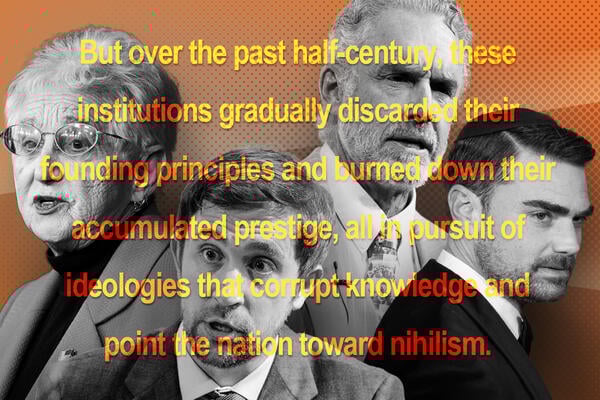
    In recent years, many conservatives have abandoned their past commitments to free speech and the rejection of federal control over academia. The nearly 50 signers of the Manhattan Statement represent a broad range of the alt right and the old right, with celebrities like Jordan Peterson and Ben Shapiro joining serious scholars such as Dorian Abbot, Victor Davis Hansen, Lee Jussim and Eric Kaufmann, as well as several professors whose academic freedom I have defended, such as Peter Boghossian and Joshua Katz. It’s disturbing to see so many thoughtful conservatives that I respect joining a call for massive expansion of government control over colleges.

    One of the signers, Representative Virginia Foxx (R-NC), is a member (and former chair) of the House Committee on Education and the Workforce, a sign that the Manhattan Statement is not some theoretical wish list aimed at reforming universities, but a very real political threat that could easily be enforced on colleges in the near future. 

    However, even terrible legislation is too slow a process for these conservatives, who write that “we call on the President of the United States to draft a new contract with the universities” with these extraordinary requirements. It shows a breathtaking ignorance of basic American civics for so many conservatives to believe that the President single-handedly has the power to impose extraordinary conditions at his whim on any college receiving any grants or student loans, and even personally dictating the accreditation status of colleges.

    To legitimize government intrusion, the Manhattan Statement invents pure historical fiction: “During the Founding era, schools of higher education were established by government charter and written into the law, which stipulated that, in exchange for public support, they had a duty to advance the public good, and, if they were to stray from that mission, the people retained the right to intervene.”

    The first American colleges were chartered in the Colonial era, not the Founding era, and there is no mention of any “right to intervene” by “the people” in any college charter. That imaginary “right to intervene” would be prohibited now by the First Amendment. The AAUP’s 1915 Declaration of Principlesrevered by this Statement’s signers such as Peter Wood—states that politicians and even college trustees “have neither competency nor moral right to intervene” in the professional work of academics.

    The Manhattan Statement claims, “The American people send billions to the universities and are repaid with contempt.” The “American people” represent a wide range of views. They are repaid for their money with scientific and medical advances of enormous value, with educated students who expand the productivity of the leading economy in the world, and with the general expansion of knowledge. And contempt for the American people is pretty rare among academics. But I oppose this anti-contempt rhetoric on a deeper, moral level. Universities should have more expressions of contempt. We need more arguments on campus, more core disagreements, even when it offends people. If contempt is forbidden, many of the Manhattan Statement’s signers would be the first against the wall. And the belief that universities should precisely mirror the public’s views and identities is wrong, as these same conservatives have repeatedly said when denouncing diversity.

    Manhattan Institute poll last month found that a strong majority of Democrats and independents support free speech on campus. But only 44% of Republicans agreed that “it’s more important for universities to protect free speech, even if some find it offensive.” Conservatives are retreating from principles of free speech and limited government because they want to purge their enemies, and the Manhattan Statement is a clear declaration of this move.

    What the Manhattan Statement claims to be the problem—“a new kind of tyranny—one in which ideology determines truth, and the university functions as a political agent …”—is, in fact, the perfect description of Rufo’s solution. He’s simply taking a deluded fantasy of left-wing tyranny on campus as a justification to impose a very real proposal for right-wing tyranny. 

    We are witnessing the worst government attacks on academic freedom in the history of American higher education, as the Trump regime has launched an assault on campus free inquiry that’s unconstitutional, illegal, immoral and indefensible. It’s a moment when all principled defenders of academic freedom, regardless of their critiques of academia, should speak out strongly against repression and the belief that government control can be a solution to academia’s problems. Instead, these so-called conservatives are standing up to applaud authoritarianism, and calling for greater destruction of their enemies, the universities.

    I want this column to be a space for interviews with authors and debates with those who disagree with me, and I encourage readers to write letters to the editor in response ([email protected]) and to email me ([email protected]) with their own ideas.

    Source link