
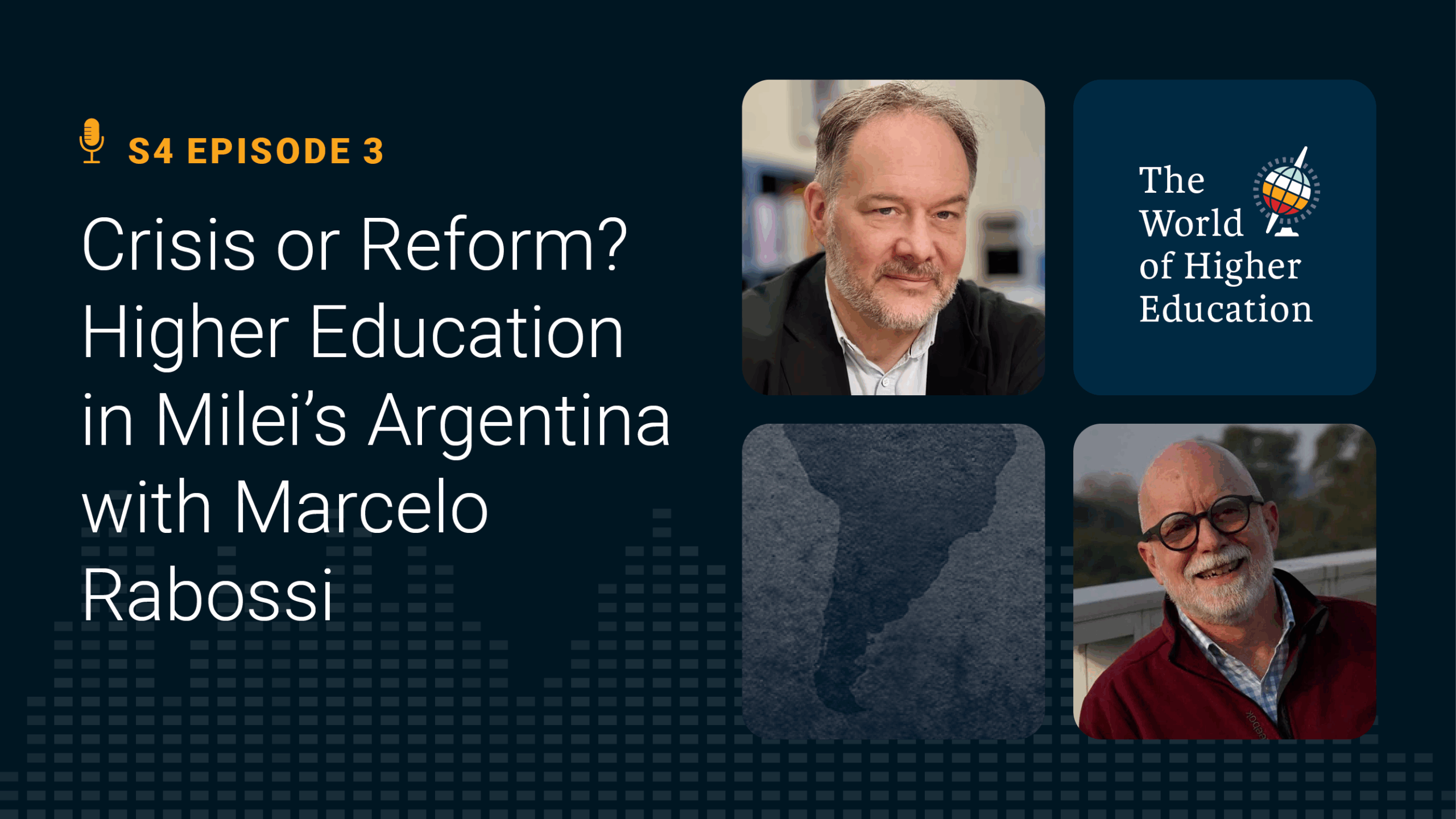
Back in late 2023, a little known libertarian by the name of Javier Milei was elected President of Argentina with a strong mandate to conquer that country’s hyperinflation. His strategy for doing so was pretty straightforward — freeze public spending, which would mean a big loss in real terms until inflation came down, and then let the free market do the rest.
That was easier said than done. Milei lacked a majority in Congress and all of the legacy parties had some reason to try and preserve the status quo, but more or less, Milei got his way and the public sector, including public universities, have had to shrink enormously as a result. Falling budgets, cratering salaries, the lot.
But now the opposition is starting to gain strength. Over the northern summer, Congress passed a bill meant to roughly double state spending on public higher education. Last week, predictably Milei vetoed the law. We can probably expect a season of protests and strikes to ensue.
Returning to the show today to discuss all this is Marcelo Rabossi of the Universidad Torcuato Di Tella in Buenos Aires. He joined the podcast 18 months ago at the outset of Milei’s term to discuss what the President’s agenda was likely to have in store for the higher education sector. Today he’s with us to talk about how the system is surviving what amounts to a massive cut in real pesos, and what the next few months look like as tensions mount between the President and the opposition.
Of particular interest, I think, is where we talk about how, despite Milei’s affinity to the US hard right, he’s avoided Trumpian tactics, like targeted cutbacks through research rescissions and outright institutional extortion.
But enough from me. Let’s hear from Marcelo.
The World of Higher Education Podcast
Episode 4.3 | Crisis or Reform? Higher Education in Milei’s Argentina with Marcelo Rabossi
Transcript
Alex Usher (AU): Marcelo, when we last spoke in January 2024, Javier Milei was newly elected president at the head of La Libertad Avanza. He didn’t have a majority in Congress—still doesn’t. He was elected on a mandate to stop hyperinflation, but his appeal wasn’t just about tighter money. He was a libertarian who wanted to shrink the size of government enormously, which is, in some ways, quite a revolutionary idea in Argentina. Generally speaking, how has his first year and a half in office gone? Is inflation down? Has the size of the government shrunk?
Marcelo Rabossi (MR): From the very beginning, even during his campaign, Milei promised radical changes to literally crash hyperinflation. He aimed to do this by reducing government spending and opening the economy. Inflation has dropped substantially. For example, in December 2023, monthly inflation peaked at 25% and now it’s around 2% for three consecutive months. This is largely due to Milei’s aggressive austerity measures and a very tight monetary policy. He significantly cut federal spending and restored market dynamics.
It’s also true that poverty has declined, from 54% in early 2024 to about 32% in early 2025. On the other hand, economic activity has stagnated, and retirees have lost much of the purchasing power of their pensions. That’s the dark side of Milei’s economic plan.
AU: How has he been able to achieve his agenda without a majority in Congress? What’s the dynamic there? Does he strike deals with conservative parties, or does the presidency give him some ability to rule by decree? How do you get things done when you’re a minority president?
MR: That’s a great question, because I think this is the first party in power with a minority in both chambers of Congress. Milei has relied on emergency executive decrees to bypass legislative opposition or blockages and to implement deep reforms.
Early on, he also struck strategic deals with conservative parties, particularly PRO—the party of former President Macri—and the Radical Civic Union. These strategies helped him pass the “Ley de Bases” in 2024, which was a foundational reform to deregulate the economy.
However, this approach had its limits. He’s now facing growing resistance, even from former allies. Internal divisions and shifting loyalties have made these alliances fragile.
By mid-2025, even some conservative legislators began distancing themselves from Milei’s more extreme measures and aggressive behavior. So I’d say he has governed through a mix of executive power, tactical alliances, and public pressure—but he’s losing that advantage.
AU: My understanding is that Milei’s approach to reducing expenditure and inflation has been simply to freeze spending on government departments. Inflation is lower now than it was two years ago, but it’s still reasonably high, so inflation just erodes the value of that spending.
How has this affected higher education? How big has the cut been to higher education in real terms—that is, after inflation? And is higher education different from other social sectors? Presumably you’d see the same dynamics with hospitals and other services. Is higher education being targeted for bigger reductions, or no?
MR: You’re absolutely right. Spending freezes across all public areas—education, health, infrastructure—have been his primary tool to fight inflation. But as you noted, when inflation remains high, even if it’s slowing, frozen budgets imply reductions in real terms.
Regarding higher education, let me give you some numbers. In 2024, funding for Argentina’s public universities fell by around 30% in real terms and by 2025, the projected university budget is about 35–36% lower than in 2023. According to my analysis, around 80% of higher education spending in Argentina goes to salaries, and those dropped by about 30–35%. Capital expenditures for infrastructure have also collapsed.
But it’s not only university funding. Overall, education has suffered a real decrease of more than 30% between 2023 and 2025. For example, teacher training and technology programs are down 40%, and early childhood education infrastructure is down 60%. Scholarships for low-income students have also decreased by about 40%. I should add that schools are funded at the provincial level, so national cuts didn’t have as large an impact there. But universities, which are funded nationally, were hit hard. Overall, higher education has been one of the hardest-hit sectors.
So, this “freeze strategy,” as I call it, has helped Milei achieve fiscal surpluses and reduce inflation—but it has come at the cost of shrinking real investment in the country’s future.
AU: The president is sometimes seen as Argentina’s Trump—that’s sort of his international reputation. He certainly has admirers on the U.S. far right. Elon Musk even copied him with the chainsaw routine, attacking public finances.
I don’t get the sense that Milei is a friend of higher education. He rants about “woke intellectuals” and that kind of thing, which lines up with the American right. But I don’t get the sense he’s copied Trump in terms of silencing particular lines of research or picking fights with individual universities.
So apart from the financial cuts, which can maybe be defended purely on anti-inflationary grounds, what has the relationship been between Milei and the higher education sector?
MR: Unlike Trump, Milei hasn’t gone after specific research areas or individual institutions. He hasn’t interfered with academic freedom—there have been no restrictions on curricula, no attacks on gender studies or climate research, and no attempt to control university governance.
His approach has been more structural than targeted at specific institutions. That said, the University of Buenos Aires—the largest and most important in the system—has been his main target, simply because it’s the most visible.
I should add that some of his early ideas, like replacing direct public funding of universities with vouchers, have remained more like theoretical provocations than serious proposals. They have no real support and no chance of being implemented.
So while Milei’s stance toward higher education is hostile, it’s not close to institutional repression. His obsession is with the economy and controlling inflation.
AU: A moment ago, you talked about roughly a 30% decline in real terms for university support—maybe a bit higher if you compare the end of 2025 to the end of 2023. How does a university deal with a cut of 33%? What kinds of decisions do they have to make to keep the doors open in conditions of austerity like that? And what have been the consequences of those decisions?
MR: First, universities reacted in order to survive. I would say they are operating in survival mode. In this scenario, universities have had to freeze salaries, delay infrastructure repairs, and cut back on research funding. They’ve also shortened semesters, reduced course offerings, and postponed new programs. Some campuses, like the University of Buenos Aires, have even merged departments or cut non-essential services.
To give you an idea of why these fiscal restrictions have hit so hard: between 80% and 90% of universities’ total income comes from national government funds. Remember, undergraduate education in Argentina is tuition-free, and undergraduates represent more than 90% of a total student body of over 2 million enrolled in national institutions. On the other hand, historically Argentina’s public universities haven’t had a strong tradition of fundraising. Some institutions are beginning to move in that direction, collecting money from private donors, but it’s still very limited.
AU: Surely those kinds of cutbacks would make private universities in Argentina more attractive, right? Argentina doesn’t have a huge private sector—it’s not like Chile or Brazil. I think about 80% of students are in the public system. But have private universities seen an opportunity here? Are they taking advantage of these cuts to tout the benefits of paying tuition and offering something more complete than the public sector?
MR: As I always say, in Argentina the private sector is more tolerated than stimulated, unlike in Brazil or Chile. There are about 60 private universities in the country with around 400,000 undergraduates. Historically, they’ve largely avoided political confrontations and remained neutral. Politics tends to play out in the public sector, so unlike national institutions, private universities haven’t been cast as ideological enemies or targets. This has allowed them to operate with less social and political confrontation.
On the financial side, the private sector largely depends on tuition fees—on average, 90% of their income comes from that source. So decreases in public funding haven’t been an issue for them, since they don’t rely on public subsidies or loans. Recently, however, there have been rumors about public scholarships for students at private universities.
Financially speaking, they’re in reasonably good shape. They’ve been able to maintain operations, salaries, and infrastructure. In a way, they look relatively resilient. And you’re right—while public universities are cutting programs, freezing salaries, and facing potential strikes, private universities now appear more stable and predictable for students and families. For those who can afford tuition, private institutions may seem like a real option.
AU: The public universities have obviously been fighting back over the past year and a half. I’ve lost count of the number of strikes, protests, and demonstrations of public opposition.
What’s interesting is that just in the past few months—during the Northern Hemisphere summer, your winter—Congress considered a bill to stabilize university finances. If I understand correctly, they mandated a funding floor tied to a certain percentage of GDP. That law passed about a month ago. What was this bill, and how did it pass? Because it seems to get back to the question of the president losing allies, since some of his conservative partners voted for it.
MR: Right. The goal of this law was to increase Argentina’s university budget from around 0.4% of GDP to 1.5% in the next five years. That’s a big jump. Beginning in 2026, funding will rise to 1% of GDP.
Historically, public spending on universities has been around 0.6% of GDP, peaking at 1% but usually closer to 0.8%. So this proposal represents a significant increase. It’s intended to replace the funding law passed by the government in 2024.
The bill was introduced in Congress by the rectors of Argentina’s 56 national universities, with support from unions and student organizations. It also proposes updating budget allocations for accumulated inflation in 2023–2024 and reinforcing faculty salaries starting in December 2023, with monthly updates tied to the consumer price index.
AU: Let’s talk about what happens politically here. Both houses of Congress passed the law, and Milei vetoed it on September 10th, I think. How does this get resolved at this point? What happens politically to the bill from here on in?
MR: You’re right about the veto—it’s his main political tool, given that he has no majority in either chamber. University unions, students, and education advocates have already staged protests and strikes, and more demonstrations are expected, especially around Congress.
The veto will escalate tensions between Milei and the education sector, and it’s becoming a rallying point for the opposition. In my view, the next few weeks will be critical. If Congress can’t override the veto, universities will remain under severe financial strain, and political pressure on Milei will intensify.
Either way, this is more than a budget fight. The opposition says it’s a battle over the future of public education in Argentina.
AU: President Milei has another two years and three months left in his mandate. What’s your best guess about higher education? How is it going to fare between now and then? What does the Argentinian system look like at the end of 2027?
MR: Yes, you’re right—we have two years ahead. It’s difficult to predict the future in Argentina, although some would say: expect a new crisis and you’ll probably be right.
As we’ve said, despite lacking a congressional majority, Milei has pushed through major reforms via executive decrees. That’s been his political tool. His confrontational style has kept him in the spotlight but also sparked resistance from traditional parties, the far left, conservatives, and even moderate liberals.
Whether this initial economic stabilization translates into long-term growth—and consequently, political support—remains the big question. If he wins in the next legislative elections this October, he will likely maintain his firm stance, continue vetoing, and I don’t see major changes. If the economy grows, there may be some money to calm the situation, but not enough to achieve what the vetoed law proposed: doubling university funding in relative terms in the short or medium term. That’s a kind of utopia, even if the country emerges from its depression.
But if Milei loses by a wide margin, the pressure will be enormous, creating a vicious circle that prevents Argentina from escaping economic stagnation. Keep in mind: the only way for universities to receive more funding is for the country to grow. If conflict increases, investors will postpone decisions, and in such a scenario, there are no winners.
Again, public universities in Argentina are more than just educational institutions—they are symbols of social mobility and national pride. Milei’s veto of the bill to increase university funding and staff salaries will likely trigger widespread outrage, uniting students, faculty, unions, and the political opposition. In fact, new public demonstrations are already underway and may continue for weeks, months, or even the next two years until his mandate ends.
AU: Lots to keep an eye on. Marcelo Rabossi, thank you so much for being with us today.
MR: It’s my pleasure. Thank you so much.
AU: And it just remains for me to thank our excellent producers, Sam Pufek and Tiffany MacLennan, and you—our listeners and readers—for joining us once again. If you have any questions or comments about today’s episode, or suggestions for future ones, please don’t hesitate to write to us at [email protected].
Join us next week when our guest will be Yale University’s Zach Bleemer, professor of economics, who has just co-written a fascinating new paper, Changes in the College Mobility Pipeline since 1900. We’ll be talking about some of that report’s surprising findings. Bye for now.
*This podcast transcript was generated using an AI transcription service with limited editing. Please forgive any errors made through this service. Please note, the views and opinions expressed in each episode are those of the individual contributors, and do not necessarily reflect those of the podcast host and team, or our sponsors.