Tag: market research

  • Planning with Purpose: Designing Certificate Programs That Align with Market and Mission

    Planning with Purpose: Designing Certificate Programs That Align with Market and Mission

    Higher education is seeing a surge of interest in non-degree credentials. Learners are seeking faster, more affordable pathways to workforce advancement. Employers are increasingly open to (and in some cases requesting) alternatives to traditional degrees. And with new federal policy expanding Pell Grant eligibility to non-degree programs, institutions are feeling the urgency to act.

    But not all certificate programs are created equal. And while the trend line is clear, the strategy behind how institutions respond is anything but. This moment presents an opportunity, but only for those willing to plan with purpose and set realistic expectations.

    What’s driving demand for short-term credentials?

    Recent data underscores a clear increase in interest:

    • Undergraduate certificate enrollment grew 33% and graduate certificate enrollment grew 21% from Fall 2020 to Fall 2024, according to National Student Clearinghouse data.
    • Google search volume for certificates has increased 19% from 2020 to 2025, according to Google Trends data.

    Today’s learners are drawn to programs that offer accelerated timelines, reduced costs, and clear pathways to meaningful career outcomes. Many working adults are looking to upskill or pivot careers, and a certificate can be a more practical option than a full degree.

    On the employer side, organizations want proof of skills and are increasingly willing to collaborate with institutions on curriculum design. In fact, according to a 2022 employer survey from Collegis and UPCEA, 68% of respondents said they would be interested in teaming up with an institution to develop non-degree credentials to benefit their workforce.

    Certificates are a piece of the puzzle — not the whole strategy

    Despite the interest, many institutions struggle to meet enrollment goals for certificate programs. Strong market trends do not automatically translate into high enrollment volume. The reality is that most certificates serve niche audiences and deliver modest numbers. When treated as stand-alone growth drivers, they often fall short.

    The institutions that see the most strategic value from certificates do so by positioning them within a larger enrollment and academic ecosystem. For example, we’ve helped our partner institutions find success in using certificate interest as a marketing funnel to drive engagement in related master’s programs. Once a prospective student engages, enrollment teams can advise them on the best fit for their career goals, which, for some students, is enrolling in the full degree program.

    Ready for a Smarter Way Forward?

    Higher ed is hard — but you don’t have to figure it out alone. We can help you transform challenges into opportunities.

    What a strategic certificate model looks like

    A certificate program with purpose isn’t just a set of courses — it’s a product with clear value to both learners and the institution. Key elements of a strategic approach include:

    1. Workforce alignment: Programs must be rooted in real-time labor market data. What skills are employers seeking? Which certifications are valued? Aligning with reputable industry certifications is a proven way to ensure relevance and employer recognition.
    2. Accessibility: Pricing should reflect the certificate’s value relative to degree programs, and eligibility for financial aid must be prioritized. Lack of aid is a significant barrier to enrollment for many prospective learners.
    3. Laddering and stackability: Certificates should not be terminal unless intentionally designed that way. They should stack into larger degree pathways or offer alumni incentives for continuing their education.
    4. Delivery speed and flexibility: Busy adult learners expect quick starts, clear outcomes, and minimal red tape. Institutions need streamlined onboarding and agile curriculum design.
    5. Internal collaboration: Designing certificates in isolation often leads to friction. Academic, enrollment, and marketing teams must be aligned on purpose, target audience, and outcomes.
    6. Employer engagement: Employers want to be part of the development process and seek assurance that certificate programs teach the skills they need. Their involvement enhances the recognition and credibility of the credential.

    The role of institutions: Balance mission with market

    Certificate programs are not a shortcut to growth. But they can be a smart strategic lever when grounded in data and designed to complement an institution’s broader mission. They offer colleges and universities an opportunity to:

    • Expand access to underserved learners
    • Respond more nimbly to labor market shifts
    • Strengthen ties with regional employers
    • Drive awareness and enrollment for degree programs

    The key is alignment. When certificate offerings reflect both market demand and institutional mission, they can play a powerful role in expanding reach and impact.

    Plan with purpose, execute with intent

    Certificates are more than just a trending credential. They’re a tool to serve learners in new ways. But institutions must resist the urge to chase quick wins. Success requires thoughtful design, realistic expectations, and cross-functional collaboration.

    With the right foundation, certificate programs can do more than fill a gap. They can open doors for learners, employers, and institutions alike. Collegis supports this effort with integrated services in market research, instructional design, and portfolio development — empowering institutions to make informed, mission-aligned decisions that deliver impact.

    Innovation Starts Here

    Higher ed is evolving — don’t get left behind. Explore how Collegis can help your institution thrive.

    Source link

  • The 2026 Growth Strategy Higher Ed Needs Right Now

    The 2026 Growth Strategy Higher Ed Needs Right Now

    Why Playing It Safe Is the Riskiest Strategy 

    The convergence of changing demographics, economic volatility and the relentless disruption of AI presents every leader with a stark choice: drive transformative growth or manage a legacy of decline. The choice is yours.

    The era of steady traditional enrollment is over. Beginning in 2026, most institutions will confront a lasting decline in their core undergraduate market. At the same time, public faith in higher education’s value is weakening, leaving institutions to rebuild trust through proof, not promises.

    Findings from EducationDynamics’ 2026 Landscape of Higher Education Report highlight a critical truth: volatility is the new normal and transformation is no longer optional.

    Growth in this new era demands more than adaptation—it demands reinvention. Institutions must lead with strategy, act with urgency and build around the Modern Learner. Because in a market defined by disruption, there are only two paths forward: reinvent or risk irrelevance.

    Key Takeaway #1: An Unstable Economic and Employment Landscape 

    Economic volatility is rising as job creation slows, and uncertainty spreads. The workforce is growing more cautious than ambitious, and in this climate, the traditional promise of a college degree is under siege.

    College graduates still enjoy higher employment rates, yet public faith in that value is eroding. The perception gap is widening, and institutions can no longer rely on reputation alone to carry their story.

    This is the moment to lead with proof, not platitude.

    Institutions must demonstrate return on investment with clarity and consistency. Publish outcomes data. Showcase alumni success. Connect every program to real career mobility. This isn’t just about convincing students, it’s about rebuilding trust across the entire ecosystem of alumni, employers, policymakers and the public.

    In today’s economy, outcomes are the new currency of reputation. The institutions that clearly and consistently prove their value will be the ones that grow.

    Key Takeaway #2: A Radically Transformed Enrollment Environment 

    Institutions now operate in a fundamentally different enrollment landscape. The long-anticipated demographic cliff is no longer a future threat; it’s here. The 2025 cycle marked the high-water mark for traditional-aged undergraduates. From 2026 on, institutions will face a sustained and irreversible decline in their core market. 

    But this doesn’t have to be a crisis. It’s an opportunity to pivot and capture where growth has moved. The new lifeblood of higher education lies in: 

    • Adult learners seeking rapid reskilling in a volatile economy 
    • Dual-enrollment students accelerating their path to a degree 
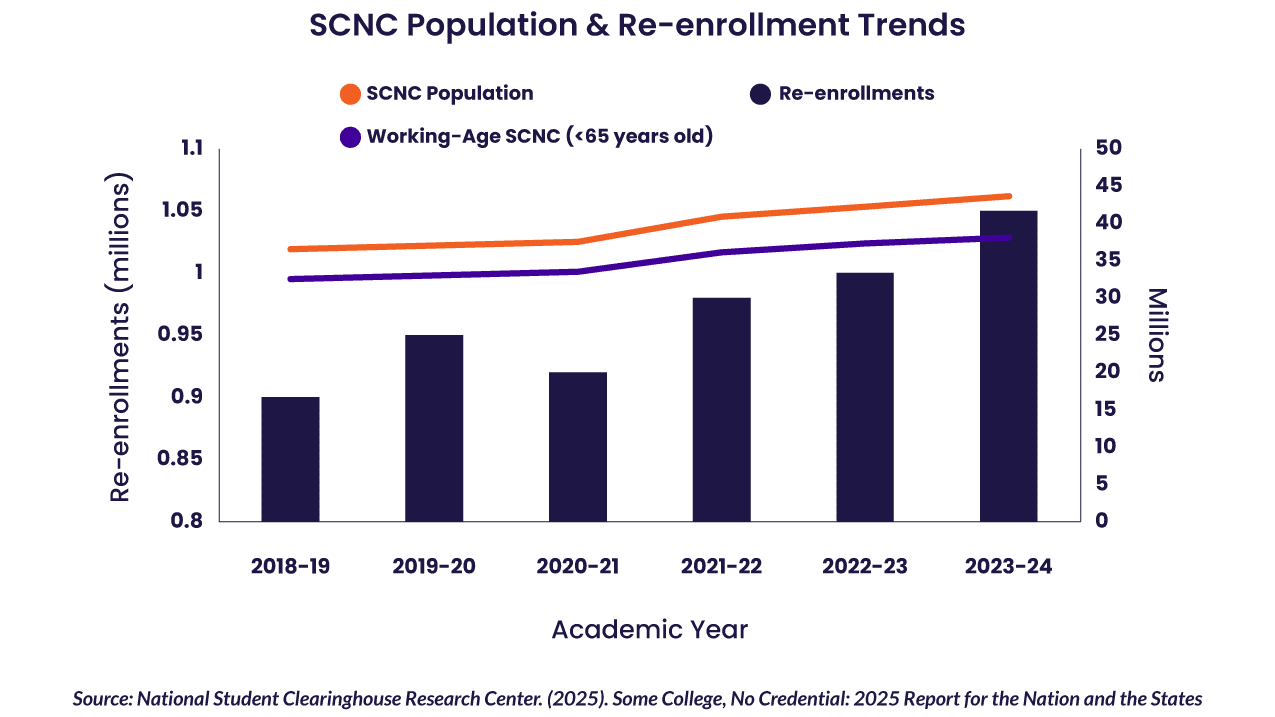
    • “Some college, no credential” learners returning to finish what they started 

    The lines between traditional and nontraditional students have disappeared. These aren’t separate segments—they’re one unified audience shaping the future of higher education.

    Leaders who continue to operate with outdated distinctions risk designing strategies for a market that no longer exists. Modern Learners value cost, convenience and career outcomes—and they expect institutions to deliver all three.

    This is the moment to retire the old playbook, embrace a new mindset and build for the learner who’s already redefining what comes next.

    Key Takeaway #3: AI Is an Unmistakable Force with Far-Reaching Implications 

    AI is accelerating change across every dimension of higher education, from how institutions engage to how graduates build careers. 

    While the technology itself isn’t new, its rapid integration is rewriting the rules. AI has fractured the traditional recruitment funnel. Modern Learners use AI-powered tools to search, compare and evaluate options before they reach an institution’s website. The student journey is now self-directed, hyper-personalized and constantly evolving, demanding that marketing and enrollment teams adapt in real time. 

    But AI’s impact extends far beyond recruitment. Its growing influence in the workforce is forcing institutions to rethink their academic mission. Institutions that lead will design education for the AI era by combining technical fluency with human-centered skills such as creativity, critical thinking and ethics. 

    Key Takeaway #4: AI Is an Unmistakable Force with Far-Reaching Implications 

    Incrementalism is now the greatest risk. In an age of constant disruption, small adjustments and siloed strategies hinder growth. The institutions that succeed will lead with clarity, agility and a unified vision centered on the Modern Learner. 

    Sustained growth demands leadership that acts decisively across three dimensions: 

    1. Align program portfolios with high-growth sectors. Move beyond tradition-bound curriculums. Invest in programs that meet labor-market demand and retire those that no longer serve a clear purpose. 
    2. Unify brand and enrollment strategies. The boundaries between undergraduate, graduate and online student populations are disappearing. Institutions must speak with one voice and focus on the three factors that drive every learner’s decision: cost, convenience and career outcomes. 
    3. Lead the conversation on value and outcomes. Public trust cannot be rebuilt through messaging alone. It must be earned through transparency, data and measurable results.

    This is the moment that will define the next decade of higher education. The difference between survival and sustainable growth hinges on decisive, informed action. Leaders must either seize this moment to shape the future or watch their institutions be defined by it. 

    From Insight to Action: Ten Strategic Imperatives for Sustainable Growth 

    The era of incremental adjustment is over. Conviction is now the currency of leadership. This moment demands bold leadership and a decisive strategy that converts disruption into a roadmap for measurable growth. 

    The EducationDynamics’ 2026 Landscape of Higher Education Report delivers that roadmap. Our Ten Strategic Imperatives are pragmatic, research-driven levers designed to help your institution build resilience and sustainable momentum for 2026 and beyond. 

    Imperative #1: Prove Outcomes. Protect Reputation.  

    Publish transparent results and illustrate career alignment to help students understand program value. 

    Imperative #2: Market ROI Relentlessly. 

    Lead with affordability and clearly communicate a projected and proven return on investment. 

    Imperative #3: Capture the Dual Enrollment Surge.   

    Build structured high school-to-degree pipelines. 

    Imperative #4: Own the Adult Learner Market.

    Offer flexible, online and stackable options with the support working learners need to balance their multiple priorities. 

    Imperative #5: Prioritize Accessibility through the Three C’s.  

    Deliver education that meets learners on cost, convenience and career outcomes. 

    Imperative #6: Lead in Responsible AI Adoption.  

    Optimize marketing for AI discoverability and AI powered platforms, while Integrating AI into advising, engagement and instruction. 

    Imperative #7: Reinvent Vulnerable Disciplines.  

    Reframe liberal arts around adaptability and skills attainment. 

    Imperative #8: Re-engage the Stopped-Out Majority. 

    Convert the 43 million with some college, no credentials into completers through credit recovery, tailored pathways and adult-first design. 

    Imperative #9: Stack Credentials into Careers.  

    Link short-term certificates to degree pathways. 

    imperative #10: Advocate for Policy Stability. 

    Simplify aid communication and push for predictable funding. 

    Together, these imperatives form a blueprint for how higher education can evolve from reactive adaptation to proactive growth. 

    Transform Disruption into Growth

    The time for caution has passed. Those who hesitate or fail to act with purpose will fall behind in a marketplace that does not wait. 

    At EducationDynamics, we partner with colleges and universities prepared to lead this transformation—those who understand that meeting the Modern Learner where they are is not just an enrollment strategy but the new mission of higher education. 

    For deeper insights and actionable strategies, download the full 2026 Landscape of Higher Education Report and learn how your institution can stay ahead of the curve. 

    Source link

  • The End of the Traditional Student Era: Higher Ed’s New Enrollment Reality

    The End of the Traditional Student Era: Higher Ed’s New Enrollment Reality

    For decades, the term “traditional student” referred to an 18–22-year-old, full-time student living on campus and largely unencumbered by adult responsibilities. That definition may have been true in the past, but today, it’s holding institutions back. 

    Across the country, Gen Z students increasingly look like their older counterparts in how they approach higher education. They’re working while enrolled, choosing flexible learning formats, weighing cost against career ROI, and demanding that programs fit into — not disrupt — their lives. At the same time, adult learners remain a vital audience, and their motivations often mirror those of younger students. 

    For enrollment and marketing leaders, the takeaway is clear: Stop relying on outdated labels and start building strategies for the actual students you serve. 

    The blurred lines between traditional and adult learners 

    Recent Gallup-Lumina research shows that 57% of U.S. adults without a degree have considered enrolling in the past two years, and more than 8 in 10 say they’re likely to do so within the next five years. While adult learners have long valued affordability, flexibility, and career outcomes, these same factors now dominate Gen Z’s expectations. 

    Cost concerns are particularly telling, as highlighted by The CIRP Freshman Survey 2024. The study found that 56.4% of incoming first-year students reported some or major concern about paying for college, with even higher rates among Hispanic or Latino (81.4%) and Black or African American (69.6%) students. 

    Work and life responsibilities are also playing a growing role. Georgetown University’s Center on Education and the Workforce (CEW) reports that between 70-80% of undergraduate students are employed while enrolled, with about 40% working full-time.  

    For many, this isn’t a nice-to-have — it’s the only way they can afford school. 

    Why this matters for enrollment strategy 

    If your enrollment marketing still segments audiences primarily by age, you’re likely missing the mark. Here’s the reality: 

    • An 18-year-old commuter working 30 hours a week and taking hybrid classes might have more in common with a 35-year-old career changer than with a residential peer. 
    • Transfer and degree completer students (36.8 million Americans with some college but no credential) are often juggling similar priorities. 
    • Both groups respond to messaging that clearly connects program design to life balance, affordability, and employment outcomes. 

    The “traditional vs. adult” distinction no longer works for understanding motivations, predicting behaviors, or designing student experiences. 

    Ready for a Smarter Way Forward?

    Higher ed is hard — but you don’t have to figure it out alone. We can help you transform challenges into opportunities.

    4 Priorities that span generations 

    Regardless of age, today’s students share a core set of expectations that shape their enrollment decisions. These priorities now cut across the full spectrum of higher education audiences. 

    1. Affordability 

      The Gallup-Lumina report states that finances are among the most influential factors in enrollment decisions for unenrolled adults. Cost is also the top reason adults have stopped out of higher education and a leading reason current students consider doing so.  

      Gen Z mirrors this cost-conscious mindset, with many forgoing the traditional four-year route and embracing community colleges or transfer pathways as a lower-cost way to begin their degree journey.

      2. Flexible learning programs 

        Hybrid, online, and asynchronous options are no longer “adult learner perks” — they’re mainstream expectations. Traditional-aged students now seek flexible schedules to balance work, internships, and other commitments, mirroring adult learners. The pandemic accelerated digital comfort across age groups, making flexibility table stakes for recruitment. 

        3. Career outcomes 

          The Gallup-Lumina report shows that 60% of currently enrolled students cite expected future job opportunities as a “very important” factor in choosing to enroll. For stopped-out adult students, career prospects were also the top motivator. 

          Knowing this, institutions should ensure career outcomes are central to program design, marketing, and student advising. Those that clearly articulate skill alignment, employment pathways, and alumni success stories will attract and retain students. 

          4. Work-life balance 

            More students than ever are balancing jobs, caregiving, and other priorities with their academic responsibilities. For adult learners, this has always been true, but for traditional-aged students it’s increasingly the norm.  

            Institutions should respond by offering flexible schedules, targeted support, and streamlined services that help students balance academics with work and family demands. 

            Moving from segmentation to personalization 

            The solution isn’t to erase audience differences but to recognize that motivations and needs cut across age lines. Institutions should: 

            • Use behavioral and attitudinal data (not just demographics) to inform personas. 
            • Map programs to shared priorities, ensuring flexible formats and clear ROI messaging. 
            • Equip enrollment teams to surface emerging trends from student conversations. 
            • Invest in CRM and marketing automation to deliver personalized, timely outreach. 

            The opportunity for forward-thinking institutions 

            Institutions that adapt now can capture a larger share of a changing student market. Meeting the needs of today’s learners, who span generations, life stages, and responsibilities, requires more than minor adjustments. It calls for rethinking how programs are designed, marketed, and delivered to address shared priorities and remove persistent barriers. 

            Consider the following tactics: 

            • Retooling marketing messages to emphasize affordability, flexibility, and career outcomes. 
            • Rethinking program delivery models for a mixed audience. 
            • Breaking down internal silos between “traditional” and “adult learner” recruitment. 

            From outdated labels to modern enrollment strategies 

            The traditional student still exists, but they’re no longer the majority. Today’s demand for higher education comes from learners of all ages and circumstances. 

            The lines are blurred, and the labels are outdated. It’s time to create enrollment strategies that reflect today’s student realities and anticipate tomorrow’s opportunities. 

            Innovation Starts Here

            Higher ed is evolving — don’t get left behind. Explore how Collegis can help your institution thrive.
    Source link

  • From Intuition to Intelligence: Leveraging Data to Guide Academic Portfolio Strategy

    From Intuition to Intelligence: Leveraging Data to Guide Academic Portfolio Strategy

    In today’s competitive higher education landscape, institutions can no longer afford to rely on instinct alone when it comes to academic program planning. The stakes are too high and the margin for error too slim. 

    Leaders are facing increasing pressure to align their portfolios with market demand, institutional mission, and student expectations — all while navigating constrained resources and shifting demographics. 

    The good news? You don’t have to guess. Market intelligence offers a smarter, more strategic foundation for building and refining your academic program mix. 

    Why program optimization matters now more than ever 

    Most institutions have at least one program that’s no longer pulling its weight — whether due to declining enrollment, outdated relevance, or oversaturated competition. At the same time, there are often untapped opportunities for growth in emerging or underserved fields. 

    But how do you decide which programs to scale, sustain, or sunset? 

    Optimizing your portfolio requires more than internal performance metrics. It calls for an external lens — one that brings into view national and regional trends, labor market signals, and consumer behavior. When done effectively, academic portfolio strategy becomes less about trial and error, and more about clarity and confidence. 

    The first step: Start with the market 

    The strongest portfolio strategies begin with robust external data. At Collegis Education, we draw from sources like the National Center for Education Statistics (IPEDS), Lightcast labor market analytics, and Google search trends to assess program performance, student demand, and employment outlooks. 

    National trends give us the big picture and a foundation to start from. But for our partners, we prioritize regional analysis — because institutions ultimately compete and serve in specific geographic contexts, even with fully online programs. Understanding what’s growing in your state or region is often more actionable than knowing what’s growing nationwide. 

    Our proprietary methodology filters for: 

    • Five-year conferral growth with positive year-over-year trends 
    • Programs offered by a sufficient number of institutions (to avoid anomalies) 
    • Competitive dynamics and saturation thresholds 
    • Job postings and projected employment growth 

    This data-driven process helps institutions avoid chasing short-term trends and instead focus on sustainable growth areas. 

    Ready for a Smarter Way Forward?

    Higher ed is hard — but you don’t have to figure it out alone. We can help you transform challenges into opportunities.

    Data in action: Insights from today’s growth programs 

    Collegis’ latest program growth analyses — drawing from 2023 conferral data — surface a diverse mix of high-opportunity programs. While we won’t detail every entry here, a few trends stand out: 

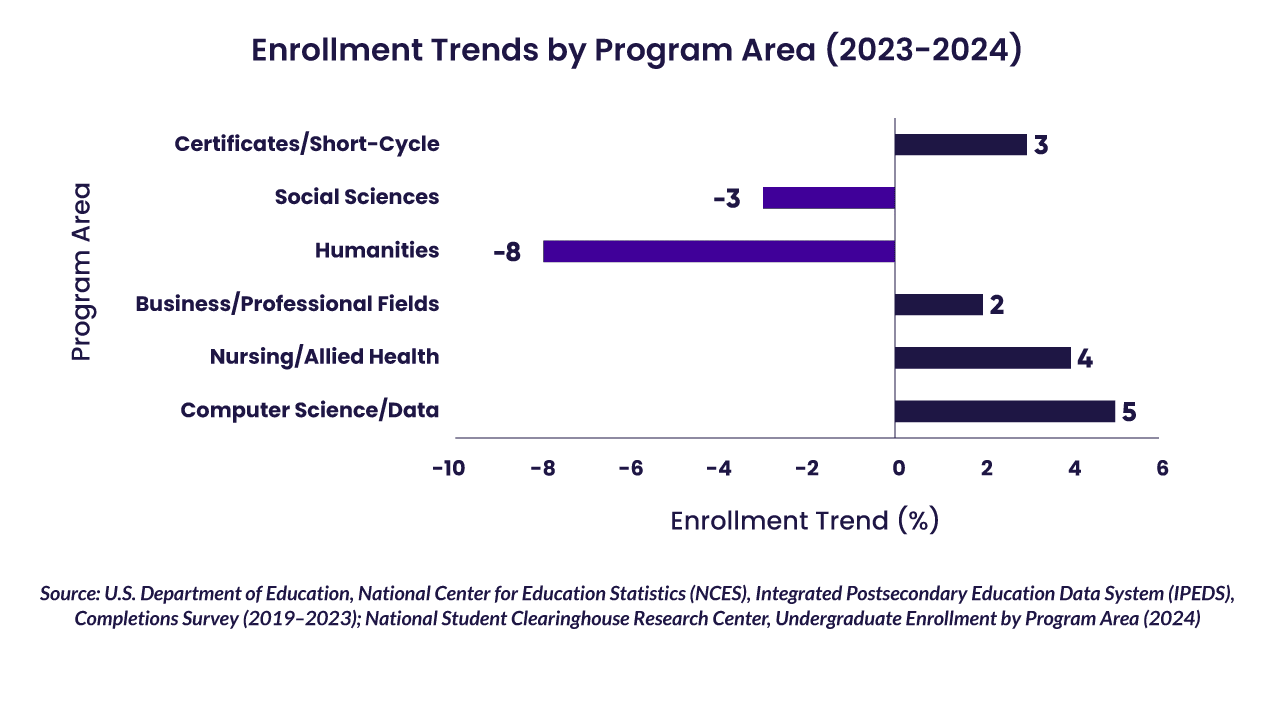
    • Technology and healthcare programs remain strong at the undergraduate level, with degrees like Computer Science and Health Sciences showing continued growth. 
    • Graduate credentials in education and nursing reflect both workforce need and strong student interest. 
    • Laddering potential is especially evident in fields like psychology and health sciences, where institutions can design seamless transitions from associate to bachelor’s. In fields such as education, options to ladder from certificate to master’s programs are growing in demand. 

    What’s most important isn’t the specific programs, it’s what they reveal: external data can confirm intuition, challenge assumptions, and unlock new strategic direction. And when paired with regional insights, these findings become even more powerful. 

    How to turn insight into strategy 

    Having market data is just the beginning. The true value lies in how institutions use it. At Collegis, we help our partners translate insight into action through a structured portfolio development process that includes the following: 

    1. Market analysis: Analyzing external data to identify growth areas, saturation risks, and demand signals — regionally and nationally. 
    1. Gap analysis: Identifying misalignments between current offerings and market opportunity. 
    1. Institutional alignment: Layering in internal metrics — enrollment, outcomes, mission fit, modality, and margin. 
    1. Strategic decisions: Prioritizing programs to expand, launch, refine, or sunset. 
    1. Implementation support: Developing go-to-market plans, supporting change management, and measuring results. 

    By grounding these decisions in both internal and external intelligence, institutions can future-proof their portfolios — driving enrollment, meeting workforce needs, and staying mission-aligned. 

    Put data to work for your portfolio 

    Program portfolio strategy doesn’t have to be a guessing game. With the right data and a trusted partner, institutions can make bold, confident moves that fuel growth and student success. 

    Whether you’re validating your instincts or exploring new academic directions, Collegis can help. Our market research and portfolio development services are built to support institutions at every step of the process — with national insights and regional specificity to guide your next move. 

    Innovation Starts Here

    Higher ed is evolving — don’t get left behind. Explore how Collegis can help your institution thrive.
    Source link

  • Graduate Student Insights and Perspectives

    Graduate Student Insights and Perspectives

    Facing challenges in enrollment, retention, or tech integration? Seeking growth in new markets? Our strategic insights pave a clear path for overcoming obstacles and driving success in higher education.

    Unlock the transformative potential within your institution – partner with us to turn today’s roadblocks into tomorrow’s achievements. Let’s chat.

    Source link

  • Employer Perceptions of Higher Ed Partnerships

    Employer Perceptions of Higher Ed Partnerships

    Facing challenges in enrollment, retention, or tech integration? Seeking growth in new markets? Our strategic insights pave a clear path for overcoming obstacles and driving success in higher education.

    Unlock the transformative potential within your institution – partner with us to turn today’s roadblocks into tomorrow’s achievements. Let’s chat.

    Source link

  • The Effect of Employer Understanding and Engagement on Non-Degree Credentials

    The Effect of Employer Understanding and Engagement on Non-Degree Credentials

    The Effect of Employer Understanding and Engagement on Non-Degree Credentials Report

    HoMore than 500 employers share their perceptions

    As the workforce evolves, many employers are considering the relevance and use of alternative credentials for upskilling or reskilling employees. This reimagining of workforce education provides an opportunity for higher ed leaders to partner with employers on microcredential programs that drive a funnel of enrollments.

    Collegis teamed up with UPCEA to survey more than 500 employers about their perceptions of microcredentials and interest in partnering with colleges and universities on these non-degree programs.

    Download the report to receive insights on:

    What incentivizes employers to work with higher ed institutions

    Employer valuation of alternative credentials

    Employer use of alternative credentials in lieu of degrees in the hiring process

    Download Now

    MktoForms2.loadForm(“//087-TII-060.mktoweb.com”, “087-TII-060”, 1548);

    Additional Resources

    The post The Effect of Employer Understanding and Engagement on Non-Degree Credentials appeared first on Collegis Education.

    Source link

  • Rethinking Your Student Population

    Rethinking Your Student Population

    Rethink your student population whitepaper

    Adult learners are higher ed’s future

    Reskilling, upskilling and lifelong learning are creating a big opportunity for higher education to become the go-to resource for career-minded adults. But not all adult learners are alike. In this report, we break them down into four types of adult learners (Career Advancer, Career Builder, Discerning Academic and Hesitant Learner).

    Download the white paper with the following insights for each persona:

    • Top motivations
    • Recruitment strategies
    • Program optimization recommendations

    Collegis Education surveyed 1,000 adult learners interested in pursuing degrees for this white paper, Rethink Your Student Population. Discover who makes up the majority of the adult learner market and how to target your outreach to grow your enrollment in this untapped population.

    Also, get key takeaways in our infographic The Adult Learners You’re Ignoring.

    Download Now

    MktoForms2.loadForm(“//087-TII-060.mktoweb.com”, “087-TII-060”, 1789);

    Additional Resources

    The post Rethinking Your Student Population appeared first on Collegis Education.

    Source link

  • Modern Learners, Modern Strategies: The New Rules of Engagement

    Modern Learners, Modern Strategies: The New Rules of Engagement

    Brett is a working professional with a packed schedule, balancing career growth with personal responsibilities. He knows that advancing in his field requires new skills and credentials, but he needs a program that fits his life, one that is flexible, aligned with his career and worth the investment. Brett is just one example of Modern Learner, a growing population of students who prioritize efficiency, affordability and real-world outcomes in their education.  

    Higher education has undergone a decade of transformation, from evolving enrollment patterns to advancements in technology and changing student expectations. As the landscape continues evolves, so do the behaviors and preferences of students like Brett—giving rise to the Modern Learner.  

    EducationDynamics’ latest report, “Engaging the Modern Learner: The 2025 Report on the Preferences and Behaviors Shaping Higher Ed,” examines these emerging trends. For over a decade, we have tracked student behavior and preferences, adapting our research to reflect the evolving higher education environment. Previously known as the Online College Students Report, this study has expanded in scope to provide a more comprehensive understanding of Modern Learners and their needs.  

    Explore the most significant changes over the past ten years, key findings from our research and actionable strategies to help higher education leaders challenge the status quo and drive innovative outcomes.  

    How Have Student Behaviors and Preferences Changed in the Last Decade?

    Student search, decision-making, and engagement behaviors have shifted significantly over the past decade. Strategies that once drove enrollment may no longer be as effective, requiring institutions to adapt. By examining these changes, we can identify emerging patterns that will shape the future of higher education.  

    Modern Learners Expect Immediate Admit Decisions 

    With greater access to information through technology, prospective students are making decisions faster than ever before. As a result, Modern Learners expect rapid responses from institutions. In 2015, 43% of fully online learners said that they would enroll at the first school that contacted them. By 2025, the urgency has increased significantly, with nearly 75% of online learners indicating that they would enroll in the first school that admits them. This shift underscores the growing need for institutions to streamline their admissions processes, ensuring quick response times and efficient decision-making to remain competitive in enrolling Modern Learners.

    Search Initializes at the Brand Level

    Student search behavior is another trend that has faced a significant shift in recent years, with more students starting their search by focusing on schools rather than specific programs.

    Recent data reveals that 58% of respondents begin their search by considering schools first. This trend is even more pronounced among online learners, where approximately 60% prioritize finding a school before narrowing down their program options. Following school, the next most common search is subject area, with students increasingly exploring broader categories before selecting a specific program.

    Given this shift, higher education marketing strategies need to reflect an approach that encompasses both promotion of programs and the institution itself. As prospective students often initiate their search with a school-focused mindset, schools must position their brand clearly to effectively engage and capture early interest, which will guide students towards relevant programs as they progress through the enrollment funnel.

    AI Impacts Consideration Sets 

    The adoption of AI tools, such as website chatbots and on-demand engagement platforms, has grown steadily over the past decade. Recent data highlights notable increases in the use of chatbots. In 2015, only about 15% of online learners engaged with website chatbots or live chat agents. Now, in 2025, that number has more than doubled, reaching 30% of fully online students.  

    Moreover, students increasingly turn to AI tools like Search Generative Experience (SGE) for answers to critical questions about schools and their offerings, with 37% of Modern Learners using AI for information gathering. As students refine their consideration sets, AI-driven engagement tools provide timely and relevant information, making them a key touchpoint in the decision-making process. The growing reliance on these platforms calls for institutions to employ the use of informative and accessible AI tools to offer students seamless support throughout their research and decision-making processes.  

    Preference and Acceptance of Online Modality has Increased

    It’s no secret that in the past decade, online education has not only gained traction but has become the preferred education modality for a growing population of students. In 2015, only 32% of fully online students believed their online education was better than their previous classroom study. However, that number has more than doubled for today’s respondents. 71% of online learners express a preference for online higher education experiences when compared to classroom education, indicating a fundamental change in student expectations and satisfaction with digital learning environments.  

    Engaging the Modern Learner

    At EducationDynamics, our research continually seeks to understand the evolving needs of students. Through years of research and emerging insights from our 2025 survey, a clear picture of the Modern Learner has emerged—one defined by a focus on flexibility, career, and a desire for personalized education experiences. Modern Learners are not only looking to complete a degree, they also aim to shape their own learning journeys in ways that align with their personal and professional goals. 

    Shared Demands and Preferences 

    Despite their diverse backgrounds, Modern Learners share several key expectations. They prioritize affordability, flexible learning formats and responsive support. If their needs aren’t met, they will quickly seek alternative options. This shift in expectations means that institutions need to rethink how they attract, engage and support students. Meeting the Modern Learner where they are is no longer optional; it is essential for long-term success. 

    The Power of Brand & Reputation

    A strong institutional brand plays a crucial role in the student decision-making process. As students begin their search with a school-focused mindset, a well-established reputation can be the deciding factor in where they apply. In fact, reputation ranked as the third most influential factor in application decisions, cited by 31% of students overall and 51% of traditional undergraduates, in our 2025 survey. To remain competitive, institutions must build a credible and respected brand that not only attracts prospective students but also reinforces trust and long-term value throughout their educational journey. 

    Value and Affordability

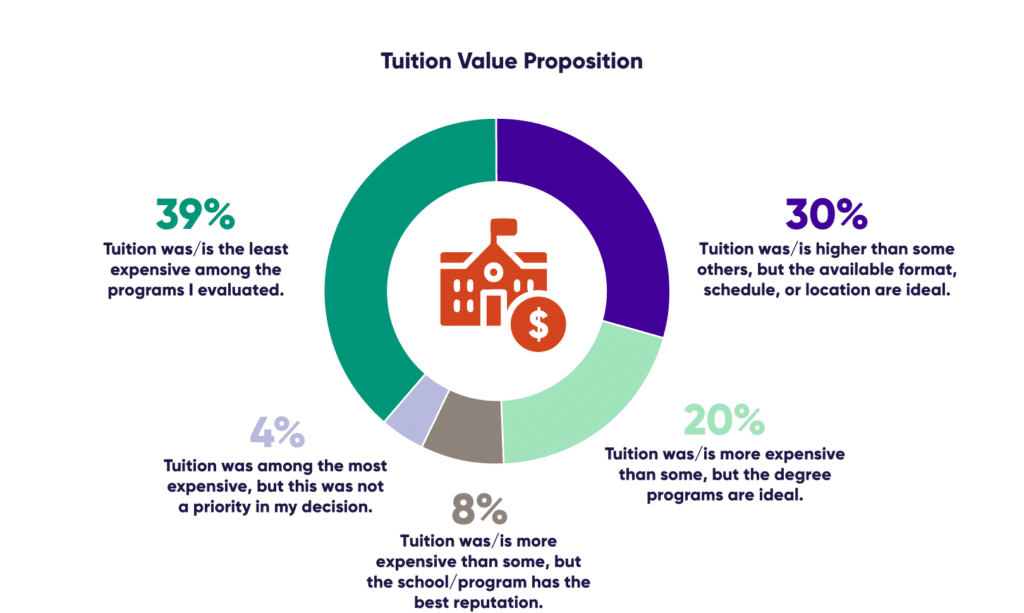
    While cost is a significant consideration for Modern Learners, affordability alone doesn’t drive enrollment decisions. A well-rounded value proposition plays an equally important role. Our research shows that 46% of students cite tuition cost as a critical factor, but other factors like program relevance to careers, flexibility, and reputation also weigh heavily in their decision-making process. 

    Supporting students with financial literacy is crucial, as 38% of students identify it as a helpful resource during the enrollment process. By clearly communicating both affordability and long-term value such as career outcomes, program flexibility and personalized support, schools can resonate with the priorities of cost-conscious, value-driven Modern Learners.  

    The Importance of Career Focus

    For Modern Learners, education is a direct pathway to career advancement. Regardless of age or background, they share a strong motivation to upskill quickly and gain credentials that lead to tangible career outcomes. This focus on career alignment is evident, with 20% of Modern Learners citing a program’s relevance to their career as a determining factor in their enrollment decision.

    The Modern Learner Survey reveals that 76% of students feel their institution clearly outlines potential career paths related to their program. While this is positive, gaps remain. Traditional undergraduates are the most informed, with 84% receiving clear career guidance, compared to 73% of non-traditional students and 77% of graduate students. These gaps highlight the need for institutions to consistently communicate career values across all Modern Learner segments, ensuring they understand how their education supports their professional goals.

    The Demand for Flexible Learning Models

    Flexibility is no longer an educational preference; it is a necessity for Modern Learners. As today’s students move away from traditional classroom modalities and increasingly seek flexible environments, institutions must invest in program models that accommodate careers and family commitments.  

    When deciding where to apply, 31% of Modern Learners cited flexible course schedules as a key factor. This need is particularly evident among graduate students, who are more likely to be balancing family and work responsibilities. While 53% of respondents do not have children under 18 at home, a notable portion are managing family commitments in addition to their studies. Among fully online students, the number of children at home has increased by 15%, reinforcing the growing demand for learning models that complement busy schedules. 

    The Role of AI and Social Media

    AI and social media play an increasingly important role in shaping student decisions. Social media is no longer merely an avenue for entertainment; it has evolved into a tool for student engagement and research throughout the entire decision-making process. With students interacting across multiple platforms daily, schools must harness these channels to stay visible and relevant as students progress through the consideration phase. To successfully leverage social media, marketing teams should prioritize creating dynamic, visually engaging experiences, particularly through video content, which resonates strongly with Modern Learners.  

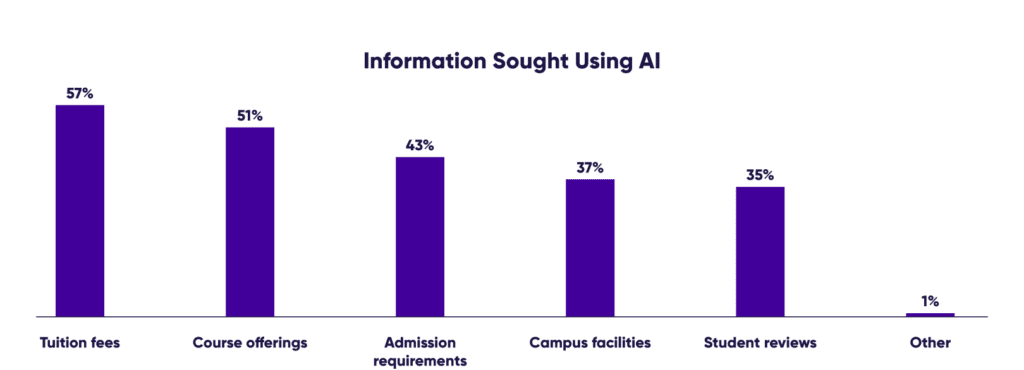
    At the same time, AI enhances this by personalizing interactions and providing real-time insights into student preferences, helping institutions refine their marketing strategies. With the rise of generative AI tools, nearly 70% of Modern Learners now use AI in some capacity, including AI chatbots like ChatGPT, to assist their search for school information. Approximately 37% use these tools specifically to gather information about schools, with tuition fees (57%), course offerings (51%), and admission requirements (43%) being the most sought-after details. This highlights the opportunity for schools to integrate AI into their marketing strategies to provide comprehensive, accessible information that supports prospective students with their enrollment decision.  

    Modern Strategies to Engage the Modern Learner 

    As the needs and expectations of students continue to evolve, it’s important for institutions to adapt in ways that truly serve and support Modern Learners. Here are actionable steps to create a personalized, student-centered experience that fosters trust and drives success.  

    1. Embrace Data-Driven Decision Making: Modern Learners expect personalized experiences, and data is the key to delivering them. Through leveraging market research and insights, like those from the 2025 Modern Learner Report, institutions can better understand student preferences and behaviors. To turn those insights into action, invest in tools for data collection and analysis that allow for continuous improvement and refinement.  
    2. Build a Strong and Authentic Brand: A cohesive and authentic brand is integral to connecting with students. Focus on building a positive online experience that bolsters brand visibility, while garnering trust that your institution can provide timely and reliable information that students seek.  
    3. Prioritize Career Outcomes: Career outcomes are top of mind for students as they consider their educational investment. Make career pathways clear by showcasing programs, internship opportunities, alumni success stories and career counseling services to help students see the tangible benefits of their degree.  
    4. Create Flexible and Personalized Learning Pathways: Flexibility is essential for meeting the diverse needs of Modern Learners. Offer programs with adaptable schedules and learning formats, allowing students to choose a pathway that best aligns their lifestyle and goals.  
    5. Optimize the Digital Experience (Especially Websites and Al): An engaging digital experience is critical to attracting and retaining students. Through regular website updates and the integration of AI-powered tools to offer support, institutions can streamline the user experience to ensure a smooth journey from inquiry to enrollment. 
    6. Enhance Communication Speed: Modern Learners expect timely and informative responses and are quicker to make decisions than in years past. Adopt tools that provide real-time communication capabilities, such as chatbots or automated updates, to keep students engaged and informed throughout the enrollment process.   
    7. Develop a Dynamic Social Media Strategy: Social media is a powerful tool for building connections and increasing brand awareness among Modern Learners. With platforms like Instagram, TikTok, and YouTube playing a major role in their online engagement, video content is especially effective in capturing their attention.  By understanding your audience’s media habits and aligning your content with platforms they use the most, you can deliver the right message at the right time, keeping your institution top of mind.  
    8. Don’t Forget About the Human Touch: While technology undoubtedly plays a significant role in modern times, students still seek personal connections. Ensure that students can engage with advisors, staff, or faculty to guide them through the enrollment process, while providing the support they need.

    Aligning with Modern Learners: A New Era in Enrollment

    In this evolving landscape, Modern Learners are placing greater emphasis on career relevance, affordability, and flexibility, demanding more from their education than ever before. The findings from the Modern Learner Survey underscore the importance of aligning educational programs with career paths, improving financial transparency, and providing tailored support to meet diverse needs. The time is now for higher education leaders to challenge outdated enrollment strategies that no longer resonate with today’s highly discerning, cost-conscious, and value-focused students.  

    To navigate these changes effectively, institutions must adopt innovative, data-driven strategies that speak directly to the Modern Learner’s priorities. For a deeper dive into these insights and actionable recommendations, explore the full “Engaging the Modern Learner” report today.  

    Source link

  • Inside the Minds of Grad Students: 5 Key Findings from Our Latest Study on Graduate Enrollment

    Inside the Minds of Grad Students: 5 Key Findings from Our Latest Study on Graduate Enrollment

    As a higher education leader, it’s no secret that you’re facing a fiercely competitive graduate enrollment landscape. You know as well as I do that understanding what prospective students want and how they behave isn’t just helpful – it’s crucial to your institution’s success. That’s why we teamed up with UPCEA to conduct a deep dive into today’s post-baccalaureate students, uncovering their unique needs, expectations, and wants.

    We’ve published those insights in our latest report to help colleges and universities fine-tune their graduate enrollment strategies and deliver real results. You can download the complete report here: “Building a Better Pipeline: Enrollment Funnel Needs and Perspectives from Potential Post-Baccalaureate Students“

    Our research focused on individuals who expressed at least some interest in pursuing advanced education, and this study sheds light on what matters most to potential graduate students—everything from program types and communication preferences to application expectations.

    As we dug into the data, some obvious themes emerged. Here are five key findings that can prepare your institution to stand out in this tight market and guide you in shaping strategies that resonate, engage, and deliver results.

    1. Graduate enrollment is a crowded market—and the stakes are high

    This is no surprise to those working in higher ed in recent years. Graduate enrollment is slowing, with just a 1.1% projected increase over the next five years. Adding to the challenge, 20% of institutions dominate 77% of the market. For everyone else, it’s a fierce battle for a shrinking pool of candidates. To win, you’ll need a sharp, focused approach.

    2. Online programs are the clear favorite

    Did you know that 71% of prospective students are “extremely” or “very” interested in fully online programs? Hybrid formats come in a close second, while traditional in-person options are struggling to keep pace. The data confirms that flexibility isn’t a trend—it’s a necessity.

    3. Program information is a make-or-break factor

    Here’s something we see far too often: quality programs losing prospective students simply because critical details—like tuition costs and course requirements—are buried or missing entirely from the school’s website. In fact, 62% of students indicated they would drop off early in their search for this exact reason.

    The fix? It’s simpler than you might think. By optimizing your program pages and doubling down on SEO, you can turn passive visitors into engaged prospects.

    4. Financial transparency builds trust

    Sticker shock is real. High application fees, vague cost information, and limited financial aid details are among the top reasons students abandon the application process late in the game. By addressing these concerns clearly and directly, you’re not just solving a problem, you’re building trust.

    When it comes to connecting with prospective graduate students, email reigns supreme. Whether it’s inquiring about programs (47%), application follow-ups (67%), or receiving application decisions (69%), email is the channel students trust the most.
    But here’s the catch: your emails have to be timely, personalized, and relevant in order to make an impact.

    The key to graduate enrollment success is just a click away

    The insights highlighted above are just the tip of the iceberg. Imagine what’s possible when you apply them to your graduate enrollment strategy.

    If you’re ready to refine your approach and stay ahead of the curve, we’ve got you covered. Our report dives deeper into the data and uncovers actionable insights, including:

    • Positioning your online and hybrid offerings to meet growing demand
    • Optimizing program pages to emphasize the information students value most
    • Communicating financial information proactively to convert candidates
    • Building email outreach strategies that build trust and keep students engaged

    Grab your complimentary copy of the report today, and let’s start building a better pipeline together!

    Your roadmap to winning in the competitive graduate market.

    Optimize Your Enrollment Funnel

    Get the latest data on graduate student enrollment trends. Download the full report now.

    Source link