Tag: Marketing

  • Using UGC and Authentic Storytelling For Education Marketing

    Using UGC and Authentic Storytelling For Education Marketing

    Reading Time: 9 minutes

    Today’s schools need to get creative to promote their programs in a way that resonates with prospects. To spur action from your audience, you need to build trust, create engagement, and foster an emotional connection. How do you do that with so many other schools competing for the spotlight? One of the most effective strategies for making a strong impression on your audience is combining user-generated content and authentic storytelling. 

    These methods allow your institution to showcase real experiences, highlight student voices, and differentiate itself from competitors in an increasingly crowded educational landscape. Keep reading to discover the unique advantages of these effective education marketing tactics, get actionable insights into how to use them to reinvent your marketing plan, and examine real examples for inspiration.

    Struggling with enrollment?

    Our expert digital marketing services can help you attract and enroll more students!

    What Is User-Generated Content (UGC)?

    User-generated content refers to any content, such as testimonials, social media posts, blogs, and videos, created by students, alumni, faculty, or other stakeholders rather than your institution itself. By leveraging UGC, you can present an unfiltered, genuine representation of student life and success. This makes your marketing feel more authentic and increases engagement and reach across digital platforms.

    Why is user-generated content important in marketing? UGC is created by your students and alumni; it is perceived as more trustworthy than traditional promotional materials. Prospective students are more likely to trust and engage with content created by their peers rather than content crafted solely by an institution. This credibility makes UGC a powerful tool for increasing enrollment and engagement.

    The Unique Advantages of User-Generated Content in Education Marketing

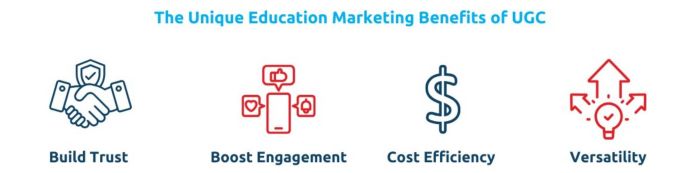
    A key user-generated content advantage is its ability to build trust. When prospective students see real stories from current students or alumni, they develop a connection to your institution. This sense of authenticity makes them more likely to inquire about programs and ultimately enroll.

    Another advantage is the ability to foster engagement across digital platforms. Content created by students, such as Instagram stories, TikTok videos, or blog posts, generates far higher engagement than traditional ads. People love sharing their experiences, and prospective students love seeing real perspectives from peers who have been in their shoes.

    A major user-generated content advantage is cost-effectiveness. Instead of investing heavily in producing marketing materials, you can encourage students and alumni to share their stories organically. This reduces costs and enhances your reach, as UGC spreads naturally through networks.

    Another reason why user-generated content is important in marketing is its adaptability across multiple platforms. UGC can be repurposed into social media campaigns, website testimonials, video promotions, and email marketing efforts. This versatility allows you to maintain a steady stream of fresh, compelling content.

    Image 2Image 2

    Source: HEM

    What Is Authentic Storytelling in an Educational Marketing Context?

    Authentic storytelling goes beyond traditional marketing materials to craft compelling narratives highlighting real student and faculty experiences. Instead of relying solely on promotional messages, this approach uses emotion, relatability, and personal journeys to engage prospective students.

    What is the power of storytelling in education? Authentic storytelling is powerful because it transforms abstract institutional values into relatable, real-world experiences. It allows prospective students to see themselves in your stories, making their decision-making process more personal and impactful. This approach humanizes your institution and strengthens your brand identity.

    One of the best ways to incorporate authentic storytelling into your marketing strategy is by featuring in-depth student and alumni stories. A compelling blog could follow the experiences of an international student adjusting to life in a new country while studying at your institution. A video series could showcase students discussing their educational journey, including their challenges and triumphs. By doing this, you create content that is informative and emotionally engaging.

    The Advantages of Authentic Storytelling in Education Marketing

    Unlike traditional promotional content, authentic storytelling builds emotional connections that influence student decision-making. By sharing real experiences from your students and faculty, you provide prospects insight into your institution’s culture, values, and impact.

    One of the greatest advantages of authentic storytelling is its ability to make your institution’s messaging more relatable. Instead of generic promotional materials, prospective students see real-life success stories, challenges, and personal growth journeys, helping them visualize their own future at your school.

    Another unique benefit is the ability to enhance brand trust and credibility. People connect with stories, not advertisements. By showcasing genuine experiences through student interviews, alumni journeys, and behind-the-scenes campus life, your school appears more transparent and welcoming. This approach fosters a deeper connection with your audience, making them more likely to engage with your institution.

    Authentic storytelling also strengthens retention and alumni relations. When students feel emotionally connected to your institution through compelling narratives, they are more likely to remain engaged throughout their education and beyond. Alumni who feel valued through storytelling initiatives often become ambassadors for your school, further enhancing your brand reach.

    Image 3Image 3

    How Your School Can Leverage User-Generated Content and Authentic Storytelling

    Building a marketing strategy around user-generated content and authentic storytelling requires a proactive approach. Instead of simply encouraging students to share their experiences, you need to create opportunities for engagement, provide platforms for their voices, and consistently highlight their stories. By doing so, you ensure that the content generated aligns with your school’s brand and messaging while maintaining the authenticity that makes it so powerful.

    Encourage Student-Generated Social Media Content

    One of the best ways to integrate UGC into your marketing strategy is by motivating students to share their experiences on social media. Encourage them to document campus life, extracurricular activities, and classroom experiences.

    For example, your university might launch an Instagram challenge where students post their favorite campus spots with a branded hashtag. Similarly, a career college could create a TikTok trend showcasing student projects or daily routines in their training programs.

    Example: This video, posted by a UCLA student, is a free promotion for the school’s dining hall. She is making a relatable joke about the proverbial ‘freshman fifteen,’ an expression for the weight gain that tends to occur in the first year of college. The creator credits the delicious food at UCLA for her freshman fifteen, and this is not the only video of its kind on her page. Satisfied students eager to share their experiences are invaluable for generating compelling UGC. Encourage students to use specific hashtags for their UGC as this creator did (#ucla #dininghall, etc).

    @ronigrush

    If you didn’t gain freshman 15 I hate you #ucla #dininghall #food #foodtok #icecreamday #collegelife #freshmanyear #freshman15

    ♬ Dance You Outta My Head – Cat Janice

    Source: TikTok

    Feature Student and Alumni Testimonials

    Prospective students value hearing from those who have already walked the path they are considering. Featuring student and alumni testimonials on your website, in promotional videos, and on social media channels provides relatable insights into your programs.

    An example of effective testimonial use is a nursing college that records short video interviews with recent graduates discussing their experiences and career outcomes. These testimonials provide compelling, relatable stories that reinforce the value of your school’s programs.

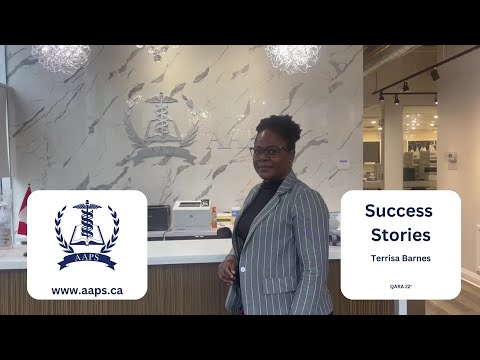
    Example: AAPS regularly posts alumni video testimonials highlighting each graduate’s unique background, career goals, and how the institution supported the attainment of their objectives. Here, Teresa Barnes describes how the Quality Assurance and Regulatory Affairs program at AAPS helped her to find success as a Medical Writer. Your alumni community is probably full of careerists who are proud of their achievements and are excited to talk about their journey. This is an excellent opportunity for effective brand storytelling.

    YouTube videoYouTube video

    Source: Academy of Applied Pharmaceutical Sciences | YouTube

    Develop Long-Form Content With Authentic Storytelling

    Creating blog posts or video documentaries featuring students’ journeys can be a powerful way to engage prospects. A compelling blog could follow a student during an internship and how the experience shaped their career aspirations. This approach showcases your school’s opportunities while telling a relatable story that resonates with other students considering similar paths.

    Additionally, long-form content allows for in-depth storytelling that goes beyond surface-level promotions. A well-written blog post could feature a student reflecting on their academic journey, describing their challenges, the mentors who guided them, and the personal growth they experienced. Similarly, a video series might document a student’s transition from their first day on campus to their graduation, providing prospective students with a complete picture of what they can expect.

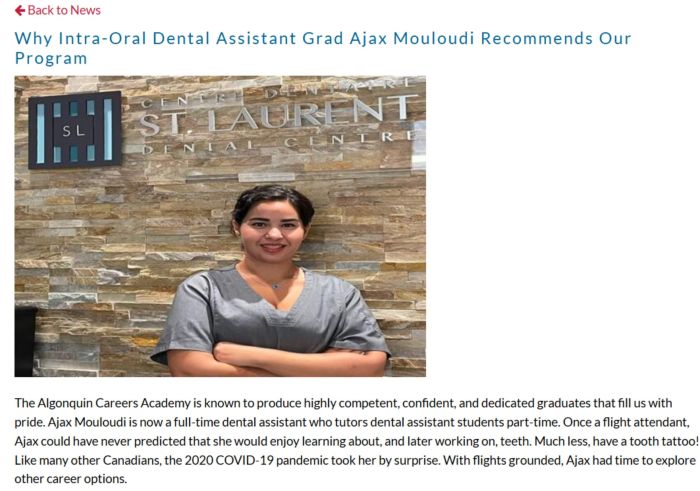
    Example: Blogs remain a relevant way to tell your school’s story and give your student body a voice. Here, Algonquin Careers Academy tells the story of one of their dental assistant graduates. By publishing a blog post that features a student interview, the message is personable, inspirational, and authentic. Try to infuse personality into your long-form content whether you choose to blog, post videos, create a newsletter, or all three.

    Image 4Image 4

    Source: Algonquin Careers Academy

    Highlight Behind-The-Scenes Content

    Showcasing the day-to-day experiences of students, faculty, and staff makes your institution feel more welcoming and accessible. A behind-the-scenes video series might follow a day in the life of a student in a culinary arts program, walk viewers through a school event, and showcase hands-on learning experiences and interactions with industry professionals.

    An effective example comes from business schools that share faculty-led discussions, giving students an inside look at the classroom environment before they apply. This storytelling adds authenticity and provides a window into your school’s culture and academic strengths.

    Example: Here, the American Musical and Dramatic Academy showcases its open house event, building anticipation for prospects and providing useful information about what they can expect from the event. Behind-the-scenes videos are easy to film, effective for humanizing your brand, and excellent ways to inform your audience in an engaging, easy-to-digest format.

    @amdaofficial

    Get a behind the scenes look at AMDA student life during our open house events! #amdacollege #collegelife #collegeopenhouse #collegetok #nyclife

    ♬ Canyons – Official Sound Studio

    Source: AMDA College | TikTok

    Run UGC Contests and Campaigns

    To increase engagement, your school can launch user-generated content campaigns that incentivize participation. This could include video challenges, photo competitions, or student-run social media takeovers. For instance, a digital marketing diploma program might host a competition where students submit real-world marketing campaign ideas, with the winner featured on your school’s website and social media pages. This not only showcases student talent but also strengthens your brand’s credibility.

    Example: Seguin High School showcases the artistic talent of one of their students who had won an art contest. Not only is this an excellent way to instill well-deserved pride and support in your students, but it is also a great way to humanize your school brand and display your strong community.

    Image 5Image 5

    Source: Seguin High School | Instagram

    Get Support as You Elevate Your Education Marketing Strategy

    In today’s highly competitive and interconnected world, attracting qualified student prospects online is essential to a successful recruitment strategy. Schools and universities must implement innovative and authentic marketing techniques, leveraging user-generated content and authentic storytelling to connect with their audiences on a deeper level. Working with a marketing agency specializing in education marketing can be a game changer for your results. 

    For over 15 years, Higher Education Marketing has crafted successful digital marketing strategies for schools worldwide. Our deep understanding of education marketing allows us to design multichannel campaigns that drive engagement and enrollment. We provide  tailored services, including:

    • Content Marketing
    • Search Engine Optimization (SEO)
    • Social Media Marketing
    • Paid Advertising Campaigns

    Partner with us to harness the power of storytelling in education and leverage the benefits of user-generated content to drive real engagement. Contact us today to explore how our expert digital marketing solutions can transform your student recruitment efforts and enhance your institution’s online presence.

    Struggling with enrollment?

    Our expert digital marketing services can help you attract and enroll more students!

    Frequently Asked Questions

    Question: Why is user-generated content important in marketing? 

    Answer: UGC is created by your students and alumni; it is perceived as more trustworthy than traditional promotional materials. Prospective students are more likely to trust and engage with content created by their peers rather than content crafted solely by an institution.

    Question: What is the power of storytelling in education? 

    Answer: Authentic storytelling is powerful because it transforms abstract institutional values into relatable, real-world experiences. It allows prospective students to see themselves in your stories, making their decision-making process more personal and impactful. This approach humanizes your institution and strengthens your brand identity.


    Source link

  • Do More with Less: 7 Strategic Advantages of Shared Services in Higher Education

    Do More with Less: 7 Strategic Advantages of Shared Services in Higher Education

    College administrators wear many hats to ensure their institutions thrive. Stakeholders expect them to be visionaries, budget stewards, tech experts, and student champions. However, wearing too many hats can hinder the ability to meet more strategic and forward-thinking institutional demands, effectively diluting leadership capacity and outcomes. 

    How can administrators remove some of those hats without losing control or spending more? 

    How can they guide their institutions to achieve better outcomes with fewer resources?  

    At the 2024 Collegis Education Summit, keynote speaker Dr. John Smith-Coppes, president of Joyce University, shared his advice for achieving higher ed excellence amid market paradigms, shifting learner expectations, and capacity constraints.

    “Embrace your institutional superpower and then partner for expertise. You have to know what you are really good at, but also where you might need help. Having the bravery to objectively look at the brutal facts can take you from good to great. Keep this in mind: Your institution is perfectly designed to get the outcomes it’s getting.”

    -Dr. John Smith-Coppes, President of Joyce University

    Dr. Smith-Coppes is right. If you’re not getting the results you want, you have to shine a light on the operation and consider what adjustments or changes will better position your institution for desired outcomes.

    To echo Dr. Smith-Coppes and answer the earlier questions, working with a strategic partner who has deep expertise in higher education shared services and can manage certain responsibilities more efficiently can get your institution closer to turning aspiration into reality. A true partnership is not about simply outsourcing tasks. Rather, it’s a strategic way to gain access to specialized knowledge, proven methodologies, and scalable resources, all while enabling administrators to focus on their core areas of expertise.

    Mounting challenges facing higher ed leaders

    When I talk to administrators, the conversation inevitably turns to the challenge of doing more with less. They consistently grapple with four key issues:

    • Budget Cuts: Funding is uncertain or shrinking, forcing them to rethink the allocation of resources.
    • Advancing Technology: Technology is rapidly evolving, leaving administrators to scramble after the next advancement or emerging capability.
    • Socioeconomic Pressures: With some questioning the value of postsecondary education, relevant programs with affordable tuition have never been more critical.
    • Employee Turnover: Retaining top talent is difficult, leaving critical gaps.

    But none of these issues surprise us. On the contrary, Collegis Education has partnered with numerous public and private institutions of varying sizes and levels of brand recognition to address these challenges, uncovering advantageous pathways toward more sustainable and fruitful operations.

    The results speak for themselves. Administrators gain more time to leverage their core strengths to elevate their institution’s mission and educational outcomes while actualizing a variety of clear benefits. Here is what Collegis Education continues to deliver for our shared-service partners.

    Seven ways shared services in higher education deliver results

    Institutions that leverage shared services experience benefits in a variety of key areas. Explore some of the most significant advantages:

    1. Improved financial stability

    Predictability and optimization are the key words here. With our solutions for technology management, enrollment management, and student services, institutions know exactly what to budget every year. At the same time, we find cost savings by getting a better return on technology investments, strategically decommissioning redundancies, and renegotiating contracts.

    2. Enhanced operational efficiency

    Is there a better way to reach an institution’s goals more efficiently? More often than not, the answer is yes. We help bring these opportunities to the surface by fully assessing the school’s infrastructure, technology, processes, and other operating procedures. This assessment denotes areas of excellence and points of failure as well as identifies where lag or waste exists. With these insights, we can identify and prioritize emerging opportunities to drive improvement. All this informs a multiyear roadmap that guides higher ed leaders on how to thoughtfully implement changes that engage key stakeholders to accelerate the change management cycle.

    3. Objective perspective & best practices

    We bring a unique perspective to our recommendations based on our work with other schools while protecting each school’s anonymity and uniqueness. This helps give you a baseline of how your school performs when compared to similar ones. Are you leading or lagging? As an unbiased third party, we offer fresh ideas backed by the knowledge of the results they have produced. It’s a great way to eliminate the “but this is how we’ve always done it” objection and gain buy-in from internal staff.

    4. Risk mitigation & accountability

    There’s rarely a higher ed situation we haven’t already dealt with at another institution. Our partners benefit from this experience, allowing them to proactively avoid operational and technical risks. They also benefit tremendously from having a partner who holds themselves accountable to quantifiable outcomes measured by agreed-upon service level agreements (SLAs). Together, these provide a lot of peace of mind when it comes to issues like cybersecurity, compliance, disaster recovery, and business continuity.

    5. Specialized expertise without the overhead

    Hiring and retaining experienced staff is challenging enough. Finding people with skill sets to leverage evolving technology capabilities like artificial intelligence (AI) is a whole other story. That’s why our partners rely on Collegis to provide the expertise that’s hard to find. We’re software-agnostic and implement solutions that are in the school’s best interest from a financial, operational, and strategic perspective without the need for full-time employees to manage them.

    6. Data-enabled decision making with full transparency

    Data at most institutions is stored in siloes, with limited stewardship and governance over its quality and consistency. However, many of the “data” solutions in the market today are complicated and difficult to implement and support.

    This is why we built Connected Core, a scalable higher education industry cloud solution that integrates siloed data sets, systems, and applications to enable institutional intelligence. This proven approach and methodology for collecting, connecting, and activating institutional data eliminates data doubt and gives leaders the confidence to make quickly make strategic decisions with confidence.

    7. Focus on core mission & educational outcomes

    By outsourcing some functions, administrators can redirect resources and energy to what truly matters: student success. By reducing the number of hats they wear, leaders can instead focus on using the tools they have on hand to manage strategic initiatives that drive institutional growth.

    Strategic delegation to yield better outcomes

    Some leaders fear losing control through outsourcing, and rightfully so. Too many vendors tout “partnership” when, in fact, they are trying to build an unhealthy dependency that is not mutually beneficial.

    That’s just not us. It fundamentally goes against our values and who we are as a company.

    Our partnerships are built on collaboration and shared governance. Institutions set priorities, and all actions follow clear assessments, implementation plans, and progress reviews. Our partners gain greater control over technology, enrollment, and budgets. Control isn’t lost, but visibility and accountability are gained.

    Shared-services models allow administrators to confidently offload specific responsibilities. Leveraging external expertise amplifies your internal strengths and empowers your leaders to focus on building and maintaining a thriving campus community.

    But the first step is starting the conversation with the right partner.

    Innovation Starts Here

    Higher ed is evolving — don’t get left behind. Explore how Collegis can help your institution thrive.

    Source link

  • Top 10 Private School Marketing Ideas

    Top 10 Private School Marketing Ideas

    Reading Time: 10 minutes

    Are you an administrator or marketer at a small private school? If so, you likely face unique challenges in growing your school community. Unlike large institutions with extensive resources, your budget may be more limited, and your brand may not have the same level of recognition. Yet, your school likely offers something invaluable: a personalized, high-quality educational experience that deserves greater visibility. Your marketing strategy should spotlight the unique selling points that differentiate your private school from other institutions. 

    How do you market a small private school? Traditional outbound marketing methods, such as print ads and direct mail, are costly and less effective in today’s digital market. Instead, try inbound marketing,  a group of strategies that offer a cost-efficient and impactful way to attract, engage, and retain families interested in your school. Keep reading to explore ten effective private school marketing ideas that will grow your community.

    Struggling with enrollment?

    Our expert digital marketing services can help you attract and enroll more students!

    What Is Inbound Marketing and Why Is It Ideal for Private Schools Like Yours?

    Inbound marketing is a strategy that focuses on attracting prospective families to your school through valuable content, SEO, social media engagement, and other digital efforts. Instead of pushing advertisements onto audiences who may not be interested, inbound marketing creates meaningful connections with families actively looking for the right educational institution.

    If you’re wondering how to market a new private school using inbound strategies, remember that the key is to build trust and provide the right information at the right time. Parents today research extensively before choosing a school for their children. Though many outbound strategies remain relevant today, namely to increase visibility, offer useful content, address concerns, and showcase your school’s strengths. Inbound marketing can position your institution as the best choice. Now, let’s explore specific ways that you can grow your private school community.

    HEM Image 2HEM Image 2

    Source: HEM

    10 Proven Inbound Marketing Strategies for Private Schools

    Incorporating these tactics into your marketing strategy can reach your target audience, create relationships by providing value, and incite desired action. An effective private school marketing campaign combines several, if not all, of the techniques discussed below. If any are missing from your current plan, now’s the time to start implementing them! 

    1. Create a High-Quality, SEO-Optimized Website

    Your website is the foundation of your school marketing strategy. It must be visually appealing, easy to navigate, and optimized for search engines. Parents should find essential information, such as tuition, curriculum, testimonials, and admissions requirements quickly and effortlessly. A well-structured website should include dedicated pages for admissions, academic programs, extracurricular activities, and student life. 

    Ensuring mobile responsiveness and fast load speeds will improve user experience and increase engagement. Incorporating multilingual and culturally adapted content can expand your reach, particularly if you’re targeting international students. Regularly updating your website with blog posts, news, and event details ensures prospective parents see a dynamic, engaged school community.

    Example: Are you trying to expand your private school community beyond borders? If so, you’ll want to borrow this effective SEO technique from Crimson Global Academy. Below, you’ll see that they’ve tailored their site content to different countries and used subdirectories in their URLs.

    Using sub-directories (/uk/, /ca/) signals to search engines that the content is tailored for a specific region. Google prioritizes localized content in search results, meaning parents and students searching for private schools in their home country are more likely to find your institution.

    The benefits of this SEO strategy are far-reaching. They include broadened international reach, higher performance in multilingual searches, and higher click-through rates due to relevance.

    HEM Image 3HEM Image 3

    Source: Crimson Global Academy

    2. Develop Engaging Blog Content

    A well-crafted blog is a valuable resource for current and prospective families, positioning your school as a thought leader in education. By publishing informative and engaging content, you can address parents’ most pressing concerns, showcase student success stories, and highlight what makes your school unique.

    For example, you can write about how to help children transition to a new school successfully by offering expert advice and real-life experiences from parents and students. Another great topic is discussing the benefits of small class sizes and how they enhance student learning, highlighting the personalized attention and academic advantages your school provides. 

    You can also explore how your school’s curriculum prepares students for future success in higher education and beyond, showcasing testimonials from alumni who have excelled. Additionally, sharing success stories from students and faculty can illustrate the positive impact of your educational programs. 

    Finally, providing a step-by-step guide for parents navigating the private school admissions process can ease their concerns and position your school as a supportive and transparent institution. Consistently publishing high-quality blog posts improves search engine rankings, making your school more visible to families searching for private education options.

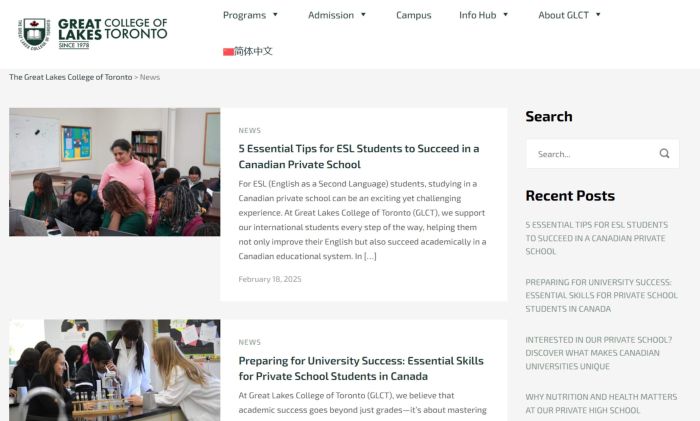
    Example: The Great Lakes College of Toronto publishes blogs relevant to their prospects – students from all over the world interested in attending prestigious Canadian universities. With their target audience in mind, GLCT creates content that provides value. For example, learning tips for ESL learners, how to prepare for Canadian universities, and much more. Make sure your blog content aligns with your site visitors’ needs and provides valuable information.

    HEM Image 4HEM Image 4

    Source: Great Lakes College of Toronto

    3. Leverage Social Media Marketing

    Social media platforms like Facebook, Instagram, and LinkedIn are powerful tools for building community and engagement. Your school can foster stronger connections with prospective and current families by posting student achievements, behind-the-scenes content, and faculty highlights.

    Live Q&A sessions can address frequently asked questions about your school’s programs and admission process. Hosting interactive polls, student takeovers, and parent testimonials can increase engagement and trust.

    Additionally, investing in paid social media advertising can expand your school’s reach to target families actively searching for private school options. Schools can also create private Facebook groups for prospective and current parents, providing a space for questions and engagement.

    Example: This Instagram post from CLS West Covina highlights the strength of the school community. In addition to academic excellence, your private school should highlight other features of the student experience that contribute positively to learning, such as extracurricular activities, a nurturing environment, community involvement, global awareness, and more. Social media remains the perfect stage for your school’s unique selling points.

    HEM Image 5HEM Image 5

    Source: CLS West Covina | Instagram

    4. Implement a Lead Nurturing Email Campaign

    Once a prospective family expresses interest, it’s essential to maintain communication through well-crafted email campaigns. Personalized drip campaigns can guide them through enrolling, providing timely information about your school, key deadlines, and success stories from current students. 

    Automated email sequences can include welcome emails, event reminders for open houses, and curriculum overviews. A segmented approach, where emails are tailored to different stages of the admission journey, can significantly improve conversion rates. Sending personalized content based on user interaction, such as downloadable brochures, testimonials, and exclusive invitations, keeps families engaged throughout the decision-making process.

    5. Use Video Marketing to Showcase Your School’s Culture

    Video content is one of the most effective ways to give prospective families an immersive experience of your school. Creating high-quality video tours, faculty introductions, and student testimonials can provide a dynamic look into daily life at your institution. Highlighting classroom environments, extracurricular activities, and real-world student experiences can create an emotional connection with families. 

    Short-form videos on platforms like Instagram Reels and TikTok can help boost engagement among younger audiences, while long-form content on YouTube and your website can provide in-depth insights. Hosting live virtual tours where prospective families can ask real-time questions enhances engagement.

    6. Optimize Your Google My Business Profile

    Many parents start their search for private schools on Google. A fully optimized Google My Business profile ensures your school appears in local search results with accurate contact details, reviews, and images. Encouraging satisfied parents to leave positive reviews can significantly enhance your school’s online reputation.

    Regularly updating your profile with recent photos, upcoming events, and engaging posts can make your school stand out among competitors. Answering common parent inquiries directly on your profile, such as tuition costs and curriculum highlights, helps streamline decision-making. Additionally, responding promptly to positive and negative reviews demonstrates strong community engagement and builds trust with prospective families.

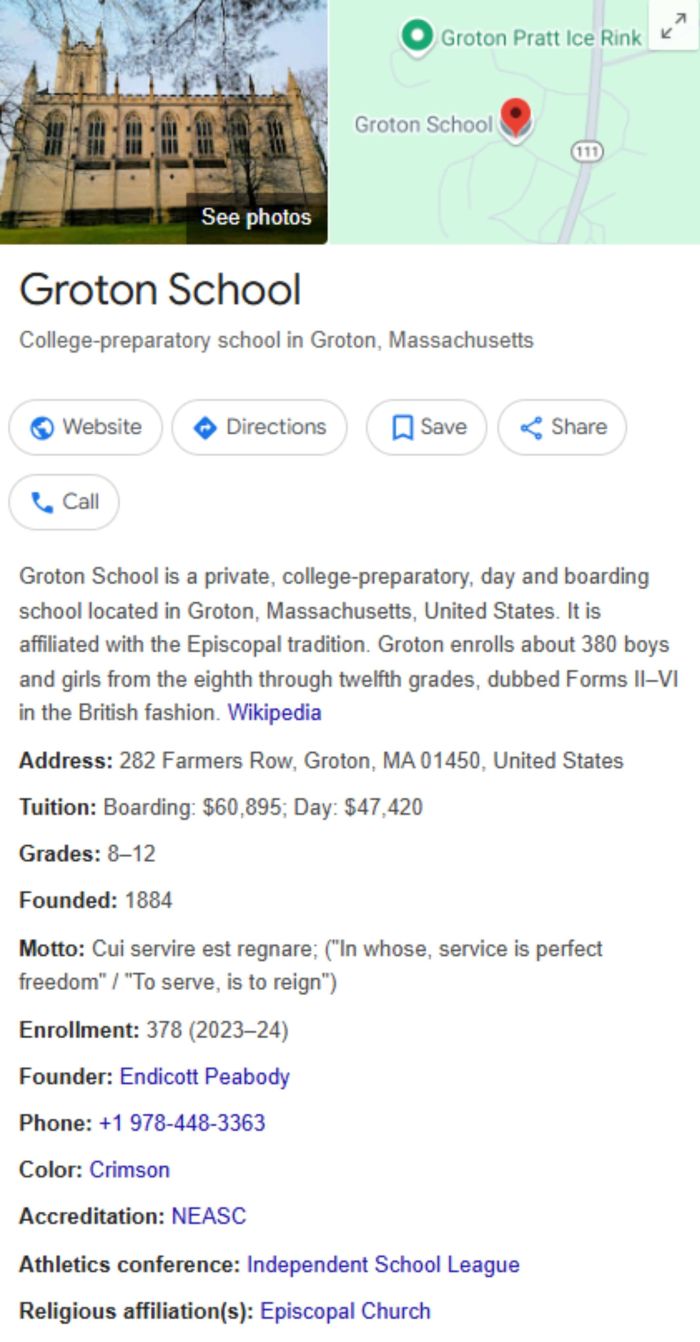
    Example: This is what your private school looks like in search results when you optimize your Google My Business account. This essential feature provides an easily digestible snapshot of your institution, presents a professional image to web users, and makes it much easier for your target audience to find you.

    HEM Image 6HEM Image 6

    Source: Groton School | Google

    7. Host Virtual and In-Person Open Houses

    In today’s digital landscape, virtual open houses offer a convenient way for parents to learn about your school from anywhere. In-person tours and interactive virtual sessions cater to a broader audience while answering common questions in real time.

    A well-structured open house should include live presentations from school leaders, faculty members, and current students who can share their experiences. Offering breakout sessions for different grade levels or programs allows parents to focus on the most relevant aspects of your school. 

    Additionally, incorporating Q&A panels, video tours of classrooms and facilities, and even virtual meet-and-greet opportunities with teachers can help prospective families get a more personal feel for your school’s community. Recording these sessions and making them available on your website also ensures that families who couldn’t attend live still have access to the information.

    Example: Queen Anne’s School makes it a priority to offer prospects a positive first impression through in-person “Open Morning” events and a virtual tour to showcase their beautiful campus. They also offer personal tours, group tours on site, taster days, and taster boarder experiences to accommodate every prospect’s preferences. Wow future students and their families by giving them a taste of your unique student life experience.

    YouTube videoYouTube video

    HEM Image 7HEM Image 7

    Source: Queen Anne’s School

    8. Invest in Paid Digital Advertising

    While organic traffic is essential, strategic paid advertising can help small private schools reach highly targeted audiences. Google Ads and Facebook Ads can be optimized to reach families searching for private school options in your area.

    Displaying retargeting ads to parents who previously visited your website can help keep your school top-of-mind. Running A/B tests on ad creatives and messaging can improve ad performance and maximize return on investment.

    9. Create Downloadable Resources to Capture LEADS

    Providing valuable downloadable resources, like e-books, checklists, and guides, can encourage prospective families to share their contact information. For instance, a downloadable guide on “Choosing the Right Private School for Your Child” can position your institution as an industry expert while generating qualified leads. Interactive tools, such as school comparison charts and tuition calculators, can further engage visitors and increase conversion rates.

    To maximize the effectiveness of downloadable resources, schools should ensure that these materials are highly relevant, visually appealing, and easy to understand. Including real-world examples, student success stories, or insights from school faculty can add credibility and value. 

    Additionally, placing lead capture forms strategically throughout the website, such as on admissions pages, blog posts, and program descriptions, can encourage more sign-ups. Schools can also create exclusive content for different stages of the enrollment journey, such as a “First-Time Parent’s Guide to Private School Admissions” or a “Step-by-Step Checklist for Enrollment Success,” providing tailored resources that guide families through the decision-making process. Regularly updating these materials ensures they remain relevant and aligned with current education trends.

    10. Utilize Retargeting Strategies

    Most parents don’t enroll immediately after visiting your website. Retargeting strategies, such as displaying ads to users who previously visited your site, can help keep your school top-of-mind. This ensures interested families receive gentle reminders to revisit your offerings and complete the application process. Email remarketing campaigns can also re-engage families who started but did not complete an application.

    To enhance retargeting effectiveness, schools should segment their audience based on engagement levels, such as visitors who viewed tuition pages, downloaded an admissions guide, or attended a virtual open house. Personalized messaging, such as an email featuring student testimonials or a special enrollment incentive, can encourage hesitant families to take the next step. 

    Schools can also leverage dynamic display ads that adjust content based on a user’s previous website activity, like showing program-specific ads for those who viewed a particular course or highlighting upcoming admissions deadlines. Schools can effectively nurture leads and increase enrollment conversions using a multi-channel approach, combining retargeting ads with personalized email follow-ups.

    Getting Professional Marketing Support Can Help Your Private School Grow

    Navigating the complexities of digital marketing can be overwhelming, especially for small private schools with limited resources. That’s where expert guidance can make all the difference. 

    At Higher Education Marketing, we specialize in helping educational institutions maximize their online presence through customized inbound marketing strategies. Whether you need assistance with content creation, SEO, social media management, or lead nurturing, our team of education marketing experts ensures that your school effectively reaches its target audience.

    With over 15 years of experience, we understand the nuances of school marketing ideas and tailor our solutions to your institution’s specific needs. Our digital marketing services include:

    • SEO Optimization
    • Paid Advertising Campaigns
    • Social Media Management
    • Website Development
    • Email Marketing Automation

    Start Growing Your Private School Today

    By embracing inbound marketing, your small private school can attract the right families, establish a strong online presence, and build a thriving school community. Whether you’re looking to optimize your digital strategy, refine your content marketing approach, or improve engagement through paid advertising, HEM is here to help. 

    The combination of a strong website, engaging blog content, an active social media presence, and targeted email marketing ensures that your school remains visible and competitive in the evolving field of education.

    Struggling with enrollment?

    Our expert digital marketing services can help you attract and enroll more students!

    Frequently Asked Questions

    Question: How do you market a small private school?

    Answer: Traditional outbound marketing methods, such as print ads and direct mail, are costly and less effective in today’s digital market. Instead, try inbound marketing,  a group of strategies that offer a cost-efficient and impactful way to attract, engage, and retain families interested in your school.

    Question: How to market a new private school?

    Answer: The key is to build trust and provide the right information at the right time. Parents today research extensively before choosing a school for their children. Though many outbound strategies remain relevant today, namely to increase visibility, offer useful content, address concerns, and showcase your school’s strengths. Inbound marketing can position your institution as the best choice.

    Source link

  • Top 10 Best Summer Camp Marketing Strategies

    Top 10 Best Summer Camp Marketing Strategies

    Reading Time: 11 minutes

    Marketing your summer camp successfully requires a well-rounded approach  integrating digital strategies to maximize reach and engagement. With families and students searching online for the perfect summer experience, schools must stay ahead of the competition by adopting fresh, innovative methods. 

    This blog explores ten of the best summer camp marketing strategies to ensure your program stands out.

    Struggling with enrollment?

    Our expert digital marketing services can help you attract and enroll more students!

    1. Leverage Content Marketing to Build Trust and Authority

    You’ve probably heard this before, but we’ll say it again: Content is king! One of the most effective ways to promote your summer camp is by creating blog posts, videos, and articles about the benefits of attending your camp. This helps engage prospective attendees and parents. Highlight success stories, showcase daily camp activities, and provide insights into what makes your program unique. 

    The first step to creating an effective summer content marketing campaign is choosing what platforms to use. You might be wondering, “Where can I promote my summer camp?” The best places include social media sites like Facebook, Instagram, and TikTok, as well as Google Ads and YouTube for targeted paid campaigns. 

    Local community websites, parenting blogs, and school newsletters are effective promotional channels. Focus on building credibility and encouraging trust among parents evaluating different options.

    Example: Here is a simple way to garner interest in your summer camp program. Visual Arts Mississauga posts a video of the activities they provide, including studio and outdoor creative activities, a variety of themes (a new one each week), and special guests. Try filming a few brief snippets of your daily camp activities and list some of your campers’ favorite things about the experience. With minimal editing and some upbeat music, you can certainly catch the attention of a parent searching for a positive camp experience for their child. It worked for Visual Arts Mississauga!

    As you can see in the comments, a parent inquired for pricing information. The great thing about social media platforms like TikTok? You can answer questions directly. Don’t forget to obtain permission from parents and campers before posting them.

    Image 11Image 11

    Source: Visual Arts Mississauga | TikTok

    2. Optimize Your Website for Search Engines

    If your website isn’t optimized for search engines, you’re missing a significant number of potential campers. Search Engine Optimization (SEO) ensures that your summer camp appears when families search for programs online. By enhancing your site’s structure, improving page speed, and using long-tail keywords like “summer camp programs in (insert your location here),”  you can improve visibility. 

    To further enhance visibility, you should optimize your summer camp program pages by structuring them with clear headings, engaging descriptions, and high-quality images of camp activities. Adding frequently asked questions (FAQs) to the page improves user experience and provides quick answers to common inquiries. 

    Internal linking to other relevant pages, such as registration forms or blog posts, boosts SEO by keeping visitors engaged. Additionally, integrating schema markup allows search engines to understand the content better, increasing the chances of appearing in featured snippets.

    Example: This is what an FAQ section could look like on your camp landing page. Adding structured data to your FAQs increases the likelihood of appearing as a featured snippet on search engines. Be sure to use conversational language to optimize for voice search results. Don’t forget to leverage your FAQs for content planning. This is a great way to add value for site visitors – providing the answers they’re searching for in detail in more detail.

    Image 2Image 2

    Source: Kustermans

    3. Create a Strong Social Media Presence

    Beyond posting regularly, an effective social media strategy involves using platform-specific features to maximize engagement. Instagram Stories and Reels allow you to share real-time updates, camper testimonials, and behind-the-scenes glimpses of camp life. 

    Facebook Groups can build a community of returning campers and interested parents, fostering discussion and sharing updates. TikTok offers a creative space to showcase fun camp activities through short, engaging videos that appeal to younger audiences.

    Additionally, paid social media advertising is a great way to extend your reach. By running targeted ad campaigns on platforms like Facebook and Instagram, you can ensure your summer camp marketing efforts reach families actively looking for programs. 

    Geo-targeting and interest-based targeting allow you to refine your audience, ensuring your ads reach parents who are most likely to enroll their children. Running contests and giveaways on social media can also increase engagement and word-of-mouth promotion as parents and campers share your content with their networks.

    Example: Here, Western University uses its active Facebook page to maintain a strong presence, notify parents of important dates, build anticipation for the summer, and show off all of the fun activities in store. Their page features consistent branding setting them apart from other school summer camps.

    Image 3Image 3

    Image 4Image 4

    Source: Sport Western Summer Camp | Facebook

    4. Utilize Email Marketing Campaigns

    Email marketing remains a powerful tool for reaching prospective campers and their families. Sending out newsletters with enrolment updates, discounts, and testimonials keeps your audience informed and engaged. 

    An effective email marketing strategy involves segmentation, where prospective families are grouped based on their engagement levels, preferences, and past interactions. You can ensure that each recipient receives relevant messaging by tailoring content to different segments, such as new inquiries, returning campers, and families who haven’t yet completed registration.

    Drip email campaigns are particularly valuable for nurturing leads. These automated sequences gradually provide information about your camp, from program details to testimonials, making it easier for parents to commit. Additionally, incorporating visually appealing emails with compelling subject lines improves open rates and engagement.

    5. Targeted Digital Advertising Campaigns

    Traditional advertising is still effective, relevant, and part of a well-rounded marketing campaign. “How do I advertise my summer camp?” you ask. To advertise your summer camp using targeted ads, leverage platforms like Google Ads, Facebook, and Instagram to target parents actively searching for summer programs. By utilizing geo-targeting, interest-based segmentation, and retargeting campaigns, you can maximize ad visibility, drive inquiries, and increase enrolment conversions efficiently.

    Google Ads enables your summer camp to appear at the top of search results when parents look for camp programs, increasing visibility. Running display ads and retargeting campaigns ensures that those who have previously visited your website are reminded of your offerings, improving conversion rates. Additionally, YouTube Ads allow you to showcase engaging video content of camp activities, testimonials, and program highlights to attract more interest.

    Facebook and Instagram Ads offer detailed audience segmentation tools, allowing you to reach parents based on location, interests, and browsing behavior. Carousel, video, and story ads create immersive experiences that engage prospective campers and their families. To further boost engagement, A/B testing different ad creatives and copy variations helps refine messaging to determine what resonates best with your audience.

    A/B testing involves creating multiple versions of an advertisement, landing page, or email to determine which version performs best. In digital advertising, A/B testing can compare different ad headlines, images, calls to action, and audience targeting strategies. 

    Advertisers can analyze performance metrics such as click-through rates (CTR), conversion rates, and engagement levels by running multiple variations simultaneously. The winning version can then be scaled for maximum impact, ensuring your budget is allocated to the most effective ad variations.

    Example: When you invest in YouTube ads like the one pictured below, you can show up at the top of the platform’s summer camp search results and greatly expand your reach.

    Image 5Image 5

    Source: YouTube

    6. Encourage Camper and Parent Testimonials

    Word-of-mouth remains a powerful marketing tool. Encouraging past campers and their parents to leave reviews on Google, Facebook, and your website adds credibility to your program. Video testimonials are particularly effective at providing an authentic look into the camp experience. Families researching camps trust peer reviews, and showcasing positive experiences helps establish trust and attract new registrations.

    Example: Encourage happy campers to leave high-value testimonials highlighting how your program has positivly impacted their lives. The two pictured below are excellent examples of moving word-of-mouth endorsements that improve your program’s public reception and potentially incite desired action.

    Image 6Image 6

    Source: Double H Ranch

    7. Develop an Ambassador Program

    Leveraging past campers as ambassadors can create a community-driven summer camp marketing effect that builds long-term brand loyalty. Encouraging past attendees to share their experiences and recommend your camp to friends and family fosters authentic promotion. 

    One of the most effective approaches is a structured referral program, where returning campers receive discounts or perks when they bring a friend. Offering rewards such as camp merchandise, VIP experiences, or exclusive access to special activities can further incentivize participation. 

    When working with minors as ambassadors, schools should obtain parental consent, follow child privacy regulations such as COPPA, and ensure that all promotional activities align with ethical guidelines to protect student identity and well-being.

    Beyond peer referrals, partnering with local influencers, parenting bloggers, and community leaders can significantly amplify your reach. Inviting these ambassadors to visit your camp, create content, and share their experiences with their followers can increase visibility among parents searching for reputable programs. Providing them with branded hashtags, social media templates, and storytelling prompts ensures consistent and compelling messaging.

    To sustain engagement, camps should maintain an ongoing relationship with ambassadors by featuring them in newsletters, social media posts, and alumni spotlights. Creating private groups or online communities for ambassadors fosters a sense of belonging and motivates them to continue advocating for your camp. Implementing an easy-to-use referral tracking system helps measure success and refine strategies for maximum impact.

    8. Highlight Your Camp’s Unique Selling Points (USPS)

    In a competitive summer camp market, it is crucial to clearly define and communicate your camp’s unique selling points (USPs) to stand out from the rest. Parents and campers have many choices, so highlighting what makes your camp different will help you attract the right audience and increase enrolment.

    A USP is a distinct feature or quality that sets your camp apart. To effectively market your camp, you must identify and promote these features across your website, social media, and advertising campaigns. Below are some strong examples of USPs that summer camps can highlight:

    • Specialized Programs 
    • Small Camper-to-Counselor Ratio
    • Exclusive Locations
    • Highly Qualified Staff
    • Customizable Camp Experiences
    • Unique Themes or Storylines
    • Exclusive Partnerships 
    • All-Inclusive Pricing and Amenities 

    Once you’ve identified your USPs, ensure they are featured prominently on your website homepage, camp brochures, social media posts, and digital advertising. Use testimonials from past campers and parents to reinforce the uniqueness of your offerings.

    Example: The School of Magic is unique because of its emphasis on connecting with nature and developing real-world skills. Those unique selling points are evident in the Instagram post below. What sets your summer camp program apart?

    Image 7Image 7

    Source: The School of Magic

    9. Partner With Schools and Community Organizations

    Collaborating with schools and local community centers broadens your marketing reach. Schools can distribute flyers and email newsletters promoting your camp, while community organizations can help you reach families looking for summer activities. Building partnerships with educational institutions ensures that your camp gains credibility and visibility in trusted spaces where families make enrolment decisions. Create a buzz around any partnerships in your content across various platforms. 

    Example: On its website, the Canadian Adventure Camp has a tab called Memberships and Partnerships. There, they list and explain their collaborations and community involvement, showcasing how they add value for campers, families, and those in need. If you’re collaborating with any organization or if you’re involved in charity work, be sure to highlight how you make a difference!

    Image 8Image 8

    Image 9Image 9

    Image 10Image 10

    Source: Canadian Adventure Camp

    10. Optimize Your Camp’s Mobile Experience

    With more parents researching and booking camps on their smartphones, having a mobile-optimized digital presence is essential. A slow or non-responsive website can drive potential campers away, leading to lost enrolment opportunities. To ensure a seamless mobile experience, camps should prioritize mobile usability in all aspects of their digital marketing strategy.

    Responsive web design is the foundation of a successful mobile experience. Your website should automatically adjust to different screen sizes, ensuring readers can easily browse your camp’s programs, pricing, and enrolment details on any device. Without this adaptability, parents may abandon their search in favor of a competitor with a more mobile-friendly platform.

    Fast load times are another critical factor. If a webpage takes too long to load, parents may become frustrated and leave before completing the registration process. Optimizing images, minimizing unnecessary code, and leveraging browser caching can significantly improve site speed. Google prioritizes fast-loading websites in search results, meaning that a well-optimized mobile site can enhance your summer camp advertisement efforts by increasing visibility in search rankings.

    Once a parent arrives on your site, easy navigation and registration are essential. Mobile users should be able to access key pages; such as program descriptions, schedules, and pricing, within a few taps. Registration forms should be concise, requiring only necessary information, and offer autofill features to streamline the process.

    Providing click-to-call and chat features offers immediate communication options for parents with questions. A simple button allowing users to call directly from their mobile device or engage in a live chat session with a representative can make a huge difference in converting inquiries into sign-ups. Chatbots can also be used for quick responses outside of business hours, ensuring prospective campers receive the information they need when they need it.

    Finally, mobile-friendly payment options make transactions seamless. Integrating secure, one-click payment solutions like Apple Pay, Google Pay, or PayPal can speed up registration and reduce drop-offs. Parents should be able to complete payment without switching devices or navigating through a complex checkout system.

    Boost Your Camp Enrolment Today!

    Marketing a summer camp successfully requires a well-rounded, strategic approach that meets parents and campers where they are—online! By leveraging SEO, content marketing, social media, email campaigns, paid advertising, and mobile optimization, you can increase visibility, boost engagement, and ultimately drive more enrolments. Highlighting your camp’s unique selling points, developing a strong ambassador program, and ensuring a seamless mobile experience will set your camp apart in a competitive market.

    With the right mix of digital marketing techniques, your summer camp can attract the right audience and maximize registrations year after year. Whether refining your summer camp advertisement strategy, improving your website, or launching targeted ad campaigns, a data-driven approach ensures long-term success.

    At Higher Education Marketing, we specialize in helping camps and educational institutions implement proven digital marketing strategies that deliver results. If you’re ready to take your summer camp marketing to the next level, reach out to us today to learn how we can help you achieve your enrolment goals.

    Struggling with enrollment?

    Our expert digital marketing services can help you attract and enroll more students!

    Source link

  • Graduate Student Insights and Perspectives

    Graduate Student Insights and Perspectives

    Facing challenges in enrollment, retention, or tech integration? Seeking growth in new markets? Our strategic insights pave a clear path for overcoming obstacles and driving success in higher education.

    Unlock the transformative potential within your institution – partner with us to turn today’s roadblocks into tomorrow’s achievements. Let’s chat.

    Source link

  • Rethinking Your Student Population

    Rethinking Your Student Population

    Rethink your student population whitepaper

    Adult learners are higher ed’s future

    Reskilling, upskilling and lifelong learning are creating a big opportunity for higher education to become the go-to resource for career-minded adults. But not all adult learners are alike. In this report, we break them down into four types of adult learners (Career Advancer, Career Builder, Discerning Academic and Hesitant Learner).

    Download the white paper with the following insights for each persona:

    • Top motivations
    • Recruitment strategies
    • Program optimization recommendations

    Collegis Education surveyed 1,000 adult learners interested in pursuing degrees for this white paper, Rethink Your Student Population. Discover who makes up the majority of the adult learner market and how to target your outreach to grow your enrollment in this untapped population.

    Also, get key takeaways in our infographic The Adult Learners You’re Ignoring.

    Download Now

    MktoForms2.loadForm(“//087-TII-060.mktoweb.com”, “087-TII-060”, 1789);

    Additional Resources

    The post Rethinking Your Student Population appeared first on Collegis Education.

    Source link

  • How to Unlock Graduate Enrollment Growth [Webinar]

    How to Unlock Graduate Enrollment Growth [Webinar]

    Your graduate programs should be thriving, but if you’re relying on outdated outreach tactics, you’re leaving enrollments on the table. Today’s grad students expect more personalization, relevance, and connection. And if you’re not aligning with their needs, another institution will. The only way to meet them where they are is by asking the right questions and getting real answers. That’s exactly what Collegis Education and UPCEA did, and now we’re pulling back the curtain to share what we found.

    Unlock Graduate Enrollment Growth
    Proven Strategies for Engaging Graduate Students
    Date
    : April 8, 2025
    Time: 2:00 pm (Eastern) / 1:00 pm (Central)

    Tracy Chapman

    Chief Academic Officer

    Collegis Education

    Headshot of Bruce Etter

    Bruce Etter

    Senior Director Research & Consulting
    UPCEA

    Join Tracy Chapman, Chief Academic Officer at Collegis Education, and Bruce Etter, Senior Director of Research & Consulting at UPCEA, for their upcoming webinar “Unlock Graduate Enrollment Growth: Proven Strategies for Engaging Graduate Students.” In this session, they’ll reveal some surprising discoveries about graduate enrollment and the factors that drive impact and growth.

    • Graduate student needs and expectations
    • Why grad students disengage during their enrollment journey
    • What information grad students are willing to give you and when
    • How to best communicate and reach graduate students actively evaluating programs
    • Presidents
    • Provosts
    • Enrollment leaders 
    • Marketing leaders

    At the end, we’ll leave room for questions and conversion, and all attendees will receive a copy of the entire research report. 

    See you on April 8! 

    Source link

  • Mastering SEO and GEO in Education Marketing

    Mastering SEO and GEO in Education Marketing

    Reading Time: 12 minutes

    The modern digital era has brought with it a world of remarkable changes and developments in the information space that today’s students are well-placed to enjoy. The search engine as you know it is changing and adapting to these changes, with old methods and processes giving way to newer, more effective ones. 

    While traditional Search Engine Optimization (SEO) remains essential, Generative Engine Optimization (GEO) is emerging as a complementary strategy for AI-driven search experiences. With AI-powered search engines like Google’s Gemini and ChatGPT transforming how prospective students find information online, today’s schools must adapt or risk being swept under the radar.

    Keen on increasing organic traffic and leads?

    Optimize your site, attract students, and elevate your visibility with our specialized SEO strategies.

    The Evolution of Search in Education Marketing

    Now, a few well-placed keywords are not enough. Although about 91% of today’s organizations still make significant marketing-related gains from SEO, the rules are fundamentally different now. Today’s prospective students use the search engine in ways that are quite unprecedented.

    While traditional search engines serve up lists of links, AI-powered search engines deliver direct answers. Even better, they deliver such complete conversational responses that you do not need to visit a website. There’s a dual approach to this process: maintaining strong SEO foundations while embracing the emerging power of GEO.

    Educational institutions stand to gain from this development. Prospective students can conduct exhaustive research without contacting an admissions office. By tapping the search button, they can get answers to vital questions about program details, application requirements, and career outcomes.

    SEO: Still the Foundation of Digital Visibility

    While AI is visibly gaining momentum, SEO remains an important tool. When executed properly, it can produce these benefits:

      • Enhanced Visibility: Optimised content drives organic traffic, increasing inquiries and applications to your school. Recent industry sources report that schools that invest in comprehensive SEO measures enjoy a significant improvement in conversion rates.
      • Better User Experience: With clear metadata, logical headings, and mobile-friendly designs, students can find information better on websites. The results include longer site visits, lower bounce rates, and higher engagement, which can help boost search rankings further. 
    • Established Authority: By creating comprehensive content, you’re signalling to search engines and users that your school is knowledgeable and can be trusted. It gives a sense of authority that can ultimately boost your school’s profile. 

    What is the difference between SEO and GEO marketing? The key difference between SEO and Generative Engine Optimization marketing lies in their focus and approach. SEO is used for traditional search engines, and GEO is used for AI-Driven searches:

    • SEO optimizes content for traditional search engines (Google, Bing) to improve rankings in organic search results using keywords, backlinks, and technical SEO strategies.
    • GEO marketing optimizes content for AI-driven search experiences (Google SGE, ChatGPT), ensuring content is AI-friendly, conversational, and structured for retrieval by generative AI models.

    While SEO targets search engine algorithms, GEO marketing tailors content for AI-driven responses and voice search interactions.

    Effective SEO Strategies for Education

    The optimization approaches discussed below have been proven to be used by the most successful institutions. 

    Strategic On-Page Optimization:

    Using long-tail keywords like “best MBA programs in Canada for working professionals” can help capture niche audiences.

    Content Authority: 

    Create in-depth guides and case studies addressing the nuanced questions that prospective students typically ask. So, instead of just listing program requirements, develop extensive resources that cover career paths, industry connections, and student outcomes. 

    Mobile Optimization: 

    A responsive design is a must-have, thanks to most searches now happening on mobile devices. This holds true for young people who use smartphones to explore their educational options. 

    Schema Implementation: 

    Structured data markup can help search engines interpret your content much better. An education-specific schema like EducationalOccupationalCredential or EducationalOrganization can boost your program’s visibility in search results.

    Local SEO: 

    Institutions with physical campuses need to optimize for local searches. This includes claiming and maintaining Google Business Profile listings, building local citations, and creating location-specific content highlighting campus facilities and community connections.

    The AI Search Revolution: Understanding GEO

    What is Generative Engine Optimization (GEO)?

    More pertinently, what is GEO in SEO? Generative Engine Optimization in SEO refers to optimizing content for AI-driven search engines and generative AI models like Google’s Search Generative Experience (SGE) and ChatGPT. It focuses on structuring content for AI retrieval by using natural language, clear formatting, authoritative sources, and relevant keywords to improve visibility in AI-generated responses.

    The way we interact with information today has changed drastically, courtesy of AI-powered search engines. You can now get direct, synthesized answers culled from several sources, so you don’t have to click through multiple links. The way this happens is in these three steps:

    AI models scour the web for relevant information, searching from institutional websites to educational forums and third-party resources.

    They blend this information into coherent, structured responses that address the specific query and can often include details from multiple sources. 

    Users will now get conversation-like answers without having to visit individual websites. These answers often come complete with citations or even visual elements.

    Mastering GEO for Education Marketing

    Imagine asking an AI assistant for the best digital marketing courses or top universities for business programs—and your institution doesn’t appear. That’s where Generative Engine Optimization (GEO) comes in.

    What is GEO in digital marketing? GEO in digital marketing optimizes content for AI-driven search tools like Google’s Search Generative Experience (SGE) and ChatGPT. Unlike traditional SEO, which focuses on ranking in search engine results, GEO ensures your content is structured, conversational, and AI-friendly, making it more likely to surface in AI-generated responses.

    As AI search adoption grows, Generative Engine Optimization is becoming critical. Prospective students are no longer just typing keywords into Google; they’re asking AI assistants for tailored recommendations. If your institution isn’t optimizing for AI-driven search, you risk being invisible in the conversations shaping students’ decisions.

    That’s why mastering GEO for education marketing is no longer optional—it’s essential. Schools, colleges, and universities must adapt their digital strategies to ensure AI models recognize their programs, faculty, and unique offerings. Ignoring this trend means missing out on valuable opportunities to engage with future students where they’re already searching.

    Focus on these strategies if you’re looking to succeed with GEO:

    • Answer-focused Content: Use a Q&A format to create clear and concise responses to common questions. Instead of burying tuition-related information in program pages, provide direct answers to questions like “How much does it cost to attend [School Name]?” 
    • Authoritative Information: Provide precise, updated information and only cite credible sources. You can reference accreditation bodies, link to relevant research and put out consistent information across all digital channels. 
    • Comprehensive FAQs: Use detailed FAQ sections to cover key topics like admissions and campus life. Using proper schema markup, structure these sections so that AI tools can pull information straight from your authoritative source.
    • AI-Friendly Schema: To make your content more machine-readable, use FAQ, Course, Event, and Speakable schemas. This way, AI systems can connect the different pieces of information contained on your site.
    • Multichannel Distribution: Let your content be shown across platforms like YouTube, LinkedIn, and Quora to gain more visibility. Because AI search engines pull material from varying sources, a consistent message across your channels will help your school be represented the right way.

    Example: This screenshot captures Google search results for “Does ATC Toronto offer an auto detailing program?” It includes a prominently featured snippet directly answering the question on the left side of the page, and AI search results also answer the question on the right.

    HEM Image 2HEM Image 2

    Source: Google

    Creating Content That Excels in Both Worlds

    Here are our best tips for creating suitable content for traditional and AI-driven searches:

    Create Optimal Content:

    • Optimize Your Content Structure because human readers and AI algorithms will benefit immensely from clear organization. 
    • Create a logical hierarchy using descriptive headings and subheadings. For example, move your program pages from a general overview to curriculum, faculty, career outcomes, and other specific details. 
    • Incorporate bullet points and numbered lists for easy scanning. This is particularly important for details about admission requirements, application deadlines, and program benefits.
    • Implement appropriate schema markup to help search engines understand your content.
    • Let your content have a clear content hierarchy that guides users from general information to specific details.

    Focus On Quality and Engagement

    • It is important to create high-quality content that addresses user intent. Follow these strategies:
    • Reach out to prospective students with answers to their most asked questions. Correctly predict and sort out their needs across all decision-making stages.
    • Balance authoritative information with a conversational tone. Do this while avoiding academic jargon and maintaining the appropriate level of sophistication for your target audience.
    •  Use short paragraphs and clear language to make your content readable. Also, blend concise, direct answers with in-depth guides. 
    • Let your student testimonials, faculty perspectives, and alumni success stories feature authentic voices as they can help humanize your institution. 

    Example: The University of Toronto has a section on its website that features testimonials from current students, alumni, and staff, helping to boost the school’s image with genuine feedback.

    HEM Image 3HEM Image 3

    Source: University of Toronto – Current Students

    Embrace Semantic SEO

    Modern search optimization has gone past keywords, and here’s how:

    Develop comprehensive pillar pages that cover broad topics like “Graduate Programs” or “Student Life” with links to more specific content. Use natural language mirroring how people speak and search. Incorporate variations and related as opposed to repeating the same keywords.

    • Create content clusters that address related topics and questions. Also, you can link between them to establish topical authority and help users navigate your site.
    • Consider the semantic field around educational topics, including synonyms, related concepts, and commonly associated terms.

    Example: Here, R-MA demonstrates its mastery of semantic SEO with this Student Life page. Apart from providing a general overview of the school’s Student Life Program, the page also contains links to specific aspects of the program.

    HEM Image 4HEM Image 4

    Source: Randolph-Macon Academy

    Overcoming the Zero-Click Challenge

    One of the biggest threats to education marketers is the rise of zero-click searches, where users get answers without visiting your website. Nearly 65% of Google searches now end without clicks to any websites. This trend is particularly problematic for institutions relying on website traffic for lead generation.

    Here’s a quick look at how Zero-Click searches show up in search engines:

    Featured Snippets: This displays key information directly in results, answering questions about application deadlines, tuition costs, and program requirements without requiring clicks.  

    Voice Search: Conversational queries often receive single, direct answers, particularly for straightforward questions like “When are applications due for [School Name]?”

    AI Summaries: New tools seek to compile information from multiple sources into one response. Synthesizing details about educational programs without directing users to specific institutional websites.

    Strategies to Combat Zero-Click Searches

    • Optimize the content for featured snippets: Structure content to rank better by directly answering questions. 
    • Implement FAQ Schema: Mark up Q&A content with the right schema so your answers appear more in search results. 
    • Create must-click content: Create resources that resonate with the users, including calculators and virtual campus tours.
    • Leverage Rich Results: Using structured data, enhance how your content appears in search results so it’s more appealing and clicked.
    • Focus on Complex Questions: Target those queries that you can’t answer in a snippet, those that need you to go further into your school’s offerings. 

    Example: Oxford University enhances its FAQ sections using structured data. By doing so, their answers are featured directly in search results—ensuring that key information about admissions and tuition is visible in a zero-click environment.

    HEM Image 5HEM Image 5

    Source: Oxford University Help Center

    Optimizing for Voice and Conversational Search

    With voice assistants becoming more popular, optimizing for spoken queries is becoming increasingly important. Over 27% of searches are run through a voice interface, mostly among the younger generations. Here are some voice search best practices to use to this effect.

    • Use natural, question-based keywords that match how people speak, such as “How do I apply to [School Name]?” rather than “application process.”
    • Voice search is predominantly mobile-driven, so make sure your site is mobile-friendly and fast-loading.

    Creating Conversation-Ready Content

    To create conversation-ready content, you’ll need to follow certain rules. Our best tips include writing in short, digestible paragraphs that voice assistants can easily read aloud. 

    You must provide direct answers to common questions to start each relevant section. Another key tip is to create how-to guides and FAQ sections that fit with voice queries. 

    Let your content follow a conversation-like style, just like prospective students engage. There should be relevant context to match every user request, and the information provided should be clear and concise for the best results. 

    Essential Tools and Emerging Trends

    To stay competitive in educational marketing, you need the right tools and awareness of emerging trends. Here are some must-have SEO and GEO tools. 

    • Google Search Console: Monitor performance and identify opportunities by tracking how your pages appear in search results and which queries trigger their appearance.
    • SEMrush: Research keywords and analyze competitor strategies while paying particular attention to education-specific terms and competing institutions.
    • Ahrefs: Track backlinks and content performance, building a strong link profile that enhances your institution’s perceived authority.
    • Schema Markup Generators: Create and validate structured data to improve how search engines interpret your content.
    • Mobile Testing Tools: Ensure optimal performance across all devices, recognizing that many prospective students research educational options on smartphones.

    Trends Reshaping Education Marketing

    • AI-Generated Search Summaries: By focusing on direct answers instead of posting traditional link listings, your search results appear faster and function better. 
    • Voice Search Growth: This accounts for over 27% of all searches, mostly among younger demographic groups.
    • Engagement as a Ranking Signal: User interaction affects visibility, with metrics like time on site and interaction rates affecting search performance.
    • Video Content Prominence: Educational videos are gaining importance in search results, particularly for how-to and explanatory content about programs and campus life.
    • Social Proof Integration: With reviews, testimonials, and user-generated content, you can create more impact in traditional and AI-driven search results.

    The Human Element: Storytelling in a Digital World

    Although technical optimization remains crucial, education marketing relies heavily on human connection. The schools that balance data-driven strategies with authentic storytelling that resonates with prospective students succeed.

    • If you’re looking for a means to build student trust in your offerings through authenticity, here’s how to go about it. 
    • Share real student success stories and testimonials that show how transformative your educational programs are. 
    • Highlight those unique program features and opportunities that differentiate your institution from competitors.
    • Maintain transparency and avoid excessive jargon. Focus on pointing out what makes your institution special.
    • Create content that addresses the emotional aspects of the educational decision.

    Example: Here, AAPS masterfully emphasizes the transformative power of its program by highlighting the experiences and successes of a student, recounted by the student herself.

    HEM Image 6HEM Image 6

    Source: AAPS

    Blending Data and Creativity

    • Use analytics to inform content strategy, identifying topics and formats that resonate with your target audience.
    • Enhance text with visual and interactive elements that engage users and encourage deeper exploration of your offerings.
    • Personalize messaging for different audience segments, with their varying priorities and concerns.
    • Test and refine approaches based on performance data, continuously improving your digital marketing effectiveness.

    Embracing the Future of Education Marketing

    As the digital outlook for today’s educational market continues to evolve, schools must continually adapt to remain competitive. The future of search engines belongs to those who can master both SEO and GEO to produce results that drive and direct conversations. 

    The tide favours schools whose content resonates with traditional search engines and AI-powered platforms. The target is to position your institution for this kind of leverage, and that’s the essence of this piece. 

    Ready to transform your digital presence? Start optimizing today and watch your institution’s story unfold—one search at a time.

    Keen on increasing organic traffic and leads?

    Optimize your site, attract students, and elevate your visibility with our specialized SEO strategies.

    Frequently Asked Questions

    Question: What is the difference between SEO and GEO marketing?

    Answer: The key difference between SEO and Generative Engine Optimization marketing lies in their focus and approach. SEO is used for traditional search engines and GEO is used for AI- Driven searches.

    Question: What is GEO in SEO?

    Answer: Generative Engine Optimization in SEO refers to optimizing content for AI-driven search engines and generative AI models like Google’s Search Generative Experience (SGE) and ChatGPT.

    Question: What is GEO in digital marketing?

    Answer: GEO in digital marketing optimizes content for AI-driven search tools like Google’s Search Generative Experience (SGE) and ChatGPT.

    Source link

  • Your alumni magazine is a source of marketing gold

    Your alumni magazine is a source of marketing gold

    In a time of skyrocketing paper and postage costs, alumni magazines are paradoxically enjoying a renaissance. After cutting back—or cutting down—print issues during the pandemic, many institutions are now pushing for expanded page counts, more copies, better photography, multimedia extras and more institutional support.

    Why?

    Because audiences appreciate the thought-provoking content and the tangible, premium reminder of the enduring connection with their alma mater. In a 2024 CASE readership survey, 68 percent of TCU Magazine’s readers reported spending 30 minutes or more with every issue. Almost half reported that the magazine was a go-to source for continuing education.

    Journalists are pouring their passion and experience into institutional magazines because higher education shines glimmers of hope into an increasingly dark world. They highlight purpose-driven students who will tackle the problems of the future and brilliant faculty whose research is providing innovative solutions to the planet’s most pressing challenges.

    Our readership analytics at TCU Magazine have long shown a strong audience appetite for well-researched and carefully written and edited feature stories about forward momentum and its relationship to education. Since 2015, our overall page views have experienced an astounding 1,300 percent growth. That number sounds outlandish, but I can assure you it is accurate.

    Our alumni, parents, donors and internal stakeholders are and always have been the primary audiences. But they aren’t the only people who want to know about the students, faculty, staff and initiatives that thrive on our campus. TCU Magazine’s stories are crafted to be relevant far beyond our campus community and long after the initial date of publication.

    In 2021, when all the rules were being rewritten, we proposed a partnership with our colleagues in marketing. We suggested a trial run of using existing magazine stories as peer marketing material, promoting those features to internet users who live in the proximity of the country’s top 150 colleges and universities. The goal was for other professionals in higher education to learn about TCU beyond our exceptional student experience and athletic success.

    TCU’s marketing director agreed that long-form content could run alongside more traditional digital marketing materials. Why not? Serving stories about improving teacher retirement plans; developing free, open-source digital mapping tools; or better understanding mutations in the BRCA gene benefit us and all manner of readers.

    Audiences learn something new and interesting about how research is shaping the future, and we achieve our goal of enhancing TCU’s academic reputation.

    Win-win.

    Together, we built a partnership with a digital marketing agency based in Fort Worth. With their expert guidance, we got a crash course in the differences between Google Display Network and SEM keywords, Demand Gen ad placements, bidding strategies, and the wisdom of narrowing ad placements in social media feeds.

    We launched our first joint academic content campaign in April 2021 with a modest investment. The results were promising: In two months, we got the TCU initials in front of more than six million people around the country and enticed 87,000 of those people to click on the ad and come to the website to read the story.

    Best of all, these were what we refer to as quality clicks, because the average reader spent almost two minutes on one of our stories, far above the internet’s long-form content average of less than 40 seconds. That small trial convinced our divisional leaders that magazine material could be marketing gold.

    We didn’t need to reinvent the wheel or invest in outside development of marketing-specific content because we had a treasure trove already flowing from a steady creative stream inside our office.

    We expanded the efforts in 2022, sharing new stories with 10.5 million pairs of eyes and bringing 116,000 more people to our site to learn about TCU research. That year, we got an email from Puerto Rico about French professor Benjamin Ireland’s research reuniting families torn apart during forced internment during World War II. “I am not sure why Facebook ‘promoted’ your article to me this morning,” the effusive author shared, “but something made me click to read more.”

    We’ve continued to grow these campaigns. Though our mission at the magazine is and always will be to serve the TCU community first, we now factor in whether a proposed story might have a broader impact or might help us tell a more expansive tale about how the type of ethical leadership that flourishes here and makes the world a better place.

    My opinion is that these campaigns have worked because they’re a perfect merger of marketing and communication. We’re doing what magazine writers and editors have always done—telling authentic stories about real people doing purpose-driven work.

    What’s not to like?

    Caroline Collier is director of editorial services at Texas Christian University and editor of TCU Magazine.

    Source link

  • Roles in Educational Marketing Strategies

    Roles in Educational Marketing Strategies

    Reading Time: 8 minutes

    Are you wondering what sort of systems your school needs to streamline processes, enhance communication, and maximize student success? Two critical tools in this digital transformation are Customer Relationship Management (CRM) systems and Learning Management Systems (LMS). If you’re thinking about which kinds of systems to implement – CRM vs LMS

    While both play vital roles in educational institutions, their functions, benefits, and implementation strategies differ significantly. Understanding the difference between CRM and LMS and integrating them into your educational marketing strategy can provide a powerful edge. In this blog, we provide all of the guidance you’ll need to get started.

    Simplify student management and boost recruitment efficiency!

    Transform your student portal experience. Get a FREE HEM-SP demo today.

    What Is a CRM System?

    In an educational marketing context, a Customer Relationship Management (CRM) system is designed to manage interactions with prospective and current students. You can use CRM systems to track leads, nurture relationships, and streamline admissions workflows. These tools are indispensable if you’re looking to optimize your marketing and recruitment efforts by ensuring every prospective student receives personalized attention at the right time.

    CRM systems often include features such as lead tracking, segmentation, automated workflows, communication tools, and analytics. By providing insights into the enrollment journey, CRMs help schools allocate resources more effectively and improve conversion rates. A robust CRM can also support long-term engagement by keeping alumni connected to the institution.

    What is the best CRM for schools? Every school is different but generally, to choose the best CRM platform for your school, you should prioritize a system tailored to the education sector, like Mautic by HEM, which offers tools for lead management, personalized communication, and data-driven insights to streamline your admissions and marketing efforts.

    Built on the Mautic open-source marketing automation platform, it offers a comprehensive solution for managing leads, automating communication, and gaining insights into recruitment performance. With features such as contact management, campaign workflows, and lead scoring, Mautic by HEM helps schools supercharge their marketing and admissions efforts.

    HEM IMAGE 2HEM IMAGE 2

    Do you want to know how to use CRM and LMS to take your student experience to the next level? Contact us for a demo

    What Is an LMS?

    What is the purpose of LMS in education? A Learning Management System (LMS) is a platform designed to deliver, track, and manage educational content and student learning experiences. LMS platforms provide the infrastructure for online learning, offering tools for course creation, assignment tracking, progress monitoring, and student engagement. Schools use LMS platforms to enhance in-person and online education by providing a centralized hub for learning resources and communication.

    In addition to managing educational delivery, an LMS can provide valuable data on student performance and engagement, allowing educators to tailor instruction and support to individual needs. HEM’s Student Portal System, which includes a Student Information System (SIS), is an example of how an LMS can be integrated into an institution’s broader ecosystem. It streamlines everything from course scheduling to attendance tracking, creating a seamless experience for educators and learners.

    HEM IMAGE 3HEM IMAGE 3

    CRM vs LMS: Key Differences

    Although CRM and LMS systems serve different purposes, they often complement each other in educational marketing strategies. The primary distinction lies in their focus: CRM systems are designed to manage relationships with prospects and current students, while LMS platforms are dedicated to managing the delivery of educational content.

    A CRM system focuses on pre-enrollment activities, such as lead generation, nurturing, and conversion. It ensures prospective students receive timely, relevant information encouraging them to apply and enroll. By contrast, an LMS supports post-enrollment activities, including course delivery, student engagement, and academic tracking.

    Despite their distinct roles, both systems share a common goal: improving the student experience. By integrating CRM and LMS platforms, schools can create a cohesive journey from initial contact to graduation and beyond.

    HEM IMAGE 4HEM IMAGE 4

    Source: HEM

    Benefits of a CRM System in Educational Marketing

    Implementing a CRM system in your school’s marketing strategy can yield several benefits. CRMs streamline lead management by organizing contacts, tracking interactions, and automating follow-ups. This allows your admissions team to focus on high-priority leads while ensuring no prospect falls through the cracks.

    Mautic by HEM, for instance, empowers schools to create automated workflows for tasks such as email marketing, SMS campaigns, and event registrations. These tools help nurture leads effectively, moving them through the enrollment funnel. The platform’s robust reporting capabilities provide deep insights into the success of your marketing efforts, enabling data-driven decision-making.

    CRMs also enhance personalization. By segmenting leads based on criteria such as program interest, location, or stage in the admissions process, schools can deliver tailored messages that resonate with each prospect. This level of customization increases engagement and improves conversion rates.

    Example: One principal benefit of using a CRM for your school is access to detailed data that you can use to make your next move. The report below demonstrates how you can track registrations, what program the prospect has registered for, the prospects’ registration progress, and payment statuses. This is enough to craft and send a personalized follow-up message – a process that can be automated on CRMs like Mautic.

    HEM IMAGE 5HEM IMAGE 5

    Source: Mautic | Higher Education Marketing

    Benefits of an LMS for Educational Institutions

    An LMS enhances the learning experience by providing a centralized platform for educational content and resources. Students can access course materials, submit assignments, and communicate with instructors from anywhere, fostering flexibility and accessibility.

    LMS platforms also facilitate data collection, allowing educators to monitor student performance and identify areas for improvement. By tracking metrics such as course completion rates, assessment scores, and engagement levels, schools can make informed decisions to improve outcomes.

    HEM’s Student Portal System exemplifies how an LMS can integrate seamlessly into an educational institution. With features such as course scheduling, attendance tracking, and performance reporting, it streamlines administrative tasks while enhancing the student experience. This dual functionality ensures that both educators and learners have the tools they need to succeed.

    Example: Here, the learning benefits of Ontario eSecondary School are outlined plainly – they offer quick support, access to expert teachers, and personalized help. An LMS significantly improves the student experience by providing resources that enrich lessons and offer support from staff. 

    An LMS is particularly essential for online academies like Ontario eSecondary School in order to provide structure and necessary resources to students; however, with an increasingly tech savvy student population that tends to expect online options, an LMS can benefit any school. 

    The second image demonstrates how courses can be delivered using LMS tools. Your aim should be to improve student experience by creating an interactive learning experience. This can be accomplished by integrating communications and multi-media tools with your LMS.

    HEM IMAGE 6HEM IMAGE 6

    HEM IMAGE 7HEM IMAGE 7

    Source: Ontario eSecondary School

    Implementing a CRM System: Actionable Advice

    To implement a CRM system effectively, start by identifying your school’s specific needs and goals. Consider factors such as the size of your admissions team, the complexity of your enrollment process, and the channels you use to communicate with prospects.

    Next, select a CRM system designed for the education sector. Mautic by HEM is an excellent choice, offering features such as automated workflows, lead scoring, and detailed reporting tailored to the unique challenges of student recruitment. Requesting a demo is a great way to explore the platform’s capabilities and determine how it aligns with your goals.

    Once you’ve chosen a CRM, focus on integration and training. Ensure the system integrates with your existing tools, such as your website and email marketing platforms. Provide thorough training for your team to ensure they can use the CRM effectively. Finally, monitor performance and gather feedback to refine your processes over time.

    Implementing an LMS: Actionable Advice

    When implementing an LMS, start by defining your educational goals. Consider the types of courses you offer, the level of interactivity you want to provide, and the needs of your students and instructors.

    Select an LMS that aligns with these goals. HEM’s Student Portal System, for example, offers a comprehensive solution for managing courses, tracking attendance, and monitoring student progress. By integrating these functions into a single platform, the system simplifies administration while enhancing the learning experience.

    Ensure your LMS is user-friendly and accessible. Provide training for instructors and students to maximize adoption. Regularly review performance metrics to identify areas for improvement and ensure the platform continues to meet your institution’s needs.

    Example: Here, the SP Student Information System is being used for course planning. LMS systems like this help you centralize the information that students need to retain lessons and complete their assignments. Be detailed and clear when providing lesson information.

    HEM IMAGE 8HEM IMAGE 8

    Source: Student Information System

    Combining CRM and LMS for Maximum Impact

    While CRM and LMS systems serve different purposes, integrating them can create a seamless experience for both prospective and current students. For example, data from your CRM can inform personalized communication with enrolled students through your LMS. Similarly, insights from your LMS can help you refine your marketing efforts by highlighting the types of content and courses that resonate most with learners.

    HEM’s suite of solutions, including Mautic by HEM and the Student Portal System, offers an integrated approach to educational marketing and administration. By combining the strengths of CRM and LMS platforms, schools can create a unified strategy that supports students at every stage of their journey.

    It’s Time to Get Started!

    LMS vs CRM? Instead of choosing one over the other, try focussing on how each system contributes to your educational marketing strategy. A CRM system like Mautic by HEM helps schools attract and convert prospective students, while an LMS like HEM’s Student Portal System ensures those students have an exceptional learning experience. By leveraging both tools, schools can optimize their processes, enhance engagement, and achieve their goals more effectively.

    If you’re ready to take your school’s marketing and administrative efforts to the next level, consider exploring HEM’s Mautic and Student Portal solutions. With the right tools and strategies in place, your institution can thrive in today’s competitive educational landscape.

    Simplify student management and boost recruitment efficiency!

    Transform your student portal experience. Get a FREE HEM-SP demo today.

    Frequently Asked Questions

    Question: What is the best CRM for schools? 

    Answer: Every school is different but generally, to choose the best CRM platform for your school, you should prioritize a system tailored to the education sector, like Mautic by HEM, which offers tools for lead management, personalized communication, and data-driven insights to streamline your admissions and marketing efforts.

    Question: What is the purpose of LMS in education?

    Answer: A Learning Management System (LMS) is a platform designed to deliver, track, and manage educational content and student learning experiences.

    Source link