Tag: Marketing

  • Inside the Minds of Grad Students: 5 Key Findings from Our Latest Study on Graduate Enrollment

    Inside the Minds of Grad Students: 5 Key Findings from Our Latest Study on Graduate Enrollment

    As a higher education leader, it’s no secret that you’re facing a fiercely competitive graduate enrollment landscape. You know as well as I do that understanding what prospective students want and how they behave isn’t just helpful – it’s crucial to your institution’s success. That’s why we teamed up with UPCEA to conduct a deep dive into today’s post-baccalaureate students, uncovering their unique needs, expectations, and wants.

    We’ve published those insights in our latest report to help colleges and universities fine-tune their graduate enrollment strategies and deliver real results. You can download the complete report here: “Building a Better Pipeline: Enrollment Funnel Needs and Perspectives from Potential Post-Baccalaureate Students“

    Our research focused on individuals who expressed at least some interest in pursuing advanced education, and this study sheds light on what matters most to potential graduate students—everything from program types and communication preferences to application expectations.

    As we dug into the data, some obvious themes emerged. Here are five key findings that can prepare your institution to stand out in this tight market and guide you in shaping strategies that resonate, engage, and deliver results.

    1. Graduate enrollment is a crowded market—and the stakes are high

    This is no surprise to those working in higher ed in recent years. Graduate enrollment is slowing, with just a 1.1% projected increase over the next five years. Adding to the challenge, 20% of institutions dominate 77% of the market. For everyone else, it’s a fierce battle for a shrinking pool of candidates. To win, you’ll need a sharp, focused approach.

    2. Online programs are the clear favorite

    Did you know that 71% of prospective students are “extremely” or “very” interested in fully online programs? Hybrid formats come in a close second, while traditional in-person options are struggling to keep pace. The data confirms that flexibility isn’t a trend—it’s a necessity.

    3. Program information is a make-or-break factor

    Here’s something we see far too often: quality programs losing prospective students simply because critical details—like tuition costs and course requirements—are buried or missing entirely from the school’s website. In fact, 62% of students indicated they would drop off early in their search for this exact reason.

    The fix? It’s simpler than you might think. By optimizing your program pages and doubling down on SEO, you can turn passive visitors into engaged prospects.

    4. Financial transparency builds trust

    Sticker shock is real. High application fees, vague cost information, and limited financial aid details are among the top reasons students abandon the application process late in the game. By addressing these concerns clearly and directly, you’re not just solving a problem, you’re building trust.

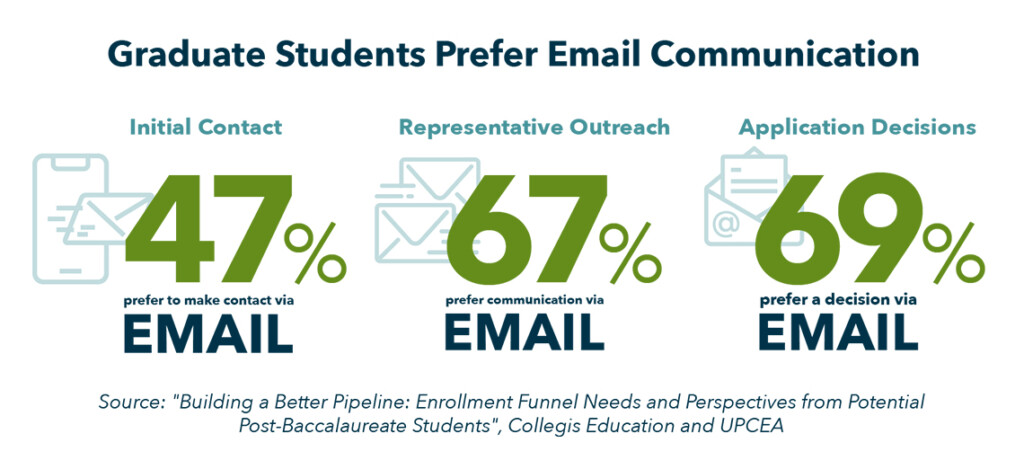
    When it comes to connecting with prospective graduate students, email reigns supreme. Whether it’s inquiring about programs (47%), application follow-ups (67%), or receiving application decisions (69%), email is the channel students trust the most.
    But here’s the catch: your emails have to be timely, personalized, and relevant in order to make an impact.

    The key to graduate enrollment success is just a click away

    The insights highlighted above are just the tip of the iceberg. Imagine what’s possible when you apply them to your graduate enrollment strategy.

    If you’re ready to refine your approach and stay ahead of the curve, we’ve got you covered. Our report dives deeper into the data and uncovers actionable insights, including:

    • Positioning your online and hybrid offerings to meet growing demand
    • Optimizing program pages to emphasize the information students value most
    • Communicating financial information proactively to convert candidates
    • Building email outreach strategies that build trust and keep students engaged

    Grab your complimentary copy of the report today, and let’s start building a better pipeline together!

    Your roadmap to winning in the competitive graduate market.

    Optimize Your Enrollment Funnel

    Get the latest data on graduate student enrollment trends. Download the full report now.

    Source link

  • A Guide to Video Marketing for Schools

    A Guide to Video Marketing for Schools

    Reading Time: 11 minutes

    With video consumption accounting for nearly 83% of global internet traffic and popular platforms like Instagram, YouTube, TikTok, and Facebook prioritizing video content, video marketing has become indispensable for educational institutions aiming to boost visibility and enrollment. 

    To stay competitive in today’s market, you’ll need to harness the potential of video advertising effectively. This comprehensive guide explores the power of video marketing for schools, the types of video content that work best for student recruitment, strategies for success, and solutions to common challenges.

    Struggling to stand out in a crowded market?

    Boost Enrollment with Engaging Short Videos

    The Power of Video Ads

    Video ads have revolutionized student recruitment strategies. With the average attention span of viewers shrinking to just eight seconds, video offers a uniquely engaging way to capture attention and convey key messages. 

    Prospective students, especially from Generation Z, respond favorably to videos that are authentic, visually appealing, and emotionally resonant. Institutions that embrace this medium can benefit in several ways.

    HEM Image 2HEM Image 2

    Source: HEM

    Are you ready to start seeing the benefits of video marketing for schools in your strategy? Reach out to learn about our short-form video services

    The Rise of Video Content

    The prevalence of mobile devices has played a crucial role in video’s dominance. Roughly 75% of video consumption now takes place on smartphones, which means that optimizing video content for mobile viewing is no longer optional. 

    How can you ensure that your videos perform well on mobile devices? Optimize videos for vertical viewing on social media stories, reels, and TikTok where many of your prospects spend time each day. 

    Videos resonate because they combine auditory and visual stimuli, making it easier to communicate complex ideas quickly. From showcasing campus life to highlighting academic achievements, videos allow your institution to tell compelling stories that resonate with viewers on an emotional level.

    Video is also uniquely positioned to address the challenge of dwindling attention spans. Short, visually rich content quickly captures the viewer’s interest and sustains it by combining engaging visuals with concise messaging. 

    Platforms such as TikTok, with its bite-sized, highly engaging format, demonstrate the power of video to connect with younger audiences effectively. On platforms like YouTube, longer-form videos offer opportunities to dive deeper into campus life, academic programs, or institutional values.

    Engagement metrics further underscore the importance of video. Social media algorithms prioritize video content, leading to higher visibility and better engagement rates. 

    Studies consistently show that video posts receive significantly more likes, shares, and comments than static posts. This increased interaction enhances the institution’s online presence and builds a stronger connection with potential students by inviting them to engage directly with the content.

    Finally, video content creates a multisensory experience that helps prospective students visualize themselves at the institution. When students see themselves participating in activities, walking the campus, or enjoying the community, they are more likely to form an emotional connection that influences their decision-making process. 

    Example: Here, UC Berkeley shares a short, interesting interview-styled video, optimized for vertical video apps. When choosing a video format and editing your video, be sure to keep your viewer’s short attention span in mind.

    @ucberkeley What do students from around the world know about UC Berkeley? 🐻🌎 #berkeley #ucberkeley #studyabroad #bayarea #publicinterview ♬ original sound – UC Berkeley

    Source: UC Berkeley | TikTok

    Types of Video Ads for Student Recruitment

    To fully leverage video advertising, it’s important to understand the different types of videos that resonate with your audience. Each type serves a unique purpose, allowing schools to communicate effectively across various platforms.  

    Hype Promo Videos

    Hype promo videos are ideal for generating excitement around major announcements, such as launching a new program or an upcoming campus event. These high-energy videos grab attention with dynamic visuals and captivating music, making them perfect for social media platforms where scrolling speeds are fast. 

    While shorter clips work well for platforms like Instagram and TikTok, longer versions can be hosted on the institution’s website or YouTube channel to provide a more comprehensive overview.

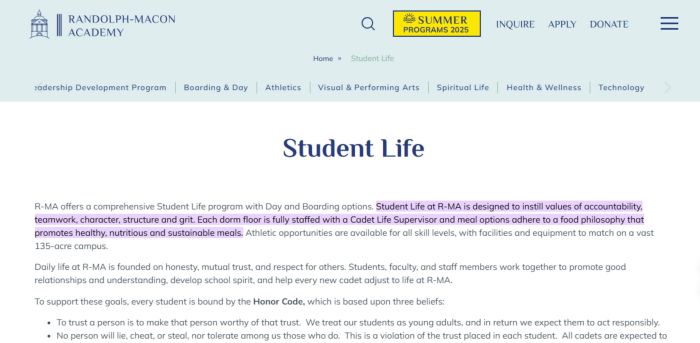
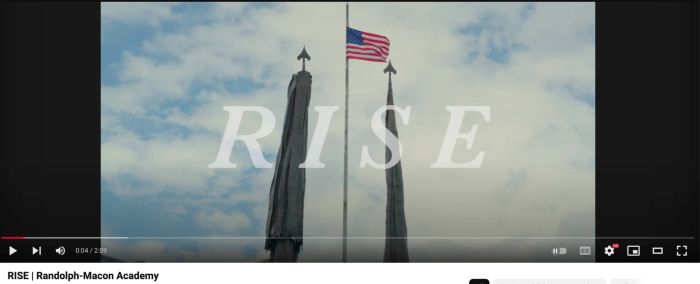
    Example: Randolph-Macon Academy uses high-quality footage, eye-catching editing, and epic music to tell a compelling story about the student life experience they offer. Hype promo videos are an excellent avenue for visual storytelling.

    HEM Image 4HEM Image 4

    Source: Randolph – Macon Academy | YouTube

    User-Generated Content

    User-generated content (UGC) is a game-changer for student recruitment. Content created by current students, alumni, or ambassadors exudes authenticity, which prospective students highly value. 

    Whether it’s a student documenting their day on campus or an alumnus sharing their career journey, UGC builds trust and fosters a sense of relatability. Institutions can encourage student participation by offering incentives like branded merchandise or featuring contributors prominently on official channels.

    Example: This UGC video from Cumberland College is authentic and appeals to the desires of a specific Gen-Z audience particularly as the popularity of online careers grows. Throughout your UGC campaign, be sure to focus on highlighting genuine experiences to differentiate the content from a traditional ad.

    @cumberlandcollegebc ✨ Want to give your career a boost? ✨ Our Digital Marketing diploma program will give you the chance to develop the digital skills you need to thrive in today’s business world! 👉👉 $12,000 in financial aid with the new Valued Skills Bursary available when you study online or at our Surrey campus! #DigitalMarketing #Surrey #BC #OnlineLearning #CumberlandCollege ♬ original sound – Cumberland College

    Source: Cumberland College

    DIY Video Tips

    Limited budgets should never deter institutions from producing impactful video content. If you’re wondering how to create video ads on a limited budget, look no further than a modern smartphone. Capable of capturing high-quality footage, you can create professional-looking videos without expensive equipment.

    Simple strategies like natural lighting, stabilizing the camera, and adding subtitles can elevate production quality. Starting small with test videos allows for refinement over time, paving the way for a more robust video marketing strategy.

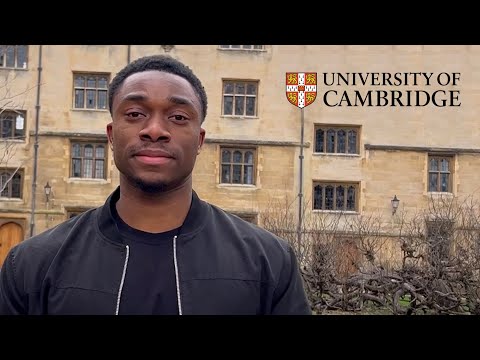
    Example: Video marketing for schools doesn’t always have to involve highly produced footage. As long as the quality isn’t compromised, and the results are just as engaging, all you really need to get started is a modern smartphone with a decent camera and some creative ideas. Video marketing is heavily trend-driven, particularly on platforms where short-form videos are popular. For your DIY videos, do preliminary research, taking note of the trends that viewers are responding to.

    YouTube videoYouTube video

    Source: Cambridge University | YouTube

    Strategies for Effective Video Content

    Creating effective video ads requires more than just compelling visuals. Institutions must adopt a strategic approach to ensure their content aligns with their goals and resonates with their target audience.

    Focus on Quality Over Quantity

    Every video should reflect the institution’s values, strengths, and mission. To ensure consistently high-quality video content, schools can implement several strategies. 

    First, create clear production guidelines that include lighting, sound, and framing recommendations. These guidelines can help amateur creators, such as students contributing user-generated content, maintain a professional standard.

    When relying on user-generated content (UGC), provide participants basic training or tip sheets on capturing footage. Encourage contributors to use stable tripods, proper lighting, and minimal background noise to enhance video clarity. Offering editing support or simple tools to enhance UGC—such as branded filters or overlays—ensures that the final product aligns with the institution’s brand identity.

    Consistency in quality also comes from pre-production planning. For example, institutions can create storyboards or scripts for key content themes, ensuring each video maintains a cohesive narrative. Review processes are equally critical; assigning a designated team or individual to review and approve content before publication allows schools to catch inconsistencies and errors early.

    Investing in scalable tools, such as video editing software or mobile apps, allows schools to polish videos before posting. Paired with these efforts, periodic feedback sessions with creators can help refine content over time. A single high-quality video can generate more engagement and drive more conversions than a series of poorly produced clips.

    Segment Videos by Topic

    Educational institutions cater to diverse audiences, each with unique interests and priorities. By creating topic-specific videos, schools can address these varying needs effectively. For instance, one video might highlight academic programs, while another focuses on student life or campus facilities. 

    This segmentation ensures prospective students receive information tailored to their interests, enhancing engagement and encouraging further exploration.

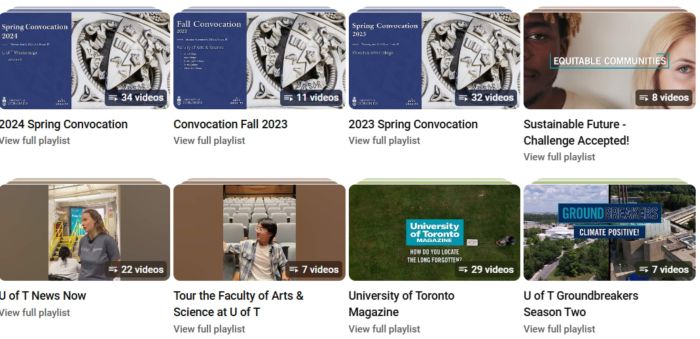
    Example: Organize your videos into playlists to make it easier for viewers to find what they’re looking for as the University of Toronto did on their YouTube page in the image below.

    HEM Image 7HEM Image 7

    Source: University of Toronto

    Showcase Real Success Stories

    Nothing resonates more deeply than genuine success stories. Featuring interviews with current students, alumni, or faculty members allows institutions to highlight real-world outcomes and the impact of their programs. 

    These narratives provide relatable insights that prospective students can envision for themselves, making the institution’s offerings more tangible and aspirational.

    To create compelling success story videos, schools should start by identifying standout students or alumni whose journeys reflect the institution’s values and strengths. 

    Conduct interviews in visually appealing settings, such as iconic campus locations, to give viewers a sense of place. Incorporate diverse voices and experiences to ensure the stories resonate with a wide audience.

    Actionable strategies include integrating authentic visuals, such as clips of the featured individual participating in classes, engaging in extracurricular activities, or achieving milestones in their careers. Pair these visuals with concise, heartfelt narratives that emphasize personal growth and accomplishments.

    For consistency and quality, schools can create a structured framework for storytelling. This might include opening with a brief introduction, highlighting the challenges or goals the individual faced, and concluding with their achievements and future aspirations. Encourage participants to speak naturally, as unscripted moments often feel more genuine and relatable.

    Additionally, amplify the impact of these stories by embedding them into broader marketing campaigns. Share snippets on social media, include them in email outreach, or feature them prominently on the institution’s website. This multi-channel approach ensures that success stories reach prospective students at various touchpoints, enhancing their overall effectiveness.

    Boost Engagement with CTAs

    Every video should include a clear and compelling Call-To-Action (CTA). CTAs are the bridge between engagement and action, guiding viewers to take the next step in their journey with the institution. To craft effective CTAs, schools should focus on clarity and relevance. For instance, a video showcasing campus life might end with an invitation to “Book a Campus Tour,” while a testimonial video could encourage viewers to “Apply Today and Start Your Journey.”

    The placement and timing of CTAs are equally important. CTAs placed at the end of a video often drive action most effectively, as viewers are already immersed in the content. However, mid-video CTAs can also be used strategically in longer videos to re-engage audiences who may drop off before the end. Interactive elements like clickable links or embedded forms can make CTAs even more effective by reducing friction for viewers.

    Customization of CTAs based on the platform is another key strategy. On YouTube, a CTA might take the form of a video overlay or end screen, while Instagram could use stickers or swipe-up features. These platform-specific approaches ensure that the CTA feels natural and intuitive to the viewer.

    Finally, measuring the success of CTAs is critical. Schools can track metrics such as click-through rates, conversions, and engagement to refine their approach over time. A/B testing different CTA phrasing or formats can also provide valuable insights into what resonates most with prospective students. With these strategies in place, CTAs can transform passive viewership into active interest and tangible results.

    Overcoming Challenges in Video Marketing

    Despite its benefits, video marketing comes with its own set of challenges. Educational institutions must address these hurdles to maximize the impact of their campaigns.

    Privacy and Legal Compliance

    Privacy concerns are paramount when creating promotional content involving students. Institutions should implement consent forms and adhere to relevant regulations to ensure that all video materials comply with legal requirements. Transparency in this process not only safeguards the institution but also builds trust with stakeholders.

    Maintaining Brand Cohesion

    Consistency is key to building a strong brand identity. To achieve this, schools should develop a brand style guide that outlines visual and messaging standards for all video content. This ensures that every video aligns with the institution’s overall branding, reinforcing recognition and credibility.

    Generating Fresh Content

    Keeping content fresh and engaging can be a challenge, especially for institutions with limited resources. One solution is to develop themes or “content buckets,” such as academic achievements, campus events, or faculty highlights. This approach provides a structured framework for content creation, making it easier to maintain a steady flow of new material.

    Leveraging Stock Footage

    For institutions with constrained budgets, stock footage offers a cost-effective alternative to original video production. By customizing stock footage with branded elements like logos or text overlays, schools can create visually appealing content that feels authentic and aligned with their messaging.

    Enhancing Impact with Professional Elements

    While authenticity is critical, incorporating professional touches can elevate video quality and make content more impactful. Techniques like using green screens, investing in studio settings, and optimizing videos for mobile viewing can significantly enhance production value. 

    Additionally, tailoring content for specific platforms—such as LinkedIn for professional audiences or Instagram for visual storytelling—ensures maximum reach and engagement.

    Building Trust Through Authenticity

    Authenticity is the cornerstone of effective video marketing. Overly polished advertisements can sometimes feel impersonal, while genuine, unscripted content fosters emotional connections. 

    Videos that highlight real student experiences, showcase unfiltered moments, or provide behind-the-scenes glimpses into campus life resonate deeply with prospective students, making them more likely to consider the institution.

    Cost-Effectiveness and ROI

    Video marketing doesn’t have to break the bank. User-generated content, in particular, offers a highly cost-effective way to create engaging videos. Encouraging students and alumni to contribute content not only reduces production costs but also enhances relatability. 

    When paired with strong CTAs, video ads often outperform other formats in generating conversions, making them a high-ROI investment for student recruitment campaigns.

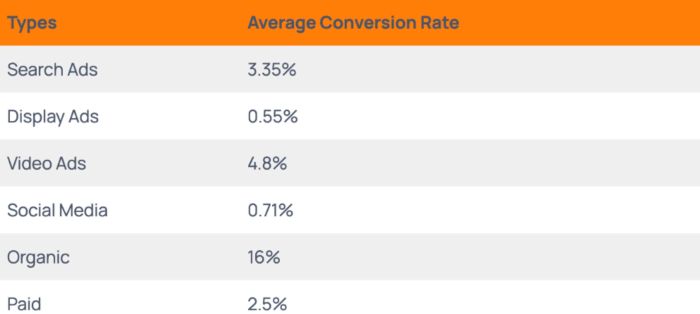
    Example: Pictured below are the average conversion rates of various traffic sources. Second only to organic traffic (referring to visitors that complete a desired action after finding your institution through unpaid search results), video marketing boasts a high 4.8% conversion rate making it a worthy investment.

    HEM Image 8HEM Image 8

    Source: Business Dasher

    In review, what are the best video marketing strategies for schools? Creating effective video ads requires you to go beyond compelling visuals. Schools need to adopt a strategic approach to ensure their content aligns with their goals and resonates with their target audience. 

    This includes focusing on quality over quantity by creating visually appealing and professional videos that reflect the institution’s values. Schools should also segment their video content by topic to cater to the diverse interests of their prospective students, ensuring each video delivers targeted and relevant information.

    Leveraging real success stories is another impactful strategy, as these narratives provide relatable and aspirational insights. Institutions should also craft clear and engaging calls-to-action (CTAs) that guide viewers toward the desired next steps, such as applying or signing up for a campus tour. 

    Ensuring consistency in quality, brand cohesion, and authenticity while addressing privacy concerns and optimizing for platform-specific formats will further enhance the effectiveness of video ads. By combining these strategies, you can create videos that capture attention and drive meaningful engagement and conversions.

    Video ads are transforming digital marketing strategies for schools. Embracing this powerful medium can significantly amplify your reach, foster emotional connections, and drive enrollment. From leveraging user-generated content to creating high-quality promotional videos, the strategies outlined in this guide provide a roadmap for success. 

    Don’t get left behind as marketing trends evolve. Institutions that prioritize video marketing will be better positioned to connect with the next generation of students and thrive in an increasingly competitive landscape. The time to invest in video ads is now and we can help you get started.

    Struggling to stand out in a crowded market?

    Boost Enrollment with Engaging Short Videos

    Frequently Asked Questions

    Question: How to create video ads on a limited budget?

    Answer: Look no further than a modern smartphone. Capable of capturing high-quality footage, you can create professional-looking videos without expensive equipment. Simple strategies like using natural lighting, stabilizing the camera, and adding subtitles can elevate production quality.

    Question: What are the best video marketing strategies for schools?

    Answer: Creating effective video ads requires you to go beyond compelling visuals. Schools need to adopt a strategic approach to ensure their content aligns with their goals and resonates with their target audience.


    Source link

  • Leverage Student Ambassadors and UGC in Education Marketing

    Leverage Student Ambassadors and UGC in Education Marketing

    Reading Time: 11 minutes

    Authenticity has become a cornerstone of successful education marketing campaigns. Nothing speaks louder to prospective students than real experiences shared by current students. That’s why we recommend the combined use of two powerful tools: student ambassador programs and user-generated content (UGC). 

    These strategies harness the voices of your students to create compelling, authentic narratives that resonate. In this blog, we’ll explore the enrollment-boosting potential of student ambassadors and UGC for education marketing, the benefits they offer, and actionable steps to integrate them into your strategy. Let’s get started!

    Struggling with enrollment?

    Our expert digital marketing services can help you attract and enroll more students!
    Understanding the Role of a Student Ambassador

    What is a student ambassador? A student ambassador is a current student who represents your institution in various capacities, from marketing and recruitment to campus events. These individuals are typically chosen for their enthusiasm, communication skills, and ability to connect with diverse audiences. 

    What do student ambassadors do? As the face of your school, student ambassadors embody its culture and values, offering prospective students and their families an authentic glimpse into campus life. 

    The roles of student ambassadors are varied. They may host campus tours, participate in Q&A sessions during open houses, or even create content for your social media platforms. By sharing their personal experiences, they help humanize your institution, breaking down barriers and building trust.

    HEM Image 2HEM Image 2

    HEM Image 3HEM Image 3

    Source: University of Waterloo

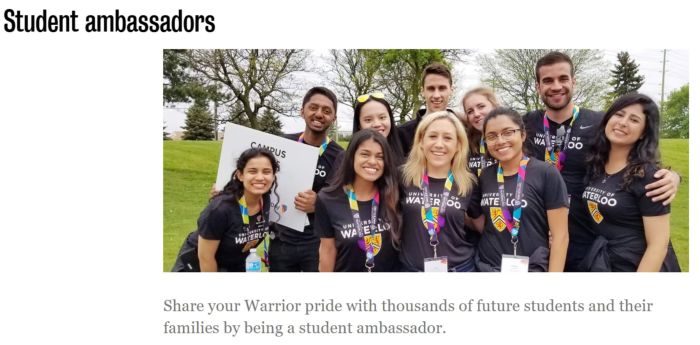
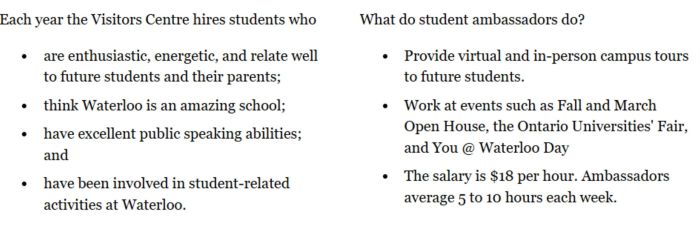
    Example: On its website, the University of Waterloo has a dedicated page for members of its community who are interested in its student ambassador program. This page details the role of a student ambassador, the requirements for candidates, their workload, and compensation. When you launch your student ambassador program, use site content to provide vital information to potential candidates and the students they’ll support in their roles. Use social media to keep your audience updated on the application process and involve student ambassadors in content creation to establish a relationship between them and the rest of your student body. 

    Reach out for help implementing effective enrollment-boosting digital marketing strategies! 

    What Is User-Generated Content (UGC)?

    User-generated content (UGC) refers to any content created by your students, alumni, or even staff, rather than your marketing team. This can include photos, videos, testimonials, social media posts, or blogs that showcase their authentic experiences. Unlike polished advertising campaigns, UGC is often raw and unfiltered, making it highly relatable and trustworthy.

    Now that audiences are bombarded with promotional material, UGC stands out. It delivers a level of authenticity that professionally crafted content simply cannot replicate. For prospective students, seeing someone “just like them” thriving at your institution can be the deciding factor in their enrollment journey.

    HEM Image 4HEM Image 4

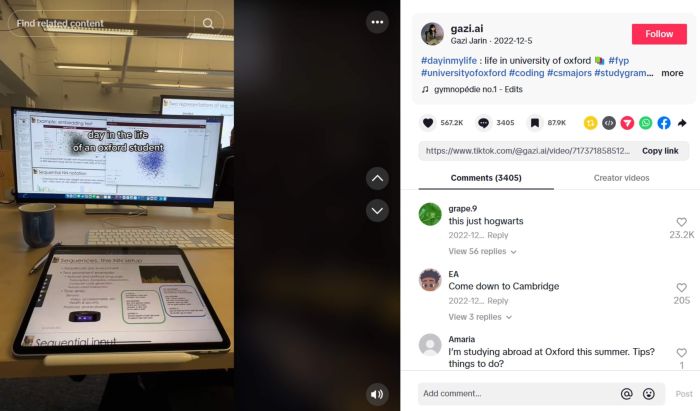
    Source: University of Oxford | TikTok

    Example: Take a look at the comments on this TikTok video. The bottom one shows how many prospective students are turning to current students for advice and insights into their journey with your institution. This “day in the life” video from a University of Oxford student offers a glimpse into campus life from a personal perspective. Videos shared on a student’s personal page often feel more genuine since they don’t come across as promotional content.

    That’s not to say your school shouldn’t engage with these posts! Use hashtags, like #universityofoxford, to find UGC created by your community and reshare it on your school’s profile. To encourage more of this content, promote specific hashtags and even run contests or challenges to inspire creativity and engagement.

    The Benefits of Student Ambassadors and UGC

    Though their methodology is different, both student ambassador programs and UGC help to tell your school’s unique story authentically.

    These methods are particularly effective at humanizing your school’s brand. Discover some more of the unique benefits you can see when you combine these strategies correctly.

    • Authenticity and Trust: Both student ambassadors and UGC provide unfiltered insights into your institution. Prospective students are more likely to trust the words of a peer than a marketing brochure. When real students share their stories, it creates a sense of transparency and trust.
    • Increased Engagement: Content created by student ambassadors and peers often performs better on social media platforms. Audiences are more likely to engage with posts that feel genuine and relatable. This increased engagement can translate to higher visibility for your institution.
    • Cost-Effectiveness: Leveraging the voices of your students can reduce the need for extensive advertising budgets. While there may be costs associated with training or compensating ambassadors, the return on investment through increased applications and enrollment often outweighs the initial expenditure.
    • Community Building: By involving students in your marketing efforts, you foster a sense of pride and belonging. Ambassadors feel more connected to your institution, and their enthusiasm is infectious, positively influencing both their peers and prospective students.

    How to Build a Successful Student Ambassador Program

    Building a student ambassador program involves creating a structured initiative that aligns with your school’s marketing goals and fosters authentic engagement. A successful program requires careful planning, clear objectives, and ongoing support to empower ambassadors as true representatives of your institution. Here, we’ll walk you through the essential steps to design and implement a program that connects with prospective students and amplifies your school’s story.

    Define Clear Objectives

    Clear objectives are the cornerstone of a student ambassador program, aligning with your marketing goals and guiding ambassadors toward success. Start by clearly outlining the program’s purpose. For example, increasing applications, enhancing campus tour experiences, or boosting social media engagement. 

    This clarity of intent should be paired with measurable goals, to help ambassadors understand what success looks like. Measurable goals could be increasing tour attendance by 20% or generating a set number of social media posts each month 

    Tailor these objectives to match the unique strengths of each ambassador, assigning roles that play to their talents, such as public speaking for campus tours or storytelling for blog posts and videos. Providing a clear role description that details their responsibilities, tasks, and time commitments is equally critical to avoid confusion and set expectations. 

    To foster motivation, explain the “why” behind their tasks, helping them see how their efforts impact prospective students, build trust in the institution, and contribute to enrollment goals. Regular check-ins or feedback sessions can also ensure ambassadors stay on track, allowing for adjustments and maintaining engagement. With clearly defined objectives and the right support, ambassadors can confidently represent your institution and drive meaningful results.

    Recruit the Right Ambassadors

    Select ambassadors who reflect the diversity and values of your institution. Look for individuals who are enthusiastic, articulate, and comfortable sharing their experiences. Peer recommendations, faculty referrals, and application processes can help identify the best candidates.

    Foster Collaboration

    Facilitate collaboration between ambassadors and your marketing team. Regular meetings can help align their content with your broader campaigns while maintaining authenticity. Ambassadors should feel supported but not micromanaged.

    HEM Image 5HEM Image 5

    Source: University of Windsor

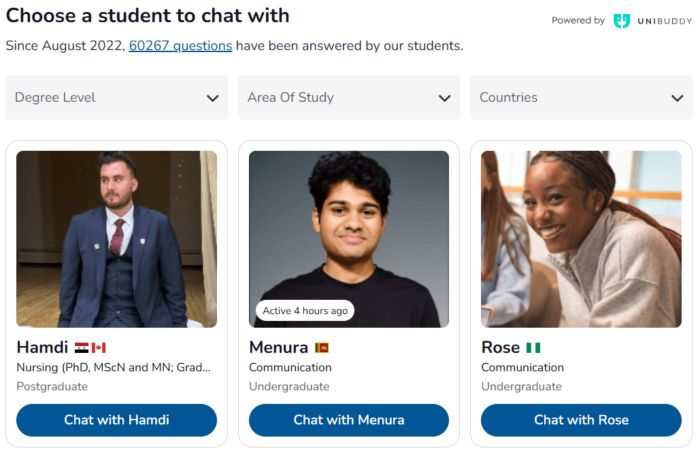
    Example: The University of Windsor demonstrates trust in its student ambassadors with a unique feature on its website. It allows current and prospective students to select an ambassador to chat with for answers to their school-related questions. To replicate this success, implement a comprehensive training program to ensure consistency and quality. Clear expectations enable your ambassadors to take on key responsibilities confidently, delivering a strong return on your investment.

    Provide Comprehensive Training

    • Familiarize Ambassadors with Your Institution’s Key Messaging and Values
      Begin by familiarizing ambassadors with your institution’s key messaging and values. This includes providing them with a clear understanding of your school’s mission, vision, and what sets it apart from competitors. Equip them with talking points about academics, extracurricular offerings, campus facilities, and student life, ensuring consistency in how they communicate your brand. Role-playing exercises can be particularly effective here, helping ambassadors practice delivering messages in a variety of scenarios, such as open houses, campus tours, or online Q&A sessions.
    • Train Ambassadors on Social Media Best Practices
      Training should also include social media best practices, especially if ambassadors are creating content for your platforms. Teach them how to craft posts that are engaging and aligned with your school’s tone and style. Provide guidelines on appropriate language, photo and video quality, and compliance with privacy policies.
    • Develop Public Speaking Skills
      Since many ambassadors will engage with prospective students and families in person, public speaking training is invaluable. Help them refine their communication skills with workshops that focus on clarity, confidence, and storytelling. Encourage them to share personal anecdotes about their experiences at your school, as these authentic stories are often the most memorable. Practice sessions with constructive feedback can significantly boost their comfort in delivering presentations or handling impromptu questions.
    • Build Soft Skills for Diverse Audiences
      Effective training also involves building soft skills like empathy, adaptability, and cultural awareness, especially for ambassadors interacting with diverse audiences. 

    Include scenarios that challenge them to navigate different cultural perspectives or address sensitive questions tactfully. By fostering these skills, you ensure ambassadors can create welcoming and inclusive experiences for prospective students and their families.

    • Incorporate Interactive Training Methods
      To make training engaging and practical, use a mix of interactive methods such as role-playing, group discussions, and hands-on activities. Incorporate real-world examples and success stories from past ambassadors to inspire new recruits and show them what’s possible. Providing a training manual or digital resource hub can also serve as a handy reference for ambassadors as they grow into their roles.
    • Provide Ongoing Support and Refreshers
      Finally, ongoing support and refreshers are critical. Schedule periodic check-ins to provide additional guidance, address challenges, and celebrate successes. The more prepared they are, the more effectively they’ll represent your school.

    Empower Ambassadors to Create

    Empowering student ambassadors to create their own content is one of the most effective ways to showcase the authentic, lived experiences that resonate with prospective students. By trusting ambassadors with creative freedom, you enable them to craft content that feels genuine and relatable—qualities that polished marketing campaigns often struggle to replicate.

    Start by encouraging ambassadors to focus on their personal experiences and unique perspectives. Heartfelt testimonials are another powerful form of content. Whether it’s a written story, a video, or a social media post, ambassadors sharing their personal journeys—why they chose your school, how it’s impacted their lives, and what they’ve learned—can create an emotional connection with viewers. 

    To provide inspiration and structure, consider giving student ambassadors a content calendar – a detailed content plan that outlines the where, what, and when of your posts. Highlighting diverse voices within your ambassador team ensures a broad range of experiences and perspectives are represented, appealing to a wider audience.

    Celebrate Their Contributions

    Recognize and reward your ambassadors for their efforts. This can range from financial compensation to exclusive perks like access to networking events or career development opportunities. Publicly celebrating their work reinforces their value and motivates others to get involved.

    HEM Image 6HEM Image 6

    Source: New York University

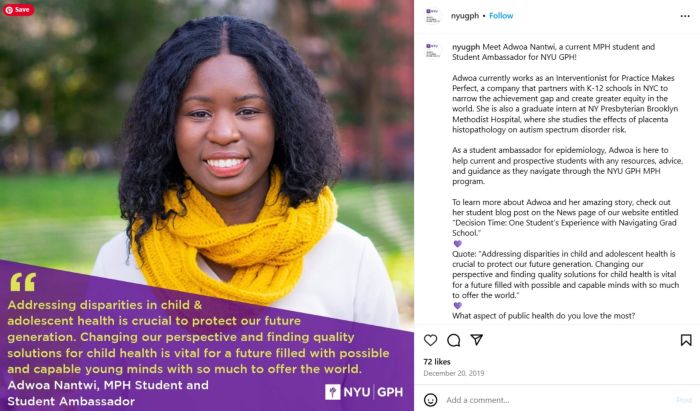
    Example: Here, New York University’s School of Global Public Health welcomes a new student ambassador, celebrating her accomplishments in the field, describing her role in the NYU community, and directing the audience to her student blog post. In addition to monetary rewards, student ambassadors appreciate public acknowledgments of their contributions. 

    Measure Success

    Track the impact of your ambassador program using metrics such as social media engagement, website traffic, and application rates. Use this data to refine your approach, ensuring continuous improvement.

    Incorporating UGC into Your Marketing Strategy

    A UGC marketing campaign can be a goldmine for schools looking to leverage their communities to tell their story. By encouraging students to share their experiences, you tap into a wealth of relatable and engaging material that resonates with prospective students. Let’s explore how to integrate UGC into your marketing strategy for maximum impact.

    Create Opportunities for UGC

    Encourage your students to share their experiences by hosting contests, themed hashtag campaigns, or student takeovers on social media. The more accessible you make the process, the more likely students are to participate.

    HEM Image 7HEM Image 7

    Source: Caleontwins | TikTok

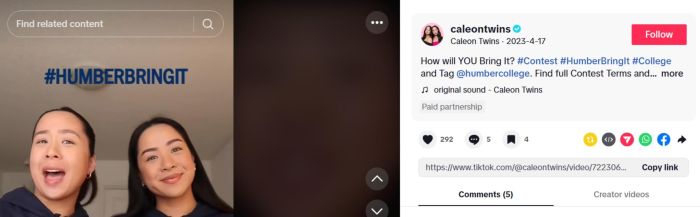
    Example: Here, Humber College has paid well-known influencers to promote a contest called Humber Bring It. The aim was to showcase all the unique skills students brought to their community. In their video, the Caleon twins shared all the essential details of the contest such as the deadline, prizes for winners (a 5000 dollar tuition credit or a laptop), and the hashtag that each contestant should use. Contests like this are the perfect way to create a UGC buzz around your institution. 

    Showcase UGC Across Platforms

    To maximize the impact of user-generated content (UGC), feature it prominently across your marketing platforms. Incorporate student stories, photos, and videos on your website’s homepage, within program pages, and in blog posts to provide a genuine glimpse into campus life. Social media channels are another natural home for UGC, where they can drive engagement and create relatable touchpoints with prospective students. Consider integrating this content into admissions brochures, emails, and campus tour presentations to ensure consistent messaging.

    Before sharing any UGC, prioritize student consent. Always seek permission from contributors, clearly explaining where and how their content will be used. Providing written guidelines and gaining explicit agreement ensures transparency and builds trust. By celebrating your students’ experiences respectfully and prominently, you showcase your school’s vibrant community and also create a foundation of authenticity and ethical storytelling that resonates with your audience.

    Maintain Quality Control

    While UGC is inherently less polished, maintaining a level of quality ensures it aligns with your institution’s values and messaging. Begin by establishing clear guidelines for students contributing content. 

    These guidelines should outline your school’s tone, branding, and expectations for appropriateness, while still encouraging creativity and individuality. For example, provide tips on photography and video basics, such as lighting and framing, to enhance visual appeal without compromising authenticity.

    Review content before publication to ensure it represents your school positively. This doesn’t mean heavily editing or sanitizing the material—rather, it’s about ensuring the content reflects your institution’s culture, is free of inappropriate language or imagery, and avoids unintentional misrepresentation.

    Offering feedback to students can also be a valuable learning experience, helping them refine their work while staying true to their voice. By balancing authenticity with quality, you showcase the best of your community in a way that’s both relatable and professional.

    Engage with UGC Creators

    Show appreciation for students who contribute content by engaging with their posts, sharing their work, or even spotlighting them in dedicated campaigns. This not only boosts their morale but also encourages others to participate.

    Use UGC to Tell Stories

    Go beyond individual posts by weaving UGC into cohesive narratives. For example, compile videos and testimonials into a series showcasing different aspects of campus life. Storytelling adds depth and emotional resonance to your campaigns.

    Bringing It All Together

    Student ambassador programs and UGC are avenues for building authentic connections with your audience. By leveraging the voices of your students, you showcase your institution’s unique story in a way that resonates deeply with prospective students and their families.

    At Higher Education Marketing, we specialize in helping schools like yours unlock the potential of these strategies and many others. Whether you’re just starting or looking to refine your approach, our expertise ensures your campaigns drive meaningful engagement and results.

    Your students are your greatest storytellers. Let their voices elevate your brand and inspire the next generation to join your community.

    Struggling with enrollment?

    Our expert digital marketing services can help you attract and enroll more students!

    Frequently Asked Questions 

    What is a student ambassador

    A student ambassador is a current student who represents your institution in various capacities, from marketing and recruitment to campus events.

    What do student ambassadors do? 

    As the face of your school, student ambassadors embody its culture and values, offering prospective students and their families an authentic glimpse into campus life.

    Source link

  • Understanding Digital Marketing Strategy and Costs to Effectively Budget for Growth

    Understanding Digital Marketing Strategy and Costs to Effectively Budget for Growth

    In today’s digital-first world, higher education institutions are increasingly turning to digital marketing to educate, engage, enroll, and retain students. However, one of the key challenges that the campus decision-makers face is understanding the potential costs associated with digital marketing and how to effectively budget for growth.

    As someone deeply immersed in the world of digital strategy, I often find myself having the same conversation with campus leaders: how do we set realistic expectations about what it really costs to do effective digital marketing? And more importantly, how do we directly link those costs with your institution’s growth objectives? In this blog, I will highlight the key data-driven strategies for assessing ROI and how these strategies inform a strategic budget plan that strengthens your institution’s overall portfolio and drives sustainable growth.

    The importance of setting realistic expectations

    Success in higher education landscape, particularly when managing a large portfolio, is driven by a disciplined, metrics-oriented approach. From my experience, the institutions that excel are those that rely on crisp numbers, rigorously evaluate their plans ahead of time, and understand the value of projections and estimations. By leveraging detailed forecasts and aligning resources accordingly, we can navigate the complexities of enrollment growth with precision and confidence, always mindful that incremental progress, evaluated at every stage, is key to achieving long-term goals.

    Setting expectations means recognizing that significant results take time and careful planning. This translates to setting realistic growth expectations based on an understanding that reaching your enrollment goals will take multiple academic terms. When I am collaborating with our partners, we adopt a structured five year growth trajectory where Year 1 serves as the “foundational” phase, establishing the core infrastructure and strategic alignment. Year 2 is focused on “scaling,” optimizing initial investments to drive measurable growth. Years 3 and beyond are dedicated to “sustained value creation,” with a continuous focus on refining processes and maximizing returns through ongoing optimization and strategic enhancements. This phased approach allows for calculated risk-taking and ensures a clear path to long-term, scalable success.

    Chart showing 5-year projected growth for digital leads with 20%YoY growth

    Once we’ve set realistic expectations for our digital strategy, it’s crucial to ensure that every tactic -whether paid digital marketing, SEO, or creative content, all work together seamlessly to achieve your goals. These elements don’t function in isolation; rather, they complement each other to drive greater visibility, engagement, and, ultimately, enrollments. A well-rounded strategy that integrates SEO to boost discoverability, paid digital marketing for targeted reach, and compelling content to engage prospective students will create a strong foundation for success. By understanding how these components interrelate, you’ll be better equipped to assess their effectiveness and make data-driven adjustments as needed.

    From here, let’s dive into how digital strategy translates into budget planning and ROI. Understanding the interconnectedness of these key elements will help you allocate resources more efficiently and set a clear path for measuring the success of your investments.

    Connecting strategy to ROI and crafting a strategic budget plan for growth

    The connection between strategy and ROI is grounded in the ability to align your digital marketing efforts with measurable outcomes, and it all starts with the establishment of clear and precise enrollment goals. Prioritizing top programs ensures that marketing resources are directed toward the areas with the highest demand or growth potential, improving overall program performance. The right channel mix is crucial to reaching the right audience, maximizing visibility, and efficiently converting interest into applications. Monitoring data and optimizing it in real-time ensures that marketing efforts are continuously adjusted for maximum effectiveness, enhancing the likelihood of meeting targets and improving ROI. Finally, effective allocation based on application timing, seasonality projections, and market revisions allows for strategic adjustments in campaigns to account for fluctuating demands, ensuring marketing spend is optimized throughout the enrollment cycle. Collectively, these elements create a robust framework for maximizing ROI, ensuring that marketing investments lead to increased applications, conversions, and, ultimately, student enrollment.

    Graphic of connecting digital marketing strategy to ROI: Enrollment Goal Mapping, Program Prioritization, Channel Mix Strategy, Monitor&Optimize, App Deadlines and Scaling UpGraphic of connecting digital marketing strategy to ROI: Enrollment Goal Mapping, Program Prioritization, Channel Mix Strategy, Monitor&Optimize, App Deadlines and Scaling Up

    How do you craft a budget that supports your growth goals? Whether you are the decision-making authority or a decision influencer, here are the essential steps to craft a budget plan that aligns with your institution’s growth objectives and maximizes your enrollments:

    1. Define your enrollment goals in detail

    When you think of marketing costs, what comes to mind first? How much will it cost to meet your enrollment goals, right? So, your first step in planning a budget is to have your overall Enrollment goal (and, for graduate or online programs, a goal for every program) in front of you. With the goal (or program-level goals) in hand, determine what that means in terms of percentage growth from the current state. You may also have subsidiary goals like enhancing brand awareness, building more brand equity, or engaging alumni. If these are going to be part of your plan, they should also have tangible goals for what you are trying to do. Defining your enrollment goals helps you allocate your budget accordingly and measure ROI effectively.

    STRATEGY TIP

    Develop a “Goal Mapping” Scenario or you can say a Reverse Funnel (for each program). After you set enrollment goals (for the year or the term) you then need to understand the lead to enroll ratio. This will help you work backwards to determine how many accepted apps/admits will be needed, how many completed apps, how many submitted apps, and finally how many qualified leads will be needed. Based on the program category, dig deeper into what the Cost per Leads (CPL’s) are, based on industry benchmarks. That will help you calculate the estimated ad spend needed to generate those qualified leads.
    Goal Mapping for digital marketing: 1. Qualified Inquiry 2. Submitted Application 3. Completed Application 4. Admitted StudentGoal Mapping for digital marketing: 1. Qualified Inquiry 2. Submitted Application 3. Completed Application 4. Admitted Student

    A note on program-level goals: If you don’t have program-level enrollment goals for your online and graduate programs, finalize those as soon as possible. Until then, focus marketing on building brand awareness. It is likely that people in your own backyard could be less familiar with your program than you may think they are. Brand advertising will ensure that awareness rises so that when you have your program goals, you can build your campaigns on a higher level of familiarity with your institution. However, given that Google reports that 75 percent of graduate and online program searches don’t include an institution name, remember that branding alone will not be enough to fill your classes.

    Institutional example: When we began work with one of our partners nearly two years ago, they had not established program-level goals. So, in year one, we focused the largest portion of the budget on institutional awareness, with mini-campaigns focused on specific programs of importance to the institution. By the beginning of the second year, the institution had set program-level goals based on a greater understanding of market conditions. At that point, we began transitioning our campaigns to focus (ultimately 80 percent of the budget) on the programs with the “mini campaign” focused on continuing the brand equity efforts.

    2. Prioritize your programs

    It is highly unlikely that most institutions can spend marketing dollars on every program they offer. This means that in order to maximize the ROI of your marketing budget, you must prioritize your programs. But how? Take a data-driven approach, prioritizing programs for which you a) know there is market demand both among students and employers, and b) understand the competitor environment. These are the “cash cows” that will demonstrate the best ROI on your marketing spend and support the programs that, while not demonstrating significant market demand, are critical to the institutional mission.

    STRATEGY TIP

    Spreading a $100K marketing budget across 15 -20 programs will only dilute the ad spend, by spreading it too thin. Instead, identify the top 5-7 programs that have the greatest market demand and focus on them. Note that sometimes, the programs that seem most in need of a “marketing boost”, really aren’t. They are struggling because their market demand situation is not what it once was.

    Institutional example: A partner institution recently commissioned RNL to conduct a Program Prioritization and Positioning study focused on their current program mix. The goal was to take a data-driven deep dive into 12 programs vying for marketing dollars, with a focus on understanding student demand and employer needs in the region. The results indicated that while one of the programs they had planned to prioritize came out on top, two others that they hadn’t been planning to focus on also demonstrated strong demand, and one of the programs that they had questioned was confirmed as having weak local market demand.

    3. Determine your channel strategy

    Once you have prioritized your programs for marketing ROI, setting your channel strategy is pivotal. Personas (at the graduate and online levels developed for each program) dictate the channels on which you should focus. You don’t want (or need) to be present on every single channel just for the sake of “eyeballs.” Be mindful of the budget and how best to use it in order to maximize return, which can only be accomplished if you apply the personas that will inform you where your target student spend their “digital time.” So, for example, not every program may benefit from marketing on LinkedIn. Since it is expensive with a $10 minimum ad spend, a persona-based approach may indicate that other platforms are a much better match. But you can only do this if you know the characteristics of your audience, and that comes from the program personas.

    STRATEGY TIP

    The critical element in increasing marketing ROI is to engage the right students at the right time on the right channel, without spreading your budget too thin. In contrast, being too invested in any single channel exclusively or too long is also almost always the wrong strategy. There is always a point of diminishing returns as students cycle to different platforms, and you want to be sure to know where to go next before you approach that point by being able to tap into the next new thing.
    Chart of program and channel performance for different degrees and channels.Chart of program and channel performance for different degrees and channels.

    Institutional example: One of our prestigious campus partners was struggling with recent market shifts that resulted in an overall decline in applications. We dug into market and performance data to help them prioritize programs that had the highest lead-to-enroll ratios, lowest cost per acquisition, and good search volume with an eye to increasing marketing ROI and overall success. This approach not only helped regain their momentum at the top of the funnel but also generated strong conversion volume that exceeded goals and sustainably reduced cost per conversion. These changes benefited not only the marketing operation but were also felt by the call center, and further down the funnel where we saw an increase in applications.

    Talk with our digital and enrollment experts

    We’re to help you find the right digital marketing and recruitment strategies. Let’s set up a time to talk.

    Contact us

    4. Analyze data regularly and optimize with agility

    If (quality) content is king, data is queen! Sustained growth can only occur when data and insights are continuously incorporated into strategy. Analyzing performance data is crucial to understanding which programs and channels are yielding the largest numbers of applications and enrollments and, hence, generating the best return on ad spend (ROAS). This type of analysis allows for a data-driven approach to strategic pivots on how the marketing budget is allocated to ensure the highest ROI (or ROAS) across channels and the program portfolio. As the cost of marketing has risen, so has the need for marketers to make an effective case to senior leadership for additional marketing dollars. You can only do this if you can demonstrate that you are the best possible stewards of current resources.

    STRATEGY TIP

    As you continue to increase your campaign efficiency and success with the focus on ROI, your cost per lead will gradually start to go down – on average by 5 – 10 percent in year 2 and beyond. So, campaigns can generate more qualified leads efficiently over the years (for the same cost), thereby maximizing the return on your ad spend (ROAS). This helps you not just grow but also helps in building forecasts and projections for growth compounded over several years – and it also provides a strong ROI-driven basis for any requests you may need to make for additional funds elsewhere.
    Cost-per-lead trends over one year, showing how current CPL has been greatly reduced from the previous year.Cost-per-lead trends over one year, showing how current CPL has been greatly reduced from the previous year.

    A note on analytics platforms: The fact that resources have become increasingly scarce at the same time as marketing costs have skyrocketed has resulted, out of necessity, in more sophisticated tracking of ROI. If your internal systems are set up in the correct manner (or if you are working with a strategic partner like RNL) every lead can be tracked to its source, thereby allowing for the assessment of just how effectively each marketing dollar has been used.

    Institutional example: A prestigious campus partner was having challenges with converting leads to applications and enrollments. We reviewed their full-funnel data (compete with attribution percentages) and realized something wasn’t working. The top of the funnel was healthy, with good lead volume. However, down the funnel we saw that a disproportionate number of leads were not converting to apps and enrollments. As a result of the review and data analysis, we made a bold strategic pivot to shift significant budget allocations to the channel (Google search) that we could see was producing the greatest numbers of applications and enrollments. Without the data, solving the challenge would have been impossible. With the data, it was easy. Since we made this change, applications, and enrollments have consistently increased each academic period.

    Graphic showing two circle charts and the reallocation of channel spend from Facebook as the largest channel to Google Search as the largest channelGraphic showing two circle charts and the reallocation of channel spend from Facebook as the largest channel to Google Search as the largest channel

    Making sure that the top of the funnel strategy is guided by down funnel numbers is the KEY! Effective strategy must evolve through ongoing optimizations with thoughtful placements across diverse media platforms that are informed by performance data. Remember that the path to enrollment is rarely linear and an integrated media strategy allows you to provide a personalized message in the right place at the right time.

    5. Understand and account for seasonality/application timings/expansion

    Another aspect of the dynamic nature of the marketing process relates to the seasonality of lead flow – and subsequent enrollment. This requires flexibility to adjust your strategies based on real-time performance data collected throughout the year. For any program or institution, there are times of the year during which more or fewer leads are generated. Fully understanding these trends takes time; you can make preliminary judgments on when the lead volume is highest and lowest within one year, but multiple years will allow for greater certainty. As you build your capacity to track lead generation – and conversion throughout the funnel – by program and source – you can create visualizations that map these factors by month. They can be used to build monthly budget allocations like those presented below.

    Bar chart showing budget allocation over the year for search, social, display, retargetingBar chart showing budget allocation over the year for search, social, display, retargeting

    Institutional example: For one campus partner we used the annual performance data in an innovative way. Our data insights indicated that there was more market share to capture, by having the program leverage low cost per conversion at the top of the funnel at certain points in the year, and low cost per acquisition at the bottom at other points of the year. There was time to scale up both applications and enrollments. We developed a forecast plan to address the potential areas of opportunity, calculated the cost, and pitched it to the partner. Once approved, we moved with agility, and implemented additional ad spend on the top champion programs and frontloaded the budgets for the academic periods yielding the highest number of applicants and enrollments. With this, we were not only able to meet the qualified lead goal but also exceeded the enrollments by 19% for the following academic period.

    The lifetime value of the student

    As you budget for growth, it’s crucial to consider the lifetime value (LTV) of a student. LTV refers to the total revenue a student generates throughout their academic journey and beyond. This value encompasses tuition fees, ancillary revenues (like housing and meal plans), alumni donations, and increasingly in our era lifelong learning opportunities.

    Talk with our digital and enrollment experts

    We’re to help you find the right digital marketing and recruitment strategies. Let’s set up a time to talk.

    Contact us

    Source link

  • Avoiding Marketing Pitfalls Pt. 3: Communicating to Everyone the Same Way 

    Avoiding Marketing Pitfalls Pt. 3: Communicating to Everyone the Same Way 

    In higher education marketing, effective communication starts with understanding that no single message fits every audience. Treating all prospects the same not only dilutes your messaging but also wastes valuable opportunities to engage meaningfully. From hyper-segmenting digital audiences to tailoring follow-up communications, success lies in customizing the way you connect with each unique segment. Here’s how to refine your approach and avoid the pitfall of blanket communication. 

    Hyper-Segmentation: Getting Specific About Who You’re Talking To 

    Not every message serves the same purpose. Awareness messaging has its place—whether it’s introducing your institution to new markets or keeping your name top of mind for existing ones. But when your goal is generating actionable leads, hyper-segmentation becomes essential. 

    The question to ask is: What do we know about each audience, and how can we leverage that in both messaging and segmentation? For example, out-of-state prospects might respond to communication about scholarship opportunities designed for non-residents. A prospective student interested in music may be drawn to band scholarship messaging, while someone working for a partner employer might appreciate hearing about tuition reimbursement benefits. Even behavioral data can unlock opportunities. Consider those who’ve engaged with specific program content but haven’t applied yet—these individuals are prime candidates for abandoned cart-style messaging to re-engage them and move them closer to applying. 

    Hyper-segmentation is not about casting a wide net but rather creating smaller, targeted audiences with clear, actionable insights. The more specific you can get, the better your chances of connecting in ways that matter. 


    Follow-Up Communication: Treating Every Lead with Intent 

    When it comes to follow-up communication, understanding a lead’s origin is critical. A student who visited your booth at a college fair or participated in an in-person campus event has already demonstrated more active engagement than someone who passively submitted their email address after watching a social media reel. Similarly, a lead captured through a paid search landing page may already be deep in their decision-making process and need entirely different messaging than someone still in the exploratory phase. 

    The goal is to meet each lead where they are, considering their intent and what you already know about them. From there, you can take incremental steps to learn more and guide them through the enrollment funnel. For example, an inquiry generated at a college fair might warrant an immediate invitation to schedule a personalized follow-up conversation, while a more passive lead might benefit from an introductory email series designed to build familiarity and trust over time. By aligning your follow-up strategies with the context and intent of each lead, you avoid the misstep of treating them all as if they’re at the same stage of the journey. 


    Building a Messaging Matrix: Positioning Your Value for Every Audience 

    The core features and benefits of your institution don’t change depending on the audience—but how you frame and position them should. A messaging matrix is a critical tool for ensuring your communication resonates with specific groups while maintaining consistency across your overall brand. 

    Investing time in creating a messaging matrix allows you to align features, benefits, and proof points with each of your target audiences. There are certainly obvious points of messaging differentiators—for example, traditional undergraduate students might value campus life, student organizations, and academic advising, while adult learners may prioritize flexible scheduling, career advancement opportunities, and credit transfer policies. Within those broader categories, however, there’s even more nuance—transfer students and first-time freshmen have distinct motivations and concerns. Similarly, graduate students pursuing executive leadership roles will likely need messaging that’s vastly different from that aimed at career advancers just starting their journeys. 

    By taking the time to map out these variations, you create a framework that ensures your messaging aligns with the unique goals and priorities of each segment. This step doesn’t just make your marketing more effective—it also reinforces your brand as one that truly understands the diverse needs of its audience. 


    Closing Thoughts

    In a time when higher education institutions are competing for shrinking pools of prospective students, a personalized approach to marketing is no longer optional—it’s essential. By prioritizing hyper-segmentation, aligning follow-up communications with audience intent, and building out a messaging matrix, you can transform how you engage with prospects at every stage of their journey. The closer you can get to marketing to an audience of one, the better your chances of not only capturing their attention but also converting them into students who feel truly understood and valued by your institution. 


    Jess Lanning began her career in higher education at a private university where she served as director of enrollment marketing on a record enrollment team. Over her decade-long career, she has focused on strategizing and implementing digital marketing campaigns as a senior vice president of strategy and senior partnership manager for higher education-specific agencies. In these roles, she served undergraduate, adult, and graduate audiences across the verticals of paid social, search engine marketing, search engine optimization, conversion rate optimization, digital PR, and user experience. Jess now serves as a Director of Digital Strategy at Liaison and we are very lucky to have her!

    Source link

  • How Admissions and Marketing Teams Can Collaborate

    How Admissions and Marketing Teams Can Collaborate

    Fostering Interdepartmental Collaboration to Drive a More Effective and Engaging Student Journey

    Achieving success in your higher education marketing strategy requires seamless collaboration between your admissions and marketing teams to create a connected, consistent student journey experience. When these teams align, they move beyond their isolated efforts and build a unified strategy that not only captures students’ attention but also drives meaningful engagement and enrollments.

    Admissions teams gain critical, real-time insights from their conversations with prospective students, and marketing teams transform those insights into strategies and assets that resonate with the right audiences. By sharing their insights, both teams can better inform campaigns, conversations, and touchpoints, ensuring every interaction feels intentional, relevant, and student-centered.

    However, this alignment doesn’t happen by chance. It requires deliberate collaboration, thoughtful planning, and the strategic use of data at every stage. From discovery interviews and customer relationship management (CRM) data analysis to shared campaign development, each step in the process plays a vital role in delivering a cohesive, engaging experience that guides prospective students from curiosity to commitment.

    The Importance and Benefits of Collaboration Between Admissions and Marketing Teams 

    In an increasingly competitive higher ed landscape, having admissions and marketing teams that collaborate and communicate with each other regularly can make a meaningful difference in the experience that an institution delivers to prospective students, while optimizing its marketing efforts for maximum impact.  

    When admissions and marketing operate in silos, the cohesion breaks down. Collaboration prevents these gaps, ensuring every message, from the first ad to the final admissions call, feels aligned and purposeful.

    Creating a Unified Message

    Students don’t distinguish between “admissions” and “marketing” — they only see the institution. That’s why a unified message is so crucial to every higher education marketing strategy. A consistent and unified message — whether it’s delivered through ads, emails, website visits, or conversations with admissions personnel — builds trust, strengthens the brand, and guides prospective students smoothly through their decision-making journey.

    Building a Powerful Feedback Loop  

    When admissions and marketing teams stay in consistent communication, they create a powerful feedback loop that strengthens the institution’s messaging and better serves its prospective students.

    Admissions teams are on the front lines, having daily conversations with students and hearing their motivations, hesitations, and questions firsthand. These interactions provide invaluable qualitative insights that can flow back into marketing assets and strategies. 

    For example, if students frequently ask about program outcomes — such as what they can do with a certain degree — marketing can develop targeted blog content, alumni video spotlights, or landing page updates showcasing career opportunities, industry connections, and success stories related to the degree. Additionally, if there are common points of confusion that come up in students’ conversations with admissions staff, marketing materials can be created that clearly and directly address these issues. 

    By tapping into this feedback loop, both teams can make meaningful, real-time adjustments that align the institution’s messaging with students’ priorities, enhance engagement, and drive better outcomes.

    Empowering Teams With Critical Insights and Knowledge

    Both admissions and marketing teams bring something unique and valuable to the table when it comes to understanding the institution’s brand, its offerings, and its students. While there are areas of overlap, each team also has its own distinct focal points that allow it to provide useful details the other team can benefit from, creating a richer and more comprehensive appreciation of how each team can best serve the institution’s students.

    Practical Ways to Collaborate 

    Now that we’ve established the importance of collaboration, let’s take a look at some practical ways to bring this strategy to life. 

    Coordinate and Share Learnings During a Discovery Process

    The first step is discovery, the phase where both admissions and marketing teams collaborate to analyze and uncover insights that will make their work more accurate, impactful, and aligned. The discovery process includes in-depth conversations with key university stakeholders; audits of existing school resources, marketing collateral, and program materials; and market research and competitive analysis to understand the institution’s positioning and audience needs.

    Each team adds unique value to the process. Admissions teams gather information about program-specific details, students’ motivations, and nuances that resonate during enrollment conversations, while marketing teams analyze the institution’s competitive positioning, audience behaviors, and key differentiators. By sharing and coordinating these efforts upfront, teams can reduce redundancies, ensure alignment, and create a more cohesive strategy that delivers consistent, tailored messaging. 

    Here are some tactics that can help in coordinating and consolidating discovery efforts:

    Schedule Ongoing Check-Ins With Teams

    Consistent communication is critical for collaboration. Regular monthly or quarterly meetings that include both admissions and marketing staff create space for sharing insights, identifying trends, and closing messaging gaps. 

    Admissions teams can spotlight common motivations, pain points, and areas of confusion among students, so marketing teams can update campaigns to address these themes in real time. These sessions ensure all higher education marketing strategies stay aligned and adaptive, making the student experience feel more cohesive.

    Leverage CRM Data

    Every interaction with a student leaves a breadcrumb trail of data. By tapping into call notes and CRM system data, admissions and marketing teams can track students’ questions, motivations, and hesitations. 

    Analyzing this data can reveal trends that marketing can address through website updates, FAQs, and ad campaigns. Sharing actionable summaries allows admissions teams to prepare for upcoming conversations and marketing teams to preemptively answer students’ concerns, creating a more seamless experience for prospects.

    Share and Understand Key Resources

    Developing key marketing resources, such as a Strategic Marketing Guide (SMG), and sharing them across teams can help keep admissions and marketing teams’ collaboration efforts on track. 

    An SMG isn’t just a document — it’s the framework that ensures every team is aligned in understanding the key components of the institution’s brand, story, and students. Personas, unique value propositions (UVPs), brand stories and positioning, and messaging frameworks outlined in an SMG help admissions and marketing teams speak the same language and tell a shared story.  

    Connect Your Admissions and Marketing Teams Through Collaboration With Archer

    At Archer Education, we don’t just build marketing strategies — we build lasting capabilities. Our approach goes beyond campaign launches and lead generation to focus on sustainable online infrastructure that empowers universities to thrive long after our work is done. From aligning admissions and marketing teams to developing data-driven messaging frameworks, we act as a true partner in developing custom higher education marketing strategies that work. 

    Our collaboration is designed to transfer knowledge, not just deliver results. We equip your teams with the tools, training, and insights they need to operate with confidence, ensuring your institution isn’t reliant on outside support to maintain momentum. The result is a marketing engine that runs smoothly long after Archer’s involvement has ended, empowering your teams to lead with agility in an ever-changing higher education landscape. 

    Contact us today to learn more. 

    Subscribe to the Higher Ed Marketing Journal:

    Source link

  • 2025 Higher Education Trends: What to Watch & How You Can Plan

    2025 Higher Education Trends: What to Watch & How You Can Plan

    Higher education is experiencing transformative shifts as institutions respond to societal, economic, and technological changes. This year is set to bring new opportunities and challenges. We’re always keeping a pulse on the industry and where it’s headed so we can stay proactive and prepared –– ready to support our partners through whatever conditions they’re facing.

    10 most impactful higher ed trends for 2025

    To help institutions stay ahead, we asked our team of experts to share their predictions for this year’s most impactful trends in higher education. From AI and digital transformation to new enrollment strategies, these insights highlight what’s shaping the future of higher ed— and how institutions can adapt.

    1. Increased mergers and consolidations

    The pace of mergers and consolidations among smaller colleges is expected to accelerate in 2025, according to Collegis Education CEO Kim Fahey. With financial pressures and declining enrollment, many institutions will view mergers as a strategic alternative to closure. But these transitions are anything but simple.

    “Mergers involve unique technology requirements and complex data management challenges,” Fahey explains. Successfully integrating applications, systems, and hardware requires expert guidance. Higher ed leaders will look to partner with experienced organizations to help navigate these intricacies.

    2. Heightened focus on data privacy and security

    The information security landscape is becoming increasingly intricate. With 21 comprehensive state privacy laws, alongside European Union (EU) regulations, federal rules, and Title IV requirements, compliance challenges are mounting.

    “Smaller schools often lack the experience and qualifications to manage these threats,” notes Dr. Jason Nairn, CISSP, Collegis VP of Information Technology. Cyberattacks, like phishing and social engineering, are relentless. In 2025, institutions must prioritize more robust cybersecurity measures, leveraging external partnerships and security tools to protect sensitive data.

    3. Acceleration of digital transformation

    Cloud migration will take center stage as institutions transition away from outdated, on-campus systems. While many schools still rely on highly customized platforms, which limits their ability to adopt or migrate to more modern technology, the adaptability and scalability of cloud platforms are simply too compelling to ignore.

    Furthermore, technology infrastructures must be sufficiently modernized in order to capitalize on emerging tech innovations in AI and predictive analysis. This process can’t happen overnight –– it’s an evolution, according to Fahey.

    “Cloud migrations take 18+ months, so schools need to act now,” she emphasizes. An institution-wide commitment to digital transformation will not only modernize operations but also position institutions to stay competitive in an increasingly tech-driven environment.

    4. Adoption of shared services models

    Financial constraints will push smaller schools toward shared services and consortium models to access the technology and expertise they need at a manageable scale. These models allow institutions to pool resources and reduce costs but require significant change management, according to Jeff Certain, VP of Solution Development at Collegis.

    “This will require schools to standardize and make some concessions,” Certain explains. “This could pose a challenge, but they may not have an option.” Institutions must embrace these shifts to remain sustainable while navigating limited budgets.

    5. Growth in career-focused and flexible education

    Programs aligning with workforce needs will gain momentum in 2025. Alternative credentials like microcredentials and certificates will become more prominent, offering shorter, career-oriented pathways for learners.

    “Institutions will increasingly recognize and credit learning outside the classroom, exploring more direct pathways into the workforce,” predicts Dr. Tracy Chapman, Chief Academic Officer for Collegis. This reflects growing demand for flexible, career-focused education that meets student and employer expectations.

    6. Ed tech consolidation and market impact

    It is not just colleges and universities facing consolidation. Ed tech companies and services providers are also reshaping the landscape with their own mergers and acquisitions. While these changes may offer schools more comprehensive solutions, they may not necessarily align with institutional objectives.

    “Some recent acquisitions have led to poorer customer experiences,” Fahey observes. Institutions must carefully evaluate new partnerships to ensure they will deliver meaningful improvements.

    7. Higher Focus on Retention

    With the “enrollment cliff” looming, institutions must double down on maintaining their existing student base as a key to sustainability. Purposeful and cost-effective retention strategies will play a pivotal role in maintaining financial health, as retaining current students is often more cost-effective than recruiting new ones.

    “Retention strategies build stronger, more loyal communities,” says Patrick Green, VP of Enrollment Strategy. Forward-looking schools have perceived the importance of fostering a sense of belonging across the student lifecycle and are providing robust support networks that improve student persistence and satisfaction.

    8. Rise of value-focused marketing

    Students and families are increasingly demanding clear ROI from their education. As a result, institutions will need to demonstrate how their programs lead directly to employment and career advancement.

    “Building relationships with regional industries and showcasing job placement rates will be essential,” advises Tanya Pankratz, AVP of Marketing at Collegis. Marketing efforts will need to start highlighting tangible outcomes (e.g., alumni success stories, job placement rates, and employer partnerships) to win over prospective students.

    9. Expanded role of AI and emerging technologies

    AI and other emerging technologies will revolutionize higher education operations. From enrollment management and personalized marketing to virtual campus tours using augmented reality (AR) and virtual reality (VR), technology has the means to dramatically enhance the student experience –– or wreak technical havoc if data, platforms and tools are misaligned.

    “AI-driven tools make personalization more accessible, but the strategy remains critical,” notes Dan Antonson, AVP of Data and Analytics. Institutions must invest in data infrastructure to fully harness these advancements in order to build and maintain a competitive edge.

    10. Proliferation of strategic partnerships

    Higher ed institutions are increasingly recognizing that they don’t need to own the entire value chain. In 2025, strategic partnerships will play a more prominent role.

    “Institutions will double down on their core mission of education and seek out partners to support other critical functions,” Dr. Chapman explains. These partnerships provide access to technology, expertise, and resources, allowing schools to focus on what they do best — educating students.

    Opportunities on the horizon for higher ed

    As evident in this compilation of higher ed trends, the landscape is set for significant change in 2025 and beyond. Institutions that proactively address these trends will be well-positioned to navigate challenges and seize opportunities. By embracing digital transformation, fostering strategic partnerships, and adopting value-driven approaches, schools can ensure long-term success in an evolving marketplace.

    Excited about the opportunities that lie ahead? Collegis Education has the experience and expertise to guide you through any twists and turns you may face. We’ll help you stay on the leading edge instead of chasing trends. Connect with us and let’s start creating solutions together.

    Innovation Starts Here

    Higher ed is evolving — don’t get left behind. Explore how Collegis can help your institution thrive.

    Source link

  • 2025 Education Marketing Strategies for Success

    2025 Education Marketing Strategies for Success

    Reading Time: 8 minutes

    Education marketing is poised for a transformative shift in 2025. As technological innovations accelerate and global competition intensifies, schools, colleges, and universities must adopt strategies that meet the evolving expectations of prospective students.

    If you’re new to educational marketing or administration, you may benefit from a working definition of the topic we’re exploring. What is education marketing? Education marketing promotes educational institutions, programs, and services to prospective students, their families, and other stakeholders.

    It involves creating targeted campaigns that address the unique needs, aspirations, and challenges of prospective learners. At its core, education marketing is about building trust, showcasing value, and creating meaningful connections that align an institution’s offerings with the goals of its audience.

    This blog, inspired by insights from the webinar Staying Ahead in 2025: Top Education Marketing Strategies for Success, explores the key trends and actionable strategies to help educational institutions thrive in this dynamic environment. Let’s explore!

    Struggling with enrollment?

    Our expert digital marketing services can help you attract and enroll more students!

    Great Expectations: What Prospects Are Looking for in 2025

    Prospective students in 2025 demand education marketing efforts that resonate with their individual aspirations, challenges, and goals. Personalization has become a non-negotiable element of successful marketing, requiring institutions to deliver tailored messages across diverse platforms. Students value authenticity and transparency, seeking honest communication about program costs, outcomes, and career prospects.

    Social proof is more influential than ever. Reviews, testimonials, and user-generated content (UGC) have become vital tools in building trust and credibility. Institutions that effectively showcase authentic student experiences on platforms like TikTok, Instagram, and YouTube can connect with audiences on a deeper level, cutting through generic promotional noise.

    With over 70% of initial student engagement occurring online, a robust digital presence is critical. Schools with interactive websites, active accounts, and engaging virtual events stand out in an increasingly competitive global market. The ease of accessing information about institutions worldwide has raised the stakes, emphasizing the need for innovative and standout marketing strategies.

    HEM Image 2HEM Image 2

    Source: HEM

    Are you seeking strategies for a future-oriented education marketing plan? Reach out to learn about our specialized digital marketing services! 

    Leveraging AI for Personalization and Automation

    Artificial intelligence (AI) is revolutionizing education marketing by enabling personalized and efficient communication. In 2025, institutions will be using AI-driven tools to deliver highly targeted content and streamline engagement processes.

    AI-powered email marketing has proven to boost open rates and increase revenue per email by analyzing prospective student data. Dynamic segmentation, which groups students based on behaviours like website visits and social interactions, allows institutions to craft campaigns aligned with individual journeys.

    Example: Putting prospects into groups based on their site usage as pictured below is the first step in dynamic segmentation. What comes next? Program your CRM system to update segments as prospects progress through the enrollment process, and finally, use automation tools (ideally integrated into your CRM program) to send follow-up messages after interactions like webinar attendances or program page visits. Amidst many competitors, you must stay fresh in the minds of your prospective students.

    HEM Image 3HEM Image 3

    Source: HEM

    Chatbots are emerging as indispensable tools for managing routine inquiries. Capable of handling up to 80% of these interactions, chatbots provide instant, tailored responses that improve lead-to-application conversion rates. From guiding students to specific program pages to assisting with application processes, chatbots reduce administrative strain while enhancing user experience. For international students, multi-language support ensures inclusivity and accessibility.

    Example: Use Chatbots intentionally like the University of Windsor did below. Site visitors are asked with whom they would like to connect and are sent to a page where they can select the right person to meet their needs. This allows for a customized, self-directed experience.

    HEM Image 4HEM Image 4

    Source: University of Windsor

    Predictive analytics, another AI-driven innovation, enables institutions to anticipate prospective student needs. By analyzing past behaviors, institutions can proactively craft campaigns that address concerns and guide students toward enrollment.

    By analyzing historical data such as website interactions, email engagement, and application trends, predictive analytics identifies patterns that signal a prospective student’s likelihood to take specific actions, such as submitting an application or attending an open house. 

    This technology allows institutions to craft highly targeted campaigns that address common concerns, deliver timely follow-ups, and provide personalized recommendations. Predictive analytics can be applied across various channels, including email marketing, chatbot interactions, and digital advertising platforms, making it a versatile tool for improving enrollment outcomes and optimizing the student journey.

    Optimizing Digital Advertising Strategies

    Digital advertising is an essential component of education marketing, and in 2025, precision and creativity will define success. Institutions are refining their pay-per-click (PPC) campaigns and leveraging video ads to capture attention and drive conversions.

    Precision targeting through platforms like Google Ads and Meta Ads ensures relevance. Long-tail keywords and geo-specific targeting help align campaigns with user intent, making them more effective. For example, phrases like “best nursing programs in Toronto” resonate more with prospective students than generic terms such as ‘nursing programs’ or ‘nursing school’. 

    Video content continues to dominate as the preferred format for engagement. Authentic, short-form videos featuring user-generated content are especially effective. These videos highlight program features, campus life, and success stories, building trust and fostering emotional connections.

    Engaging carousel ad formats are also gaining traction, offering a visually dynamic way to present multiple aspects of an institution in a single advertisement. By showcasing different programs, campus highlights, or student testimonials in a swipeable format, carousel ads keep prospective students engaged longer. These ads are particularly effective on platforms like Instagram and Facebook, where interactive content drives higher click-through rates and engagement. 

    Example: Static ad images are more likely to be skipped. Carousel ads are an attention-grabbing format that incites curiosity. Valuable, relevant, and short-form copy as pictured below works well as it keeps attention while imparting information your audience cares about.

    HEM Image 5HEM Image 5

    Source: Concordia University

    Remarketing strategies are proving invaluable for re-engaging prospective students. Dynamic ads tailored to past interactions, such as revisiting previously explored programs, help institutions stay top-of-mind and boost conversion rates. Platforms like TikTok provide creative opportunities to connect with younger audiences, further enhancing reach and engagement.

    Navigating Changing Search Landscapes

    The rise of AI-powered search engines like Google Gemini and ChatGPT is reshaping how users seek information. These tools prioritize conversational content and direct answers, requiring institutions to adapt their SEO strategies to maintain visibility.

    Example: Incorporating conversational, question-based phrases as pictured below helps your site show up in search results. This is particularly relevant as AI, which favors concise answers, emerges as one of the most transformative education marketing trends. Try to add relevant, on-topic questions that your prospects are likely pondering into site content seamlessly. Then add the answer to that question. This boosts your chances of being featured in “People Also Ask” and other types of rich results.

    HEM Image 6HEM Image 6

    HEM Image 7HEM Image 7

    Source: Gemini

    High-quality, question-based content is essential for meeting the needs of AI-driven search engines and enhancing user experience. Institutions are optimizing FAQ pages to provide comprehensive, conversational answers to prospective students’ most common questions. 

    For example, detailed FAQ sections that include interactive components, such as collapsible menus or embedded videos, help address a wide range of inquiries efficiently. This approach not only supports AI-driven search tools like Google Gemini (Formerly Bard) and ChatGPT but also caters to user expectations for clear, straightforward information.

    Voice search optimization further complements this strategy. With 58% of users relying on voice search daily, content must include natural, long-tail keywords that align with how people speak. For instance, crafting answers to questions like “What’s the cost of a nursing program in Toronto?” ensures visibility in voice and conversational search queries. Together, these strategies create a seamless path for students to access the information they need, whether browsing through AI-enhanced search results or engaging directly with an institution’s website.

    Example: AI tools like Copilot pictured below offer user-friendly, well-structured answers to education-related questions, guiding prospective students effectively to your institution.

    HEM Image 8HEM Image 8

    Source: Copilot

    Local SEO remains a powerful driver of inquiries. Enhancing Google Business Profiles, incorporating location-specific keywords, and encouraging positive reviews are key strategies. Schema markup further boosts visibility by creating rich search results, such as event listings and review stars, that attract clicks and engagement.

    Practical Strategies for 2025

    Content remains central to education marketing success, but its format and delivery are evolving. High-quality, SEO-optimized content that directly addresses student questions is crucial. Institutions are increasingly adopting visual and interactive formats, such as infographics, videos, and quizzes, to create engaging and shareable content.

    Marketing technology plays a pivotal role in streamlining operations. CRM systems and automated email tools enable institutions to automate routine communications, such as application reminders and follow-ups. This ensures timely interactions while freeing up resources for strategic initiatives.

    Mautic is a cutting-edge CRM and marketing automation solution tailored specifically for the education sector. Built on the robust Mautic platform, HEM has enhanced this system to address the unique challenges and opportunities faced by educational institutions. 

    By enabling streamlined lead management, Mautic by HEM allows schools to segment, manage, and follow up with prospects efficiently, enhancing both cost-effectiveness and operational efficiency.

    With Mautic, your school can supercharge your marketing efforts through automated email campaigns, customizable forms, and seamless workflows. The platform’s out-of-the-box custom reports provide deep insights into admissions efforts, helping schools track team productivity and the progress of leads through the enrollment funnel. 

    Tools for automated SMS and email follow-ups, meeting bookings, and calls empower teams to nurture leads effectively, turning prospects into enrolled students. Designed to simplify complex tasks and enhance collaboration, Mautic is the ideal solution for schools looking to elevate their student recruitment strategies.

    In an era of rapid technological advancements, agility is essential. Institutions must regularly monitor campaign performance, experiment with new platforms, and stay informed about industry innovations. Being prepared to pivot strategies allows institutions to adapt to changing audience preferences and platform updates.

    The Road Ahead

    In summary, What will education marketing look like in 2025? In 2025, education marketing will focus on data-driven, personalized, transparent, and multi-channel strategies to engage students effectively. When you embrace AI-driven tools, optimize digital advertising, and adapt to evolving search landscapes, your school can navigate the complexities of a highly competitive market.

    As the digital-first generation redefines expectations, educational institutions have a unique opportunity to deliver value and build trust at every stage of the student journey. The strategies outlined here provide a comprehensive roadmap for success, ensuring your school sees results in 2025 and beyond.

    Struggling with enrollment?

    Our expert digital marketing services can help you attract and enroll more students!

    Frequently Asked Questions

    Question: What is education marketing? 

    Answer: Education marketing promotes educational institutions, programs, and services to prospective students, their families, and other stakeholders. 

    Question: What will education marketing look like in 2025? 

    Answer: In 2025, education marketing will focus on data-driven, personalized, transparent, and multi-channel strategies to engage students effectively.


    Source link

  • How to Create an Education Marketing Plan for 2025

    How to Create an Education Marketing Plan for 2025

    Reading Time: 9 minutes

    It’s 2025! Now is the perfect time to reevaluate your strategies and set a fresh, bold new vision for your institution’s success. This year, education marketing will continue to evolve rapidly, and staying ahead means adapting to the latest trends, technologies, and audience expectations. Keeping this in mind as you follow the 4 stages of the marketing planning process will help you boost your school’s digital marketing campaign results. 

    What are the 4 stages of the marketing planning process? Follow these steps: Analyze, plan, implement, and control. The advice we’re sharing today is applicable during each of these phases.

    As a school marketer or administrator, you have the opportunity to refresh your education marketing plan, making it more dynamic, personalized, and impactful. This guide will walk you through actionable steps to rethink your approach and leverage the tools that will define success in 2025. Let’s get started!

    Struggling with enrollment?

    Our expert digital marketing services can help you attract and enroll more students!

    Evaluating 2024’s Performance to Shape 2025 Goals

    How do you create a marketing plan for education? Any successful education marketing plan involves a data-driven evaluation of the previous year’s performance, an analysis of current digital marketing trends, and a targeted investigation into what your particular audience needs.

    To start your school’s reimagined marketing plan, conduct an honest evaluation of the previous year’s performance. Begin by reviewing their analytics from 2024, identifying what strategies brought the most engagement, where the most valuable leads originated, and what channels seemed underutilized. Metrics such as lead-to-enrollment conversion rates, social media engagement trends, and website traffic sources can illuminate what strategies resonated most effectively with prospective students and parents.

    To make this evaluation productive, a methodical approach should be applied. Your team can organize findings by categorizing successful campaigns, unexpected successes, and areas where they fell short. This allows you to use data to guide your decisions. This data-driven assessment will form a solid foundation for crafting strategies that are both visionary and practical in 2025.

    HEM Image 6HEM Image 6

    HEM Image 8HEM Image 8

    Source: HEM

    Example: Digital marketing audits such as the one we completed for one of our clients are an excellent way to reflect on last year’s performance and enter the new year with a data-informed plan. Our digital marketing audits include traffic insights, keyword rankings, and personalized suggestions for optimizing your school site. This provides a solid starting point to creating a marketing plan that drives results.

    Do you need support as you create a new digital marketing plan for your school? Reach out to see how our digital marketing services can help

    Reimagine How You Engage with Prospective Students

    In 2025, your audience expects you to meet them where they are. To stay relevant, you need to embrace a digital-first strategy that prioritizes engagement over promotion. Emerging technologies like augmented reality (AR) and virtual reality (VR) can bring your campus to life for prospective students, offering immersive experiences that go beyond static images or videos.

    HEM Image 5HEM Image 5

    Source: University of Western University

    Example: This AR campus tour, complete with 360º images, audio guidance, and detailed written descriptions of your campus as Western has done is a convenient, immersive way to share your school with prospects. Take full advantage of new technology when creating an education marketing plan. Though not as revolutionary as AR and VR, social media is another tool you should never neglect when creating a school marketing campaign.

    Social media is where the most authentic connections happen, especially on platforms like TikTok and Instagram. But the key to standing out in 2025 will be authenticity. Think about how you can use short-form videos to showcase real student experiences, faculty achievements, or day-in-the-life snapshots. Consider hosting live Q&A sessions or interactive events to foster direct engagement. The more you humanize your institution, the stronger the connection you’ll create with your audience.

    Leverage Artificial Intelligence for Smarter Marketing

    Artificial intelligence (AI) has moved beyond being a buzzword—it’s now a vital part of successful marketing. This year, take advantage of AI to transform how you interact with prospective students. Predictive analytics, powered by AI, can help you understand student behavior and target your campaigns with unprecedented precision. You can predict the types of students most likely to enroll, what they care about, and how they prefer to engage with your school.

    Chatbots are another way AI can streamline your communication. Today’s chatbots don’t just answer basic questions—they guide prospective students through complex processes like application submission or program selection. You can also use AI to personalize your outreach efforts, crafting content tailored to each prospect’s unique interests and behaviors. AI provides efficiency and more; it helps you create an experience that feels relevant and meaningful.

    Make Accessibility and Inclusivity a Priority

    Your prospective students come from diverse backgrounds and circumstances, and they expect your marketing to reflect that. In 2025, it’s more important than ever to create campaigns that are accessible to everyone. Take a close look at your website and digital content. Is it optimized for screen readers? Does it work seamlessly on mobile devices? These small adjustments can make a big difference in how inclusive your institution feels to prospective students.

    Inclusivity also means speaking to the values your audience cares about. Highlighting diversity, equity, and inclusion initiatives on your campus can help students see themselves as part of your community. International students, in particular, will appreciate content that acknowledges their unique needs, whether it’s visa support, language resources, or cultural events. By showing that you’re committed to creating an inclusive environment, you’ll build trust and strengthen your brand.

    HEM Image 4HEM Image 4

    Source: Syracuse University |  Instagram

    Example: Here, Syracuse University demonstrates its commitment to diversity and inclusion with a dedicated office for championing these principles. On its Instagram page dedicated to its Office of Diversity and Inclusion, Syracuse University provides updates on how it fosters acceptance and respect in meaningful, action-oriented ways. 

    Adapt Your SEO Strategy for the Future of Search

    Search engine optimization (SEO) is evolving, and your strategy needs to keep pace. In 2025, the way people search for information is increasingly conversational. With voice search growing in popularity, you need to focus on optimizing for natural language queries. Prospective students are asking questions like, “What’s the best school for me in New York?” or “How can I study abroad in Italy?” Tailoring your content to match these queries will make it easier for them to find you.

    Video SEO is also a critical area to watch. Platforms like YouTube and TikTok are now major search engines for younger audiences. By creating engaging video content and optimizing it with descriptive titles, tags, and captions, you can expand your reach significantly. Don’t forget to prioritize user experience—your website should load quickly, look great on mobile, and provide intuitive navigation.

    HEM Image 3HEM Image 3

    Source: TikTok

    Example: As you create your 2025 SEO strategy, don’t underestimate the importance of video SEO on platforms such as TikTok and YouTube. Your young prospects are searching for information about schools in an easy-to-digest, engaging format. This means that video platforms the perfect place for you to make your first impression on them. 

    Stay Ahead with Innovative Advertising Strategies

    If paid advertising is part of your student recruitment strategy, now is the time to rethink how you’re using it. Interactive ads—featuring live polls, quizzes, or even augmented reality filters—can capture attention and drive engagement. Streaming platforms and connected TV are also gaining traction as advertising spaces, giving you new ways to reach prospective students and their families.

    Retargeting campaigns will be even smarter in 2025, thanks to AI. Imagine delivering ads that dynamically adjust based on a prospective student’s previous interactions with your website or social media. These personalized ads feel more relevant, increasing the chances of conversion. At the same time, new privacy regulations mean you’ll need to adopt ethical, transparent practices when handling user data. Building trust with your audience will be just as important as getting their attention.

    Use Data to Continuously Improve

    Marketing isn’t static—it’s an ongoing process of learning and refining. This year, make data-driven decision-making the backbone of your strategy. Use your analytics tools to track key metrics like website traffic, social media engagement, and lead conversions. What’s working? What’s falling flat? By identifying education marketing trends and adjusting your approach in real time, you can ensure that your efforts are always aligned with your goals.

    Predictive analytics can help you go even further by forecasting future trends and identifying areas for growth. For example, if your data shows that a specific program is generating high interest but low conversions, you can adjust your messaging to address potential concerns. The more you rely on insights, the more effective your campaigns will be.

    HEM image 2HEM image 2

    Source: Google Analytics

    Example: In 2025, analytics tools will continue to be essential for making informed decisions about your school’s digital marketing strategy. As you can see in the example above, Google Analytics provides information about traffic volume and sources, audience demographics, and user behavior for your site. 

    Showcase Your Brand’s Values Through Partnerships

    Students in 2025 want more than just a degree—they want to join a community that aligns with their values. Highlighting your partnerships with industry leaders, alumni, and global institutions can help reinforce your school’s credibility and reach. Think about how you can collaborate with partners to launch new initiatives, co-host events, or create content that appeals to your target audience.

    For international students, partnerships with schools abroad or study-abroad programs can be particularly compelling. Promoting these opportunities shows that you’re forward-thinking and globally minded, which can resonate with students looking for diverse and enriching experiences.

    HEM Image 1HEM Image 1

    Source: Instagram | Ivy Campus USA

    Example: Partnerships are a highly effective way to demonstrate your institution’s commitment to continuous academic enrichment for students. Here, Ivy Campus USA announces a partnership with Artal International Preparatory School that offers young students unique skills. Try forging partnerships that can provide valuable and unique learning opportunities for your prospects. 

    Anticipate What Students Will Want in 2025

    The next generation of students expects your institution to care about issues that affect them directly such as mental health, career development, and sustainability. Incorporating these priorities into your marketing campaigns can help you stand out. Highlight your mental health resources, career placement rates, and green initiatives. Transparency is key—students and their families want clear, honest information about tuition costs, scholarships, and program outcomes.

    By anticipating their needs and addressing them upfront, you can create a marketing plan that not only attracts attention but builds trust.

    Create a Seamless Multi-Channel Experience

    Your audience moves seamlessly between platforms, and they expect your marketing to do the same. Whether someone is exploring your website, scrolling through Instagram, or attending a virtual open house, they should encounter consistent messaging and visuals that reinforce your brand. In 2025, it’s critical to ensure that all your channels work together to provide a unified experience.

    Real-time engagement will also be a game-changer. Live events—like virtual Q&A sessions or webinars—offer opportunities to connect directly with prospective students and answer their questions. By creating these interactive moments, you can leave a lasting impression and strengthen their connection to your school.

    By embracing new technologies, prioritizing inclusivity, and building campaigns that reflect the values of modern students, you can create a strategy that resonates deeply and drives real results. The new year is your opportunity to reimagine what’s possible, and with the right approach, you’ll not only meet your goals but exceed them.

    We’re here to help!

    Struggling with enrollment?

    Our expert digital marketing services can help you attract and enroll more students!

    FAQ

    What are the 4 stages of the marketing planning process?

    Follow these steps: Analyze, plan, implement, and control.

    How do you create a marketing plan for education?

    Any successful education marketing plan involves a data-driven evaluation of the previous year’s performance, an analysis of current digital marketing trends, and a targeted investigation into what your particular audience needs.

    Source link

  • Multi-Channel Marketing Strategies for Schools

    Multi-Channel Marketing Strategies for Schools

    Reading Time: 14 minutes

    The rapid growth of the internet and social media have created a thriving online space for prospective students to explore educational offerings. It has also paved the way for a vibrant market that educational institutions can explore to attract students and boost their enrollment numbers. 

    Yet, even as these opportunities arise, schools still have to find the best ways to reach prospective students and their families. To make the most of these opportunities and properly engage the students using these platforms, today’s schools must master Multi-Channel Marketing. 

    At HEM, we know all about Multi-Channel Marketing and the value it brings to schools. We have over 15 years of experience in education marketing to draw from, so we know the strategies that give the best results. In this blog post, we’ll explore the basics and essentials of multi-channel marketing in higher education.

    The information contained here will help schools create and implement an effective and comprehensive multi-channel marketing strategy. This strategy will help them boost visibility, increase engagement, and ultimately drive enrollment growth.

    Struggling with enrollment?

    Our expert digital marketing services can help you attract and enroll more students!

    Understanding Multi-Channel Marketing in Higher Education

    What is multi-channel marketing? Multi-channel marketing refers to the practice of reaching out to, and marketing educational offers to prospective students, using platforms/channels like social media, email, websites, and paid ads. Each channel serves a unique purpose, allowing institutions to create engaging interactions that resonate with students.

    So why is multi-channel marketing important in education marketing? Multi-channel marketing helps schools reach prospective students, on the platforms they use most, with content that helps promote their educational offerings and boosts enrollment.

    Today’s students are digital natives exposed to a lot of information from an unlimited supply of sources daily. Educational institutions must, therefore, maintain a presence across these platforms while tailoring content to their interests and needs. 

    Digital marketing for schools calls for a specific type of approach. This approach helps schools establish connections and strengthen their brand identity, turning initial curiosity into commitment.

    The Importance of Consistency Across Channels

    The importance of consistency in messaging with multi-channel marketing can not be overemphasized. When an institution provides a unified message across the board, it reinforces its identity and creates a seamless experience for students. When their messaging aligns, it builds their credibility and makes their message clear enough for the target audience who can, in turn, see the institution as genuine and reliable.

    Key Channels and Their Specific Strategies for Multi-Channel Marketing for Higher Education

    We start by asking – what is a multi-channel marketing strategy? It is an action plan that aims to reach and engage an audience via multiple channels. For education marketing, it is a set of plans to help schools become more visible and accepted by prospective students. 

    To create an effective multi-channel marketing strategy, schools should leverage the unique benefits that each platform contributes to the marketing effort. While it is important to maintain a consistent core message across these platforms, it is equally important to tailor approaches for each specific channel. Here’s how your school can achieve this across different platforms. 

    Social Media

    Schools can use social media platforms like Instagram, Facebook, and LinkedIn to build strong connections with prospective students. They can showcase campus life and academic programs through short videos, student testimonials, and campus photos as part of efforts to show glimpses of the day-to-day experience for students. Also, they can share relatable stories and other behind-the-scenes content. 

    Platforms like TikTok and Instagram which focus on short-form videos can also be used to target younger audiences. Schools can explore this social media space where prospective students thrive. There, they can engage them in authentic, meaningful conversations and sell their offers to this audience. 

    Example: Randolph Macon College splatters social media images of students partaking in school events across their website. Clicking on any of these pictures will lead you to the social media posts from which the image was culled. These posts show what student life is like at the college.

    Image 7Image 7

    Source: Randolph Macon College

    Paid Advertising

    Paid advertising, most notably via Pay-Per-Click advertising and social media ads, helps schools reach highly targeted audiences based on location, interests, and online behaviours. 

    While your social media ads highlight the lifestyle aspects of campus life and depict an ideal college experience, search ads should be geared toward academic programs and rankings. This makes it easier for institutions to reach the right audience at the right time. The focus here should be on creating clear, compelling calls-to-action (CTAs) like “Apply Now” or “Request Info.” 

    In addition, students who have previously visited the school’s site or engaged with their social media content can be targeted with “retargeting ads.” This is so the schools remain top of mind when they make a decision. 

    Example: This photo, culled from Instagram shows a sponsored “Week in the Life” post curated by students of Georgetown University/McDonough School of Business’s MSC in Business Analytics program. The post provides information about the university’s Online Master of Science in Business Analytics program and invites them to learn more with a boldly visible CTA.

    Image 6Image 6

    Source: Georgetown University | School Instagram

    Content Marketing

    Institutions can use blogs, videos, and downloadable guides as a resource for selling their offerings to prospective students. They can post informative blog posts like “How to Choose the Right Major” or “Tips for Applying for Financial Aid” and, in the process, answer the questions that prospective students ask and help them make well-informed decisions. 

    Video content, shown via virtual tours, student testimonials, and even faculty introductions also provide valuable insights into what the campus environment and overall student experience look like. 

    Example: Here, John Cabot University allows visitors to its website to explore stories, and events, from its alumni, students, and faculty. You can learn important information from these sources from a place of trust and first-hand experience.

    Image 5Image 5

    Source: John Cabot University

    Website and SEO

    A good SEO strategy for education marketing plays a key role in shaping how students find schools’ websites online. An optimized, well-designed website that contains relevant information and is easy to navigate can make a huge difference in a student’s SEO experience. By focusing on optimizing key pages that contain relevant information, these schools can steer prospective students toward the information they need.

    This information may range from details on specific programs and campus events to admission requirements and tuition fees. Another important tip is to make the website mobile-friendly to cater to students who now research schools from their phones.

    Video Marketing

    Many schools today are increasingly switching to platforms like YouTube, Instagram Reels, and TikTok to create and showcase video content about their offerings online. Video Marketing for schools uses contents that go from ‘‘day-in-the-life” snippets of current students to tours of facilities and highlights of extracurricular activities. 

    This type of content bridges the gap between browsing and visiting in person by offering glimpses into the campus experience. 

    Email Marketing 

    Email Marketing offers a means for schools to deliver personalized, targeted messages directly to the inboxes of prospective students. This strategy proves particularly effective for keeping leads warm and sharing detailed information about programs, events, and application tips. 

    Thankfully, schools can now use automation tools to set up drip campaigns that direct students through the enrollment process. This way, they can furnish students with the right content at the right time during each stage of their decision journey. 

    Example: Here, The London School of Economics and Political Science delivers a personalized email to a prospective student. The email contains registration information and encourages the student to take immediate action with a clear CTA.

    Image 4Image 4

    Source: London School of Economics

    Review Platforms 

    Finally, review Platforms like Google Reviews or other sites that rank colleges. Positive reviews and testimonials from current students and alumni offer social proof that others have had positive experiences with the school. The reverse is also true. 

    As a prospective student, you’ll most likely be encouraged by and trust a school more if you come across these positive reviews on the school’s website. If you find thoughtful responses to negative feedback, you may interpret it as a commitment to growth and student satisfaction. 

    Mapping The Student Journey

    To enjoy the benefits of Multi-Channel Marketing efforts, schools must understand the various stages of the student journey. Each phase calls for a different approach and set of strategies to engage with and make meaningful connections with students.

    Image 3Image 3

    Source: HEM

    Awareness Stage

    This stage is the beginning of the student’s journey where they are exploring their options and just starting to research potential schools. Schools aim to build visibility and introduce their unique qualities to students at this stage, mostly using social media, blog content, and paid ads. 

    Consideration Stage

    In this stage, students tend to compare their options while also seeking specific information on programs, costs, and campus life. FAQs, financial aid guides, virtual campus tours, and other content that can answer their questions provide value at this stage. 

    Also, schools can use emails and retargeting ads to provide extra reminders and insights, emphasizing why they may be the best choice. 

    Decision Stage

    The decision stage is the stage where students are set to take action, from filling out applications to scheduling campus visits. At this critical juncture, clear calls to action can help speed up the enrollment process. 

    Schools can embed these CTAs directly in blog posts and landing pages to capture leads and increase conversions. They should also provide straightforward application instructions, important deadlines, and information on securing financial aid at this stage. 

    Example: ENSR, shown below, provides links to application forms, contact forms, and tuition information to students who click on the “Apply to ENSR” menu. The next page opens up to a welcome page and caters to students who may have decided to apply to the school.

    Image 2Image 2

    Source: ENSR

    Enrollment Stage

    At this stage, the students have decided to attend the institution, so it is now the institution’s prerogative to maintain that connection. Schools may use such onboarding processes as welcome emails, orientation materials, and pre-arrival checklists to help students prepare for their first day on campus.

    This way, the schools can ease their new students and in the process, receive commendation and long-term loyalty from the students. 

    Channel-Specific Strategies For Education Marketing 

    While schools should aim to be consistent with the core message of their marketing, there’s value in using tailored approaches for each channel they seek to engage students with. For instance, if you were promoting a university open house, you could implement a multi-channel campaign with the following strategies:

    Social Media Ads: Short, engaging videos on Instagram and Facebook could showcase a vibrant campus environment and invite students to attend the open house.

    Email Marketing: Personalized emails sent to prospective students at various stages of the admissions funnel could provide detailed event information and even offer one-on-one consultations. 

    PPC Ads 

    Google Ads targeting students actively searching for open houses or virtual tours could ensure the campaign reaches the right audience.

    Landing Page

    A dedicated landing page featuring event details and a user-friendly registration form could simplify the sign-up process and increase conversions. 

    With such a strategic approach, educational institutions can boost event attendance and applications, creating a more engaging and impactful marketing campaign.

    Tracking and Measuring Success 

    Here are some of the key tools that schools can use to ensure the effectiveness of their Multi-Channel Marketing efforts. 

    Google Analytics: This critical tool helps in tracking website traffic, user behaviour, and conversions across various digital touchpoints. It helps schools identify the channels driving the most traffic and leads so they can adjust their strategies accordingly. 

    Customer Relationship Management (CRM)

    Schools can use platforms like Mautic, Hubspot, or Salesforce, to track individual students interacting across multiple channels. This helps to ensure that there’s consistent follow-up on choices made by the students.

    Social Media Analytics: With tools like Facebook Insights and Instagram Analytics, schools can track engagement, reach, and follower demographics to understand which content types resonate most with their audience. 

    For example, Facebook Insights highlights post reach, allowing schools to identify top-performing content, while Instagram Analytics provides data on story interactions and audience behaviour. 

    Leveraging these insights, schools can refine their social media strategies, focusing on content that maximizes visibility and engagement with prospective students.

    Email Marketing Platforms: Platforms like Mailchimp and Constant Contact enable tracking of open rates, click-through rates, and conversions. They then help to offer insights into how well email campaigns are working. 

    PPC Campaign Trackers: Use tools like Google Ads and Facebook Ads Manager to monitor clicks, impressions, and conversions. This helps you assess the quality of traffic your paid ads are driving to your school’s websites. 

    How To Synergize Email, Social Media, Blog Posts, and Paid Ads for Maximum Reach and Engagement

    As a school keen on reaching and engaging prospective students, you need to build a cohesive approach that unifies your social media, ads, and blog posts. Here’s how to achieve this. 

    Create a Unified Campaign Calendar

    This is most often the first step towards aligning content across your different platforms. It helps create a connection between the channels you use, so prospective students who explore these channels can always get a clear picture at all times. 

    You can launch a blog post to introduce a topic, push it further with social media snippets, and proceed to send emails that buttress the message and call for action. 

    Example: The marketing calendar of one of HEM’s client schools, revealing clear and coordinated schedules for content, social media, email marketing, and paid advertising across several platforms.

    Image 1Image 1

    Source: HEM

    Drive Traffic from One Channel to Another

    Students should be moved to visit your other platforms when they check out one of them. One trick is to add links (that lead to a blog post) to a CTA you insert somewhere in a social media post. You can also add social sharing buttons to email newsletters so people who read them can help spread your content. 

    Use Consistent Branding and Messaging Across Platforms

    How can schools build their brand reputation? Schools can build their brand reputation by providing consistent messaging and visuals across the various platforms used in engaging students. The same logos, colours, and taglines should be used across emails, social media posts, blogs, and ads. If you’re promoting an event on different platforms, use the same visuals and phrasing across the board so people can recognize them immediately. 

    Example: Observe how The London School of Economics and Political Science maintains consistent visuals across their email, YouTube, and website platforms.

    HEM Image 8HEM Image 8

    Source: London School of Economics

    Leverage Audience Segmentation

    Segment your audience to deliver tailored content that students at various stages can relate to. You may send unique emails to seniors and juniors or target social ads based on location. Also, reach parents who make key decisions on issues regarding K-12 education and create content that appeals to them and their kids. 

    Optimize Content Based on Platform Performance

    Keep tabs on your engagement across channels to refine your approach when necessary. So, if your Instagram posts highlighting student success stories perform well, you can use that type of content in emails and add to achieve similar results. 

    Use Automation to Simplify Cross-Platform Synergy

    Schools can simplify their content and create consistent messaging across channels using automation tools. An example is the use of automated email sequences to respond to brochure downloads, which can help engage students without manual follow-ups. 

    Using Automation to Streamline Multi-Channel Engagement

    Automation tools, when used in education marketing, can integrate platforms and personalize messaging. This then makes it easier to reach out to prospective students. Here are a few of such tools for schools to consider using:

    Customer Relationship Management (CRM) Systems: Schools can use good CRM systems like HubSpot and Mautic to store student information, automate follow-ups, and score leads. This can help admission teams prioritize their student engagement strategies and avoid missing opportunities. 

    Email Marketing Platforms: With platforms like MailChimp and Hubspot, you can create automated emails that are set off by specific behaviours or actions online. An example is where students receive a follow-up email with more program details when they download a brochure. This helps you sustain and maximize student engagement with minimal oversight. 

    Social Media Scheduling Tools: Scheduling tools like Hootsuite and Buffer allow you to post across platforms in advance so you can more consistently and promptly drive engagement. 

    Automated Workflows: Here are several automated workflows, with examples, that schools can use. 

    → Triggered Emails Based on Behaviour: These types of emails are automatically sent when a prospective student clicks a link, downloads content, or visits a specific webpage. For example, a prospective student who downloads a program brochure from your website could automatically get a follow-up email offering more details about the program and campus tours, or webinar invites. Another reminder will be sent to the student a couple of days later if they fail to click the link even after opening it. 

    → Remarketing on Social Media: Here, students who have not taken action having already shown interest are re-engaged. You can use this strategy if, for instance, a student doesn’t complete an inquiry form after visiting your school’s admissions page. In this case, you can automatically display ads (for a Facebook or Instagram remarketing campaign) that remind the student of application deadlines or show student success stories. 

    Nurturing Long-Term Leads with Automated Drip Campaigns:  Automated drip campaigns help schools follow up on students who are yet to make a decision, by using (for example) a series of pre-written emails sent at specific intervals. As an example, it can involve a school sending periodic emails with useful content, like “What Makes Our University Stand Out,” and “Tips for Completing Your Application” to students who fill out inquiry forms without immediately applying. 

    Automated Lead Scoring: This is an automated process that assigns a score to each prospective student based on their interactions with your marketing content. This helps to prioritize high-interest students for personal outreach. You can assign higher scores to, say, a student who downloads your school’s brochure and opens three newsletters. This then alerts the admissions team to reach out to them more intently. 

    Data-Driven Decision-Making with Analytics: Analytics tools like Google Analytics 4 provide insights into what’s working across your channels and allow you to refine your marketing focus. Track metrics like website traffic and conversion rates to make data-driven marketing decisions. This way, you can make informed adjustments and improve student recruitment. 

    Final Thoughts

    As the prospects in education marketing become even more complicated, schools must master and develop the right strategies for Multi-Channel Marketing to thrive. This involves fully understanding the student journey, coordinating campaigns, leveraging diverse platforms, and making data-driven decisions, among other things discussed here. 

    Ultimately, the successful implementation of multi-channel marketing relies on consistency, strategic planning, and leveraging the unique strengths of each platform. Begin by understanding your audience and their journey, and use the tools at your disposal to make meaningful connections that lead to increased student enrollment. With these strategies in place, you can position your school to enhance its reach, drive engagement, and reach its enrollment goals.

    Struggling with enrollment?

    Our expert digital marketing services can help you attract and enroll more students!

    Frequently Asked Questions

    Question: What is Multi-Channel Marketing?

    Answer: Multi-channel marketing refers to the practice of reaching out to, and marketing educational offers to prospective students, using platforms/channels like social media, email, websites, and paid ads.

    Question: Why is multi-channel marketing important in education marketing? 

    Answer: Multi-channel marketing helps schools reach prospective students, on the platforms they use most, with content that helps promote their educational offerings and boosts enrollment. 

    Question: What is a multi-channel marketing strategy? 

    Answer: It is an action plan that aims to reach and engage an audience via multiple channels.

    Question: How can schools build their brand reputation? 

    Answer: Schools can build their brand reputation by providing consistent messaging and visuals across the various platforms used in engaging students.

    Source link