Tag: Mary

  • Higher education postcard: Queen Mary University of London

    Higher education postcard: Queen Mary University of London

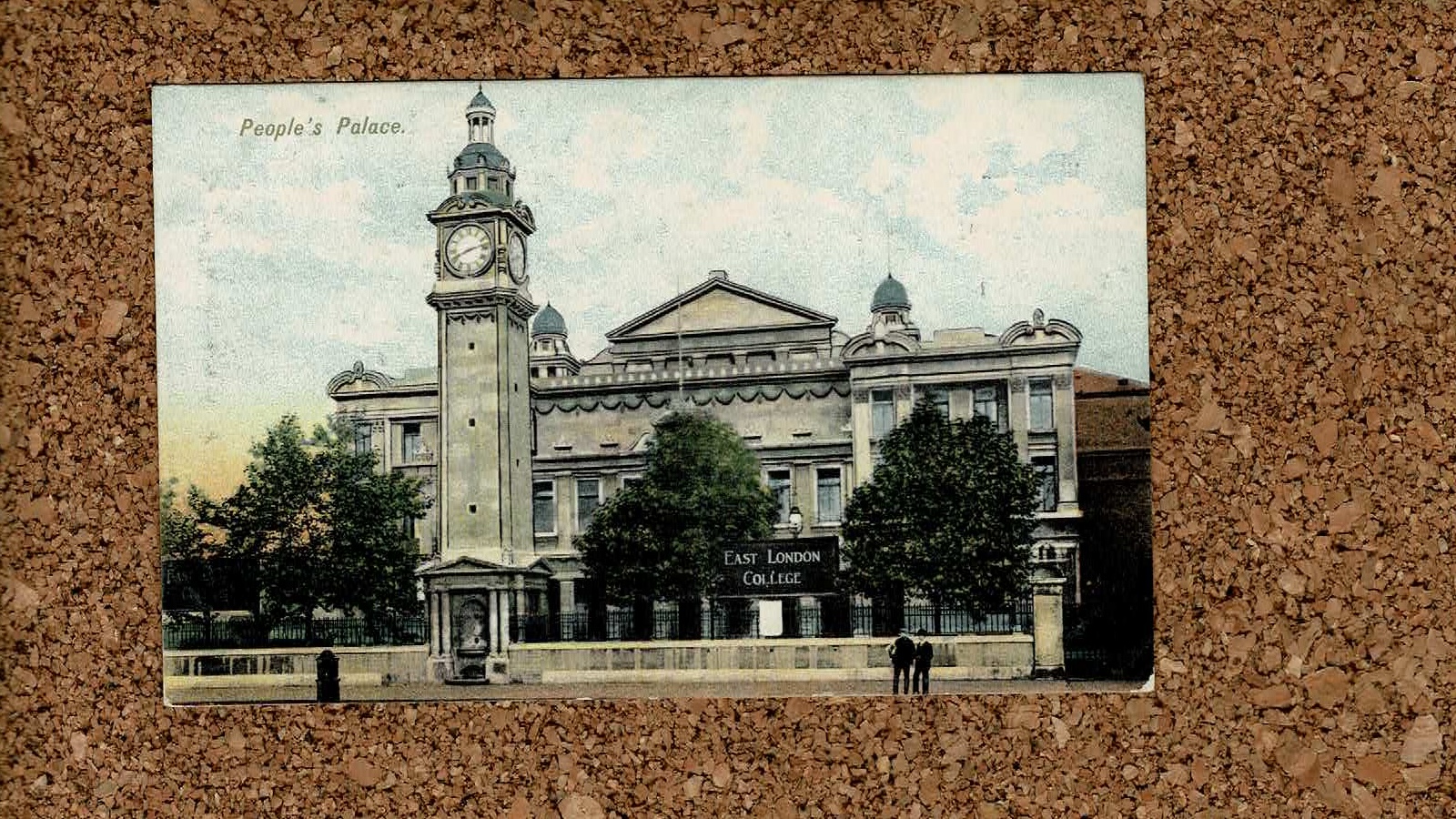
    Down on the Mile End Road in London, within the sound of Bow bells (and hence properly Cockney) you will find what used to be the People’s Palace, and is now Queen Mary University of London.

    The institution we see today has four antecedents: the medical schools at the London and at St Bartholomew’s hospitals, Westfield College, and Queen Mary College. The name which survives is that of the last-founded college: as this is also the largest campus by far, it does confirm that possession is nine-tenths of the law.

    The medical schools were the earliest to be founded: the London Hospital Medical College in 1785 and St Bartholomew’s Hospital Medical College in 1843 (although a lecture theatre had been in place in Barts since 1791). I’ve told a little of the story of medical education in London when I wrote about St George’s. At the end of the eighteenth century and into the nineteenth, hospitals were slowly putting medical education on a more formal footing, and the London Hospital was at the forefront.

    Next to come on the scene was Westfield College. Established in 1882, Westfield was a residential college for women. I’ve written about it before for Wonkhe, so for now I’ll keep the focus on the East End.

    And on 14 May 1887 Queen Victoria formally opened the People’s Palace on the Mile End Road. The picture below, from the Illustrated London News, shows the Great Hall, which was the only element which had been completed at the time. It had a capacity for 2000 people seated, and was most magnificent.

    The People’s Palace would host art exhibitions and concerts, and would have library and reading rooms, gardens and a swimming pool. Associated with it was a technical institute which would teach higher skills associated with East London’s industries and crafts. The technical institute was to be funded by the Draper’s Company; the People’s Palace was built following public subscriptions, much of it coming from the great and the good.

    (This, by the way, was the model for the technical and recreative institutes founded in south London soon thereafter, and which I wrote about in relation to London South Bank University.)

    In 1896 the People’s Palace Technical Schools became East London Technical College. I can’t be certain about this, but I imagine it had by that time been taken over by the relevant London borough, following enabling legislation in the early 1890s. It was by then supporting people studying for the civil service entrance examinations, and also for the University of London’s BSc degree examinations. The first students graduated early in the twentieth century.

    On 17 May 1907 the Morning Post reported that

    The East London College has been admitted by the Senate as a school of the University [of London] in the Faculties of Arts, Science, and Engineering for period of three years on the understanding that the governing body of the school shall do their utmost to satisfy the Senate upon certain points of educational organisation and finance.

    You’ll spot the associated name change – and this also gives us an earliest date for the picture on the postcard (look at the sign!).

    In 1910 the membership of the university was renewed for a further five years, and in 1915 granted without time limit. East London College was properly a school of the University of London. It was strong in science and engineering, particularly in aeronautical engineering. It had a wind tunnel – which was very new technology then – and was the first department of aeronautical engineering in the UK.

    The 1930s became a little exciting for the college, for good reasons and bad.

    The bad reason was a fire in the early hours of Wednesday 25 February 1931, which destroyed the Great Hall of the People’s Palace. So the illustration from 1897 is, sadly, all you’ll get of this today.

    But at a similar time, the college was considering seeking a royal charter, and it looks like the fire crystallised things. The Drapers’ Company facilitated the People’s Palace and the college becoming a single corporate body, and in 1934 a royal charter was granted. This was also the occasion for a change of name. East London College being felt by some, apparently, to be a bit déclassé. And so Queen Mary College – named for the then Queen, Mary of Teck – was born on 12 December 1934.

    And on 13 February 1937 the rebuilt People’s Palace was opened by the new King George VI and Queen Elizabeth (who most readers will know of better as the late Queen Mother.) The full-page spread from the Illustrated London News below gives some of the flavour. I wonder whether this was part of a post-abdication-crisis public relations push to ensure that the new King was perceived in a positive light? The tale of Margaret Paxton, who gave flowers to the Queen, and was descended from the child who gave flowers to Queen Victoria in 1897, is a publicist’s dream, and will no doubt have taken a bit of work to manage.

    Through the following decades Queen Mary College was forging links with the two medical schools – for example, a joint hall of residence was opened in Woodford in 1974. Further changes happened in the 1980s – firstly some changes to provision, when the University of London reshuffled. Queen Mary lost Classics and Russian, but gained lab science subjects from Westfield, Chelsea, Queen Elizabeth and Bedford colleges. This was only a precursor to the larger changes to come: in 1989 Westfield College merged with Queen Mary, which became Queen Mary and Westfield College. The merged college was based on the Mile End and associated campuses – the Westfield College buildings were sold off.

    Ten years later the two medical schools merged with the college to form the Barts and the London School of Medicine and Dentistry. This was simply one part of a general rationalisation of medical education in London which saw the small independent schools brought within the ambit of larger institutions.

    Let’s add a couple of things to bring the story up to date.

    Firstly, in 2012 Queen Mary joined the Russell Group, along with three other universities (pop quiz – without googling, can you name the other three?). It’s an unusual Russell Group in that its entry profile is much more reflective of its neighbourhood. It continues to do good things for the east London population.

    Secondly, in 2013 it formally changed its name from Queen Mary and Westfield College to Queen Mary, University of London. Which is tricky for dinosaurs like me who still think of it as QMW (and while were at it, Royal Holloway continues in my head to be RHBNC). But I will need to learn to deal with modernity as it approaches.

    The college has a good site on its history if you want to read more.

    Nine Nobel prize winners are connected with the college: six in physiology or medicine, one each in literature and physics, and one winner of the Nobel peace prize (pop quiz part two: again without googling, can you name the peace prize winner? I met them once…)

    And finally, here’s a jigsaw of the postcard. The card was written and posted, but it seems to have been stuck in an album or scrap-book at some point so the back is half covered in the remnants of brown paper. Anyway, it was posted at Paddington to an address in the Regent’s Park neighbourhood of London. All I can make of the written message is

    …before I left. I will certainly call and see you one day. I am not going ‘til next Tuesday…

    Source link

  • 3 Questions for Professor Mary Wright

    3 Questions for Professor Mary Wright

    Last year, Brown University announced that Mary Wright was embarking on a new adventure in early 2025.

    If you are anywhere near or around the CTL world, you likely know (or know about) Mary Wright. Her 2023 JHU Press publication, Centers for Teaching and Learning: The New Landscape in Higher Education, is a must-read for every university leader. Mary—along with Tracie Addy, Bret Eynon and Jaclyn Rivard—also has a forthcoming book with Johns Hopkins (2026), which will provide a 20-plus-year look at continuities and changes in the field of educational development.

    Therefore, it was big news earlier this year when Mary moved from her role as associate provost for teaching and learning and executive director of Sheridan Center at Brown to a new position as a professor of education scholarship at the University of Sydney. With Mary now more than six months in her new role, this was a good time to catch up with how things are going.

    Q: Tell us about your new role at the University of Sydney. What does a faculty appointment in Australia constitute in terms of teaching, research and administrative responsibilities?

    A: As in the U.S., a faculty appointment (here, called an academic appointment) varies greatly across and even within Australian institutions. In my role, I serve as a Horizon Educator, an education-focused academic role, which carries a heuristic of 70 percent time to education, 20 percent to scholarship and 10 percent to leadership or service-related activities. Like my prior 20-plus years of experience in the U.S., I am still an academic developer (called an educational developer in the U.S.), which means that education most frequently involves teaching and mentoring other academics as learners.

    I am a level-E academic, which is akin to a full professor role in the U.S. (The trajectory starts at level A, which encompasses associate lecturer and postdoctoral fellows and goes through level B [lecturer], level C [senior lecturer], level D [associate professor] and level E [professor].)

    There are many differences between U.S. and Australian higher education, but I’ll highlight two here in relation to those who work in CTLs. The first and most significant is that, in the U.S., educational developers are often positioned as professional staff. In Australia, many universities treat this work with parity to other academics. I feel that this substantially raises the credibility and value of academic development.

    Second, professional learning around teaching is a required part of many academics’ contracts, initially or for “confirmation,” and it is structured into their workloads. I first worried that this would prompt a good deal of reactance, but I have not found this to be the case. I now find this to be a more equitable system for students (and academic success), compared to the U.S.’s (primarily) voluntary approach.

    Q: Moving from Rhode Island to Australia is a big move. What is it about the University of Sydney that attracted you to the institution, and why did you make this big move at this point in your career?

    A: Three factors attracted me to the University of Sydney. First, I was attracted to what I will call their organizational honesty. The institution was very open that they were not where they wanted to be in regard to teaching and the student experience; they wanted to be a different kind of institution. They also had a very clear theory of change, mapping very much onto metaphors I write about elsewhere: requiring convening and community building (hub); support of individual career advancement (incubator); development of evidence-based practice, such as the scholarship of teaching and learning (sieve); and advancing the value of teaching and learning through recognition and reward (temple).

    Specifically, USyd was investing in over 200 new Horizon Educator positions, education-focused academics charged to be educational leaders. One part of my role is to work with this amazing group of academics to advance their own careers, as well as to realize the institution’s ambitions for enhanced teaching effectiveness. To anchor this work at a macro level, USyd also had been working very hard on developing and rolling out a new Academic Excellence Framework, which provides a clear pathway to the recognition and reward of education—in addition to other aspects of the academic role

    The University of Sydney is also making a significant investment in grants to foster the scholarship of teaching and learning, which has been a long-standing interest of mine but was often done “off the side of the desk.” My role involves working with people, programs and practices to facilitate SoTL.

    In addition to university strategy, I was attracted by the opportunity to work with Adam Bridgeman and colleagues in the university’s central teaching and learning unit. Educational Innovation has been engaged in very interesting high-level work around AI and assessment, as well as holistic professional learning to support academics, but like many CTLs, it has been stretched since COVID to advance a growing number of institutional aims. Because of my prior leadership in CTLs, I felt like I could also contribute in this space.

    Q: Pivoting from a university leadership staff role to a faculty role is appealing to many of us in the nonfaculty educator world. (Although I know you also had a faculty position at Brown). Can you share any advice for those who might want to follow in your footsteps?

    A: For some context, I started my career in the early 2000s in a professional staff role in a CTL and also occasionally adjuncted. I became a research scientist in the CTL, then moved to direct a CTL in 2016 and had an affiliate faculty position (with the staff/administrative role as primary). In 2020, I then moved to a senior administration role (again, my primary role was professional staff). So, I have worn a number of hats.

    Three factors have been helpful in transitioning across roles. First, I love to write, and while the scholarly work rarely “counted” for anything in these series of positions, I think it helped me advance to the next step. Second, it’s important to read a lot to stay current with the vast literature on teaching and learning. I think this can add value to my work with individual academics—to help them publish—as well as my work on committees, where there is often some literature to cite on the topic at hand.

    Finally, I think professional associations can be very helpful in building bridges and networks, especially for those considering an international transition. In the U.S., the POD Network was a key source of support. Now, before even applying to my current role, I subscribed to the newsletter of HERDSA (Higher Education Research and Development Society of Australasia) and I participated in one of their mentoring programs. I also serve as a co-editor of the International Journal for Academic Development, which exposed me to articles about Australian academic development, and I got some generous and wise advice from Australian and New Zealand IJAD colleagues about the job search.

    Source link

  • Mary Baldwin President Suddenly Resigns

    Mary Baldwin President Suddenly Resigns

    Liz Albro Photography/iStock/Getty Images

    Mary Baldwin University president Jeff Stein resigned Tuesday after two years in the role, The News Leader reported. Fall classes at the formerly all-women private university in Staunton, Va., started Monday. 

    A university spokesperson told Inside Higher Ed that Stein resigned for personal reasons, and the university has not shared any other information about his departure.

    Stein was the first male president at Mary Baldwin since 1976 and assumed the role in 2023 after former president Pamela Fox retired. The university’s Board of Trustees appointed Todd Telemeco, who was the vice president and dean of Mary Baldwin’s Murphy Deming College of Health Sciences, as Stein’s permanent replacement. 

    “We thank Dr. Stein and his wife, Chrissy, for their two years of service to the University, and we wish them the best in their future endeavors. We are especially grateful for Dr. Stein’s ability to reinvigorate the connection between the University and our alumni,” board co-chairs Eloise Chandler and Constance Dierickx wrote in a statement. “This renewed energy in alumni relations has also contributed to significantly higher alumni giving rates.”

    Prior to becoming president at Mary Baldwin, Stein served as vice president for strategic initiatives and partnerships and an associate professor of English at Elon University in North Carolina.

    Source link

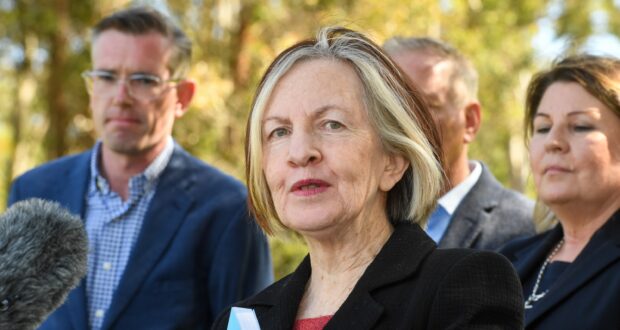
  • Mary O’Kane to lead ATEC from July, UA chief’s pitch to press

    Mary O’Kane to lead ATEC from July, UA chief’s pitch to press

    Professor O’Kane will lead ATEC from July. Picture: Cath Piltz

    The chair of the Australian Universities Accord is to lead the yet-to-be-established Australian Tertiary Education Commission, Education Minister Jason Clare revealed on Wednesday night.

    Please login below to view content or subscribe now.

    Membership Login

    Source link

  • Richard Bland wins total autonomy from William & Mary

    Richard Bland wins total autonomy from William & Mary

    Richard Bland College is one step closer to total autonomy, the Progress-Index reported.

    The public two-year college in Virginia, established in 1960 as an extension campus of William & Mary, has always been governed by its parent institution’s Board of Visitors. Now both houses of the State Legislature have passed a bill that establishes an independent, nine-member Board of Visitors for Richard Bland—a longtime goal of the college’s administrators.

    The legislation now awaits Governor Glenn Youngkin’s signature.

    “Governor Youngkin has demonstrated his commitment to growth and prosperity in Petersburg, and his support of RBC’s independence will add to that legacy,” said Richard Bland president Debbie Sydow.

    While the college has always operated independently of William & Mary, efforts to set up its own board have been ongoing for over a decade.

    Sydow called the new legislation “momentous, especially as RBC is poised to deepen and expand its strategic partnerships.” 

    Source link