The predicted drop means there are 64,000 fewer than expected master’s students enrolled in US institutions in 2025/26 than previously anticipated, following five years of international growth propping up overall US master’s enrolment.
“Uncertainty around immigration policies appears to be one of the primary drivers, if not the primary driver, of the decline in international enrolments,” Brady Colby, head of market research at Validated Insights, told The PIE News.
The study, conducted by Validated Insights higher education marketing agency, draws on data from multiple sector bodies, revealing nearly half of US institutions expect graduate international application volumes to decline this year.
This builds on an existing downward trend, with 42% of institutions reporting fewer international graduate applications last year, according to IIE.
It reveals international enrolments have been driving the upward trajectory of US master’s programs since 2018/19, as domestic enrolments have declined.
From academic years 2018/19 to 2023/24, domestic master’s enrolment saw a 0.5% decline, while international enrolments grew by more than 6%, producing an overall growth rate of 0.4%.
Since 2021, the number of international master’s enrolments has steadily increased by over 11%, with this year’s sharp drop likely to have financial repercussions for institutions planning for sustained growth.
“Recently, projections indicated that international master’s enrolment in 2025/26 would be as high as 660,000, meaning there are now expected to be 64,000 fewer of these students than previously anticipated in 2025/26,” the report states.
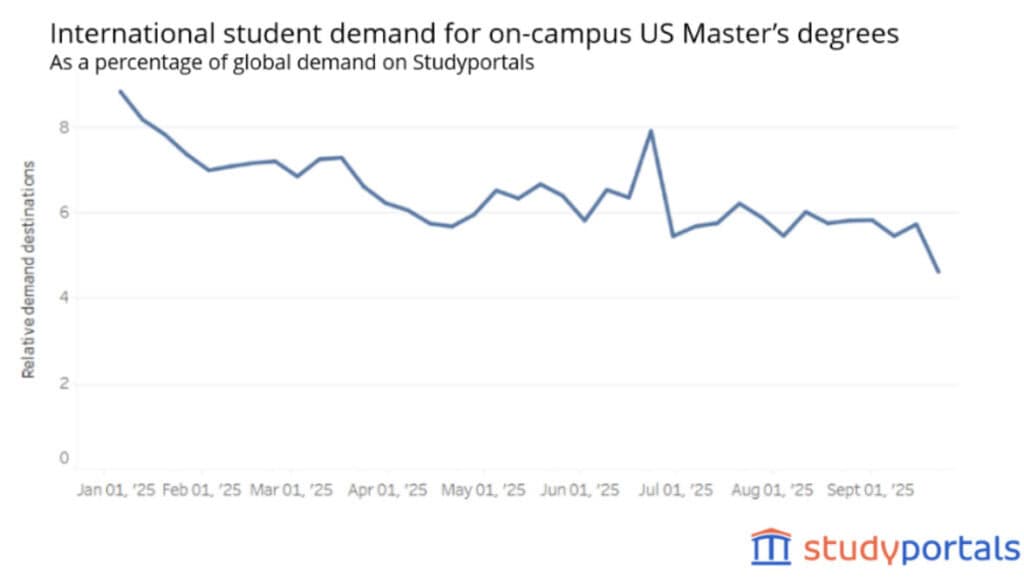
It highlights recent NAFSA data indicating new international master’s enrolments fell by 19% year-over-year in fall 2025, alongside Studyportals analysis showing prospective student interest in the US plummeting by 50% between January and April 2025.
The impact of the decline varies dramatically depending on field of study, with international students over-represented in STEM master’s, comprising 80% of software engineering graduates and 77% of computer science graduates.
By contrast, education and healthcare programs tend to have the lowest percentages of international students, according to the report.
The report warns that many high-demand STEM programs are “highly dependent on international students”, forecasting course closures if the downward trend continues.
What’s more, “the US risks losing early-career talent in computer science, AI, cyber security, data science and engineering,” said Colby. “These are precisely the fields were domestic supply already falls short of labour market demand,” he added.
The knock-on effects will be felt not just by universities, but by employers, domestic students, and the broader US knowledge economy
Brady Colby, Validated Insights
Over time, repercussions include increased hiring bottlenecks for US employers, reduced innovation in AI and emerging technologies, and the exodus of firms expanding operations in countries with more predictable post-study work policies.
If current trends continue, higher education finances will come under increased pressure, causing program closures in STEM and MBA programs and a “measurable drag” on innovation and economic competitiveness, said Colby.
“The knock-on effects will be felt not just by universities, but by employers, domestic students, and the broader US knowledge economy,” he continued, highlighting the US economy could lose $7 billion in aggregate revenue due to declining international student numbers.
Following administration’s recent overhaul of the H-1B visa process in favour of higher wage earners, alongside anticipated restrictions on Optional Practical Training (OPT), the decline is likely to continue.
In a NAFSA survey of current US international students, over half of respondents (53%) said they would not have enrolled in the first place if access to H-1B was determined by wage levels.
Meanwhile, 54% of respondents said they would not have enrolled in the first place had OPT been rescinded. And 57% of master’s students who intend to stay in the US said they would be unlikely to try and stay if OPT were eliminated.
At The Red Pen, we frequently encounter applicants who are uncertain about pursuing a master’s with a low GPA. It’s important to remember that the GPA alone does not define an applicant’s capabilities, potential, or future success. Additionally, it is a myth that applicants with a low GPA can only seek admission to unranked or less popular universities. According to the Council of Graduate Schools, many institutions follow holistic admissions practices, evaluating candidates on academic metrics alongside non-cognitive traits such as resilience, leadership, and creativity. For applicants considering a master’s with a low GPA, admissions committees often look beyond transcripts, particularly at progressive programmes that assess essays, recommendations, professional experience, and test scores with contextual sensitivity. Based on our expertise supporting postgraduate applicants, the following strategies can help you build a compelling application, even with a less-than-ideal academic record.
Begin with an honest self-assessment before applying for a master’s with a low GPA
Before applying, take a step back and evaluate your academic strengths and weaknesses with objectivity. For applicants pursuing a master’s with a low GPA, this self-assessment becomes especially important. If you are aiming for a master’s in computer science, highlight your strengths in programming, software development, or applied projects. At the same time, acknowledge weaker areas, including calculus or advanced mathematics, and outline how you plan to address them through targeted coursework, certifications, or professional experience. This level of self-awareness signals maturity, a growth mindset, and academic intent, qualities that postgraduate admissions committees consistently value.
Holistically shortlist programmes when applying for a master’s with a low GPA
Not all universities assign the same weight to academic grades. For applicants considering a master’s with a low GPA, it is essential to research how institutions evaluate candidates beyond transcripts. Universities such as Northeastern University, Lund University, and the University of Manchester often place strong emphasis on work experience, personal statements, and references alongside academic performance. Applicants should also reflect on their career stage, whether they are entering the workforce, changing fields, or building more profound subject expertise. Shortlisting programmes that align with current strengths and long-term goals increases the likelihood of success and ensures a stronger academic and professional fit. The best-fit programme is not always the highest-ranked; it is the one that recognises potential in context.
Craft programme-specific narratives that put context first
Avoid generic applications, particularly when applying for a master’s with a low GPA. Take time to understand each programme’s academic focus, teaching approach, and graduate outcomes, then tailor your narrative accordingly. One applicant targeting urban planning programmes across the US and the UK had a lower GPA but adopted a focused strategy. For data-intensive programmes, he highlighted his GIS expertise and analytical work. In sustainability-led courses, he foregrounded his experience in climate-impact projects. This approach helped contextualise academic performance within a broader profile of skills, knowledge, and long-term intent, allowing admissions committees to assess readiness beyond grades alone.
Strengthen academic readiness with additional coursework
Retaking challenging subjects or completing relevant coursework can significantly strengthen the academic readiness of applicants pursuing a master’s with a low GPA. Short, project-based courses with defined learning outcomes allow applicants to demonstrate mastery of the subject beyond their earlier grades. Certifications and bridge courses that emphasise applied learning are particularly effective in addressing gaps in foundational knowledge. Applicants should implement this learning in professional or research contexts and reference these outcomes in their statements or interviews. This signals initiative, discipline, and the ability to translate theory into practice, qualities that admissions committees value strongly at the postgraduate level.
Emphasise professional experience
In many cases, professional experience can carry significant weight in postgraduate admissions, particularly for applicants pursuing a master’s with a low GPA. Admissions committees often look for evidence of applied learning, responsibility, and progression that may not be reflected fully in academic transcripts. Whether through leading a project, managing operational challenges, or contributing across teams, professional achievements help demonstrate readiness for advanced study. One applicant to a project management master’s programme highlighted her role in developing a scheduling tool that reduced delays by 30 percent. This outcome illustrated leadership, initiative, and relevance, helping balance a modest academic record.
Excel in standardised tests
Strong performance on standardised tests such as the Graduate Record Examination (GRE) or the Graduate Management Admission Test (GMAT) can help reinforce academic preparedness, particularly for applicants with a low GPA pursuing a master’s. Competitive scores provide admissions committees with recent, comparable evidence of quantitative ability, analytical thinking, and subject readiness. We have worked with applicants who secured offers from selective postgraduate programmes despite lower academic averages, supported by strong test results that reassured committees of their capacity to manage rigorous coursework.
Use references strategically
References, or Letters of Recommendation, can add critical depth to an application, particularly for candidates pursuing a master’s with a low GPA. Strong referees provide context that transcripts cannot, offering insight into academic growth, intellectual curiosity, and professional maturity. Applicants should choose recommenders who are familiar with their journey and can speak credibly about progress over time. In one case, a professor described how an applicant retook a demanding course, achieved stronger results the second time, and later applied that knowledge in a professional co-op. Such detail lends credibility and reinforces evidence of readiness beyond grades.
Address the GPA tactfully
Applicants should avoid leaving a low GPA unexplained, particularly when applying for a master’s with a low GPA. If academic performance was affected by personal, financial, or health-related challenges, use the optional statement rather than the Statement of Purpose to provide a concise and factual context. The emphasis should remain on accountability, learning, and progression rather than justification. Admissions committees value applicants who demonstrate self-awareness and maturity in addressing setbacks. When framed thoughtfully, a lower GPA becomes one part of a broader academic journey rather than a defining limitation.
How to approach a master’s with a low GPA
What to Do
How it helps
Self-assess honestly
Demonstrates self-awareness, a growth mindset, and a readiness to address academic gaps proactively.
Holistically shortlist programmes
Seek universities that value your overall profile, not just academic scores.
Craft programme-specific narratives
Highlights alignment with each programme’s unique focus, reframing your GPA within a broader context.
Showcase additional coursework
Proves academic readiness and ability to grasp new concepts through recent, relevant learning.
Emphasis on professional experience
Reveals leadership qualities, problem-solving, and real-world impact, which may outweigh grades.
Excel in standardised tests like the GRE and GMAT
Compensates for a low GPA and reassures admissions committees of your academic capabilities.
Use references strategically
Adds credibility and depth by having mentors vouch for your resilience and progress.
Address low GPA tactfully
Builds trust by providing mature, honest context without making excuses, showing how you’ve grown.
The data, collected from January 6 to September 28, aligns closely with the start of Donald Trump’s second presidential term and the ensuing uncertainty around student visas and post-graduation work opportunities. It is based on the search behaviour of over 50 million prospective students on Studyportals.
“Prospective international students and their families weigh not only academic reputation but also regulatory stability and post-graduation prospects,” said Studyportals CEO Edwin van Rest: “Right now, those factors are working against institutions.”
Studyportals said the steep decline – dropping more than 60% in less than nine months – corresponds to proposed and enacted policy changes impacting student visa duration, Optional Practical Training (OPT) and H-1B work authorisation in the US.
Last week, the Trump administration shocked businesses and prospective employees by hiking the H-1B visa fee to $100,000 – over 20 times what employers previously paid. Days later, the government announced proposals to overhaul the visa system in favour of higher-paid workers.
Sector leaders have warned that OPT could be the administration’s next target, after a senior US senator called on the homeland security secretary Kristi Noem to stop issuing work authorisations such as OPT to international students.
Such a move would have a detrimental impact on student interest in the US, with a recent NAFSA survey suggesting that losing OPT reduces enrolment likelihood from 67% to 48%.
Meanwhile, roughly half of current students planning to stay in the US after graduation would abandon those plans if H-1B visas prioritised higher wage earners, the survey indicated.
“Prospective students are making go/no-go enrolment decisions, while current students are making stay/leave retention decisions,” said van Rest.
“Policy changes ripple through both ends of the pipeline, reducing new inflow and pushing out existing talent already contributing to US research, innovation and competitiveness,” he added.
Data: Studyportals
The search data revealed a spike in interest at the beginning of July, primarily from Vietnam and Bangladesh, and to a lesser extent India and Pakistan. Experts have suggested the new Jardine-Fulbright Scholarship aimed at empowering future Vietnam leaders could have contributed to the rise.
Meanwhile, Iran, Nepal and India have seen the steepest drops in master’s demand, declining more than 60% this year to date compared to last.
While federal SEVIS data recorded a 0.8% rise in international student levels this semester, plummeting visa arrivals and anecdotal reports of fewer students on campus suggest the rise was in part due to OPT extensions – individuals who are counted in student totals but who are not enrolled on US campuses or paying tuition fees.
Beyond the immediate financial concerns of declining international enrolments for some schools, van Rest warned: “The policies we adopt today will echo for years in global talent flows.”
The UK and Ireland have gained the most relative market share of international interest on Studyportals – both up 16% compared to the same period in 2024. Australia, Austria, Sweden and Spain all experienced a 12% increase on the previous year.
In the US, international students make up over half of all students enrolled in STEM fields and 70% of all full-time graduate enrolments in AI-related disciplines, according to Institute of International Education (IIE) data.
The policies we adopt today will echo for years in global talent flows
Edwin van Rest, Studyportals
What’s more, universities with higher rates of international enrolment have been found to produce more domestic STEM graduates, likely due to greater investment in these disciplines, National Foundation for American Policy (NFAP) research has shown.
Last year, graduate students made up 45% of the overall international student cohort (including OPT), compared to undergraduate which comprised roughly 30%, according to IIE Open Doors data.
Universities with higher proportions of overseas students have been found to produce more domestic STEM graduates, likely due to greater investment in these disciplines, National Foundation for American Policy (NFAP) research has shown.
The news of plummeting international demand comes as domestic enrolments are declining, with less high school graduates entering college education and an overall demographic shrinking of university-age students.
In a recent survey by the American Council on Education (ACE), nearly three quarters of college leaders said they were concerned about enrolment levels this semester, with 65% moderately or extremely worried about immigration restrictions and visa revocations.
Liberty University, one of the largest Christian universities in the United States, has built an educational empire by promoting conservative values and offering flexible online degree programs to hundreds of thousands of students. But behind the pious branding and patriotic marketing lies a troubling pattern: Liberty University Online has become a master’s degree debt factory, churning out credentials of questionable value while generating billions in student loan debt.
From Moral Majority to Mass Marketing
Founded in 1971 by televangelist Jerry Falwell Sr., Liberty University was created to train “Champions for Christ.” In the 2000s, the school found new life through online education, transforming from a small evangelical college into a mega-university with nearly 95,000 online students, the vast majority of them enrolled in nontraditional and graduate programs.
By leveraging aggressive digital marketing, religious appeals, and promises of career advancement, Liberty has positioned itself as a go-to destination for working adults and military veterans seeking master’s degrees. But this rapid expansion has not come without costs — especially for the students who enroll.
A For-Profit Model in Nonprofit Clothing
Though technically a nonprofit, Liberty University operates with many of the same profit-driven incentives as for-profit colleges. Its online programs generate massive revenues — an estimated $1 billion annually — thanks in large part to federal student aid programs. Students are encouraged to take on loans to pay for master’s degrees in education, counseling, business, and theology, among other fields. Many of these programs are offered in accelerated formats that cater to working adults but often lack the rigor, support, or job placement outcomes associated with traditional graduate schools.
Federal data shows that many Liberty students, especially graduate students, take on substantial debt. According to the U.S. Department of Education’s College Scorecard, the median graduate student debt at Liberty can range from $40,000 to more than $70,000, depending on the program. Meanwhile, the return on investment is often dubious, with low median earnings and high rates of student loan forbearance or default.
Exploiting Faith and Patriotism
Liberty’s marketing strategy is finely tuned to appeal to Christian conservatives, homeschoolers, veterans, and working parents. By framing education as a moral and patriotic duty, Liberty convinces students that enrolling in an online master’s program is both a personal and spiritual investment. Testimonials of “calling” and “purpose” are common, but the financial realities can be harsh.
Many students report feeling misled by promises of job readiness or licensure, especially in education and counseling fields, where state licensing requirements can differ dramatically from what Liberty prepares students for. Others cite inadequate academic support and difficulties transferring credits.
The university spends heavily on recruitment and retention, often at the expense of student services and academic quality.
Lack of Oversight and Accountability
Liberty University benefits from minimal federal scrutiny compared to for-profit schools, largely because of its nonprofit status and political connections. The institution maintains close ties to conservative lawmakers and was a vocal supporter of the Trump administration, which rolled back regulations on higher education accountability.
Despite a series of internal scandals — including financial mismanagement, sexual misconduct cover-ups, and leadership instability following the resignation of Jerry Falwell Jr. — Liberty has continued to expand its online presence. Its graduate programs, particularly in education and counseling, remain cash cows that draw in federal loan dollars with few checks on student outcomes.
A Cautionary Tale in Christian Capitalism
The story of Liberty University Online is not just about one school. It reflects a broader trend in American higher education: the merging of religion, capitalism, and credential inflation. As more employers demand advanced degrees for mid-level jobs, and as traditional institutions struggle to adapt, schools like Liberty have seized the opportunity to market hope — even if it comes at a high cost.
For students of faith seeking upward mobility, Liberty promises a path to both spiritual and professional fulfillment. But for many, the result is a diploma accompanied by tens of thousands in debt and limited economic return. The moral reckoning may not be just for Liberty University, but for the policymakers and accreditors who continue to enable this lucrative cycle of debt and disillusionment.
The Higher Education Inquirer will continue to investigate Liberty University Online and similar institutions as part of our ongoing series on higher education debt, inequality, and regulatory failure.
By Ian Blenkharn, Director of Education and Student Services at the University of Bath.
Like most institutions across the sector, the University of Bath is carefully considering the potential opportunities, implications and challenges posed by the new Lifelong Learning Entitlement (LLE).
Bath is somewhat unusual in having both a high proportion of integrated master’s courses and a high proportion of students studying programmes with a placement year (nearly two-thirds of Bath students undertake a placement during their time with us). This means we have a large number of students studying five-year, integrated masters programmes with a year on placement.
This raises important questions for us, as it will for others across the sector. The information so far published about the LLE seems to suggest that we will be able to charge students for the full, five-year integrated-masters-with-placement programme, which has a total of 600 credits under the CATS credit accumulation framework. However, it isn’t yet clear whether students, who are automatically entitled to a ‘digital wallet’ to cover up to 480 credits of higher education study, will be able to pay for the entirety of their programme without access to private funding.
For those programmes offered at Bath, the shortfall would be the cost of the placement year – either 15% or 20% of the maximum regulated fee. Perhaps not a deal-breaker for those with access to the Bank of Mum and Dad. However, it could deter some students for whom the chance to work for a year in industry provides unparalleled opportunities to build social capital, experience and confidence to compete in the graduate jobs market. We know that such opportunities are transformative for our students. The prospect of this becoming the preserve of students who can privately fund their tuition risks not only the viability of the programmes we offer but also the social mobility benefits they afford students from widening participation backgrounds.
The decision by the Labour government to defer the implementation of the LLE to January 2027 means there is some time to clarify the situation for both universities and students. However, we will have students applying in September 2025 for deferred entry in 2027, so the time to clarify the situation is shorter than it first appears.
It is imperative that everyone has clarity on this issue (and many others associated with the LLE) before we enter the 2025/2026 recruitment cycle. This is so universities can appropriately advise students on how much their course will cost and whether their Lifelong Learning Entitlement will be sufficient to cover those costs. At the moment, far too many unanswered questions are swirling around the LLE, as evidenced by the 400+ sector participants who logged on to the Higher Education Strategic Planners Association (HESPA)-organised seminar on the LLE with representatives from the Student Loans Company. The sector, and most importantly the students who will be pioneers of the new LLE system, need these questions answered as soon as possible.