Tag: matter

  • Why Small Private Colleges Matter More Than Ever – Edu Alliance Journal

    Why Small Private Colleges Matter More Than Ever – Edu Alliance Journal

    Opinion Piece by Dean Hoke — Small College America and Senior Fellow, The Sagamore Institute

    A Personal Concern About the Future of Public Education

    It’s impossible to ignore the rising level of criticism directed at our nation’s public schools. On cable news, social media channels, political stages, and in school board meetings, teachers and administrators have become easy targets. Public schools are accused of being ineffective, mismanaged, outdated, or, in some corners, ideologically dangerous. Some commentators openly champion the idea of a fully privatized K–12 system, sidelining the public institutions that have educated the vast majority of Americans for generations.

    For those of us who have spent our lives in and around education, this rhetoric feels deeply personal. Public schools aren’t an abstraction. They are the places where many of us began our education, where our children discovered their strengths, where immigrants found belonging, where students with disabilities received support, and where caring adults changed the trajectory of young lives.

    Behind every one of those moments stood a teacher.

    Amid this turbulence, there is one group of institutions still quietly doing the hard work of preparing teachers: small private nonprofit colleges.

    Small Private Colleges: An Overlooked Cornerstone of Teacher Preparation

    Despite the noise surrounding public education, small private colleges remain committed to the one resource every school depends on: well-prepared, community-rooted teachers.

    They rarely make national headlines. They don’t enroll tens of thousands of students. But they are woven into the civic and human infrastructure of their regions—especially in the Midwest, South, and rural America.

    This reality became even clearer during a recent episode of Small College America, in which I interviewed Dr. Michael Scarlett, Professor of Education at Augustana College. His insights provide an insider’s view into the challenges—and the opportunities—facing teacher preparation today. Note to hear the entire interview click here https://smallcollegeamerica.transistor.fm/28

    I. The Teacher Shortage: A Structural Crisis

    Much has been written about the teacher shortage, but too often the conversation focuses on symptoms rather than causes. Here are the forces shaping the crisis.

    1. Young people are turning away from teaching

    Data from the ACT show that only 4% of students express interest in becoming teachers—down from 11% in the late 1990s. Bachelor’s degrees in education have fallen nearly 50% since the 1970s. Surveys show that fewer than 1 in 5 adults would recommend teaching as a career.

    The message is clear: Teaching is meaningful, but many no longer see it as sustainable.

    As Dr. Scarlett told us: “The pipeline simply is not as wide as it needs to be.”

    Recent data offers a glimmer of hope: teacher preparation enrollment grew 12% nationally between 2018 and 2022. However, this modest rebound is almost entirely driven by alternative certification programs, which increased enrollment by 20%, while traditional college-based programs grew by only 4%. This disparity underscores a critical concern: the very programs that provide comprehensive, relationship-based preparation—including those at small colleges—are not recovering at the same rate as faster, less intensive alternatives.

    2. Burnout and attrition have overtaken new entrants

    The pandemic accelerated an already-existing national trend: teachers are leaving faster than new ones are entering.

    Reasons include:

    • Student behavior challenges
    • Standardized testing pressure
    • Emotional fatigue
    • Inequities across districts
    • Lack of respect
    • Political and social media hostility

    As Scarlett notes, these realities weigh heavily on early-career teachers: “What new teachers face today goes far beyond content knowledge. They face inequities, discipline issues, emotional exhaustion… and they’re expected to do it all.”

    3. Alternative certification can’t fill the gap

    Alternative routes help—but they cannot replace the traditional college-based pipeline. Many alt-cert teachers receive less pedagogical training and leave sooner.

    Scarlett captures the trend: “Teaching has always attracted people later in life… we’ve definitely seen an uptick.”

    And while alternative routes have seen growth in recent years—increasing 20% between 2018 and 2021—this expansion has not translated into solving the shortage. As of 2025, approximately 1 in 8 teaching positions nationwide remains either unfilled or filled by teachers not fully certified for their assignments. The shortcut approach cannot substitute for comprehensive preparation.

    “The national teacher shortage is real… and retention is just as big a challenge as recruitment.” — Dr. Michael Scarlett

    II. The Quiet Backbone: How Small Private Colleges Sustain the Teacher Workforce

    Small private colleges graduate fewer teachers than large public institutions, but their impact is disproportionately large—especially in rural and suburban America.

    1. They prepare the teachers who stay

    About 786 private nonprofit colleges offer undergraduate education degrees—representing roughly 20% of all teacher preparation institutions in the United States. Together, they produce approximately 25,119 graduates per year, an average of 32 per institution.

    These numbers may seem modest, but these graduates disproportionately:

    • Student-teach locally
    • Earn licensure in their home state
    • Take jobs within 30 miles of campus
    • Stay in the profession longer

    Public schools desperately need these ‘homegrown’ teachers who understand the communities they serve.

    2. Small colleges excel at the one thing teaching requires most: mentoring

    Teacher preparation is not transactional. It is relational. And this is where private colleges excel. Scarlett put it plainly: “Close relationships with our students, small classes, a lot of direct supervision… we nurture them throughout the program.” In a profession that relies heavily on modeling and mentorship, this matters enormously.

    3. Faculty—not adjuncts—supervise student teachers

    One of the most striking differences: “Full professors… working with the students in the classrooms and out in field experiences. Other institutions outsource that.”

    This is not a trivial distinction. Faculty supervision affects:

    • Preparedness
    • Confidence
    • Classroom management
    • Retention

    Where larger institutions rely on external supervisors, small colleges invest the time and human capital to do it right.

    4. They serve the regions hit hardest by shortages

    Rural districts have the highest percentage of unfilled teaching positions. Many rural counties rely almost exclusively on a nearby private college to produce elementary teachers, special education teachers, and early childhood educators.

    When a small college stops offering education degrees, it often leaves entire counties without a sustainable teacher pipeline.

    5. They diversify the educator workforce

    Small colleges—especially faith-based, minority-serving, or mission-driven institutions—often enroll first-generation students, students of color, adult career-changers, and bilingual students. These educators disproportionately fill shortage fields.

    “What we have here is special… students understand the value of a small college experience.” — Dr. Michael Scarlett

    III. Should Small Colleges Keep Offering Education Degrees? The Economic Question

    Let’s be direct: Teacher preparation is not a high-margin program.

    Costs include:

    • Intensive field supervision
    • CAEP or state accreditation
    • High-touch advising
    • Small cohort sizes

    Education majors also often have lower net tuition revenue compared to business or STEM.

    So why should a small college continue offering a program that is expensive and not highly profitable?

    Because the alternative is far worse—for the institution and for the region it serves.

    1. Cutting teacher-prep weakens a college’s identity and mission

    Many private colleges were founded to prepare teachers. Teacher education is often central to institutional mission, community trust, donor expectations, and alumni identity.

    Removing education programs sends the message that the college is stepping away from public service.

    2. Teacher-prep strengthens community partnerships

    Education programs open doors to:

    • District partnerships
    • Dual-credit pipelines
    • Grow Your Own initiatives
    • Nonprofit and state grants
    • Alumni involvement

    These relationships benefit the entire institution, not just the education department.

    3. Education majors support other academic areas

    Teacher-prep indirectly strengthens:

    • Psychology
    • English
    • Sciences
    • Social sciences
    • Music and arts

    When teacher education disappears, these majors often shrink too.

    4. The societal mission outweighs the limited revenue

    There are moments when institutional decisions must be driven by mission, not margins. Producing teachers is one of them.

    5. Addressing concerns about program quality and scale

    Some critics question whether small programs can match the resources and diversity of perspectives available at large universities. This is a fair concern—and the answer is that small colleges offer something different, not lesser.

    Graduation and licensure pass rates at small private colleges consistently match or exceed those of larger institutions. What smaller programs may lack in scale, they compensate for through personalized mentorship, faculty continuity, and deep community integration. These are not peripheral benefits—they are the very qualities that predict long-term teacher retention.

    IV. Why Students Still Choose Teaching—and Why Small Colleges Are Ideal for Them

    Despite all the challenges, students who pursue teaching are deeply motivated by purpose.

    Scarlett described his own journey: “I wanted to do something important… something that gives back to society.”

    Many education majors choose the field because:

    • A teacher changed their life
    • They want meaningful work
    • They value community and service
    • They thrive in supportive, intimate learning environments

    This makes small colleges the natural home for future teachers.

    V. What Small Colleges Can Do to Strengthen Their Programs

    Below are the strategies that are working across the country.

    1. Build Grow Your Own (GYO) teacher pipelines

    Districts increasingly partner to:

    • Co-fund tuition
    • Support paraeducator-to-teacher pathways
    • Provide paid residencies
    • Guarantee interviews for graduates

    2. Develop dual-credit and “teacher cadet” high school programs

    Scarlett sees this as a major reason for hope: “We’re seeing renewed interest in teaching through high school programs… This gives me hope.”

    3. Offer specialized certifications (ESL, special ed, early childhood, STEM)

    These areas attract students and meet district needs.

    4. Create 4+1 BA/M.Ed pathways

    Parents and students love the value.

    5. Provide flexible programs for career-changers

    The rise of adult learners presents a major opportunity for private colleges. “We prepare our students for the world that exists.” — Dr. Michael Scarlett

    VI. Why Small Colleges Must Stay in the Teacher-Prep Business

    If small private colleges withdraw from teacher preparation, the consequences will be immediate and dramatic:

    • Rural and suburban schools will lose their primary source of new teachers.
    • Teacher diversity will shrink.
    • More underprepared teachers will enter classrooms.
    • Districts will become more dependent on high-turnover alternative routes.
    • Student learning will suffer.

    And the profession will lose something even more important: the human-centered preparation that small colleges provide so well.

    • The teacher shortage will not be solved by legislation alone.
    • It will not be solved by fast-track certification mills.
    • It will not be solved by online mega-universities.
    • It will not be solved by market forces.
    • It will be solved in the classrooms, hallways, and mentoring relationships of the small colleges that still believe in the promise of teaching.

    If we want public schools to remain strong, we must support the institutions that prepare the teachers who keep them alive. Small private colleges aren’t just participants in the teacher pipeline—they are its foundation.

    When these colleges thrive, they produce educators who stay, who care, and who transform communities. That’s not just good for education—it’s essential for American democracy.


    Dean Hoke is Managing Partner of Edu Alliance Group, a higher education consultancy firm. He formerly served as President/CEO of the American Association of University Administrators (AAUA). Dean has worked with higher education institutions worldwide. With decades of experience in higher education leadership, consulting, and institutional strategy, he brings a wealth of knowledge on colleges’ challenges and opportunities. Dean is the Executive Producer and co-host for the podcast series Small College America and a Senior Fellow at the Sagamore Institute based in Indianapolis, Indiana.
    Source link

  • The Black Box Problem: Why Cameras Matter in the Online Classroom – Faculty Focus

    The Black Box Problem: Why Cameras Matter in the Online Classroom – Faculty Focus

    Source link

  • The Black Box Problem: Why Cameras Matter in the Online Classroom – Faculty Focus

    The Black Box Problem: Why Cameras Matter in the Online Classroom – Faculty Focus

    Source link

  • Key Performance Indicators that Matter in 2026

    Key Performance Indicators that Matter in 2026

    Securing steady enrollment growth and keeping students happily on board are top priorities in higher education. But how do you ensure you’re truly meeting student needs and demands? It’s all about measuring performance effectively. Gone are the days of navigating blindly through raw data; Key Performance Indicators (KPIs) are the laser-focused measures that cut through the noise, providing clear direction and a true sense of what’s working. It’s time to harness the power of data to steer your institution toward success.

    Key Performance Areas

    So, where do you start?

    Determining your institution’s unique strategic goals is the first step. Once you know your target destination, KPIs become the navigation tools that guide you there. Look beyond generic metrics and choose a balanced set of KPIs across six performance areas:

    AI Readiness

    AI Readiness is the next-generation key area that proves you’re building a university that is smarter, more efficient and more responsive than anything the old systems could produce. If AI isn’t a core part of your institution’s DNA, you’re not just falling behind, you’re becoming obsolete. This isn’t about having a chatbot on your admissions page. It’s about a complete institutional transformation.

    You can’t manage what you don’t measure. Here are the metrics that will expose whether your institution has truly embraced the future.

    • AI density: Percentage of keywords that are ranking in AI overviews.
    • Engagement metrics from AI chatbots such as engaged sessions and views.
    • AI-Driven Workflow Automation Rate: Percentage of key administrative processes (e.g., admissions review, financial aid queries) that are fully or partially automated by AI.
    • AI-Informed Decision-Making Rate: Percentage of high-level strategic decisions made based on predictive analytics and AI models.
    • Student Support AI Integration: The percentage of student inquiries (e.g., in financial aid, advising or registrar services) handled by AI-powered tools.
    • Personalized Learning Platform Adoption: The percentage of courses or students utilizing AI-powered platforms to tailor educational content and pace.

    Enrollment and Student Retention Metrics

    Strong enrollment and retention lead to higher graduation rates, reduced revenue loss and an improved institutional reputation. Driving college or university enrollment and retention involves pinpointing relevant Persistence, Progression, Retention and Completion (PPRC) metrics, gathering data from all angles (think systems, surveys, records) and using those insights to craft action plans.

    These numbers aren’t just about growth. They are a measure of your institution’s ability to engage and keep students in a hyper-competitive market.

    We delve deeper into this area by tracking:

    • Enrollment rate: Percentage of applicants who accept and enroll in the program.
    • Retention rate: Percentage of students who continue their studies from one semester/year to the next.
    • Time-to-degree completion: Average time it takes students to graduate.
    • Student satisfaction: Overall satisfaction with the educational experience, measured through surveys or feedback.
    • Application start rate: Percentage of people who begin an application.
    • Application completed rate: Percentage of people who finish and submit an application.
    • New student start rates: Percentage of accepted students who actually begin their studies.

    Financial and Operational Performance

    A healthy financial and operational performance ensures sustainability, resource optimization, and the ability to reinvest in student success. We monitor:

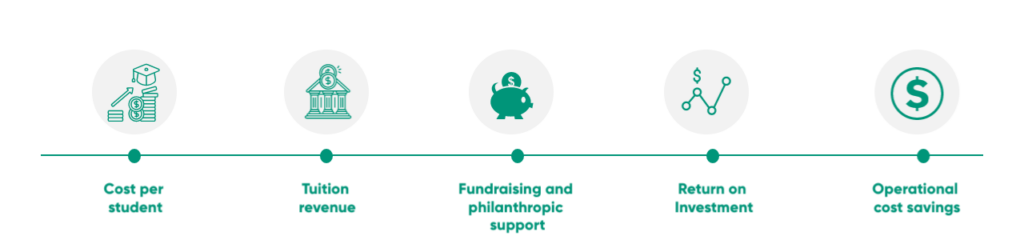
    • Cost per student: Average cost of educating each student.
    • Tuition revenue: Income generated from student tuition fees.
    • Fundraising and philanthropic support: Donations and grants received to support the institution.
    • Return on investment: Measurable benefit in relation to resources invested.
    • Operational cost savings: Reductions in operational expenses without compromising quality.
    Infographic presenting key performance indicators (KPIs) for financial and operational performance of an educational institution. KPIs include: cost per student, tuition revenue, fundraising and philanthropic support, return on investment, and operational cost savings.

    Student Engagement and Learning Outcomes

    High student engagement and successful learning outcomes translate to greater student satisfaction, improved graduate employability and a boost to your institution’s reputation. Track the following key performance indicators:

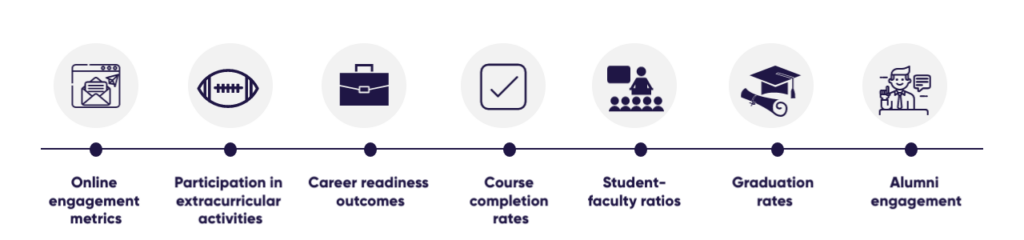
    • Online engagement metrics: Measures of student interaction and participation in online learning platforms.
    • Participation in extracurricular activities: Level of student involvement in non-academic activities.
    • Career readiness outcomes: Success of graduates in securing employment and achieving career goals.
    • Course completion rates: Percentage of students who successfully complete each course.
    • Student-faculty ratios: Number of students assigned to each faculty member.
    • Graduation rates: Percentage of students graduating within the expected or predefined timeframe.
    • Alumni Engagement: Level of engagement and involvement of graduates with the institution.
    Infographic showcasing KPIs related to student engagement, learning outcomes, and alumni involvement. KPIs include: online engagement metrics , participation in extracurricular activities, career readiness outcomes, course completion rates, student-faculty ratios, graduation rates, and alumni engagement.

    Diversity, Equity and Inclusion

    Fostering a diverse and inclusive environment promotes equity in student success, attracts a wider talent pool, and strengthens your community. We assess:

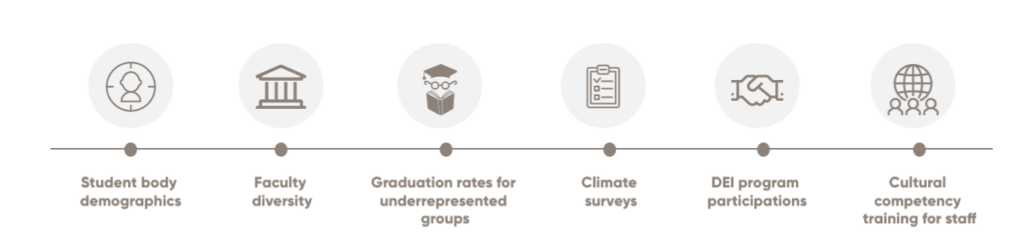
    • Student body demographics: Representation of different ethnicities, genders, socioeconomic backgrounds, etc. in the student population.
    • Faculty diversity: Representation of different groups among faculty members.
    • Graduation rates for underrepresented groups: Success rates of students from minority or disadvantaged backgrounds.
    • Climate surveys: Assessments of the campus environment in terms of inclusivity and belonging.
    • DEI program participations: Number of students, faculty, and staff engaging in diversity, equity, and inclusion initiatives.
    • Cultural competency training for staff: Efforts to equip staff with knowledge and skills to support a diverse student body.
    Infographic displaying Diversity, Equity, and Inclusion (DEI) KPIs relevant to colleges and universities. KPIs include: student body demographics (e.g., race, ethnicity, gender), faculty diversity (representation of diverse identities), graduation rates for underrepresented groups, climate surveys (assessing inclusivity and belonging), DEI program participation (engagement in diversity initiatives), and cultural competency training for staff (developing understanding and skills to interact respectfully with diverse groups).

    Brand Key Performance Indicators for Reputation and Marketing Effectiveness

    Effective marketing strategies to increase student enrollment play a key role in establishing a strong brand reputation and contributing to a positive public image.
    We monitor these key performance indicators:

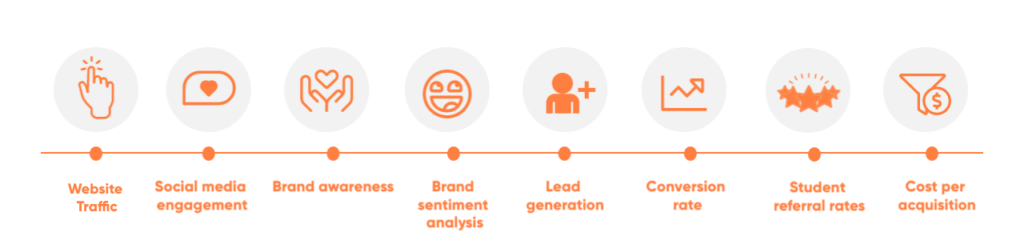
    • Website traffic: Number of visitors to the institution’s website.
    • Social media engagement: Likes, shares, comments, and other interactions on social media platforms.
    • Brand awareness: Recognition and familiarity with the institution by the target audience.
    • Brand sentiment analysis: Understanding public perception and opinion of the institution.
    • Lead generation: Number of potential students identified through marketing efforts.
    • Conversion rate: Percentage of leads who actually enroll in the program.
    • Student referral rates: Number of new students enrolled through recommendations from current or former students.
    • Cost per acquisition: Average cost of acquiring a new student through marketing campaigns.
     Infographic showcasing KPIs for brand reputation and marketing effectiveness of colleges and universities. KPIs include: website traffic (number of visitors), social media engagement (likes, shares, comments), brand awareness (recognition and familiarity), brand sentiment analysis (public perception), lead generation (potential student identification), conversion rate (leads enrolled), student referral rates (new students from recommendations), and cost per acquisition (average marketing cost per new student).

    Implementing KPIs for Success

    You’ve chosen your key performance indicators (KPIs). But hold up, don’t get lost in a sea of data just yet. We must translate those fancy metrics into real action.

    First things first, let’s talk SMART goals. Ditch the vague aspirations and define clear, measurable objectives. Instead of “improve student satisfaction,” aim for “increase student satisfaction score by 5% within the next semester.” See how much more focused and actionable that is?

    Data is your fuel, but dashboards are your engine. Imagine analyzing spreadsheets manually – cumbersome, right? Data visualization tools and dashboards are your secret weapons for making sense of all that information. They reveal trends, highlight areas for improvement and showcase your progress in a clear, digestible way.

    Collaboration is key. Don’t work in silos! Involve different departments – admissions, finance, academics, marketing – everyone who plays a role in achieving your goals. Share your KPIs, gather their insights and work together to track progress and make informed decisions. Remember, a data-driven culture thrives on shared ownership and collective action.

    Remember, adaptability is your superpower. The higher education landscape is dynamic, so your KPIs should be too. Review and update them based on new priorities, data-driven insights and feedback regularly. Be flexible, be responsive and embrace continuous improvement as your guiding principle.

    The Future is Not an Improvement. It’s a Revolution.

    Your competitors—the legacy players—are selling you on a slightly better version of the past. More data, a slightly cleaner CRM, a new consulting strategy. But what if the problem isn’t a lack of optimization but a fundamental design flaw?

    The next generation of enrollment demands a completely new approach built on intelligence, not just data.

    • From “Sticker Shock” to Financial Clarity
      You can’t afford to lose students to sticker price anxiety. The future is about radical transparency. It’s about a clear, simple financial aid process that tells a student their true cost of attendance from day one. No surprises. No opaque spreadsheets. Just clarity.
    • From Data Overload to Predictive Intelligence:
      Stop drowning in data. The future is about leveraging AI and predictive analytics to identify the students most likely to enroll and graduate. It’s about understanding their unique needs before they even ask and delivering a hyper-personalized experience that feels like it was designed just for them.
    • From Siloed Chaos to a Seamless Student Journey:
      Overthrow the departmental silos. The future of enrollment is an all-in-one platform that connects every stage of the student journey—from initial search to application, financial aid and enrollment. It’s one portal, one point of contact, one seamless experience.

    Stop Tinkering. Start Transforming.

    You have a choice. You can keep doing what you’ve always done, hoping a better website or a new consulting firm will solve a systemic problem. Or you can admit the old way of doing things is broken and choose to fundamentally transform your approach.

    Your KPIs aren’t just a measure of your progress; they are proof that the traditional system is failing. It’s time to stop measuring the problem and start building the solution.

    Ready to dismantle the old way and build the next generation of enrollment? Partner with EDDY to identify crucial KPIs, develop effective strategies to increase student enrollment, and track progress toward sustainable growth. Together, we can turn your data into a powerful force for positive change and empower your institution to reach its full potential.

    Take the first step today! Contact EDDY to learn how we can help you leverage the power of KPIs and achieve your strategic goals.

    Source link

  • When Majors Matter

    When Majors Matter

    I’ll admit a pet peeve when writers set out two extreme views, attributed vaguely to others, and then position themselves in the squishy middle as the embodiment of the golden mean. It seems too easy and feeds the cultural myth that the center is always correct.

    So, at the risk of annoying myself, I’ve been frustrated with the discourse recently around whether students’ choice of majors matters. It both does and doesn’t, though that may be more obvious from a community college perspective than from other places.

    “Comprehensive” community colleges, such as my own, are called that because they embrace both a transfer mission (“junior college”) and a vocational mission (“trade school”). The meaning of a major can be very different across that divide.

    For example, students who major in nursing have the inside track at becoming nurses in a way that students who major in, say, English don’t. Welding is a specific skill. HVAC repair is a skill set aimed squarely at certain kinds of jobs. In each case, the goal is a program—sometimes a degree, sometimes a diploma or certificate—that can lead a student directly into employment that pays a living wage. In some cases, such as nursing, it’s fairly normal to go on to higher degrees; in others, such as welding, it’s less common. Either way, though, the content of what’s taught is necessary to get into the field.

    In many transfer-focused programs, the opposite is true. A student with the eventual goal of, say, law school can take all sorts of liberal arts classes here, then transfer and take even more. Even if they want to stop at the bachelor’s level, the first two years of many bachelor’s programs in liberal arts fields are as much about breadth as about depth. Distribution requirements are called what they’re called because the courses are distributed across the curriculum.

    At the level of a community college, you might not be able to distinguish the future English major from the future poli sci major by looking at their transcripts. They’ll take basic writing, some humanities, some social science, some math, some science and a few electives. And many receiving institutions prefer that students don’t take too many classes in their intended major in the first two years. Whether that’s because of a concern for student well-roundedness or an economic concern among departments about giving away too many credits is another question.

    Of course, sometimes the boundary gets murky. Fields like social work straddle the divide between vocational and transfer, since the field often requires a bachelor’s degree. Similarly, a field like criminal justice can be understood as police training, but it also branches into criminology and sociology. And business, a perennially popular major, often leads to transfer despite defining itself as being all about the market.

    The high-minded defense of the view that majors don’t matter is that student interest is actually much more important than choice of major. I agree strongly with that. I’d much rather see a student who loves literature study that than force herself to slog through an HVAC program, hating every moment of it. The recent travails of computer science graduates in the job market should remind us that there are no guaranteed occupations. Students who love what they study, or who just can’t stop thinking about it, get the most out of it. And after a few years, most adults with degrees are working in fields unrelated to their degrees anyway. To me, that’s a strong argument for the more evergreen skills of communication, analysis, synthesis, research and teamwork: No matter what the next hot technology is, people who have those skills are much more likely to thrive than people who don’t. A candidate’s tech skill may get them the first job, but their soft skills—not a fan of the term—get them promoted.

    I want our students to be able to support themselves in the world that actually exists. I also want them to be able to support themselves in the world that will exist 20 years from now. Technological trends can be hard to get right. Remember when MOOCs were going to change everything? Or the Segway? In my more optimistic moments, I like to think that bridging the divide between the liberal arts and the vocational fields is one of the best things community colleges can do. Even if that feels squishy and centrist.

    Source link

  • Why stories still matter in a fast-moving world

    Why stories still matter in a fast-moving world

    Key points:

    Seventeen years after Suzanne Collins first introduced us to The Hunger Games, the world is still captivated by Panem. The latest installment, Sunrise on the Reaping, dives into Haymitch’s backstory and has been called a “propulsive and heart-wrenching addition” to the series by The New York Times. For many of us, books like these aren’t just stories–they’re cultural moments.

    I remember reading the original trilogy on my iPad while training for a half-marathon. Katniss’ fight against the Capitol powered me through some of my longest runs. That’s the magic of books: They meet us where we are and carry us somewhere else entirely. They become part of our personal history, woven into our memories and milestones.

    But the power of books goes far beyond personal nostalgia. When a major title drops, it’s not just a release date–it’s a shared experience. Readers rush to get their hands on it. Social media lights up with reactions. Libraries field waitlists. These moments remind us why books matter. They connect us, challenge us, and inspire us.

    This fall, we’re about to experience two more of these moments. On October 21, Diary of a Wimpy Kid: Partypooper hits shelves. Jeff Kinney’s beloved series has become a rite of passage for young readers, and this latest installment–centered around Greg Heffley’s attempt to throw himself the ultimate birthday bash–is already generating buzz. It’s funny, relatable, and perfectly timed for a generation that’s grown up with Greg’s awkward, hilarious adventures.

    Just a few weeks later, on November 11, Dog Man: Big Jim Believes arrives. Dav Pilkey’s Dog Man series has redefined what it means to be a children’s book phenomenon. With its blend of humor, heart, and comic-style storytelling, Dog Man has helped countless kids fall in love with reading. This new title promises to be no different, offering a story about belief, friendship, and finding strength within.

    These books aren’t just for kids–they’re cultural touchstones. They bring generations together. Parents read them with their children. Teachers use them to spark classroom discussions. Librarians build displays around them. And kids? They devour them and talk about them with the kind of passion usually reserved for blockbuster movies or viral games.

    And yes, there’s a business side to books. Pricing, distribution, marketing strategies–they all matter. Behind every book on a shelf is a network of people working to make that moment possible. Publishers, authors, illustrators, binders, warehouse teams, sales reps, marketers, and more. It’s easy to forget that when you’re holding a finished book, but every title is the result of countless decisions, collaborations, and passions.

    In a world dominated by screens, short-form content, and constant notifications, books offer something different. They ask us to slow down. To focus. To imagine. To empathize. And that’s more important than ever.

    Literacy isn’t just about reading words on a page–it’s about understanding the world. It’s about critical thinking, emotional intelligence, and the ability to engage with complex ideas. Books help build those skills. They give kids the tools to navigate life, not just school.

    Because in a world that’s constantly changing, books remain one of our most powerful tools for understanding it–and each other. The world needs stories. And stories need us.

    Britten Follett
    Latest posts by Britten Follett (see all)

    Source link

  • Resilience is a matter of national health

    Resilience is a matter of national health

    With ongoing shortages of some 40,000 nurses and a 26 per cent drop in applicants to nursing degree courses in the last two years the staffing crisis in the NHS is set to get more acute.

    There is the backdrop of strikes, the legacy of Covid, low pay, the costs of studying along with the cost of living crisis.

    It is, perhaps, little wonder that around 12 per cent of nursing students in England fail to complete their degrees – twice the average undergraduate drop out rate. As health students tell us, “there are times when the NHS is not a nice place to be.”

    The constant cycle of coursework and clinical placements is “a treadmill, hard graft.” Students talk about feeling isolated, particularly during placements.

    The pressure to succeed and the fear of judgment from peers and professionals over not being able to “tough it out” can get in the way of students accessing support. The emotional toll of the work, coupled with the expectation to maintain a brave face, leads to compassion fatigue, burnout and a sense of depersonalisation.

    “It’s not,” students tell us, “what I thought it would be.”

    The resilience narrative

    Of course, the notion that healthcare is inherently tough and that only the most resilient can survive is not new. In fact, it’s something of a badge of honour.

    As one student told us, “there is this echo chamber. Students all telling each other about how tough it is, about the pressure, the volume of work, how it is non-stop and overwhelming.”

    But tying students’ worth to their ability to withstand adversity, that it is up to them to make up for something lacking in themselves instead of focusing on their capacity to thrive and grow, can be disempowering and debilitating.

    It’s time to change this corrosive resilience narrative, to bury the notion that it is the student who is somehow coming up short, who needs fixing. Resilience is not about survival and just getting through. It’s about coming back from set backs and thriving. It is about learning and growing. And it’s about something that is fostered within a supportive community rather than an ordeal endured alone by every student.

    So resilience becomes about putting in place support, about gathering what you need to be a success instead of simply finding a lifeline in a crisis.

    It is community that becomes a building block of resilience: the pro-active building of strong networks among students that enable and encourage them to support each other; building a wider support network of academic staff, supervisors in placements, of family and friends. It is here you find fresh perspective, the space to come back from setbacks.

    A midwifery student describes the: “WhatsApp group to keep in touch, check in and support each other. We’ve got a real sense of community;” a nursing student talks about how “it turned out that other students were just as terrified and felt like they were starting from scratch with every new placement.

    Sharing our feelings and experiences really helped normalise them;” and the medical student who suddenly “realised that everyone else was struggling. I wasn’t the only one who didn’t have confidence in themself and their abilities.”

    And by challenging negative interpretations of themselves, the “I can’t do it”, “I don’t belong”, “I’m the only one who’s struggling,” students begin to see new choices. Resilience becomes about developing the sense of agency and the confidence to respond differently, to challenge, to get the support you need to navigate towards your own definition of success.

    What matters

    So, to be resilient also means making the space to reflect on what truly matters to you when the norm, as a health student, is to focus only on the patients.

    Our medical student talks about how:

    …I spend a lot of time focused on looking after others and have seen myself as a low priority. This lack of self care used to result in things building up to breaking point. I needed a place to reflect, away from all the academic pressures. A time to focus on myself.

    It can take courage to do different, to do what is right for you rather then what people expect you to do. It takes courage not to join in with the prevailing culture when it doesn’t work for you. So resilience is also about bravery.

    The midwifery student again:

    I’m stopping negative experiences being the be all and end all of my experience.

    Disruptors and modellers

    What we’re talking about here is a cultural shift, about redefining the resilience narrative so it is about enabling students to discover their strengths and navigate their challenges with confidence.

    The role of staff is critical – as disruptors of the prevailing narrative in healthcare; in modelling behaviour; and re-inventing their everyday interactions with the practitioners of tomorrow.

    By using coaching tools and techniques, those of whose job it is to support students can:

    • Create a supportive environment that mitigates against self-stigma and provides students with permission and opportunities to be proactive in disclosing needs and unconditional reassurance that they feel they will be heard and valued;
    • Work in relationship with the whole student, supporting students to reflect on who they are and where they are going, and to make courageous choices;
    • Foster a sense of community to create a more supportive and effective learning environment

    We know there are places where this work has already getting results.

    A Clinical Skills Tutor describes how this approach:

    …has made me rethink my relationship with students, opened me up to working with students in a way I’d not thought about. I’ve seen how empowering it can be. I’m much more effective at making sure they get the support they need.

    Empowering students to redefine “resilience” on their own terms makes it a platform for learning and growth, rather than a burden to bear. There are more likely to succeed in their studies and will be better prepared for the challenges in their professional lives.

    As our student nurse puts it:

    “Grit turns your thinking on its head. I’ve been happier, calmer, better able to cope. I ask for help and support when I need it. I don’t bottle things up to breaking point. Things just don’t get to crisis point any more.

    Source link

  • Ramadan should matter to higher education

    Ramadan should matter to higher education

    Ramadan celebrates the revelation of the Islamic holy book, the Qur’an, to the Prophet Muhammad.

    One of the five pillars of Islam is fasting (abstaining from all food and drink) during daylight hours in this holy month.

    In the UK, approximately 321,000 (11 per cent) students identify as muslim, which is the largest religious group after christian students (27 per cent).

    However, in a recent survey of nearly 300 UK educators, almost a quarter of them couldn’t say when Ramadan took place in 2024. A quarter also didn’t know whether they had any muslim students in their classes.

    Only 30 per cent knew the exact dates of Ramadan, and 47 per cent could only guess approximately. Worryingly, 40 per cent of respondents had no idea whether their muslim students were fasting, and despite 56 per cent acknowledging a need for change in teaching practices, only half of them had actually made any adjustments.

    This is concerning – because the practice of Ramadan will undoubtedly impact muslim students’ ability to engage with their studies among those who are able to observe it.

    The ninth month of the Islamic calendar

    Throughout Ramadan, priorities may shift towards personal worship and devotion, as well as family and community.

    They are more likely to require time to pray during the day, and to be absent to celebrate Eid at the end of Ramadan.

    Changes to muslim students’ routines to enable them to take part in pre-dawn meals and night prayers may also impact their learning. The effects of Ramadan will also fluctuate during a given day as well as through the fasting period.

    You can gain an insight into Ramadan from a students’ perspective in this video, produced by Oxford Brookes University.

    A prevalent myth is that staff should avoid eating and drinking in front of fasting students. This is not necessary – muslim students respect the need for others to eat and drink and generally do not expect others to alter their behaviour.

    However, it is considerate to avoid organising social events centred around food and drink during Ramadan.

    Another misconception is the belief that students will automatically request support or adjustments if needed. In reality, students may not be aware of their rights to reasonable adjustments on religious grounds, or they might not feel comfortable making those sorts of requests.

    Staff should openly communicate institutional policies regarding religious observance and encourage students to discuss their needs without fear of judgement or disadvantage.

    Fasting doesn’t affect all students in the same way. Not all muslim students fast – some may be exempt due to health reasons, travel, or other personal circumstances. The effects of fasting can also vary, with some students managing well while others may struggle, particularly during the holiest last ten days of Ramadan.

    Evidence regarding the impact on learning of fasting during Ramadan is mixed. It can have different impacts on cognitive functioning depending on whether students are studying in predominantly muslim countries or not.

    In terms of the impact of disrupted sleep routines and a lack of sleep on learning, the evidence is fairly robust, with multiple studies showing a negative impact. This sleep disruption when observing Ramadan could potentially have a greater impact on students’ learning than fasting itself.

    Unfortunately, the limited guidance available on most institutional webpages in the UK seems to be aimed at muslim students themselves, putting the onus on them to seek support or adjustments. This positioning takes away some of the responsibility of institutions to amend practices and policies to support these students.

    Supporting muslim students

    With these issues in mind, I led a project to find out what educators proactively do to support muslim students.

    Based on our findings, and with contributions from a panel of muslims and other experts, we created a guide containing information and practical support for educators to implement in their classrooms. The guide is available to download from the National Teaching Repository.

    In the guide we have:

    • included an email template (page 9) that you can adapt to send to all students to acknowledge Ramadan
    • included a link to free printable posters about Ramadan to display on campus
    • busted common myths, for example around eating and drinking
    • provided 6 ways to make relatively small changes to learning and teaching practices that could make a big difference. These include 1) Acknowledge Ramadan, 2) Avoid Assumptions and Ask, 3) Adjust Assessment Timings, 4) Offer Asynchronous Learning, 5) Raise Awareness and Celebrate, and 6) Be Inclusive and make Sustainable Change.
    • given some guidance relating to supporting students who are on a work placement

    Supporting muslim students on work placements during Ramadan presents unique challenges and opportunities. The guide encourages conversations with placement coordinators and managers early to explore what accommodations might be available, such as flexible scheduling to allow for prayers or adjusted meal breaks to accommodate Suhoor (pre-dawn meal) and Iftar (meal to break the fast).

    It also highlights the importance of understanding the potential impact of such accommodations not only on students but also on clients, patients, or service users in placement settings, ensuring that any adjustments made are both supportive and practical.

    Organising a three-way meeting between the placement provider, the student, and the academic lead can help surface specific issues and create tailored solutions. And constructing a formal policy for supporting fasting students on placements could serve as a blueprint for sustainable, long-term change.

    More broadly, institutions could formalise their approach by adding “religious observance” as a standing agenda item in relevant committees and planning meetings. This would ensure that religious inclusion is not treated as an afterthought but as an integral part of institutional decision-making.

    Working with university chaplaincies is another recommendation – chaplains often have direct connections with religious student groups and can provide valuable insights into their needs. Ideally the sector would move beyond fixes and towards normalising religious inclusivity, reduce barriers to learning, and demonstrate a genuine commitment to equity and fairness.

    We hope that the guide will make it relatively easy for educators to take some immediate positive action, and that even a small change will make a positive difference by increasing a sense of belonging and mattering to our muslim students.

    Source link

  • WEEKEND READING: Matt Goodwin’s ‘Bad Education’ isn’t good scholarship, but does that matter?

    WEEKEND READING: Matt Goodwin’s ‘Bad Education’ isn’t good scholarship, but does that matter?

    • Steven Jones is Professor of Higher Education at the University of Manchester and his latest book is Universities Under Fire (2022). This review of Bad Education by Matt Goodwin has been written in a personal capacity.
    • HEPI’s other review of the Matt Goodwin’s book can be accessed here.

    In Bad Education, Matt Goodwin makes the argument that Western universities have moved ‘sharply and radically to the left’ (p.51) over the last six decades, to the extent that diversity is now deemed more important than merit. According to Goodwin, a woke orthodoxy has gripped the sector: free speech is stifled; non-authorised viewpoints are unwanted; and social justice trumps the pursuit of truth. Some minorities flourish within this culture, but other ‘political’ minorities – like the one to which Goodwin claims membership – are structurally disadvantaged. 

    To stand this argument up, Goodwin needs the reader to accept two fundamental premises. The first is that the author’s sense of victimhood is real, while others are imaginary or exaggerated. Goodwin achieves this by attributing his every professional setback – from having journal articles and funding bids declined to being overlooked for invited talks (p.47) – to his whiteness, his maleness, or his political positions, such as his refusal to participate in ‘cult-like worship of the EU on campus’ (p.44). No other explanation is countenanced. 

    The second premise is that the real power in universities is cultural, not economic, and therefore held by diversity champions and other woke activists. The evidence Goodwin offers here is underwhelming. Where academic scholarship is cited, the sources are mostly US-based, and the author shows no curiosity about the think-tanks and lobby groups that funded the surveys in which he places his faith. Critical higher educational research is studiously avoided, though Goodwin does turn to Elon Musk for a quote about the ‘woke mind virus’ (p.104). In places, Bad Education reads as a checklist of debunked myths and personal memoirs (‘as I’ve seen first-hand’ is a familiar clause). Yet in the final chapter, Goodwin addresses the reader directly to assert: ‘I’ve bombarded you at times with statistics and research because I wanted you to read it for yourself and make up your own mind’ (p.198). 

    I tried hard to make up my own mind, but it’s difficult to be persuaded by Goodwin’s case against universities when the bulk of empirical data point in an opposite direction. If recruitment practices are so diversity conscious, why were there only 25 Black British female professors in the UK as recently as 2019? If ‘reverse racism’ is such a problem, why did the awarding gap between White and Black students achieving high degrees stand at 18.4% in 2021? In my experience, and according to my research, minority groups are far from over-represented in senior levels of university management and governance, and board cultures tend to be driven by corporate principles, not woke ideologies. As for no-platforming, fewer than 0.8 per cent of university events or speaker invitations were cancelled in 2021-22. In other words, the truths that Goodwin is so boldly willing to speak may be his truths, but they are not universal.

    Among the fellow marginalised white men willing to support Goodwin is the University of Buckingham’s Eric Kaufmann, who is quoted extensively, and whose back-cover endorsement describes Bad Education as ‘deeply personal and impeccably researched.’ It’s certainly deeply personal. Take Goodwin’s indignation towards a lecturer who unfriended some Conservative voters on Facebook after the 2015 UK general election (p.89). The reader is not told what this incident is supposed to signify, let alone why Goodwin’s cherished free speech principles appear not to extend to academics’ private social media accounts.

    That’s not to say that the sector is always operating to the highest ethical standards. Goodwin is on firmest ground when highlighting human rights violations in China (p.90), and calling out universities for turning a blind eye. But rather than take this argument to its logical conclusion – by critiquing a fee model that leaves sectors reliant on income from overseas students – Goodwin pivots back into anger and anecdote, rebuking universities for being defensive about their historic links with the slave trade (p.91) and sharing stories about junior colleagues too scared to disclose their pro-Brexit leanings (p.94).

    Despite Goodwin’s stated aim to ‘push back against authoritarianism’ (p.208), there are echoes of Donald Trump’s playbook throughout Bad Education. The author’s anti-diversity bombast recalls the President’s recent claim that a fatal air crash near Washington DC was connected to DEI programmes in federal government. It’s not entirely clear to which level of institutional bureaucracy Goodwin is referring when he imagines a ‘hyper-political and highly activist managerial blob’ (p.157), but the language is redolent of that being deployed in the US to justify a purge of federal bureaucrats. According to Goodwin, this ‘managerial blob’ is defined by an insistence on rainbow lanyards and flags on campus, among other things. This is not a characterisation of senior leaders that most university staff would recognise. Could it be that the author is so distracted by empty performative gestures that he fails to see where power is really located?

    Goodwin has now left academia, a story he tells in most chapters, steadily elevating it to the level of Shakespearean tragedy: ‘my professorship – everything I had ever wanted, everything I had worked for – was over’ (p.195). At a time when 10,000 jobs are on the line at UK universities, such self-indulgence is unfortunate. Goodwin’s contrast between the ‘luxury beliefs’ of academics and the ‘real world’ he claims to inhabit (p.78) encapsulates what makes Bad Education read like a ‘prolonged gripe,’ as another reviewer put it. Paradoxically, Goodwin now enjoys a range of high-profile platforms from which to air his grievances about being no-platformed, regularly appearing on television to blame wokeism for various social ills. Why is it that only ‘cancelled’ academics seem to have media agents?

    Bad Education builds towards what Goodwin calls a ‘manifesto’ for universities (pp.217-19) that want to have ‘good, not bad, education’ (p.217). It’s a simplistic way to wrap up any book, comprising a bullet-pointed list of the same few complaints expressed in slightly different terms. Those of us in higher education will quickly recognise Bad Education’s distortions: universities haven’t lurched radically left and there’s no woke coup. But does that matter? Are we the target readership? Or is the book speaking to external audiences? What if a review like this merely confirms what Goodwin and his fellow academic outcasts have been saying all along?

    Since accepting the terms of the market, English universities have struggled to articulate their role in society. Academic expertise has been devalued and the status of higher education as a public good compromised, with universities increasingly embroiled in unwinnable culture wars. These are perfect conditions for someone like Goodwin to ‘blow up’ his own career (p.4), break the ‘secret code of silence’ (p.3) and position himself as the fearless ‘rogue professor’ (p.16). In such ways, important debates become framed by individuals with the shallowest insights but the deepest grudges. Bad Education does a passable job of confirming suspicions about what really goes on inside a secretive and often aloof sector, guiding its readers further down an anti-university, anti-expert rabbit hole. If we continue to leave vacuums in the discourse, then diversity-blaming narratives like Goodwin’s will continue to fill them.

    Source link

  • Job titles matter for inclusive and meaningful work

    Job titles matter for inclusive and meaningful work

    Job titles, and the names given to organisational roles, are important for the meaning that individuals derive from their work and their engagement with their work.

    Yet within many UK universities, and especially the post-92s, the trend is towards new job titles with potentially negative connotations for the job holders in terms of the meaning of their work and their commitment to it and to their institution.

    Such universities have been moving away from the conventional “lecturer” titles, adopting the US system of titles. US institutions typically designate their junior (un-tenured) academics as Assistant Professors, with an intermediate grade of Associate Professor and then a full Professor grade. Within the US system, most long serving and effective staff can expect to progress to full Professor by mid-career.

    Yet, in this new UK system, only around 15-20 per cent of academics are (and likely ever to be) full Professors and many academics will spend their entire careers as Assistant Professors or Associate Professors, retiring with one of these diminutive job titles.

    The previous, additive, job titles of Lecturer to Senior Lecturer and then to Principal Lecturer or Reader had meaning outside the university and, crucially, had meaning for the post-holders, giving a sense of achievement and pride as they progressed. Retiring as a Senior or Principal Lecturer was deemed more than acceptable.

    Status and self-esteem

    It is not hard to imagine the impact that the changes in job titles is having upon mid and late-career academics who may have little chance of gaining promotion to full professor, perhaps because quite simply they draw the line at working “just” 60 hours a week, 50 weeks a year. The impact on status and self-esteem is immense. Imagine explaining to your grandkids that you are, in essence, an assistant to a professor. As an Associate Professor, and particularly in a vocational discipline, one of the authors is often asked, “I can understand you wanting to work part-time for a university, but what’s your main job?” Associate, affiliate, adjunct – these names are pretty much the same thing to outsiders.

    Managerially, though, the change from designating academics as Senior Lecturer to Assistant Professors and from Principal Lecturers to Associate Professors is genius. These diminutive job titles confer inferiority – but with the promise that if you keep your nose to the grindstone and keep up the 60+ hour weeks, 50 weeks a year, you might be in with a chance of a decent job title, as a professor. What a fantastic, and completely friction-free, way of turning the performative screw.

    The UK university sector is not alone and other public sector organisations have similarly got into a meaning muddle from the naming of their jobs. For example, in the British civil service, a key middle management role is labelled “Grade B2+”, whereas a relatively junior operational role is designated a rather grand sounding “Executive Officer”. And just last autumn, the NHS acknowledged that names do matter, abandoning the designation of “junior” doctor which was used to encompass all medics that sit within the grades below what is known as “consultant”, and which their union described as “misleading and demeaning” – it’s been replaced with “resident” doctor.

    Meaningful work

    A name gives meaning to workers. It gives status, prestige, and identity. While those organisations such as universities who fail to realise the importance of job titles may be able to turn the screw in the short-term, extracting ever more work from their junior-sounding Assistant and Associate Professors, they will in the longer-term, for sure, have an ever more demoralised and demotivated workforce for whom the job has little meaning other than the pay.

    And, since pay for university academics in the UK has been so badly eroded in recent decades, job title conventions are a self-inflicted injury – one that risks academics’ engagement and wellbeing and, ultimately, their institutions’ performance.

    Source link