Tag: McGhee

  • Make America Crash Again (Glen McGhee and Dahn Shaulis)

    Make America Crash Again (Glen McGhee and Dahn Shaulis)

    Climate change has begun to have immediate effects, with increasing natural disasters disrupting communities and infrastructure. Reduced environmental regulations have intensified these risks, disproportionately affecting vulnerable populations and increasing economic costs.

    The rollback of regulatory protections in finance, environment, and education has allowed risky practices to grow while reducing oversight. This shift has raised the chances of economic shocks and deepened social inequalities.

    Trade disputes and reduced international cooperation have weakened key economic and diplomatic relationships. At the same time, BRICS countries are expanding their influence, altering the global economic landscape in ways that require careful attention.

    The expansion of surveillance programs and strict immigration enforcement have raised concerns about civil liberties and community trust. These pressures threaten the social cohesion needed to address larger systemic issues.

    Recent reporting by the Higher Education Inquirer shows that the student debt crisis and speculative financial pressures in higher education mirror and magnify these broader challenges. The sector’s increasing reliance on debt financing not only affects students but also contributes to wider economic fragility (HEI 2025).

    Earlier analysis emphasized that these trends were predictable outcomes of longstanding policy decisions and economic structures (HEI 2020).

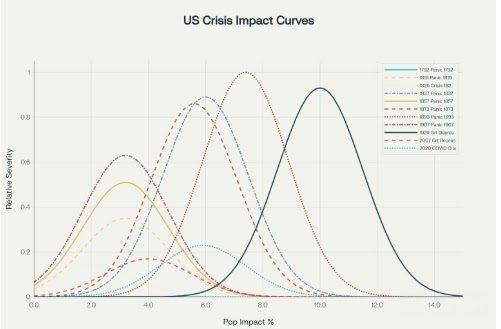
                 [Analysis of US Economic Downturns for duration and population impact]

    Preventing a serious downturn requires coordinated action on multiple fronts. Strengthening regulations is necessary to reduce financial risks and protect consumers. Effective climate policies are essential, particularly those focused on vulnerable communities. Reforming higher education financing to reduce unsustainable debt burdens can ease economic pressures. Restoring international cooperation and fair trade practices will help rebuild economic and diplomatic relationships. Protecting civil rights and fostering social trust are crucial to maintaining social cohesion.

    These issues are deeply interconnected and require comprehensive approaches.

    Sources

    Higher Education Inquirer, Let’s Pretend We Didn’t See It Coming…Again (June 2025): https://www.highereducationinquirer.org/2025/06/lets-pretend-we-didnt-see-it-comingagain.html

    Higher Education Inquirer, The US Working‑Class Depression: Let’s All Pretend We Couldn’t See It Coming (May 2020): https://www.highereducationinquirer.org/2020/05/lets-all-pretend-we-couldnt-see-it.html

    Federal Reserve, Consumer Credit Report, 2025

    U.S. Department of Education, Student Loan Debt Statistics, 2025

    Intergovernmental Panel on Climate Change (IPCC), Sixth Assessment Report, 2023

    Council on Foreign Relations, The BRICS and Global Power, 2024

    Source link

  • A 20-Year Reflection on Transparency and the Illusion of Access (Glen McGhee)

    A 20-Year Reflection on Transparency and the Illusion of Access (Glen McGhee)

    The cancellation of the latest NACIQI (National Advisory Committee on Institutional Quality and Integrity) meeting brought back bitter memories that refuse to fade. 

    It’s been twenty years since I traveled to Washington, DC—dressed in my best lobbying attire and carrying a meticulous roster of Department of Education staff—to visit the Office of Postsecondary Education (OPE) on K Street. My goal was simple, even noble: to seek answers about the opaque workings of accreditation in American higher education. What I encountered instead was a wall of silence, surveillance, and authoritarianism.

    I stepped off the elevator on the seventh floor of the Department building and signed in. Under “Purpose of Visit,” I wrote: Reform. I was calm, professional, and respectful. I asked to see the NACIQI Chair, Bonnie, hoping that she would be willing to speak with me about a system that, even then, was falling into disrepair. But what happened next still infuriates me.

    Within seconds, two armed, uniformed guards approached me. They didn’t ask questions. They gave an ultimatum: leave or be arrested.

    I eventually complied, descending into the lobby, still stunned. From there I began dialing—one by one—through the directory of names I had so carefully assembled. I called staffers, analysts, assistants, anyone who might answer. Not a single person picked up. I could feel the eyes of the guards watching me, one of them posted on the mezzanine like a sniper keeping watch over a public enemy. I was not dangerous. I was not disruptive. I was, however, unwanted.

    The next day, I turned to my Congressman, Allen Boyd, whose LA generously tried to intervene. His office contacted OPE, attempting to broker a meeting on my behalf. The Department didn’t even return his call. Apparently, a sitting member of Congress—who didn’t sit on a high-ranking committee—carried no weight at the fortress of federal education oversight.

    This most recent overstepping by US ED—unilaterally postponing NACIQI’s Summer 2025 meeting—reminds observers of how limited the oversight provided by NACIQI really is. It is, apparently, nothing more than a performative shell that fulfills ceremonial functions, and not much more.

    I would argue that this latest episode reveals that NACIQI is less an independent watchdog and more a ceremonial body with limited real power, and so my view differs somewhat from David Halperin, because he sees more substantive activity than I do.

    The history of ACICS (Accrediting Council for Independent Colleges and Schools) and SACS (Southern Association of Colleges) appearing before NACIQI illustrates how regulatory capture can manifest not only through industry influence, but also through bureaucratic design and process control. The OPE’s central role, combined with NACIQI’s limited enforcement power, has allowed failing accreditors to retain recognition for years, even in the face of overwhelming evidence of noncompliance and harm to students.

    The illusion of accountability has long been a feature of the accreditation system, not a flaw. NACIQI meetings, when they occur, are tightly scripted, with carefully managed testimony and limited public engagement. The real decisions are made elsewhere, behind closed doors, often under the influence of powerful lobbying groups and entrenched bureaucracies that resist transparency and reform at every turn.

    Despite the increasing scrutiny on higher education and growing public awareness of student debt, poor educational outcomes, and sham institutions, the federal recognition of accreditors remains an elite-controlled process. It is a closed loop. Institutions, accreditors, and government officials all play their roles in a carefully choreographed performance that rarely leads to systemic change. The result is a system that protects institutions at the expense of students, particularly the most vulnerable—low-income, first-generation, and minority students who are often targeted by predatory schools hiding behind federal accreditation.

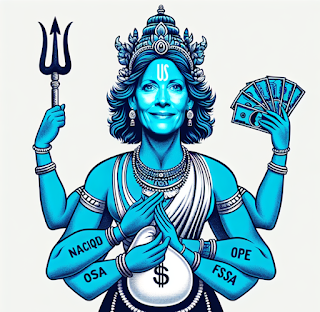
    This is the reality of the U.S. Department of Education’s accreditation apparatus: inaccessible, unaccountable, and increasingly symbolic. NACIQI, far from being an independent advisory body, has always functioned as a ceremonial front for political appointees and entrenched interests. It is, as I see it, just another arm of Vishnu—multiplicitous, all-seeing, but ultimately indifferent to critique or reform. Whether it’s chaired by a bureaucrat or a former wrestling executive like Linda McMahon, the outcome is the same: the process is rigged to exclude dissent and suppress scrutiny.

    And yet, pundits today still fail to grasp the implications. They speak of accreditation as if it were a technocratic process guided by evidence and integrity. They act as if NACIQI were a neutral arbiter. But I know otherwise, because I was there—thrown out, silenced, and treated like a trespasser in the very institution that claims to protect educational quality and student interest.

    This is more than personal bitterness. It’s about structural rot. When critics are expelled, when staff are muzzled, and when public servants ignore elected representatives, we are not dealing with oversight—we are witnessing capture. Accreditation in this country serves the accreditors and the institutions, not students, not taxpayers, and certainly not reformers.

    Two decades later, the anger remains. So does the silence.


    Sources:
    Department of Education building directory and procedures (2005)
    Congressional Office of Rep. Allen Boyd (archival record, 2005)
    Public notices regarding NACIQI meeting cancellations (2024–2025)
    David Halperin, Republic Report

    Source link

  • How the 2025 U.S. Department of Education Reorganization Fulfills Grover Norquist’s Dream (Glen McGhee)

    How the 2025 U.S. Department of Education Reorganization Fulfills Grover Norquist’s Dream (Glen McGhee)

    In 2001, conservative activist Grover Norquist declared that his goal was to shrink government “to the size where I can drag it into the bathroom and drown it in the bathtub.” More than two decades later, under the leadership of Secretary Linda McMahon, the U.S. Department of Education’s March 2025 reorganization delivers on that radical vision—not with fire and fury, but with vacancies, ambiguity, and quiet institutional collapse.

    Vacant Seats, Hollow Power

    With dozens of senior leadership roles left vacant, enforcement functions gutted, and policymaking handed over to political allies and industry insiders, the Department no longer resembles a federal agency tasked with protecting students and public investment. Instead, it has become a hollowed-out vessel primed for deregulation, privatization, and corporate exploitation.

    The new organizational chart is littered with the word “VACANT.” From Chiefs of Staff and Deputy Assistant Secretaries to senior advisors in enforcement, civil rights, and postsecondary education, entire divisions have been effectively immobilized. The Office of Civil Rights is barely staffed at the top. The Rehabilitation Services Administration is leaderless. The General Counsel’s office lacks oversight in key regulatory areas. This is not streamlining—it is strategic self-sabotage.

    Federal Student Aid (FSA), overseeing over $1.5 trillion in loans, is run by an acting chief. Critical offices such as the Office of Postsecondary Education (OPE) are fragmented, missing key leadership across multiple branches—especially those charged with accreditation, innovation, and borrower protections.

    The Kent Controversy: A Symptom of Systemic Rot

    The collapse of federal oversight is not only evident in the vacancies—it is also embodied in controversial political appointments. As education policy watchdog David Halperin has reported, the Trump administration’s nominee for Under Secretary of Education, Nicholas Kent, epitomizes the revolving door between the Department of Education and the for-profit college industry.

    Kent’s career includes roles at Education Affiliates, which in 2015 paid $13 million to settle a Department of Justice case involving false claims for federal student aid, and later at Career Education Colleges and Universities (CECU), the lobbying group for the for-profit college sector. Under Kent’s policy leadership at CECU, the organization actively fought against borrower defense rules, gainful employment regulations, and other safeguards meant to protect students from exploitative educational institutions.

    Despite this record, the Senate Health, Education, Labor and Pensions (HELP) Committee advanced Kent’s nomination on May 22, 2025, in a party-line 12–11 vote—without a hearing. HELP Ranking Member Bernie Sanders objected, saying, “In my view, we should not be confirming the former lobbyist that represented for-profit colleges.” Advocates, including Halperin and six education justice organizations, sent a letter to Chairman Bill Cassidy calling for public scrutiny of Kent’s background and the Trump administration’s destructive higher education agenda.

    Among their concerns are the elimination of key enforcement staff and research arms at the Department, the cancellation of ongoing research contracts, the rollback of borrower defense and gainful employment protections, the $37 million fine reversal against Grand Canyon University for deceptive practices, and the Department’s silence on accreditation reform and oversight of predatory schools. These developments, the letter argued, mark a decisive return to the era of unchecked corporate education—where taxpayer dollars are funneled to dubious institutions and students are left with mountains of debt and worthless credentials.

    “Mission Accomplished” for the Privatization Movement

    This version of the Department of Education, stripped of its regulatory muscle and stocked with industry sympathizers, is not an accident. It’s the culmination of decades of libertarian, neoliberal, and religious-right agitation to disempower public education. The policy pipeline now flows directly from organizations like the Heritage Foundation and ALEC to appointed officials with deep ties to the industries they were once charged with policing.

    Rather than serving the public, the department’s primary role now appears to be facilitating the private sector’s conquest of higher education—through deregulation, outsourcing, and the erosion of civil rights protections.

    A Shrinking Federal Presence, an Expanding Crisis

    The consequences are far-reaching. Marginalized students—Black, brown, low-income, first-generation, disabled—depend disproportionately on federal guarantees, oversight, and funding. As these protections recede, so too does their access to meaningful educational opportunity. Instead, they are increasingly funneled into high-debt, low-return programs or shut out entirely.

    Meanwhile, the political vacuum left by this strategic dismantling is being filled by corporate actors, right-wing religious institutions, and profit-seeking “ed-tech” startups. The dream of public education as a democratic equalizer is being replaced by a market of extraction and exploitation.

    The Dream Realized

    Grover Norquist’s fantasy of drowning the government has now been partially fulfilled in the U.S. Department of Education. What remains is an agency in name only—a shell that no longer enforces its core mission. In the name of efficiency and deregulation, the department has abandoned millions of students and ceded its authority to those who view education as a commodity rather than a public right.

    The danger now is not only what’s been lost, but what is being built in its place. The Higher Education Inquirer will continue to monitor the ongoing capture of education policy and fight for a system that serves students, not shareholders.

    Sources:

    U.S. Department of Education, Organizational Chart, March 17, 2025

    David Halperin, Republic Report, “The Senate Shouldn’t Vote on Trump Higher Education Pick without a Hearing”

    U.S. Department of Justice press releases on Education Affiliates

    Politico Pro Education updates, May 2025

    Senate HELP Committee voting record, May 22, 2025

    Heritage Foundation and CECU policy recommendations

    Source link