Tag: McMahons

  • Five Things to Know About McMahon’s Plan to Break Up ED

    Five Things to Know About McMahon’s Plan to Break Up ED

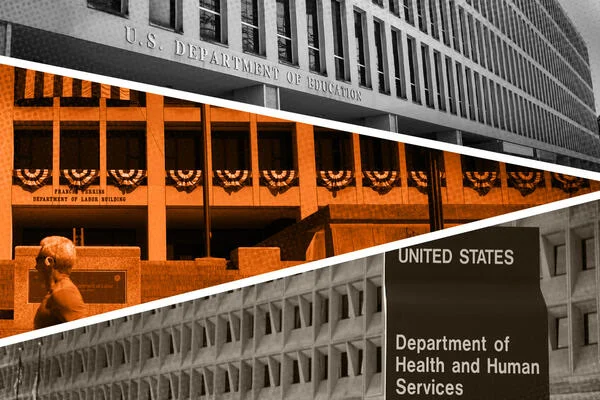
    Dozens of the Education Department’s programs were scattered across Washington D.C. last week, but a few core components remain at the Lyndon B. Johnson Building on Maryland Avenue: the offices for civil rights, special education and federal student aid (FSA).

    These three offices, particularly FSA, oversee some of the department’s most direct services to taxpayers—including the Pell grant, federal student loans, discrimination complaints and individualized education programs for students with disabilities—so moving them would likely be more complicated and controversial.

    Since President Trump first took office, some of the more vocal pushback to his plan for shutting down the department has come from the parents, families and advocacy groups who depend on these offices. But other programs at ED, including those in the Office of Postsecondary Education, were outsourced to other agencies Tuesday through a series of six interagency agreements as part of a broader effort to diminish the department. And even though the three offices were spared in this latest round of dismantling, they may not be safe in the long run.

    President Trump has talked about moving FSA to the Small Business Association and sending special education to the Department of Health and Human Services. Plus, as the Department of Justice has become increasingly involved in education issues, several experts anticipate OCR could be relocated there.

    A senior department official told reporters last week that ED is “still exploring the best plan” for those offices and the programs they oversee.

    In the meantime, here’s a rundown of what we know about Trump’s latest effort to dismantle ED.

    Why is ED Doing This?

    The Trump administration has been clear from the start: its “final mission” is to shut down the department. Officials touted this latest action as a key step toward that goal.

    Even though ED is still going to oversee the programs, this move is a way for Trump officials to show they don’t need the department itself to ensure “the effective and uninterrupted delivery of services, programs, and benefits on which Americans rely,” as stated in Trump’s executive order.

    don’t delete this space/it’s for the chart

    Education Secretary Linda McMahon told department staff last week that it’s all part of an effort to “streamline bureaucracy” and “return power to the states.” But she acknowledged that the agreements are a temporary solution and that Congress will need to sign off eventually.

    Further, she told staff that it’s important to explain to the American public that, in the long run, shutting down the department doesn’t mean getting rid of all its programs.

    “So it is important how we message that,” McMahon said, citing survey data that showed the majority of Americans opposed shutting down the department but that changed when they learned the programs would remain. “Because honestly, folks, and I’m not trying to sugarcoat this, in the end of this the goal will be to have Congressional votes to close the Department of Education.”

    This move comes after years of conservatives lambasting the department for being too woke. They, like McMahon, have said reducing the federal role in education will be a way to protect students’ and parents’ rights.

    “Each of us in this room has a chance to be part of history,” McMahon said.

    What’s Actually Changing?

    Many higher education policy analysts say not much. Aside from outsourcing dozens of grant programs and adding extra steps to the award allocation process, little is expected to change (at least directly). Still, higher ed experts are divided on whether the funding system can survive such a transition.

    Congress will still decide how much money is available and what it should go toward. And the Department of Education will still receive funding, post grant applications and set guidelines for the competitions. But now, rather than that money going directly from ED to institutions, it will be funneled through four other agencies: the Departments of Health, Interior, Labor, and State, which will then dole out the money to colleges and universities.

    These agencies, particularly the Department of Labor and its Employment and Training Administration, will now be the ones to actually run the competition, decide who wins and allocate the funds. When colleges have questions about drawing down federal dollars or staying in compliance with department policies, it won’t be ED they contact.

    don’t delete // space for chart

    Why the Department of Labor?

    Most of the higher education grant programs are heading to the Department of Labor, including TRIO, programs supporting historically Black colleges and universities and the Fund for the Improvement of Postsecondary Education.

    This shift follows a growing push across the country to better align higher education with workforce demands. Some, including the Trump administration argue that it makes sense to move college grant programs to the Department of Labor, where the mission is improving “the welfare of the wage earners” and “advanc[ing] opportunities for profitable employment.”

    Nineteen higher ed programs at moving to the Labor Department.

    Photo by Andrew Harnik/Getty Images

    One senior department official told reporters that if education is about creating the workers of tomorrow then “nowhere is it better housed than at the Department of Labor [which] thinks about this night and day.” In fact, the department has already integrated its Office of Career Technical and Adult Education with Labor and a handful of states have merged their departments of education and workforce. (During President Trump’s first term, officials briefly proposed merging Education and Labor, though that idea didn’t move forward.)

    But critics fear that Labor won’t be able to effectively oversee grants for short-term, technical training programs, let alone broader initiatives focused on college access, equity and student success. Largely, they worry that the plan could sow confusion, weaken accountability measures and eventually lead to the consolidation of programs that are similar but not duplicative and intentionally separate.

    Angela Hanks, a Democrat who previously served as ETA’s acting assistant secretary, said in a social media post that “it’s hard to describe” the “nonsensical” nature of what Trump and McMahon are doing and compared the transfer of power to “having a frog carry a camel on its back.”

    Currently, Hanks said, the main youth-focused program at Labor serves about 130,000 students while TRIO alone serves about 870,000. The office would also take on even larger programs like Title I funding for low-income kids at K-12 schools, which serve up to 26 million students.

    What’s in the Fine Print?

    The interagency agreements do appear to maintain the operation of existing programs for now, but critics argue details both large and small in the text that add bureaucracy and confusion to the process rather than reducing it.

    For example, while the seven grant programs for minority-serving institutions are still expected to continue, various parts are being sent off to different agencies. Four grants that involve Alaskan-, Native American–, Asian American– and Pacific Islander–serving institutions will be housed at the Department of Interior. Labor will oversee the remaining three, which support HBCUs as well as predominantly Black- and Hispanic-serving institutions.

    Federal policy restricts some institutions from receiving multiple awards across different grant designations despite being eligible, but spreading out various MSI grants could still create complications. Historically, when deciding which grant program is the best fit or clarifying compliance standards, institutions could go to one office for the answers. Now, they may have to contact multiple different staffers.

    Multiple higher ed experts have also expressed the concern that rather than cutting grant funds, which only Congress can do, the Trump administration may try to consolidate programs that are similar but not identical.

    For example, CCAMPIS, a program focused on subsidizing child care for student parents, is being moved to HHS, which already oversees the Community Services and Child Care and Development Block Grants. These programs target a broader swath of low-income individuals and families, so college access advocates fear that if the funding pots are merged, it could pull grant dollars away from the student parents they were intended for.

    Language describing such efforts to “integrate” programs appears in the announcement’s news release, as well as in the fact sheets and agreements. But legal experts say that’s what Congress was trying to avoid by creating ED, and they expect the agreements to face court challenges.

    “The Department’s actions will expand federal involvement, rather than streamline it,” said Josie Eskow Skinner, a former general counsel attorney at ED who is now a partner at Sligo Law Group. “As a result of these agreements, states will now have to deal with the potentially conflicting or duplicative demands of multiple federal agencies with no central point of coordination or technical assistance.”

    How Does It Align With Project 2025?

    In a hearing held by the House Education and Workforce Committee the day after McMahon announced the interagency agreements, Rep. Suzanne Bonamici, an Oregon Democrat, said the Heritage Foundation’s Project 2025 “laid the groundwork for this illegal move of this program and shutting down the Department of Education.”

    Project 2025, a sweeping 900-page manual, outlines a multitude of recommended changes across nearly all sectors of the federal government, including how to shut down ED. Following last week’s decision, the Trump administration has made several of the suggested changes including moving career education and postsecondary programs to Labor and transferring tribal college programs to the Interior Department. (Lindsey Burke, who now serves as ED’s deputy chief of staff for policy and programs, authored the manual’s education chapter.)

    Still remaining on the Project 2025 to-do list include moving the Office for Civil Rights to the Department of Justice and giving Treasury control of federal student aid.

    Trump has repeatedly denied involvement with the project, even though actions in the first few months closely follow the project’s recommendations.

    But there’s one key way McMahon’s actions so far differ from Project 2025—she’s not making funding cuts or eliminating programs. Project 2025 recommends doing so through an act of Congress.
    Source link

  • 3 takeaways from Linda McMahon’s confirmation hearing

    3 takeaways from Linda McMahon’s confirmation hearing

    This audio is auto-generated. Please let us know if you have feedback.

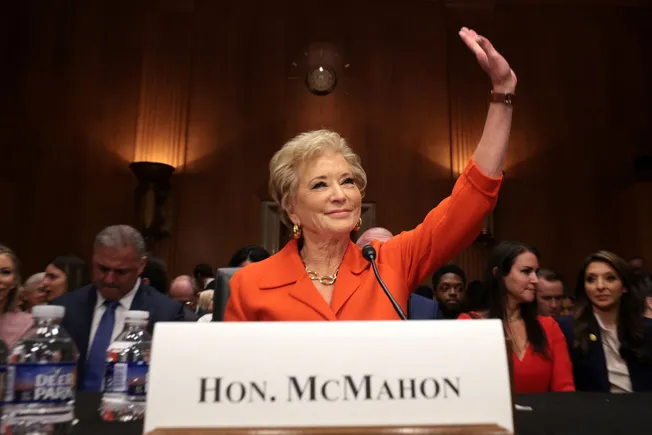
    WASHINGTON — U.S. education secretary nominee Linda McMahon told a Senate panel Thursday that, if confirmed, she would not defund public schools but would seek to reform the U.S. Department of Education by reducing federal bureaucracy and bringing schools back to the basics of reading and math. 

    “We are failing our students, our Department of Education, and what we are doing today is not working, and we need to change it,” McMahon said.

    However, when asked about some specific changes she would make to Education Department programming, McMahon said, if confirmed, she would evaluate department functions before making recommendations. She said she would “reorient the department toward helping educators, not controlling them.”

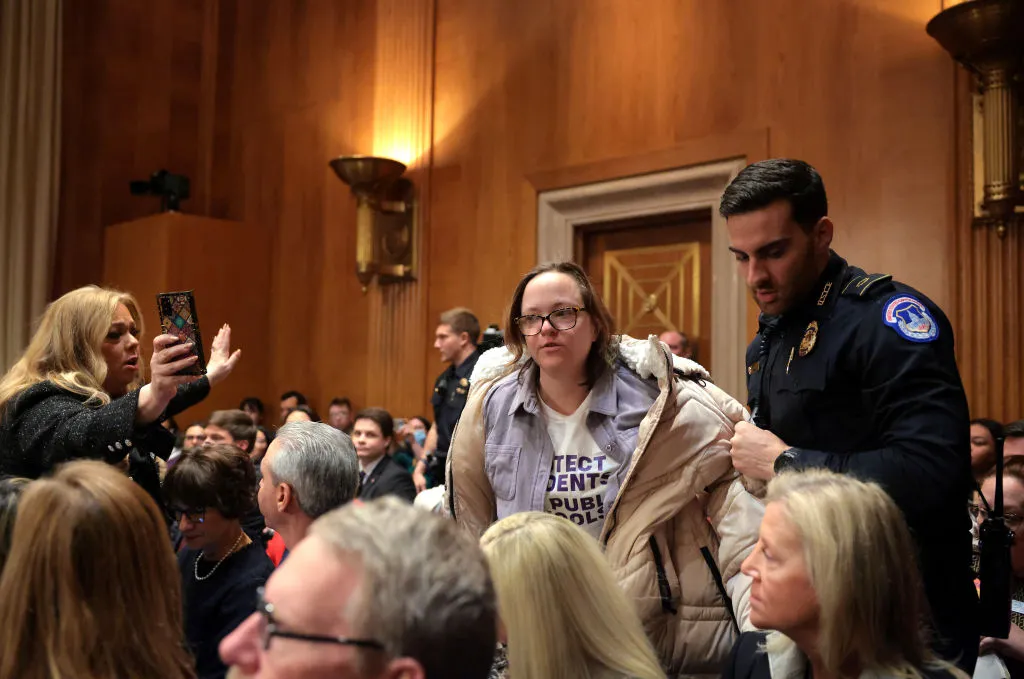
    The 2 ½-hour confirmation hearing, held by the Committee on Health, Education, Labor and Pensions, was briefly interrupted five times by people protesting McMahon’s nomination. The Republican-controlled Senate is expected to approve McMahon’s nomination in the coming days.

    McMahon’s confirmation hearing comes amid drastic changes at the Education Department. President Donald Trump has already issued various executive orders that severely limit federal funding, prohibit activities related to diversity, equity and inclusion, and call for an end to “indoctrination” in K-12 schools, which he said includes “gender ideology and discriminatory equity ideology.” 

    Trump is also expected to issue an executive order that would significantly reduce the Education Department’s authority and responsibility in the federal government. 

    In fiscal year 2024, the Education Department received $79.1 billion from Congress. Lawmakers have yet to approve FY 2025 funding. 

    Among the Education Department’s responsibilities is managing $1.6 trillion in higher education student loans.


    A person is standing near another person in a uniform. The room is full with other people sitting. Another person is standing and holding a cell phone

    A protester disrupts Linda McMahon, President Donald Trump’s nominee to be U.S. education secretary, as she testifies during her Senate Health, Education, Labor and Pensions Committee confirmation hearing on Capitol Hill on Feb. 13, 2025, in Washington, D.C.

    Kayla Bartkowski via Getty Images


    Trump nominated McMahon just weeks after winning the November election. McMahon served as administrator of the Small Business Administration for two years in Trump’s first administration. She is also a former president and CEO of World Wrestling Entertainment.

    McMahon is also board chair at America First Policy Institute, a nonprofit think tank that supports free enterprise and nationalism. At the state level, McMahon served on the Connecticut State Board of Education. She also served as a trustee at Sacred Heart University, a private Catholic school in Fairfield, Connecticut. She is currently the treasurer on the university’s Board of Trustees, according to the school’s website.

    In 2012, she won the Connecticut Republican primary for U.S. Senate but lost to current Democratic Sen. Chris Murphy, who is a member of the HELP committee.

    If the Senate approves McMahon’s nomination, she would succeed Miguel Cardona as the 13th U.S. education secretary since the department’s founding in 1979.

    Here are three takeaway exchanges from the confirmation hearing.

    Antisemitism on college campuses

    Several Republican senators asked McMahon about antisemitism on college campuses.

    “​​Will you make sure that Jewish Americans are safe on our campuses, for heaven’s sake?” asked Sen. Josh Hawley, R-Mo., referring to “a wave of antisemitism” particularly since the Oct. 7, 2023, Hamas attack on Israel. “Will you make sure that this stops on our college campuses that are getting all of this federal tax money?”

    McMahon said she would “absolutely,” or schools would “face defunding of their monies.”

    Several senators asked McMahon about the Education Department’s responsibility for the federal student loan program. Sen. Tim Kaine, D-Va., questioned McMahon’s commitment to existing public service loan forgiveness programs passed by Congress.

    “Those that have been passed by Congress? Yes, that’s the law,” McMahon said.

    Committee Chair Bill Cassidy, R-La., said McMahon’s experience overseeing the Small Business Administration “would be a great asset as the department looks to reform a very broken student loan program.”

    During the hearing, McMahon also voiced support for more skill-based learning and dual enrollment in K-12. “I think we have to look at education and say our vocational and skill-based training is not a default education,” McMahon said. 

    Closing the Education Department

    Several Democratic lawmakers probed McMahon about Trump’s push to eliminate the Education Department. On Wednesday, Trump referred to the department as a “big con job” and said he wanted the agency closed immediately. 

    “The president has given a very clear directive that he would like to look in totality at the Department of Education, and believes that the bureaucracy of it should be closed, that we should return education to our states, that the best education is that closest to the kids,” McMahon said.

    Source link

  • 3 takeaways from Linda McMahon’s confirmation hearing

    3 takeaways from Linda McMahon’s confirmation hearing

    This audio is auto-generated. Please let us know if you have feedback.

    WASHINGTON — U.S. education secretary nominee Linda McMahon told a Senate panel Thursday that, if confirmed, she would not defund public schools but would seek to reform the U.S. Department of Education by reducing federal bureaucracy and bringing schools back to the basics of reading and math. 

    McMahon also said her priorities as education secretary would be to expand school choice and skills-based learning, give local schools and parents more decision-making power, and to protect students from discrimination and harassment. 

    “I’m very hopeful that we will get back to the basics of education so that our children can read when they leave 3rd grade, and that 8th grade students can do math and reading proficiently,” McMahon said. “We are failing our students, our Department of Education, and what we are doing today is not working, and we need to change it.” 

    However, when asked about some specific changes she would make to Education Department programming, McMahon said, if confirmed, she would evaluate department functions before making recommendations. She said she would “reorient the department toward helping educators, not controlling them.”

    The 2 ½-hour confirmation hearing, held by the Committee on Health, Education, Labor and Pensions, was briefly interrupted five times by people protesting McMahon’s nomination. The Republican-controlled Senate is expected to approve McMahon’s nomination in the coming days.

    McMahon’s confirmation hearing comes amid drastic changes at the Education Department. President Donald Trump has already issued various executive orders that severely limit federal funding, call for expansion of private school choice, prohibit activities related to diversity, equity and inclusion, and call for an end to “indoctrination” in K-12 schools, which he said includes “gender ideology and discriminatory equity ideology.” 

    Trump is also expected to issue an executive order that would significantly reduce the Education Department’s authority and responsibility in the federal government. 

    Federal education funding represents just about 14% of total K-12 spending in 2024, with the rest provided by local and state governments and other sources. Still, education experts say federal investments are important for supporting funding equity and accountability.

    In fiscal year 2024, the Education Department received $79.1 billion from Congress. Lawmakers have yet to approve FY 2025 funding. 

    Among the Education Department’s responsibilities is managing $1.6 trillion in higher education student loans.

    District and state K-12 programs also received $189.5 billion over the past five years in federal COVID-19 emergency funds to support pandemic recovery efforts. 

    A person is standing near another person in a uniform. The room is full with other people sitting. Another person is standing and holding a cell phone

    A protester disrupts Linda McMahon, President Donald Trump’s nominee to be U.S. education secretary, as she testifies during her Senate Health, Education, Labor and Pensions Committee confirmation hearing on Capitol Hill on Feb. 13, 2025, in Washington, D.C.

    Kayla Bartkowski via Getty Images


    Trump nominated McMahon just weeks after winning the November election. McMahon served as administrator of the Small Business Administration for two years in Trump’s first administration. She is also a former president and CEO of World Wrestling Entertainment.

    McMahon is also board chair at America First Policy Institute, a nonprofit think tank that supports free enterprise and nationalism. At the state level, McMahon served on the Connecticut State Board of Education. She also served as a trustee at Sacred Heart University, a private Catholic school in Fairfield, Connecticut. She is currently the treasurer on the university’s Board of Trustees, according to the school’s website.

    In 2012, she won the Connecticut Republican primary for U.S. Senate but lost to current Democratic Sen. Chris Murphy, who is a member of the HELP committee.

    If the Senate approves McMahon’s nomination, she would succeed Miguel Cardona as the 13th U.S. education secretary since the department’s founding in 1979.

    Here are three takeaway exchanges from the confirmation hearing.

    Closing the Education Department

    Several Democratic lawmakers probed McMahon about Trump’s push to eliminate the Education Department. On Wednesday, Trump referred to the department as a “big con job” and said he wanted the agency closed immediately. 

    “The president has given a very clear directive that he would like to look in totality at the Department of Education, and believes that the bureaucracy of it should be closed, that we should return education to our states, that the best education is that closest to the kids,” McMahon said.

    She acknowledged that only Congress has the power to shut down the agency. And McMahon noted that programs established by federal statute, such as Title I for low-income schools and services to students with disabilities under the Individuals with Disabilities Education Act, would need to continue with or without an Education Department. 

    Source link

  • Senate schedules Linda McMahon’s confirmation hearing

    Senate schedules Linda McMahon’s confirmation hearing

    Linda McMahon, President Donald Trump’s nominee for education secretary, will appear before the Senate Health, Education, Labor and Pensions Committee next week—a key step in her confirmation process.

    And though the former business mogul was originally expected to sail through the confirmation process, she’ll likely have to answer questions at the hearing next Thursday about recent upheavals in the Education Department and the president’s plan to get rid of the agency.

    In the last week, news broke that the Trump administration put dozens of department employees on paid leave and is planning an executive order to shut down the department, setting off alarm bells across the higher ed sphere. At the same time, Trump’s attempts to freeze thousands of federal grants and push agency staff toward “deferred resignation” are caught up in court. Education advocacy groups say that halting the grants violates the constitutional principle of separation of powers and that cutting the number of unionized agency staff is not only illegal but also could hinder key operations like the federal student aid program.

    But while many of Trump’s executive orders remain in limbo, department appointees who don’t require confirmation are quickly moving behind the scenes to carry out Trump’s education agenda. They’ve opened multiple civil rights investigations into colleges over antisemitism and transgender participation in women’s sports, announced changes to the federal aid application, and removed more than 200 DEI-related webpages from the department’s website.

    Trump has yet to announce who will join McMahon and fill other key agency roles, such as under secretary and head of Federal Student Aid, nor has he formally named all the acting officials who will fill those roles in the meantime. The lack of transparency regarding who will lead the department and who is currently serving in temporary roles now has only heightened concerns among higher education officials, policy experts, lobbyists and advocacy groups. The lack of clarity makes it hard to decipher what Trump’s regulatory priorities will be and how colleges, universities, accreditors, students and others should prepare for the next four years. But many are hopeful that McMahon’s hearing will shed some light on the subject.

    The secretary-designate, who is best known as the former CEO of World Wrestling Entertainment, has limited experience in education policy aside from serving for one year on the Connecticut State Board of Education and a long-running tenure on the Sacred Heart University Board of Trustees. And to this date, she has made little comment about her views on public education.

    She does, however, have some experience working in Washington. McMahon served as director of the Small Business Administration during Trump’s first term. Then, in 2021, as the president reluctantly left office, she helped found the America First Policy Institute, a pro-Trump think tank.

    Now, the billionaire is likely to lead the very department Trump has said he wants to see dismantled. The president told White House reporters Tuesday that he told McMahon, “I hope you do a great job and put yourself out of a job.

    The Wall Street Journal and The Washington Post reported earlier this week that the new administration is preparing an executive order about the department’s future, though the specifics are still in the works.

    Sources told the Journal that the order could “shut down all functions of the agency that aren’t written explicitly into statute or move certain functions to other departments,” but other sources familiar with talks about the order told Inside Higher Ed that the order could direct McMahon, once confirmed, to come up with a plan to break up the department entirely. (The second suggested order, and its resulting plan, would have to include legislative action from Capitol Hill, as the department’s existence is written into law.)

    But for now, McMahon is awaiting confirmation and the department still exists. So who’s running the agency and carrying out its statutory duties?

    So far, the White House has only formally announced an acting secretary, Denise Carter, who had previously served as acting head of the Federal Student Aid office. A news release from the department several days later listed 10 other appointees, ranging from chief of staff to deputy general counsel. On Thursday, the department shared the names of six more officials, including deputy under secretary and senior adviser of the communications office.

    But the department’s announcements about appointees haven’t indicated who is temporarily filing some of the top jobs at the department, such as under secretary. Under federal law, the default acting official is the first assistant to the vacant position or the top deputy for that office, though the president can designate someone else who meets the criteria. Details about who is serving as those acting officials has instead come from other department statements.

    For example, James Bergeron—president of the National Council of Higher Education Resources and a Republican former House policy adviser—was named deputy under secretary Thursday. But on Tuesday, the department identified him in a news release as acting under secretary. Before Tuesday’s release, Bergeron had not been listed as an appointee at all. Thursday’s announcement only referred to him as deputy under secretary, not acting.

    In another instance, the department named Craig Trainor—who worked under Trump’s attorney general Pam Bondi as an AFPI senior litigation counsel—deputy assistant secretary for policy in the Office for Civil Rights. And then, in later news releases, the agency identified Trainor as the acting assistant secretary for civil rights.

    Although the department has yet to announce an acting chief operating officer for FSA, a department official told Inside Higher Ed that Carter is wearing two hats and continuing to lead FSA while serving as acting secretary. Phillip Juengst, a longtime FSA official, they said, is also helping lead the agency.

    The Education Department did not respond to Inside Higher Ed’s request for further detail about who is serving in what acting role and why it hasn’t formally been announced. Instead, they pointed reporters back to the news releases mentioned prior.

    Most of the appointees so far are unfamiliar faces to D.C. area policy experts and former department staffers.

    Bergeron, however, is an exception. He worked at the National Council of Higher Education Resources starting in 2014, advocating for higher education service agencies that work in the student loan space. Some debt-relief groups raised concerns about Bergeron’s appointment. But former department officials described Bergeron as a competent and more reasonable choice than some other Trump appointees. Before serving as president of NCHER, he worked as a staffer on the House Education and the Workforce Committee.

    Emmanual Guillory, senior director of government relations at the American Council on Education, said the day after Trump took office that the initial lack of clarity about who was serving in what role didn’t concern him. He didn’t expect Carter or other acting appointees to carry out substantial policy actions before confirmed appointees took control. Guillory said Thursday that his comments haven’t changed, so he remains unconcerned two weeks later.

    Source link