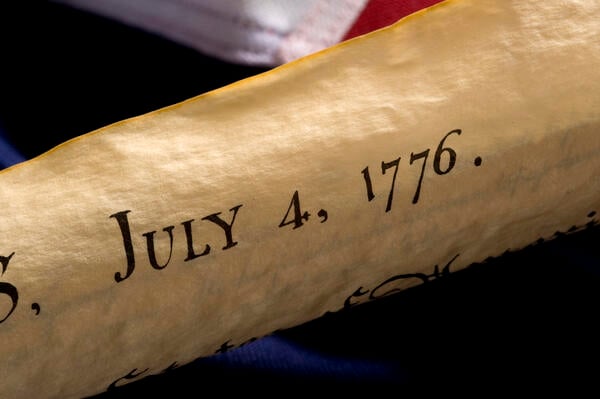
Every year for the past 25 years, I have taught an intermediate-level undergraduate course at Indiana University Bloomington called The Declaration of Independence and the Meaning of American Citizenship. I love teaching this course, because it allows students to engage history by interpreting a rather simple text that is well recognized even if not necessarily well understood—and this tension between vague familiarity and real understanding makes the teaching fun.
My basic approach to the topic and the course, outlined on the syllabus, has remained pretty fixed over the years:
This class will pay special attention to the meaning of “America.” It will address serious questions about what it means to think “historically.” It will trace and analyze the many ways that the meanings of American citizenship have been contested since 1776, and it will do so through a focus on alternative interpretations of the Declaration of Independence, which has sometimes been called the “birth certificate of American democracy.”
The Declaration is not the only important text in American political history. In particular, we will pay attention to its complex relationship to the U.S. Constitution, the other seminal “founding” document of the U.S. political system. But it is a very important touchstone for many important historical debates, and it is an even more important symbol of American political identity (which is why the late historian Pauline Maier referred to it as “American Scripture”).
The Declaration is also a very instructive example of the fact that core political symbols, texts and principles can be interpreted in different ways and are often heavily contested. Such rhetorical contests play an important role in the evolution of democracy over time, as disenfranchised groups appeal to “foundational” texts, like the Declaration, to justify their demands for recognition and inclusion—and as those who oppose recognition and inclusion also sometimes draw upon the same texts, though in very different ways.
In this course we will discuss how the Declaration has been a source of inspiration for activists and social movements seeking to democratize American society, and how it has also been used, differently, by opponents of democratization.
As we will see, there is not one true “meaning” of the Declaration.
But there are more and less nuanced, and more and less inclusive, interpretations of the Declaration. The primary goal of this course is to develop a historically and philosophically informed understanding of the Declaration—what it says, what it has meant, how it has justified many of the things most of us hold dear and some things many of us find revolting—and, by doing so, to nurture a more informed and reflexive understanding of contemporary American democracy. And because it is a course taught in a U.S. public university, to students most if not all of whom are citizens of the U.S., such an understanding has potentially significant implications for the way each of us thinks and acts as a citizen.
The course was originally inspired by a chance encounter, many decades ago, with a fascinating anthology, published in 1976—the year of the Bicentennial—and edited by famed labor historian Philip S. Foner, entitled We, The Other People: Alternative Declarations of Independence by Labor Groups, Farmers, Woman’s Rights Advocates, Socialists, and Blacks, 1829–1975. This volume, as its title suggests, furnishes a wide range of texts to explore with students. Over the years, I have incorporated dozens of other texts, some modeled directly on the 1776 Declaration, others simply drawing heavily on it, including the speeches of a great many presidents, especially Lincoln.
Central to the course are three famous speeches delivered by dissenters who were widely reviled in their time: Frederick Douglass’s 1852 “What to the Slave is the Fourth of July?”; Eugene V. Debs’s “Liberty,” given in 1895 upon his release from six months in prison for leading the 1894 Pullman strike; and Martin Luther King Jr.’s “I Have a Dream” speech, given at the August 1963 March on Washington for Jobs and Freedom.
But the syllabus also includes speeches by Confederate leaders Jefferson Davis and Alexander Stephens; populist Tom Watson; and segregationist governor George C. Wallace. Elizabeth Cady Stanton’s “Declaration of Sentiments,” adopted in 1848 at the Seneca Falls Convention for women’s rights, plays an important role; so too the 1898 “White Declaration of Independence” published by white racists in Wilmington, N.C., who overthrew a multiracial city government and terrorized the Black community.
The course is very historical, but also very contemporary, because July 4 comes every year, and because past historical struggles over the meaning of the Declaration continue to resonate in the present—and indeed are sometimes revived in the present.
But in the coming year the course will be more relevant than ever, because President Donald Trump has made clear that he plans to turn the entire year leading up to next year’s 250th anniversary of the Declaration’s signing into a celebration of “American greatness”—and thus of himself.
Back in May 2023, Trump released a campaign video promising what Politico described as “a blowout, 12-month-long ‘Salute to America 250’ celebration,” including “a ‘Great American State Fair,’ featuring pavilions from all 50 states, nationwide high school sporting contests, and the building of Trump’s ‘National Garden of American Heroes’ with statues of important figures in American history.”
In his second week in office, Trump issued two executive orders centered on the Declaration. The first, “Celebrating America’s 250th Birthday,” announced that “it is the policy of the United States, and a purpose of this order, to provide a grand celebration worthy of the momentous occasion of the 250th anniversary of American Independence on July 4, 2026.” The other, “Ending Radical Indoctrination in K–12 Schooling,” mandated the termination of “radical, anti-American ideologies” and the re-establishment of a “President’s Advisory 1776 Commission” charged with promoting patriotic education.
Trump has long laid claim to “the spirit of July 4, 1776.” In the final days of his first term, as the nation was overtaken by a wave of Black Lives Matter demonstrations protesting the police killing of George Floyd, he established his “1776 Commission,” which was intended to legitimate his increasingly repressive approach to the demonstrations and to energize his 2020 re-election campaign (the resulting report was also an explicit repudiation of The New York Times’ 2019 “The 1619 Project”).
The commission and its hurriedly drafted “The 1776 Report” failed to help fuel Trump’s failing 2020 campaign. But its broader ideological mission—to inaugurate a MAGA-inflected cultural revolution in a second Trump term—was hardly defeated.
The MAGA movement’s attempt to overthrow Joe Biden’s 2020 election— “Today is 1776,” tweeted MAGA congresswoman Lauren Boebert on Jan. 6, 2021, speaking for the thousands of “3 Percenters,” “Proud Boys” and assorted “patriot” groups that invaded the Capitol building—may have failed. But only temporarily. For Trump has returned to the White House with a vengeance and has commenced an ideological and economic assault on higher education, committed to “Restoring Truth and Sanity to American History” by purging society of “divisive narratives that distort our shared history.”
Historical understanding and social criticism are out and national reverence is in.
I cannot imagine a more exciting time to be teaching a course on the Declaration of Independence and the meaning of American citizenship.
But I also cannot imagine a more challenging and indeed precarious time to do so.
For the course—which does not seek to promote reverence or national pride or “American greatness”—is at odds with the prevailing spirit of the time, or at least its ascendant ideology.
It seeks to promote historical understanding, based on serious historical scholarship, and a general appreciation for the complex ways that the Declaration has figured in debates and conflicts over the shifting meaning of American citizenship. The course refuses to ignore or whitewash the ways that patriotism and even the preamble of the Declaration itself have been mobilized to oppose the forms of inclusion, and democratization, that we now take for granted (like the abolition of chattel slavery, considered by Southern states to be such a despotic violation of slaveholder property rights that they seceded from the Union, and formed the Confederacy, by appealing to the Declaration’s “consent of the governed”).
It also refuses to treat American history as the happy working out over time of a beneficent commitment to universal freedom that was embraced from the beginning by all Americans. For while certain universalist words were there from the beginning—coexisting with much less universalistic words, to be sure—a commitment to their universal application was most definitely not there from the beginning. That promise took decades and even centuries to be even haltingly redeemed, partially and in steps, due to the blood, sweat and tears of generations of brave activists—a process that continues to this day. And the fact that the Declaration’s words played such an important role in this contentious politics is the very reason why it is such a seminal text, one that deserves appreciation and celebration even as it is a human invention not above moral reproach or historical critique.
In politics as in life, criticism, and not easy praise, is the sincerest form of flattery.
As a professor, my approach to the course material is not partisan in any sense. I have no interest in changing the minds of any of my students, whatever they happen to think, except in the sense that all good teaching is about getting students to think more deeply and more regularly. In this sense, I seek to change the mind of every student, by engaging every student with historical materials, and ideas, and intellectual challenges, and by fostering a climate of respectful questioning and disagreeing in the classroom so that students can hear and listen to those with viewpoints different from their own. The pedagogy of higher education is not normal out in the world beyond the academy, though it would not be a bad thing if it were much more normalized than it currently is. That is why colleges and universities exist.
All the same, we have arrived at a historical moment in the U.S., perhaps unlike any before, in which such education is considered partisan, and denounced as “indoctrination,” by a MAGA movement and a Trump administration obsessed with a closing of borders, and ranks, and minds, in the name of patriotic “unity” and “American greatness.”
At a time when historical education is reduced to the celebration of national greatness, a historically serious course on the Declaration of Independence that treats it as a text to be critically engaged, not worshipped, might be considered subversive. Indeed, GOP-controlled state legislatures across the country, following the Trump administration’s lead, have instituted a wide range of measures designed to subject university teaching to heightened political scrutiny (in my own state of Indiana, vague “intellectual diversity” standards have been enacted into law, and Attorney General Todd Rokita has created a web portal, ominously named “Eyes on Education,” that encourages parents and teachers to report “objectionable” forms of teaching).
The problem with such censoriousness is that, if taken seriously, it is hard to see how the Declaration is worth anything at all. None other than Frederick Douglass himself noted precisely this back in 1852: “There was a time when, to pronounce against England, and in favor of the cause of the colonies, tried men’s souls. They who did so were accounted in their day, plotters of mischief, agitators and rebels, dangerous men. To side with the right, against the wrong, with the weak against the strong, and with the oppressed against the oppressor! Here lies the merit, and the one which, of all others, seems unfashionable in our day. The cause of liberty may be stabbed by the men who glory in the deeds of your fathers.”
Since July 4, 1776, the Declaration’s words have resonated at every moment when citizens have together sought to make the society, in the words of that other foundational text, the Constitution, “a more perfect union.” To dismiss the critical appropriation of the Declaration is to devalue both the text itself and the entire course of American history.
This July 4, I will be reflecting on the historical and the contemporary meaning of the text whose publication Americans will celebrate, and gearing up to once again teach The Declaration of Independence and the Meaning of American Citizenship at a time when it could not be more relevant.