Tag: Medical

  • $100m Coalition election promise to fund 200 regional medical students matches Labor – Campus Review

    $100m Coalition election promise to fund 200 regional medical students matches Labor – Campus Review

    Regional and rural Australia’s doctor shortage is being targeted as an election issue by the Coalition, which is promising to fund an extra 200 students to train as general practitioners to work in the bush.

    Please login below to view content or subscribe now.

    Membership Login

    Source link

  • Medical Journals Now Reportedly Under Government Scrutiny

    Medical Journals Now Reportedly Under Government Scrutiny

    The Trump administration now appears to be targeting medical journals, questioning at least three different publications about how they represent “competing viewpoints” and assess the influence of funding organizations like the National Institutes of Health on submitted papers, MedPage Today reported.

    Republican activist Edward Martin Jr., who is currently serving as interim U.S. attorney in Washington, D.C., sent a letter to CHEST Journal and at least two other unnamed publications earlier this month demanding answers to a series of questions about their processes and practices.

    “It has been brought to my attention that more and more journals and publications like CHEST Journal are conceding that they are partisans in various scientific debates—that is, that they have a position for which they are advocating either due to advertisement (under postal code) or sponsorship (under relevant fraud regulations),” Martin wrote. “The public has certain expectations and you have certain responsibilities.”

    The letter then requested answers by May 2 to questions including “Do you accept articles or essays from competing viewpoints?“ and “How do you handle allegations that authors of works in your journals may have misled their readers?”

    “I am also interested to know if publishers, journals, and organizations with which you work are adjusting their method of acceptance of competing viewpoints,” Martin wrote. “Are there new norms being developed and offered?”

    CHEST is a peer-reviewed journal published by the American College of Chest Physicians that produces articles on such subjects as pulmonary hypertension, lung cancer and obstructive sleep apnea.

    Martin’s letter “should send a chill down the spine of scientists and physicians,” Adam Gaffney, a pulmonary and critical care physician who has published in CHEST, told MedPage Today. “It is yet another example of the Trump administration’s effort to control academic inquiry and stifle scientific discourse—an administration, it warrants mentioning, that has embraced medical misinformation and pseudoscience to reckless effect. Journal editors should join together and publicly renounce this as yet more thinly guised anti-science political blackmail.”

    JT Morris, a senior supervising attorney at the Foundation for Individual Rights and Expression, told MedPage Today that the First Amendment clearly protects CHEST’s independence.

    “A publication’s editorial decisions are none of the government’s business, whether it’s a newspaper or a medical journal,” he said. “Like with any bully, the best response is to stand up to them—and that includes officials who try to intimidate Americans into parroting the government’s view. The First Amendment packs a powerful punch, and it has these medical journals’ backs.”

    Source link

  • The Dark Legacy of Elite University Medical Centers

    The Dark Legacy of Elite University Medical Centers


    (Image: Mass General is Harvard University Medical School’s teaching hospital.)  


    For decades, America’s elite university medical centers have been the epitome of healthcare research and innovation, providing world-class treatment, education, and cutting-edge medical advancements. Yet, beneath this polished surface lies a troubling legacy of medical exploitation, systemic inequality, and profound injustice—one that disproportionately impacts marginalized communities. While the focus has often been on racial disparities, this issue is not solely about race; it is also deeply entangled with class. In recent years, books like Medical Apartheid by Harriet Washington have illuminated the history of medical abuse, but they also serve as a reminder that inequality in healthcare goes far beyond race and touches upon the economic and social circumstances of individuals.

    The term Medical Apartheid, as coined by Harriet Washington, refers to the systemic and institutionalized exploitation of Black Americans in medical research and healthcare. Washington’s work examines the history of Black Americans as both victims of medical experimentation and subjects of discriminatory practices that have left deep scars within the healthcare system. Yet, the complex interplay between race and class means that many poor or economically disadvantaged individuals, regardless of race, have also faced neglect and exploitation within these prestigious medical institutions. The legacy of inequality within elite university medical centers, therefore, is not limited to race but is also an issue of class disparity, where wealthier individuals are more likely to receive proper care and access to cutting-edge treatments while the poor are relegated to substandard care.

    Historical examples of exploitation and abuse in medical centers are well-documented in Washington’s work, and contemporary lawsuits and investigations reveal that these systemic problems still persist. Poor patients, especially those from marginalized racial backgrounds, are often viewed as expendable research subjects. The lawsuit underscores the intersectionality of race and class, arguing that these patients’ socio-economic status exacerbates their vulnerability to medical exploitation, making it easier for institutions to treat them as less than human, especially when they lack the resources or power to contest medical practices.

    One of the most critical components of this issue is the stark contrast in healthcare access between the wealthy and the poor. While elite university medical centers boast state-of-the-art facilities, cutting-edge treatments, and renowned researchers, these resources are often not equally accessible to all. Wealthier patients are more likely to have the financial means to receive the best care, not just because of their ability to pay but because they are more likely to be referred to these prestigious centers. Conversely, low-income patients, especially those without insurance or with inadequate insurance, are often forced into overcrowded public hospitals or community clinics that are underfunded, understaffed, and unable to provide the level of care available at elite institutions.

    The issue of class inequality within medical care is evident in several key areas. For instance, studies have shown that low-income patients, regardless of race, are less likely to receive timely and appropriate medical care. A 2019 report from the National Academy of Medicine found that low-income patients are often dismissed by healthcare professionals who underestimate the severity of their symptoms or assume they are less knowledgeable about their own health. In addition, patients from lower socio-economic backgrounds are more likely to experience medical debt, which can lead to long-term financial struggles and prevent them from seeking care in the future.

    Moreover, class plays a significant role in the underrepresentation of poor individuals in medical research, which is often conducted at elite university medical centers. Historically, clinical trials have excluded low-income participants, leaving them without access to potentially life-saving treatments or advancements. Wealthier individuals, on the other hand, are more likely to be invited to participate in research studies, ensuring they benefit from the very innovations and breakthroughs that these institutions claim to provide.

    Class-based disparities are also reflected in the inequities in medical professions. The road to becoming a physician or researcher in these elite institutions is often paved with significant economic barriers. Medical students from low-income backgrounds face steep financial challenges, which can hinder their ability to gain acceptance into prestigious medical schools or pursue advanced research opportunities. Even when low-income students do manage to enter these programs, they often face biases and discrimination in clinical settings, where their abilities are unfairly questioned, and their economic status may prevent them from fully participating in research or other educational opportunities.

    Yet, the inequities within these institutions don’t stop at the patients. Behind the scenes, workers at elite university medical centers, particularly those from working-class and marginalized backgrounds, face their own form of exploitation. These medical centers are not only spaces of high medical achievement but also sites of labor stratification, where workers in lower-paying roles are largely people of color and often immigrants. Support staff—such as janitors, food service workers, custodians, and administrative assistants—are often invisible but essential to the functioning of these hospitals and research institutions. These workers face long hours, poor working conditions, and low wages, all while contributing to the daily operations of elite medical centers. Many of these workers, employed through third-party contractors, lack benefits, job security, or protections, leaving them vulnerable to exploitation.

    Custodial workers, who are often exposed to hazardous chemicals and physically demanding work, may struggle to make ends meet, despite playing a crucial role in maintaining the hospital environment. Similarly, food service workers—many of whom are Black, Latinx, or immigrant—also work in demanding conditions for low wages. These workers frequently face job insecurity and are not given the same recognition or compensation as the high-ranking physicians, researchers, or administrators in these centers.

    At the same time, the stratification in these institutions extends beyond support staff. Medical researchers, residents, and postdoctoral fellows—often young, early-career individuals, many from working-class backgrounds or communities of color—are similarly subjected to precarious working conditions. These individuals perform much of the vital research that drives innovation at these centers, yet they often face exploitative working hours, low pay, and job insecurity. They are the backbone of the institution’s research output but frequently face barriers to advancement and recognition.

    The higher ranks of these institutions—senior doctors, professors, and researchers—enjoy financial rewards, job security, and prestige, while those at the lower rungs continue to experience instability and exploitation. This division, which mirrors the economic and racial hierarchies of broader society, reinforces the very class-based inequalities these medical centers are meant to address.

    In recent years, some progress has been made in addressing these inequalities. Many elite universities have implemented diversity and inclusion programs aimed at increasing access for underrepresented minority and low-income students in medical schools. Some institutions have also begun to emphasize the importance of cultural competence in training medical professionals, acknowledging the need to recognize and understand both racial and economic disparities in healthcare.

    However, critics argue that these efforts, while important, are often superficial and fail to address the root causes of inequality. The institutional focus on “diversity” and “inclusion” often overlooks the more significant structural issues, such as the affordability of education, the class-based access to healthcare, and the economic barriers that continue to undermine the ability of disadvantaged individuals to receive quality care.

    In addition to acknowledging racial inequality, it is crucial to tackle the broader issue of class within the healthcare system. The disproportionate number of Black and low-income individuals suffering from poor healthcare outcomes is a direct result of a system that privileges wealth and status over human dignity. To begin addressing these issues, we need to move beyond token diversity initiatives and work toward policy reforms that focus on economic access, insurance coverage, and the equitable distribution of medical resources.

    Scholars like Harriet Washington, whose work documents the intersection of race, class, and healthcare inequality, continue to play a pivotal role in bringing attention to these systemic injustices. Washington’s book Medical Apartheid serves as a historical record but also as a call to action for creating a healthcare system that genuinely serves all people, regardless of race or socio-economic status. The fight for healthcare equity must, therefore, be a dual one—against both racial and class-based disparities that have long plagued our medical institutions.

    The story of Henrietta Lacks, as told in The Immortal Life of Henrietta Lacks by Rebecca Skloot, exemplifies the longstanding exploitation of marginalized individuals in elite university medical centers. The case of Lacks, whose cells were taken without consent by researchers at Johns Hopkins University, brings to light both the historical abuse of Black bodies and the profit-driven nature of academic medical research. Johns Hopkins, one of the most prestigious medical centers in the world, has been complicit in the kind of exploitation and neglect that these institutions are often criticized for—issues that disproportionately affect not only Black Americans but also economically disadvantaged individuals.

    The Black Panther Party’s healthcare activism, as chronicled by Alondra Nelson in Body and Soul, also directly challenges elite medical institutions’ failure to provide adequate care for Black and low-income communities. Nelson’s work reflects how, even today, these institutions are often slow to address the systemic issues of health disparities that activists like the Panthers fought against.

    Recent lawsuits against elite medical centers further underscore the importance of holding these institutions accountable for their role in perpetuating medical exploitation and inequality. In An American Sickness by Elisabeth Rosenthal, the commercialization of healthcare is explored, highlighting how university hospitals and medical centers often prioritize profits over patient care, leaving low-income and marginalized groups with limited access to treatment. Rosenthal’s work highlights the role these institutions play in a larger system that disproportionately benefits wealthier patients while neglecting the most vulnerable.

    A Global Comparison: Countries with Better Health Outcomes

    While the United States struggles with systemic healthcare disparities, other nations have shown that equitable healthcare outcomes are possible when class and race are not barriers to care. Nations with universal healthcare systems, such as those in Canada, the United Kingdom, and many Scandinavian countries, consistently rank higher in overall health outcomes compared to the U.S.

    For instance, Canada’s single-payer system ensures that all citizens have access to healthcare, regardless of their income. This system reduces the financial burdens that often lead to delays in care or avoidance of treatment due to costs. According to the World Health Organization, Canada has better health outcomes on a variety of metrics, including life expectancy and infant mortality, compared to the U.S., where medical costs often lead to unequal access to care.

    Similarly, the United Kingdom’s National Health Service (NHS) provides healthcare free at the point of use for all citizens. Despite challenges such as funding constraints and wait times, the NHS has been successful in ensuring that healthcare is a right, not a privilege. The U.K. consistently ranks higher than the U.S. in terms of access to care, health outcomes, and overall public health.

    Nordic countries, such as Norway and Sweden, also exemplify how universal healthcare can lead to better outcomes. These countries invest heavily in public health and preventative care, ensuring that even their most marginalized citizens receive the necessary medical services. The result is a population with some of the highest life expectancies and lowest rates of chronic diseases in the world.

    These nations show that, while access to healthcare is a critical issue in the U.S., the challenge is not a lack of innovation or capability. Instead, it is the systemic barriers—both racial and economic—that persist in elite medical centers, undermining the potential for universal health equity. The U.S. could learn from these nations by adopting policies that reduce economic inequality in healthcare access and focusing on preventative care and public health strategies that serve all people equally.

    Ultimately, the dark legacy of elite university medical centers is not something that can be erased, but it is something that must be acknowledged. Only by confronting this painful history, alongside addressing class-based disparities, can we begin to build a more just and equitable healthcare system—one that serves everyone, regardless of race, background, or socio-economic status. Until this happens, the distrust and skepticism that many marginalized communities feel toward these institutions will continue to shape the landscape of American healthcare. The path forward requires a concerted effort to address both racial and class-based inequities that have defined these institutions for far too long. The U.S. can, and must, strive for healthcare outcomes akin to those seen in nations that have built systems prioritizing equity and fairness—systems that put human dignity over profit.


    Source link

  • Parents, Medical Providers, Vaccine Experts Brace for RFK Jr.’s HHS Takeover – The 74

    Parents, Medical Providers, Vaccine Experts Brace for RFK Jr.’s HHS Takeover – The 74


    Get stories like this delivered straight to your inbox. Sign up for The 74 Newsletter

    While Robert F. Kennedy Jr. ‘s Senate confirmation to head the Department of Health and Human Services was not unexpected, it still shook medical providers, public health experts and parents across the country. 

    Mary Koslap-Petraco, a pediatric nurse practitioner who exclusively treats underserved children, said when she heard the news Thursday morning she was immediately filled with “absolute dread.”

    Mary Koslap-Petraco is a pediatric nurse practitioner and Vaccines for Children provider. (Mary Koslap-Petraco)

    “I have been following him for years,” she told The 74. “I’ve read what he has written. I’ve heard what he has said. I know he has made a fortune with his anti-vax stance.”

    She is primarily concerned that his rhetoric might “scare the daylights out of people so that they don’t want to vaccinate their children.” She also fears he could move to defund Vaccines for Children, a program under the Centers for Disease Control and Prevention that provides vaccines to kids who lack health insurance or otherwise wouldn’t be able to afford them. While the program is federally mandated by Congress, moves to drain its funding could essentially render it useless.

    Koslap-Petraco’s practice in Massapequa Park, New York relies heavily on the program to vaccinate pediatric patients, she said. If it were to disappear, she asked, “How am I supposed to take care of poor children? Are they supposed to just die or get sick because their parents don’t have the funds to get the vaccines for them?” 

    And, if the government-run program were to stop paying for vaccines, she said she’s terrified private insurance companies might follow suit. 

    Vaccines for Children is “the backbone of pediatric vaccine infrastructure in the country,” said Richard Hughes IV, former vice president of public policy at Moderna and a George Washington University law professor who teaches a course on vaccine law.

    Kennedy will also have immense power over Medicaid, which covers low-income populations and provides billions of dollars to schools annually for physical, mental and behavioral health services for eligible students.

    If Kennedy moves to weaken programs at HHS, which experts expect him to do, through across-the-board cuts in public health funding that trickle down to immunization programs or more targeted attacks, low-income and minority school-aged kids will be disproportionately impacted, Hughes said. 

    “I just absolutely, fundamentally, confidently believe that we will see deaths,” he added.

    Anticipating chaos and instability

    Following a contentious seven hours of grilling across two confirmation hearings, Democratic senators protested Kennedy’s confirmation on the floor late into the night Wednesday. The following morning, all 45 Democrats and both Independents voted in opposition and all but one Republican — childhood polio survivor Mitch McConnell of Kentucky — lined up behind President Donald Trump’s pick.

    James Hodge, a public health law expert at Arizona State University’s Sandra Day O’Connor College of Law, said that while it was good to see senators across the political spectrum asking tough questions and Kennedy offering up some concessions on vaccine-related policies and initiatives, he’s skeptical these will stick.

    “Whatever you’ve seen him do for the last 25 to 30 years is a much, much greater predictor than what you saw him do during two or three days of Senate confirmation proceedings,” Hodge said. “Ergo, be concerned significantly about the future of vaccines, vaccine exemptions, [and] how we’re going to fund these things.”

    Hodge also said he doesn’t trust how Kennedy will respond to the consequences of a dropoff in childhood vaccines, pointing to the current measles outbreak in West Texas schools.

    “The simple reality is he may plant misinformation or mis-messaging,” he said.

    During his confirmation hearings, Kennedy tried to distance himself from his past anti-vaccination sentiments stating, “News reports have claimed that I am anti-vaccine or anti-industry. I am neither. I am pro-safety … I believe that vaccines played a critical role in health care. All of my kids are vaccinated.”

    He was confirmed as Linda McMahon, Trump’s nominee to head the Department of Education, was sitting down for her first day of hearings. At one point that morning, McMahon signaled an openness to possibly shifting enforcement to HHS of the Individuals with Disabilities Education Act — a federal law dating back to 1975 that mandates a free, appropriate public education for the 7.5 million students with disabilities — if Trump were to succeed in shutting down the education department.

    This would effectively put IDEA’s $15.4 billion budget under Kennedy’s purview, further linking the education and public health care systems.

    In a post on the social media site BlueSky, Randi Weingarten, president of the American Federation of Teachers, wrote she is “concerned that anyone is willing to move IDEA services for kids with disabilities into HHS, under a secretary who questions science.”

    Keri Rodrigues, president of the National Parents Union and a parent of a child with ADHD and autism, told The 74 the idea was “absolutely absurd” and would cause chaos and instability. 

    Kennedy’s history of falsely asserting a link between childhood vaccines and autism — a disability included under IDEA coverage — is particularly concerning to experts in this light.

    “You obviously have a contingent of kids who are beneficiaries of IDEA that are navigating autism spectrum disorder,” said Hughes, “Could [we] potentially see some sort of policy activity and rhetoric around that? Potentially.”

    Vaccines — and therefore HHS — are inextricably linked to schools. Currently, all 50 states have vaccine requirements for children entering child care and schools. But Kennedy, who now has control of an agency with a $1.7 trillion budget and 90,000 employees spread across 13 agencies, could pull multiple levers to roll back requirements, enforcements and funding, according to The 74’s previous reporting. And Trump has signaled an interest in cutting funding to schools that mandate vaccines.

    “There’s a certain percentage of the population that is focused on removing school entry requirements,” said Northe Saunders, executive director of the pro-vaccine SAFE Communities Coalition. “They are loud, and they are organized and they are well funded by groups just like RFK Jr.’s Children’s Health Defense.”

    Kennedy will also have the ability to influence the makeup of the committees that approve vaccines and add them to the federal vaccine schedule, which state legislators rely on to determine their school policies. Hodge said one of these committees is already being “re-organized and re-thought as we speak.”

    “With him now in place, just expect that committee to start really changing its members, its tone, the demeanor, the forcefulness of which it’s suggesting vaccines,” he added.

    Hughes, the law professor, said he is preparing for mass staffing changes throughout the agency, mirroring what’s already happened across multiple federal departments and agencies in Trump’s first weeks in office. He predicts this will include Kennedy possibly asking for the resignations “of all scientific leaders with HHS.” 

    Kennedy appeared to confirm that he was eyeing staffing cuts Thursday night during an appearance on Fox News’s “The Ingraham Angle.”

    “I have a list in my head … if you’ve been involved in good science, you have got nothing to worry about,” Kennedy said.


    Get stories like these delivered straight to your inbox. Sign up for The 74 Newsletter

    Source link

  • The big chill for academic medical centers (opinion)

    The big chill for academic medical centers (opinion)

    Recent executive actions by President Trump, most notably a blanket freeze of federal grants and loans, sent chills through higher education. Even though the full funding stoppage was quickly rescinded and subjected to legal challenges, universities probably will continue to face partial pauses on federal funding, as well as questions over the impact of other recent executive actions, like ones aimed at DEI.

    While consequential for all of higher education, pending and potential moves by the Trump administration that implicate funding could especially affect what has become an increasingly dominant aspect of multiple universities in terms of budgets and focus—academic medical centers (AMCs). AMCs are major funding recipients from the National Institutes of Health, the National Science Foundation and other federal agencies. AMCs and their health enterprises also are deeply connected to patient care programs like Medicare and Medicaid.

    For some higher education institutions, AMCs have come to play a central role in campus life and identity, especially as more AMCs have expanded to become full-fledged health systems. While some raise concerns and others celebrate this trend, the fact remains that some research universities are increasingly shaped by their AMCs. Using our own institution, the University of Kentucky, as one example, its health-care enterprises now account for around $5 billion of an $8.4 billion budget.

    Media outlets covered the “confusion and chaos” that beset university presidents, medical center vice presidents, deans and researchers after the initial federal funding freeze. Now that the freeze has been temporarily rescinded, leaders of academic medical centers should move beyond confusion and chaos to focus on public presentations that emphasize their competence, compliance and cooperation with federal reviews. Now is an opportune time to pick up on President Trump’s recent emphasis on “merit” as the key to gaining federal support. University academic medical centers are well positioned to demonstrate and document their case.

    To showcase “merit,” for example, a university academic medical center could cite ratings and commentaries about its successful NIH grant proposals, illustrating the talent and competitive advantages of its principal investigators and research teams. And they should emphasize that the NIH-funded research projects are not isolated: They are inseparable from a cooperative network within university health centers and hospitals. Evaluating these complex applied research alliances helps answer external questions about efficiency, effectiveness and significance of projects. The same kinds of questions are continually monitored in analysis of existing and new university degree programs for the education of medical doctors, nurses, physician assistants, pharmacists, medical technicians and health-care administrators. In addition to evaluating the training and preparation of researchers and health-care practitioners, an AMC pays systematic attention to accountability and responsibility for patient care and treatment as part of its daily and annual operations. These stories need to be told.

    There are other sources that can be used to document AMC merit and performance. One can look at accreditation reports, specialized degree program reviews and financial balance sheets for the mosaic of health services and programs that are housed under the umbrella of an academic medical center. Institutional data can show that an academic medical center that aligns colleges of medicine and health care with such disciplines as biochemistry, physiology, bioengineering and statistics has evolved into a dynamic institution in which practice and advanced research are intertwined with providing professional services within a community.

    A few summary statistics indicate this presence. The top 20 university AMCs each brought in more than $400 million in NIH research grants in fiscal year 2023. Within this group, Johns Hopkins University is first, with $843 million, followed by the University of California, San Francisco, with $789 million, and in third place, the University of Pennsylvania with $703 million. These are the peak of a cluster of 220 university medical centers in which academic programs such as the college of medicine partner with university medical foundations.

    The fusion represents a new academic model in which the medical and health programs typically constitute about 60 percent or more of the total university budget. At universities with this structure, the AMC typically is home to a majority of the university faculty positions and student enrollments. The AMC also becomes a major economic force and employer in metropolitan areas and regional communities.

    The academic health and medical complexes are economic engines. They often are the largest employer in the metropolitan area or even in the state, such as is the case for the University of Alabama at Birmingham and its health system. Universities in this category are the major provider of health services to large constituencies of patients. This academic health organization includes partnerships with Medicare, Medicaid and private insurance companies. Federal grants for research and service to the university often stimulate state financial support in terms of program grants and capital funding from state legislatures and governors and major gifts from foundations and private donors.

    The message for “merit” is that these universities represent a new type of American organization—what might be termed the academic health business model. An abundance of quantitative and qualitative data makes external evaluation and detailed analysis of accountability possible. Sound policy evaluation from several constituencies—the executive branch, Congress, federal and state agencies, university leaders, and patient advocacy groups—calls for thoughtful, informed analysis to review and perhaps renew what has evolved as a distinctive academic enterprise.

    A lively dialogue about the promises and benefits of AMCs that includes consideration of recent executive actions and potential future decisions, such as funding levels for Medicaid, is timely. The events of the last two weeks provide a much-needed moment for academic constituencies to reflect on what the expansion of AMCs means for individual research universities and higher education broadly in the future. If a funding freeze causes a chill for AMCs and their health enterprises, does the rest of the campus catch a cold, or even worse?

    Recent presidential actions from Washington, D.C., have highlighted how much the budgets and identities of some research universities are more and more defined by their AMCs. In addition to helping AMCs continue to sustain and enhance their vital missions, all higher education groups need to contemplate the implications for universities whose mission and purposes are increasingly characterized and shaped by their academic medical centers.

    John R. Thelin is University Research Professor Emeritus at the University of Kentucky. He is the author of several books on the history of higher education.

    Neal H. Hutchens is a professor in the Department of Educational Policy Studies and Evaluation at the University of Kentucky. His research focuses on the intersection of higher education law, policy and practice.

    Source link

  • UConn’s DEI medical oath is not what the doctor ordered

    UConn’s DEI medical oath is not what the doctor ordered

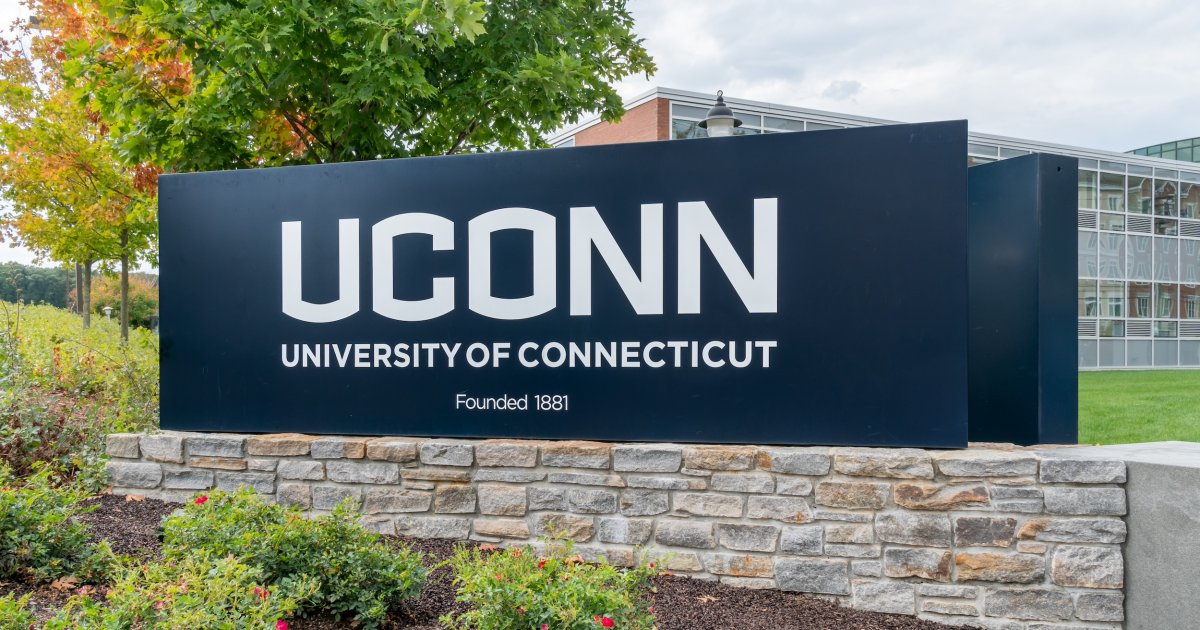
    For millenia, medical students have taken the Hippocratic Oath, solemnly pledging to prioritize the well-being of patients and “abstain from whatever is deleterious and mischievous.” But unfortunately, schools such as the University of Connecticut have recently created their own versions of the oath that prioritize politics at the expense of the First Amendment. 

    In August, UConn required the incoming class of 2028 to pledge allegiance not simply to patient care, but to support diversity, equity, and inclusion. The revised oath, which was finalized in 2022, includes a promise to “actively support policies that promote social justice and specifically work to dismantle policies that perpetuate inequities, exclusion, discrimination and racism.” 

    WATCH VIDEO OF THE OATH HERE

    This practice is a grave affront to students’ free speech rights. In January, FIRE called the medical school to confirm that the oath is mandatory; an admissions staff member told us it was. We are asking them to confirm this in writing.  

    As a public university, UConn is strictly bound by the First Amendment and cannot compel students to voice beliefs they do not hold. Public institutions have every right to use educational measures to try to address biases they believe stymie the healthcare system. But forcing students to pledge themselves to DEI policies — or any other ideological construct — with which they may disagree is First Amendment malpractice. This is no different than forcing students to pledge their allegiance to a political figure or the American flag. 

    When we raised concerns in 2022 about the University of Minnesota Medical School’s oath, which includes affirming that the school is on indigenous land and a vow to fight “white supremacy,” the university confirmed that students were not obligated to recite it.

    In the 1943 landmark case West Virginia State Board of Education v. Barnette, the Supreme Court declared that students could not be made to salute the American flag, saying, “if there is any fixed star in our constitutional constellation, it is that no official, high or petty, can prescribe what shall be orthodox in politics, nationalism, religion, or other matters of opinion or force citizens to confess by word or act their faith therein.” 

    Justice Jackson, writing for the majority, emphasized that the First Amendment protects the individual’s “sphere of intellect and spirit” from governmental or institutional control. Just as UConn cannot force its medical students to express support for socialized medicine or vaccination mandates, it cannot compel them to pledge fealty to its preferred set of political principles. 

    University of Minnesota Medical School swears off compelled speech in white coat ceremony 

    News

    After FIRE criticized the medical school for appearing to force students to profess political views, the university affirmed the oath was not required.


    Read More

    More broadly, these nebulous commitments could become de facto professionalism standards, and students could face punishment for failing to uphold them. (After all, they took an oath.) What, exactly, must a medical student do to “support policies that promote social justice”? If a student disagrees with UConn’s definition of “social justice” or chooses not to promote it in the prescribed way, could she be dismissed for violating her oath? 

    FIRE has repeatedly seen administrators of professional programs — including medicinedentistrylaw, and mortuary science — deploy ambiguous and arbitrarily defined “professionalism” standards to punish students for otherwise protected speech.

    UConn isn’t alone in making such changes to the Hippocratic Oath. Other prestigious medical schools, including those at HarvardColumbiaWashington UniversityPitt Med, and the Icahn School of Medicine, have adopted similar oaths in recent years. However, not all schools compel students to recite such oaths. When we raised concerns in 2022 about the University of Minnesota Medical School’s oath, which includes affirming that the school is on indigenous land and a vow to fight “white supremacy,” the university confirmed that students were not obligated to recite it. That’s the very least UConn could do to make clear that it puts medical education — and the law — ahead of politics. 

    Source link

  • Leveraging European Partnerships in Medical Education

    Leveraging European Partnerships in Medical Education

    By Ivan Dimitrov, Digital Marketing Expert at Medlink Students.

    The United Kingdom faces a critical shortage of medical professionals, a problem exacerbated by the limited availability of medical school places.

    Each year, thousands of aspiring doctors compete for a finite number of spots, leaving many qualified candidates unable to pursue their dreams of contributing to the healthcare system. This bottleneck not only cuts down individual potential but also intensifies the workforce gap in the UK National Health Service (NHS).

    However, there is hope, as innovative solutions are already being tried out. Additionally, new ideas, like partnerships with reputable European universities, present a unique opportunity to address these challenges while opening new pathways for aspiring medical students.

    The Problem: Limited Medical Education Opportunities in the UK

    UK medical schools are oversubscribed, with only a fraction of applicants securing a place each year. For instance, in 2023, only around 7,000 places were available for about 27,000 applicants, leaving thousands of capable students unable to pursue medical education domestically. Those potential students can afford medical school, but there are no seats available for them in the UK.

    This situation places immense pressure on the healthcare system, which is already grappling with severe understaffing and increased demand. Published data suggests there were 125,572 vacancies (9%) in the NHS between March and June 2023. The broader economy also suffers, as estimates suggest poor health outcomes cost the UK between £30.7 billion to £138 billion annually, depending on the research cited.

    Meanwhile, the demand for medical education continues to rise, with applications increasing by nearly 30% over the last decade. However, this increase remains insufficient to meet demand, even though the workforce has grown by 18% between 2018 and 2022, largely driven by international medical graduates (IMGs)

    Even with the planned expansion of UK medical school places, which is already underway, the demand for healthcare professionals is projected to far surpass supply in the foreseeable future.

    The Obvious Long-Term Solution: Expanding UK Medical Schools

    The most logical long-term solution is to expand the UK’s medical school capacity. This initiative is already underway in various forms, including the addition of new medical school seats and pilot programmes like doctor-degree apprenticeships. However, scaling up these efforts requires significant time, planning, and financial investment, which comes with uncertainty. 

    In the meantime, the NHS faces mounting pressures. Currently, over 25,000 doctors registered with the GMC are aged 60 or older and nearing retirement. Without urgent action to fill this gap, the healthcare system will continue to struggle to meet demand.

    While long-term plans are vital, they cannot meet the immediate need for doctors. This is where short-term solutions, such as leveraging partnerships with European universities, can play a critical role.

    A Policy Proposal: Partnering with European Universities as a Short-Term Solution

    To address the urgent need for more doctors, the UK government can explore strategic partnerships with European medical schools. Such partnerships could alleviate the strain on the domestic system while ensuring students receive high-quality, GMC-approved training abroad.

    Key components of the proposal:

    1. Hand-picked, Accredited Medical Schools

      Partnering with select European universities ensures that students receive an education that meets UK standards. These partnerships would focus on medical schools that offer training recognised by the General Medical Council (GMC), guaranteeing seamless integration into the NHS upon graduation.

      But would this approach cost more? Not necessarily. Tuition for UK medical students is currently capped at £9,250 per year, while many European medical schools charge between €3,000 and €18,000 annually. Factoring in lower living costs across much of Europe, studying abroad could be an affordable alternative for many students.

      Even if the UK government were to subsidise part of the cost (an entirely political decision), the potential savings from addressing workforce shortages and improving public health could far outweigh the expense. With healthcare-related economic losses estimated to be at least £30 billion annually, the return on investment is compelling.

      2. A National Branding Campaign for Medical Education Abroad

      To overcome stigma, the government could launch a branding campaign to highlight the benefits of studying medicine abroad and emphasise the value of returning to serve in the NHS after graduation. Such a campaign would promote healthcare careers and position international education as a prestigious and viable path for aspiring doctors.

      3. Financial Accessibility for Students

      To ensure equitable access, the government could negotiate tuition discounts at partner universities or provide scholarships for a small number of students. This would not only serve as a great motivator but also open opportunities for lower-income students and diversify the future medical workforce.

      Medlink Students is currently taking advantage of this approach by partnering with select universities in the Caribbean to give a broader range of students access to high-quality medical education. 

      Expanding this concept to European institutions could create a broader pool of skilled graduates ready to serve the NHS. This method can also secure a steady influx of motivated students to the partnered medical schools, improving their standings and boosting the local economy.

      4. Return-to-Service Agreements

      To ensure the investment benefits the NHS, students could sign contractual agreements committing to work within the UK healthcare system for a specified period after completing their training. Similar approaches have already been successfully employed in other countries that offer scholarships tied to public service commitments.

      While some may argue that students could break these agreements, existing data suggests otherwise. In 2022, 52% of new doctors joining the GMC register were IMGs, showing the strong appeal of the NHS as a workplace. UK students with familial and social ties at home are even more likely to return.

      Not coming back to the UK to practise would be an extreme exception, not the norm.

      Learning from International Examples

      Many countries have implemented programmes to address medical workforce shortages by partnering with international institutions. For instance:

      • Saudi Arabia: Saudi Arabia encourages students to study abroad with scholarships but requires them to return for mandatory public service. The UK could adopt a similar return-to-service model, ensuring overseas-trained doctors contribute directly to the NHS workforce.
      • Malaysia: Malaysia sponsors students to study in selected universities abroad under agreements prioritising national healthcare staffing. The UK could use this approach to target shortages in high-demand regions or specialities.
      • Singapore: Singapore integrates scholarships, branding campaigns, and competitive salaries to attract and retain healthcare talent. This comprehensive strategy demonstrates how financial incentives and targeted marketing can strengthen the healthcare pipeline.

      These examples demonstrate how well-designed policies can address workforce gaps while maintaining financial and political feasibility.

      What’s in it for European Universities?

      European universities do not face the same capacity constraints as the UK, and many universities actively seek to attract international students.

      Countries like Bulgaria, Georgia, Poland, Hungary, the Czech Republic, and others have long-established medical programmes that cater specifically to international students. These programmes provide high-quality, accredited, and internationally recognised medical education in English.

      These programmes typically run parallel with domestic ones, meaning that an influx of UK students would not displace local applicants but would instead guarantee a steady intake of motivated international students. In fact, many universities are actively expanding their capacity to accommodate more international enrolment to increase revenue and demonstrate their ability to adapt to evolving needs and external pressures.

      This makes partnerships feasible without creating strain on current educational systems. On the contrary, partnering with the UK presents substantial benefits for European medical schools, including:

      • Financial Stability: European universities could benefit from a steady stream of tuition income, particularly if the UK government negotiates direct subsidies or covers part of the costs through scholarships. This model has proven effective for institutions hosting scholarship-funded students from Saudi Arabia and Malaysia.
      • Reputational Gains: Collaboration with the UK and GMC recognition could enhance the standing of partner universities globally, attracting further international students.
      • Economic Impact: Hosting UK students would bring economic benefits to local communities, creating demand for housing, goods, and services.

      Additionally, with the support of specialiсed agencies to assist students in managing their documents and application processes, the influx of students can be efficiently handled. Consequently, implementing partnerships with European medical schools is not only a matter of negotiation but also a viable and realistic political decision for the UK. 

      Conclusion

      By initiating partnerships with European universities, the UK government can expand opportunities for aspiring medical students, reduce NHS workforce shortages, and make the dream of becoming a doctor more accessible to all. This potential policy would not only bridge the current gap but also create a more resilient and inclusive healthcare system for the future.

      While expanding domestic medical school capacity remains essential, international collaboration offers an immediate, cost-effective solution to bridge the gap. By combining political will, financial support, and a focus on equitable access, the UK can turn its healthcare challenges into opportunities for growth and innovation.

    Source link

  • Medical College Admission Data, 2023

    Medical College Admission Data, 2023

    This is a reboot of a visualization I did in 2018, which I found fascinating, but which didn’t get much traffic at the time, and thus, I’ve not refreshed it.  But I still find it compelling and instructive.

    Each year, the Association of American Medical Colleges publishes a lot of data about admission to medical colleges in the US. But frankly, it’s a mess, and takes a lot of effort to clean up and visualize: Each link is a separate spreadsheet, and each spreadsheet has spacer rows and merged cells and lots of stuff that needs to be scrubbed (carefully) before analyzing and visualizing.  So, if you use this work in a professional capacity, I’d appreciate your support for my time, software and hosting costs at this link. As a reminder, I don’t accept contributions from high school counselors, students, or parents who are using the site.  (And if you know anyone at AAMC, tell them raw data would be much appreciated).

    There are seven views here, some of which combine several data sets.  Use the tabs across the top to access the views.

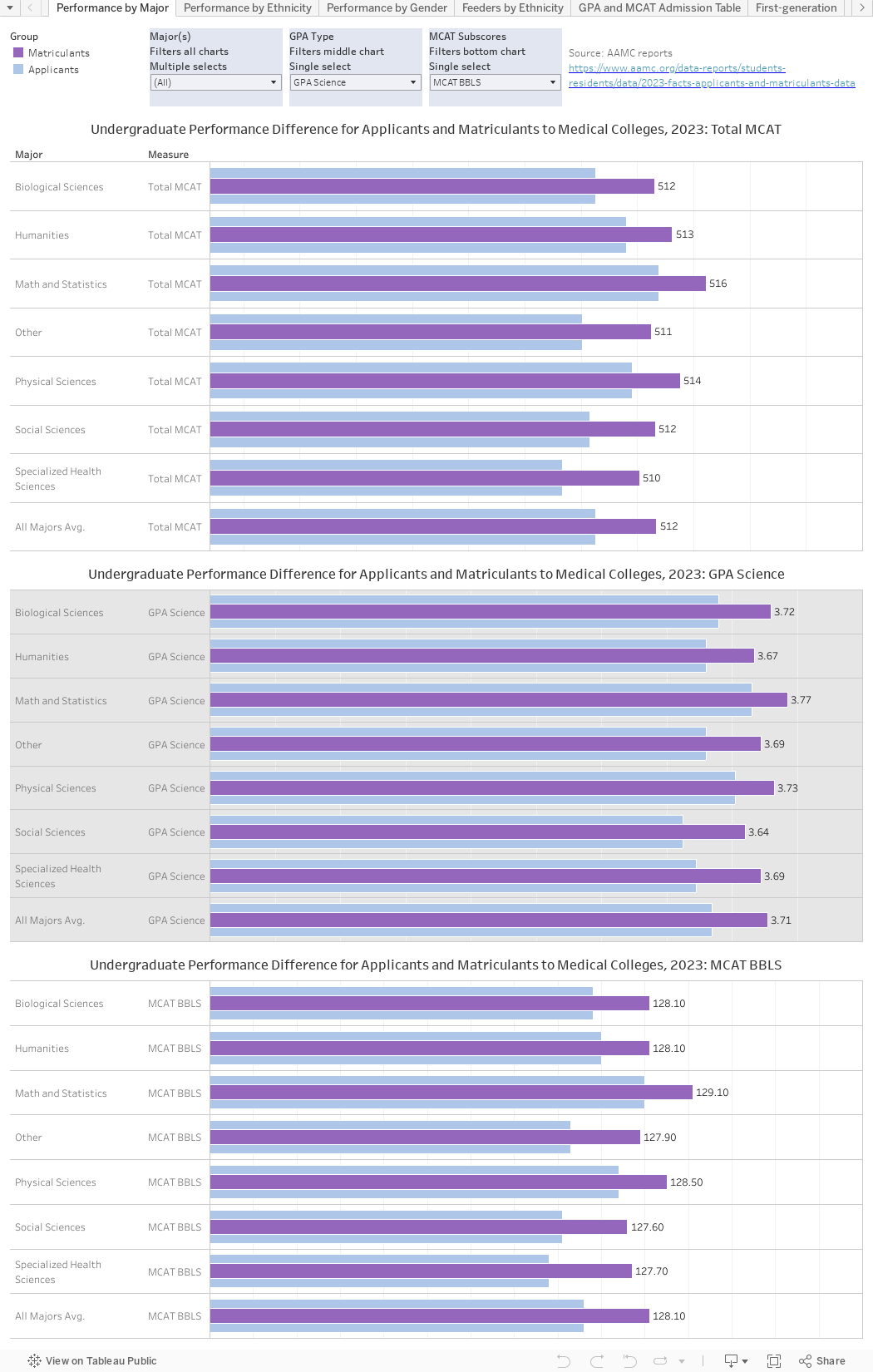
    The first three tabs show similar data, broken out three ways: By undergraduate major, by ethnicity, and by gender for applicants and matriculants. Don’t be afraid to use the filters to get what you want; you won’t break anything, and there is a reset button at the bottom.

    The top chart on these three views shows Total MCAT scores for applicants (blue) and matriculants (purple).  The middle chart shows your choice of GPA, using the filter at the top: Science, Non-Science, and Overall.  And the bottom chart shows sub-scores on the MCAT, again, based on the filter you choose.  Hover over a bar for details. 

    Total MCAT scores range from 472 to 578 with 500 being the mid-score, and each of the four sections–Biological and Biochemical Foundations of Living Systems; Chemical and Physical Foundations of Biological Systems; Psychological, Social, and Biological Foundations of Behavior; and Critical Analysis and Reasoning Skills–is scored from a low of 118 to a high of 132, with a midpoint of 125. Read about them here, whence I shamelessly stole this information.

    The fourth tab shows which undergraduate institutions sent applications to US Medical Schools in what quantity, based on student ethnicity.  Note that the data are not complete, but rather a compilation of five different reports, for colleges sending applications from at least 100 White students, 50 Asian students, 15 African-American students, 10 Hispanic students, or five Native American/Alaska Native students.  A college can be on one list but not another: For instance, the University of Oklahoma is #1 for Native students, but not on the list of institutions sending at least 50 Asian students.

    When you hover over the bars, you can see that institution in larger context, like this:

    The fifth tab gets into the nitty-gritty, and show the distribution of applicants and admits by GPA and MCAT ranges (top two charts), as well as the admission rate (bottom), showing the success of being admitted to at least one medical college.

    The sixth and seventh tabs are simple summaries by first-generation status, and gender over time.

    There is an awful lot of data here, and again, if you have any sway with the AAMC, tell them I’d sign my life away to get raw data in one big file.  As always, let me know what you see here.

    Source link