Tag: meme

  • LAWSUIT: Ex-cop sues after spending 37 days in jail for sharing meme following Charlie Kirk murder

    LAWSUIT: Ex-cop sues after spending 37 days in jail for sharing meme following Charlie Kirk murder

    NASHVILLE, Dec. 17, 2025 — On Sept. 21, the police came for Larry Bushart. They handcuffed him and hauled him away in the dead of night. He spent 37 days in jail while held on a $2 million bond — an amount the retired police officer could not afford.

    It’s the sort of treatment one expects for accused murderers and thieves. But Larry’s only “crime”? In the aftermath of Charlie Kirk’s assassination, he posted a meme on Facebook quoting President Trump’s remarks about a different shooting a year earlier and in a different state.

    “I spent over three decades in law enforcement, and have the utmost respect for the law,” said Larry. “But I also know my rights, and I was arrested for nothing more than refusing to be bullied into censorship.”

    Today, with the help of the Foundation for Individual Rights and Expression, Larry filed a federal civil rights lawsuit against Sheriff Nick Weems and Perry County, Tennessee, for violating his constitutional rights in retaliation for his protected speech. 

    The meme that Larry Bushart shared on Facebook.

    “If police can come to your door in the middle of the night and put you behind bars based on nothing more than an entirely false and contrived interpretation of a Facebook post, no one’s First Amendment rights are safe,” said FIRE senior attorney Adam Steinbaugh.

    Larry’s ordeal began when he commented on a Facebook post for a Kirk vigil in Perry County. The meme — which Larry did not create — used a picture of Donald Trump, quoted him saying “We have to get over it” following the January 2024 school shooting at Perry High School in Iowa, and included the commentary, “This seems relevant today…”

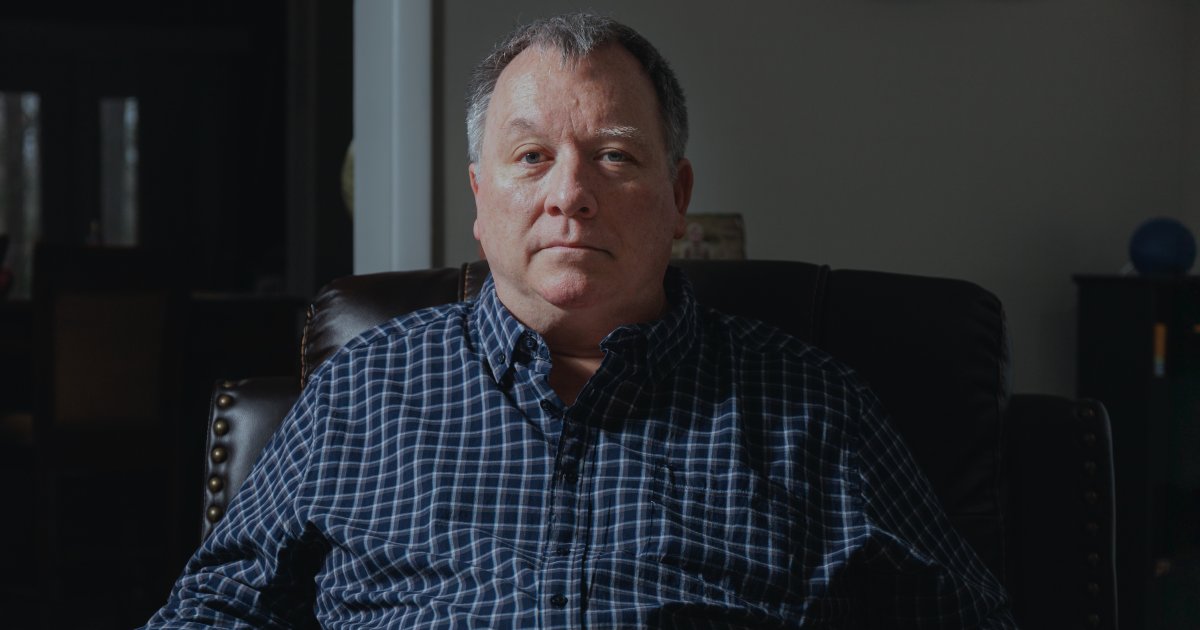
    COURTESY PHOTOS OF LARRY FOR MEDIA USE

    Weems concocted the pretext that because the meme referenced the 2024 shooting at Perry High School in Iowa, it could be interpreted as a threat against Perry County High School in Tennessee. At his request, the local police first visited Larry’s home around 8 p.m. to inform him the sheriff’s office might be in contact with him.

    Bodycam footage indicates the officer was just as confused as Larry was. “So I’m going to be completely honest with you, I have really no idea what they’re talking about,” he said. “He just called me and said there were some concerning posts that were made… I don’t know, I just know they said something was insinuating violence.”

    “No it wasn’t,” Larry responded. “I’m not going to take it down.”

    Hours later, Perry County issued a warrant for his arrest, and local police returned after 11 p.m. to arrest him for “threatening mass violence at a school.” Again, bodycam footage indicates local police were just as perplexed about why they were taking him into custody. “I threatened no one . . .” Larry told them. “I may have been an asshole, but . . .”

    “. . . that’s not illegal,” the officer finished for him.

    Based on Weems’ flimsy justification alone, Larry was locked up for over a month. He lost his job and missed his wedding anniversary as well as the birth of his grandchild. Amazingly, Weems admitted in a later interview that he knew at the time of the arrest that Larry’s post used a pre-existing meme and was not threatening a local high school.  But law enforcement left out that extremely important context from their warrant application

    Larry went free only after a media firestorm and widespread backlash. Weems still insisted he was justified in having Larry arrested because the post caused “mass hysteria” in the community. But none of the Facebook responses to Larry interpreted his post as a threat, the Perry County school district has no records of any complaints about Larry’s post, and Perry County and Weems have refused to respond to multiple public records requests requesting evidence of this “mass hysteria.”

    With FIRE’s help, Larry is suing Perry County and Weems in the U.S. District Court for the Western District of Tennessee for violating his First Amendment right to free speech and his Fourth Amendment right against unlawful seizure. Larry is also suing Investigator Jason Morrow who, on Weems’ orders, helped procure the misleading arrest warrant. And because Weems and Morrow knew their actions were egregiously unconstitutional, FIRE is suing them in their personal capacities, meaning they would be on the hook for monetary damages. Rounding out Larry’s legal team is Phillips and Phillips, PLLC, in Lexington, TN, which also defended Larry in criminal court.  

    “This lawsuit goes beyond Larry,” said FIRE attorney David Rubin. “It’s about making sure police everywhere understand that they cannot punish or intimidate people for sharing controversial opinions online. Law enforcement across the country should be on notice: Respect the First Amendment, or prepare to face the consequences.”


    The Foundation for Individual Rights and Expression (FIRE) is a nonpartisan, nonprofit organization dedicated to defending and sustaining the individual rights of all Americans to free speech and free thought — the most essential qualities of liberty. FIRE educates Americans about the importance of these inalienable rights, promotes a culture of respect for these rights, and provides the means to preserve them. 

    CONTACT:

    Alex Griswold, Communications Campaign Manager, FIRE: 215-717-3473; [email protected]

    Source link

  • ‘I hate freedom of opinion’ meme leads to sentencing in German court

    ‘I hate freedom of opinion’ meme leads to sentencing in German court

    Last year, FIRE launched the Free Speech Dispatch, a regular series covering new and continuing censorship trends and challenges around the world. Our goal is to help readers better understand the global context of free expression. Want to make sure you don’t miss an update? Sign up for our newsletter

    Guilty finding for German editor’s doctored “I hate freedom of opinion” image 

    Germany’s speech policing can’t stay out of the spotlight for long, apparently. This month, David Bendels, editor-in-chief for the Alternative for Germany (AfD)-affiliated Deutschland Kurier, received a seven-month suspended sentence for “abuse, slander or defamation against persons in political life.” 

    The offense? Bendels had edited and posted a photo of Interior Minister Nancy Faeser so that a sign she held said, “I hate freedom of opinion.” (Just think of how many different versions you saw of the Michelle Obama sign meme here in the U.S.) A Bavarian district court found Bendels guilty under a provision giving advanced protections to political figures against speech. Bendels’ sentencing has provoked criticism outside of his political circle, with figures like former Green Party leader Ricarda Lang questioning the “proportionality” of the ruling.

    Political speech under fire, from Thailand to Zimbabwe to Russia 

    • American academic Paul Chambers, a Naresuan University lecturer, has lost his visa and is facing trial after the Royal Thai Army accused him of violating Thailand’s oppressive lese-majeste laws. The laws, which ban insults to the country’s monarchy, regularly result in long prison sentences for government critics.
    • Hamas militants tortured a Palestinian man to death after he participated in anti-Hamas protests.
    • A St. Petersburg military court sentenced 67-year-old Soviet-era dissident Alexander Skobov to 16 years in prison for participating in the Free Russia Forum and making a social media post in support of Ukraine.
    • Indian comedian Kunal Kamra is experiencing a wave of retaliation after joking about state leader Eknath Shinde at a comedy club. Kamra is facing multiple criminal charges, including defamation, as well as death threats. But he isn’t backing down — his response on X included a “step-by-step guide” on “How to Kill an Artist.”
    • Zimbabwe police have detained journalist Blessed Mhlanga for weeks on charges of “transmitting information that incites violence or causes damage to property.” He had interviewed a veteran and political figure who called for the resignation of President Emmerson Mnangagwa.
    • Israeli military temporarily blindfolded, handcuffed, and detained filmmaker Hamdan Ballal, best known for the Oscar-winning documentary “No Other Land,”  while he was receiving medical care after settlers attacked him during Ramadan near his home in the West Bank.
    • Burkina Faso’s military junta is accused of forcibly conscripting journalists who criticized severe press freedom violations in the country.
    • Nigeria’s Borno State arrested a 19-year-old for his viral social media post criticizing public schools in the region and intend to charge him with “ridiculing and bringing down the personality of” the governor.
    • Lawyers representing dissenting voices aren’t free from consequences, either. An Iranian court sentenced a dozen lawyers who provided legal services to clients from the country’s 2022 protest movement to three years in prison on “propaganda” charges. 

    Turkey targets journalists amid protests

    Protesters gather in Istanbul after the detention of the city’s Mayor Ekrem Imamoglu.

    Last month, Turkish police banned protests in Istanbul and arrested the city’s Mayor Ekrem Imamoglu, a popular rival of President Recep Tayyip Erdogan. The crackdown has extended to the press, too. Authorities arrested BBC correspondent Mark Lowen and deported him for “being a threat to public order,” arrested AFP photographer Yasin Akgül for “taking part in an illegal gathering,” and charged Swedish journalist Kaj Joakim Medin for allegedly “being a member of a terrorist organization” and “insulting” Erdogan. 

    The latest in tech and censorship:

    • Late last month, a massive earthquake struck Myanmar, causing thousands of deaths and injuries. But the country’s military junta nevertheless continued severe restrictions on reporting and internet access, hampering recovery efforts.
    • The Kenyan high court in Nairobi ruled that a lawsuit alleging Meta’s content moderation practices fueled violence in Ethiopia can go forward.
    • Meta says it’s facing “substantial” fines because it “pushed back on requests from the Turkish government to restrict content that is clearly in the public interest” in the aftermath of Mayor Imamoglu’s arrest.
    • Turkish authorities also demanded the social media platform X block hundreds of accounts within the country, to which X partially complied but has since challenged some of the orders “to defend the expression of our users.”
    • X is also challenging the use of a provision of India’s Information Technology Act to issue content takedown orders.
    • India’s Supreme Court, in response to Wikimedia Foundation’s appeal against an order from the Delhi High Court, pushed back against that court’s demand that Wikipedia take down a page detailing Asian News International’s lawsuit against the Foundation.
    • The Investigatory Powers Tribunal issued a ruling opposing the UK government’s attempt to keep secret Apple’s appeal against orders that it offer a backdoor in its encrypted cloud service for users around the world.
    • European Union authorities are reportedly planning to announce penalties including “a fine and demands for product changes” against X for alleged violations under the Digital Services Act.

    Pakistan’s blasphemers still under attack

    Late last month, a Pakistan court sentenced five men to death for posting “blasphemous” content online, a common charge and penalty in Pakistan. But that’s not all. A Pakistani YouTuber is also facing blasphemy charges (not his first) for naming a perfume “295” — a reference to the blasphemy law in the country’s penal code.

    Let’s check back in across the pond…

    Lately, it seems not a day goes by without the UK’s free speech issues hitting the headlines. This month is no different. Here’s the latest:

    • As I’ve written about in recent editions of the Dispatch, the UK has been flirting with enforcement of blasphemy laws in the country. That risk has advanced with the charge of “intent to cause against the religious institution of Islam, harassment, alarm or distress” filed against a man who burned a Quran outside the Turkish consulate in London. The alleged target in the case — the “religious institution of Islam” — is notable.
    • On the other hand, the UK’s Advertising Standards Authority chose not to act on hundreds of complaints filed over an allegedly anti-Christian KFC ad that “depicts a man being baptised in a lake of gravy before transforming into a human-sized chicken nugget.”(Last year, the ASA did act against a comedy tour ad that could cause “serious offence” to Christians.)
    • A lower court in Poole found anti-abortion activist Livia Tossici-Bolt guilty on two charges of breaching a public spaces protection order for standing outside an abortion clinic with a sign that read “Here to talk, if you want.” The court gave her a conditional discharge and ordered her to pay £20,000 (about $27,000) in legal costs.
    • Over 30 police officers arrested six activists from Youth Demand at a Quaker meeting house in London “on suspicion of conspiracy to cause a public nuisance.” One member said the group was “so incensed” by the raid “that they didn’t even offer officers a cup of tea.”
    • Hertfordshire police are conducting a “rapid and thorough review” after the arrest and 11-hour detainment of  a couple on various charges, including harassment and malicious communications because they voiced complaints about their daughter’s school on WhatsApp.
    • The aforementioned arrests are just a drop in the pond — data obtained by The Times found that UK police are detaining around 12,000 people annually for “sending messages that cause ‘annoyance’, ‘inconvenience’ or ‘anxiety’ to others via the internet, telephone or mail.”

    China’s critics targeted in Hong Kong — and Canada 

    Chinese dissident artists Badiucao

    Chinese dissident artist and human rights activist Badiucao holding his Lennon Wall flag that he designed in support of Hong Kong’s pro-democracy movement, October 5, 2019.

    Milan digital gallery Art Innovation is facing criticism for its response to an artist it featured in a short video broadcast on billboards during a recent art fair in Hong Kong. In it, artist, CCP critic, and frequent target of censorship Badiucao mouthed the words, “You must take part in revolution,” a Mao Zedong quote and the title of his new graphic novel

    When he announced that he planned to publish a statement about his effort to skirt Hong Kong’s censorship laws, Art Innovation warned him there would “definitely” be legal action if material “against the Chinese government is published.” And in a social media post, the gallery said Badiucao was not upfront about the “nature of the work” so they “can consider it a crime.”

    And that’s not all the news out of Hong Kong. In recent weeks, a 57-year-old man was sentenced to a year in prison for “seditious” social media posts including some calling the Chinese government a “terrorist state” and an “evil axis power.” Police also took in for questioning the parents of U.S.-based democracy activist Frances Hui, who is wanted in Hong Kong on national security charges.

    Hong Kong’s campaign to target its activists is causing a stir elsewhere, too — in Canadian elections. Canadian member of parliament and Liberal Party candidate Paul Chiang stepped down from the April 28 election days after a video of comments he made earlier this year surfaced. In it, Chiang encouraged people to bring Conservative party candidate Joe Tay, who is wanted by Hong Kong authorities, to Toronto’s Chinese consulate to collect a bounty for him.

    P.S. If you enjoyed this newsletter, you may be interested in my book, “Authoritarians in the Academy: How the Internationalization of Higher Education and Borderless Censorship Threaten Free Speech.” It comes out Aug. 19 and is now available for pre-order!

    Source link