Tag: mental health

  • student-mental-wellbeing-college-life-crisisThe Cengage Blog

    student-mental-wellbeing-college-life-crisisThe Cengage Blog

    Reading Time: 3 minutes

    May is Mental Health Awareness Month, a time to elevate conversations around mental wellbeing and reduce the stigma that surrounds it. In recognition, we’re sharing stories directly from students who are navigating the pressures and facing the challenges of higher ed life today.

    One of those students is Ruby Adamowicz, a sophomore at Isenberg School of Management, University of Massachusetts, Amherst. Here’s Ruby’s perspective, in her own words.

    The right direction

    I’m nearing the end of my sophomore year of college, and I can still confidently say that I have absolutely no idea where I’ll end up after graduation. I see my peers landing internship offers and studying abroad — even my own roommate has a full-time job offer set for her once she graduates.

    Now, I’m not saying that I’m coasting through college. Trust me, I have put in the work. But I’ve also realized that success does not look the same for everyone. We’re all moving through life at our own pace. I always remind myself that some people find themselves as undergrads, some as post-grads and many are simply still trying to figure out who they are, which is normal and okay.

    This brings me to the question that’s almost always in every student’s head: “Am I headed in the right direction?”

    Second-guessing first-year decisions

    For me, I have always struggled with finding my passion and figuring out what jobs align with my major. It’s like a mental battle. I’m constantly asking myself: “Am I doing this because I genuinely love it, or is it just what makes the most sense?”

    I consider myself extremely fortunate that I was a freshman while both of my sisters were seniors at the same school. In all honesty, they were the ones who encouraged me to major in marketing. In my high school mind, following in their footsteps was what made the most sense. I figured I would know what classes to take, how to find an internship and have some overall guidance during my first year. And it seemed like the smart choice. Business is so broad and allows you to be creative. But, two years in, I still second-guess whether this is my “passion.”

    Figuring things out – one day at a time

    There are days when I feel inspired and even motivated to work on social media projects and brainstorm my entrepreneurial ideas. Other days, I feel like I’m going through the motions — just checking off my tasks for the day. Sometimes, I’m inspired to plan out my goals, update my resume and have a strong sense of where I want to be post-grad. There are also times when I feel like I’m stuck, almost like a fish out of water. And that’s okay. I’ve learned that “figuring it out” doesn’t mean that your life will fall into place that same day. It means taking small steps, such as talking to your professors, stepping out of your comfort zone, joining clubs, being social and challenging yourself.

    Follow your own path

    What I’ve come to learn during my time at college is that nobody has it all figured out — even your classmate who has 500+ connections on LinkedIn and is posting about their summer internship.

    We’re all experiencing college for the first time and trying to figure out what to do to be happy. There are ups and downs, but you can take it one day at a time. If you’re reading this and are feeling lost, confused, behind or even stuck, I’m here to remind you that it is so normal. It’s a feeling that comes from comparing yourself to people who are on a different path than you. As the saying goes, “Comparison is the thief of joy.”

    What now

    Honestly, this is a great question that I try to answer each day.

    Life is not one straight line. It’s everyone’s first time living, trying to navigate what the world has to offer. But the more you show up and put yourself out there, you’ll find what life has for you. College is not a race to be employed. It’s a chance to figure out what makes you feel happy.

    Apply for the internship you feel underqualified for, make friends with new people and take advantage of all the opportunities possible.

    So, I will leave you with this. If you’re feeling lost and keep asking yourself, “Am I doing enough?” — you are not alone.

    Take it one day at a time.

    Written by Ruby Adamowicz, sophomore marketing major at the University of Massachusetts, Amherst and Cengage Student Ambassador

    Do you see some students struggling with their mental health? Let them know they’re not alone. Share this article and explore additional articles about student mental wellbeing.
    Source link

  • Arizona Republicans Want Chaplains to be in Public Schools – The 74

    Arizona Republicans Want Chaplains to be in Public Schools – The 74


    Get stories like this delivered straight to your inbox. Sign up for The 74 Newsletter

    Republican politicians who accuse public school teachers of indoctrinating students with a “woke agenda” are pushing to bring religious chaplains into the same schools to provide counseling to students.

    “I think Jesus is a lot better than a psychologist,” Rep. David Marshall, R-Snowflake, said during a March 11 meeting of the Arizona House of Representatives’ Education Committee.

    Marshall said that he’s been a chaplain who provides counseling for 26 years.

    Senate Bill 1269, sponsored by Flagstaff Republican Sen. Wendy Rogers, was modeled after similar legislation passed in recent years in Texas and Florida.

    The proposal would give school districts the option of allowing volunteer religious chaplains to provide counseling and programs to public school students. Districts that decide to allow chaplains would be required to provide to parents a list of the volunteer chaplains at each school and their religious affiliation, and parents would be required to give permission for their child to receive support from a chaplain.

    Despite ample concerns that the proposal violates the First Amendment’s Establishment Clause and that it would open up schools to legal liability for any bad mental health advice a chaplain might provide, the bill has already passed through the Senate on a party-line vote. The House Education Committee also approved it along party lines.

    Rogers told the Education Committee that the existence of any requirement for the separation of church and state in U.S. law “was a myth,” adding that she sees no harm in bringing religion into public schools.

    Rogers, a far-right extremist, has embraced white nationalism, and in 2022 spoke at a white nationalist conference, calling the attendees “patriots” and advocating for the murder of her political enemies.

    She has also said she is “honored” to be endorsed by a prominent antisemitic Christian nationalist and regularly trafficks in antisemitic tropes. And Rogers has advocated racist theories, appeared on antisemitic news programs and aligned herself with violent anti-government extremists.

    Democrats on the committee raised the alarm that Rogers’ bill would violate the Establishment Clause by allowing chaplains with religious affiliations to counsel students, while not providing the same kinds of services to students who don’t follow a religion or who follow a less-common religion with no chaplains available to the school.

    An amendment to the bill, proposed by committee Chairman Matt Gress, a Phoenix Republican, requires that the chaplains be authorized to conduct religious activities by a religious group that believes in a supernatural being. The amendment would also allow a volunteer chaplain to be denied from the list if the school’s principal believes their counsel would be contrary to the school’s teachings.

    Both of these changes would allow districts to exclude chaplains from The Satanic Temple of Arizona, a group that doesn’t believe in a higher power but promotes empathy and has chapters across the country that challenge the intertwining of Christianity and government.

    Oliver Spires, a minister with The Satanic Temple of Arizona, voiced his opposition to Rogers’ bill during a Feb. 5 Senate Education Committee meeting.

    The legislation, Spires said, would disproportionately impact students from minority religions who see Christian chaplains providing support to their peers while no chaplains representing their religion are available.

    “If a district listed a Satanist on their chaplain list, would they have your support?” he asked the committee members.

    Gress’s amendment would preclude that.

    Gaelle Esposito, a lobbyist for the American Civil Liberties Union of Arizona, told committee members on Tuesday that school counselors are required to undergo specialized training to prepare them to help students — requirements that religious chaplains wouldn’t have to meet, even though they’d be providing similar services.

    “They will simply not be equipped to support students dealing with serious matters like anxiety, depression, eating disorders, self harm or suicidal ideation,” Esposito said. “Religious training is not a substitute for academic and professional training in counseling, health care or mental health… Even with the best intentions, chaplains may provide inappropriate responses or interventions that could harm students.”

    But as Democrats on the House Education Committee argued that Arizona should provide more funding for trained counselors and social workers to help students with mental health issues, the Republicans on the panel said that students are actually struggling with mental health issues because they don’t have enough religion in their lives.

    “I’ve heard that there is a mental health crisis afflicting kids,” Gress, a former school board member, said. “Now, I don’t necessarily think in many of these cases that something is medically wrong with these kids. I think, perhaps, there is a spiritual deficit that needs to be addressed.”

    Rep. Justin Olson, R-Mesa, said he’s been frustrated by the federal courts’ interpretation of the First Amendment to require the separation of church and state, claiming it has made the government hostile to religion instead of protecting it.

    “I heard comments here today that this is going to harm kids — harm kids by being exposed to religion? That is absolutely the opposite of what is happening here today in our society,” Olson said. “We have become a secular society, and that is damaging our society. We need to have opportunities for people to look to a higher power, and what better way than what is described here in this bill?”

    Democratic Rep. Nancy Gutierrez, of Tucson, called SB1269 “outrageous” and “incredibly inappropriate.”

    And Rep. Stephanie Simacek, of Phoenix, pointed out that the courts have repeatedly ruled against allowing religious leaders to be invited to share their faith with public school students. She described Rogers’ bill as indoctrination that gives preferential treatment to students who have religious beliefs over those who don’t

    “No one is saying that you may not go and celebrate your God, however you see fit,” Simacek, a former teacher and school board member, said. “But this is not the place, in public education, where our students go to learn math, reading and writing and history.”

    Florida’s school chaplain law, which went into effect last July and is similar to Rogers’ proposal, has received ample pushback from First Amendment advocacy groups, as well as some church groups who said that allowing untrained chaplains to provide mental health support to students would have unintended negative consequences.

    The option to bring chaplains into schools in Florida has not been particularly popular, with several large school districts deciding not to implement a program allowing them.

    Proposed legislation similar to SB 1269 has been introduced in red states across the country this year, including in Indiana, Nebraska, Iowa, Montana and North Dakota.

    The bill will next be considered by the full House of Representatives. If it passes the chamber, it will return to the Senate for a final vote before heading to Gov. Katie Hobbs.

    Arizona Mirror is part of States Newsroom, a nonprofit news network supported by grants and a coalition of donors as a 501c(3) public charity. Arizona Mirror maintains editorial independence. Contact Editor Jim Small for questions: [email protected].


    Get stories like these delivered straight to your inbox. Sign up for The 74 Newsletter

    Source link

  • Oklahoma Bills Would Restrict Student Cellphone Use, Social Media, Sex Ed – The 74

    Oklahoma Bills Would Restrict Student Cellphone Use, Social Media, Sex Ed – The 74


    Get stories like this delivered straight to your inbox. Sign up for The 74 Newsletter

    OKLAHOMA CITY — Oklahoma lawmakers filed hundreds of bills affecting education for the next legislative session.

    Oklahoma Voice collected some of the top trends and topics that emerged in legislation related to students, teachers and schools. The state Legislature will begin considering bills once its 2025 session begins Feb. 3.

    Bills would restrict minors’ use of cellphones and social media

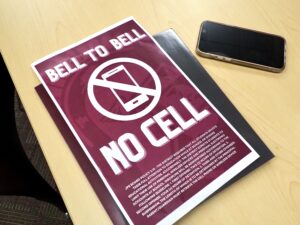
    A poster reads, “bell to bell, no cell” at the Jenks Public Schools Math and Science Center on Nov. 13. The school district prohibits student cellphone use during class periods. (Nuria Martinez-Keel/Oklahoam Voice)

    As expected, lawmakers filed multiple bills to limit student cellphone use in public schools, an issue that leaders in both chambers of the Legislature have said is a top priority this year.

    The House and Senate each have a bill that would prohibit students from using cellphones during the entire school day. Some Oklahoma schools already made this a requirement while others allow cellphone access in between classes.

    After encouraging all districts to establish cellphone restrictions, Gov. Kevin Stitt visited multiple schools in November that have done so.

    Senate Bill 139 from Education Committee vice chair Sen. Ally Seifried, R-Claremore, would require all districts to ban students from accessing their cellphones from the morning bell until dismissal, and it would create a $2 million grant program to help schools enact phone-free policies.

    Legislation from a House leader on education funding, Rep. Chad Caldwell, R-Enid, would prohibit student cellphone use while on school premises.

    Multiple bills target children’s social media use. Sen. Kristen Thompson, R-Edmond, aims to ban social media accounts for anyone under 16 with SB 838 and, with SB 839, to deem social media addictive and dangerous for youth mental health. 

    A bill from Seifried would outlaw social media companies from collecting data from and personalizing content for a minor’s account, which a child wouldn’t be allowed to have without parent consent

    SB 371 from Sen. Micheal Bergstron, R-Adair, would require districts to prohibit the use of social media on school computers or on school-issued devices while on campus. SB 932 from Sen. Darcy Jech, R-Kingfisher, would allow minors or their parents to sue a social media company over an “adverse mental health outcome arising, in whole or in part, from the minor’s excessive use of the social media platform’s algorithmically curated service.”

    School chaplain bill reemerges

    Multiple lawmakers have refiled a bill seeking to enable religious chaplains to counsel students in public schools. A version of the controversial bill passed the House last year but failed in the Senate.

    Its original author, Rep. Kevin West, R-Moore, refiled it as House Bill 1232. Sen. Shane Jett, R-Shawnee, and Sen. Dana Prieto, R-Tulsa, filed similar school chaplain bills with SB 486 and SB 590.

    More restrictions suggested for sex education, gender expression

    Another unsuccessful bill returning this year is legislation that would have families opt into sex education for their children instead of opting out, which is the state’s current policy.

    Students wouldn’t be allowed to take any sex education course or hear a related presentation without written permission from their parents under SB 759 from Prieto, HB 1964 from Danny Williams, R-Seminole, and HB 1998 from Rep. Tim Turner, R-Kinta.

    Sen. Dusty Deevers, R-Elgin, would have any reference to sex education and mental health removed from health education in schools with SB 702.

    Prieto’s bill also would exclude any instruction about sexual orientation or gender identity from sex education courses. It would require school employees to notify a child’s parents before referring to the student by a different name or pronouns.

    Other bills similarly would limit students’ ability to be called by a different name or set of pronouns at school if it doesn’t correspond to their biological sex.

    Deevers’ Free to Speak Act would bar teachers from calling students by pronouns other than what aligns with their biological sex or by any name other than their legal name without parent consent. Educators and fellow students could not be punished for calling a child by their legal name and biological pronouns.

    Rep. Gabe Woolley, R-Broken Arrow, filed a similar bill.

    No public school could compel an employee or volunteer to refer to a student by a name or pronoun other than what corresponds with their sex at birth under SB 847 from Sen. David Bullard, R-Durant, nor could any printed or multimedia materials in a school refer to a student by another gender.

    Corporal punishment in schools

    Once again, Oklahoma lawmakers will consider whether to outlaw corporal punishment of students with disabilities. State law currently prohibits using physical pain as discipline on children with only the most significant cognitive disabilities.

    In 2020, the state Department of Education used its administrative rules to ban corporal punishment on any student with a disability, but similar bills have failed to pass the state Legislature, drawing frustration from child advocates.

    Sen. Dave Rader, R-Tulsa, was an author of last year’s bill to prohibit corporal punishment of students with any type of disability. He filed the bill again for consideration this session.

    HB 2244 from Rep. John Waldron, D-Tulsa, would require schools to report to the Oklahoma State Department of Education the number of times they administer corporal punishment along with the age, race, gender and disability status of the students receiving it. The state Department of Education would then have to compile the information in a report to the Oklahoma Commission on Children and Youth.

    Oklahoma Voice is part of States Newsroom, a nonprofit news network supported by grants and a coalition of donors as a 501c(3) public charity. Oklahoma Voice maintains editorial independence. Contact Editor Janelle Stecklein for questions: [email protected].


    Get stories like these delivered straight to your inbox. Sign up for The 74 Newsletter

    Source link

  • “How Are You Doing Today?” A Survey for Starting Each Class – Faculty Focus

    “How Are You Doing Today?” A Survey for Starting Each Class – Faculty Focus

    Source link