Tag: Mental

  • Counslr Launches in Texas to Increase Access to Mental Health Support for Staff and Students

    Counslr Launches in Texas to Increase Access to Mental Health Support for Staff and Students

    New York, NY –  Counslr, a leading B2B mental health and wellness platform, announced today that it has expanded its footprint into the State of Texas starting with a partnership with Colorado Independent School District (ISD) in Colorado City, TX. This partnership will empower students and staff to prioritize their mental health by enabling them to access unlimited live texting sessions with Counslr’s licensed and vetted mental health support professionals, who are available on-demand, 24/7/365 and also utilize the app’s robust and curated wellness resources. By increasing accessibility to Counslr’s round-the-clock support, Colorado ISD aims to empower those silent sufferers who previously did not or could not access care, whether due to cost, inconvenience, or stigma.

    Texas is facing a critical mental health care crisis, with over 95% of its counties officially designated as Mental Health Professional Shortage Areas. This alarming statistic underscores the severe lack of access to mental health services across the state, particularly in rural, border, and frontier communities. This resource scarcity underscores the urgent need for additional resources and innovative solutions to bridge this critical care gap for school communities.

    “We’re excited to partner with Counslr to bring innovative, accessible mental health resources to our school community,” said Alison Alvarez, Family and Community Engagement Coordinator, of Colorado ISD. “This partnership empowers our 6-12 grade students and staff with the support they need to thrive—both in and out of the classroom.”

    As factors such as academic pressures, social media influence, burnout and world events contribute to an increase in mental health challenges for young people, schools throughout the country are recognizing the growing need to offer more accessible, prevention-focused resources. A recent study found that digital mental health apps like Counslr can play an important role in expanding access to mental health support, especially for school communities. Most users turned to Counslr through on-demand sessions, showing just how valuable it is to have someone available in the moment when support is needed most. Interestingly, more than 80% of sessions happened between 7 PM and 5 AM, a time when traditional counseling services are usually unavailable. This suggests that Counslr helps fill a critical gap, offering students and school community members a reliable way to talk to licensed counselors around the clock. The app was also used for a wide range of concerns, highlighting its potential to meet diverse mental health needs through both immediate and scheduled support.

    “As we expand across the country, we’re proud to partner with new school communities to ensure that every student, regardless of location or background, has access to the mental health support they deserve,” said Josh Liss, Counslr CEO. Adding that, “With most of Counslr’s users being first-time care seekers, we’re excited to help reach those traditionally unreachable, who need help but do not or cannot access it, no matter where they are located.”

    ABOUT COUNSLR

    Counslr is a text-based mental health support application that provides unlimited access to robust wellness resources and live texting sessions with licensed professionals, 24/7/365. Users can access support on-demand within two minutes of opening the app, or by scheduled appointment. Through real-time texting, users enjoy one-on-one, private communication with a licensed counselor that can be conducted anytime, anywhere. Counslr was designed to help individuals deal with life’s day-to-day issues, empowering individuals to address concerns while they are “small” to help ensure that they stay “small”. Counslr partners with organizations of all shapes and sizes (companies, unions, nonprofits, universities/colleges, high schools, etc) so that these entities can provide Counslr’s services to their employees/members/students at no direct cost. For more information, please visit www.counslr.com.


    eSchool News Staff
    Latest posts by eSchool News Staff (see all)

    Source link

  • May May Be Over, But Mental Health Challenges on Campus are Far from It

    May May Be Over, But Mental Health Challenges on Campus are Far from It

    Last month, during Mental Health Awareness Month, posters went up on campuses across the country, and social media hashtags trended. Now we’re in June, and the conversation begins to fade—while students’ struggles do not. 

    We cannot afford to relegate mental health to a single month on the calendar. Mental health is essential to student well-being and must be central to the work of educators, advocates, and policy leaders throughout the year.  

    According to the CDC, suicide remains the second leading cause of death among young people aged 10 to 24. A Jed Foundation (JED) study revealed that 3 in 5 learners are struggling with financial insecurity, while 60 percent fear for their future. And among young people with depression, more than 60 percent are not receiving the help they need.

    These statistics are heartbreaking. But they are not just numbers. They are students.

    Today’s college students face immense challenges. This generation is coming of age in a world shaped by instability. They are digital natives – always connected, yet deeply isolated and yearning for authentic human connection. They have survived a pandemic but still live in the shadows of economic uncertainty and climate change. They are struggling not only to pay tuition, but also to meet their most basic needs: food, housing, and, in some cases, childcare. And far too many of our students are now familiar with violence in places once considered safe—places like schools, churches, synagogues, and even grocery stores.

    Our students carry an unprecedented emotional weight. 

    Now adding to that weight are the relentless political assaults on who they are and what they deserve.

    Across the country, we’ve seen books banned, attempts to erase history, programs dismantled, and policies enacted that deny students the right to feel seen, safe, and supported. At a time when mental health support should be expanding, it’s being defunded or discredited. At a time when our students need more understanding, they’re met with suspicion and censorship. 

    Even the fundamental promise of higher education—as a gateway to opportunity—is being recast as suspect or expendable. These attacks strike at the core of belonging, purpose, and possibility. They undermine our efforts to build a society where everyone, all of us, can thrive. 

    It’s no wonder that a Lumina and Gallup poll finds that one in three students are considering leaving their programs due to mental health and emotional stress. When support disappears, so does persistence. No single institution can solve the student mental health crisis alone. It will take all of us working across education, healthcare, philanthropy, government, and community spaces to prioritize mental health.

    On behalf of students, we must confront this crisis with compassion, collaboration, and conviction.

    Three principles can guide our efforts to protect students’ emotional health:

    • Mental health must be a core, not a peripheral, issue. It is central to student success, institutional mission, and employee well-being. It must be considered mission-critical and treated with the same urgency as academic success.
    • Mental health must be holistic, not siloed. It must be embedded in campus life, intersecting with health, academics, and student services. A “whole campus” approach is needed.
    • Mental health must be multifaceted, not solely focused on individual counseling. Addressing the issue requires a systems-level response emphasizing wholeness, wellness, and a sense of belonging. 

      While the federal government is cutting funding for school mental health, states are providing strong leadership. A recent convening by The Jed Foundation (JED), a nonprofit that protects emotional health and prevents suicide for teens and young adults nationwide, and the State Higher Education Executive Officers Association highlighted how states are advancing creative, community-rooted strategies to ensure every student feels seen, safe, and supported.

      For instance, Louisiana embraced generational and culturally responsive outreach, using tools like yoga set to hip hop music and leveraging social media to meet students where they are. They also wove mental health into broader attainment conversations—linking well-being with educational and economic outcomes.

      Montana launched “Thriving Together,” a campus-wide initiative focused on resilience, life skills, and collective care. With limited budget resources, the state partnered with external organizations to fund and deliver services.

      Wyoming has found success in telehealth, particularly in reaching students in rural areas where staff shortages and budget gaps limit access to care.

      We see other practices that can be put in place elsewhere. Colleges can train all campus stakeholders to recognize signs of distress and support mental well-being as a shared responsibility. States and local communities can invest more in the mental health workforce, ensuring enough trained providers are available to meet growing demand. And collectively, we can sustain and evolve the work because mental health requires ongoing adaptation and commitment to stay aligned with changing student needs.

      At Lumina Foundation, we understand that students need more than credentials—they need to feel hopeful about their future. Our new goal that 75 percent of working adults hold a credential of value by 2040 is not just a policy target—it’s a moral commitment. It’s about ensuring every learner not only earns a degree but also has the security, well-being, and civic agency to live a fulfilling life.

      Mental health is central to that vision.

      This isn’t easy work. But supporting students’ mental health is essential and must be done year-round. It is foundational to academic success, human dignity, and the promise of higher education.

      Dr. Michelle Asha Cooper is vice president for public policy at Lumina Foundation.

    Source link

  • College parents speak out in new survey: Weekly updates, mental health info and more access needed

    College parents speak out in new survey: Weekly updates, mental health info and more access needed

    As colleges nationwide double down on enrollment, retention, and student success strategies, one key voice is becoming harder to ignore: the family. According to the 2025 Current Families Report released by CampusESP, families want more updates, more access, and more say in the college journey, and they’re increasingly dissatisfied when they don’t get it. In addition, when parents do receive the information they need to support their student, research shows significant gains in student yield and retention.

    The survey, conducted across 81 colleges and universities and with more than 32,000 parents and supporters of current students, is the most comprehensive look at family engagement to date. And the findings are impossible to miss.

    Mental health, money, and mentorship

    Nearly half of all parents talk to their student daily, with the number jumping to over 60% for low-income and first-generation households. These families aren’t just chatting about weekend plans — they’re offering support on mental health (53%), academic advice (57%), and student life (69%).

    “Parents aren’t bystanders — they’re active advisors,” says the report. “And they need the right tools to guide their students.”

    Communication expectations are high

    A staggering 77% of families want to hear from their student’s college weekly or more, up 12% in just four years. While email is still the go-to channel, the demand for text messaging is surging, especially among Black, Hispanic, low-income, and first-gen families.

    However, a gap remains: 48% of families prefer text, but only 28% of colleges offer it.

    Trust wavers without transparency

    Families are becoming more skeptical about the return on their tuition investment. Only 59% say college is worth the cost — a sharp drop from 77% the year before. Their #1 request? More info on career services and job placement, which ironically ranked lowest in satisfaction.

    Families want in, but feel left out

    Even when they receive a high number of communications from their student’s college, families still feel sidelined. Just 46% are satisfied with their opportunities to get involved on campus, down from 63% last year. And only 30% feel they have good ways to connect with other families.

    Yet the desire is there: 38% want to be more involved, and 22% say they’re more likely to donate to their student’s college than their own alma mater.

    Financial aid frustration runs deep

    Navigating costs is a pain point. 59% say it’s hard to pay for college, and only 25% found financial aid information easy to understand.

    And with confusion comes attempts at self-education. Nearly half of families rely on their student’s login to access key financial records—posing serious data privacy concerns.

    The report confirms what many enrollment leaders have long suspected: families aren’t just part of the support system — they are the support system. The challenge for institutions? Reaching them with the right information, in the right format, at the right time.

    “Family engagement isn’t optional — it’s a strategic advantage,” the report concludes.

    Download the full 2025 Current Families Report from CampusESP to explore the findings and access actionable strategies for turning family influence into institutional success.

    Source link

  • Getting students drawing can help belonging and mental health

    Getting students drawing can help belonging and mental health

    Empowering students to develop a creative skillset in response to curriculum-based tasks facilitates experimentation and exploration.

    Increasing creativity supports problem-solving and innovation in a range of academic disciplines. Developing these skills, students acknowledge improvements in their mental health and wellbeing. At De Montfort University, our drawing centre gives students opportunities to develop drawing skills, not only to improve visual communication, but to enhance creativity more broadly.

    Our students say that this ability to design and create improves their confidence to become more imaginative in their studies, developing a confidence that transcends beyond the ability to be creative, enabling more holistic engagement in studies and the wider university experience.

    A centre for creativity

    The drawing centre – part of the central Library and Student Services directorate – offers an inclusive studio environment in which students are supported in a non-assessed way to develop individualised approaches to the creative process.

    Many students first enter the drawing centre thanks to timetabled sessions aligned to curriculum content, others bravely wander in to see what’s happening, and some come along as a supportive friend but soon find themselves engaged and wanting more. Located at the very heart of our Leicester campus, the centre is visible from outside – its interior attracts many to come in and embrace creative development, in an environment designed to support wellbeing.

    The centre is led by experienced arts teacher Chris Wright, who recognised the decline in student confidence and associated mental health and sought to address it. Knowing the importance of a students’ ability to engage creatively, to explore creativity in a nurturing, non-judgemental environment, Chris championed the establishment of a space to develop creative design thinking, doing this to facilitate preparedness for study from a place of perceived mental safety.

    A starting point for the centre was research indicating that mainstream education appears to marginalise art and design subjects in favour of STEM disciplines – a point which echoed Chris’s 20 years of experience teaching arts disciplines, where he witnessed a diminishing focus on craft, experimentation, and creativity, leading to a decline in critical thinking and the negative impacts of this on the student experience.

    Realising the need to develop student confidence in drawing and mark-making, the drawing centre was established in 2018 to provide bespoke support to a small selection of courses at our university. It has grown to become a core part of university activity with provision for multi-modalities of learning for all four faculties, engaging over 2,600 student visits each academic year.

    Confidence

    Many providers seek to understand and support incoming students during that key period of transition into higher education.

    As part of our approach, we invite new students to engage in a self-evaluation exercise. Findings have indicated that high proportions of students start their higher education journey with little or no confidence in visual expression (the ability to express oneself through visual media), visual literacy (the ability to work with visual media), and visualisation (the ability to think in a visual way). The drawing centre aims to address this, based on the principles that with support and in the right environment all students have creativity that should be developed. We offer the chance to develop drawing, visual and creative skills to students who clearly recognise alignment between creativity and their academic studies, as well as to those who don’t.

    Through non-assessed creative activity, exploration and play, students are challenged to explore stimuli and tasks in different ways. They are taught about physical and visual representation, examining how changes in design approaches can impact processes and outputs. Doing this in a “fun” environment, students also share their experiences, often exploring and expressing deeper concepts than purely the physical medium in which they are working or in response to the task set.

    Echoing the mental health benefits of playful approaches to learning, students develop confidence in their creative abilities and recognise the impact of this on their studies. Chris’s student self-evaluation research identifies where visual acuity confidence is lacking and allows for a bespoke curriculum to be designed with course teams to meet student needs. Extracurricular sessions encourage students’ confidence, alongside coaching for staff to embed creative play within assessed activity.

    Power of community

    Some 96 per cent of drawing centre users recognise this as an important learning community, acknowledging creative skill development, and beyond that, resilience. Students feel more confident in approaching academic studies, using the skills developed through creative exploration, adapting these approaches for use in their disciplines. The non-assessed approach is considered non-judgmental, the learning environment is recognised as one in which students develop a toolbox of skills for use in any task and preparing them for lifelong learning.

    Community building within student cohorts supports the development of a sense of belonging, and is considered an increasingly important factor in a student’s sense of wellbeing within the learning environment. Belonging impacts the student experience and attainment, therefore providing students with a physical space in which they feel safe and supported to creatively explore delivers positive benefits beyond the development of creative skills.

    An ongoing process

    We hope to shine a light on the power of developing creativity during study, particularly to improve mental health and support engagement with study. The drawing centre is an experiential learning environment, one that invites the exploration and empowers a community. Students are encouraged to use creative enquiry, informing criticality within their studies.

    We encourage others to consider student support from a creative perspective. Practical guides outline approaches to student belonging, recognising the ways in which this can be approached and benefits it brings. From our experience, creative exercises and opportunities to explore in a non-assessed environment at the heart of campus enable students to develop confidence and lifelong learning skills.

    Source link

  • Supporting Student Mental Health in the Classroom: A Faculty Guide to Compassionate Engagement – Faculty Focus

    Supporting Student Mental Health in the Classroom: A Faculty Guide to Compassionate Engagement – Faculty Focus

    Source link

  • 3 Tips to Improve Student Mental Health

    3 Tips to Improve Student Mental Health

    Reading Time: 3 minutes

    This post is a modified version of an article that originally appeared on the Cengage EMEA “Unstoppable Minds Blog.”

    As Mental Health Awareness Month comes to a close, we’re highlighting insights from someone who’s been in students’ shoes. While studying psychology at Queen Mary University of London and serving as a Cengage EMEA Student Ambassador, Roya Mohamed shared three simple but powerful tips to help students take care of their mental health.

    I remember my first year at university. All of the new friends I made, the exciting modules I took, the societies I joined, my first time living away from home, learning how to cook and how to save money. It was such an exciting time full of adventure and new beginnings. I learned so much about myself and the world of adulthood. However, I also remember the all-nighters, the breakdowns, the tears, the times I almost gave up, the sacrifices I made and the feelings of loneliness and exhaustion I had. Being a student is not easy I would know — and the increasing academic and societal pressures cause a strain on our precious mental health. Being thrown into the deep end during my first year caused my mental health to plummet and I fell into a deep depression where I had to go to therapy. It was a bleak time in my life and for a while I didn’t know how to get out of the negative cycle I was in. But I did — hooray! There were a couple of changes I made to my daily routine that notably improved my wellbeing and stopped me from ever going back to that period of darkness. Follow these steps to start taking control of your mental health and wellbeing:

    1. Scheduling

    Not having a daily schedule can leave students feeling overwhelmed and unprepared. This can cause feelings of stress which can contribute to poor mental health. Planning time for revision, relaxation, hobbies, friends, family and sleep really helped to create a routine in my life and to avoid the anxiety I used to have about completing everything on my to-do listHowever, it will take time to adapt and follow a routine. But having a structure to your life will make you feel less worried and we all know that worrying does us no good.

    1. Positive self-talk

    This is a psychological strategy that you can use to increase your self-esteem, confidence, self-love and positivity. How do you do it? The clue is in the name! This technique involves talking positively to yourself, praising your achievements no matter how big or small they are and motivating yourself with words of affirmation. Being kind to oneself is a crucial step to maintaining good mental health. For example, when I received a grade that I wasn’t happy with, I would say to myself, “Roya, that was a very difficult exam and you still scored above the class average, you should be really proud of yourself!” At first it felt weird doing this, but you begin to internalize the thoughts and quickly realize how good it makes you feel!

    1. Sleep

    We all know that students have a tricky relationship with sleep. It is recommended that university students sleep for 7-9 hours a night. This can prevent you from feeling fatigued, sleepy, having low concentration levels and becoming irritable. However, we commonly see students pulling “all-nighters” where they sleep very little — or not at all — in order to complete an academic task. I don’t recommend this at all. When it comes to revising, all-nighters are practically useless. This is because our sleep cycle at night consists of four cycles, each lasting 90 minutes. In each stage of the cycle, our body and brain rejuvenate in different ways. One area that is affected is our memory of that day. If you don’t go through the four cycles, then the hours of revision won’t be “consolidated” into your memory — moved from short term to long term memory. This causes stress and regularly losing sleep can contribute to poor mental well-being. Once I began to sleep enough, I really saw how it improved my life.

    These are just some of the changes I began to make which took my mental health out of the darkness I was in and back to the bright old me!


    Roya Mohamed was a former Cengage Student Ambassador studying psychology at Queen Mary University of London.

    Roya shared three meaningful student mental health tips that can help improve overall well-being. If you think these tips might be impactful for your students, share this article and also check out “5 Ways I’m Building Connections With My College Peers” by Pranav Harwadekar, a junior at Texas A&M University.

    Source link

  • SIU Trains Safety Officers to Respond to Mental Health Crises

    SIU Trains Safety Officers to Respond to Mental Health Crises

    Southern Illinois University in Carbondale is investing in a new dedicated team of first responders to provide care for students experiencing mental health challenges.

    A $290,000 grant from the Illinois Board of Higher Education will fund training and support for a crisis response team to engage students during emergency calls. Student Health Services at SIU developed a response model based on best practices that ensures students, particularly those from vulnerable populations, receive immediate support and direct connection to appropriate treatment.

    The grant is designed to expand and enhance the existing services mandated by the state’s 2020 Mental Health Early Action on Campus Act, which requires two- and four-year colleges to implement various preventative measures and clinical care services for student mental health, including increasing awareness of support services, creating partnerships for mental health services and implementing peer-support networks.

    SIU leaders hope the new model, CAPS Plus, will both improve safety for students in critical moments and promote retention and success for students by connecting them with relevant support resources for ongoing care.

    What’s the need: Rates of anxiety and depression, as self-reported by students, have grown over the past five years, with about one-third reporting moderate or severe anxiety or depression symptoms, according to the 2024 Healthy Minds study.

    While a large number of college students experience poor mental health or have struggled with mental health challenges, connecting students with relevant resources when they need them remains an obstacle to timely care.

    About one-third of college students say they don’t know where to seek help on campus if they or a friend are experiencing a mental health crisis, according to a spring 2023 Student Voice survey by Inside Higher Ed and College Pulse. Roughly one in five students said they have not received services for mental or emotional health because they prefer to deal with issues on their own or with support from friends and family, according to the 2023 Healthy Minds survey.

    SIU’s Department of Public Safety responded to almost 50 mental health-related incidents in the past year. Student focus groups revealed that participants were aware of the ways encounters with law enforcement have escalated, sometimes resulting in death for the person in crisis. Similarly, past research shows that police involvement can exacerbate mental health challenges, and individuals from marginalized communities are less likely to trust the police.

    “We recognize that those in crisis may benefit from intervention services not specifically provided by a law enforcement agency,” said Benjamin Newman, SIU’s director of public safety and chief of police, in an April press release.

    A 2022 Student Voice survey by Inside Higher Ed found that about one-third of all respondents had “a great deal” of trust in campus safety officers, but only 19 percent of students who had negative interactions with police growing up said the same. Almost half (46 percent) of respondents said they felt safer with police on campus, but Black and Hispanic students were less likely to say they felt this way.

    Over 38 percent of survey respondents also said they want colleges and universities to expand mental health supports to improve safety and security on campus, the most popular response.

    Put in practice: The university’s Department of Public Safety and the Counseling and Psychological Services office created a collaborative response team to engage students who may need mental health support. Now, if an officer encounters a community member in crisis, a mental health professional is contacted to assist, Newman said.

    The collaborative mental health response teams first started in February. The group includes the Department of Public Safety, Counseling and Psychological Services, clinicians, campus administrators, faculty members and external partners, including local emergency room staff.

    Team members completed critical incident response and crisis intervention training, in which they learned to identify symptoms of mental illnesses, developmental disabilities, trauma, dementia and delirium as well as de-escalation techniques, intervention steps and transition to treatment services.

    Additionally, dispatchers receive training on how to screen and de-escalate calls that could involve mental health concerns so they can effectively alert the crisis team.

    In addition to using the grant funding, the university also implemented a mental health and wellness fee for the upcoming academic year to support continued access to services.

    If your student success program has a unique feature or twist, we’d like to know about it. Click here to submit.

    Source link

  • The State of Student Mental Health at HBCUs

    The State of Student Mental Health at HBCUs

    Title: Flourishing: Bolstering the Mental Health of Students at HBCUs and PBIs

    Source: United Negro College Fund (UNCF)

    Student mental health is often a chief concern for university administrations and faculty alike, with institutions working to develop strong mental health resources for students. Mental health concerns, however, can vary drastically from student to student, requiring dynamic responses to support the ever-changing challenges students face.

    Over the course of two semesters in 2023, over 2,500 students at 16 HBCUs and two Predominantly Black Institutions were administered the Health Minds Survey (HMS) to determine the unique mental health challenges and provide insights into the college experience for Black students. A report by UNCF, in partnership with the Healthy Minds Network and The Steve Fund, found that Black students at HBCUs demonstrate more positive mental health outcomes compared to students overall. The report also highlights potential areas for schools to further support students. The key takeaways are listed below:

    • HBCU students are flourishing: 45 percent of HBCU students report flourishing mental health, in comparison to the national HMS sample of students (36 percent) and Black students at small predominantly white institutions (PWIs) (38 percent). These figures were determined by students agreeing with statements such as “I am a good person and live a good life” and “I am confident and capable in the activities that are important to me.”
    • HBCU students report a greater sense of belonging (83 percent) and lower levels of high loneliness (56 percent) than their peers when compared to Black students at PWIs, of whom 72 percent report feeling a sense of belonging and 58 percent report high loneliness.
    • HBCU students report less anxiety, less substance use, and being less at-risk for developing an eating disorder than both the national HMS sample of students and the sample of Black students at PWIs.
    • Financial stress plays a significant role in mental health for students at HBCUs, with 52 percent of students reporting that their financial situation is “always” or “often” stressful.
    • More than half of students at HBCUs report unmet mental health needs (54 percent), which can be defined as “exhibiting moderate to severe symptoms of anxiety or depression and reporting no mental health treatment within the past year.” Findings indicate that this may stem in part from HBCU students reporting stigmas around seeking out mental health services. 52 percent of HBCU students reported experiencing these stigmas, compared to 41 percent of the national HMS sample.
    • Nearly 80 percent of HBCU students agree that student mental health is a top priority for their school, and 55 percent of students report feeling that their campus supports open discussions regarding mental health.

    In response to the survey findings, the report supplies several recommendations to further support and increase research on HBCU mental health resources. UNCF states that producing longitudinal studies regarding mental health at HBCUs and exploring the intersecting factors that impact mental health may allow institutions to better react to the ever-changing mental health needs of their students. Further data support would provide means to measure outcomes for mental health programs and resources, allowing institutions to fine-tune their services to best support student flourishing.

    To read more, click here to access the full report.

    Julia Napier


    If you have any questions or comments about this blog post, please contact us.

    Source link

  • ShareWell Offers Free Mental Health Support to University Students Nationwide

    ShareWell Offers Free Mental Health Support to University Students Nationwide

    ShareWell—the first peer-to-peer mental health support platform—is now offering free, unlimited memberships to all university students across the U.S.

    With 70% of college students reporting mental health challenges, ShareWell aims to fill critical gaps in care by providing live, virtual peer-led support groups on topics like anxiety, depression, academic pressure, and life transitions. Students can join as many sessions as they want—completely free—by signing up with their university email at www.sharewellnow.com.

    It’s a simple way to access community support during what can be some of the most overwhelming years of life.

    Source link

  • Mental Health and Financial Barriers Threaten College Student Success (TimelyCare)

    Mental Health and Financial Barriers Threaten College Student Success (TimelyCare)

    Seven in 10 students have considered taking a break or dropping out.

    FORT WORTH, Texas, March 12, 2025
    /PRNewswire/ — Mental health struggles and financial pressures are
    jeopardizing college students’ ability to complete their education,
    according to a new study by TimelyCare, higher education’s most trusted virtual health and well-being provider,

    “Many students are slipping through the cracks due to unmet financial, academic, and emotional needs.”

    The
    survey, which gathered responses from 740 students attending two- and
    four-year colleges across the U.S., exposes significant barriers to
    student success and calls for specific action by educational
    institutions to address pressing concerns.

    Key Findings:

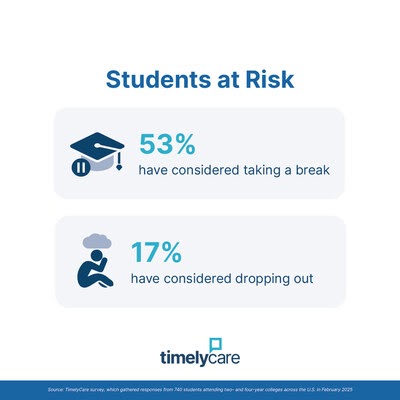
    Students at Risk of Stopping – More than half (53%) of current
    college and university students said they had considered taking a break
    from school, and 17% considered dropping out and not returning.

    Financial Strain – Nearly one-third (31%) of respondents cited
    financial strain as a primary reason for considering withdrawal.
    Additionally, a significant portion of students reported relying on a
    combination of financial aid, scholarships, and part-time or full-time
    work to cover costs.

    Success Barriers – An overwhelming 95% identified at least one
    obstacle impacting their success. Mental health (53%) and finances
    (49%) were the top challenges, followed by physical health (33%),
    academics (28%) and social belonging (26%).

    Gaps in Support Access – While 90% of students had used at
    least one school-provided resource such as academic advising, tutoring,
    or mental health counseling, issues like lack of awareness, inconvenient
    office hours, and inaccessible locations kept many from getting the
    needed help.

    Success Defined
    Students identified GPA, gaining knowledge,
    and graduating or completing their coursework as their top measures of
    success in line with a 2024 survey. Interestingly, non-traditional students placed graduating and gaining knowledge above GPA.

    “This study makes it crystal clear that many students are slipping
    through the cracks due to unmet financial, academic, and emotional
    needs,” said Nicole Guerrero Trevino,
    PhD, Vice President for Student Success, TimelyCare. “Our institutions
    must rise to the occasion to ensure no student is left behind.”

    What Can Be Done?
    In an open-ended question, students identified several ways institutions can better support their success, including:

    Promoting Awareness of Resources: Students called for more
    accessible and transparent communication about resources like tutoring,
    counseling, and career services.
    “Make a comprehensive list of all resources in one place.”
    “Talk about these services more openly. I didn’t know they existed when I needed them.”

    Tailoring Support for Non-Traditional and First-Generation Students: Develop
    targeted programs and policies, such as childcare options and
    evening/online classes, to support students balancing multiple roles.
    “Offer different hours for people who work full time during regular work hours.”

    Engaging Faculty and Staff: Train educators and advisors to proactively identify struggling students and provide personalized support.
    “Make
    it feel more normal that all students are impacted in some way and
    encourage all students to look into getting the help they need. It still
    feels almost taboo to seek out help in most situations.”

    Expanding Mental Health and Financial Well-Being Resources: Increase
    counseling availability, destigmatize mental health challenges, and
    offer virtual and flexible options for access. Streamline communication
    about scholarships, grants, and emergency funding while providing robust
    financial literacy resources.
    “Give access to virtual services or anonymous services”

    TimelyCare virtual success coaching
    supplements on-campus academic preparedness, career readiness, and
    financial wellness support with an integrated 1:1 care and coaching
    model.

    A complete list of questions and responses from the February 2025 survey may be found here. Click here to download a related infographic.

    About TimelyCare
    TimelyCare
    is the most trusted virtual health and well-being solution for learning
    communities, offering personalized, clinically proven care that fosters
    student success and delivers life-changing outcomes. With an unmatched
    range of service options on one seamless, easy-to-access platform,
    including mental health counseling, on-demand emotional support, medical
    care, psychiatric care, health coaching, success coaching, basic needs
    assistance, faculty and staff guidance, peer support and self-guided
    wellness tools, we extend the efforts of 400+ campus wellness teams,
    ensuring millions of students have direct, anytime access to our
    culturally competent and diverse care providers. Recognized as a
    Princeton Review Top 5 Need to Know Organization for Mental Health
    Awareness, TimelyCare drives measurable and meaningful improvements in
    depression and anxiety, empowering every student on their wellness
    journey while strengthening learning environments.

    Source link