Tag: Merge

  • New Jersey City University and Kean University sign official deal to merge

    New Jersey City University and Kean University sign official deal to merge

    Dive Brief:

    • New Jersey City University has signed a definitive agreement to become part of nearby Kean University, the institutions announced in a joint press release Wednesday. 
    • The agreement — approved unanimously by both universities’ governing boards — is subject to accreditor approval by the Middle States Commission on Higher Education as well as by state and federal regulators. Officials expect the merger to be completed by July. 
    • Once complete, NJCU will become “Kean Jersey City.” The two public institutions signed a letter of intent to merge in May after recent years of financial and governance turmoil at NJCU.

    Dive Insight:

    The agreement marks a major milestone for NJCU, which a state-appointed monitor directed to find a financial partner early in 2024. 

    Under the merger terms, Kean will take on NJCU’s assets and liabilities. It will also honor NJCU students’ academic credits, need-based financial aid commitments and merit scholarships if they transition to Kean. Once they do, students will pay Kean’s tuition and fee prices, which amounted to $15,300 for full-time undergraduate students in the 2025-26 academic year.

    A steering committee will oversee the next steps of the merger, including the complicated work of academic and operational integration, as well as navigating regulatory and governmental reviews. 

    As part of the agreement, NJCU students will gain access to Kean’s student services, clubs and organizations after the merger. 

    As for student sports, the agreement establishes a separate advisory committee to look at athletic programming at NJCU post-merger. The university currently competes in more than a dozen NCAA Division III sports, including men’s basketball, women’s softball, and men’s and women’s volleyball and track and field. The committee is expected to make its final report to Kean’s president in December.

    As part of the fiscal 2026 state budget, New Jersey lawmakers lined up $10 million for Kean to help fund its merger with NJCU. The money is to help with feasibility studies, planning and legal work as the two institutions integrate. 

    NJCU’s board voted in March to pursue a merger with Kean. The move came after years of financial distress followed by recovery and turnaround work led by Andrés Acebo, who joined NJCU as interim president in January 2023 before being named permanent president this September. 

    About six months prior to his appointment, NJCU had declared a financial emergency.  Declining enrollment and funding shortfalls led the university to increase scholarships, add academic programs, and spend more on student services and real estate expansions. Those moves failed to turn enrollment around and “instead served to dramatically increase NJCU’s expenses,” New Jersey’s comptroller said in 2023. 

    But by fall 2024, Fitch Ratings lifted the NJCU’s outlook from negative to stable, with analysts citing “significant progress toward achieving fiscal balance despite continued pressure on student enrollment.” The improvements were the product of both state aid and cost cutting at the institution. 

    In fall 2023, NJCU’s student headcount stood at 5,833 students, down 27% from 2018 levels, according to federal data. By fall 2024, the university’s total enrollment fell another 6% year over year, though first-year, full-time students grew by 3% and transfers surged 28%,  NJ.com reported.

    In a statement Wednesday, Acebo said the merger with Kean represents “a significant milestone in a process designed to secure the future of our institution and the communities we have proudly served for nearly a century.”

    Source link

  • NJ Governor Hopefuls Split on Forcing School Districts to Merge – The 74

    NJ Governor Hopefuls Split on Forcing School Districts to Merge – The 74


    Get stories like this delivered straight to your inbox. Sign up for The 74 Newsletter

    New Jersey’s gubernatorial candidates both want school districts to consolidate as a cost-saving maneuver, but they differ on whether the state should force districts to merge with their neighbors.

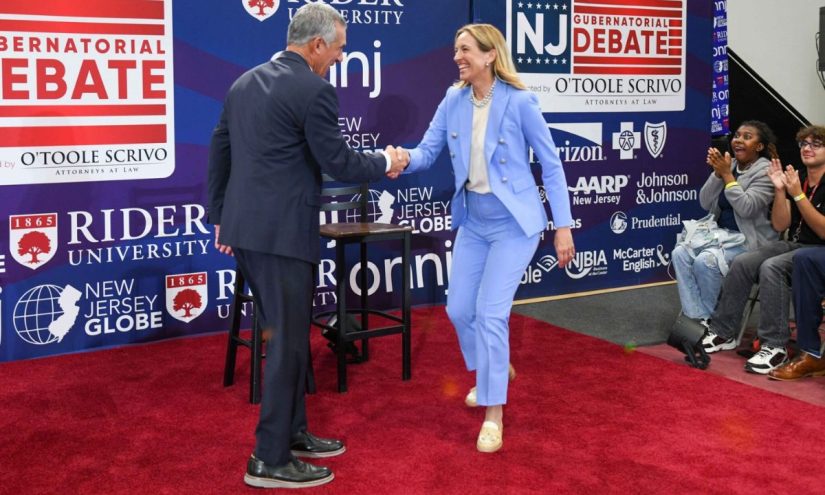
    Rep. Mikie Sherrill, the Democratic gubernatorial nominee, said during Sunday’s gubernatorial debate that she would first incentivize mergers but added that compulsory consolidation was an option.

    “I’d start by offering the carrot to help the areas that want to consolidate, but when there are areas that are not putting enough money into students, into educators, into the buildings, and then they are taking a lot of money in property taxes and from the state level, then we’ll have to start to look at compulsory movements,” Sherrill said.

    Republican Jack Ciattarelli, a former assemblyman, likewise said he would seek to boost incentives and assistance to municipalities and school districts seeking mergers, but he pledged not to force them.

    “I do not believe that our state government should force consolidation. That’s up to the locals,” he said. “But I’ll tell you what, if you do consolidate or you do regionalize, Governor Ciattarelli will help incentivize that to make it easier.”

    Sherrill and Ciattarelli are vying to succeed Gov. Phil Murphy, a Democrat who cannot seek a third term in November.

    Officials have long hailed school consolidation as a means of easing local property taxes by reducing duplicative administrative and facilities costs, but uptake has been slow.

    New Jersey had 590 operating school districts during the 2024-2025 school year, according to state data, down from 599 in the 2020-2021 school year.

    The number of non-operating districts — districts that have a board of education but send all their students to schools in outlying districts — fell from 17 to 16 over that same time period. Sherrill signaled those districts could be the first merged if she wins the governor’s race.

    “We have some school districts who have the whole administrative cost, all of the buildings, and yet they’re not even running a K-12 school system, so we do need to merge some of these school districts,” she said.

    Schools consume a majority of local property taxes — 52% of all those collected in 2024, according to property tax tables published by the Department of Community Affairs — and the more than $15.1 billion in school aid approved in the current state budget accounted for more than a quarter of all spending approved in the annual appropriations bill for the current July-to-June fiscal year. That total includes more than $4 billion in combined special education, transportation, and other categories of aid separate from the state’s school funding formula.

    Ciattarelli suggested school vouchers — which allow property tax dollars to follow a student to a private school, a public school outside their district, or a charter school — could be a fix for ailing districts.

    “When a school system is failing — and there’s some reasonable metrics that tell us whether or not a school system is failing — there’s got to be choice,” he said. “That choice comes in the form of vouchers. That choice comes in the form of charter schools.”

    Because vouchers typically draw from school district funding, they could cause funding to decline at in-district public schools as students seek education elsewhere.

    New Jersey lawmakers have considered compelling school district mergers or shared service agreements, but to date, such mergers have been entirely voluntary.

    Murphy, who has generally favored school mergers, last year said he was “not wild about compulsory” consolidation, cautioning that home rule, a constitutional framework that gives local governments broad authority over the administration of school and other municipal services, could limit forced mergers.

    A law he signed in 2022 created grants for districts to study whether consolidation was feasible, though only a handful of districts have explored such mergers since.

    Cape May City Elementary School and West Cape May Elementary School are the latest to receive grants to explore a merger. Together, the two Cape May County schools have just 241 students.

    New Jersey Monitor is part of States Newsroom, a nonprofit news network supported by grants and a coalition of donors as a 501c(3) public charity. New Jersey Monitor maintains editorial independence. Contact Editor Terrence T. McDonald for questions: [email protected].


    Get stories like these delivered straight to your inbox. Sign up for The 74 Newsletter

    Source link

  • Elon University and Queens University of Charlotte announce intent to merge

    Elon University and Queens University of Charlotte announce intent to merge

    This audio is auto-generated. Please let us know if you have feedback.

    Dive Brief:

    • Elon University and Queens University of Charlotte plan to merge by summer 2026, the private North Carolina institutions said Tuesday. 
    • While leaders are still ironing out the details, Elon intends to operate Queens “in partnership” with the latter’s leaders once the merger is complete, according to a joint news release. The universities said more details about the new institution’s leadership structure and programming details will be released in early 2026.
    • Leaders from Elon and Queens plan a fall listening tour in the Charlotte area to get feedback on the proposed merger from students, faculty, staff, alumni and civic leaders, and they will use the input to help develop a plan for the combination, the institutions said.

    Dive Insight:

    Elon and Queens, which sit about 115 miles apart, framed their intent to merge as complementary for each institution and a way to help meet the educational needs of the Charlotte area in the coming years. 

    The combination “creates new advantages of scale, bringing together resources, faculty expertise, research capacity and student services across both universities,” they said in the release. 

    The trustees of both institutions unanimously supported the proposed merger and will hold a joint meeting next month ahead of planning for integrating the institutions’ operations, the universities said. The boards are expected to finalize the partnership details in November.

    Students at both universities will be able to continue their programs uninterrupted, according to a merger FAQ.

    Elon is by far the larger institution, and the one on a growth trajectory. Between 2018 and 2023, fall enrollment rose 3.1% to 7,207 students. During that same period, Queens’ fall headcount dropped 27.2% to 1,846.

    Of the two institutions, Elon also has deeper financial resources, with assets amounting to $1.3 billion in fiscal 2024 compared to $337.8 million for Queens. 

    Queens’ budget has suffered from falling tuition revenues and a decline in government grants and contracts, in addition to rising expenses. In 2024, it reported a total deficit of $8.7 million. Meanwhile, Elon logged a hefty surplus of $70.4 million during the same year.

    But in the FAQ, the universities said their plan to merge did not stem from financial distress and is “not driven by crisis.”

    Instead, they pointed to the workforce needs of the Charlotte area, noting growing demand for graduate degrees as well as a growing shortage of nurse practitioners, physician assistants and lawyers in the area.

    The merger would “accelerate new programs across vital industries” and expand access to Elon’s law school in Charlotte — the only one in the city today, the institutions said.

    Queens has deep roots in Charlotte. It was founded in 1857, initially as a women’s college before becoming fully coed in the 1980s. Elon was founded in the city of the same name in 1889.  

    Queens has long been a leader in undergraduate and graduate education, deeply connected to Charlotte’s civic and business community and committed to shaping the region and nation through thought leadership,” Jesse Cureton, who took over as acting president of Queens this summer, said in a statement. 

    He added that the merger with Elon “ensures continuity for our students and faculty while creating bold new opportunities to expand our impact and strengthen Charlotte’s role as a hub for higher education.” 

    Elon President Connie Ledoux Book said that the combination “unites two institutions deeply committed to student success, and together, we will expand relevant, high-impact programs that connect academic excellence with real-world opportunity in service to the Charlotte region.”

    Source link

  • Elon U and Queens U of Charlotte to Merge

    Elon U and Queens U of Charlotte to Merge

    Elon University and Queens University of Charlotte, private institutions roughly two hours apart, announced Tuesday that they plan to merge, with more details to come in the next few months.

    Although the “formal structure of the proposed merger” still needs to be finalized, Elon officials said in a university announcement that “the vision is clear: to create a stronger, more sustainable model of higher education in Charlotte that expands access, enhances opportunity, prepares a future-ready workforce and honors the storied legacies of both institutions.”

    Language in the announcement suggests that Elon will absorb Queens as part of the merger.

    “At the conclusion of the merger, which is anticipated in the summer of 2026, Elon will operate Queens in partnership with existing and legacy leaders,” Elon officials wrote in a news release.

    Elon is the larger of the two institutions and appears to be more financially stable.

    Elon enrolled more than 7,230 students last fall, according to its Common Data Set. The head count at Queens came in at 1,599 students last fall, its Common Data Set shows. Elon has an endowment valued at more than $361 million, compared to nearly $162 million at Queens, which has operated at a deficit in recent years, public financial records show.

    Queens also laid off employees last year after it missed its enrollment goal by about 100 students, which it blamed on the flawed rollout of the new Free Application for Federal Student Aid. 

    Officials expect the merger, which will require regulatory approval, to be finalized next summer.

    Source link

  • Rosemont College to Merge With Villanova

    Rosemont College to Merge With Villanova

    Rosemont College will merge with its much larger neighbor, Villanova University, joining two private, Catholic institutions in the Philadelphia area, The Philadelphia Inquirer reported.

    The small college, located less than a mile from Villanova, will be renamed Villanova University, Rosemont Campus, in a move that seems more akin to an acquisition than a merger. Tenured and tenure-track faculty at Rosemont will reportedly be offered teaching contacts.

    Like many small colleges, Rosemont has faced financial and enrollment challenges recently. 

    Rosemont’s enrollment stood at 777 students in fall 2023, according to recent federal data. While that number was higher than the two preceding years, it fell short of the 902 students Rosemont enrolled in 2019, or in previous years when the college typically surpassed the 1,000 mark.

    Public financial records show that Rosemont operated at a loss in the last four fiscal years. Amid the financial struggles, Rosemont has borrowed $7 million from its endowment—recently valued at $23 million—since 2020. A recent audit indicated “substantial doubt” that Rosemont would be able to remain open if its financial struggles persisted.

    During the merger process—which is expected to be completed in 2028, pending regulatory approvals—Rosemont will stay open and operate independently, with financial support from Villanova. But officials told the Inquirer they will stop accepting new students in October.

    The Rosemont merger comes after Cabrini University, another small private college in the Philadelphia region, closed in May 2024. Villanova purchased Cabrini’s campus soon afterward.

    Financial challenges have battered colleges in the Keystone State in recent years, with three institutions announcing closures last year. Another, the Pennsylvania Academy of the Fine Arts, ended its degree programs but remains open as a museum. More closures are on the horizon as Pennsylvania State University considers a plan to shutter up to 12 of its campuses.

    Source link