Tag: Mexico

  • Can Western New Mexico U Recover a Golden Parachute?

    Can Western New Mexico U Recover a Golden Parachute?

    Western New Mexico University is looking to claw back $1.9 million in severance already paid to former president Joseph Shepard, who stepped down in January following a spending scandal.

    Shepard, who led the university for nearly 14 years, resigned late last year in the aftermath of media reports that found he spent university funds to upgrade the president’s house with lavish furniture. Critics also raised questions about costly recruiting trips to Greece, Spain and Zambia that yielded very few enrollments from those countries. The Office of the State Auditor determined in November that Shepard “engaged in the waste of public funds” and found instances where his travel appeared to be “unrelated to official university business.”

    But in December, after the damning details came to light, board members—some of whom had joined the president on international trips—gave Shepard nearly $2 million in severance, plus additional fringe benefits and a five-year faculty contract that required him to teach six credit hours a year, though he had the option to do so online. Shepard’s annual faculty salary is set at $200,000, down from the base salary of $365,000 he was making as president.

    The agreement prompted outrage at WNMU, which is located in one of the nation’s poorest states and has many low-income students. Democratic governor Michelle Lujan Grisham subsequently demanded the resignation of the board, who complied, and has since appointed new members.

    Last week, the new board voided Shepard’s separation agreement and terminated his teaching contract, arguing that the regents who struck the deal did so improperly and in violation of New Mexico’s Open Meetings Act. State officials have made similar arguments in a related lawsuit.

    A Board Reversal

    WNMU regents took up Shepard’s contract and separation agreement at a Thursday meeting.

    John V. Wertheim, one of the new regents appointed by the governor in recent months, argued that the prior board failed to provide proper notice of the action items at the December meeting where they approved Shepard’s contract. Given the alleged failure of compliance with New Mexico’s Open Meetings Act, Wertheim argued that the board’s approval of the deal was invalid.

    In two separate motions, the board unanimously agreed to invalidate the deal and terminate Shepard’s teaching contract. Board Chair Steven Neville said the agreement is now “in limbo.”

    Wertheim noted that while WNMU’s board hired special counsel to advise them on the matter, there are outstanding questions, many of which he said regents would not be able to answer immediately due to both the legal complexity of the issue and because it is a personnel matter.

    “I’m sure both the press and the public are going to have a lot of questions, and all I ask is that there be patience … because all of these detailed questions, we don’t necessarily have the answers today to give everyone, but we will, in due course,” Wertheim said at the meeting.

    Following the vote, Shepard accused WNMU in an emailed statement to Inside Higher Ed of orchestrating a smear campaign against him.

    “After serving 14 exemplary years of advancing the university, it’s troubling that this new, Governor-appointed Board has chosen this path. This is a matter before the courts. The Board’s desire to attempt to circumvent the legal process is telling in that they know they can’t win where facts matter and are doing all they can to prevent the truth from being shared,” Shepard wrote, calling the move an effort to destroy his reputation and career.

    But the state’s governor praised the board’s decisions as the “right thing.”

    “They recognized that public dollars must serve the public good, not pad executive pockets during difficult transitions,” Lujan Grisham wrote on social media. “This decision represents exactly the kind of fiscal responsibility and accountability New Mexicans deserve from their public institutions. Our students and their families work too hard and sacrifice too much to see their tuition dollars and taxpayer investments squandered on excessive golden parachutes.”

    What’s Next?

    WNMU declined to provide a comment to Inside Higher Ed, noting the situation was a personnel matter. But according to board members’ remarks, a legal fight with Shepard is expected and a settlement remains a possibility.

    Complicating the matter are two lawsuits brought by the state.

    New Mexico attorney general Raúl Torrez filed a lawsuit earlier this year in an effort to void the contract and recover severance payments. Torrez argued regents breached their fiduciary duty by approving the costly agreement and violated open meeting laws at December’s meeting.

    Torrez brought the initial complaint in January and amended it in February. While he initially attempted to block the payment, that effort was unsuccessful, as the funds had already been disbursed. The legal fight in that case is ongoing.

    Then, in late June, the New Mexico State Ethics Commission also sued Shepard, accusing him of violating the Governmental Conduct Act, which applies to state employees. In addition to the prior complaints of lavish spending, the commission accused him of diverting $177,404 intended for an ADA-compliant walkway and ramp to instead construct a walkway and patio “for the purpose of hosting events related to his daughter’s wedding” held on campus.

    (Shepard has denied that university funds were used to help pay for his daughter’s wedding.)

    The lawsuit also alleges that as president, “Shepard had a practice of authorizing university expenditures from which he benefited that were only loosely connected to university purposes.”

    The commission is seeking financial penalties and for Shepard to reimburse WNMU for the construction of the originally planned ADA-compliant ramp and walkway, which were not built.

    Back at the university, board members say they are open to some financial compensation for the former president. Had Shepard been fired for cause, he would have received no severance. Had he been fired without cause, he would have received less than $600,000, per the contract he previously negotiated with the board in 2022.

    Wertheim indicated at Thursday’s meeting a desire to reach a settlement.

    “The best resolution for everyone is to get this in front of a retired judge or justice of the New Mexico Supreme Court to hammer out a fair, negotiated settlement,” he said at the meeting.

    Before Thursday’s vote, Shepard was reportedly scheduled to teach two online classes this fall, including one on business ethics. However, Interim president Chris Maples told The Silver City Daily Press that he and other officials plan to meet to determine what will happen with those courses. And with the semester starting Aug. 15, they’ll need to make a decision soon.

    “Whatever we do, we’ll do the best job we possibly can for our students,” he told the newspaper.
    Source link

  • Heroic Telephone Operator saved the lives of others in the Folsom, New Mexico Flood of 1908 (Friday’s Labor Folklore)

    Heroic Telephone Operator saved the lives of others in the Folsom, New Mexico Flood of 1908 (Friday’s Labor Folklore)

    According to Tom Drake of the New Mexico Historic Preservation Division, “the town never recovered from the disastrous flood of 1908.”  

    On that day – August 27, 1908 – a freak storm struck the town with only a few hours warning, leading to tragic results. Earlier that summer hay was cut and the leftover stalks littered the fields around the river’s headwaters. “When the rains came the water collected the hay stalks and other debris and carried them along until they began to block the small railroad bridges. When these impromptu dams gave way, the resulting surge added to the already swelling river.” (Mike Schoonover, Folsom Area History, 2010)

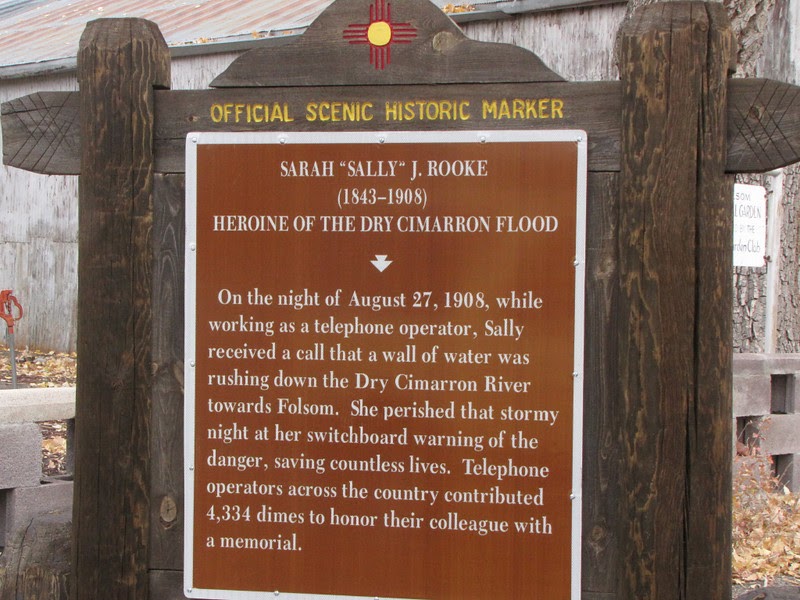
    People living upriver sounded the alarm by calling Folsom’s switchboard operator, Sally Rooke. Sally began ringing townspeople who had a telephone, warning them to escape the impending flood. She stayed at her station, contacting over 40 people who were saved from the flood. Then the rushing waters washed away her building. 

    “Residents of the town who lived on high ground and beyond the reach of the torrent, saw houses containing families crying for aid swept away before their eyes, powerless to render them any assistance.”

    Along with drowned cattle and horses, Sally’s body was found 12 miles downstream still wearing the headpiece worn by telephone operators. She died along with 17 other people that day.

    Eighteen years later the town honored her with a small memorial, donated by the contributions of telephone operators around the country. In 2007 the New Mexico Dept. of Cultural Affairs erected a historic marker in her name. Sally Rooke joins other notable women of New Mexico as part of that state’s Historic Women Marker Initiative.  

    Source link

  • Landmark New Mexico Education Equity Case Heads Back to Court Next Week – The 74

    Landmark New Mexico Education Equity Case Heads Back to Court Next Week – The 74


    Get stories like this delivered straight to your inbox. Sign up for The 74 Newsletter

    The parties in the long-running Yazzie-Martinez lawsuit over educational equity in New Mexico will meet in court next week to discuss a motion alleging the state has not complied with previous court orders, along with the plaintiffs’ request for a “remedial plan.”

    The case, originally filed in 2014, led to a finding in 2018 by the late First Judicial District Court Judge Sarah Singleton, who found that the state was not providing equitable educational opportunities to Native students, English language learners, low-income students and students with disabilities. She ordered the state to take steps to address the needs of these at-risk students and ensure schools have the resources to provide them with the education they deserve.

    Attorneys representing Louise Martinez and Wilhelmina Yazzie filed a joint motion of non-compliance in September 2024, arguing that the state has not made significant progress in addressing the needs of at-risk students. Specifically, in their motion, plaintiffs point to ongoing poor student performance; high turnover within the New Mexico Public Education Department; high teacher vacancy rates; and a lack of targeted funding for at-risk students.

    Since Singleton’s decision, the state has increased funding for public education, but students are still being overlooked, Melissa Candelaria, education director for the NM Center on Law and Poverty, which represents the plaintiffs, told Source NM.

    The motion hearing is scheduled for 9 a.m. Tuesday, April 29.

    “We believe the court’s ruling should have been a wakeup call,” Candelaria said. “Our students can’t afford more bureaucratic churn and empty promises from PED. And we believe, the plaintiffs believe, the court must step in to enforce a real community-driven plan that reflects the urgency and the gravity to improve the overall state education system.”

    Candelaria noted that the joint motion was not opposed by New Mexico Attorney General Raúl Torrez, who represents the state in the case. Court documents state that Torrez “agrees” that there has been “insufficient compliance.” However, private counsel for the PED did oppose the motion, particularly the plaintiff’s proposed remedial plan.

    PED had not responded to a request from Source NM for comment prior to publication.

    That plan, as detailed in court documents, includes nine components or goals, including: establishing a multicultural and multilingual educational framework; building an education workforce; increasing access to technology; developing methods of accountability; and strengthening the capacity of the PED.

    “There’s no longer a debate that a statewide education plan is necessary. Now, the decision is who leads that development,” Candelaria said.

    Candelaria also told Source the plaintiffs propose the Legislative Education Study Committee take the lead in developing the remedial plan because the department’s staff have knowledge and expertise in the area of education and have access to data. The department also has a director and permanent staff, as opposed to the PED, which has had multiple cabinet secretaries lead the department in the nearly seven years since Singleton’s decision, she noted.

    “Without a plan, the efforts by the Legislature will still be piecemeal and scattershot and it’s not going to result in what we want to see in a transformed education system that’s equitable and that builds on the strengths and provides for the needs of the four student groups in the case,” Candelaria said.

    The PED opposes the motion on this point, according to court documents, and argues the education department should take the lead in developing the plan. The department also says more time is needed to create and then implement the plan. Plaintiffs suggest that the five-year plan should be developed within six months of this month’s hearing.

    Wilhelmina Yazzie, one of the original plaintiffs, told Source she feels “very optimistic” ahead of the motion hearing and that she hopes the judge agrees a plan is necessary. She added that the inequities in public education were emphasized during the COVID-19 pandemic.

    “Especially our tribal communities who are really deeply impacted by that, and they still continue to suffer to the present time right now and just by the state not taking the action that we need them to take,” Yazzie said.

    Yazzie’s son, Xavier Nez, 22, was in third grade when the lawsuit started. He is now in his third year studying at the University of New Mexico. Candelaria pointed out that since the 2018 court decision, multiple classes of students have made their way through the state’s educational system and failed to receive a comprehensive education. Yazzie’s youngest child, Kimimila Black Moon, is currently in third grade but attends private school.

    “She’s not in the public school because I still haven’t seen changes,” she said.

    Yazzie told Source that another goal of hers is to get out into communities throughout the state and speak with families because many parents are still unaware of the lawsuit and “they’re the ones that firsthand know what their children need, what they’re lacking, how they’re doing in school.”

    Source New Mexico is part of States Newsroom, a nonprofit news network supported by grants and a coalition of donors as a 501c(3) public charity. Source New Mexico maintains editorial independence. Contact Editor Julia Goldberg for questions: [email protected].


    Get stories like these delivered straight to your inbox. Sign up for The 74 Newsletter

    Source link

  • Counslr Launches in New Mexico and Illinois; Expands Footprint in New York to Increase Access to Mental Health Support

    Counslr Launches in New Mexico and Illinois; Expands Footprint in New York to Increase Access to Mental Health Support

    NEW YORK, NY – Counslr, a leading B2B mental health and wellness platform, announced today that it has expanded its footprint into the State of New Mexico starting with a partnership with Vista Nueva High School, Aztec, NM; and into the State of Illinois starting with a partnership with Big Hollow School District, Ingleside, IL. These initial partnerships will empower students and staff to prioritize their mental health by enabling them to access unlimited wellness resources and live texting sessions with Counslr’s licensed and vetted mental health support professionals, who are available on-demand, 24/7/365. By increasing accessibility to Counslr’s round-the-clock support, Vista Nueva and Big Hollow aim to bridge gaps in mental health support for students and staff, enabling those who previously did not or could not access care, whether due to cost, inconvenience, or stigma, to receive the support they desire.

    1 in 6 youth suffer from a mental illness, but the majority do not receive mental health support due to substantial obstacles to care. Additionally, mental health is even a bigger challenge in rural America due to unique barriers, including fewer providers resulting in longer wait times or insufficient access to crucial mental health services. This resource scarcity underscores the urgency for additional resources and innovative solutions to bridge this critical gap in mental health care for school communities.

    “We are happy to be able to offer students another tool that they can use to support their mental well-being. Knowing that students have been able to speak with a professional outside of school hours helps us know this app was needed and is useful,” states Rebekah Deane, Professional School Counselor, Vista Nueva High School. “We hope this tool also assists students in learning how to navigate systems so that when they graduate high school they know these options exist and they can continue to seek out support when necessary.”

    As factors such as academic pressures, social media influence, burnout and world events contribute to heightened stress levels and mental health challenges, schools throughout the country are recognizing the growing need to offer more accessible resources and preventative mental health services to both students and staff.

    “Counslr provides an extremely easy-to-access platform for those who otherwise may not seek the help they need, and we are very excited to join Counslr in this partnership. We are all very well aware of the impact that technology has had on the mental health of our students and we feel that Counslr can meet our students in a setting they are comfortable with,” states Bob Gold, Big Hollow School District Superintendent. “Outside of our students, we are thrilled to be able to offer this service to the amazing adults who work with our students every day. There are so many families dealing with some sort of trauma, and the life of an educator is no different.  These adults tend to give so much of themselves to their students, so we strongly feel that our efforts here to join with Counslr is our way of providing an opportunity for our educators to focus on their own mental health.”

    In addition to the geographic expansion,Counslr has also expanded its existing footprint in states like New York, most recently partnering with the Silver Creek Central School District to support its students and staff.  

    “We know mental health needs are on the rise, for students and adults.  To me, Counslr is a resource our students and staff both deserve,” states Dr. Katie Ralston, Superintendent, Silver Creek Central. “In the beginning stages at Silver Creek Central, it has proven to be an asset, as it offers access to everyone on the spot, any day, for any situation.”

    “Supporting diverse populations of students and faculty across the country clearly illustrates that mental health knows no boundaries,” said Josh Liss, Counslr CEO. Adding that, “With 86% of Counslr’s users being first-time care seekers, we strive to reach these silent sufferers who need help, but do not or cannot access it, no matter where they are located.”

    ABOUT COUNSLR

    Counslr is a text-based mental health support application that provides unlimited access to robust wellness resources and live texting sessions with licensed professionals, 24/7/365. Users can access support on-demand within two minutes of opening the app, or by scheduled appointment. Through real-time texting, users enjoy one-on-one, private communication with a licensed counselor that can be conducted anytime, anywhere. Counslr was designed to help individuals deal with life’s day-to-day issues, empowering individuals to address concerns while they are “small” to help ensure that they stay “small”. Counslr partners with organizations of all shapes and sizes (companies, unions, nonprofits, universities/colleges, high schools, etc) so that these entities can provide Counslr’s services to their employees/members/students at no direct cost. For more information, please visit www.counslr.com.

    eSchool News Staff
    Latest posts by eSchool News Staff (see all)

    Source link

  • Beyond the Rhetoric: Mexico’s Higher Education Reality with Alma Maldonado Maldonado

    Beyond the Rhetoric: Mexico’s Higher Education Reality with Alma Maldonado Maldonado

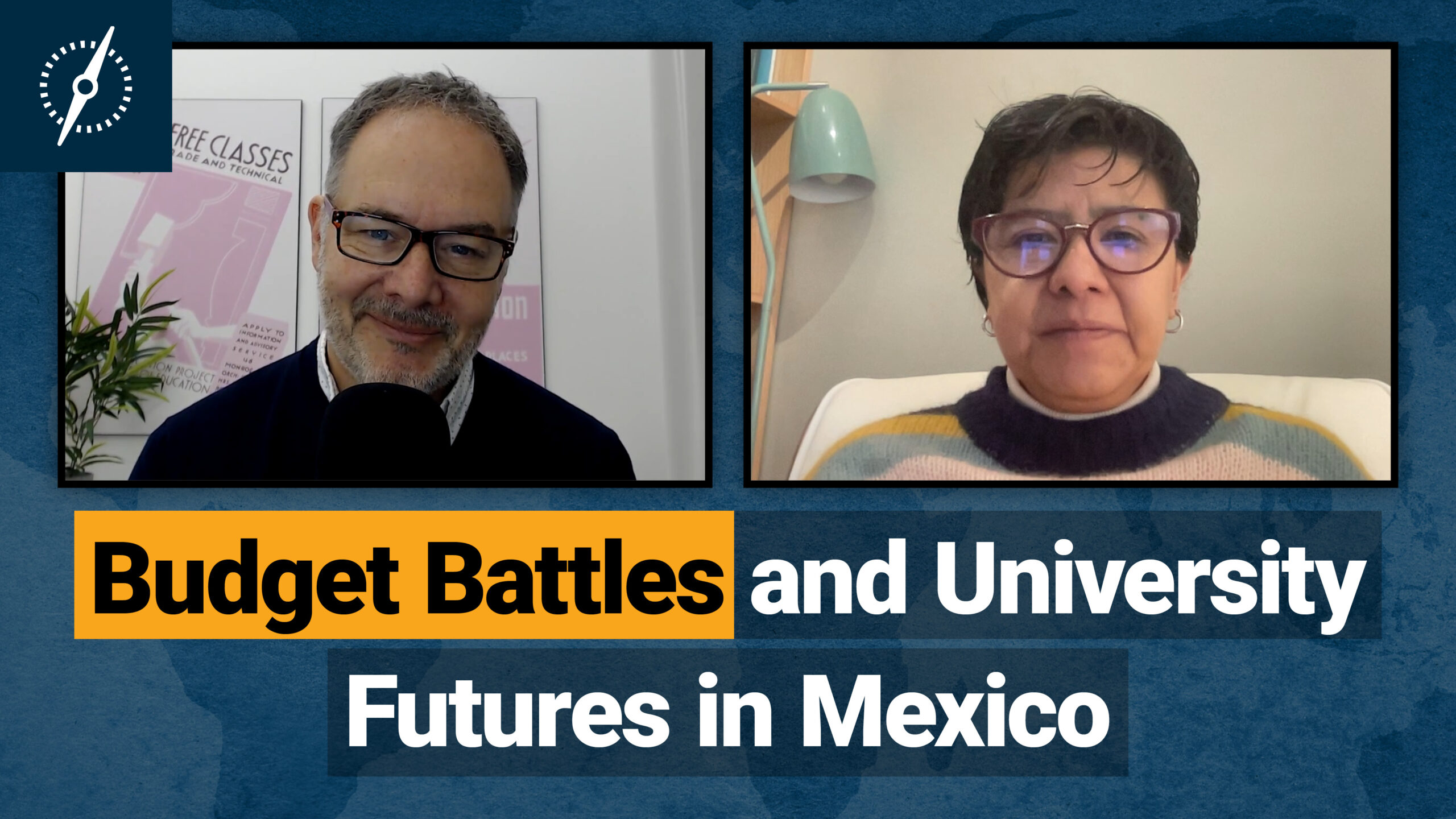
    Hi everyone. I’m Alex Usher, and this is the World of Higher Education podcast. If you’re a really faithful listener, you may remember that when the show was in beta and we were fooling around with formats and guests, we did an episode about Mexican higher education and its tribulations under the populist president Andres Manuel Lopez Obrador or AMLO for short.

    Our guest that day was my friend, Alma Maldonado Maldonado, an education researcher at Cinvestav, which is the Center for Research and Advanced Studies of the National Polytechnic Institute. That interview was so brilliant, we turned this podcast into a full-time investigation of higher education developments in various countries around the world.

    Today, Alma’s back with us again to talk about how things have and have not changed in Mexico over the past two years. The big story there is that there’s a new president in town. Last spring, Claudia Sheinbaum became the country’s first ever woman president. One who happens to have a PhD in engineering with a specialty in energy and sustainability.

    You’d think that might be an advantage to a higher education sector, but Scheinbaum comes from AMLO’s Morena party and her instincts seem to be to continue her predecessor’s tradition of attacking higher education as being a dissolute elite enterprise.

    So what does this mean for Mexican higher education? Well, in general, it’s not good. Alma takes us through the implications of Morena’s supermajority in Congress, as well as its early attempts to put fiscal pressure on universities, and its continued fascination with the experimental and kind of shambolic Benito Juarez universities.
    Spoiler alert, there are not a lot of silver linings in this story, either for public or private sector universities in Mexico. But enough from me, let’s hand things over to Alma to explain.


    The World of Higher Education Podcast
    Episode 3.16 | Beyond the Rhetoric: Mexico’s Higher Education Reality with Alma Maldonado Maldonado

    Transcript

    Alex Usher (AU): Alma, almost two years ago, then-President López Obrador had about a year and a half left in his mandate and was essentially at war with the university sector and the scientific community. How did his administration end with respect to higher education? Did anything change? Did things get better or worse in his final months? Were there any significant policy shifts we should know about?

    Alma Maldonado Maldonado (AMM): Hi Alex, thanks for inviting me. It’s a pleasure to be here. Well, I think most things didn’t change. Essentially, everything stayed the same. His rhetoric and narrative against higher education institutions, against graduates from abroad, and especially against UNAM, continued until the end of his term, unfortunately.

    There wasn’t anything that made him change that rhetoric. One reason for this is that he had political capital—he knew his base supported him fully. So, why change something that was working for him? On the contrary, the attacks on universities and the restriction of resources continued right until the end.

    AU: So, nothing was resolved. But earlier this year, there were elections for the presidency and both the Chambers of Deputies and the Senate. Did higher education play any role in that election? Were there significant policy differences between the parties?

    AMM: Not really. Education didn’t feature much in the campaign—similar to what we see in the U.S. It just wasn’t important. There were only a few mentions here and there about education, but in general, it wasn’t a key part of any campaigns.

    What we did see, unfortunately, was this sort of competition around scholarships. One candidate would say, “I’ll offer scholarships for secondary education,” and the other would respond, “Well, I’ll offer scholarships for secondary, but also primary, and even preschool!” That was the extent of the debate around education policy between the two main candidates. I’m not surprised but it was very disappointing because in a country like Mexico, where education can be a major driver of social change, it wasn’t given the attention it deserves.

    AU: The winner of the election was Claudia Sheinbaum of the Morena party, the same party as López Obrador. But she has a somewhat different image—she’s a scientist with an advanced degree from UNAM, a doctorate, I think. Does her presidency signal any kind of shift for higher education?

    AMM: It’s complicated. On paper, yes, she’s better. She has a PhD from UNAM and worked as an academic—one of the few cases where an academic has become president. Not the first, of course, but still, it’s notable.

    She has a pro-science and pro-higher education rhetoric, especially given her background in the student movement at UNAM in the 1980s. She fought alongside people like Emanuel Ordorica, Carlos Simas (her former husband), and Antonio Santos. She wasn’t a leader in that movement, though now some are rewriting history to present her as one.

    Her narrative emphasizes free higher education and the idea that education is a right, not a privilege. But since she took office a few months ago, we haven’t seen much change in terms of the most important issue—financing. It’s clear: follow the money.

    In the initial draft of the national budget, the funding for UNAM and other major universities was cut. Later, the government said, “Oh no, it was a mistake. We didn’t mean to cut the budget. Sorry, let’s fix it.” Imagine—someone who champions free higher education putting universities in that position. It’s a contradiction.

    AU: She has large majorities in both chambers of parliament, so she has significant power to implement her agenda. Why do you think she proposed cuts to education funding initially?

    AMM: Well, because she’s seen as the president of higher education and science. Reducing the budget as her first move would’ve been disastrous for her image.

    But you’re right—she has total control of Congress and the Senate. Right now, she’s focused on other reforms, particularly in the judicial system, and she’s changing a lot of laws. Education isn’t on the map because López Obrador already changed the Constitution’s third article, which governs education. There’s no immediate need for her to revisit it.

    AU: Let’s circle back to the budget cuts. Last month, the proposed budget included a cut of 10 billion pesos—about 500 million U.S. dollars—to higher education, with half of that falling directly on UNAM. There was significant outcry, and she backtracked somewhat. Do we know how this will end up? Will the universities be held whole, or are cuts still coming?

    AMM: They decided to reorganize the budget, but now they’re cutting other areas instead. Unfortunately, that includes initial education and other sectors. They also cut the Senate’s budget, which has caused disputes.

    In terms of higher education, they’ve claimed that funding will remain the same as last year, with a slight adjustment for inflation. But the adjustment is minimal—about 3%—while experts estimate inflation at around 5% but they’re just adding 3%. So, effectively, there’s still less money to spend. There’s less money for infrastructure, materials, and other essentials. Universities are in a slightly better position than they were a few weeks ago, but the situation remains difficult. The contradictions in her policies have drawn a lot of criticism.

    AU: Why was so much of the proposed cut targeted at UNAM? Was it deliberate? Is there animosity toward the university?

    AMM: There’s speculation about that. Some believe it was a punishment for UNAM’s independence, particularly regarding topics like judicial reform. UNAM has maintained a critical stance, which Morena and Claudia don’t like.

    Let’s not forget that one of the first things López Obrador did when he came to power six years ago was to modify the Constitution’s third article, removing university autonomy. When there was backlash, they said, “Oh, it was a mistake. We didn’t mean it.” But there have been many such “mistakes.”

    AU: Going back to AMLO, he also set a goal of increasing enrollment by 1.5 million students while also underfunding institutions at the same time. How did that play out? Did he reach that goal? How did the funding play into the final result?

    AMM: Currently, enrollment coverage in higher education is about 44%—very low compared to other Latin American countries. AMLO’s goal was to reach 50%, but he fell short.

    Now, Claudia Sheinbaum is aiming for 55%. I don’t think that’s realistic. The common system in Mexico is to add 5% on any policy, even if the last one isn’t achieved. To achieve that, they’d need to add about 1.2 million students, which isn’t feasible with the current system.

    The problem is that the educational spaces being created aren’t in the places where students want to go. There’s a clear contradiction between their enrollment goals and actual planning.

    AU: Part of AMLO’s strategy was the Benito Juárez Universities—small, access-oriented institutions in remote areas. You previously described them as “Potemkin institutions.” What’s the current situation? Will Sheinbaum continue with this policy?

    AMM: Yes, she’s continuing the project. But as I’ve said before, it remains very obscure. We don’t know who attends these universities, who teaches there, or what students are learning. I have a student doing their master’s dissertation on these universities, and they can’t get access for research.

    Sheinbaum recently announced plans to open 50 more. But we don’t even know what’s happening with the existing 140—or whether that number is accurate. There have been protests at these universities over issues like unreceived degrees and inadequate resources. I wouldn’t be surprised that Colombia would adopt them because they’re friends of Claudia. The idea is that these institutions could increase 40,000 new spaces. While they’re meant to provide education in remote areas with programs tailored to local communities, they’re not addressing the larger participation gaps.

    AU: We’ve been talking mainly about the public sector, but what about the private sector? Institutions like Tecnológico de Monterrey are highly regarded. How does the disarray in the public sector affect them? Does it make them stronger?

    AMM: I think they are struggling too, but we need to distinguish between the high-prestige institutions and the low-prestige ones. So, let’s start with the high-prestige institutions like Tecnológico de Monterrey or Universidad Autónoma de Guadalajara.

    They are struggling financially, particularly because some scholarships they used to receive for graduate programs have been eliminated. For example, many students in their graduate programs previously got scholarships from the National Science and Technology Council. But now, under the current rhetoric, those scholarships are only being given to students in public institutions.

    This has forced high-prestige private institutions to get more creative with their resources to maintain their programs.

    On the other hand, there are low-prestige private institutions, some of which are as bad as the Benito Juárez Universities. They lack quality, but the government lets them operate because they solve a demand problem. Parents want their kids to attend college, and these institutions offer that possibility, even if the education isn’t great. Families make sacrifices to pay for these degrees because, in their minds, a degree is still a degree.

    And then, in the middle, there are institutions that are more decent in terms of quality. But the big question is: who ensures the quality of these institutions? That’s been a longstanding issue, and it hasn’t improved under the current government.

    AU: It’s a classic trade-off we see in many countries. Alma, we’ve covered a lot of doom and gloom. Are there any bright spots you foresee for 2025?

    AMM: I wish I could say I see more positive things coming, but honestly, I don’t. A big part of my concern is tied to North America and what a Trump presidency could mean for Mexico. If he returns to power, we’re likely to face serious challenges around migration and broader U.S.-Mexico relations.

    It’s really sad that Mexico didn’t take advantage of opportunities to strengthen ties with the U.S. while Biden was in office. There could have been agreements, collaborations, and advancements, but those didn’t materialize.

    In the face of all this, creativity will be key. Maybe we’ll see new programs to support migrants with higher education degrees who end up staying in Mexico. It’s critical that we do better this time than we did during the Dreamers situation. But honestly, I’m not confident that the government is prepared to handle these challenges effectively. So, unfortunately, I don’t see much good news ahead.

    AU: Well that’s a good reminder that international affairs do intrude on higher education affairs sometimes. Alma, thanks for being with us.

    AMM: Thank you very much, Alex.

    AU: And thank you to our excellent producers, Tiffany MacLennan and Samantha Pufek. If you have comments or questions, reach out at [email protected]. Don’t forget to subscribe to our YouTube channel. Join us next week when Michael Shattock will discuss governance in European universities. Bye for now.

    *This podcast transcript was generated using an AI transcription service with limited editing. Please forgive any errors made through this service.

    Source link

  • Equipping the Future – New Mexico Education

    Equipping the Future – New Mexico Education

    In the heart of Albuquerque’s west side, a new beacon of hope for elementary education is set to rise: Equip Academy of New Mexico.

    Spearheaded by Mercy Herrera, a Yale graduate with deep New Mexico roots, the school is designed to empower Kindergarten through 5th grade students through a unique blend of high academic expectations and culturally responsive teaching. With a personal history marked by overcoming educational challenges, Herrera is bringing her passion and vision to Equip Academy, aiming to equip every child with the tools to live out their greatness.

    On August 21 Equip Academy received unanimous approval to open as a charter school from the Public Education Commission.

    The school is set to open on Albuquerque’s west side in August 2025, with a focus to help improve student achievement and support the academic success of all students. This comes out of experience, as Herrera’s own academic journey was anything but straightforward.

    Raised in a family that moved frequently due to financial instability and personal challenges, Herrera attended multiple elementary schools, making it difficult to establish a strong academic foundation. “College seemed super out-of-reach,” she recalled, but her determination led her to Central New Mexico College (CNM), where she began to rebuild her academic confidence.

    After transferring to the University of New Mexico (UNM) and excelling in a Sign Language Interpreting Program, Herrera’s educational path took her to Harvard, where she presented research on translating scriptural metaphors from English to American Sign Language (ASL). This experience eventually led her to Yale University, where she earned her master’s degree in Disability Studies and Biblical Literature.

    In applying for Yale, Herrera didn’t tell a soul. She almost didn’t believe that someone like her, who struggled in school, could elevate to such a college. And yet, Herrera got in.

    Despite her achievements, Herrera never forgot her New Mexico roots or the struggles she faced growing up.

    Reflecting on the 2018 Yazzie-Martinez decision, which highlighted the state’s failure to provide an adequate education to many of its students, Herrera acknowledged that she would have been classified as a Yazzie-Martinez student.

    “My story isn’t unique,” Herrera said, “it’s common.”

    With support from mentors who believed in her, Herrera found the importance of quality education in shifting the narrative for students from backgrounds like hers. With the support, she made it to CNM, graduated UNM, attended an Ivy League, and earned a second masters in the Science of Teaching from New York City’s Pace University. It is this experience, and the belief that New Mexico’s students deserve to succeed, that drives the vision and mission of Equip Academy.

    “Every child has the opportunity to live out their greatness, and our commitment is to equip them to do so,” Herrera said, quoting the school’s vision.

    Equip Academy aims to provide a joyful and engaging environment with high expectations that prioritizes measurable academic learning while celebrating student curiosity and community, regardless of that student’s background.

    A key aspect of Equip Academy’s approach is its commitment to culturally responsive education. Understanding the diverse cultural landscape of New Mexico, Herrera has integrated culturally respectful education efforts into the school’s curriculum. “New Mexico has so much richness and beauty, and I think it took me leaving to understand that,” she said.

    To ensure the school is responsive to students across all walks of life, Herrera is working closely with the Hispanic Cultural Center, National Institute of Flamenco, Indian Pueblo Cultural Center and utilizing resources from the Native American Community Academy (NACA) to ensure that the school’s curriculum respects and reflects the cultural heritage of its students.

    To support students academically, Equip Academy will implement a two-teacher model for kindergarten and first grade, allowing for more individualized attention. As part of her background, Herrera has worked as a teacher instructional coach and has made teacher support a key for the school’s success.

    The school will also use cross-grade, flexible guided reading groups to ensure that students receive instruction at their individual “just right” level, helping them progress academically. Herrera emphasizes the importance of data-driven instruction and teacher excellence, which will be central to the school’s success.

    Herrera’s return to New Mexico came after years of working in high-performing charter schools in New York City and driven by a desire to bring the same level of educational excellence to her home state. The experience shaped her vision for Equip Academy, prompting her to say, “I don’t know how, and I don’t know when, but I want to start a charter school in New Mexico.”

    Now, that vision is becoming a reality.

    Equip Academy plans to open with two kindergarten classes and one first-grade class, eventually growing to serve 450 students from kindergarten through fifth grade. The school will operate on a slow-growth model, adding one grade level each year to ensure that students receive a consistent and high-quality education throughout their elementary years.

    As Herrera prepares for Equip Academy’s opening, she remains focused on the bigger picture: equipping students with the knowledge and skills they need to dream audaciously, engage deeply, and pursue lives of purpose. Her journey from a struggling student to an educational leader is proof that, with the right support and opportunities, New Mexico’s students can achieve greatness.

    Herrera’s words and hope for Equip Academy’s incoming students, “Believe in yourself, know what you want to do, and pursue it with everything you’ve got. With the right support, anything is possible.”

    Equip Academy is now accepting interest forms for future teachers and students. For more information, visit the Equip Academy LinkedIn page.

    Source link