

Tag: Miami

  • Why are Miami police questioning a woman over Facebook posts?

    Why are Miami police questioning a woman over Facebook posts?

    This essay was originally published by UnHerd on Jan. 20, 2026.


    “This is freedom of speech. This is America, right?”

    Those were the incredulous words of Raquel Pacheco, a U.S. Army veteran and three-time candidate for local office. She made the remark while being questioned by police at her Miami Beach home last week for criticizing her mayor on Facebook.

    On Jan. 6, Miami Beach Mayor Steven Meiner posted a message on his official Facebook page saying, among other things, that “Miami Beach is a safe haven for everyone” and that the city “is consistently ranked by a broad spectrum of groups as being the most tolerant in the nation.”

    Speech is not a crime — even if it complicates ICE’s job

    Aaron Terr explains why alerting others to law enforcement activity, or reporting on it, is protected by the First Amendment.


    Read More

    That is, apparently, unless you criticize him. Pacheco’s response — accusing Meiner of “consistently call[ing] for the death of all Palestinians,” trying “to shut down a theater for showing a movie that hurt his feelings,” and “REFUS[ING] to stand up for the LGBTQ community in any way” — appears to have been too much free speech for the mayor to tolerate.

    Six days later, two Miami Police officers knocked on Pacheco’s door, claiming they were there “to have a conversation” and confirm that it was her who made those comments. In a video of the interaction, the officers justify their visit by saying they wanted to prevent “somebody else getting agitated or agreeing with” Pacheco’s post. They added that the line about Meiner’s views on Palestinians “can probably incite somebody to do something radical,” and advised her “to refrain from posting things like that because that could get something incited.”

    What occurred at Pacheco’s home raises serious concerns in a free society. Her statements fall well short of the legal threshold for incitement, which applies only to speech which urges unlawful action and is likely to provoke it immediately. A careful reading of her post reveals no call for illegal activity, nor any indication that it would prompt others to act unlawfully.

    If sharp but non-threatening criticism and political commentary can be treated as unlawful incitement, freedom of speech ceases to exist in any meaningful sense.

    Residents of the United Kingdom are all too familiar with police interventions over social media content. In September, blogger Pete North was arrested for posting a meme displaying the text “F— Palestine F— Hamas F— Islam… Want to protest? F— off to a Muslim country & protest.” That same month, Deborah Anderson, an American who had been living in England for years, was visited by police for Facebook posts that “upset someone.” And last January, a couple were arrested on suspicion of harassment, evidently for comments as mild as describing an employee at their daughter’s school as a control freak in a parents’ WhatsApp chat. Sadly, such incidents are just a fraction of longstanding limitations on speech in the UK.

    These examples demonstrate why the First Amendment sets the bar so high for its few, narrow exceptions. Democracy requires ample breathing room to speak about public issues. If sharp but non-threatening criticism and political commentary can be treated as unlawful incitement, freedom of speech ceases to exist in any meaningful sense.

    Such cases highlight the need to safeguard free expression in both the U.S. and the UK. Censorious practices which appear in one place often spread elsewhere. Across the West, law enforcement responses to online criticism are becoming more common. Without vigilance, such interventions will continue. The principle is clear: free expression must be protected.
    Source link

  • Miami Dade Fights Hearing on Trump Library Land Deal

    Miami Dade Fights Hearing on Trump Library Land Deal

    Ever since Miami Dade College announced last month that it was donating land for the construction of Donald J. Trump’s presidential library, the community college has faced criticism. Now it is fighting in court to prevent a public hearing on the deal, which would resolve a lawsuit brought by a citizen who has argued the move is illegal.

    At a Sept. 23 board meeting, Miami Dade College transferred land to the state of Florida to be used for Trump’s presidential library. Critics alleged that the meeting was rushed, failed to offer adequate public notice on the specifics of the deal and lacked any discussion or debate; a public notice referenced only a “potential real estate transaction” as the reason for the meeting.

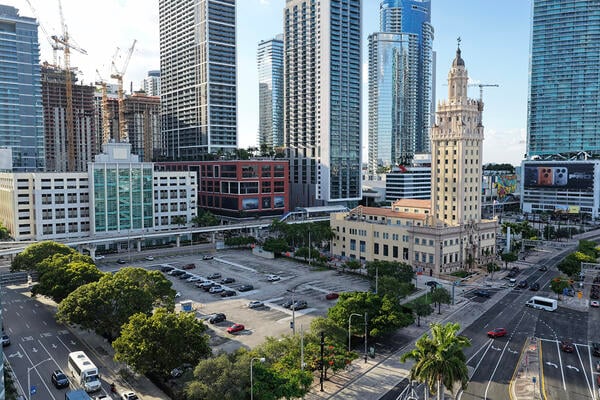
    Some estimates have put the value of the 2.6-acre site in downtown Miami at $250 million to $300 million, though others say it is worth $67 million. But regardless of the dollar amount, Miami Dade College is giving the land away for free.

    Marvin Dunn, a local historian, sued to block the transfer, alleging in his lawsuit that the Board of Trustees “unquestionably violated” state anticorruption laws. Dunn argued in a court filing that “depriving the public of reasonable notice of this proposed decision was a plain violation of the Sunshine Act and of the Florida Constitution” and asked for an injunction to block the transfer.

    Judge Mavel Ruiz of Florida’s 11th Judicial Circuit granted Dunn a temporary injunction earlier this month, noting that he is likely to prove his claims about sunshine law violations, but she did not altogether block the land transfer. She also left the door open for the Board of Trustees to redo the deal.

    “It is understood that the board can provide the reasonable disclosure and convey this property as they see fit,” Ruiz said. “That’s why this is not a case, at least for this court, rooted in politics.”

    Jesus Suarez, an attorney for Continental Strategy (founded in 2022 by former Republican lawmaker Richard Corcoran, who was later tapped to lead New College of Florida), which is representing Miami Dade College, has contended that the deal is completely aboveboard.

    “The law doesn’t require that there be any specificity in the notice,” Suarez has argued. College lawyers also said they would appeal the ruling to temporarily block the transfer.

    State officials have bristled at Ruiz’s temporary injunction. Florida attorney general James Uthmeier, who has assigned members of his staff to assist the college in its legal battle, told The Miami Herald the temporary injunction is not technically in place because it was not issued as a written order.

    Dunn, meanwhile, is seeking to expedite legal proceedings, aiming for a trial to begin by January.

    While Ruiz emphasized that the case is not about politics, the MDC board, which is appointed by Republican governor Ron DeSantis, is overwhelmingly comprised of Republican donors. Board chair Michael Bileca and trustee Jose Felix Diaz are also former GOP lawmakers.

    Of the seven trustees, six have donated to Republican candidates and causes. Miami Dade College president Madeline Pumariega, who has defended the way the board handled the transfer, has also donated to GOP candidates, though she has given to Democrats in the past as well. (Most of the presidents at Florida’s 40 public institutions have either Republican ties or past donations.)

    Miami Dade College officials did not respond to a request for comment from Inside Higher Ed.

    Source link